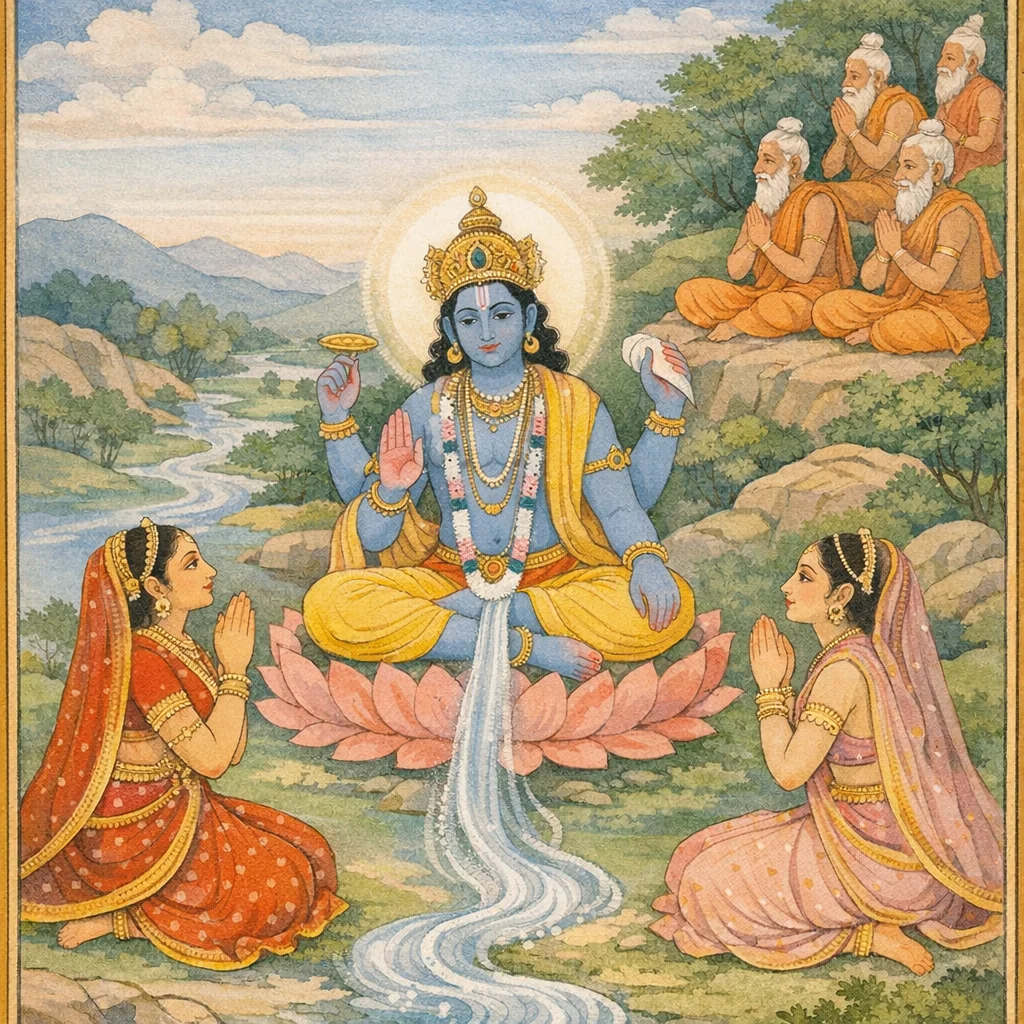
Adhyaya 7
Haristuti-saṅgraha: Devatā–Ṛṣi Praṇāma, Nāma-māhātmya, and Vairāgya from Deha-āsakti
Following the earlier context with Pārvatī, Indra clarifies that praise offered without knowing the Lord’s essential form can become disrespect, yet the mere priority of uttering the Divine Name still grants merit. A succession of deities and ṛṣis then sings stotras to Hari, blending exaltation with admissions of limitation and moral frailty, and petitions for protection or a divine abode. Śacī and Rati stress remembrance of the Lord’s lotus-feet and lotus-face; Dakṣa links holiness to the Gaṅgā’s descent from those feet and to Rudra’s becoming Śiva through that contact. Bṛhaspati and others turn to vairāgya, urging the cutting of attachment to perishing kin and possessions. Aniruddha exposes kāma-driven fixation on the body as māyā, while still affirming household duties such as dāna when grounded in dharma. Varuṇa and Nārada foreground the delusion of “I/mine” and extol nāma-japa as the sweetest truth. Mind-born sages (from Vasiṣṭha onward) repeat śaraṇāgati and the incomprehensibility of the cosmic form, and Pulaha warns that offerings without bhakti are fruitless. Kratu and Vaivasvata emphasize death-time remembrance and the shock of dispassion. The chapter ends by treating the sages as mutually comparable and foreshadowing a further stotra “born of Ananta,” carrying the discourse into the next unit.
Shlokas
Verse 1
नाम षष्ठो ऽध्यायः श्रीकृष्ण उवाच / पार्वत्यानन्तरोत्पन्न इन्द्रो वचनमब्रवीत् / इन्द्र उवाच / तव स्वरूपं हृदि संविजानन् समुत्सुकः स्यात्स्तवने यस्तु मूढः / अजानतः स्तवनं देवदेव तदेवाहुर्हेलनं चक्रपाणे
Śrī Kṛṣṇa said: After what arose in connection with Pārvatī, Indra spoke these words. Indra said: “He who truly knows Your essential form within his heart becomes eager to praise You; but the deluded one praises without understanding. O God of gods, such unknowing ‘praise’ is itself called disrespect, O Cakrapāṇi, Bearer of the discus.”
Verse 2
तथापि तद्वै तव नाम पूर्वं भवेत्तदा पुण्यकरं भवेदिति / रुद्रादि कानां स्तवने नास्ति शक्तिस्तदा वक्तव्यं मम नास्तीति किं वा
Even so, if Your Name is uttered first, it becomes a cause of merit. If one lacks the power to hymn Rudra and the other deities, then what should be said—should one declare, “I have no capacity,” or what else?
Verse 3
गुणांशतो दशभी रुद्रतो वै सदा न्यूनो मत्समः कामदेवः / ज्ञाने बले समता सर्वदास्ति तथाः कामः किं च दूतः सदैव
In terms of his share of qualities, Kāmadeva is always tenfold inferior to Rudra; yet he is equal to Me. In knowledge and strength there is always equality; and so Kāma is indeed ever a messenger.
Verse 4
एवं स्तुत्वा देवदेवो हरिं च तूष्णीं स्थितः प्राञ्जलिर्नम्रभूर्धा / तदनन्तरजो ब्रह्मा अहङ्कारिक ऊचिवान्
Thus, having praised Hari, the God of gods stood silently with folded hands and bowed head. Then Brahmā, born thereafter—the principle of ahaṅkāra (ego)—spoke.
Verse 5
अहङ्कारिक उवाच / नमस्ते गणपूर्णाय नमस्ते ज्ञानमूर्तये / नमो ऽज्ञानविदूराय ब्रह्मणेनं तमूर्तये
Ahaṅkārika said: “Salutations to You who are complete with all hosts (of powers and beings); salutations to You who are the very embodiment of knowledge. Salutations to You who are far removed from ignorance; salutations to Brahman—the embodiment of reverence.”
Verse 6
इन्द्रादहं दशगुणैः सर्वदा न्यून उक्तो न जनि त्वां सर्वदा ह्यप्रमेय / तथापि मां पाहि जगद्गुरो त्वं दत्त्वा दिव्यं ह्यायतनं च विष्णो
Compared to Indra, I am ever spoken of as tenfold inferior; and I do not truly know You, for You are always immeasurable. Even so, protect me, O Teacher of the world—O Viṣṇu—by granting me a divine abode.
Verse 7
आहङ्कारिक एवं तु स्तुत्वा तूष्णींबभूव ह / तदनन्तरजा स्तोतुं शची वचनमब्रवीत्
Thus the proud one, having offered praise, fell silent. Then Śacī spoke words, and thereafter began to offer her own hymn of praise.
Verse 8
शच्युवाच / संचिन्तयामि अनिशं तव पादपद्मं वज्राङ्कुशध्वजसरोरुहलाञ्छनाढ्यम् / वागीश्वरैरपि सदा मनसापि धर्तुं नो शक्यमीश तव पादरजः स्मरामि
Śacī said: Unceasingly I contemplate Your lotus-feet, adorned with the auspicious marks of the thunderbolt, the goad, the banner, and the lotus. Even the lords of speech cannot always hold them fully in mind; O Lord, therefore I remember the dust of Your feet.
Verse 9
आहङ्कारिकप्राणाच्च गुणैश्च दशभिः सदा / न्यूनभूतां च मां पाहि कृपालो भक्तवत्सल
From the ego-born vital force and from the ten guṇas that ever act upon me—protect me, who am deficient and fallen, O compassionate One, O lover of Your devotees.
Verse 10
एवं स्तुत्वा शची देवी तूष्णीं भगवती ह्यभूत् / तदनन्तरजा स्तोतुं रतिः समुपचक्रमे
Thus, after offering praise, the goddess Śacī became silent; then, immediately afterward, Rati began to offer her own hymn of praise.
Verse 11
रतिरुवाच / संचिन्तयामि नृहरेर्वदनारविन्दं भृत्यानुकंपितधिया हि गृहीतमूर्तिम् / यच्छ्रीनिकेतमजरुद्ररमादिकैश्च संलालितं कुटिलङ्कुन्तलवृन्दजुष्टम्
Rati said: I meditate upon the lotus-face of Narahari—He who, out of compassion for His servants, assumes a form. That Lord, the abode of Śrī (Lakṣmī), is lovingly cherished by Brahmā, Rudra, Ramā (Lakṣmī) and others, and is adorned with clusters of graceful curling locks.
Verse 12
एतादृशं तव मुखं नुवितुं न शक्तिः शच्या समापि भगवन्परिपाहि नित्यम् / कृत्वा स्तुतिं रतिरियं परमादरेण तूष्णीं स्थिता भगवतश्च समीप एव
Such a face of Yours cannot be adequately praised—even by Śacī herself. O Bhagavān, protect us always. Having offered her hymn with the highest reverence, Rati then stood silently, right near the Blessed Lord.
Verse 13
रत्यनन्तरजो दक्षः स्तोतुं समुपचक्रमे
Then Dakṣa, rising immediately after the act of love, began to offer praise in the form of a hymn.
Verse 14
दक्ष उवाच / संचिन्तये भगवतश्चरणोदतीर्थं भक्त्या ह्यजेन परिषिक्तमजादिवन्द्यम् / यच्छौचनिः सृतमजप्रवरावतारं गङ्गाख्यतीर्थमभवत्सरितां वरिष्ठम्
Dakṣa said: With devotion I contemplate that sacred ford born from the Lord’s feet—consecrated by Brahmā and revered even by the unborn and the primal beings. From it flowed the Purifier, descending through the highest manifestations; it became the holy tīrtha called Gaṅgā, foremost among rivers.
Verse 15
रुद्रोपि तेनव विधृतेन जटाकलापपूतेन पादरजसा ह्यशिवः शिवोभूत् / एतादृशं ते चरणं करुणेश विष्णो स्तोतुं शक्तिर्मम नास्ति कृपावतार / रत्या समः श्रुतिगतो न गतोस्मि मोक्षमेतादृशं च परिपाहि निदानमूर्ते
Even Rudra, by bearing the sanctified dust from Your feet—purified by the matted locks upon his head—was changed from inauspicious to auspicious and became truly Śiva. Such are Your feet, O Viṣṇu, Lord of compassion; I have no power to praise them, O embodiment of grace. Though I have heard the teaching of the Vedas and enjoy pleasures like Rati, I have not attained mokṣa—therefore protect me in this very condition, O embodied primordial Cause.
Verse 16
एवं स्तुत्वा स दक्षस्तु तूष्णी मेव बभूव ह / तदनन्तरजः स्तोतुं बृहस्पतिरुपाक्रमीत्
Having thus offered praise, Dakṣa fell silent. Immediately thereafter, Bṛhaspati began to chant his hymn of glorification.
Verse 17
बृहस्पतिरुवाच / संचिन्तयामि सततं तव चाननाब्जं त्वं देहि दुष्टविषयेषु विरक्तिमीश
Bṛhaspati said: I ceaselessly contemplate Your lotus-like face; O Lord, grant me dispassion toward corrupt and harmful objects of the senses.
Verse 18
एतेषु शक्तिर्यदि वै स जीवो कर्ता च भोक्ता च सदा च दाता / योषां च पुत्रसुहृदौ च पशूंश्च सर्वमेवं विनश्यति यतो हि तदाशु छिन्धि
Even if one imagines the jīva’s power to rest in these worldly ties, making him ever the doer, the enjoyer, and the giver through them—wife, sons, friends, and even cattle: all perish in this very way. Therefore, cut off that attachment swiftly.
Verse 19
संसारचक्रभ्रमणेनैव देव संसारदुः खमनुभूयेहागतोस्मि / शक्तिर्न चास्ति नवने मम देवदेव सत्या समं च सततं परिपाहि नित्यम्
O Lord, by wandering in the turning wheel of saṃsāra I have tasted its sorrow and have come here seeking refuge. I have no strength of my own for liberation, O God of gods; therefore, together with Truth (satya), protect me always—unceasingly.
Verse 20
एवं श्रुत्वा च परमं तूष्णीमेव स्थितो मुनिः / तदनन्तरजस्तोतुं ह्यनिरुद्धोपचक्रमे
Having heard the supreme teaching, the sage remained wholly silent. Thereafter, Aniruddha began to offer his hymn of praise.
Verse 21
अनिरुद्ध उवाच / एवं हरेस्तव कथां रसिकां विहाय स्त्रीणां भगे च वदने परिमुह्य नित्यम् / विष्ठान्त्रपूरितबिले रसिको हि नित्यं स्थायी च सूकरवदेव विमूढबुद्धिः
Aniruddha said: Thus, abandoning the relish-filled discourse about you, O Hari, a person remains perpetually deluded—ever infatuated with a woman’s sexual organ and face. Indeed, he becomes a constant relisher of a hole filled with excrement and intestines; and, like a pig, he stays fixed there—his intellect thoroughly bewildered.
Verse 22
मज्जास्थिपित्तकफरफलादिपूर्णे चर्मान्त्रवेष्टितमुखे पतितं ह पीतम् / आस्वादने मम च पापगतेर्मुरारे मायाबलं तव विभो परमं निमित्तम्
O Murāri—Lord, all-pervading—this body, filled with marrow, bones, bile and phlegm, with its mouth wrapped in skin and intestines, is truly a fallen thing; yet it is ‘drunk in’ and relished. That I, bound for sinful destinies, still take delight in it—this, O Lord, is supremely caused by the overpowering force of Your māyā.
Verse 23
संसारचक्रे भ्रमतश्च नित्यं सुदुः खरूपे सुखलेशवर्जिते / मलं वमन्तं नवभिश्च द्वारैः शरीरमारुह्य सुमूढबुद्धिः
With a thoroughly deluded mind, the being mounts (takes up) a body that constantly wanders in the wheel of saṃsāra—of a form filled with intense suffering and devoid of even a trace of true happiness—ever discharging filth through its nine gates.
Verse 24
नमामि नित्यं तव तत्कथामृतं विहायदेव श्रुतिमूलनाशनम् / कुटुंबपोषं च सदा च कुर्वन्दानाद्यकुर्वन्निवसन् गृहे च
O Lord, I continually bow to the nectar of Your sacred discourse—abandoning that which destroys the very root of Vedic learning. Even while living at home and constantly maintaining one’s family, one should not neglect gifts and allied duties (such as charity and sacred offerings).
Verse 25
दूरे च संसारमलं त्विदं कुरु देहि ह्यदो दिव्यकथामृतं सदा / एतादृशोहं तव सद्गुणौघं स्तोतुं समर्थो नास्मि शचीसमश्च
Drive far away this impurity of worldly existence from me, and grant me always this nectar of divine discourse. Such as I am, I am not capable of praising the flood of your noble qualities—nor even one equal to Śacī (Indrāṇī) could do so.
Verse 26
एवं स्तुत्वानिरुद्धस्तु तूष्णीमास खगेश्वर / तदनन्तरजः स्तोत्रं मनः स्वायंभुवोब्रवीत्
Thus, having offered praise, Aniruddha fell silent, O lord of birds. Immediately thereafter, Svāyambhuva (Brahmā) spoke a hymn born of his own mind.
Verse 27
स्वायंभुव उवाच / स्तोतुं ह्यनुप्रविशतोपि न गर्भदुः खं तस्मादहं परमपूज्यपदं गतस्ते
Svāyambhuva said: Even while entering the womb, I did not suffer the sorrow of gestation; therefore, in relation to You, I have attained the supremely venerable state.
Verse 28
मनोर्भार्या मानवी च यमः संयमिनीपतिः / दिशाभिमानी चन्द्रस्तु सूर्यश्चक्षुर्नियामकः / परस्परसमा ह्येते मुक्त्वा संसारमेव च
Manu’s wife is Mānavī, and Yama is the lord of Saṃyaminī; the Moon presides over the directions, and the Sun governs the eye and sight. All these are comparable in their offices—yet all remain within the domain of saṃsāra.
Verse 29
प्रवाहाद्विगुणोनश्चेत्येवं जानीहि चाण्डज / सूर्यानन्तरजः स्तोतुं वरुणः संप्रचक्रमे
“Know it thus, O Egg-born (Garuḍa): it is less than the flow by twice the measure.” After this, Varuṇa—born after Sūrya—set about offering praise.
Verse 30
वरुण उवाच / त्वद्विच्छया रचिते देहगेहे पुत्त्रे कलत्रेपि धने द्रव्यजातौ / ममाहमित्यल्पधिया च मूढा संसारदुः खे विनिमज्जन्ति सर्वे
Varuṇa said: By Your will this bodily “house” is fashioned—together with sons, spouse, wealth, and all kinds of possessions. Yet, deluded by small understanding and clinging to “mine” and “I,” all beings sink into the sorrow of saṃsāra.
Verse 31
अतो हरे तादृशीं मे कुबुद्धिं विनाश्य मे देहि ते पाददास्यम् / अहं मनोः पादपादार्धभूतगुणेन हीनः सर्वदा वै मुरारे
Therefore, O Hari, destroy this misguided understanding of mine and grant me servitude at Your feet. For I am ever deficient in virtue, even to the tiniest fraction—O Murāri.
Verse 32
एवं स्तुत्वा तु वरुणः प्राञ्जलिः समुपस्थितः / वरुणानन्तरोत्पन्नो नारदो ह्यस्तुवद्धरिम्
Thus, after offering praise, Varuṇa stood before Him with hands joined in reverence; and immediately after Varuṇa, Nārada arose and likewise praised Hari (Lord Viṣṇu).
Verse 33
नारद उवाच / यन्नामधेयश्रवणानुकीर्तनात्स्वाद्वन्यतत्त्वं मम नास्ति विष्णो / पुनीह्यतश्चैव परोवरायान्यज्जिह्वाग्रे वर्तते नाम तस्य
Nārada said: O Viṣṇu, by hearing and repeatedly chanting His Name, there remains for me no truth sweeter than this. Therefore, purify me completely, so that the Name of that Supreme One—beyond the higher and the lower—may abide upon the tip of my tongue.
Verse 34
यज्जिह्वाग्रे हरिनामैव नास्ति स ब्राह्मणो नैव स एव गोखरः / अहं न जाने च तव स्वरूपं न्यूनो ह्यहं वरुणात्सर्वदैव
He upon whose tongue the name of Hari is not present is not truly a Brāhmaṇa at all—he is only like a cow or a donkey. And I do not know Your true nature; I am ever inferior, even compared to Varuṇa.
Verse 35
एवं स्तुत्वा नारदो वै खगेन्द्रस्तूष्णीमभूद्देवदेवस्य चाग्रे / यो नारदानन्तरं संबभूव भृगुर्महात्मा स्तोतुमुपप्रचक्रमे
Having thus offered praise, Nārada—O king of birds—fell silent before the Lord of lords. Then the great-souled Bhṛgu, who arose after Nārada, began to utter a hymn of praise.
Verse 36
भृगुरुवाच / किमासनं ते गरुडासनाय किं भूषणं कौस्तुभभूषणाय / लक्ष्मीकलत्राय किमस्ति देयं वागीश किं ते वचनीयमस्ति / अतो न जाने तव सद्गुणांश्च ह्यहं सदा वरुणा त्पादहीनः
Bhṛgu said: “What seat could be offered to You, who are enthroned upon Garuḍa? What ornament could adorn You, already adorned with the Kaustubha jewel? What gift could be given to You, whose consort is Lakṣmī herself? O Lord of speech, what words could ever be spoken to You? Therefore I do not truly know how to praise Your noble virtues—for I am ever deficient at Your feet.”
Verse 37
एवं स्तुत्वा हरिं देवं भृगुस्तूष्णीं बभूव ह / तदनन्तरजो ह्यग्निरस्तावीत्पुरुषोत्तमम्
Having thus praised Hari, the divine Lord, Bhṛgu fell silent. Immediately thereafter, Agni (Fire), born next in turn, offered praise to Puruṣottama, the Supreme Person.
Verse 38
अग्निरुवाच / यत्तेजसाहं सुसमिद्धतेजा हव्यं वहाम्यध्वरे आज्यसिक्तम्
Agni said: “By the radiance of Him alone I blaze with heightened brilliance; I bear the oblation (havya) in the sacrifice—an offering anointed with ghee—into the sacred rite.”
Verse 39
यत्तेजसाहं जठरे संप्रविश्य पचन्नन्नं सर्वदा पूर्णशक्तिः / अतो न जाने तव सद्गुणांश्च भृगोरहं सर्वदैवं समोस्मि
By that very radiance I enter the belly and, ever endowed with complete power, digest the food. Therefore I cannot fully know the extent of Your noble qualities, O descendant of Bhṛgu; in every way I am one with You, as the same divine principle.
Verse 40
तदनन्तरजा स्तोतुं प्रसूतिरुपचक्रमे
Thereafter, Prasūti began to offer praises, commencing a hymn.
Verse 41
प्रसूतिरुवाच / यन्नामार्थविचारणेपिमुनयो मुह्यति वै सर्वदा त्वद्भीता अपि देवता ह्यविरतं स्त्रीभिः सहैव स्थिताः / मान्धातृध्रुवनारदाश्च भृगवो वैवस्वताद्याखिलाः प्रेम्णा वै प्रणमाम्यहं हितकृते तस्मै नमो विष्णवे
Prasūti said: Even the munis are ever bewildered when they seek to discern the true import of Your Holy Name. Even the gods—though awed by You—remain unceasingly with their consorts. Mānadhātṛ, Dhruva, Nārada, the Bhṛgus, Vaivasvata and all the rest—out of loving devotion I bow for the welfare of all. Salutations to that beneficent Lord Viṣṇu.
Verse 42
अतो न जाने तव सद्गुणान्सदा एवं विधा का मम शक्तिरस्ति / स्तुत्वा ह्येवं प्रसूतिस्तु तूष्णीमासीत्खगेश्वर
Therefore I do not truly know Your ever-excellent virtues; what power have I to praise You in such a way? Having thus offered praise, Mother Prasūti fell silent—O Lord of birds, Garuḍa.
Verse 43
अग्निर्वागात्मको ब्रह्मपुत्रो भृगु ऋषिस्तथा / तद्भार्या वै प्रसूतिस्तु त्रय एते समाः स्मृताः
Agni, whose very nature is sacred Speech (Vāc), is said to be a son of Brahmā; likewise the sage Bhṛgu. And his wife indeed is Prasūti—these three are remembered as equal in rank.
Verse 44
वरुणात्पादहीनाश्च प्रवहाद्विगुणाधमाः / दक्षाच्छतावरा ज्ञेया मित्रात्तु द्विगुणाधिकाः
Compared with those under Varuṇa, some are said to be deprived of their feet; compared with those in the realm called Pravaha, they are twice as wretched. From Dakṣa they are to be understood as a hundredfold worse; but in relation to Mitra, the severity is doubled yet again.
Verse 45
प्रसूत्यनन्तरं जातो वसिष्ठो ब्रह्मनन्दनः / विनयावनतो भूत्वा स्तोतुं समुपचक्रमे
Immediately after his birth, Vasiṣṭha—the beloved son of Brahmā—bowed down in humility and then began to offer praise.
Verse 46
वसिष्ठ उवाच / नमोस्तु तस्मै पुरुषाय वेधसे नमोनमो ऽसद्वृजिनच्छिदे नमः / नमोनमो स्वाङ्गभवाय नित्यं नतोस्मि हेनाथ तवाङ्घ्रिपङ्कजम्
Vasiṣṭha said: Salutations to that Supreme Person, the Creator (Vedhas). Again and again, salutations to the cutter of evil and sin. Ever, repeated salutations to Him who is self-born from His own being. O Lord, I bow to Your lotus feet.
Verse 47
मां पाहि नित्यं भगवन्वासुदेव ह्यग्नेरहं सर्वदा न्यून एव / मित्रादहं सर्वदा किञ्चिदूनः स्तुत्वा देव सोभवत्तत्र तूष्णीम्
Protect me always, O blessed Lord Vāsudeva. Truly, I am ever inferior to Agni, and I am also always somewhat inferior to Mitra. Having thus praised the Lord, he then remained silent there.
Verse 48
यो वसिष्ठानन्तरजो मरीचिर्ब्रह्मनन्दनः / हरिन्तुष्टाव परया भक्त्या नारायणं गुरुम्
Marīci—born after Vasiṣṭha and a son of Brahmā—pleased Hari by praising Him with supreme devotion, worshipping Nārāyaṇa as the true Guru.
Verse 49
मरीचिरुवाच / देवेन चाहं हतधीर्भवनप्रसङ्गात्सर्वाशुभोपगमनाद्विमुखेद्रियश्च / कुर्वे च नित्यं सुखलेशलवादिना त्वद्दरं मनस्त्वशुभकर्म समाचरीष्ये
Marīci said: “By the influence of divine power my discernment has been struck down; through entanglement with worldly life I have moved toward all inauspiciousness, and my senses have turned away from the right path. Yet, deceived by mere tiny fragments of pleasure, day after day I set my mind upon your ‘gift’—and thus I go on performing unwholesome deeds.”
Verse 50
एतादृशोहं भगवाननन्तः सदा वसिष्ठस्य समान एव
“Such indeed am I—Ananta, the Blessed Lord—ever equal to Vasiṣṭha (in steadfastness and spiritual stature).”
Verse 51
एवं स्तुत्वा मरीचिस्तु तूष्णीमास तदा खग / तदतन्तरजोह्यत्रिरस्तावीत्प्राञ्जलिर्हरिम्
Having thus praised Hari, Marīci then fell silent, O Bird (Garuda). Immediately thereafter, Atri—joining his palms in reverence—began to hymn Lord Hari.
Verse 52
आविर्भवज्जगत्प्रभवायावतीर्णं तद्रक्षणार्थमनवद्यञ्च तथाव्ययाय / तत्त्वार्थमूलमविकारि तव स्वरूपं ह्यानन्दसारमत एव विकारशून्यम्
You manifest and descend for the very arising of the world and for its protection—spotless and imperishable. Your true nature is the root of all reality and meaning, changeless and essentially bliss; therefore it is entirely free from modification.
Verse 53
त्रैगुण्यशून्यमखिलेषु च संविभक्तं तत्र प्रविश्य भगवन्न हि पश्यतीव / अतो मरारेस्तव सद्गुणांश्च स्तोतुं न शक्रोमि मरीचेतुल्यः
O Bhagavan—O foe of Mura—You are free from the three guṇas, and yet You are distributed within all beings. Entering into the mystery of Your all-pervasion, one seems unable truly to see or grasp You. Therefore, O Murāri, I cannot praise even a portion of Your true virtues, being as insignificant as a mere ray of light.
Verse 54
एवं स्तुत्वा ह्यत्रिरपितूष्णीमास तदा खग / तदनन्तरजः स्तोतुमङ्गिरा वाक्यमब्रवीत्
Having thus offered praise, Atri too then fell silent, O Bird. After him, Aṅgiras, born next in order, spoke words to offer his hymn of praise.
Verse 55
अङ्गिरा उवाच / द्रष्टुं न शक्रोमि तव स्वरूपं ह्यनन्तबाहूदरमस्तकं च / अनन्तसाहस्रकिरीटजुष्टं महार्हनानाभरणैश्च शोभितम् / एतादृशं रूपमनन्तपारं स्तोतुं ह्यशक्तस्तु समोस्मि चात्रेः
Aṅgirā said: I am unable to behold Your true form—endless in arms, in belly, and in heads—adorned with innumerable thousands of crowns and beautified by many priceless ornaments. Such a boundless, limitless form I am powerless to praise; in this, I stand equal even to Atri.
Verse 56
एवं स्तुत्वा ह्यङ्गिराश्च तूष्णीमास खगेश्वर / तदनन्तरजः स्तोतुं पुलस्त्यो वाक्यमव्रवीत्
Thus, having offered praise, Aṅgirā too fell silent, O Lord of Birds. Then Pulastya, next in order, spoke words, intending to begin his hymn.
Verse 57
पुलस्त्य उवाच / यो वा हरिस्तु भगवान्स (स्व) उपासकानां संदर्शयेद्भुवनमङ्गलमङ्गलं च / (लश्च) यस्मै नमो भगवते पुरुपाय तुभ्यं यो वाविता निरयभागगमप्रसङ्गे
Pulastya said: That Lord Hari—the Bhagavān—who reveals to His own devotees the auspicious, most-auspicious realms: unto that Blessed One, the many-formed, all-pervading Lord, I bow. He indeed becomes the Protector when the time comes to go to one’s allotted share of hellish experience.
Verse 58
एतादृशांस्तव गुणान्नवितुं न शक्तं मां पाहि भगवन्सदृशो ह्यङ्गिरसा च
I am not capable of describing such exalted qualities of Yours. Protect me, O Bhagavān; for even Aṅgirasa is comparable only in a limited sense.
Verse 59
एवं स्तुत्वा पुलस्त्योपि स्तूष्णीमेव वभूव ह / तदनन्तरजः स्तोतुं पुलहो वाक्यमब्रवीत्
Having thus offered praise, Pulastya too became silent. Then Pulaha, born immediately after him, spoke words to begin the hymn of praise.
Verse 60
पुलह उवाच / निष्कामरूपरिहितस्य समर्पितं च स्नानावरोत्तमपयः फलपुष्पभोज्यम् / आराधनं भगवतस्तव सत्क्रियाश्च व्यर्थं भवेदिति वदन्ति महानुभावाः
Pulaha said: Great-souled sages declare that worship of the Lord—and even your virtuous rites—becomes fruitless when offerings such as pure bathing-water, excellent milk, fruits, flowers, and food are presented by one who lacks desireless devotion and the proper inner disposition.
Verse 61
तस्मै सदा भगवते प्रणमामि नित्यं निष्कामया तव समर्पणमात्रवुद्ध्या / वैकुण्ठनाथ भगवन्स्तवने न शक्तिः सोहं पुलसत्यसदृशोस्मि न संशयोत्र
Therefore I bow always and forever to that Blessed Lord, with a desireless mind, thinking only of offering myself to You. O Lord of Vaikuṇṭha—O Bhagavān—I have no power to praise You; yet I am like Pulastya—of this there is no doubt.
Verse 62
एवं स्तुत्वा तु पुलहस्तूष्णीमास तदा खग / तदनन्तरजः स्तोतुं क्रतुः समुपचक्रमे
Having thus offered praise, Pulaha then became silent, O Bird. Thereafter, Kratu—born next in succession—began to chant a hymn of praise.
Verse 63
क्रतुरुवाच / प्राणप्रयाणसमये भगवंस्तवैव नामानि संसृतिजदुः खविनाशकानि / येनैकजन्मशमलं सहसैव हित्वा संयाति मुक्तिममलां तमहं प्रपद्ये
Kratu said: At the moment when the life-breath departs, O Blessed Lord, it is indeed Your names that destroy the sorrows born of worldly wandering. By them, casting off at once the stain of even a single lifetime, one attains stainless liberation. To that Lord I take refuge.
Verse 64
ये भक्त्या विवशा विष्णो नाममात्रैकदजल्पकाः / तेपि मुक्तिं प्रयान्त्याशु किमुत ध्यायिनः सदा
O Viṣṇu, even those who, overcome by devotion, utter only Your Name just once attain liberation quickly—how much more, then, those who constantly meditate upon You.
Verse 65
एवं स्तुत्वा क्रतुरपि तूष्णीमास खगेश्वर / तदनन्तरजः स्तोतुं मनुर्वैवस्वतोब्रवीत्
Having thus offered praise, Kratu too fell silent, O lord of birds. Thereafter, Vaivasvata Manu—born after him—spoke, intending to offer his own hymn of praise.
Verse 66
वैवलस्वत उवाच / सोहं हि कर्मकरणे निरतः सदैव स्त्रीणां भोगे च निरतश्च गुदे प्रमत्तः / जिह्वेन्द्रिये च निरतस्तव दर्शने च सम्यग्विरागसहितः परमो दरेण
Vaivasvata (Yama) said: “Truly, I was ever absorbed in worldly deeds; I clung to the enjoyment of women and, in heedlessness, to base lust (the way of the anus). I was also addicted to the tongue and the senses; yet at the sight of You, true dispassion arose, together with a very great fear.”
Verse 67
मांसास्थिमज्जरुधिरैः सहिते च देहे भक्तिं सदैव भगवन्नपि तस्करे च / गुर्वग्निबाडबगवादिषु सत्सु दुः खात्सम्यग्विरक्तिमुपयामि सहस्व नित्यम्
O Lord, even while dwelling in this body of flesh, bone, marrow, and blood, and even amid thieves and other perils, I seek to keep constant devotion (bhakti) to You. From the sufferings caused by teachers’ harshness, by fire, by the submarine fire, by cows and the like, may I attain true dispassion—please bear with me and protect me always.
Verse 68
लोकानुवादश्रवणे परमा च शक्तिर्नारायणस्य नमने न च मेस्ति शक्तिः / लोकानुयानकरणे परमा च शक्तिः क्षेत्रादिमार्गगमने परमा ह्यशक्तिः
I have great strength to listen to worldly talk and gossip, but I have no strength to bow to Nārāyaṇa. I have great strength to follow people and run after them, yet I am most incapable of walking the sacred path—toward the holy places and the like.
Verse 69
वैश्यादिकेषु धनिकेषु परा च शक्तिः सद्ब्राह्मणेष्वपि न शक्तिरहो मुरारे
Among the wealthy, such as the Vaiśyas, there is indeed great power; yet even among virtuous Brāhmaṇas there is no such power—alas, O Murāri (Viṣṇu)!
Verse 70
वैवस्वतमनुर्देवं स्तुत्वा तूष्णीं बभूव ह / तदनन्तरजः स्तोतुं विश्वामित्रोपचक्रमे
Having praised the divine Vaivasvata Manu, he then fell silent. After him, Viśvāmitra—the one born next—began to offer his hymn of praise.
Verse 71
विश्वामित्र उवाच / न ध्याते चरणांबुजे भगवतो संध्यापि नानुष्ठिता ज्ञानद्वारकपाटपाटनपटुर्धर्मोपिनोपार्जितः / अन्तर्व्याफमलाभिघातकरणे पट्वी श्रुता ते कथा नो देव श्रवणेन पाहि भगवन्मामत्रितुल्यं सदा
Viśvāmitra said: I have not meditated on the Lord’s lotus-feet; I have not even performed the daily Sandhyā. Nor have I gained that Dharma which is skilled at breaking open the barred gate of true knowledge. Yet I have heard your sacred discourse, able to strike down the impurities that pervade the inner being. O Deva—by this very hearing, protect me, O Bhagavān, and make me ever like the great sage Atri.
Verse 72
विश्वामित्रऋषिस्त्वेवं स्तुत्वा तूष्णीं बभूव ह / भृगुनारदक्षांश्च विहाय ब्रह्मपुत्रकाः
Thus the sage Viśvāmitra, having praised in this manner, fell silent. Leaving aside Bhṛgu, Nārada, and Dakṣa, the sons of Brahmā—mind-born progeny—also remained so.
Verse 73
सप्तसंख्या वसिष्ठाद्या विश्वामित्रस्तथैव च / वैवस्वतमनुस्त्वेते परस्परसमाः स्मृताः
They are reckoned as seven in number—beginning with Vasiṣṭha, and also Viśvāmitra, and Vaivasvata Manu as well. These are remembered as mutually equal to one another in status.
Verse 74
वह्नेरप्यवरा नित्यं किञ्चिन्मित्राद्गुणाधिकाः / तदनन्तजस्तोत्रं वक्ष्ये शृणु खगेश्वर
Even those who are inferior to Fire (Agni) are, in some measure, ever more endowed with virtues than Mitra. Now I shall declare the hymn (stotra) born of Ananta—listen, O lord of birds.
Frequently Asked Questions
Because stuti becomes performative when it lacks recognition of the Lord’s svarūpa; such speech can inflate the speaker’s ego and misrepresent the divine, thereby functioning as subtle aparādha rather than reverent worship.
It teaches that nāma has intrinsic purifying power: even if one cannot compose hymns, uttering the Name first produces merit; at death, the Names are said to destroy saṃsāric sorrow and can confer liberation even when spoken once with devotion.
As a sacred tīrtha originating from the Lord’s feet, consecrated by Brahmā and revered by primordial beings; its descent becomes the foremost purifier among rivers, linking cosmology to devotional sanctity.
Inner disposition (bhāva) and desireless devotion: without niṣkāma-bhakti, even pure water, milk, fruits, flowers, and food do not yield spiritual fruit.
It shocks the listener out of sensual glamour by describing the body’s constituents (bones, bile, phlegm; nine-gated impurity) and identifying obsessive lust as māyā-driven delusion, redirecting taste toward ‘nectar’ of divine discourse.