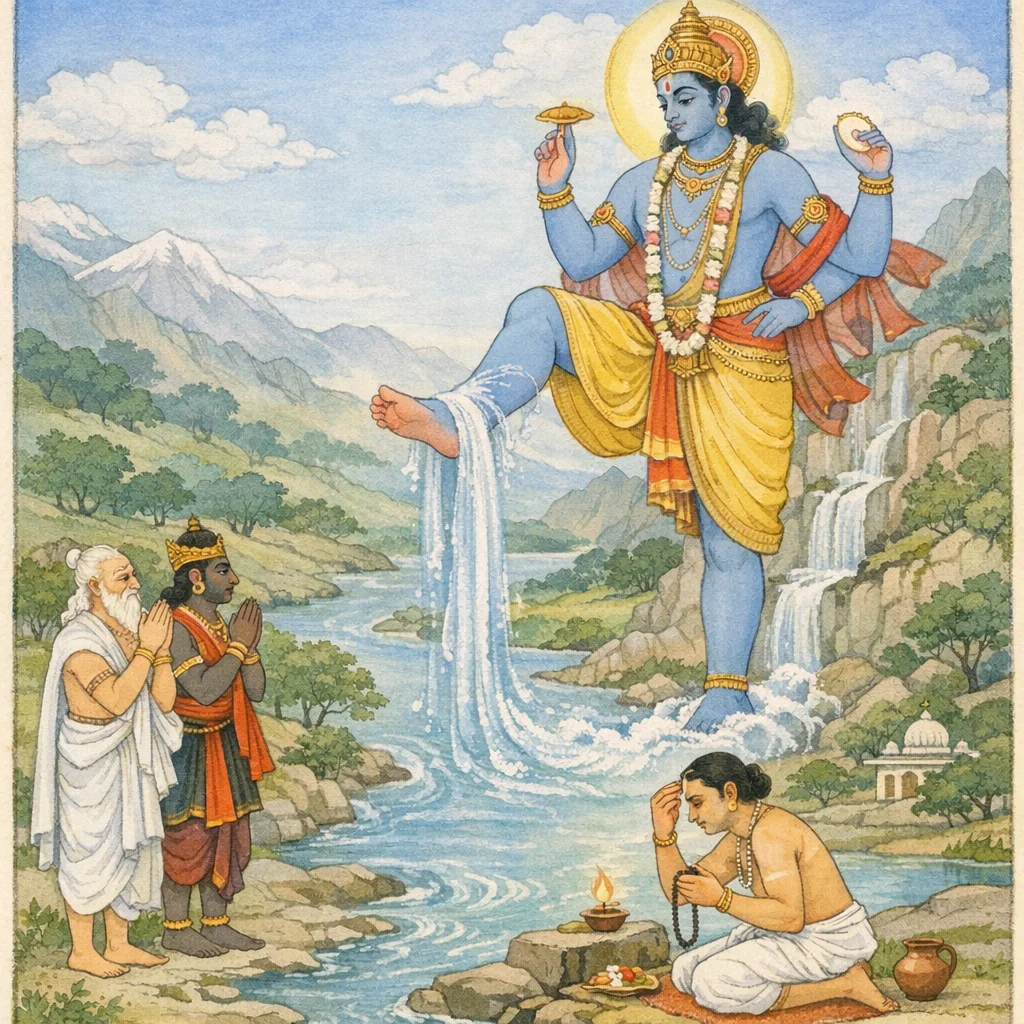
Adhyaya 29
Viṣṇv-ekapūjya-nirṇaya; Gaṅgā-Viṣṇupadī-māhātmya; Kali-yuga doṣa; Puṣkara-dharma of Viṣṇu-smaraṇa
Continuing the instruction to Garuḍa on dharma culminating in Viṣṇu-bhakti, this chapter begins by establishing that Viṣṇu alone is to be worshipped. Though Dharma and Yama stand as cosmic authorities, they acknowledge Viṣṇu as the giver of true knowledge. The discourse then glorifies Gaṅgā as Viṣṇupadī, born from Trivikrama’s stride, teaching that contact with her stream awakens devotion and supports liberation. It turns to inner discipline and vairāgya, warning against nourishing the liṅga-śarīra and against mental sin personified as Śyāmalā; it condemns cruelty even when excused as “treatment,” and cautions against association with the non-devotional. A critique of Kali-yuga follows—outward religiosity, improper offerings, and harsh social conduct. The chapter culminates in a practical devotional liturgy: a full schedule of remembering specific Viṣṇu-forms through daily acts (waking, cleansing, cow-care, tilaka, sandhyā, śrāddha, eating, drinking, sleep, and dying), concluding that such Puṣkara-dharma delights Hari and steadies joyful devotion, preparing the way for further rules of conduct and worship.
Shlokas
Verse 1
विष्णोरेवोपास्यत्वमित्यर्थनिरूपणं नामाष्टाविंशतमोध्यायः प्रवहानन्तरान्वक्ष्ये शृणु पक्षीन्द्रसत्तम / यो धर्मो ब्रह्मणः पुत्रो ह्यादिसृष्टौ त्वगुद्भवः
Now I shall explain, in sequence, what follows: the chapter called ‘The Determination of the Meaning that Viṣṇu alone is to be worshipped.’ Listen, O best of the kings of birds. That Dharma—born as a son of Brahmā at the very beginning of creation—arose from your own body, as your offspring.
Verse 2
सज्जनान्सौम्यरूपेण धारणाद्धर्मनामकः / स एव सूर्यपुत्रोभूद्यमसंज्ञामवाप सः / पापिनां शिक्षकत्त्वात्स यम इत्युच्यते बुधैः
By sustaining and protecting the virtuous in a gentle form, he is called Dharma. That very one, the son of Sūrya, obtained the name “Yama”; and because he instructs and disciplines sinners, the wise call him “Yama”.
Verse 3
श्रीकृष्ण उवाच / प्रह्लादानन्तरं गङ्गा भार्या वै वरुणस्य च / प्रह्लादादधमा ज्ञेया महिम्ना वरुणाधिका
Śrī Kṛṣṇa said: After Prahlāda comes the river Gaṅgā, who indeed is the wife of Varuṇa. She should be understood as next after Prahlāda; and in her greatness she is superior even to Varuṇa.
Verse 4
स्वरूपादधमा ज्ञेया नात्र कार्या विचारणा / ज्ञानस्वरूपदं विष्णुं यमो जानाति सर्वदा
Those who fall away from their true essential nature are to be known as the lowest—there is no need for further debate about it. Yama always recognizes Viṣṇu, the giver of the very form of knowledge.
Verse 5
अतो गङ्गेति सा ज्ञेया सर्वदा लोकपावनी / भक्त्या विष्णुपदीत्येव कीर्तिता नात्र संशयः
Therefore she is to be known as “Gaṅgā”, ever the purifier of the worlds; and with devotion she is praised as “Viṣṇupadī”—the river that issues from the feet of Viṣṇu—of this there is no doubt.
Verse 6
या पूर्वकाले यज्ञलिङ्गस्य विष्णोः साक्षाद्धरेर्विक्रमतः खगेन्द्र / वामस्य पादस्य नखाग्रतश्च निर्भिद्य चोर्ध्वाण्डकटाहखण्डम्
O Khagendra (Garuḍa), lord of birds: in ancient times, when Viṣṇu—whose very form is the principle of yajña—took the cosmic stride as Hari himself, the tip of the nail on his left foot pierced and broke through the upper portion of the cosmic shell, the egg-like cauldron of the universe (aṇḍa-kaṭāha).
Verse 7
तदुदरमतिवेगात्सम्प्रविश्यावहन्तीं जगदघततिहन्तुः पादकिञ्जल्कशुद्धाम् / निखिलमलनिहन्त्रीं दर्शनात्स्पर्शनाच्च सकृदवगहनाद्वा भक्तिदां विष्णुपादे / शशिकरवरगौरां मीननेत्रां सुपूज्यां स्मरति हरिपदोत्थां मोक्षमेति क्रमेण
Entering swiftly into her current and being borne along, this river—purified by the pollen-dust of the feet of the Destroyer of the world’s heaps of sin—washes away every stain. By merely seeing her, touching her, or even bathing once, she bestows devotion at the feet of Viṣṇu. Remembering that supremely worship-worthy river, moon-bright and fish-eyed, born from Hari’s feet, one gradually attains liberation.
Verse 8
इन्द्रोपि वायुकरमर्दितवायुकूटबिन्दुं च प्राश्य शिरसि ह्यसहिष्णुमानः / भागीरथी हरिपदाङ्कमिति स्म नित्यं जानन्महापरमभागवतप्रधानः / भक्त्या च खिन्नहृदयः परमादरेण धृत्वा स्वमूर्ध्नि परमो ह्यशिवः शिवो ऽभूत्
Even Indra, unable to endure upon his head that drop (of the Gaṅgā) driven and battered by the force of the wind, drank it. Ever knowing that Bhāgīrathī (Gaṅgā) bears the mark of Hari’s feet, that foremost great devotee—his heart melted with bhakti—reverently bore her upon his own head; thus even the one called “Aśiva” (inauspicious) became Śiva (the auspicious).
Verse 9
भागीरथ्याश्च चत्वारि रूपाण्यासन्खगेश्वर / महाभिषग्जनेन्द्रस्य भार्या तु ह्यभिषेचनी
O Lord of birds (Garuda), Bhāgīrathī (Gaṅgā) has four forms. And Abhiṣecanī is the wife of Mahābhiṣaj, the lord among physicians.
Verse 10
द्वितीयेनैव रूपेण गङ्गा भार्या च शन्तनोः / सुषेणा वै सुषेणस्य भार्या सा वानरी स्मृता
In her second manifestation, Gaṅgā became the wife of King Śantanu. And Suṣeṇā—remembered as a vānarī (monkey-woman)—indeed became the wife of Suṣeṇa.
Verse 11
मण्डूकभार्या गङ्गा तु सैव मण्डूकिनी स्मृता / एवं चत्वारी रूपाणि गङ्गाया इति किर्तितमम्
Gaṅgā—known as the wife of Maṇḍūka—is indeed remembered by the name Māṇḍūkinī. Thus it is proclaimed that Gaṅgā is described as having four forms.
Verse 12
आदित्याच्चैव गङ्गातः पर्जन्यः समुदाहृतः / प्रवर्षति सुवैराग्यं ह्यतः पर्जन्यनामकम्
From the Sun and also from the Gaṅgā, “Parjanya,” the rain-bearing power, is spoken of. Because it pours forth excellent dispassion (vairāgya), it is therefore called Parjanya.
Verse 13
शरंवराय पञ्चजन्याच्च पञ्च हित्वा जग्ध्वा गर्वकं षट्क्रमेण / स्वबाणस्य स्वहृदि संस्थितस्य भजेत्सदा नैव भक्तिं विषं च
Having abandoned the five sense-objects and restrained the five senses, and having consumed—step by step through the sixfold discipline—the pride of ego, one should constantly worship the Lord who abides in one’s own heart as one’s own inner “arrow.” Then devotion does not turn into poison, nor does poison overpower devotion.
Verse 14
लिङ्गं पुष्टं नैव कार्यं सदैव लिङ्गं पुष्टं कार्यमेवं सदापि / योनौ सक्तिर्नैव कार्या सदापि योनौ मुक्ते ऽसंगतो याति मुक्तिम्
One should not always keep nourishing the liṅga-śarīra, the subtle body; rather, one should continually strive so that it is purified and strengthened in the right way. One should never remain attached to the yoni—embodied existence; when one becomes free from the yoni, unattached, one goes to liberation.
Verse 15
वैराग्यमेवं प्रकारोत्येव नित्यमतः पर्जन्यस्त्वन्तकः पक्षिवर्य / एतावता शरभाख्यो महात्मा स चान्तरो स तु पर्जन्य एव
Thus dispassion (vairāgya) is indeed of this nature and should be held as a constant conviction. O best of birds, Garuḍa, Parjanya is Antaka—the Ender, that is, Death. In this measure the great-souled one called Śarabha is known: he is the inner, hidden one—indeed, he is Parjanya himself.
Verse 16
शश्वत्केशा यस्य गात्रे खगेन्द्र प्रभास्यन्ते शरभाख्यो पयोतः / यमस्य भार्या श्यामला या खगेन्द्र यस्मात्सदा कलिभार्यापिया च
O Garuḍa, king of birds, he on whose body the hairs ever stand on end and shine is known as Śarabha. And Yama’s consort is Śyāmalā, O lord of birds, who is also spoken of as the wife of Kali.
Verse 17
मत्वा सम्यक् मानसं या करोति ह्यतश्च सा श्यामलासंज्ञकाभूत् / मलं वक्ष्ये हरिभक्तेर्विरोधी सुलोहपात्रे सन्निधानं च तस्य
When one, having understood rightly, deliberately commits an inner wrong within the mind, that impurity is called “Śyāmalā.” Now I shall describe the defilement that is hostile to devotion (bhakti) to Hari, and how it is made to abide within an iron vessel.
Verse 18
चिकित्सितं परदुः खं खगेन्द्र दरेर्भक्तैस्त्याज्यमेवं सदैव
O Khagendra (Garuda), for the Lord’s devotees, causing another’s suffering—even if defended as a “remedy” or “treatment”—must be abandoned; thus it should be given up at all times.
Verse 19
नोच्चाश्च ते हरिभक्तेर्विहीनास्तेषां संगो नैव कार्यः सदापि / पुराणसंपर्कविसर्जिनं च पुराणतालं च पुराणवस्त्रम्
Even if they appear exalted, those who are devoid of devotion to Hari are not truly elevated. One should never, at any time, keep company with such people. One should also cast off worn-out attachments—old associations, empty show in clapping time, and even old garments—symbols of stale, hollow religiosity.
Verse 20
सुजीर्णकन्थाजिनमेखलं च यज्ञोपवीतं च कलिप्रियं च / प्रियं गृहं चोर्णविता नकं च समित्कुशैः पूरितं कुत्सितं च
In the age of Kali, people grow fond of outward signs—wearing tattered garments, deerskin and girdle, even the sacred thread (yajñopavīta)—yet they still cling to what they love: household life and a woollen covering. Their hands are filled with ritual items like fuel-sticks and kuśa grass, but their conduct remains base and blameworthy.
Verse 21
सर्वं चेत्कलिभार्याप्रियं च नैव प्रियं शार्ङ्गपाणेः कदाचित् / कांस्ये सुपक्वं यावनालस्य चान्नं तुषः पिण्याकं तुम्बबिल्वे पलाण्डुः
Even if all things become pleasing to the women of the Kali age, they are never at any time dear to Śārṅgapāṇi (Lord Viṣṇu). Food well cooked in bronze vessels, cooked grains of yavanāla, and such items as bran, oil-cake, gourds, bilva fruit, and onions—these do not please Him as sacred offerings.
Verse 22
दीर्घं तक्रं स्वादुहीनं कडूष्टणमेते सर्वे कलिभार्याप्रियाश्च / सुदुर्मुखं निन्दनं चार्यजानां सतोवमत्यात्मजानां प्रसह्य
In the age of Kali, people come to favor long-kept sour buttermilk (takra)—tasteless, bitter, and pungent. They also delight in harshness: an ugly, ill-mannered disposition, slander of the noble, and the shameless, forceful reviling of one’s own kinsmen and children.
Verse 23
सुपीडनं सर्वदा भर्तृवर्गे गृहस्थितव्रीहिवस्त्रादिचौर्यात् / प्रकीर्णभूतान्मूर्धजान्संदधानं करैर्युतं देवकलिप्रियं च
Because of constantly tormenting one’s husband’s family, and because of stealing rice, clothes, and other goods kept within the household, the sinner is made to gather scattered hairs from the head and stitch them together with the hands—an ordeal dear to the messengers of Yama, the Lord of Death.
Verse 24
इत्यादि सर्वं कलिभार्याप्रियञ्च सुनिर्मलं प्रिकरोत्येव सर्वम् / अतश्च सा श्यामलेति स्वसंज्ञामवाप सा देवकी संबभूव
Thus, she made everything—together with what was displeasing to Kali’s consort—completely pure and well ordered. Therefore she obtained the name “Śyāmalā,” and she came to be known as Devakī.
Verse 25
युधिष्ठिरस्यैव बभूव पत्नीसंभाविता तत्र च देवकी सा / चन्द्रस्य भार्या रोहिणी वै तदेयमश्विन्यादिभ्यो ऽह्यधिका सर्वदैव
There, the revered Devakī indeed became the wife of Yudhiṣṭhira. She is also Rohiṇī, the consort of the Moon, and she is ever regarded as superior even to Aśvinī and the other lunar mansions (nakṣatras).
Verse 26
रोणीं धृत्वा रोहति योग्यस्थानं तस्माच्च सा रोहिणीति प्रसिद्धा / आदित्यभार्या नाम संज्ञा खगेन्द्र ज्ञेया सा नारायणस्य स्वरूपा
Bearing the name “Roṇī,” she ascends to the fitting station; therefore she is famed as Rohiṇī. O lord of birds, know that her designation is “the wife of Āditya”; she is a manifestation of Nārāyaṇa.
Verse 27
संजानातीत्येव संज्ञामवाप संज्ञेति लोके सूर्य भार्या खगेन्द्र / ब्रह्मण्डस्य ह्यभिमानी तु देवो विराडिति ह्यभिधामाप तेन
O Khagendra, because she truly “knew” (saṃjānāt), she attained the name Saṃjñā; thus in the world she is called Saṃjñā, the wife of the Sun. And the deity who presides as the inward self-identification of the cosmic egg (brahmāṇḍa) obtained, through her, the designation “Virāṭ.”
Verse 28
गङ्गादिषट्कं सममेव नित्यं परस्परं नोत्तमं नाधमं च / प्रधानाग्नेः पाविकान्यैव गङ्गा सदा शुभा नात्र विचार्यमस्ति
The six sacred waters beginning with the Gaṅgā are ever equal in merit; among them there is neither higher nor lower. Yet the Gaṅgā—born of the primordial fire and purifying by her very nature—is always auspicious; of this there is no need for debate.
Verse 29
आसां ज्ञानत्पुण्यमाप्नोति नित्यं सदा हरिः प्रीयते केशवोलम् / गङ्गादिभ्यो ह्यवराह्यग्निजाया स्वाहासंज्ञाधिगुणा नैव हीना
By knowing these truths, one continually attains merit, and Hari—Keshava—ever becomes pleased. Indeed, though regarded as “lower” than the Gaṅgā and other holy rivers, she is in no way deficient, for she is Agni’s consort, famed by the name Svāhā, and endowed with superior qualities.
Verse 30
स्वाहाकारो मन्त्ररूपाभिमानी स्वाहेति संज्ञामाप सदैव वीन्द्र / अग्नेर्भार्यातो बुद्धिमान् संबभूव ब्रह्माभिमानी चन्द्रपुत्रो बुधश्च
O Indra, the very utterance “svāhā,” presiding over the mantra-form, is ever known by the name Svāhā. From Svāhā, the wife of Agni, was born the wise Budha—son of the Moon—identified with the principle of Brahmā, the creative intelligence.
Verse 31
बुद्ध्याहरद्वै राष्ट्रजातं च सर्वं धृतं त्वतो बुधसंज्ञामवाप / एवं चाभूदभिमन्युर्महात्मा सुभद्राया जठरे ह्यर्जुनाच्च
By his intelligence he truly subdued and upheld the entire race of the Rāṣṭras; therefore he attained the name “Budha” (the Wise). Thus too was born the great-souled Abhimanyu, in the womb of Subhadrā, from Arjuna.
Verse 32
कृष्णस्य चन्द्रस्य यमस्य चांशैः स संयुतस्त्वश्विनोर्वै हरस्य / स्वाहाधमश्चन्द्रपुत्रो बुधस्तु पादारविन्दे विष्णुदेवस्य भक्तः
Budha (Mercury), the son of the Moon, is said to be formed from portions of Kṛṣṇa, the Moon, and Yama, and also linked with the twin Aśvins and with Hara (Śiva). Born of Svāhā, that Budha is a devotee at the lotus-feet of Lord Viṣṇu.
Verse 33
नामात्मिका त्वश्विभार्या उषा नाम प्रकीर्तिता / बुधाधमा सा विज्ञेया स्वाहा दशगुणाधमा
The formula called “Nāmātmikā” is proclaimed to be Uṣā, the wife of the Aśvins. Know her to be inferior to “Budhā”; and “Svāhā” is said to be tenfold more inferior still.
Verse 34
नकुलस्य भार्या मागधस्यैव पुत्री शल्यात्मजा सहदेवस्य भार्या / उभे ह्येते अश्विभार्या ह्युषापि उपासते षड्गुणं विष्णुमाद्यम् / अतो ऽप्युषासंज्ञका सा खगेन्द्र अनन्तराञ्छृणु वक्ष्ये महात्मन्
Nakula’s wife—daughter of the king of Magadha—and Sahadeva’s wife—born of Śalya—both are indeed connected with the lineage of the Aśvins; and Uṣā too worships the primordial Viṣṇu, endowed with the six divine excellences. Therefore she is also known by the name Uṣā. O Khagendra (Garuda), listen further; I shall now speak of what comes next, O great-souled one.
Verse 35
ततः शक्तिः पृथिव्यात्मा शनैश्चरति सर्वदा / अतः शनैश्चरो नाम उषायाश्च दशाधमाः
Thereafter, that power—earth-natured in essence—moves always slowly. Therefore he is called Śanaiścara (“the slow-moving one”); and Uṣā’s ten most fallen sons are also mentioned.
Verse 36
कर्मात्मा पुष्करो ज्ञेयः शनरथ यमो मतः / नयाभिमानी पुरुषः किञ्चिन्नम्नो दशावरः
Know Puṣkara as the one whose very nature is karma, the administrator of deeds. Śanaratha is regarded as Yama. And the man who is proud of worldly policy and conduct is called Kiñcinnāmā; another is known as Daśāvara.
Verse 37
हरिप्रीतिकरो नित्यं पुष्करे क्रीडते यतः / अतस्तु पुष्कलो नाम लोके स परिकीर्तितः
Because he ever delights Hari and continually sports in Puṣkara, he is therefore celebrated in the world by the name Puṣkala.
Verse 38
हरि प्रीतिकरान्धर्मान्वक्ष्ये शृणु खगाधिप / प्रातः काले समुत्थाय स्मरेन्नारायणं हरिम्
I shall declare the dharmas that delight Hari—listen, O Lord of Birds. Rising in the early morning, one should remember Nārāyaṇa, Hari.
Verse 39
तुलसीवन्दनं कुर्याच्छ्रीविष्णुं संस्मरेत्खग / विण्मूत्रोत्सर्गकाले च ह्यपानात्मककेशवम्
One should perform reverence to Tulasī and remember Śrī Viṣṇu, O Bird (Garuda). And at the time of evacuating stool and urine, one should remember Keśava as the form presiding over apāna, the downward-moving vital force.
Verse 40
त्रिविक्रमं शौचकाले गङ्गापानकरं हरिम् / दन्तधावनकाले तु चन्द्रान्तर्यामिणं हरिम्
At the time of bodily cleansing, one should remember Hari as Trivikrama, and as the One who grants the purifying sip of the Gaṅgā; and at the time of brushing the teeth, one should remember Hari as the Inner Ruler (Antaryāmin) dwelling within the Moon.
Verse 41
मुखप्रक्षालने काले माधवं संस्मरेत्खग / गवां कण्डूयने चैव स्मरेद्गोवर्धनं हरिम्
O Khaga (Garuda), at the time of washing the face one should remember Mādhava; and while scratching or tending the cows to ease their itching, one should remember Hari as Govardhana.
Verse 42
सदा गोदोहने काले स्मरेद्गोपालवल्लभम् / अनन्तपुण्यार्जितजन्मकर्मणां सुपक्वकाले च खगेन्द्रसत्तम
At the time of milking the cow, one should always remember the Beloved of the cowherds (Śrī Viṣṇu/Kṛṣṇa). O best of bird-kings, for those whose birth and deeds are earned through endless merit, this remembrance bears fruit when the time is fully ripe.
Verse 43
स्पर्शे गवां चैव सदा नृणां वै भवत्यतो नात्र विचार्यमस्ति / यस्मिन् गृहे नास्ति सदोत्तमा च गौर्यङ्गणे श्रीतुलसी च नास्ति
From the touch of cows, people ever obtain auspiciousness—there is no need for doubt about this. But a house in which there is neither a noble, virtuous lady of the home nor sacred Tulasī in the courtyard is devoid of the highest blessing.
Verse 44
यस्मिन् गृहे देवमहोत्सवश्च यस्मिन् गृहे श्रवणं नास्ति विष्णोः / तत्संसर्गाद्याति दुः खादिकं च तस्य स्पर्शो नैव कार्यः कदापि
A house in which there is no sacred hearing of Viṣṇu—even if it hosts grand festivals for the gods—brings only suffering and the like to those who associate with it. Therefore, one should never make contact with such a place at any time.
Verse 45
गोस्पर्शनविहीनस्य गोदोहनमजानतः / गोपोषणविहीनस्य प्राहुर्जन्म निरर्थकम्
They declare a person’s life to be futile—if one has never touched a cow, does not know how to milk a cow, and does not engage in nourishing and caring for cows.
Verse 46
गोग्रासमप्रदातुश्च गोपुष्टिं चाप्यकुर्वतः / गतिर्नास्त्येव नास्त्येव ग्रामचाण्डालवत्स्मृतः
For one who offers not even a morsel of food to a cow, and who neither tends nor nourishes cows, there is truly no good destiny—none at all. He is remembered as like a village caṇḍāla (outcaste).
Verse 47
वत्स्यस्य स्तनपाने च बालकृष्णं तु संस्मरेत् / दधिनिर्मन्थने चैव मन्थाधारं स्मरेद्धरिम्
When a calf is suckling milk, one should remember child Kṛṣṇa. And when churning curd (dadhi), one should remember Hari as the support of the churning staff.
Verse 48
मृत्तिकास्नान काले तु वराहं संस्मरेद्धरिम् / पुण्ड्राणां धारणे चैव केशवादींश्च द्वादश
At the time of bathing with sacred earth (mṛttikā), one should remember Hari as Varāha. And when applying the tilaka marks (puṇḍra), one should also recite the twelve names beginning with Keśava.
Verse 49
मुद्राणां धारणे चैव शङ्खचक्रगदाधरम् / पद्मं नारायणीं मुद्रां क्रुद्धोल्कादींश्च संस्मरेत्
While assuming or wearing the sacred mudrās, one should remember the Lord who bears the conch, discus, and mace; and one should also recall the lotus, the Nārāyaṇī mudrā, and the fierce protective forms beginning with Kruddholkā.
Verse 50
श्रीरामसंस्मृतिं चैव संध्याकाले खगोत्तम / अच्युतानन्तगोविन्दाञ्छ्राद्धकाले च संस्मरेत्
O best of birds, Garuḍa, at the time of sandhyā (twilight) one should remember Śrī Rāma; and at the time of śrāddha rites one should also remember Acyuta, Ananta, and Govinda.
Verse 51
प्राणादिकपञ्चहोमेचानिरूद्धादींश्च संस्मरेत् / अन्नाद्यर्पणकाले तु वासुदेवं च संस्मरेत्
During the five homa oblations beginning with the prāṇa-offering, one should remember Aniruddha and the other Vyūha forms. And at the time of offering food and other items, one should remember Vāsudeva as well.
Verse 52
अपोशनस्य काले तु वायोरन्तर्गतं हरिम् / बस्त्रधारणकाकाले तु उपेन्द्रं संस्मरेद्धरिम्
At the time of cleansing after excretion, one should remember Hari as abiding within Vāyu, the vital wind. And at the time of putting on clothing, one should remember Hari as Upendra.
Verse 53
यज्ञोपवीतस्य च धारणे तु नारायणं वामनाख्यं स्मरेत्तु / आर्तिक्यकाले च तथैव विष्णोः सम्यक् स्मरेत्पर्शुरामाख्यविष्णुम्
While putting on the sacred thread (yajñopavīta), one should remember Nārāyaṇa as Vāmana. Likewise, at the time of performing ārati for Viṣṇu, one should properly remember Viṣṇu as Paraśurāma.
Verse 54
अपोशनेवैश्वदेवस्य काले तदन्यहोमादिषु भस्मधारणे / स्मरेत्तु भक्त्या परमादरेण नारायणं जामदग्न्याख्यरामम्
At the time of the Vaiśvadeva offering, during ācamana (sipping purifying water), likewise during other homa rites and while wearing sacred ash, one should—with devotion and the highest reverence—remember Nārāyaṇa, namely Rāma renowned as Jāmadagnya (Paraśurāma).
Verse 55
त्रिवारतीर्थग्रहणस्य काले कृष्णं रामं व्यासदेवं क्रमेण / शङ्खोदकस्योद्धरणे चैव काले मुकुन्दरूपं संस्मरेत्सर्वदैव
At the time of taking the threefold sacred bath (tīrtha-grahaṇa), one should remember—successively—Kṛṣṇa, Rāma, and Vyāsadeva. And at the time of drawing the water from the conch, one should always meditate on the form of Mukunda.
Verse 56
ग्रासेग्रासे स्मरणं चैव कार्यं गोविन्दसंज्ञस्य विशुद्धमन्नम् / एकैकभक्ष्यग्रहणस्य काले सम्यक् स्मरेदच्युतं वै खगेन्द्र
At every morsel, one should indeed practice remembrance, taking pure food offered in the name of Govinda. When receiving each item of food, one should properly remember the Imperishable Lord Acyuta, O Khagendra (Garuda).
Verse 57
शाकादीनां भक्षणे चैव काले धन्वन्तरिं स्मरेच्चैव नित्यम् / तथा परान्नस्य च भोगकाले स्मरेच्च सम्यक् पाण्डुरङ्गं च विष्णुम्
At the time of eating vegetables and the like, one should always remember Dhanvantari. Likewise, when enjoying food prepared by others, one should properly remember Pāṇḍuraṅga—Lord Viṣṇu.
Verse 58
हैयङ्गवीनस्य च भक्षणे वै सम्यक् स्मरेत्ताण्डवाख्यं च कृष्णम् / दध्यन्नभक्षे परमं पुराणं गोपालकृष्णं संस्मरेच्चैव नित्यम्
While partaking of haiyaṅgavīna (fresh butter), one should properly remember Kṛṣṇa, known as Tāṇḍava. And when eating dadhyanna (curd-rice), one should always remember Gopāla-Kṛṣṇa, the supremely primordial Lord.
Verse 59
दुग्धान्नभोगे च तथैव काले सम्यक् स्मरेच्छ्रीनिवासं हरिं च / सुतैलसर्पिः षु विपक्वभक्षसंभोजने संस्मरेद्व्यङ्कटेशम्
While partaking of milk-and-rice, at the proper time, one should rightly remember Hari, Śrīnivāsa. And when eating well-cooked foods prepared with good oil and ghee, one should remember Vyaṅkaṭeśa (Veṅkaṭeśvara).
Verse 60
द्राक्षासुजम्बूकदलीरसालनारिङ्गदाडिम्बफलानि चारु / स्मरेत्तु रम्भोत्तमनारिकेलधात्रीसुभोगे खलु बालकृष्णम्
Grapes, jambu fruits, bananas, mangoes, oranges, and pomegranates—these lovely fruits; and amid sweet enjoyments such as plantains, the best bananas, coconuts, and āmalakī—one should indeed remember Bāla-Kṛṣṇa, the child Kṛṣṇa.
Verse 61
सुपानकस्यैव च पानकाले सम्यक् स्मरेन्नारसिंहाख्यविष्णुम् / गङ्गामृतस्यैव च पानकाले गङ्गातातं संस्मरेद्विष्णुमेव
At the time of drinking supānaka (a sacred beverage), one should properly remember Viṣṇu known as Narasiṁha. And at the time of drinking Gaṅgā-water, one should remember Viṣṇu alone—He who is the fatherly guardian of the Gaṅgā.
Verse 62
प्रयाणकाले संस्मरेत्तार्क्ष्यवाहं नारायणं निर्गुणं विश्वमूर्तिम् / पुत्रादीनां चुंबने चैव काले सुवेणुहस्तं संस्मरेत्कृष्णमेव
At the time of departing from the body, one should remember Nārāyaṇa—the Lord who rides Garuḍa, who is beyond the guṇas, and whose form is the universe. Even when sons and others are kissing the dying person, one should remember Kṛṣṇa alone, the Lord holding the flute in His hand.
Verse 63
सुखङ्गकाले स्वस्त्रियश्चैव नित्यं गोपि कुचद्वन्द्वविलासिनं हरिम् / तांबूलकाले संस्मरैच्चैव नित्यं प्रद्युम्नाख्यं वासुदेवं हरिं च
At the time of intimate pleasure, one should always remember Hari—the Lord who sports with the cowherd maiden’s pair of breasts. And at the time of taking betel, one should always remember Hari as Vāsudeva, known also by the name Pradyumna.
Verse 64
शय्याकाले संस्मरेच्चैव नित्यं संकर्षणाख्यं विष्णुरूपं हरिं च / निद्राकाले संस्मरेत्पद्मनामं कथाकाले व्यासरूपं हरिं च
At the time of lying down on one’s bed, one should always remember Hari in the form of Viṣṇu known as Saṅkarṣaṇa. At the time of falling asleep, one should remember Him as Padmanāma; and at the time of sacred narration, one should remember Hari in the form of Vyāsa.
Verse 65
सुगानकाले संस्मरेद्वेणुगीतं हरिं हरिं प्रवदेत्सर्वदैव / श्रीमत्तुलस्याश्छेदने चैव काले श्रीरामरामेति च संस्मरेत्तु
At the time of auspicious singing, one should remember the Lord’s flute-song (veṇu-gīta) and constantly utter “Hari, Hari.” And at the time of cutting the sacred tulasī, one should indeed remember and repeat “Śrī Rāma, Rāma.”
Verse 66
पुष्पादीनां छेदने चैव काले सम्यक स्मरेदेत्कपिलाख्यं हरिं च / प्रदक्षिणेगारुडान्तर्गतं च हरिं स्मरेत्सर्वदा वै खगेन्द्र
When plucking or cutting flowers and the like, one should rightly remember Hari known as Kapila; and while performing pradakṣiṇā (circumambulation), one should remember Hari who abides within Garuḍa—thus, O Khagendra, remember Hari at all times.
Verse 67
प्रणमकाले देवदेवस्य विष्णोः शेषान्तस्थं संस्मरेच्चैव विष्णुम् / सुनीतिकाले संस्मरेन्नारसिंहं नारायणं संसंमरेत्सर्वदापि
At the time of bowing, one should remember Viṣṇu—the God of gods—who abides upon Śeṣa, and meditate upon Viṣṇu. At the time of right conduct and good counsel, one should remember Narasiṃha; and at all times one should remember Nārāyaṇa.
Verse 68
पूर्तिर्यदा क्रियते कर्मणां च सम्यक् स्मरेद्वासुदेवं हरिं च / एवं कृतानि कर्माणि हरिप्रीतिकराणि च
When acts of pūrti—pious completion and public merit—are properly performed, one should also remember Vāsudeva, Hari. Deeds done in this manner become pleasing to Hari.
Verse 69
सम्यक् प्रकुर्वन्नेतानि पुष्करो हरिवल्लभः
By properly performing these prescribed acts, Puṣkara—beloved of Hari—attains the intended spiritual result.
Verse 70
एतस्मादेव पक्षीश कर्म यत्समुदाहृतम् पुष्कराख्यानमतुलं शृणोति श्रद्धयान्वितः / हरिप्रीतिकरे धर्मे प्रीतियुक्तो भवेत्सदा
Therefore, O lord of birds (Garuḍa), whoever listens with faith to this incomparable account called “Puṣkara,” together with the rites (karma) that have been declared, becomes ever joyful and devoted to that dharma which pleases Hari (Viṣṇu).
Frequently Asked Questions
Gaṅgā is described as purified by contact with Hari’s feet and as removing stains of sin; even a single act of seeing, touching, or bathing is said to bestow devotion at Viṣṇu’s feet, and sustained remembrance of her as Viṣṇupadī supports gradual attainment of mokṣa.
Śyāmalā is presented as the impurity that arises when a person knowingly commits inner (mental) wrongdoing. Because bhakti depends on purified intention and right discernment, deliberate inner transgression is framed as a defilement that obstructs devotion and must be abandoned through restraint and purification.
It provides a structured devotional routine: remembering specific forms/names of Viṣṇu during ordinary actions (morning rising, cleansing, cow-care, tilaka, sandhyā, śrāddha, eating/drinking, sleep, and the moment of death). The teaching is that continuous smaraṇa transforms daily karma into dharma pleasing to Hari.