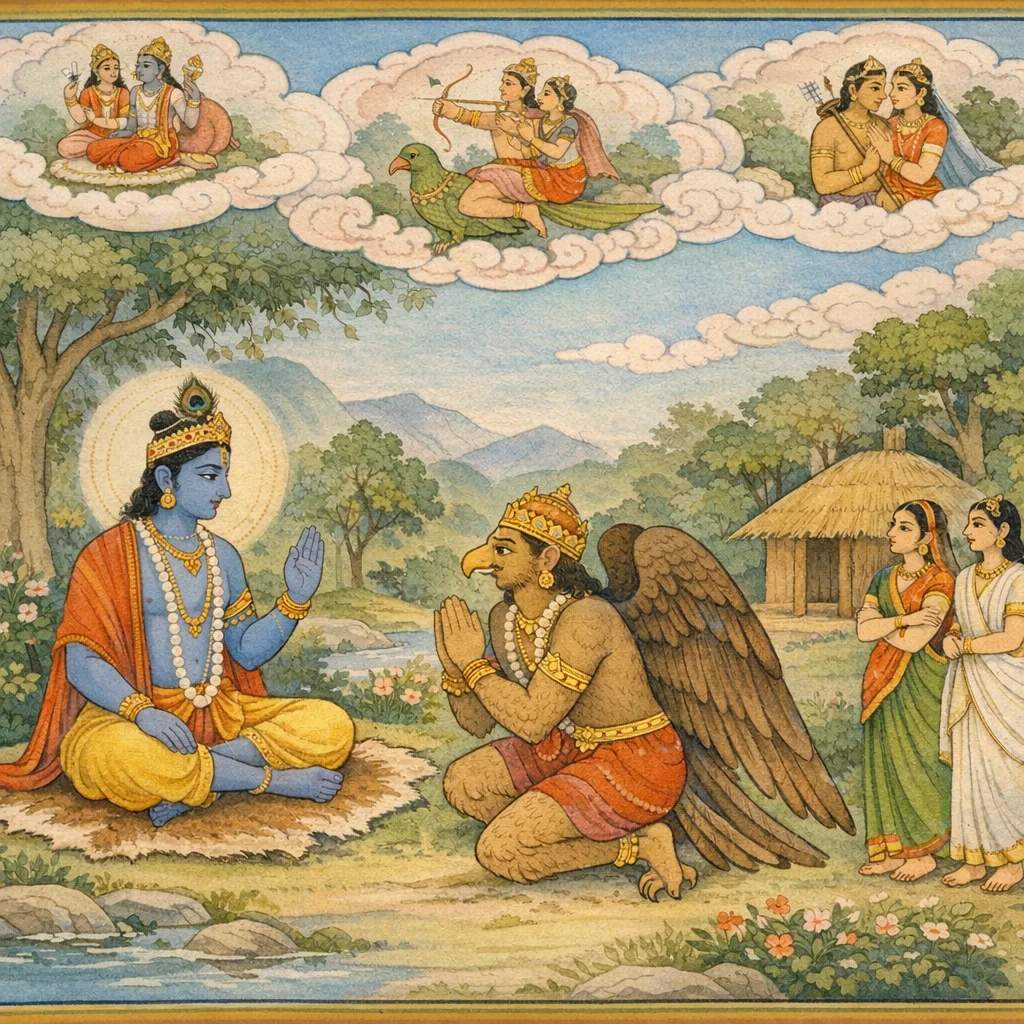
Adhyaya 28
Multi-form Manifestations, Indra–Kāma Incarnations, Pravāha, and the Twofold Buddhi (Sense-Discipline and Exclusive Refuge in Viṣṇu)
Continuing the Kṛṣṇa–Garuḍa dialogue, this chapter first maps multi-birth and multi-form identities (Satī reborn as Pārvatī; Vāruṇī as Śrī/Lakṣmī linked with Śeṣa/Balabhadra), showing how one divine presence can manifest in layered ways to accompany avatāras. Garuḍa asks about apparent “equalities” among figures (such as Jāmbavatī and others), and Kṛṣṇa explains that equality is due to permeation by a higher divine presence, while degrees of power still differ. An enumerative theology follows: seven Indra-forms (including Arjuna/Mantradyumna, Vāli/Purandara, Gādhi, Vikukṣi, Kuśa) and Kāma-forms (Pradyumna, Sudarśana associations, Skanda, Sanatkumāra), along with Aniruddha’s twofold nature and Rati’s dual manifestation. The narrative then introduces Pravāha/Ativāha and emphatic truth-oaths proclaiming Viṣṇu as Supreme, affirming the reality of jīva, Īśvara, matter, and real difference. Finally, it turns from doctrine to practice: sense-powers (hearing/seeing) and appetite are analyzed, “futile bathing” with delusion is criticized, and the “two wives” are identified as two kinds of buddhi—corrupt ritualistic superstition versus pure intellect that commands worship of Viṣṇu alone—preparing for Pravāha’s story and the consequences of right versus wrong refuge.
Shlokas
Verse 1
नाम सप्तविंशो ऽध्यायः या पूर्वसर्गे दक्षपुत्री सती तु रुद्रस्य पत्नी दक्षयज्ञे स्वदेहम् / विसृज्य सा मेनकायां च जज्ञे धराधराद्धेमवतो वै सकाशात्
Thus is it named “Chapter Twenty-Seven”: Satī, daughter of Dakṣa and wife of Rudra in the former cycle of creation, having cast off her own body at Dakṣa’s sacrifice, was born again to Menakā, from Himavat, the bearer of mountains.
Verse 2
सा पार्वता रुद्रपत्नी खगेन्द्र या शेषपत्नी वारुणी नाम पूर्वा / सैवागता बलभद्रेण रन्तुं द्विरूपमास्थाय महापतिव्रता
O king of birds (Garuda), she was Pārvatā, the wife of Rudra; formerly she was also called Vāruṇī, the consort of Śeṣa. That same great pativratā came to sport with Balabhadra, assuming a double form.
Verse 3
श्रीरित्याख्या इन्दिरावेशयुक्ता तस्या द्वितीया प्रतिमा मेघरूपा / शेषण रूपेण यदा हि वीन्द्र तपश्चचार विष्णुना सार्धमेव
She is known as Śrī, endowed with the indwelling presence of Indirā (Lakṣmī). Her second manifestation is in the form of a cloud. And when Vīndra undertook austerities in the form of Śeṣa, he did so together with Viṣṇu.
Verse 4
तदैव देवी वारुणी शेषपत्नी तपश्च क्रे इन्दिराप्रीतये च / तदा प्रीता इन्दिरा सुप्रसन्ना उवाच तां वारुणीं शेषपत्नीम्
Just then, the goddess Vāruṇī, the consort of Śeṣa, undertook austerities to please Indirā (Lakṣmī). Pleased and exceedingly gracious, Indirā then spoke to Vāruṇī, the wife of Śeṣa.
Verse 5
यदा रामो वैष्णवांशेन युक्तः संपत्स्यते भूतले रौहिणेयः / मय्यावेशात्संयुता त्वं तु भद्रे श्रीरित्याख्या वलभद्रस्य रन्तुम्
When Rāma—Rauhiṇeya, the son of Rohiṇī—descends upon the earth endowed with a portion of Viṣṇu, then you too, O auspicious one, united through My indwelling, will manifest under the name Śrī, to delight and accompany Balabhadra.
Verse 6
संपत्स्यसे नात्र विचार्यमस्तीत्युक्त्वा सा वै प्रययौ विष्णुलोके / श्रीलक्ष्म्यंशाच्छ्रीरितीड्यां समाख्यां लब्ध्वा लोके शेषपत्नी बभूव
Saying, “You shall surely attain it—there is nothing to doubt here,” she indeed departed to Viṣṇu’s realm. And, being a portion of Śrī-Lakṣmī, she obtained the revered name “Śrī,” and in the world she became the wife of Śeṣa.
Verse 7
यदाहीशो विपुलामुद्धरेच्च तदा रामः श्रीभिदासंगमे च / करोति तोषत्सर्वदा वै रमायास्तस्याप्यावेशो व्यंस्त्रितमोनसंगम्
When the Supreme Lord lifts up the vast (earth/burden), then Rāma too—at the sacred confluence associated with Śrī—ever brings delight to Ramā (Lakṣmī). By His very entry (āveśa), the entanglement of the mind is dispelled and scattered.
Verse 8
या रेवती रैवतस्यैव पुत्री सा वारुणी बलभद्रस्य पत्नी / सौपर्णनाम्नी बलपत्नी खगेन्द्र यास्तास्तिस्रः षड्विष्णोश्च स्त्रीभ्यः / द्विगुणाधमा रुद्रशेषादिकेभ्यो दशाधमा त्वं विजानीहि पौत्र
Revatī, the daughter of Raivata; Vāruṇī, the wife of Balabhadra; and Sauparṇā, the wife of Bala—O lord of birds—these three are counted among the six wives connected with Viṣṇu. Know, O grandson, that their reckoning is twofold lower than that of Rudra, Śeṣa, and the like, and tenfold lower by another stated measure.
Verse 9
गरुड उवाच / रामेण रन्तुं सर्वदा वारुणी तु पुत्रीत्वमापे रेवतस्यैव सुभ्रूः / एवं त्रिरूपा वारुणी शेषपत्नी द्विरूपभूता पार्वती रुद्रपत्नी
Garuḍa said: Desiring always to sport with Rāma, Vāruṇī—the fair-browed one—attained the status of being the daughter of King Revata. Thus Vāruṇī became three-formed as the consort of Śeṣa; and Pārvatī, becoming two-formed, became the consort of Rudra.
Verse 10
नीचाया जांबवत्याश्च शेषसाम्यं च कुत्रचित् / श्रूयते च मया कृष्ण निमित्तं ब्रूहि मे प्रभो
O Kṛṣṇa, I have heard in some places that there is a certain similarity between Nīcā and Jāmbavatī, and also a similarity with Śeṣa. O Lord, please tell me the cause of this.
Verse 11
उमायाश्च तथा रुद्रः सदा बहुगुणाधिकः / एवं त्वयोक्तं भगवन्निश्चयार्थं मम प्रभो
And Rudra likewise, in relation to Umā, is ever endowed with virtues far more abundant. Thus have You spoken, O Blessed Lord—(I ask) for the sake of my certainty, O my Master.
Verse 12
रेवती श्रीयुता श्रीश्च शेषरूपा च वारुणी / सौपर्णि पार्वती चैव तिस्रः शेषाशतो वराः
Revatī, Śrīyutā, and Śrī; Śeṣarūpā and Vāruṇī; Sauparṇī and Pārvatī as well—these are the three (principal ones); the rest are other excellent ones, in their hundreds.
Verse 13
इत्यपि श्रूयते कृष्ण कुत्रचिन्मधुसूदन / निमित्तं ब्रूहि मे कृष्ण तवशिष्याय सुव्रत
“Thus it is also heard of, O Kṛṣṇa—O Madhusūdana. Tell me the cause, O Kṛṣṇa, for me, Your disciple, O You of excellent vows.”
Verse 14
श्रीकृष्ण उवाच / विज्ञाय जांबवत्याश्च तदन्येषां खगाधिप / उत्तमानां च साम्यं तु उत्तमावेशतो भवेत्
Śrī Kṛṣṇa said: “O lord of birds, having understood (the state) of Jāmbavatī and of the others as well, know that equality among the excellent arises from being permeated by the highest (divine) presence.”
Verse 15
अवराणां गुणस्यापि ह्युत्तमानामधीनता / अस्तीति द्योतनायैव शतांशाधिकमुच्यते
Even the good qualities found in lesser persons remain dependent on the superior; and precisely to indicate that such dependence exists, the measure is stated as “a hundred and more.”
Verse 16
यथा मयोच्यते वीन्द्र तथा जानीहि नान्यथा / तदनन्तरजान्वक्ष्ये शृणु काश्यपजोत्तम
O best of birds, understand exactly as I have spoken—otherwise not. Next I shall explain what follows thereafter; listen, O foremost son of Kaśyapa.
Verse 17
चतुर्दशसु चेन्द्रेषु सप्तमो यः पुरन्दरः / वृत्रादीनां शरीरं तु पुरमित्युच्यते बुधैः
Among the fourteen Indras, the seventh is the one called Purandara. The body of Vṛtra and others is, the wise say, what is called a “pura” (a city or fortress).
Verse 18
तं दारयति वज्रेण यस्मात्तस्मात्पुरन्दरः / चतुर्दशसु चेन्द्रेषु मन्त्रद्युम्नस्तु षष्ठकः
Because he cleaves it with the thunderbolt (vajra), he is therefore called Purandara, the “fort-destroyer”. And among the fourteen Indras, Mantradyumna is the sixth.
Verse 19
मन्त्रानष्ट महावीन्द्र देवो द्योतयते यतः / मन्त्रद्युम्नस्ततो लोके उभावप्येक एव तु
O great Indra, since the god shines forth when the mantra is not lost (preserved and effective), therefore in the world he is known as Mantradyumna; indeed, both refer to one and the same person.
Verse 20
मन्त्रद्युम्नावतारोभूत्कुन्तीपुत्रोर्जुनो भुवि / विष्णोर्वायोरनन्तस्य चेन्द्रस्य खगसत्तम
O best of birds, on earth Arjuna—the son of Kuntī—was born as an incarnation of Mantradyumna, and he also embodied the powers of Viṣṇu, Vāyu, Ananta, and Indra.
Verse 21
पार्थश्चतुर्भिः संयुक्त इन्द्र एव प्रकीर्तितः / चतुर्थेपि च वायोश्च विशेषोस्ति सदार्जुन
O Arjuna (Pārtha), when one is joined with four factors, he is indeed spoken of as Indra; and even in the fourth there is a distinct, special role of Vāyu, the Wind-god.
Verse 22
वालिर्नामा वानरस्तु पुरन्दर इति स्मृतः / चन्द्रवंशे समुत्पन्नो गाधिराजो विचक्षणः
There was a monkey-king named Vāli, remembered as “Purandara”. In the Lunar dynasty was born the wise king Gādhi, renowned for his discernment.
Verse 23
मन्त्रद्युम्नावतारः स विश्वामित्रपिता स्मृतः / वेदोक्तमन्त्रा गाः प्रोक्ता धिया संधारयेद्यतः
He is remembered as the incarnation called Mantradyumna, regarded as the father of Viśvāmitra. The Veda-prescribed mantras and sacred chants are taught so that one may retain them firmly in the mind.
Verse 24
अतो गाधिरिति प्रोक्तस्तदर्थं भूतले ह्यभूत् / इक्ष्वाकुपुत्रो वीन्द्र विकुक्षिरिति विश्रुतः
Therefore he was called “Gādhi”; and for that very reason he indeed came to be on the earth. And, O best of birds (Garuda), Ikṣvāku’s son became renowned by the name “Vikukṣi”.
Verse 25
स एवेन्द्रावतारोभूद्धरिसेवार्थमेव च / विशेषेण हरिं कुक्षौ विज्ञानाच्च हरिः सदा
He indeed became an incarnation of Indra, solely for the purpose of serving Hari. More especially, by realizing Hari within the womb as the indwelling Lord, he remains forever devoted to Hari through true spiritual knowledge.
Verse 26
अतो विकुक्षिनामासौ भूलोके विश्रुतः सदा / रामपुत्रः कुशः प्रोक्त इन्द्र एव प्रकीर्तितः
Therefore he was ever renowned in the world by the name Vikukṣi. And Kuśa, the son of Rāma, is declared to be none other than Indra himself.
Verse 27
वाल्मीकिऋषिणा यस्मात्कुशेनैव विनिर्मितः / अतः कुश इति प्रोक्तो जानकीनन्दनः प्रभुः
Because the sage Vālmīki fashioned him—bringing him forth by a single blade of kuśa-grass alone—therefore Janakī’s divine son, the lordly prince, was named “Kuśa.”
Verse 28
इन्द्रद्युम्नः पुरेद्रस्तु गाधी वाली तथार्जुनः / विकुक्षिः कुश एवैते सप्त चेन्द्राः प्रकीर्तिताः
Indradyumna, Puredra, Gādhi, Vālī, and Arjuna, along with Vikukṣi and Kuśa—these are proclaimed as the seven Indras.
Verse 29
यः कृष्णपुत्त्रः प्रद्युम्नः काम एव प्रकीर्तितः / प्रकृष्टप्रकाशरूपत्वात्प्रद्युम्न इति नामवान्
Pradyumna, the son of Kṛṣṇa, is renowned as none other than Kāma, the god of love. Because his form is of supremely excellent radiance, he bears the name “Pradyumna”.
Verse 30
या रामभ्राता भरतः काम एवाभवद्भुवि / रामाज्ञां भरते यस्मात्तस्माद्भरतनामकः
That Bharata—Rāma’s brother—became, as it were, the very embodiment of devotion upon the earth; and because he bore and fulfilled Rāma’s command, therefore he is known by the name “Bharata.”
Verse 31
चक्राभिमानि कामस्तु सुदर्शन इति स्मृतः / ब्रह्मैव कृष्णपुत्रस्तु सांबो जाम्बवतीसुतः
Kāma, who presides over and identifies with the discus, is remembered as Sudarśana; and Brahmā himself is manifest as Kṛṣṇa’s son Sāmba, the son of Jāmbavatī.
Verse 32
कामावतारो विज्ञेयः संदेहो नात्र विद्यते / यो रुद्रपुत्रः स्कन्दस्तु काम एव प्रकीर्तितः
Know him to be an incarnation of Kāma; there is no doubt in this. That Skanda, the son of Rudra, is indeed proclaimed to be Kāma himself.
Verse 33
रिपूनास्कं दते नित्यमतः स्कन्द इति स्मृतः / यो वा सनत्कुमारस्तु ब्रह्मपुत्रः खगाधिप / कामावतारो विज्ञेयो नात्र कार्या विचारणा
He is remembered as “Skanda” because he continually strikes down enemies. And that Sanatkumāra—O lord of birds—who is the son of Brahmā, should be known as an incarnation of Kāma; in this there is no need for further deliberation.
Verse 34
सुदर्शनश्च परमः प्रद्युम्नः सांब एव च / सनत्कुमारः सांबश्चषडेते कामरूपकाः
Sudarśana and Parama, Pradyumna and Sāmba; Sanatkumāra and Sāmba—these six are said to be able to assume forms at will (kāmarūpa).
Verse 35
ततश्च इन्द्रकामावप्युमादिभ्यो दशावरौ / तयोर्मध्ये तु गरुड काम इन्द्राधमः स्मृतः
Thereafter, O Garuḍa, even the desires called “Indra” and “Kāma” are said to be ten degrees lower than those beginning with Umā. Between those two, the desire named “Kāma” is remembered as the lower, and “Indra” as the higher.
Verse 36
प्राणस्त्वहङ्कार एव अहङ्कारकसंज्ञकः / गरुत्मदंशो विज्ञेयः कामेन्द्राभ्यां दशाधमः
Prāṇa, the vital breath, is indeed the very ahaṅkāra, called “ahaṅkāraka,” the maker of the sense of “I.” Know it as a portion of Garuḍa; and, being the lowest of the ten, it is ruled by kāma (desire) and by the lord of the senses (Indra/indriya).
Verse 37
तदनन्तरजान्वक्ष्ये शृणु वीन्द्र समाहितः / श्रवणान्मोक्षमाप्नोति महापापाद्विमुच्यते
Next I shall declare what follows—listen with steady, gathered mind, O Vīndra (Garuḍa), best of birds. By hearing this, one attains mokṣa (liberation) and is freed even from great sins.
Verse 38
कामपुत्रोनिरुद्धो ऽपि हरेरन्यः प्रकीर्तितः / स एवाभूद्धरेः सेवां कर्तुं रामानुजो भुवि
Aniruddha—though known as the son of Kāma (Pradyumna)—is also praised as another manifestation of Hari. He himself came upon the earth as Rāma’s younger brother, in order to render sevā, devoted service, to Hari.
Verse 39
शत्रुघ्न इति विख्यातः शत्रून्सूदयते यतः / अनिरुद्धः कृष्णपुत्रो प्रद्युम्नाद्यो ऽजनिष्ट ह
He is famed as “Śatrughna” because he slays the enemies. And Aniruddha—son of Kṛṣṇa—was indeed born as the foremost among Pradyumna and the others.
Verse 40
संकर्षणादिरूपैस्तु त्रिभिराविष्ट एव सः / एवं द्विरूपो विज्ञेयो ह्यनिरुद्धो महामतिः
Aniruddha, the great-minded one, is indeed pervaded by the three forms beginning with Saṅkarṣaṇa. Thus Aniruddha is to be understood as having a twofold nature.
Verse 41
कामभार्या रतिर्या तु द्विरूपा संप्रकीर्तिता / रुग्मपुत्री रुग्मवती कामभार्या प्रकीर्तिता
Rati, the consort of Kāma, is proclaimed to possess a twofold form. She is also spoken of as Rugma’s daughter and as Rugmavatī—thus she is praised as the wife of Kāma.
Verse 42
अतिप्रकाशयुक्तत्वात्तस्माद्रुग्मवती स्मृता / दुर्योधनस्य या पुत्री लक्षणा सा रतिः स्मृता
Because she is endowed with extraordinary radiance, she is therefore remembered as Rugmavatī. And Duryodhana’s daughter, named Lakṣaṇā, is also remembered as Rati.
Verse 43
काष्ठा सांबस्य भार्या सा लक्षणं संयुनक्त्यतः / लक्षणाभिधयाभूमौ दुष्ट वीर्योद्भवा ह्यपि
Kāṣṭhā, the wife of Sāmba, thereupon united with Lakṣaṇā. In the place called Lakṣaṇābhidhā-bhūmi, a being was indeed born from corrupted seed.
Verse 44
एवं द्विरूपा विज्ञेया कामभार्या रतिः स्मृता / स्वायंभुवो ब्रह्मपुत्रो मनुस्त्वाद्यो गुरौ समः / राजधर्मेण विष्णोश्च जातः प्रीणयितुं हरेः
Thus Rati, the consort of Kāma, is to be understood as having a twofold nature. And Svāyambhuva Manu—the first Manu, the son of Brahmā—was equal to his teacher; and, through the practice of royal dharma, he was born as a portion of Viṣṇu in order to please Hari.
Verse 45
बृहस्पतिर्देवागुरुर्महात्मा तस्यावतारास्त्रय आसन् खगेन्द्र / रामावतारे भरताख्यो बभूव ह्यंभोजजावेशयुतो बृहस्पतिः
Bṛhaspati—the great-souled preceptor of the gods—had three incarnations, O King of Birds. In the incarnation connected with Rāma, he became known as Bharata; indeed, Bṛhaspati was endowed with the āveśa, the indwelling influence, of Brahmā, the lotus-born.
Verse 46
देवावतारान्वानरांस्तारयित्वा श्रीरामदिव्याऽचरितान्यवादीत् / अतो ह्यसौ नारनामा बभूव ह्यङ्गत्वमाप्तुं रामदेवस्य भूम्याम्
Having delivered the divine incarnations among the Vānaras, he proclaimed the sacred deeds of Śrī Rāma. Therefore he became known by the name Nāra, so as to attain on earth the status of an aṅga—an integral limb—of Lord Rāma.
Verse 47
कृष्णावतारे द्रोणनामा बभूव अंभोजजावेशयुतो बृहस्यपतिः / यस्माद्दोणात्संभभूव गुरुश्च तस्मादसौ द्रोणसंज्ञो बभूव
In the age of Kṛṣṇa’s incarnation, Bṛhaspati—endowed with the āveśa, the indwelling power of Ambhojajā—became known as Droṇa. And because the guru was born from a droṇa, a vessel, he therefore came to be called Droṇa.
Verse 48
भूभारभूताद्युद्धृतौ ह्यङ्गभूतो विष्णोः सेवां कर्तुमेवास भूमौ / बृहस्पतिः पवनावेशपुक्ता स उद्धवश्चेत्यमिधानमाप
To help lift the burden of the earth, he became, as it were, an aṅga of Viṣṇu and lived on earth solely to render service to Him. Endowed with the inspiration of Vāyu, that Bṛhaspati came to be known as ‘Uddhava’.
Verse 49
यस्मादुत्कृष्टो हरिरत्र सम्यगतो ह्यसौ बुधवन्नाम चाप / सखा ह्यभूत्कृष्णदेवस्य नित्यं महामतिः सर्वलोकेषु पुज्वः
Because Hari is supreme and has rightly manifested here, he is also known by the name Budhavan. He became the constant friend of Kṛṣṇadeva—great-minded and revered in all the worlds.
Verse 50
दक्षिणाङ्गुष्ठजो दक्षो ब्रह्मपुत्रो महामतिः / कन्यां सृष्ट्वा हरेः प्रीणन्नास भूमा प्रजापतिः / पुत्रानुदपादयद्दक्षस्त्वतो दक्ष इति स्मृतः
Dakṣa—born from the right thumb, the great-minded son of Brahmā—created a daughter and, by pleasing Hari (Viṣṇu), became a mighty Prajāpati upon the earth. Since he generated sons, he is therefore remembered by the name ‘Dakṣa’, the capable one.
Verse 51
शचीं भर्यां देवराजस्य विद्धि तस्या ह्यवतारं शृणु सम्यक् खगेन्द्र / रामावतारे नाम तारा बभूव सा वालिपत्नी शचीसजका च
Know Śacī to be the consort of Indra, king of the gods. Hear rightly, O Khagendra (Garuḍa), of her incarnation: in Rāma’s avatāra she became known as Tārā, the wife of Vāli, born as an offspring connected with Śacī.
Verse 52
रामान्मृते वालिसंज्ञे पतौ हि सुग्रीवसंगं सा चकाराथ तारा / अतो नागात्स्वर्गलोकं च तारा क्व वा यायादन्तरिक्षे न पापा
When her husband—known as Vāli—was slain by Rāma, Tārā then entered into union with Sugrīva. Therefore Tārā attained the heavenly world; for how could one who is not sinful ever be made to wander in the mid-region (antarikṣa)?
Verse 53
कृष्णावतारे सैव तारा च वीन्द्र बभूव भूमौ विजयस्य पत्नी / पिशङ्गदेति ह्यभिधा स्याच्च तस्याः सामीप्यमस्यास्त्वजुंनवेव चासीत्
In the age of Kṛṣṇa’s avatāra, that same woman became Tārā on earth, the wife of Vijaya. She was also known by the name Piśaṅgadā, and she had close association with Arjuna as well.
Verse 54
उत्पादयित्वा बभ्रुवाहं च पुत्रं तस्यां त्यक्त्वा ह्यर्जुनो वै महात्मा / अतश्चोभे वारचित्राङ्गदे च शचीरूपे नात्र विवार्यमस्ति
Having begotten in her a son named Babruvāha, the great-souled Arjuna then departed from that place. Therefore, both Vārā and Citrāṅgadā are to be understood as bearing the form of Śacī; there is no doubt of this.
Verse 55
पुलोमजा मन्त्रद्युम्नस्य भार्या या काशिका गाधिराजस्य भार्या / विकुक्षिभार्या सुमतिश्चेति संज्ञा कुशस्य पत्नी कान्तिमतीति संज्ञा
Pulomajā was the wife of Mantradyumna; Kāśikā was the wife of King Gādhi; Sumati was the name of Vikukṣi’s wife; and Kuśa’s wife was famed by the name Kāntimatī.
Verse 56
एता हि सप्त ह्यवराश्च शच्या जानीहि वै नास्ति विचारणात्र / शची रतिश्चानिरुद्धो मनुर्दक्षो बृहस्पतिः / षडन्योन्यसमाः प्रोक्ता अहङ्काराद्दशाधमाः
Know that these are the seven lower ones; here there is no room for further disputation. Śacī, Rati, Aniruddha, Manu, Dakṣa, and Bṛhaspati—these six are declared equal to one another. From ahaṅkāra (ego-sense) arise the ten inferior classes.
Verse 57
स वायुषु महानद्य स वै कोणाधिपस्तथा
He is present among the winds like a mighty river; and indeed, he is also the lord who presides over the quarters (the directions).
Verse 58
नासिकासु स एवोक्तो भौतिकस्तुल्य एव च / अतिवाहः स एवोक्तः यतो गम्यो मुमुक्षुभिः
That very channel is said to be in the nostrils, and it is also described as comparable to the physical path. The same is called Ativāha, by which those who seek liberation (mumuṣu) are able to proceed.
Verse 59
दक्षादिभ्यः पञ्चगुणादधमः संप्रकीर्तितः / गरुड उवाच / प्रवहश्चेति संज्ञां स किमर्थं प्राप तद्वद
In comparison with Dakṣa and the others, he is declared inferior by a fivefold measure. Garuḍa said: Why did he obtain the designation “Pravaha”? Tell me that.
Verse 60
अर्थः कश्चास्ति तन्नाम्नः प्रतीतस्तं वदस्व मे / गरुडेनैवमुक्तस्तु भगवान्देवकीसुतः / उवाच परमप्रीतः संस्तूय गरुडं हरिः
“If that name implies any meaning, tell it to me.” Thus addressed by Garuḍa, the Blessed Lord—Hari, Devakī’s son—being exceedingly pleased, praised Garuḍa and spoke.
Verse 61
कृष्ण उवाच / प्रहर्षेण हरेस्तुल्यान्सर्वदा वहते यतः / अतः प्रवहनामासौ कीर्तितः पक्षिसत्तम
Krishna said: Because, in joyful eagerness, he ever bears those who are equal to Hari, therefore that best of birds is praised by the name “Pravaha”.
Verse 62
सर्वोत्तमो विष्णुरेवास्ति नाम्ना ब्रह्मादयस्तदधीनाः सदापि / मयोक्तमेतत्तु सत्यं न मिथ्या गृह्णामि हस्तेनोरगं कोपयुक्तम्
The Supreme One is indeed Vishnu by name; even Brahma and the other gods are ever dependent upon Him. What I have spoken is truth, not falsehood. In anger, I seize the serpent with my hand.
Verse 63
सर्वं नु सत्यं यदि मिथ्या भवेत्तु तदा त्वसौ मां दशतुह्यहीन्द्रः / एवं ब्रुवन्नुरगं कोपयुक्तं समग्रहीन्नादशत्सोप्युरङ्गः
“If indeed all this is true—if it should turn out to be false—then let that lord of serpents bite me!” Saying so, he seized the snake filled with anger; yet even that serpent did not bite.
Verse 64
एतस्य संधारणादेव वीन्द्र स वायुपुत्रः प्रवहेत्याप संज्ञाम् / यो वा लोके विष्णुमूर्तिं विहाय दैत्यस्वरूपा रेणुकाद्याः कुदेवाः
O best of Indras, merely by sustaining this, the son of Vāyu came to be known as “Pravaha” (the Flowing One). But whoever in this world abandons the form of Vishnu and resorts to false deities—such as Reṇukā and others of demonic nature—falls into error.
Verse 65
तेषां तथा मत्पितॄणां च पूजा व्यर्था सत्यं सत्यमेतद्ब्रवीमि / एतत्सर्वं यदि मिथ्या भवेत्तु तदा त्वसौ मां दशतु ह्यहीन्द्रः
Indeed, the worship offered to them—and even the worship of my own ancestors—would be futile. I speak the truth, truly. If all this were false, then let that lord of serpents bite me.
Verse 66
पित्र्यं नयामि प्रविहायैव ये तु पित्रुद्देशात्केवलं यः करोति / स पापात्मा नरकान्वै प्रयातीत्येतद्वाक्यं सत्यमेतद्ब्रवीमि
I do not lead such a one to the realm of the Pitṛs. But whoever performs the rites only in name—merely “for the ancestors,” while abandoning the true obligation—such a sinful soul indeed goes to the hells. This statement is true; thus I declare.
Verse 67
न श्रीः स्वतन्त्रा नापि विधिः स्वतन्त्रो न वायुदेवो नापि शिवः स्वतन्त्रः / तदन्ये नो गौरिपुलोम जाद्याः किं वक्तव्यं नात्र लोके स्वतन्त्रः
Even Śrī (Lakṣmī) is not independent; nor is Vidhi (Brahmā) independent. Nor is Vāyu-deva independent, nor is Śiva independent. What then need be said of others—Gaurī (Pārvatī), Pulomajā (Śacī/Indrāṇī), and the rest? In this world, none is truly independent.
Verse 68
ब्रवीमि सत्यं पुरुषो विष्णुरेव सत्यं सत्य भुजमुद्धृत्य सत्यम् / एतत्सर्वं यदि मिथ्या भवेत्तु तदा त्वसौ मां दशतु ह्यहीन्द्र
I declare the truth: the Supreme Person is indeed Viṣṇu. Truth—raising my truth-bearing arm, I affirm the truth. If all this should prove false, then let that serpent-king bite me.
Verse 69
जीवश्च सत्यः परमात्मा च सत्यस्तयोर्भेदः सत्ये ए तत्सदापि / जडश्चसत्यो जीवजडयोश्च भेदो भेदः सत्यः किं च जडैशयोर्भिदा
The individual soul is real, and the Supreme Self is also real; and the distinction between them is real—this remains so always. Matter, the insentient, is real as well; and the difference between the soul and matter is real. Difference itself is real—so what meaningful “difference” could there be between the insentient and the Lord?
Verse 70
भेदः सत्यः सर्वजीवेषु नित्यं सत्या जडानां च भेदा सदापि / एतत्सर्वं यदि मिथ्या भवेत्तु तदा त्वसौ दशतु मां ह्यहीन्द्रः
Difference is real and eternal among all living beings; and the distinctions among insentient things are also always real. If all of this were false, then let that king of serpents bite me indeed.
Verse 71
एवं ब्रुवन्नुरगं कोपयुक्तं समग्रहीन्नादशत्सोप्युरङ्गः / एतस्य संधारणादेववीद्रे सा वायुपुत्रः प्रवहेत्याप संज्ञाम्
Thus speaking, he seized the serpent filled with wrath, and the serpent too roared. Because he held it fast, O wise one, the son of Vāyu came to be known by the name “Pravaha”—the one who carries and propels.
Verse 72
द्वयं स्वरूपं प्रविदित्वैव पूर्वं त्वं स्वीकुरुष्व द्वयमेव नित्यम् / स्नानादिकं च प्रकरोति नित्यं पापी स आत्मा नैव मोक्षं प्रयाति
First discern the twofold nature (of reality and of the self), and then constantly embrace that twofold discipline. Even if one performs daily bathing and similar rites, a sinful person does not attain liberation (moksha).
Verse 73
तस्माद्द्वयं प्रविचार्यैव नित्यं सुखी भवेन्नात्र विचार्यमस्ति / एतत्सर्वं यदि मिथ्या भवेत्तु तदा त्वसौ मां दशतु ह्यहीन्द्रः
Therefore, having reflected on these two matters each day, one should abide in peace—there is nothing further to deliberate here. If all this were false, then let that serpent-king indeed bite me.
Verse 74
गरुड उवाच / किं तद्द्वयं देवदेवेश किं वा तत्कारणं कीदृशं मे वदस्व / द्वयोस्त्यागं कीदृशं मे वदस्व त्यागात्सुखं कीदृशं मे वदस्व
Garuḍa said: O Lord of lords, what is that ‘pair’—those two things? And what is its cause? Tell me plainly. Tell me what the renunciation of those two is like, and what kind of happiness arises from such renunciation.
Verse 75
श्रीकृष्ण उवाच / द्वयं चाहुस्त्विन्द्रिये द्वे बलिष्ठे देहे ह्यस्मिञ् श्रोत्रनेत्रे सुसृष्टे / अवान्तरे श्रोत्रनेत्रे खगेन्द्र द्वयं चाहुस्तत्स्वरूपं च वक्ष्ये
Śrī Kṛṣṇa said: In this body, two sense-powers are spoken of as the strongest—hearing and sight—well fashioned as the ear and the eye. O Khagendra, king of birds, within these two they speak again of a further duality; I shall also describe its true nature.
Verse 76
श्रोत्रस्वभावो लोक वार्ताश्रुतौ च ह्यतीव मोदस्त्वादरास्वादनेन / हरेर्वार्ताश्रवणे दुः खजालं श्रोत्रस्वभावो जडता दमश्च
The ear, by its very nature, greatly delights in hearing worldly gossip, tasting it with eager relish. But in listening to the sacred narrative of Hari it finds a net of “pain”; such is the ear’s habit—dullness and the need for restraint.
Verse 77
नेत्रस्वभावो दर्शने स्त्रीनराणां ह्यत्यादरान्नास्ति निद्रादिकं च / हरेर्भक्तानां दर्शने दुः खरूपो विष्णोः पूजादर्शने दुः खजालम्
The very nature of the eyes is to be drawn toward seeing women and men; through excessive attachment, sleep and the like are lost. But for devotees of Hari, such “seeing” becomes a form of suffering; and in beholding the worship of Viṣṇu, the entire web of sorrow is cut away.
Verse 78
तयोः स्वरूपं प्रविदित्वैव पूर्वं पुनः पुनः स्वीकरोत्येव मूढः / शिश्रं मौर्ख्याच्चैव कुत्रापि योनौ प्रवेशयेत्सर्वदा ह्यादरेण
Even after first understanding their true nature, the deluded person repeatedly accepts them again and again; and, out of sheer folly, he keeps inserting his generative organ into some womb or other, always with eager attachment.
Verse 79
भयं च लज्जा नैव चास्ते वधूनां तथा नृणां वनितानां यतीनाम् / स्वसारं ते ह्यविदित्वा दिनेपि सुवाम यज्ञेन स्वाभावश्च वीन्द्र
Fear and shame do not remain for brides, nor for men, nor for women, nor even for ascetics. Indeed, not recognizing what is truly one’s own (inner nature) even in the light of day, they pursue the yajña and its fruits—such is their inborn tendency, O best of kings.
Verse 80
रसास्वभावो भक्षणे सर्वदापि ह्यनर्पितस्यान्नभक्ष्यस्य विष्णोः / तथो पहारस्य च तत्स्वभावः अभक्ष्याणां भक्षणे तत्स्वभावः
The natural tendency of the sense of taste is always toward eating; yet for one devoted to Viṣṇu, food that has not been offered is not fit to be eaten. Likewise, the nature of taking what is not given is to consume what should not be consumed—this is its inherent character.
Verse 81
अलेह्यलेहस्य च तत्स्वभावः पातुं त्वपेयस्य च तत्स्वभावः / द्वयोः स्वरूपं च विहाय मूढः पुनः पुनः स्वीकरोत्येव नित्यम्
What is not to be licked has, by its very nature, not to be licked; and what is not to be drunk has, by its very nature, not to be drunk. Yet the deluded one, abandoning discernment of the true nature of both, keeps accepting them again and again, endlessly.
Verse 82
तस्य स्नानं व्यर्थमाहुश्च यस्मात्तस्मात्त्याज्यं न द्वयोः कार्यमेव / अभिप्रायं ह्येतमेवं खगेन्द्र जानीहि त्वं प्रहस्यैव नित्यम्
Because they say his bathing is futile, therefore it should be abandoned—there is no need to do both. Understand this intention thus, O King of Birds; know it always, with a gentle smile.
Verse 83
भार्याद्वयं ह्यविदित्वा स्वरूपं स्वीकृत्य चैकां प्रविहायैव चैकाम् / स्नानादिकं कुरुते मूढबूद्धिः व्यर्थं चाहुर्मोक्षभोगौ च नैव / एतत्सर्वं यदि मिथ्या भवेत्तु तदा त्वसौ मां दशतु ह्यहीन्द्रः
Not understanding the true nature of the ‘two wives’, the deluded one accepts one and abandons the other. With foolish intellect he performs bathing and other rites in that mistaken way; therefore they say it is futile—there is neither liberation (mokṣa) nor enjoyment from it. If all this were false, then let that king of serpents bite me.
Verse 84
गरुड उवाच / भार्याद्वयं किं वद त्वं ममापि तयोः स्वरूपं किं वद त्वं मुरारे / तयोर्मध्ये ग्राह्यभार्यां वद त्वमग्राह्यभार्यां चापि सम्यग्वद त्वम्
Garuḍa said: “Tell me—what are the two kinds of wives? Explain their nature to me as well, O Murāri. Among them, describe clearly which wife is acceptable to be taken and which wife is unacceptable.”
Verse 85
श्रीकृष्ण उवाच / बुद्धिः पत्नी सा द्विरूपा खगेन्द्र दुष्टा चैका त्वपरा सुष्ठुरूपा / तयोर्मध्ये दुष्टरूपा कनिष्ठा ज्येष्ठा तु या सुष्ठुबुद्धिस्वरूपा
Śrī Kṛṣṇa said: O King of Birds, that Buddhi (intellect) is spoken of as a wife with two forms—one corrupt, the other beautifully pure. Of these, the corrupt form is the younger; the elder is truly the very nature of right and noble understanding.
Verse 86
कनिष्ठया नष्टतां याति जीवः सुतिष्ठन्त्या याति योग्यां प्रतिष्ठाम् / कनिष्ठायाः शृणु वक्ष्ये स्वरूपं श्रुत्वा तस्यास्त्यागबुद्धिं कुरुष्व
Through the “inferior” (kaniṣṭhā) condition, the jīva goes to ruin; through the steadfast and well-established (sutiṣṭhantī) condition, it attains a fitting and rightful station. Listen: I shall describe the true nature of this kaniṣṭhā; having heard it, cultivate the resolve to abandon it.
Verse 87
जीवं यं वै प्रेरयन्ती कनिष्ठा काम्यं धर्मं कुरुते सर्वदापि / क्व ब्राह्मणाः क्व च विष्णुर्महात्मा क्व वै कथा क्व च यज्ञाः क्वगावः
Driven by the lower impulse (kaniṣṭhā), the jīva constantly performs desire-motivated “dharma.” Where, then, are true brāhmaṇas? Where is the great-souled Viṣṇu? Where is sacred discourse? Where are sacrifices (yajñas)—and where are cows worthy of protection and gifting?
Verse 88
क्व चाश्वत्थः क्व च स्नानं क्व शौचमेतत्सर्वं नाम नाशं करोति / मूढं पतिं रेणुकां पूजयस्व मायादेव्या दीपदानं कुरुष्व
“What has an aśvattha tree to do with this? What has bathing to do with it, and what has purity?” All this, they say, destroys even the very “name” of one’s true aim. O foolish husband, worship Reṇukā, and offer the gift of lamps (dīpa-dāna) to the goddess Māyā.
Verse 89
सुभैरवादीन् भज मूढ त्वमन्ध हारिद्रचूर्णन्धारयेः सर्वदापि / ज्येष्ठाष्टम्यां ज्येष्ठदेवीं भजस्व भक्त्या सूत्रं गलबन्धं कुरुष्व
“O deluded blind one! Worship Subhairava and the like; keep turmeric powder with you at all times. On the Jyeṣṭhāṣṭamī day, worship the goddess Jyeṣṭhā with devotion (bhakti), and tie a protective thread around your neck.”
Verse 90
मरिगन्धाष्टम्यां मरिगन्धं भजस्व तथा सूत्रं स्वगले धारयस्व / दीपस्तंभं सुदिने पूजयस्व तत्सूत्रमेव स्वगले धारयस्व
On Marigandhāṣṭamī, worship (the observance called) Marigandha, and likewise wear the sacred thread upon your own neck. On an auspicious day, worship the pillar-lamp (dīpa-stambha); and that very thread should indeed be worn upon your neck.
Verse 91
महालक्ष्मीं चाद्यलक्ष्मीं च सम्यक् पूजां कुरु त्वं हि भक्त्याथ जीव / लक्ष्मीसूत्रं स्वागले धारयस्व महालक्ष्मीवान् भवसीत्युत्तरत्र
Worship Mahālakṣmī and also Ādyalakṣmī properly, with devoted bhakti, and then live in prosperity. Wear the Lakṣmī-thread upon your own neck; thereby, in what follows, you will become endowed with great Lakṣmī—abundance and auspicious fortune.
Verse 92
विहाय मौञ्जीदिवसे भाग्यकामः सुगुग्गुलान्धारयस्वातिभक्त्या / सुवासिनीः पूजयस्वाशु भक्त्या गन्धैः पुष्पैर्धूपदीपैः प्रतोष्य
Except on the day of the Mañjī rite (the sacred-thread initiation), one who seeks good fortune should, with deep bhakti, wear fine guggulu (fragrant resin). Then, promptly and devoutly, worship the suvāsinīs—auspicious married women—pleasing them with perfumes, flowers, incense, and lamps.
Verse 93
वरार्तिक्यं कांस्यपात्रे निधाय कुर्वार्तिक्यं देवतादेवतानाम् / पिचुमन्दपत्राणि वितत्य भूमौ नमस्व त्वं क्षम्यतां चेति चोक्त्वा
Placing the auspicious ārati materials in a bronze vessel, perform ārati to the gods and divine beings. Then, spreading picumanda (neem) leaves upon the ground, bow down and say: “Salutations to you; may forgiveness be granted.”
Verse 94
महादेवीं पूजयस्वाद्य भक्त्या सद्वैष्णवानां मा ददस्वाप्यथान्नम् / सद्वैष्णवानां यदि वान्नं ददासि भाग्यं च ते पश्यतो नाशमेति
Worship the Great Goddess (Mahādevī) today with devotion; do not give food to hypocrites who falsely call themselves Vaiṣṇavas. If you do give food to such false Vaiṣṇavas, your good fortune will be seen to perish before your very eyes.
Verse 95
स्ववामहस्ते वेणुपात्रे निधाय दीपं धृत्वा सव्यहस्ते पते त्वम् / उत्तिष्ठ भोः पञ्चगृहेषु भिक्षां कुरुष्व सम्यक् प्रविहायैव लज्जाम्
Placing the bamboo begging-bowl in your left hand and holding a lamp in your right, O husband—rise! Go and beg properly at five houses, casting aside all shame.
Verse 96
आदौ गृहे षड्रसान्नं च कुत्वा जगद्गोप्यं भोजनं त्वं कुरुष्व / तच्छेषान्नं भोजयित्वा पते त्वं तासां च रे शरणं त्वं कुरुष्व
First, at home, prepare a meal containing the six tastes and partake of it in privacy, as food to be kept concealed. Then, having fed others with what remains of that food, O husband, become a refuge and protector for those women as well.
Verse 97
तासं हस्तं पुस्तके स्तापयित्वा त्राहित्येवं तन्मुखैर्वाचयस्व / त्वं खड्गदेवं पूजयस्वाद्यभर्तस्तत्सेवकान्पूजयस्वाद्य सम्यक्
Placing their hands upon the sacred book, have them recite from their own mouths the words, “Protect (us)!” In the same manner, O master, worship the Sword-deity today, and properly honor his attendants as well.
Verse 98
तैः सार्धं त्वं श्वानशब्दं कुरुष्व हरिद्राचूर्णंसर्वदा त्वं दधस्व / कुरुष्व त्वं भीमसेनस्य पूजां पञ्चामृतैः षोडशभिश्चोपचारैः
Along with them, you should make the sound of a dog; and you should always keep (apply or carry) turmeric powder. You should perform worship of Bhīmasena with the pañcāmṛta and with the sixteen prescribed offerings (ṣoḍaśopacāra).
Verse 99
तत्कौपीनं रौप्यजं कारयित्वा समर्पयित्वा दीपमालां कुरुष्व / तद्दासवर्यान् भोजयस्वाद्य भक्त्या गर्जस्व त्वं भीमभीमेति सुष्ठु
Having commissioned a loincloth (kaupīna) made of silver and duly offered it, you should arrange a row of lamps as a garland of light. Then, with devotion, feed the best among his attendants, and loudly and firmly proclaim: “Bhīma! Bhīma!”
Verse 100
तद्दासवर्यान्मोदयस्व स्ववस्त्रैर्मद्यैर्मांसद्रव्यजालेन नित्यम् / महादेवं पूजयस्वाद्य सम्यग् महारुद्रैरतिरुद्रैश्च सम्यक्
Therefore, daily gladden and honor the best of His attendants with your own garments, with liquor, and with a variety of meat-offerings. Then worship Mahādeva properly today—duly and in full—by reciting the Mahārudra and Atirudra hymns as prescribed.
Verse 101
हरेत्युक्त्वा जङ्गमान्पूजयस्वशैवागमे निपुणाञ्छूद्रजातान् / शाकंभरीं विविसः सर्वशाकान्सुपाचयित्वा च गृहे गृहे च
Having uttered “Hara,” worship the moving, living beings—those Śūdras skilled in the Śaiva tradition. Entering the shrine of Śākambarī, cook well all kinds of vegetables, doing so from house to house.
Verse 102
ददस्व भक्त्या परमादरेण स्वलङ्कृत्य प्रास्तुवंस्तद्गुणांश्च / कुलादेवं पूजयस्वाद्य भक्त्या त्वं दृग्भ्यां वै तद्दिने शंभुबुद्ध्या
Give your offering with devotion and the highest reverence; adorning yourself, recite praises and remember His virtues. Today worship the family-deity with bhakti, and on that day behold with your own eyes, understanding Him to be Śambhu (Śiva).
Verse 103
तद्भक्तवर्यान्पूजयस्वाद्य सम्यक् तत्पादमूले वन्दनं त्वं कुरुष्व / सुपञ्चम्यां मृन्मयीं शेषमूर्तिं पूजां कुरुष्व क्षीरलाजादिकैश्च
Today duly honor the best among His devotees, and make your reverent salutation at the Lord’s feet. On the holy day of Supañcamī, worship an earthen image of Śeṣa, offering milk, lajā (parched grain), and the like.
Verse 104
सुनागपाशं हि गले च बद्ध्वा तच्छेषान्नं भोजयेर्भोः पुनस्त्वम् / दिने चतुर्थे भोज यस्वाद्य भक्त्या नैवेद्यान्नं भोजयस्वाद्य सुष्ठु
Having tied the ‘sunāga-pāśa’ (a ritual loop/cord) around the neck, you should again feed with the leftover food from that offering. Then, on the fourth day, with devotion, perform the feeding properly—using the food first offered as naivedya.
Verse 105
इत्यादिकं प्रेरयित्वा पतिं सा जीवेन नष्टं प्रिकरोत्येव नित्यम् / तस्याः संगाज्जीवरूपः पतिस्त्वां सम्यग्दष्टामिहलोके परत्र
Thus, by repeatedly instigating him in various ways, she continually brings her husband to ruin, even in his very life-force. Through association with her, that husband—whose true nature is the jīva, the individual soul—fails to see you rightly, both in this world and in the next.
Verse 106
तस्याः संगं सुविदूरं विसृज्यचेष्ट्वा समग्रं कुरु सर्वदा त्वम् / सुबुद्धिरूपा त्वीरयन्ती जगाद भजस्व विष्णुं परमादरेण
Cast off her company from far away, and always keep your conduct wholly upright. Then, as if embodied in right understanding, she urged you, saying: “Worship Vishnu with the highest reverence.”
Verse 107
हरिं विनान्यं न भजस्व नित्यं सा रेणुका त्वां तु न पालयिष्यति / अदृष्टनामा हरिरिवे हि नित्यं फलप्रदो यदि न स्यात्खगेन्द्र
O Khagendra, king of birds, never worship anyone other than Hari; that Renukā will not protect you. For if Hari—though unseen and known only by name—were not eternally the giver of fruits, then no worship would bear any result.
Verse 108
जुगुप्सितां श्रुत्यनुक्तां च देवीं पतिद्रुहां सर्वदा सेवयित्वा / तस्याः प्रसादात्कुष्ठभगन्दराद्यैर्भुक्त्वा दुः खं संयमिनीं प्रयाहि
Having constantly served a loathsome goddess—one not sanctioned by the Vedas—and having betrayed one’s husband, by her so‑called “favor” one must suffer misery through diseases such as leprosy and fistula, and then depart to Saṃyaminī, the city of Yama.
Verse 109
तदा कुदवी कुत्र गता वदस्वमे ह्यतः पते त्वं न भजस्व देवीम् / पते भज त्वं ब्राह्मणान्वैष्णवांश्च संसारदुः खात्तारन्सुष्ठुरूपान्
Then she said: “Tell me—where has that wicked woman gone? Therefore, O husband, do not worship the goddess. O husband, instead honor and worship the Brāhmaṇas and the Vaiṣṇavas—of excellent conduct and noble bearing—who remove the sufferings of saṃsāra.”
Verse 110
सेवादिकं प्रवीहायैव स्वच्छं मायादेव्या भजनात्किं वदस्व / ज्येष्ठाष्टम्यां ज्येष्ठदेवीं ह्यलक्ष्मीं लक्ष्मीति बुद्ध्या पूजयित्वा च सम्यक्
You abandon service and the like and call yourself “pure”—what can truly be said of worshipping the goddess Māyā? And on the Jyeṣṭhāṣṭamī observance, having duly worshipped the goddess Jyeṣṭhā—who is in fact Alakṣmī, misfortune—while imagining her to be Lakṣmī, fortune, what is really gained?
Verse 111
तस्याः सूत्रं गलबद्धं च कृत्वा नानादुः खं ह्यनुभूयाः पते त्वम् / यदा पते यमादूतैश्च पाशैर्बद्ध्वा च सम्यक् ताड्यमानैः कशाभिः
Tying a cord around your neck, you will indeed experience many kinds of suffering, O husband—when, O husband, Yama’s messengers bind you with nooses and thoroughly beat you with whips.
Verse 112
तदा ह्यलक्ष्मीः कुत्र पलायते ऽसावतो मूलं विष्णुपादं भजस्व / पते भज त्वं सर्वदा वायुतत्त्वं न चाश्रयेस्त्वं सूक्ष्मस्कन्दं च मूढ
Then, indeed, where can misfortune (Alakṣmī) flee? Go to the very root—take refuge at the feet of Viṣṇu. O lord, always worship the principle of Vāyu (the vital wind); and do not, O deluded one, seek shelter in the ‘subtle trunk’ (i.e., the merely subtle-bodied support).
Verse 113
तद्वत्तं त्वं नवनीतं च भक्त्या तदुच्छिष्टं भक्षयित्वा पते हि / तस्याश्च सूत्रं गलबद्धं च कृत्वा इहैव दुः खान्यनुभूयाः पते त्वम्
So too, you—having eaten with devotion the butter that was her leftover—will indeed fall. And after tying her cord (string) around your neck, you will experience those very sufferings right here (in this realm), O fallen one.
Verse 114
यदा पते यमदूतैश्च पाशैर्बद्ध्वा च सम्यक् ताड्यमानः कशाभिः / तदा स्कन्दः कुत्र पलायते ऽसावतो मूलं विष्णुपादं भजस्व
When you fall into the hands of Yama’s messengers—bound tightly with nooses and struck repeatedly with whips—where then will Skanda run to protect you? Therefore, take refuge at the very root: the feet of Vishnu.
Verse 115
दीपस्तंभं दापयित्वा पते त्वं सूत्रं च बद्ध्वा स्वगले च भक्त्या / तदा बद्ध्वा यमदूतैश्च पाशैर्दीपस्तंभैस्ताड्यमानस्तु सम्यक्
O husband, after causing a lamp-stand to be given (as a religious gift), and then—out of ostensible devotion—tying a sacred thread around your own neck, you are thereafter bound by Yama’s messengers with their nooses and are thoroughly beaten with lamp-posts.
Verse 116
दीपस्तंभः कुत्र पलायितोभूदतो मूलं विष्णुपादं भजस्व / लक्ष्मीदिने पूजयित्वा च लक्ष्मीं सूत्रं तस्याः स्वगले धारय त्वम्
Where has the lamp-pillar fled? Therefore, take refuge in the very root—at the feet of Vishnu. On Lakshmi’s sacred day, worship Lakshmi, and then wear her thread (amulet) upon your own neck.
Verse 117
यदा पते यमदूतैश्च पाशैर्बध्वा सम्यक् ताड्यमानः कशाभिः / तदा लक्ष्मीः कुत्र पलायते ऽसावतो मूलं विष्णुपादं भजस्व
When a man falls into Yama’s hands and Yama’s messengers bind him with nooses and beat him soundly with whips, where then does that Lakshmi—worldly fortune—flee? Therefore, take refuge in the very root: worship the feet of Vishnu.
Verse 118
विवाहमैञ्जीदिवसे मूढबुद्धे जुगुसितान्धारयित्वा सुभक्त्या / वरारार्तिकं कांस्यपात्रे निधाय कृत्वार्तिक्यं उदौदैति शब्दम्
O foolish-minded one, on the day of marriage or the sacred-thread ceremony, if one devoutly takes up what is reprehensible and, placing the bridal ārati in a bronze vessel, performs the ārati, then a loud sound arises.
Verse 119
तथैव दष्ट्वा पिचुमन्दस्य पत्रं सुनर्तयित्वा परमादरेण / यदा तदा यमदूतैश्च पाशैर्बद्ध्वाबद्ध्वा ताड्यमानश्च सम्यक्
Likewise, having bitten the leaf of the picumanda tree and making it move about as if dancing with great exertion, he is, again and again, bound with nooses by Yama’s messengers, released, and then thoroughly beaten.
Verse 120
तव स्वामिन्कुलदेवो महात्मन्पलायितः कुत्र मे तद्वदस्व / स्वदेहानां पूजयित्वा च सम्यक्कण्ठाभरणैर्विधुराणां च केशैः
O great one—tell me: where has the family-deity of your master fled? Having properly worshipped their own bodies, they adorn themselves with necklaces and ornaments, even with the hair of widows.
Verse 121
संतिष्ठमाने यमदूता बलिष्ठा संताड्यमाने मुसलैर्भिन्दिपालैः / यदा तदा कुत्र पलायिता सा केशैर्विहीना लंबकर्णं च कृत्वा
When the mighty messengers of Yama stand ready, and when she is being beaten with clubs and bludgeons, where could she possibly flee at any time? Stripped of her hair, and with her ears made to hang long, she is left utterly helpless.
Verse 122
स्ववामहस्ते वेणुपात्रं निधाय दीपं धृत्वा सव्यहस्ते च मूढः / गृहेगृहे भैक्षचर्यां च कृत्वा संतिष्ठमाने स्वगृहं चैव देवी
Placing a bamboo begging-bowl in his left hand and holding a lamp in his right, the deluded man goes from house to house living on alms; yet the Goddess (Fate/Daivī) makes him remain bound even to his own home.
Verse 123
यदा तदा यमदूतैश्च मूढ दीपैः सहस्रैर्दह्यमानश्च सम्यक् / निर्नासिका रेणुका मूढबुद्धे पलायिता कुत्र सा मे वदस्व
Again and again he is thoroughly burned by Yama’s messengers with thousands of blazing lamps. O fool of deluded mind—tell me: where has that noseless Reṇukā fled?
Verse 124
सदा मूढं खड्गदेवं च भक्त्या तं भक्तवत्पूजयित्वा च सम्यक् / तैः सार्धं त्वं श्वानवद्गर्जयित्वा संतिष्ठमाने स्वगृहे चैव नित्यम्
Ever deluded, you worship the ‘Sword-deity’ with devotion, honoring it as though it were a true object of bhakti. Then, along with such companions, you bark and roar like a dog, remaining constantly within your own house.
Verse 125
यदा तदा यमदूतैश्च सम्यक् संताड्यमानस्तत्र शब्दं प्रकुर्वन् / संतिष्ठमाने भक्तवर्यं विहाय तदा देवः कुत्र पलायितोभूत्
Then, as he was being thoroughly beaten by Yama’s messengers, he cried out loudly there. Abandoning that foremost devotee who stood firm, where indeed did his ‘god’ flee at that moment?
Verse 126
स पार्थक्याद्भीमसेनप्रतीकं पञ्चामृतैः पूजयित्वा च सम्यक् / सुव्यञ्जने चान्नकौपीनमेव दत्त्वा मूढस्तिष्ठमाने स्वगेहे
Through misguided differentiation, he duly worships an image resembling Bhīmasena with the pañcāmṛta; then he offers fine condiments, cooked food, and even a loincloth—while the true recipient, the departed soul, remains helpless in its own condition—thus he acts in delusion.
Verse 127
यदा तदा यमदूतैश्च सम्यक् संताड्यमाने यममार्गे च मूढः / भीमः स वै कुत्र पलायितोभूतो मूलं विष्णुपादं भजस्व
Whenever you are soundly beaten by Yama’s messengers and stand bewildered on the road to Yama, where can you—terrified—flee? Therefore take refuge at the very root: the feet of Lord Vishnu (Viṣṇupāda).
Verse 128
महादेवं पूजयित्वा च सम्यक् हरेत्युक्त्वा स्वगृहे विद्यमाने / यदा गृहं दह्यते वह्निना तु तदा हरः कुत्र पलायितोभूत्
Even after duly worshipping Mahādeva and repeatedly saying “Hara” while remaining in one’s own house—when that very house is burned by fire, where then has ‘Hara’ fled away?
Verse 129
शाकं भरीदिवसे सर्वमेव शाकंभरी सा च देवी महात्मन् / पलायिता कुत्र मे त्वं वदस्व कुलालदेवं पूजयित्वा च भक्त्या
“On Śākambharī’s sacred day, everything here was devoted as śāka—vegetal offerings; yet that very Goddess Śākambharī, O great soul, has fled. Tell me, where are you? I even worshipped with devotion Kulāladeva, the potters’ deity…”
Verse 131
यदा पञ्चम्यां मृन्मयीं शेषमूर्तिं संपूज्य भक्त्या विद्यमाने स्वगेहे / तदा बद्ध्वा यमदूताश्च सम्यक् संनह्यमाने नागपाशैश्चबद्ध्वा
On Pañcamī, the fifth lunar day, if one worships with devotion in one’s own home an earthen image of Śeṣa, then—even should Yama’s messengers try to seize and bind— their power to restrain is checked, as though the one being bound were protected by Śeṣa’s serpent-noose (nāga-pāśa).
Verse 132
स्वभक्तवर्यं प्रविहाय नागः पलायितः कुत्र वै संवद त्वम् / दूर्वाङ्कुरैर्मोदकैः पूजयित्वा विनायकं पञ्चखाद्यैस्तथैव
Leaving behind his foremost devotee, the serpent fled—tell me, where indeed did you go? Having worshipped Vināyaka with dūrvā grass-blades and modakas, and likewise with the five kinds of edible offerings, speak the truth.
Verse 133
संतिष्ठंमाने यमदूतैश्च सम्यक् संताड्यमाने तप्तदण्डैश्च मूढ / दन्तं विहायैव च विघ्नराजः पलायितः कुत्र मे तं वदत्वम्
“When he was tightly bound by Yama’s messengers and fiercely beaten with heated rods—O fool—Vighnarāja fled at once, leaving behind his own tooth. Tell me: where is he now?”
Verse 134
विवाहकाले पिष्टदेवीं सुभक्त्या संपूजयित्वा विद्यमानो गृहे स्वे / यदा तदा यमदूतैश्च बद्ध्वा संपीड्यमानो यममार्गे स मूढः
Even if, at the time of marriage, while still dwelling in his own household, he devoutly worships the Piṣṭa-devī—when his hour arrives, that deluded man is seized and bound by Yama’s messengers and, tormented, is driven along the road that leads to Yama.
Verse 135
विष्ठादेवी पीड्यमानं च भक्तं विहाय सा कुत्र पलायिताभूत् / विवाहकाले रजकस्य गेहं गत्वा सम्यक् प्रार्थयित्वा च मूढः
When the devotee was being tormented by Viṣṭhādevī, she abandoned him—where did she flee? At the time of a wedding, the deluded man went to the washerman’s house (rajaka) and, having properly begged, obtained it—yet still acted in folly.
Verse 136
यस्तंभसूत्रं कलशे परीत्य पूजां कृत्वा विद्यमानो गृहे स्वे / यदा तदा यमदूतश्च सम्यक् तं स्तंभसूत्रं तस्य मुखे निधाय
Whoever, while living in his own home, circumambulates the consecrated water-pot (kalaśa) and the pillar-thread (taṃbha-sūtra) and performs worship—then, at the appointed time, Yama’s messenger duly places that very pillar-thread into his mouth.
Verse 137
संताड्यमाने संतभसूत्रस्थदेवी पलायिता कुत्र मे संवदस्व / विवाहकाले पूजयित्वा च सम्यक् चण्डालदेवीं भक्तवश्यां च तस्याः
When I was being beaten, the goddess who dwells in the sacred thread fled—tell me, where has she gone? And at the time of marriage, one should properly worship Caṇḍāla-devī, for through devotion she becomes compliant.
Verse 138
तद्भक्तवर्यैः शूर्पमध्ये च तीरे संसेवयित्वा विद्यमानो गृहेस्वे / यदा तदा यमदूतैश्च बद्ध्वा संताड्यमानो यममार्गे महद्भिः
Even while living in his own house, if he keeps company with the most depraved ‘devotees’ (of wrongful ways) amid the winnowing-basket and on the riverbank, sooner or later Yama’s messengers bind him, beat him severely, and drive him along the great road to Yama.
Verse 139
चूलेदवी क्व पलायिताभूत्सुमूढबुद्धे विष्णुपादं भजस्व / ज्वरादिभिः पीड्यमाने स्वपुत्रे गृहे स्थितं ब्रह्मदेवं च सम्यक्
Where has the goddess Cūledavī fled? O utterly deluded one, take refuge at the feet of Viṣṇu. When your own son is afflicted by fever and other torments, properly worship, within your very home, Brahmā—the divine Lord who abides there.
Verse 140
धूर्पैर्दीपैर्भक्ष्यभोज्यैश्च पुष्पैः पूजां कृत्वा विद्यमानश्च गेहे / यदा तदा यमदूतैश्च बद्ध्वा संताड्यमाने वेणुपाशादिभिश्च
Even while one is still at home—having performed worship with incense, lamps, offerings of food, and flowers—at some moment the messengers of Yama bind him and beat him with bamboo-ropes and similar nooses.
Verse 141
स ब्रह्मदेवः क्व पलायितोभूत्सुमूढबुद्धे विष्णुपादं भजस्व / सन्तानार्थं बृहतीं पूजयित्वा गलेन बद्ध्वा बृहतीं वै फलं च
Where has the god Brahmā fled? O utterly deluded one, take refuge at the lotus-feet of Viṣṇu. For the sake of progeny, worship the bṛhatī plant, and bind its fruit upon your neck.
Verse 142
संतिष्ठमाने यमदूतैश्च बद्ध्वा संताड्यमाने बृहतीकण्टकैश्च / तदा देवी बृहती मूढबुद्धे पलायिता कुत्र मे तद्वद त्वम्
When you were seized and bound by Yama’s messengers, and beaten with great thorny scourges, then—O deluded one—where did the goddess Bṛhatī flee? In the same way, where will you flee now?
Verse 143
भजस्व मूढ परदैवतं च नारायणं तारकं सर्वदुः खात् / सुक्षुद्रदेवेषु मतिं च मा कुरु न च शृणु त्वं फल्गुवाक्यं तथैव
O deluded one, worship the Supreme Deity—Nārāyaṇa—who ferries beings across saṃsāra and delivers from every sorrow. Set not your mind on petty gods, and listen not to empty, fruitless words.
Verse 144
सुक्षुद्रदेवान् भिन्दिपाले निधाय विसर्जयित्वा दूरदेशे महात्मन् / संधार्य त्वं स्वकुलाचारधर्मं संपातने नरकं हेतुभूतम्
O great-souled one, though you place the petty deities in a vessel as mere tokens and cast them away in a far land, you still uphold the dharma of your family’s customary ways—yet such hypocrisy becomes a cause for a fall into hell.
Verse 145
पुनीहि गात्रं सर्वदा मूढबुद्धे मन्त्राष्टकैर्जन्मतीर्थे पवित्रे / हृदि स्थितांमारैर्व्यमुद्रां विहाय कृत्वाभूषां विष्णुमुद्राभिरग्र्याम्
O dull-witted one, always purify your body at the sacred bathing-place of your birth by means of the eightfold mantras. Abandon the Yama-mudrā held within the heart, and instead adorn yourself with the supreme Viṣṇu-mudrās.
Verse 146
सदा मूढो हरिवार्तां भजस्व ह्यायुर्गतं व्यर्थमेवं कुबुद्ध्या / सद्वैष्णवानां संगमो दुर्लभश्च क्षुब्धं ज्ञानं तारतम्यस्वरूपम्
O deluded one, always take refuge in the sacred discourse and remembrance of Hari; for life passes away, wasted thus through misguided understanding. The company of true Vaiṣṇavas is indeed rare; when knowledge is agitated, it appears only as a distorted sense of gradations and differences.
Verse 147
हरिं गुरुं ह्यनुसृत्यैव सत्यं गतिं स्वकीयां तेन जानीहि मूढ / दग्ध्वा दुष्टां बुद्धिमेवं च मूढ सुबुद्धिरूपं मा भजस्वैव नित्यम्
Following Hari (Viṣṇu) and the true Guru alone, know—O deluded one—your own real destination. Having burned away this wicked, distorted understanding, do not keep resorting again and again to the guise of ‘good intellect’ while remaining deluded.
Verse 148
मया सार्धं सद्गुरुं प्राप्य सम्यग्वैराग्यपूर्वं तत्त्वमात्रं विदित्वा / तेनैव मोक्षं प्राप्नुमो नार्जवैर्यत्तार्या विष्णोः संप्रसादाच्च लक्ष्म्याः
Having, together with me, attained a true Sadguru, and having rightly known the Reality alone—preceded by genuine dispassion (vairāgya)—by that very knowledge we attain liberation (mokṣa); this is through the gracious favor of Viṣṇu and also of Lakṣmī.
Verse 149
इत्याशयं मनसा सन्निधाय तथा चोक्तं भक्तवर्यो मदीयः / अतो भक्तः प्रवहेत्येव संज्ञामवाप वीन्द्र प्रकृतं तं शृणु त्वम्
Thus, having clearly set this intention within his mind, my foremost devotee spoke accordingly. Therefore, O Garuḍa, best of the kings of birds, that devotee came to be known by the very name ‘Pravāha’. Hear from me the account concerning him.
Verse 1130
कार्पासं वै तेन दत्तं गृहीत्वा संतिष्ठमाने यमदूतैश्च सम्यक् / संहन्यमानस्तीक्षणधारैः कुठारैः कुलालदेवं च सुदंष्ट्रनेत्रम् / विहाय वै कुत्र पलायितोभून्न ज्ञायते ऽन्वेषणाच्चापि केन
Taking the cotton that had been given by him, he stood there as Yama’s messengers closed in from all sides. While being struck with sharp-edged axes, he abandoned Kulāladeva—the potters’ deity, fierce with fangs and glaring eyes—and fled; yet where he ran off to could not be known, even after searching.
Frequently Asked Questions
The lists function as an avatāra-taxonomy: the same cosmic offices/powers (Indra, Kāma) can appear through different historical agents for dharma-restoration and service to Hari. The identifications also support the chapter’s thesis that apparent equality among great figures can arise from āveśa (divine permeation), while still preserving graded dependence on Viṣṇu.
Ativāha is described as an inner channel associated with the nostrils/breath, linked to Vāyu’s function, by which seekers oriented to mokṣa ‘proceed.’ In the chapter’s logic, breath-discipline and inner orientation must be joined to true knowledge and Viṣṇu-refuge; external rites alone are declared insufficient.
Corrupt buddhi (the ‘younger wife’) drives desire-based dharma and superstition—ritual tokens, amulets, and worship of petty or demonic-natured deities—while neglecting Hari-bhakti and genuine discernment. The text dramatizes the karmic consequence as vulnerability on Yama’s road, where such substitutes cannot protect, whereas Viṣṇu-refuge is portrayed as the true root-security.