Adhyaya 26
Veṅkaṭeśa-Māhātmya: Varāha Prelude, Descent of Śeṣācala, Svāmipuṣkariṇī and the Network of Tīrthas (with Dāna-Lakṣaṇas)
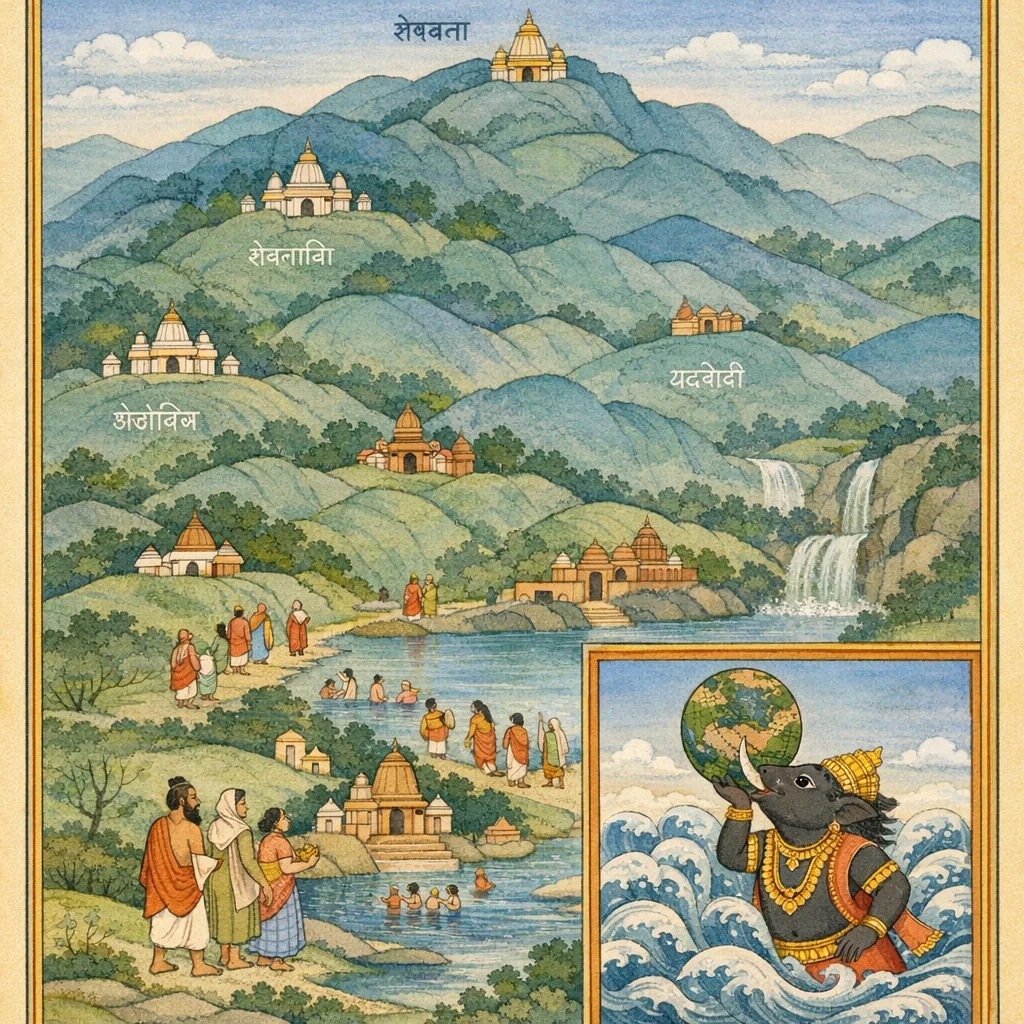
Answering the maiden’s questions about why Śrīnivāsa abides there, when Śeṣācala descended, and how Svāmipuṣkariṇī arose, Jaigīṣavya opens with a cosmic prelude: Hiraṇyākṣa’s fierce tapas, his mother Diti’s attachment, and the teaching that Hari alone is the true protector. Granted boons by Brahmā, Hiraṇyākṣa seizes the Earth; Viṣṇu manifests as Varāha at Śrīmuṣṭa, rescues and steadies the Earth, and then resolves to maintain a compassionate, human-facing presence for beings. From Vaikuṇṭha the Lord brings down Śeṣa, establishes the sacred mountain-range, marks its divisions (Śrīśaila, Ahobila, Śrīnīvāsa-kṣetra), and explains its many names (Puṣkarādri, Kanakādri, Vaikuṇṭhādri, Vyaṅkaṭādri). The teaching then exalts Svāmipuṣkariṇī as the supreme tīrtha containing all tīrthas, while insisting that liberation ripens through sat-saṅga and jñāna, not mere bathing. A detailed pilgrimage map follows—Vāyu, Candra, Raudra, Brahma, Indra, Vahni, Yama, Nairṛta, Śeṣa, and Vāruṇa tīrthas—each with bathing rules, purity injunctions, and rare Śālagrāma/mūrti-dānas with identifying marks. The chapter ends with the maiden’s disciplined bathing and charity at Svāmipuṣkariṇī and a phala-śruti promising bhakti to Śrīnivāsa through hearing this māhātmya, preparing for further tīrtha instructions and the continuing sacred geography of Veṅkaṭeśa.
Shlokas
Verse 1
नाम पञ्चविंशोध्यायः कन्योवाच / श्रीनिवासः किमर्थं वै आगतोत्र वदस्व मे / शेषाचलोपि कुत्रा भूत्कदायातश्च पापहा / स्वामिपुष्करिणी चात्र किमर्थं ह्यगता वद
The maiden said: “Tell me—why has Śrīnivāsa come here? And where was Śeṣācala before, and when did that sin-destroyer arrive? Also, for what reason has Svāmipuṣkariṇī come to be here? Tell me.”
Verse 2
जैगीषव्य उवाच शृणु भद्रे महाभागे व्यङ्कटेशस्य चागमम् / आवयोर्देवि पापानि विषमं यान्ति भामिनि
Jaigīṣavya said: “Listen, O blessed and noble lady, to the sacred account of Vyaṅkaṭeśa’s coming. O Goddess—O radiant one—when this is heard, our sins melt away and are driven into distress.”
Verse 3
आसीत्पुरा हिरण्याक्षः काश्यपो दितिनन्दनः / सनकादेश्च वाग्दण्डाद्द्वितीयद्वारपालकः
Formerly there was Hiraṇyākṣa—the son of Kaśyapa, beloved of Diti—who, due to the spoken curse of Sanaka and the other sages, became the second gatekeeper.
Verse 4
बभूव दैत्ययोनौ च देवानां कण्टको बली / संजीवो विजयः प्रोक्तो हरिभक्तो महाप्रभुः
He was born in a Daitya lineage and became a powerful thorn to the gods. He is said to be Saṃjīva, also called Vijaya—a great-souled, mighty devotee of Hari.
Verse 5
हरिण्याक्षः स्वयं दैत्यो हरिभक्तविदूषकः / एतादृशो हिरण्याक्षस्तपस्तप्तुं समुद्यतः
Hiraṇyākṣa—himself a Daitya—mocked and derided the devotees of Hari; such was Hiraṇyākṣa as he set out, resolved to perform severe austerities (tapas).
Verse 6
तदा माता दितिर्देवी हिरण्याक्षमुवाच सा / दितिरुवाच / वत्सलस्त्वं महाभागमा तपस्वाष्टहायनः
Then the goddess Diti, his mother, spoke to Hiraṇyākṣa. Diti said: “Beloved child, O greatly fortunate one—do not undertake austerities, for you are only eight years of age.”
Verse 7
त्वं मा ददस्व दुः खं मे पालयिष्यति कोविदः / क्षणमात्रं न जीवामि त्वां विना जीवनं न हि
Do not give me sorrow—you alone, O wise one, will protect me. I cannot live even for a moment without you; truly, without you there is no life for me.
Verse 8
मा तप त्वं महाभाग मम जीवनहेतवे / एवमुक्तस्तु मात्रा स विजयोवशतोब्रवीत्
“Do not grieve, O noble one, for the sake of my life.” Thus addressed by his mother, Vijaya—overcome by emotion—spoke.
Verse 9
हिरण्याक्षो मातरं प्राह जालं हित्वा विष्णोर्भजने ऽलं कुरुष्व / मयिस्नेहं पुत्रहेतोर्विरूढं सुखदुः खे चेह लोके परत्र
Hiraṇyākṣa said to his mother: “Abandon this worldly snare and devote yourself wholly to the worship (bhajana) of Viṣṇu. The affection that has grown in you toward me merely because I am your son—know that happiness and sorrow arise both here in this world and in the world beyond.”
Verse 10
यावत्स्नेहं मयि मातः करोषि तावत्क्लेशं शाश्वतं यास्यसि त्वम् / मातश्च ते मयि पुत्रत्वबुद्धिस्त्वय्यप्येषा मातृबुद्धिर्ममापि
So long as you cherish attachment toward me, O Mother, you will go to unending sorrow. O Mother, in you there is the notion that I am your son; and in me too there is this notion that you are my mother.
Verse 11
ताते पूज्ये पितृबुद्धिर्ममास्ति तस्मिंस्तुते भर्तृबुद्धिर्हि मिथ्या / निर्माति यस्माद्धरिरेव सर्वं सम्यक् पाता नियतो ऽसौ मुरारिः
O revered father, toward you I bear the feeling of a child toward her father; but to regard you as my husband is truly mistaken. For Hari alone creates all things, and that Murāri is surely the true and unfailing Protector.
Verse 12
अतो हि माता हरिरेव सर्वदा त्वन्यासां वै मातृता चोपचारात् / निर्मातृत्वं यदि मुख्यं त्वयि स्याद्द्रोणादीनां जननी का वदस्व
Therefore Hari alone is ever the true Mother; the ‘motherhood’ of other women is only figurative, upheld by convention. If actual production were the chief criterion in you, then tell me—who would be the mother of Droṇa and the rest?
Verse 13
मातृत्वं वै यदि मुख्यं त्वयि स्याद्धात्रादीनां जननी का वदस्व / यतः सदा याति जगत्तत्तो हरिः सदा पिता विष्णुरजः पुराणः
If motherhood were truly the primary principle in you, then tell me—who would be the mother of Dhātṛ the creator and the other gods? Since the whole universe ever proceeds from Him, therefore Hari—Viṣṇu, the unborn and ancient one—is forever the Father.
Verse 14
सदा पिता मुख्यपिता यदि स्याद्गर्भस्थबाले पालकः को वदस्व / मातापित्रोः पालकत्वं यदि स्यात्कूर्मादीनां पालकौ कौ वदस्व
If the father alone is always to be regarded as the primary parent, then tell me—who protects the child while it remains in the womb? And if both mother and father are indeed protectors, then tell me—who are the protectors of creatures such as tortoises and the like?
Verse 15
मातापित्रोः पालकत्वं यदि स्यात्कृपादीनां रक्षकौ कौ वदस्व / पुन्नामकान्नारकाद्देह भजान्तस्मात्त्रातापुत्रविष्णुः पुराणः
If the protection of one’s mother and father is indeed a duty, then tell me—who will protect the helpless and the rest? Since a son delivers his father from the hell called ‘Puṇ’, he is therefore called ‘putra’, the savior; and the ancient Viṣṇu is the supreme Deliverer.
Verse 16
न तारकोहं नरकाच्च सुभ्रूर्न वै भर्ता नापि पित्रादयश्च / न वै माता नानुजादिश्च सर्वः सर्वत्राता विष्णुरतो न चान्यः
O fair-browed one, I am not the deliverer from hell; nor are wife or husband, nor fathers and other kin. Neither mother, nor younger brother and the rest—no one at all is the rescuer everywhere. Vishnu alone is the universal protector; there is no other.
Verse 17
मायां मदीयां ज्ञानशस्त्रेण च्छित्वा भक्त्या हरेः स्मरणं त्वं कुरुष्व / यद्भक्तिरूपूर्वं स्मरणं नाम विष्णोस्तत्सर्वथा पापहरं च मातः
Cut through My own māyā with the weapon of knowledge, and practice the devotional remembrance of Hari. For the remembrance of Viṣṇu’s name—preceded and shaped by bhakti—is in every way a remover of sins, O Mother.
Verse 18
यो वा भक्त्या स्मरणं नाम विष्णोः करोत्यसौ पापहरो भविष्यति / अयं देहो दुर्ल्लभः कर्मभूमौ तत्रापि मध्ये भजनं विष्णुमूर्तेः
Whoever, with devotion, remembers the name of Viṣṇu—such a person will become a remover of sins. This human body is hard to obtain in the field of action (the mortal world); and even within it, rare indeed is devotion to the form of Viṣṇu.
Verse 19
आयुर्गतं व्यर्थमेव त्वदीयं शीघ्रं भजेः श्रीनिवासस्य पादम् / उपदिश्यैवं मातरं पुत्रवर्यो दैत्यावेशात्सोभवद्वै तपस्वी
“Your lifetime is passing away in vain. Quickly take refuge at the feet of Śrīnivāsa (Viṣṇu).” Having thus instructed his mother, that excellent son—through the overpowering influence of a daitya (demonic force/possession)—indeed became an ascetic.
Verse 20
चतुर्मुखं प्रीणयित्वैव भक्त्या ह्यवध्यत्वं प्राप तस्मान्महात्मा / ततो भूमिं करवद्वेष्टयित्वा निन्ये तदा दैत्यवर्यो महात्मा
Having pleased the four-faced Brahmā through devotion, that great-souled one obtained invulnerability from him. Then, the foremost of the Dānavas, that great being, wrapped the earth up like something held in the palm of the hand and carried it away.
Verse 21
श्रीमुष्टदेशे प्रादुरासीद्धरिस्तु वाराहविष्णुस्त्वजनः पुराणः / भित्त्वाचाब्धिं विविशे तं महात्मा रसातले संस्थितं भूतलं च
In the land called Śrīmuṣṭa, Hari—the primeval, unborn Viṣṇu in the form of Varāha, the Boar—manifested. Splitting the ocean, that great-souled One entered Rasātala, the nether realm, and raised up the Earth that had been stationed there.
Verse 22
स्वदंष्ट्राग्रे स्थापयित्वाऽजगाम तदागमादागतो दैत्यवर्यः / तं कर्णमूले ताडयित्वा जघान प्रसादयामास च पूर्ववद्भुवम्
Placing the Earth upon the tip of his own tusk, he departed. As he went, the foremost of the Daityas arrived; though struck at the root of the ear, he slew that foe, and then soothed the Earth again, restoring her as before.
Verse 23
सुदिग्गजान्स्थापयित्वा च विष्णुः श्रीमुष्टे वै संस्थितः श्रीवराहः / तदा हरिश्चिन्तयामास विष्णुर्भक्त्या मदीयं मानुषं देहमद्य
Having established the noble elephants of the directions, Viṣṇu—Śrī Varāha—stood firm at Śrīmuṣṭi. Then Hari, Viṣṇu, reflected in devotion: “Today, let my human body—my incarnation—be manifested.”
Verse 24
आराधयिष्यन्ति च मां क्व एते तेषां दयां कुत्र वाहं करिष्ये / एवं हरिश्चिन्तयित्वा सुकन्ये वैकुण्ठलोकादचलं शेष संज्ञम् / वीन्द्रस्कन्धे स्थापयित्वा स्वयं च समागतोभूद्भूतलं भूतलेशः
“Where will these beings worship me, and where shall I show them compassion?” Thus, O fair maiden, Hari reflected; then from Vaikuṇṭha he brought down the immovable one called Śeṣa, set him upon Vīndra’s shoulder, and the Lord of the earth himself came to the earthly realm.
Verse 25
सुवर्णमुखरीतीरमारभ्य गरुडध्वजः / श्रीकृष्णवेणीपर्यन्तं स्थापया मास तं गिरिम्
From the bank of Suvarṇamukharī up to Śrīkṛṣṇaveṇī, Garuḍadhvaja—the Lord whose banner is Garuḍa—caused that mountain to be firmly established.
Verse 26
गिरेः पुच्छे तु श्रीशैलं मध्यमे ऽहोबलं स्मृतम् / मुखं च श्रीनिवासस्य क्षेत्रं च समुदाहृतम्
At the mountain’s tail lies Śrīśaila; in its middle, Ahobila is remembered. At its mouth is the sacred kṣetra of Śrīnīvāsa—so it is proclaimed.
Verse 27
अल्पेन तपसाभीष्टं सिध्यत्यस्मिन्नहोबले / गङ्गादिसर्वतीर्थानि पुण्यानि ह्यत्र संति वै
In this holy Ahobala, even a small measure of tapas brings one’s desired aim to fulfillment; for here indeed abide all sacred tīrthas, beginning with the Gaṅgā, rich in merit.
Verse 28
य एनं सेवते नित्यं श्रद्धाभक्तिसमन्वितः / ज्ञानार्थी ज्ञानमाप्नोति द्रव्यार्थी द्रव्यमाप्रुयात्
Whoever serves this daily, endowed with faith (śraddhā) and devotion (bhakti)—the seeker of knowledge attains knowledge, and the seeker of wealth obtains wealth.
Verse 29
पुत्रार्थी पुत्रमाप्नोति नृपो राज्यं च विन्दति / यंयं कामयते मर्त्यस्तन्तमाप्नोति सर्वथा
One who longs for a son attains a son; a king obtains a kingdom. Whatever a mortal desires, that very thing he surely attains in every way.
Verse 30
चिन्तितं साध्यते यस्मात्तस्माच्चिन्तामणिं विदुः / पुष्करिण्याश्च बाहुल्याद्गिरावस्मिन्सरः सु च / पुष्कराद्रिरिति प्राहुरेवं तत्त्वार्थवेदिनः
Because whatever is contemplated there is brought to accomplishment, the wise therefore know it as Cintāmaṇi, the wish-fulfilling jewel. And because this mountain abounds in lotus-ponds—indeed a beautiful lake is here—the knowers of truth declare it to be called Puṣkarādri, the Lotus Mountain.
Verse 31
शातकुंभस्वरूपत्वात्कनकाद्रिं च तं विदुः / वैकुण्ठादागतेनैव वैकुण्ठाद्रिरिति स्मृतः
Because it is of the nature of śātakuṃbha (pure gold), they know it as Kanakādri, the Golden Mountain. And since it has come from Vaikuṇṭha, it is remembered as Vaikuṇṭhādri, the Mountain of Vaikuṇṭha.
Verse 32
अमृतैश्वर्यसंयुक्तो व्यङ्कटाद्रिरिति स्मृतः / व्यङ्कटेशस्य शैलस्य माहात्म्यं यावदस्ति हि
Endowed with nectar-like (deathless) prosperity and divine lordship, it is remembered as Vyaṅkaṭādri. Indeed, so long as the greatness of Vyaṅkaṭeśa’s mountain endures, this name and glory remain.
Verse 33
तावद्वक्तुं समग्रेण न समर्थश्चतुर्मुखः / व्यङ्कटाद्रौ परां भक्तिं ये कुर्वन्ति दिनेदिने / पङ्गर्जङ्घाल एव स्यादचक्षुः पद्मलोचनः
Even the four-faced Brahmā is not capable of describing it in full. Those who, day after day, practice supreme devotion on Veṅkaṭādri (Tirumala)—to praise them adequately, even the lotus-eyed Lord would become as if lame and without sight.
Verse 34
मूको वाग्मी भवेदेव बधिरः श्रावको भवेत् / वन्ध्या स्याद्बहुपुत्रा च निर्धनः सधनो भवेत्
Indeed, one who is mute becomes eloquent; one who is deaf becomes a keen hearer; a barren woman becomes blessed with many sons; and a poor person becomes wealthy.
Verse 35
एतत्सर्वं गिरौ भक्तिमात्रेणैव भवेद्ध्रुवम् / तत्त्वतो व्यङ्कटाद्रेस्तु स्वरूपं वेत्ति को भुवि
All this indeed becomes certainly attainable on the sacred mountain through devotion alone. But who on earth can truly know, in its real essence, the nature of Lord Veṅkaṭādri?
Verse 36
यस्मादस्य गिरेः पुण्यं माहात्म्यं वेत्ति यः पुमान् / मायावी परमानन्दं त्यक्त्वा वैकुण्ठमुत्तमम् / स्वामिपुष्करिणीतीरे रमया सहमोदते
Whoever knows the holy glory of this mountain—its sacred greatness—knows that the wondrous Lord, even abandoning the supreme Vaikuṇṭha of highest bliss, delights with Ramā (Lakṣmī) upon the bank of the Lord’s sacred lake, Svāmipuṣkariṇī.
Verse 37
कल्याणाद्भुतगात्राय कामितार्थप्दायिने / श्रीमद्व्यङ्कटनाथाय श्रीनिवासाय ते नमः
Salutations to You—Śrī Vyaṅkaṭanātha, Śrīnivāsa—whose form is auspicious and wondrous, and who bestows upon devotees the aims they desire.
Verse 38
श्रीस्वामिपुष्करिण्याश्च माहात्म्यं शृणु कन्यके / स्वामिपुष्करिणीमध्ये श्रीनिवासोस्ति सर्वदा
O maiden, listen to the sacred greatness of the holy Svāmi Puṣkariṇī. In the very midst of Svāmi Puṣkariṇī, Śrīnivāsa (Lord Viṣṇu) abides at all times.
Verse 39
स्नानं कुर्वन्ति ये तत्र तेषां मुक्तिः करे स्थिता / तिस्रः कोट्योर्धकोटिश्च तीर्थानि भुवनत्रये / तानि सर्वाणि तत्रैव संति तीर्थे हरेः सदा
Those who bathe there have liberation (mukti) held, as it were, in the palm of their hand. In the three worlds there are three and a half crores of sacred pilgrimage-places; all of them are eternally present right there, in that holy tīrtha of Hari (Viṣṇu).
Verse 40
तत्तीर्थं श्रीनिवासाख्यं सर्वदेवनमस्कृतम् / तदेव श्रीनिवासस्य मन्दिरं परिकीर्तितम्
That holy tīrtha is called Śrīnivāsa and is revered by all the gods; and that very place is also celebrated as the temple of Śrīnivāsa.
Verse 41
तद्दर्शनादेव कन्ये यान्ति पापानि भस्मसात् / एकैकस्नानमात्रेण सत्संगो भवति ध्रुवम्
O maiden, merely by beholding that sacred presence, sins are reduced to ashes. By even a single bath there, one surely attains satsanga—the company of the virtuous.
Verse 42
सत्संगाज्ज्ञानमासाद्य ज्ञानान्मोक्षं च विन्दति / अधिकारिणां भवेदेवं विपरीतमयोगिनाम्
Through satsanga one attains true knowledge, and from that knowledge one gains moksha, liberation. Thus it is for qualified seekers; for the undisciplined, unyoked to yoga, the result is the opposite.
Verse 43
तीर्थानां स्नानमात्रेण मोक्षं यान्तीति ये विदुः / ते सर्वे असुरा ज्ञेयास्ते यान्ति ह्यधमां गतिम्
Those who believe that liberation is attained merely by bathing at tīrthas, sacred pilgrimage sites, should be known as asuric in outlook; indeed, they go to a lower destiny.
Verse 44
श्रीनिवासस्य तीर्थेस्मिन्वायुकोणे च कन्यके / आस्ते वायुः सदा विष्णोः पूजां कर्तुमनुत्तमाम्
At this sacred tīrtha of Śrīnivāsa, in the wind-corner (southwest) at Kanyāka, Vāyu ever abides, performing the unsurpassed worship of Lord Viṣṇu.
Verse 45
वायुतीर्थं च तत्प्रोक्तं हस्तद्वादशकान्तरम् / हस्तषट्कप्रमाणं च पश्चिमे समुदाहृतम् / उत्तरे हस्तषट्कं तु वायुतीर्थमुदाहृतम्
That place is declared to be the Vāyu-tīrtha, with an interval of twelve hastas (hand-lengths). On the western side its extent is said to be six hastas, and on the northern side too, six hastas are described as the Vāyu-tīrtha.
Verse 46
ये वेष्णवा वैष्णवदासवर्याः स्नानं सुर्युस्तत्र पूर्वं सुकन्ये / मध्वान्तस्थाः श्रीनिवासस्तु नित्यमत्र स्नानात्प्रीयतां मे दयालुः
O virtuous maiden, those devotees—foremost among the servants of the Vaiṣṇavas—first bathe there at sunrise. In that sacred region Śrīnivāsa (Viṣṇu) abides eternally; may that compassionate Lord be pleased with me through this bathing.
Verse 47
ये मध्वतीर्थे स्नातुमिच्छन्ति देवि रुद्रादयो वायुभक्ता महान्तः / सदा स्नानं तत्र कुर्वन्ति देवि प्रातः काले चोदयात्पूर्वमेव
O Goddess, those great beings—Rudra and others—who subsist on the life-breath (vāyu) long to bathe at the Madhva Tīrtha. O Goddess, they always perform their bathing there in the early morning, even before sunrise.
Verse 48
ये वायुतीर्थे विसृजन्ति देहजं मलं मूत्रं वमनं श्लेष्मकं च / ये ऽपानशुद्धिं लिङ्गशुद्धिं च कन्ये कुर्वन्ति ते ह्यसुरा राक्षसाश्च
Those who, at the sacred Vāyu-tīrtha, discharge bodily filth—feces, urine, vomit, and phlegm—and those who cleanse the anus and the genitals there, O maiden, are indeed to be regarded as asuras and rākṣasas.
Verse 49
शृण्वन्ति ये भागवतं पुराणं किं वर्णये तस्य पुण्यं तु देवि / ये कृष्णमन्त्रं तु जपन्ति देवि ह्यष्टा क्षरं मन्त्रवरं सुगोप्यम्
O Goddess, how can I describe the merit of those who listen to the Bhāgavata Purāṇa? And O Goddess, those who repeat the Kṛṣṇa-mantra—this supremely excellent, well-guarded eight-syllabled mantra—attain extraordinary spiritual merit.
Verse 50
तेषां हरिः प्रीयते केशवोलं मध्वान्तस्थो नात्र विचार्यमस्ति / एवं दानं तत्र कुर्वन्ति ये वै द्विजाग्र्याणां वैष्णवानां विदां च
Hari—Keshava Himself—becomes pleased with them; He abides in the very essence of sweetness (madhu), so there is no doubt. Therefore, those who give charity there in this manner—especially to the foremost of the twice-born, to Vaiṣṇavas, and to the learned—truly perform the proper gift.
Verse 51
तेषां पुण्यं नैव जानन्ति देवा जानात्येवं श्रीनिवासो हरिस्तु / शालग्रामं वायुतीर्थे ददन्ते तेषां पुण्यं वेत्ति स व्यङ्कटेशः
Even the gods do not truly know the full merit of those devotees; only Hari—Śrīnivāsa—knows it thus. Those who offer a Śālagrāma at Vāyu-tīrtha—their merit is known in fullness by that Lord Vyaṅkaṭeśa.
Verse 52
सुदुर्लभो वायुतीर्थे ऽभिषेको निष्कामबुद्ध्या वैष्णवानां च देवि / तत्रापि तीर्थे लभ्यते भाग्ययोगाद्भागवतस्य श्रवणं विष्णुदासैः
O Goddess, it is exceedingly rare to obtain the abhiṣeka—sacred bathing—at Vāyu-tīrtha with a desireless mind, in the company of Vaiṣṇavas. Even there, by the joining of good fortune, one gains the hearing of the Bhāgavata from the servants of Lord Viṣṇu.
Verse 53
तथैव तीर्थे दुर्लभं तत्र देवि शालग्रामस्य द्विजवर्ये च दानम् / जंबूफलाकारसुनीलवर्णं मुखद्वयं चक्रचतुष्टयान्वितम्
Likewise, O Goddess, at a sacred pilgrimage place it is rare indeed to obtain the gifting of a Śālagrāma to an excellent Brāhmaṇa. It is described as shaped like a jambu fruit, deep blue in color, having two faces, and marked with four discus-emblems.
Verse 54
सुकेसरैः संयुतं स्वर्णचिह्नध्वजां कुशैर्वज्रचिह्नैर्यवैश्च / जानार्दनीं मूर्तिमाहुर्महान्तो दानं तस्या दुर्लभं तत्र तीर्थे
The great sages declare that, in that tīrtha, there is an image of Janārdana—adorned with fine hair, bearing a banner marked with golden emblems, and associated with kuśa grass, barley-grains (yava), and signs like the vajra. In that tīrtha, the offering (dāna) made to that form is exceedingly rare.
Verse 55
अत्युत्तमं मूर्तिदानं तु भद्रे सुदुर्ल्लभं परमं नात्र लोभः / सुदुर्लभं बहुदोग्ध्याश्च गृष्टेर्दानं तथा वस्त्ररत्नादिकानाम्
O noble one, the gift of a mūrti—a consecrated icon—is supremely excellent and exceedingly rare; let there be no greed in this matter. Rare too are the gifts of a cow that yields abundant milk and of a first-calved cow, and likewise the gifting of garments, jewels, and other precious goods.
Verse 56
अत्युत्तमं द्रव्यदानं च देवि स्वापेक्षितं दानमाहुर्महान्तः / स्वस्यानपेक्षं फलदानं च वस्त्रादानं तस्य व्यर्थमाहुर्महान्तः
O Goddess, the wise declare that the giving of wealth is the highest charity; and even a gift offered with expectation of return or recognition is still called “giving.” But if one offers fruits or garments while inwardly hoping for one’s own reward, the wise say that such giving becomes fruitless.
Verse 57
अत्युत्तमं गृष्टिदानं च पुण्यं नैवाप्यते दुग्धदोहाश्च गावः / अत्युत्तमे वस्त्रदाने सुबुद्धिः सुदुर्घटा परमा वै जनानाम्
The gifting of a gṛṣṭi cow is supremely excellent and highly meritorious, for cows that yield abundant milk are not easily obtained. Likewise, the resolve to give the very best clothing is rare among people; such highest good sense is exceedingly hard to find.
Verse 58
अत्युत्तमं भागवतस्य पुस्तकं सुदुर्घटं वायुतीर्थं च कन्ये / अत्युत्तमं द्रव्यदानं च देवि सुदुर्घटं वायुतीर्थं नृणां हि / सुदुर्लभो वैष्णवैस्तत्त्वविद्भिर्हरेर्विचारो वायुतीर्थे च कन्ये
O maiden, the Bhāgavata scripture is supremely excellent; and so too is the Vāyu-tīrtha, though it is very difficult to attain. O Goddess, the gift of wealth is supremely excellent; indeed, for people the Vāyu-tīrtha is hard to reach. And rare among truth-knowing Vaiṣṇavas is deep contemplation on Hari—especially at the Vāyu-tīrtha, O maiden.
Verse 59
श्रीनिवासस्य तीर्थस्य उत्तरस्यां दिशि स्थितम् / चन्द्रतीर्थ मिति प्रोक्तं तत्रास्ते चन्द्रमाः सदा
To the north of the sacred ford of Śrīnivāsa lies a place known as Candratīrtha; there the Moon (Candramā) ever abides.
Verse 60
श्रीनिवासस्य पूजां च तत्र स्थित्वा करोत्ययम् / तत्र स्नानं प्रकुर्वन्ति पुण्यदेशे च कन्यके
Remaining there, he performs worship of Śrīnivāsa. And there, O maiden, people undertake ritual bathing in that sacred, meritorious place.
Verse 61
गुरुतल्पादिपापेभ्यो मुच्यन्ते नात्र संशयः / तत्र स्नात्वा पूर्वभागे शालग्रामं ददाति यः
They are freed from sins such as violating the teacher’s bed (and other grave offenses)—of this there is no doubt. Whoever bathes there and, in the eastern part, gives a Śālagrāma as a sacred gift (dāna) attains that release.
Verse 62
ज्ञानद्वारा मोक्षमेति नात्र कार्या विचारणा / दधिवामनमूर्तेश्च दानं तत्र सुदुर्लभम्
Through the gateway of true knowledge one attains liberation (mokṣa)—there is no need for doubt about this. Yet the dāna offered there to the form known as Dadhivāmana is exceedingly rare.
Verse 63
बदरीफलमात्रं तु वतुलं नीलवर्णकम् / प्रसन्नवदनं सूक्ष्मं सुस्निग्धं कन्यके शुभे
O auspicious maiden, it is only the size of a badarī (jujube) fruit—round, bluish in color; with a serene face, subtle in form, and smooth and lustrous.
Verse 64
चक्रद्वयसमायुक्तं गौपूरैः पञ्चभिर्युतम् / चापबाणसमायुक्तमनतं कुण्डलाकृतिम्
It is furnished with a pair of wheels (cakra), joined with five supports called gaupūra, and equipped with bow and arrows; it is unbending and shaped like an earring, ring-like in form.
Verse 65
वनमाल सुखयुतं मूर्ध्नसाहस्रसंयुतम् / रौप्यबिन्दुसमायुक्तं सव्ये भद्रार्धमात्रकम्
Wearing the forest-garland (vanamālā) that brings delight, and bearing upon the head the mark associated with thousandfold splendour, it is adorned with silvery dots—on the left side there is an auspicious sign measuring half an ārdha.
Verse 66
चन्द्रेण सहितं देवि दधिवामनमुच्यते / एतादृशं कलौ नॄणां दुर्लभं बहुभाग्यदम् / लक्ष्मीनारायणसमां तां मूर्तिं विद्धि भामिनि
O Goddess, that form—accompanied by the Moon—is called Dadhivāmana. In the Kali age, such a vision is rare for people and bestows great good fortune. Know, O lovely one, that image to be equal to Lakṣmī and Nārāyaṇa themselves.
Verse 67
सुदुर्लभं तस्य मूर्तेश्च दानं तच्चन्द्रतीर्थे श्रवणं दुर्घटं च / सम्यक् स्वरूपं दधिवामनस्य सुदुर्घटं श्रवणं वैष्णवाच्च
Rare indeed is the dāna, the gift offered to that sacred form; and rare, too, is the hearing of it at Candratīrtha. Likewise, it is very difficult to hear correctly the true nature of Dadhivāmana—difficult even to obtain from a Vaiṣṇava devotee.
Verse 68
तत्र स्नात्वा वामनस्य स्वरूपश्रवणाद्विदुर्दानफलं समं च / दशहस्तप्रमाणं तु चन्द्रतीर्थमुदाहृतम्
Having bathed there, and by hearing of Vāmana’s divine form, the wise declare that one gains merit equal to that obtained by charitable giving. That sacred ford is called Candra-tīrtha, and it is said to extend ten hand-lengths in measure.
Verse 69
मध्याह्ने दुर्लभं स्नानं नृणां तत्र सुमङ्गले / तत्र स्थित्वा धन्यनरः सदा भजति वै हरिम्
At midday, bathing there is rare for ordinary people—yet that place is most auspicious. Remaining there, the blessed person continually worships Hari (Vishnu) indeed.
Verse 70
वराहमूर्तिदानं तु शालग्रामस्य दुर्लभम् / जंबूफलप्रमाणं तु एतद्वै कुक्कुटाण्डवत्
But the gifting of a Śālagrāma in the form of the Boar-incarnation (Varāha) is rare. Its size is said to be like a jambū fruit—indeed, comparable to a hen’s egg.
Verse 71
वदनं वलयाकारं प्रमाणं चणकादिवत् / देवस्य वामभागे च मध्यदेशं विहाय च
The face should be fashioned in a circular, ring-like form, its measure taken to be like a chickpea and the like; and it should be set upon the deity’s left side, leaving the central region aside.
Verse 72
चक्रद्वयसमायुक्तंमूर्धदेशे च भामिनि / सुवर्णबिन्दुना युक्तं भूवराहाख्यमुच्यते
O lovely one, that sign which bears a pair of wheel-marks upon the region of the head and is accompanied by a golden dot is said to be known as the ‘Bhū‑Varāha’ mark.
Verse 73
पूजां कृत्वा भूवराहस्य मर्तेर्दानं दत्त्वा श्रवणं चापि कृत्वा / तत्र स्थितं भूवराहं च दृष्ट्वा स वै नरः कृतकृत्यो हि लोके
Having worshiped Bhū‑Varāha, having given charity at the sacred ford (tīrtha), and having listened as well to the holy recitation, and then beholding Bhū‑Varāha abiding there—such a man indeed becomes, in this world, one whose life’s purpose is fulfilled.
Verse 74
तत्र स्नात्वा भूवराहस्य मर्तेः शृणोति यो लक्षणं सम्यगेव / स तेन पुण्यं समुपैति देवि स मुक्तिभाङ् नात्र विचार्यमस्ति
O Goddess, whoever bathes there and then properly listens to the true account of the sacred marks of Bhū‑Varāha’s holy place attains merit by that act; such a one becomes entitled to liberation (mokṣa)—of this there is no doubt.
Verse 75
ईशानकोणे श्रीनिवासस्य देवि रौद्रं तीर्थं परमं पावनं च / तत्र स्थित्वा रुद्रदेवो महात्मा पूजां करोति श्रीनिवासस्य नित्यम्
O Goddess, in the north‑eastern quarter of Śrīnivāsa there is the Raudra tīrtha, supreme and purifying. Abiding there, the great-souled Lord Rudra continually performs worship of Śrīnivāsa.
Verse 77
हस्ताष्टकं तत्प्रमाणं वदन्ति तत्र स्नानं वैष्णवैः कार्यमेव / तत्र स्नात्वा प्रयतो वै मुरारेः कथां दिव्यां शृणुयादादरेण / स्नानं पानं तत्र दानं च कुर्याल्लक्ष्मीनृसिंहप्रीयते देवि नित्यम्३,२६।७६ // बदरीफलमात्रं च वर्तुलं बिन्दुसंयुतम्
They declare its measure to be eight hands; there the Vaiṣṇavas must surely perform the sacred bath. Having bathed there with self-restraint, one should reverently hear the divine narration of Murāri (Viṣṇu). There one should bathe, drink the holy water, and also give in charity; O Goddess, Lakṣmī‑Nṛsiṃha is ever pleased. (The next line begins:) “Of the size of a badarī fruit, round, and marked with a dot…”
Verse 78
देवस्य वामभागे तु चक्रद्वयसमन्वितम् / सुवर्णरेखासंयुक्तं किञ्चिद्रक्तसमन्वितम्
On the deity’s left side is a mark bearing two discs (chakras), joined by golden lines and tinged with a slight redness.
Verse 79
वैश्यवर्णं सवदनं पद्मरेखादिचिह्नितम् / लक्ष्मीनृसिंहं तं विद्धि भुक्तिमुक्तिप्रदायकम्
Know that form—of Vaiśya hue, with a benign face, marked with lotus-lines and other auspicious signs—to be Lakṣmī‑Nṛsiṃha, the bestower of both worldly enjoyment and liberation.
Verse 80
एता दृशं गण्डिकायाः शिलाया मूर्तेर्दानं दुर्घटं विद्धि वीन्द्र / तत्र स्नात्वा श्रीनृसिंहस्वरूपं लक्ष्मीपतेः शृणुयाद्भक्तियुक्तः
O best of kings, know that the gifting of an idol-form (mūrti) carved from such a Gaṇḍikā stone is difficult to accomplish. Having bathed there, one endowed with devotion should listen to the glory and account of the auspicious Śrī Nṛsiṃha form of Lakṣmī’s Lord (Viṣṇu).
Verse 81
मूर्तेर्दानात्फलमाप्नोति देवि सत्यंसत्यं नात्र विचार्यमस्ति
O Goddess, by donating a consecrated image one indeed obtains its fruit—true, true; there is no need for doubt or debate about it.
Verse 82
ईशानशक्रयोर्मध्ये ब्रह्मतीर्थमुदाहृतम् / दुर्लभं मानुषाणां तु स्नानं सर्वार्थसाधकम्
Between Īśāna and Śakra lies the sacred ford called Brahma-tīrtha. For human beings, bathing there is rare to obtain, yet it is said to accomplish every worthy aim.
Verse 83
शालग्रामस्य दानं तु दुर्लभं तत्र वै नृणाम् / लक्ष्मीनारायणस्यैव मूर्तेर्दानं सुदुर्लभम्
For people, the gift of a Śālagrāma is indeed rare; rarer still is the gifting of an image (mūrti) of Lakṣmī-Nārāyaṇa.
Verse 84
स्थलमौदुंबरसमं तत्प्रमाणमुदाहृतम् / छत्त्राकारं वर्तुलं च प्रसन्नवदनं शुभम्
Its measure is declared to be equal to the span of an udumbara-wood site; it should be umbrella-shaped and circular, with a serene face—auspicious in every way.
Verse 85
चणकप्रदेशमात्रं च वदनं समुदाहृतम् / सव्ये दक्षिणपार्श्वे च समयोः पुष्कलान्वितम्
The face is said to be only the size of a chickpea’s measure; and on the left and the right sides alike, it is endowed with full symmetry and completeness.
Verse 86
गोयूथवत्सवर्णं च चतुश्चक्रसमन्वितम् / गोखुरैश्च समायुक्तं सुवर्णकिणसंयुतम्
It is of the color of a herd of cows, furnished with four wheels, fitted with (ornaments shaped like) cow-hooves, and adorned with golden studs and fittings.
Verse 87
वनमालाभिसंयुक्तं वज्रपुङ्खैश्च संयुतम् / एतादृशीं दरेर्मूर्ति लक्ष्मीनारायणं विदुः
Adorned with a garland of forest-flowers and furnished with ornaments hard as the vajra, such a form is known as Lakṣmī-Nārāyaṇa.
Verse 88
कलौ नृणां तस्य लाभो दुर्लभः संस्मृतो भुवि / दानं च सुतरां देवि दर्लभं किं वदामि ते
In the Kali age, for human beings, the attainment of that merit is remembered to be hard to gain on earth. And charity, O Goddess, is harder still—what more can I say to you?
Verse 89
ब्रह्मतीर्थे च संस्नाय श्रोतव्या वै हरेः कथा / गण्डिकायाः शिलायाश्च लक्ष्मीनारायणस्य तु
Having bathed at the Brahma-tīrtha, one should indeed listen to the sacred narrative of Hari—especially in connection with the Gaṇḍikā and the holy stone (śilā) of Lakṣmī-Nārāyaṇa.
Verse 90
लक्षणं यो विजानाति तदा तत्सदृशं फलम् / प्राप्नोत्येव न संदेहो नात्र कार्या विचारणा
Whoever understands the true distinguishing marks obtains a result corresponding to that; of this there is no doubt—no further deliberation is needed here.
Verse 91
श्रीनिवासस्य तीर्थस्य पूर्वे स्यादिन्द्रतीर्थकम् / श्रीनिवासस्य पूजां तु कर्तुमास्ते शचीपतिः
To the east of the sacred tīrtha of Śrīnivāsa lies the holy place known as Indra-tīrtha; there Indra, lord of Śacī, remains present to perform worship of Śrīnivāsa.
Verse 92
शालग्रामशिलादानं कर्तव्यं श्रोत्रियायवै / शालग्रामशिलादानं हत्याकोटिविनाशनम्
One should offer a Śālagrāma stone (Śālagrāma-śilā) to a learned brāhmaṇa who knows the Veda. The gift of a Śālagrāma stone is said to destroy even crores of the sin of killing.
Verse 93
तस्मिंस्तीर्थे तु यो देवि सीतारामशिलाभिधाम् / ददाति भूतले भद्रे भूपतेः सदृशो भवेत्
O Goddess, whoever at that sacred tīrtha offers upon the earth the stone known as the Sītā–Rāma-śilā—O auspicious one—becomes comparable to a king.
Verse 94
सीतारामशिला देवि द्विविधा संप्रकीर्तिता / पञ्चचक्रयुता काचित्षट्रचक्रेण च संयुता
O Goddess, the sacred Sītā–Rāma-śilā is declared to be of two kinds: one bears five chakra-discs, and another is endowed with six.
Verse 95
तत्रापि षट्रचक्रयुता ह्युत्तमा संप्रकीर्तिता / पञ्चचक्रयुतायाश्च फलं द्विगुणमीरितम्
Among these, the one endowed with six chakras is declared the best; and for the one endowed with five chakras, the resulting merit is said to be doubled.
Verse 96
कुक्कुटाण्डप्रमाणं च सुसिग्धं नीलवर्णकम् / वदनत्रयसंयुक्तं सट्चक्रैः केसरैर्युतम्
It is said to be the size of a hen’s egg, smooth and glossy, blue in color—endowed with three faces, and furnished with six circular markings (chakras) and hair-like filaments (kesara).
Verse 97
स्वर्णरेखासमायुक्तं ध्वजवज्राङ्कुशैर्युतम् / एतादृशं तु वै भद्रे सीतारामाभिधं स्मृतम्
Adorned with golden lines and marked with the emblems of a banner, a vajra, and an aṅkuśa—such a form, O auspicious one, is remembered by the name “Sītā–Rāma.”
Verse 98
वदनेवन्दने देवि सीतारामस्य कोशकम् / दुर्लभं तु कलौ नॄणां स्वसाम्राज्यप्रदं शुभम्
O Goddess, the sacred “treasury” (protective formula) of Sītā and Rāma is to be recited for utterance and reverent salutation; in the Kali age it is rare for people to obtain, yet it is auspicious and bestows one’s own sovereign mastery (self-rule).
Verse 99
इन्द्रतीर्थे महादेवि सीताराम भिधाशिला / या तद्दानं दुर्लभं तन्नाल्पस्य तपसः फलम्
O Great Goddess, at Indra-tīrtha there is a sacred stone known as “Sītā–Rāma.” The gifting or offering of that stone is rare to accomplish, and it is not the fruit of little austerity—only great tapas can lead to such merit.
Verse 100
दानस्य शक्त्यभावे तु श्रोतव्यं लक्षणं हरेः / शालग्राम शिलादानाद्यत्फलं तत्फलं लभेत्
But if one lacks the means to give charity, one should listen to (or recite) the sacred description and characteristics of Hari; by that, one obtains the same merit as is gained from gifting a Śālagrāma stone and similar offerings.
Verse 101
आग्नेयकोणे श्रीनिवासस्य देवि तीर्थं त्वास्ते वह्निसंज्ञं सुशस्तम् / स वह्निदेवः श्रीनिवासस्य पूजां कर्तुं ह्यास्ते सर्वदा तीर्थमध्ये
O Goddess, in the south-east corner of Śrīnivāsa’s sacred area there is an excellent tīrtha known as “Vahni”. There the Fire-god, Vahni himself, always remains within that tīrtha in order to perform the worship of Śrīnivāsa.
Verse 102
यो वा तीर्थे वह्निसंज्ञे च देवि भक्त्या स्नानं कुरुते ऽजं स्मरन्हि / ज्ञानद्वारा मोक्षमाप्नोति देवि तत्र स्नानं दुर्ल्लभं वै नृणां च
O Goddess, whoever, with devotion, bathes at the sacred ford called Vahni while remembering Ajā, the Unborn, attains liberation through the gateway of true knowledge. Yet, O Goddess, such bathing there is indeed rare for human beings to obtain.
Verse 103
ज्ञात्वा स्नानं दुष्करं तीर्थराजे भक्तिस्तस्मिन्दुर्ल्लभा चैव देवि / शालग्रामे तच्छिलायाश्च दानं सुदुर्लभं वासुदेवाभिधायाः
Knowing that bathing at the ‘King of Tīrthas’ is hard to accomplish, and that devotion to that sacred place is indeed rare, O Devī, one should also know that the gift of the Śālagrāma stone—indeed, the gifting of that sacred śilā known as Vāsudeva—is exceedingly hard to obtain, and thus supremely meritorious.
Verse 104
ह्रस्वं तथा वर्तुलं नीलवर्णं सूक्ष्मं मुखं मुखचक्रं सुशुद्धम् / सुवेणुयुक्तं वासुदेवाभिधेयं दानं कलौ दुर्लभं तस्य भद्रे
Short in stature, rounded, blue-hued, with a subtle and exceedingly pure face and a radiant facial disc—endowed with a flute—this is the gift known as “Vāsudeva.” O auspicious one, in the Kali age such a donation is difficult to obtain and to perform rightly.
Verse 105
दाने तस्याः शक्त्य भावे च देवि स्नात्वा तीर्थे वासुदेवाभिधस्य / सम्यक् श्राव्यं लक्षणं वै शिलायास्तयोस्तुल्यं फलमाहुर्महान्तः
O Goddess, when one lacks the means to make that gift, one should bathe at the sacred ford known as Vāsudeva and properly listen to the description and marks of the sacred śilā. The wise declare that both acts yield equal merit.
Verse 106
दक्षिणे श्रीनिवासस्य यमतीर्थं च संस्मृतम् / तत्रास्ते यमराजस्तु पूजां कर्तुं हरेः सदा
To the south of Śrīnivāsa lies a sacred ford remembered as Yama-tīrtha. There Yamarāja resides, ever engaged in worship of Hari.
Verse 107
तत्र स्नानं च दानं चाप्यक्षयं परमं स्मृतम् / शालग्रामशिलादानं कार्यं तत्र महामुने
There, bathing and charitable giving are remembered as supremely imperishable in merit. O great sage, the gifting of a Śālagrāma stone should be performed there.
Verse 108
पट्टाभिरामसंज्ञायाः शिलाया दानमिष्यते / तच्चूतफलवत्स्थूलं वदनत्रयसंयुतम्
The gifting in charity of the sacred stone known as “Paṭṭābhirāma” is enjoined. It should be large and stout like a mango fruit, and furnished with three faces.
Verse 109
शिरश्चक्रेण रहितं सप्तचक्रैः समन्वितम् / नीलवर्णं स्वर्णरेखं गोशुराद्यैः समन्वितम्
It is without the wheel upon the head, yet furnished with seven wheels; blue in color, marked with golden lines, and accompanied by signs beginning with “gośurā” and the like.
Verse 110
पट्टवर्धनरामं तु दुर्लभं बहुभाग्यदम् / पट्टवर्धनरामं तु यो ददाति च तत्र वै / पट्टाभिषिक्तो भवति नात्र कार्या विचारणा
The gift called “Paṭṭavardhana Rāma” is rare and bestows great good fortune. Whoever truly gives that Paṭṭavardhana Rāma there becomes as one consecrated to the throne—of this there is no need for doubt or deliberation.
Verse 111
श्रीनिवासस्य नैरृत्ये नैरृतं तीर्थमुत्तमम् / आस्ते हि निरृतिस्तत्र पूजां कुर्तुं च सर्वदा
To the south-west of Śrīnivāsa is the excellent sacred ford named Nairṛta. There, indeed, the goddess Nirṛti abides, ever engaged in receiving worship.
Verse 112
तत्र स्नानं प्रकर्तव्यं पुनर्जन्म न विद्यते / शालग्रामशिलायाश्चः पुरुषोत्तमसंज्ञिकाम्
There one must surely perform the sacred bath; then rebirth is no more (one is freed from returning again). And there is the Śālagrāma stone, known by the name “Puruṣottama.”
Verse 113
मूर्तिं ददाति यो मर्त्यः स याति परमां गतिम् / औदुंबरफलाकारं प्रसन्नवदनं शुभम्
A mortal who donates a sacred image (mūrti) attains the supreme destination. That image should be auspicious—shaped like an udumbara fruit, with a serene and pleasing face.
Verse 114
चक्रद्व्यसमायुक्तं शिरश्चक्रसमन्वितम् / सुवर्णबिन्दुसंयुक्तं वज्राङ्कुशसमान्वतम्
It is furnished with a pair of discs (cakra) and bears a disc upon the head; it is set with golden studs and equipped with a vajra-like goad (aṅkuśa).
Verse 115
तन्मूर्तिदानं दुर्लभं तत्र देवः प्रीणाति यस्माच्छ्रीनिवासो महात्मा / यदा दानं दुर्घटं स्याच्च देवि तदा श्रोतव्यं लक्षणं तस्य मूर्तेः
That gift of an icon (mūrti-dāna) is difficult to accomplish; by it the Divine is pleased, for the great Śrīnivāsa is thereby gratified. But, O Devi, when such a donation is hard to carry out, then one should hear and understand the defining characteristics (lakṣaṇa) of that icon.
Verse 116
पाशिनैरृतयोर्मध्ये शेषतीर्थं परं स्मृतम् / तत्र स्नात्वा शेषमूर्तिं प्रददाति द्विजातये
Between the region of the Pāśins and that of the Nairṛtas, the supreme sacred ford (tīrtha) known as Śeṣa-tīrtha is remembered. Having bathed there, one should offer an image (mūrti) of Śeṣa to a twice-born (brāhmaṇa).
Verse 117
स याति परमं लोकं पुनरावृत्तिवर्जितम् / औदुंबरफलाकारं कुण्डलाकृतिमेव च
He attains the supreme realm, free from return (rebirth). There his form becomes like an udumbara fruit, and also assumes a ring-like, coiled appearance.
Verse 118
शेषवद्वदनं तस्य तस्मिंश्चक्रद्वयं स्मृतम् / फलं तमेकचक्रेण संयुतं वल्मिकान्वितम्
Its mouth is said to be like Śeṣa, the serpent-king; and upon it a pair of wheels is described. That fruit is joined to a single wheel and bears the mark of an anthill.
Verse 119
किञ्चिद्वर्णसमायुक्तं शेषमूर्ति मतिस्फुटम् / सुप्ता प्रबुद्धा द्विविधा शेषमूर्तिरुदाहृता
The residual form (śeṣa-mūrti) is said to be faintly endowed with color and of indistinct cognition. This residual form is declared to be of two kinds: dormant (asleep) and awakened.
Verse 120
फणोन्नता प्रबुद्धा स्यात्सप्तलक्षफणान्विता / तत्रापि दुर्लभा सुप्ता महाभाग्यकरीस्मृता
When fully awakened, (she) is said to rise with hoods uplifted, endowed with seven lakhs of hoods; yet even there, the “sleeping” state is rare and is remembered as a bestower of great fortune.
Verse 121
इह लोके परत्रापि मोक्षदा नात्र संशयः / नवचक्रादुपक्रम्य विंशत्यन्तं च यत्र सः
In this world and in the world beyond, it bestows mokṣa—liberation; of this there is no doubt. It is that sacred arrangement/practice in which one proceeds beginning from the ninefold chakra and reaches up to the twentieth circle or level.
Verse 122
अनन्त इति विज्ञेयो ह्यनन्तफलदायकः / विश्वंभरः स विज्ञेयो विंशत्यूर्ध्वं वरानने
Know Him as “Ananta,” for He bestows limitless fruits. Know Him also as “Viśvambhara,” O lovely-faced one, in the sequence of names beyond the twentieth.
Verse 123
तत्रापि केसरैश्चैक्रर्लक्षणैश्च समन्वितम् / कलौ तु दुर्लभं नणां तद्दानं चातिदुर्लभम्
Even there, it should be endowed with proper filaments and marked with the signs of the wheel (cakra). But in the Kali age, such a thing is rare among people—and the gifting of it is even rarer.
Verse 124
स्नानं कृत्वा शेषतीर्थे विशुद्धेनैव चेतसा / एतेषां लक्षणं श्रुत्वा प्रयाति परमां गतिम्
Having bathed at the sacred Śeṣa-tīrtha with a mind made pure, and having heard the defining marks of these virtues, one attains the supreme state.
Verse 125
ततः परं महाभागे वारुणं तीर्थमुत्तमम् / तत्रास्ते वरुणो देवः पूजां कर्तुं हरेः सदा
After that, O greatly fortunate one, is the most excellent sacred ford called Vāruṇa. There the god Varuṇa resides, ever engaged in worship of Hari (Lord Viṣṇu).
Verse 126
तत्र स्नानं प्रकर्तव्यं दातव्यं दानमुत्तमम् / शिशुमारं च मत्स्यं च त्रिविक्रममथापि वा / दातव्यं भूतिकामेन तीर्थेस्मिन्विरवर्णिनि
There one should certainly perform a sacred bath and offer the highest form of charity. One may donate an image or representation of Śiśumāra, the Fish (Matsya), or even Trivikrama. Such gifts should be made by one who desires prosperity, O noble-complexioned one, at this holy ford.
Verse 127
जंबूफलसमाकारा पुच्छे सूक्ष्मा सबिन्दुका / चक्रत्रया च वदने पुच्छोपरि सचक्रका
Its form is like a jambu fruit; at the tip of the tail it is minute and marked with a tiny bindu. On the face are three circular signs, and above the tail there is also a wheel-like mark (cakra).
Verse 128
श्रीवत्सबिन्दुमालाढ्या मत्स्यमूर्तिरुदाहृता / पुच्छादधश्चक्रयुतं शिशुमारमुदाहृतम्
That form is called the Fish-incarnation (Matsya-mūrti), adorned with the Śrīvatsa mark and a garland of bindu-drops. And that which bears a discus (cakra) beneath the tail is declared to be the Śiśumāra, the celestial form.
Verse 129
वक्रचक्रयुतश्चेत्स्यात्त्रिविक्रम उदाहृतः / एतेषां लक्षणं श्रुत्वा वारुणे तीर्थ उत्तमे
If the (sacred sign) is accompanied by a curved discus (cakra), it is declared to be Trivikrama (Viṣṇu). Having heard the distinguishing marks of these (signs), one should understand them at the excellent sacred ford of Varuṇa, Vāruṇa-tīrtha.
Verse 130
एतद्दानफलं प्राप्य मोदते विष्णुमन्दिरे / पूर्वौक्ता मूर्तयो यस्मिन् गृहे तिष्ठन्ति भामिनि / भागीरथी तीर्थवरा संनिधत्ते न संशयः
Having obtained the fruit of this charitable gift, the soul rejoices in Viṣṇu’s abode. O lovely one, in the house where the sacred forms described earlier are installed and remain, there—without doubt—Bhāgīrathī (the Gaṅgā), best of tīrthas, is present.
Verse 131
स्वामि पुष्करिणीस्नानं दुर्घटं तु कलौ नृणाम् / तत्र स्थितानां तीर्थानां स्नानं चाप्यतिदुर्घटम्
O Lord, in the Kali age it is difficult for people to bathe in the sacred temple tanks (puṣkariṇīs); and even bathing at the holy tīrthas found there is exceedingly difficult.
Verse 132
शालग्रामशिलादानं दुर्घटं च तथा स्मृताम् / स्वामिपुष्करिणीतीरे कन्यादानं सुदुर्घटम्
The gifting of a Śālagrāma stone is likewise remembered as difficult to accomplish; and the giving away of a maiden in marriage on the bank of the Lord’s sacred tank, Svāmipuṣkariṇī, is exceedingly difficult—and therefore highly meritorious.
Verse 133
दुर्घटं कपिलादानं भक्ष्यदानं सुदुर्घटम् / स्वामिपुष्करिणीतीर्थे तीर्थेष्वन्येषु भामिनि
The gift of a tawny kapilā cow is difficult to accomplish, and the offering of food is even more difficult. O beloved one, this is so at the sacred tīrtha of Svāmipuṣkariṇī, and likewise at other holy pilgrimage sites.
Verse 134
स्नानं कुरु यथान्या यं शय्यादानं तथा कुरु / जैगीषव्येन मुनिना त्वेवमुक्ता च कन्यका
“Perform the bath according to proper procedure; likewise, perform the gift of a bed.” Thus instructed by the sage Jaigīṣavya, the maiden was addressed in this manner.
Verse 135
स्वामिपुष्करिणीस्नानं सा चकार धृतव्रता / तीर्थेष्वेतेषु सुस्नाता दानं चक्रे सुभामिनी
Steadfast in her vows, she bathed in the sacred tank known as Svāmī-puṣkariṇī. Having bathed well at these holy fords, that radiant lady then performed acts of charity.
Verse 136
उवास तत्र सा दवी त्रिः सप्तकन्दिनानि च / स्वामिपुष्करणीतीरमहिमानं शृणोति यः / स याति परमां भक्तिं श्रीनिवासे जगन्मये
That Goddess dwelt there for three times seven days. Whoever listens to the glory of the bank of the Lord’s sacred tank, Svāmipuṣkaraṇī, attains supreme devotion to Śrīnivāsa, the all-pervading Lord of the universe.
Frequently Asked Questions
It anchors Veṅkaṭeśa’s tīrtha-māhātmya in a cosmic rescue paradigm: Viṣṇu restores the Earth and then reflects on how beings will worship and receive compassion, motivating the descent/establishment of Śeṣācala and the localization of grace at Śrīnivāsa-kṣetra.
The chapter lists directional/adjacent tīrthas—Vāyu (south‑west corner at Kanyāka), Candra (north), Raudra (north‑east), Brahma (between Īśāna and Śakra), Indra (east), Vahni (south‑east), Yama (south), Nairṛta (south‑west), Śeṣa (between regions of Pāśins and Nairṛtas), and Vāruṇa (thereafter). The organizing principle is a sacred geography of deities stationed to worship Śrīnivāsa, with each site prescribing bathing, charity, and specific dāna-forms.
It praises sunrise bathing by Vaiṣṇava devotees and explicitly condemns defiling acts (discharging bodily waste and related cleansing) at the tīrtha, labeling such behavior as asuric/rākṣasa-like, thereby framing tīrtha efficacy as dependent on śauca (purity) and reverence.
It provides an equivalence principle: when one lacks means for Śālagrāma/mūrti-dāna, one should bathe and then listen to (or recite/learn) the description and lakṣaṇas of Hari’s sacred forms; the hearing/understanding is said to yield merit comparable to the donation.
Among those explicitly named/described are Dadhivāmana (at Candra-tīrtha), Bhū-Varāha (Varāha form), Lakṣmī-Nṛsiṃha (at Raudra-tīrtha), Lakṣmī-Nārāyaṇa (at Brahma-tīrtha), Sītā–Rāma-śilā (at Indra-tīrtha), Vāsudeva (at Vahni-tīrtha), Paṭṭābhirāma/Paṭṭavardhana Rāma (at Yama-tīrtha), Puruṣottama (at Nairṛta), Śeṣa-mūrti (at Śeṣa-tīrtha), and Matsya/Śiśumāra/Trivikrama (at Vāruṇa-tīrtha).