Adhyaya 23
Jāmbavatī’s Vaiṣṇava-Ācāra: Grace, Sense-Consecration, and Pilgrimage to Śrīnivāsa on Veṅkaṭādri
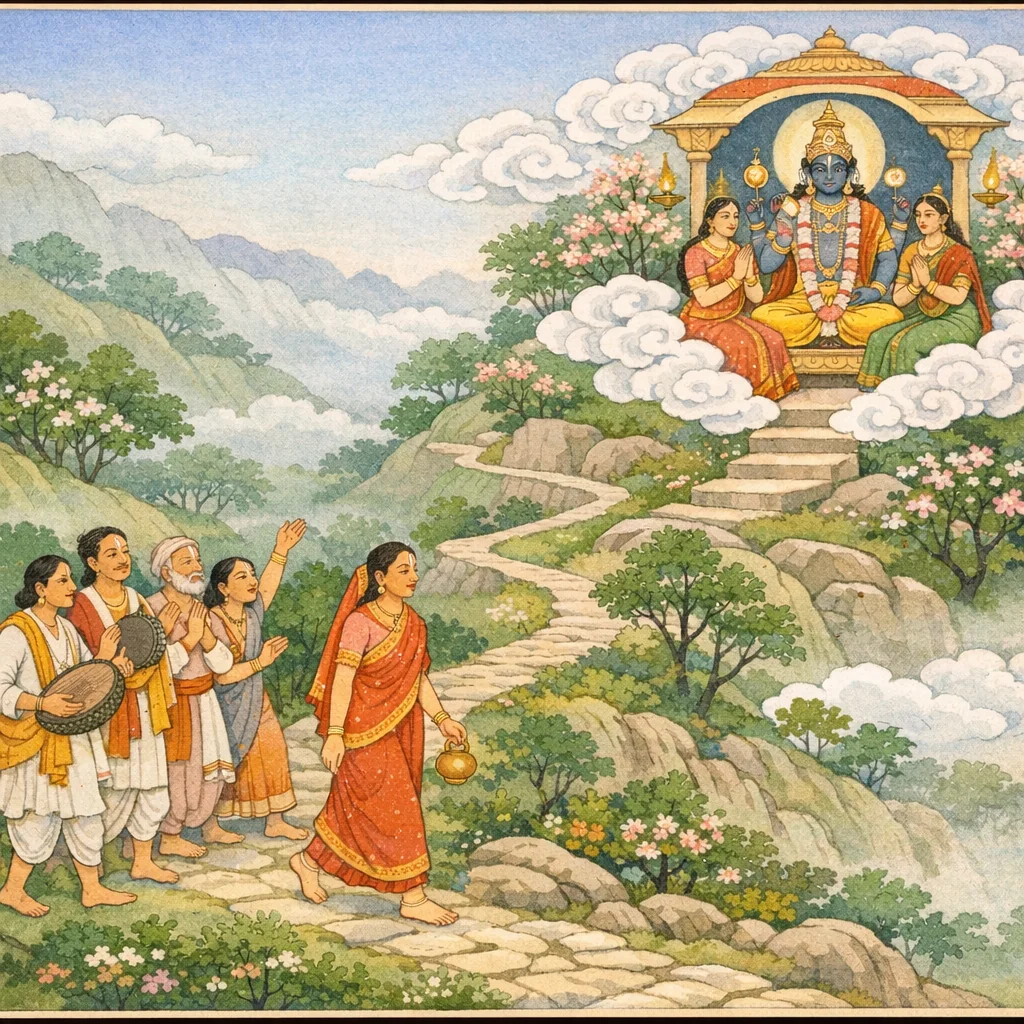
The chapter continues Kṛṣṇa’s teaching to Garuḍa on gradations of bhakti: when Lakṣmī’s inner divine impetus is strong, Keśava is pleased even by Nāma alone; when it wanes, practices seem equal in fruit, though a subtle superiority remains because Lakṣmī still abides. Asked how Jāmbavatī worshipped and why she excelled, Kṛṣṇa recounts her former birth as Soma’s daughter—unceasing Purāṇa-hearing, prostrations, circumambulation, remembrance, and dispassion, culminating in renouncing ornaments and possessions. The instruction then presents a systematic Vaiṣṇava consecration of the senses—speech, hands, ears, eyes, skin, smell, and taste—redirected to Hari through sevā, kathā, darśana, Vaiṣṇava-saṅga, pāda-tīrtha, and prasāda. Pilgrimage ethics follow: continence vows during yātrā, seeking Vaiṣṇava company, rejecting worldly-motivated pilgrims, placing Śālagrāma first in rites, and preferring compassionate travel on foot with daily Hari-kathā. Finally, Jāmbavatī’s longing contemplation culminates in darśana of Śeṣācala/Veṅkaṭādri and worship of Śrīnivāsa, with tīrtha procedures (bath, tonsure, tīrtha-śrāddha, gifts) and Bhāgavata recitation, linking inner bhakti to outward tīrtha-ācāra and preparing further teachings on proper pilgrimage conduct and offences.
Shlokas
Verse 1
नाम द्वाविंशोध्यायः श्रीकृष्ण उवाच / सोमस्य पुत्री पूर्वसर्गे बभूव भार्या मदीया जाम्बवती मम प्रिया / तासां मध्ये ह्यधिका वीन्द्र किञ्चिद्रुद्रादिभ्यः पञ्चगुणैर्विहीना
Śrī Kṛṣṇa said: “In a former creation, the daughter of Soma became My wife—Jāmbavatī, dear to Me. Among them she was especially eminent, O Vīndra, best of birds, being in some respect free from the fivefold qualities associated with Rudra and the other deities.”
Verse 2
यदावेशो बलवान्स्याद्रमायां तदानामस प्रियते केशवोलम् / यदावेशाद्ध्रासमुपैति काले तदा तासां साम्यमाहुर्महान्तः
When the inner impelling force (āveśa) within Ramā—Lakṣmī’s divine power—becomes strong, then Keśava (Viṣṇu) is pleased by the Name alone. But when, in due course, that same force declines, the wise declare an equality of result among those modes.
Verse 3
लक्ष्म्यावेशः किञ्चिदस्त्येव नित्यमतस्ताभ्यः किञ्चिदाधिक्यमस्ति
Indeed, a certain measure of Lakṣmī’s indwelling (āveśa) is always present; therefore there is some degree of superiority over the others.
Verse 4
गरुड उवाच / तासां मध्ये जाम्बवन्ती तु कृष्ण आराधनं कीदृशं सा चकार / तन्मे ब्रूहि कृपया विश्वमूर्ते आधिक्ये वै कारणं ताभ्य एव
Garuḍa said: “Among them, how exactly did Jāmbavantī worship Kṛṣṇa, and what form did her devotion take? O Viśvamūrti, Lord of the universe, please tell me with compassion—what indeed was the reason for her superiority over the others?”
Verse 5
गरुडेनैवमुक्तस्तु भगवान् देवकीसुतः / मेघगंभीरया वाचा उवाच विनतासुतम्
Thus addressed by Garuḍa, the Blessed Lord—the son of Devakī—spoke to Vinatā’s son in a voice deep and resonant like thunderclouds.
Verse 6
श्रीकृष्ण उवाच / या पूर्वसर्गे सोमपुत्री बभूव पितुर्गृहे वर्तमानापि साध्वी / जन्म स्वकीयं सार्थकं वै चकार पित्रा साकं विष्णुशुश्रूषणे न च
Śrī Kṛṣṇa said: She who, in a former creation, was born as the daughter of Soma—though living in her father’s house—remained truly virtuous. Indeed, she made her own birth meaningful, for together with her father she engaged in devoted service to Lord Viṣṇu and did not turn away from that worship.
Verse 7
शुश्राव नित्यं सत्पुराणानि चैवं चक्रे सदा विष्णुपादप्रणामम् / चक्रे सदा तारकस्यापि विष्णोः प्रदक्षिणं स्मरणं कुर्वती सा
She regularly listened to the sacred Purāṇas, and thus always offered prostrations at the feet of Viṣṇu. She also continually performed circumambulation of Viṣṇu (as the saving ‘Tāraka’), and remained engaged in remembrance of Him.
Verse 8
पित्रा साकं सा तु कन्या खगेन्द्र वैराग्ययुक्ता श्रवणात्संबभूव / केशं च मित्रं द्विरदादिकं च अनर्घ्यरत्नानि गृहादिकं च
O Khagendra (Garuḍa), that maiden, together with her father, became filled with dispassion merely by hearing (this teaching). She gave up her hair as an ornament, her friends and companions, elephants and other possessions, as well as priceless jewels, houses, and the like.
Verse 9
सर्वं ह्येतन्नश्वरं चैव मेने ममाधीनं हरिणा वै कृतं च / येनैव दत्तं पुत्रमित्रादिकं च तेना हृतं वेदनां नैव चक्रे
He understood that all this is indeed perishable, and that what seemed to be under his control was in truth arranged by Hari. The very One who had granted sons, friends, and the rest also took them away—therefore he did not give rise to anguish.
Verse 10
अद्यैव विष्णुः परमो दयालुः दयां मयि कृतवांस्ते न सुष्ठु / पित्रा साकं कन्यका सा तु वीन्द्र सदात्मनि ह्यमले वासुदेवे
Even today, Viṣṇu—the supremely compassionate—has shown mercy to me, and not without good cause. That young maiden, together with her father, O best of kings, abides in the Eternal Self—spotless Vāsudeva.
Verse 11
एकान्तत्वं सुष्ठु भक्त्या गता सा यदृच्छया सोपपन्नेन देवी / अकल्पयन्त्यात्मनो वीन्द्र वृत्तिं चकार यत्सावधिराधं प्रथैव
Having attained ekānta—true solitude, single-pointedness—through firm devotion, that Goddess, by providence and with fitting means at hand, without wavering in her inner resolve, established the course of her life; and from the very beginning she set a definite boundary for wrongdoing.
Verse 12
सा वै वित्तं विष्णुपादारविन्दे दुः खार्णवात्तराके संचकार / वागीन्द्रिद्रियं खग सम्यक् चकार हरेर्गुणानां वर्णने वा सदैव
She placed her wealth at the lotus-feet of Viṣṇu, making it a ferry across the ocean of sorrow. O bird (Garuda), she also rightly disciplined her speech and sense-powers, remaining always engaged in describing the virtues of Hari.
Verse 13
हस्तौ च विष्णोर्गृहसंमार्जनादौ चकार देवी गात्रमलापहारम् / श्रोत्रं च चक्रे हरिसत्कथोदये मोक्षादिमार्गे ह्यमृतोपमे च
The Goddess fashioned the hands for service to Viṣṇu—beginning with acts like cleaning the home—and for removing bodily impurity. She also fashioned the ears for the arising of sacred narratives about Hari, for the path that begins with liberation, and for what is nectar-like.
Verse 14
नेत्रं च चक्रे प्रतिमादिदर्शने अनादिकालीनमलापहरिणी / सद्वैष्णवानां स्पर्शने चैव संगे निर्माल्यगन्धानुविलेपने त्वक्
The eye was made for beholding sacred images and the like, and it removes the impurities accumulated since beginningless time. The skin, too, is for contact and association with true Vaiṣṇavas, and for being anointed with the fragrance of the Lord’s offered garlands (nirmālya).
Verse 15
घ्रार्णेद्रियं सा हरिपादसारे चकार संसारविमुक्तिदे च / जिह्वेन्द्रियं हरिनैवेद्यशेषे श्रीमत्तुलस्यादिविमिश्रिते च
She purified the sense of smell with the essence of Hari’s feet, which grants release from the bondage of saṃsāra; and she purified the sense of taste (the tongue) with the remnants of naivedya offered to Hari, mixed with sacred tulasī and the like.
Verse 16
पादौ हरेः क्षेत्रपथानुसर्पणे शिरो हृषीकेशपदाभिवन्दने / कामं हृदास्ये तु हरिदास्यकाम्या तथोत्तमश्लोकजनाश्चरन्ति
The Lord’s devotees—He who is praised by the highest hymns—let their feet tread the sacred paths to Hari’s holy places; they bow their heads at the feet of Hṛṣīkeśa; and with heart and speech they cherish but one desire: the longing to serve Hari. Thus do those devoted to the Supreme Lord live.
Verse 17
निष्कामरूपे च मतिं चकार वागिन्द्रियं स्तवनं स्वीचकार / एवं सदा कार्यसमूहमात्मना समर्पयित्वा परमेशपादयोः
He fixed his mind in desireless, selfless devotion, and engaged the organ of speech in praising the Lord. Thus, ever offering the whole of his actions from his very self at the feet of the Supreme Lord, he remained steadfastly dedicated.
Verse 18
तीर्थाटनार्थं तु जगाम पित्रा साकं हरेः प्रीणनाद्यर्थमेव / आराधयित्वा ब्राह्मणान्विष्णुभक्तानादौ गृहे वस्त्रसंभूषणाद्यैः
For the sake of pilgrimage to the holy tīrthas, he set out with his father, solely to please Hari. First, in his own home, he honored Brahmins who were devotees of Viṣṇu, offering them garments, ornaments, and other gifts.
Verse 19
पश्चात्कल्पं कारयामास देवी विष्णोरग्रे तीर्थयात्रार्थमेव / यावत्कालं तीर्थयात्रा मुकुन्द तावत्कालं तूर्ध्वरेता भवामि
Afterwards the Goddess caused a sacred vow to be undertaken before Viṣṇu, solely for the purpose of pilgrimage to holy places: “O Mukunda, for as long as this pilgrimage continues, for that very duration I shall remain continent, restraining and directing the vital energy upward.”
Verse 20
यावत्कालं तीर्थयात्रां करिष्ये तावद्दत्ताद्वैष्णवानां च संगम् / हरेः कथाश्रवणं स्यान्मुकुन्द नावैष्णवानां संगिनामङ्गसंगम्
So long as I undertake pilgrimage to the sacred tīrthas, grant me also the company of the Vaiṣṇavas. O Mukunda, let there be the hearing of Hari’s sacred narratives; and let there be no bodily association with those who keep company with non‑Vaiṣṇavas.
Verse 21
सुहृज्जनैः पुत्रमित्रादिकैश्च दीर्थाटनं नैव कुर्यां मुकुन्द / कुर्वन्ति ये काम्यया तीर्थयात्रां तेषां संगं कुरु दूरे मुकुन्द
O Mukunda, I would not undertake the wandering of pilgrimage with relatives and companions—sons, friends, and the like. Those who perform tīrtha‑pilgrimage out of desire for worldly gain—keep me far from their company, O Mukunda.
Verse 22
शालग्रामं ये विहायैव यात्रां कुर्वन्ति तेषां किं फलं प्राहुरार्याः / यदा तीर्थानां दर्शनं स्यात्तदैव शालग्रामं पुरतः स्थापयित्वा
Those who undertake pilgrimage while setting aside the Śālagrāma—what fruit do they gain, say the noble ones? When the tīrtha is beheld, at that very time—having first placed the Śālagrāma before oneself—one should proceed with worship.
Verse 23
तीर्थाटनं पादचैरैः कृतं चेत्पूर्णं फलं प्राहुरार्याः खगेन्द्र / पादत्राणं पादरक्षां च कृत्वा तीर्थाटनं पादहीनं तदाहुः
O Khagendra, the noble ones declare that when pilgrimage is undertaken on foot, it yields its full merit. But if one goes with foot‑protection, safeguarding the feet, they say such pilgrimage is, as it were, “without feet,” deprived of its complete fruit.
Verse 24
यो वाहने तुरगे चोपविष्टस्तीर्थाटनं कुरुते चार्धहीनम् / वृषादीनां वाहने पादमाहुः परान्नानां भोजने व्यर्थमाहुः
He who undertakes pilgrimage seated in a vehicle or upon a horse performs it with only half the merit. Riding on bulls and the like, they say, yields but a quarter. And they declare that eating food given by others as alms is fruitless.
Verse 25
महात्मनां वेदविदां यतीनां परान्नानां भोजने नैव दोषः / संकल्पयित्वा परमादरेण जगाम सा तीर्थयात्रार्थमेव
For the great-souled ascetics, the Veda-knowing yatis, there is no fault in accepting food prepared by others. Having formed her resolve with the highest reverence, she departed solely to undertake a pilgrimage to the sacred tīrthas.
Verse 26
आदौ स्नात्वा हरिनिर्मात्यगन्धं विसर्जयित्वा श्रवणं वै चकार / पित्रा साकं भोजनं चापि कृत्वा अग्रे दिने क्रोशमेकं जगाम
First, after bathing, he set aside the fragrance prepared by Hari; then he duly performed the rite of sacred listening (śravaṇa). Having also eaten together with his father, on the following day he went onward by a single krośa (about two miles).
Verse 27
तत्र द्विजान्पूजयित्वान्नपान रात्रौ तत्त्वं श्रावयामास देवी / एवं यात्रां ये प्रकुर्वन्ति नित्यं तेषां यात्रां सफलां प्राहुरार्याः
There, having honored the twice-born (dvija, brāhmaṇas) with food and drink, the Goddess caused the truth (tattva) to be heard at night. Those who perform the pilgrimage in this manner each day—the noble declare their journey to be truly fruitful.
Verse 28
विना दयां तीर्थयात्रा खगेन्द्रव्यर्थेत्येवं वीन्द्र चाहुर्महान्तः / दिवा रात्रौ ये न शृण्वन्ति दिव्यां हरेः कथां तीर्थमार्गे खगेन्द्र
O Garuḍa, the great ones declare that a pilgrimage undertaken without compassion is futile. And those who, by day and by night, do not listen to the divine narrations of Hari while walking the tīrtha-path—O lord of birds—their journey too bears little fruit.
Verse 29
व्यर्थंव्यर्थं तस्य चाहुर्गतं वै अश्वादीनां वाहनानां च विद्धि / अश्वादीनामपराधं वदस्व गङ्गादीनां दर्शनात्पापनाशः
They declare that his going is utterly in vain; know that it is due to offences connected with mounts such as horses and other conveyances. Speak of the wrongdoing involving horses and the like: by merely beholding the Gaṅgā and other sacred rivers, sins are destroyed.
Verse 30
क्षेत्रस्थविष्णोर्दर्शनात्पापनाशो मार्जारस्याप्यपराधं वदस्व / क्षेत्रस्थविष्णोः पूजनात्पापनाशः पूजावतामपराधं वदस्व
Tell me of the offence—even that of a mere cat—for it is said that by beholding Viṣṇu who abides in the sacred kṣetra, sins are destroyed. And tell me too of the offence of those who offer worship, for it is said that by worshipping Viṣṇu who dwells in the holy place, sins are wiped away.
Verse 31
जपादीनां कुर्वतां पापनाशो विष्णोर्ध्यानात्सद्य एवाधनाशः / अनुसंधानाद्रहितं सर्वमेव कृतं व्यर्थमेवेति चाहुः
For those who perform japa and the like, sins are destroyed; by meditating on Lord Viṣṇu, poverty is dispelled at once. Yet they declare that whatever is done without inner recollection (anusaṃdhāna)—all of it—is truly done in vain.
Verse 32
अतो हरेः पापविनाशिनीं कथां श्रुत्वा विष्णोर्भक्तिमान्स्यात्वगन्द्र / दृष्ट्वादृष्ट्वा हरिपादाङ्कितं च स्मृत्वास्मृत्वा भक्तिमान्स्यात्खगेन्द्र
Therefore, O lord of speech, by hearing the sin-destroying sacred narrative of Hari, one becomes devoted to Viṣṇu. And, O king of birds, by beholding again and again what is marked with the footprints of Hari, and by remembering Him repeatedly, one becomes a true devotee.
Verse 33
पित्रा साकं कन्यका सापि वीन्द्र शेषाचलस्थं श्रीनिवासं च द्रष्टुम् / जगाम सा मार्गमध्ये हरिं च सा चिन्तयामास रमापतिं च
O Indra, that maiden too went with her father to behold Śrīnivāsa who dwells on Śeṣācala. And along the way she kept contemplating Hari—Rāmāpati, the Lord of Lakṣmī.
Verse 34
कदा द्रक्ष्ये श्रीनिवासस्य वक्षः श्रीवत्सरत्नैर्भूषितं विस्तृतं च / कदा द्रक्ष्ये श्रीनिवासस्य तुन्दं वलित्रयेणाङ्कितं सुंदरं च
When shall I behold the broad chest of Śrīnivāsa, adorned with the jewel-like mark of Śrīvatsa? When shall I behold the beautiful belly of Śrīnivāsa, graced with the three auspicious folds?
Verse 35
कदा द्रक्ष्ये श्रीनिवासस्य कण्ठं महर्लोकस्याश्रयं कंबुतुल्यम् / कदा द्रक्ष्ये श्रीनिवासस्य नाभिं सदान्तरिक्षस्याश्रयं वै सुपूर्णम्
When shall I behold Śrīnivāsa’s throat—conch-like, the support of Maharloka? When shall I behold Śrīnivāsa’s navel—ever full, the very support of the mid-space (antarikṣa)?
Verse 36
कदा द्रक्ष्ये वदनं वै मुरारेर्जनलोकस्याश्रयं सर्वदैव
When shall I behold the face of Murāri (Lord Viṣṇu), who is ever the refuge of the world of beings?
Verse 37
शिरः कदा श्रीनिवासस्य द्रक्ष्ये सत्यस्य लोकस्याश्रयं सर्वदैव / कटिं कदा श्रीनिवासस्य द्रक्ष्ये भूर्लोकस्याश्रयं सर्वदैव
When shall I behold the head of Śrīnivāsa—ever the refuge of Satyaloka, the realm of Truth? When shall I behold the waist of Śrīnivāsa—ever the refuge of Bhūrloka, the earthly world?
Verse 38
कदा द्रक्ष्ये श्रीनिवासस्य चोरु तलातलस्याश्रयं सर्वदैव / कदा द्रक्ष्ये श्रीनिवासस्य जानु सुकोमलं सुतलस्याश्रयं च
When shall I behold Śrīnivāsa’s thighs, ever the support of Talātala? When shall I behold Śrīnivāsa’s tender knees, the support of Sutala as well?
Verse 39
कदा द्रक्ष्ये श्रीनिवासस्य जङ्घे रसातलस्याश्रयेः सर्वदैव / कदा द्रक्ष्ये पादतलं हरेश्च पाताललोकस्याश्रयं सर्वदैव
When shall I behold the shanks of Śrīnivāsa, the ever-present support of Rasātala? When shall I behold the soles of Hari, the ever-present refuge and foundation of the Pātāla worlds?
Verse 40
इत्थं मार्गे चिन्तयन्ती च देवी शेषाचले शेषदेवं ददर्श / फणैः सहस्रैः सुविराजमानं नानाद्रुमैर्वानरैर्वानरीभिः
Thus, as the goddess reflected along the way, she beheld Śeṣadeva upon Śeṣācala—splendidly radiant with a thousand serpent-hoods—amid many kinds of trees, with monkeys and female monkeys about.
Verse 41
अनन्त जन्मार्जितपुण्यसंचयान्मयाद्य दृष्टः परमाचलो हि / तद्दर्शनाद्वाष्पकलाकुलेक्षणा सद्यः समुत्थाय ननाम मूर्ध्ना
Indeed, today I have beheld the Supreme Mountain, earned through accumulations of merit gathered across countless births. At the sight of it, my eyes, clouded with tears, I immediately rose and bowed my head in reverence.
Verse 42
मुखं च दृष्ट्वा नमनं च कार्यं पृष्ठादिभागे नमनं न कार्यम् / सापि द्विषट्कं नमनं च चक्रे शालग्रामं स्थापयित्वा पुरो ऽस्य
After looking upon the face, one should perform the act of reverential bowing; bowing should not be done toward the back or rear side. She too then performed twelve prostrations, having first placed the Śālagrāma (stone emblem of Viṣṇu) in front of him.
Verse 43
इत्थं कार्यं वैष्णवैः पर्वतस्य त्वं वैष्णवैर्विपरीतं च कार्यम् / मध्वान्तःस्थः पर्वताग्रेस्ति नित्यं रमाब्रह्माद्यैः पूजितः श्रीनिवासः
Thus, this is the proper duty to be performed by the Vaiṣṇavas with regard to the mountain; but you have acted in a manner contrary to what Vaiṣṇavas should do. The Lord Śrīnivāsa—ever abiding within the divine “Madhva” region and upon the mountain’s summit—is eternally worshipped by Ramā (Lakṣmī), Brahmā, and the other gods.
Verse 44
सुसत्तमं परमं श्रीनिवासं द्रक्ष्ये ऽथाहं ह्यारुरुक्षे ऽचलञ्च / इत्येवमुक्त्वा कपिलाख्यतीर्थे स्थानं चक्रे सा स्वपित्रा सहैव
“I shall behold the supremely noble, highest Lord—Śrīnivāsa; and then I shall indeed climb the mountain.” Having spoken thus, she made her abode at the sacred ford known as Kapila, together with her own father.
Verse 45
अत्रैवास्ते श्रीनिवासो हरिस्तु द्रव्येण रूपेण न चान्यथेति / आदौस्नात्वा मुण्डनं तत्र कृत्वा तीर्थश्राद्धं कारयित्वा सुतीर्थे
Here itself abides Hari, the Lord of Śrī—Śrīnivāsa—truly present in that sacred substance and in that form, and not otherwise. Therefore, having first bathed there, one should perform the rite of tonsure, and in that auspicious tīrtha have the tīrtha-śrāddha (ancestral rite at a pilgrimage place) duly carried out.
Verse 46
गोभूहिरण्यादिसमस्तदानं दत्त्वा शैलं चारुरोहाथ साध्वी / शालग्रामं स्थापयित्वा स चाग्रे पुनः प्रणामं सापि चक्रे सुभक्त्या
Having given every kind of gift—cows, land, gold, and the rest—the virtuous woman then ascended a beautiful hill. Placing a Śālagrāma stone before her, she bowed down once more, offering her reverence with sincere devotion (bhakti).
Verse 47
सोपानानां शतपर्यन्तमेवमारुह्य सा ह्युपविष्टा तु तत्र / शुश्राव सा भागवतं पुराणं शुश्राव वैवेङ्कटाद्रेः प्रशंसाम्
Having thus climbed up to a hundred steps, she sat there. Seated in that place, she heard the Bhāgavata Purāṇa being recited, and she also heard praise of the sacred Veṅkaṭādri (Tirumala hill).
Verse 48
जैगीषव्याद्गुरुपादात्सुभक्त्या सुश्राव तत्त्वं वेङ्कटाद्रेश्च सर्वम्
With devoted faith at his guru’s feet, Jaigīṣavya heard and understood the entire truth concerning Lord Veṅkaṭādri (Veṅkaṭeśvara).
Frequently Asked Questions
It assigns speech to describing Hari’s virtues, hands to sevā and purity-maintenance, ears to hearing Hari narratives and liberating teachings, eyes to sacred darśana that cleanses beginningless impurities, skin to contact with true Vaiṣṇavas and nirmālya fragrance, smell to Hari’s pāda-tīrtha essence, and taste to prasāda remnants with tulasī—turning embodiment into a devotional instrument.
The text frames bodily hardship and humility (walking) as integral to yātrā’s purificatory intent; protecting the feet or riding is portrayed as diminishing that austerity, hence described as ‘footless’ or partial in fruit. The emphasis is ethical-spiritual orientation rather than travel logistics.
Compassion is stated as a non-negotiable prerequisite: without day-to-day kindness and a softened heart, the journey becomes externally correct yet internally barren, undermining the very purification that tīrtha-yātrā is meant to cultivate.
That their sin-destroying and prosperity-removing promises are realized only when joined to remembrance of Viṣṇu; performed without anusaṃdhāna, they are declared ‘in vain’ despite outward correctness.