Adhyaya 21
Kālin̄dī’s Austerity; True Tapas and Prāyaścitta; Kṛṣṇa’s Grace and Marriage
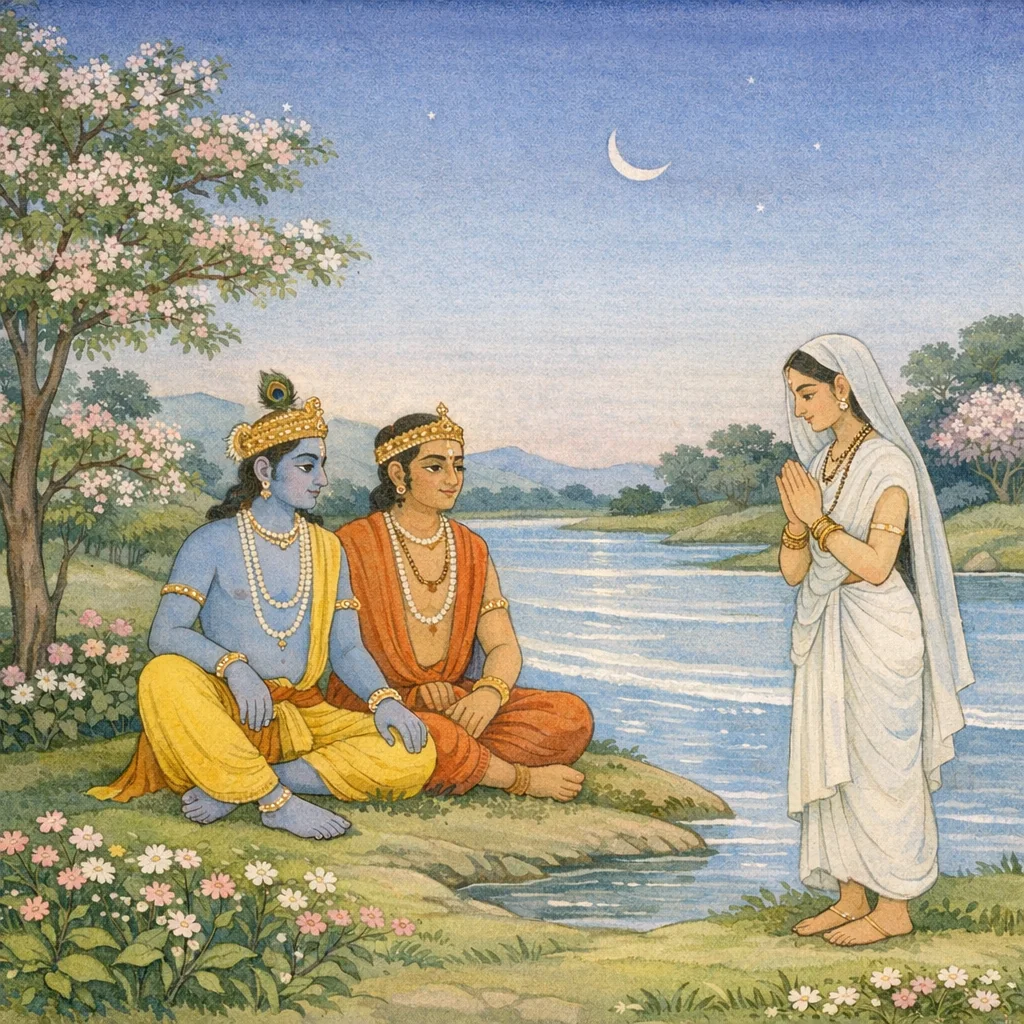
Continuing Kṛṣṇa’s instruction to Garuḍa, this chapter recounts the origin of Kālin̄dī (Yamunā), daughter of Vivasvān and sister of Yama, who performs austerities to attain Kṛṣṇa as her husband. The teaching then turns doctrinal: tapas is inner self-examination, tattva-viveka, and remorse for past sins; prāyaścitta is mental restraint and sincere repentance, not outward tokens like head-shaving. A long penitential lament lists misdirected pursuits—comfort, food, honor, and reliance on family and society—while neglecting Hari’s Name, worship, prasāda, and the company of the virtuous, concluding that remorse itself is the truest expiation. Kālin̄dī’s contemplation matures into a hierarchy affirming Hari’s pūrṇatva (completeness) above all. The narrative returns as Kṛṣṇa and Arjuna meet her on the Yamunā bank; Arjuna inquires; Kṛṣṇa accepts her in marriage as grace and support, not from personal need. The closing verses foreshadow Lakṣmaṇā’s account and affirm that secret tattva is revealed to a worthy disciple without concealment.
Shlokas
Verse 1
// ५१ // नाम विंशोध्यायः श्रीकृष्ण उवाच / कालिन्द्या अपि चोत्पत्तिं प्रवक्ष्यामि खगेश्वर / विवस्वान्नाम सूर्योभत्तस्य पुत्री व्यजायत
Śrī Kṛṣṇa said: “O Khageśvara, I shall also explain the origin of Kāлиндī. From Vivasvān, the Sun-god, a daughter was born.”
Verse 2
कालिन्दीसंज्ञका वीन्द्र यमुना यानुजा स्मृता / कृष्णपत्नीत्वकामेन चचार तप उत्तमम्
O best of birds (Garuda), she is known as Kāлиндī, and is remembered as Yamunā, the younger sister of Yama. Desiring to become Kṛṣṇa’s wife, she undertook excellent austerities.
Verse 3
तप आलोचनं प्रोक्तं तत्त्वानां च विनिर्णयः / पूर्वार्जितानां पापानामनुतापस्तपः स्मृतम्
Austerity (tapas) is said to be self-examination and the discernment of true principles; and remorseful repentance for sins accumulated in the past is also remembered as tapas.
Verse 4
प्रायो नाम तपः प्रोक्तं चित्तनिग्रह उच्यते / प्रायश्चित्तमिति प्रोक्तं न तु क्षौरं खगेश्वर
Atonement (prāyaścitta) is said to be austerity—indeed, it is called restraint of the mind. It is declared to be ‘prāyaścitta’, O Lord of birds; it is not merely the shaving of the head.
Verse 5
अनुतापयुतं भूतं तच्छणु त्वं खगेश्वर / पूर्वं न जप्तं दिव्यमन्त्रं मुकुन्द तप्तं सदा क्लेशदावानलेन
O King of birds (Garuda), listen: a being burdened with remorse—having not previously recited the divine mantra of Mukunda—remains ever scorched by the forest-fire of worldly afflictions.
Verse 6
न वै स्मृतं हरिनामामृतं च सदा स्मृतं हरिदोषादिकं च / न तु स्मृतं हरितत्त्वामृतं च सम्यक् श्रुतं लोलवार्तादिकं च
They did not remember the nectar of Hari’s Name; instead, they kept recalling only faults and the like. Nor did they remember the nectar of Hari’s true nature; rather, they listened well only to fickle gossip and such talk.
Verse 7
न पूजितं हरिपादारविन्दं सुपूजिताः पुत्रमित्रादिकाश्च / न वन्दितं हरिपादारविन्दं सुवन्दितो मित्रपादः सुघोरः
One has not worshiped the lotus-feet of Hari, yet has lavishly honored sons, friends, and the like. One has not bowed to the lotus-feet of Hari, yet has bowed intensely to the feet of friends—an attachment that becomes exceedingly dreadful.
Verse 8
न दृष्टं वै धूपधूम्रैरुपेतं हरेर्वक्रं कुन्तलैः संवृतं च / पुत्रादिकं लालितं वै मुकुन्द न लालितं तव वक्रं मुरारे
Truly, I never beheld the face of Hari—veiled by the smoke of incense and covered by curling locks—yet I fondled and cherished sons and the like. O Mukunda, O Murāri, I did not cherish Your face.
Verse 9
सुलालितं भूषणैः पुत्रमित्रं न लालितं सर्वपापापहारि / न भुक्तं वै हरिनैरवेद्यशेषं मित्रालये षड्रसान्नं च भुक्तम्
One pampers one’s son and friends with ornaments and comforts, yet does not cherish Him who removes all sins. One does not eat the sanctified remnants of offerings made to Hari, but instead eats rich food of the six tastes in the houses of friends.
Verse 10
सुपुष्पगन्धा नार्पिता ते मुरारे समर्पिताः पुत्रमित्रादिकेभ्यः / सन्तप्तोहं पुत्रमित्रादिकेषु कदा द्रक्ष्ये तव वक्त्रं मुकुन्द
O Murāri, I did not offer You fragrant, lovely flowers; instead I offered myself to sons, friends, and the rest. Afflicted by attachment to sons and friends, when shall I behold Your face, O Mukunda?
Verse 11
अवैष्णवान्नैः शिग्रुशाकादिकैश्च ह्यनर्पितान्नैश्च तथाप्यसंस्कृतैः / तथाप्यभक्ष्यै रसना च दग्धा कदा द्रक्ष्ये तव वक्त्रं मुकुन्द
Having eaten food from non-Vaiṣṇavas, and also greens such as śigru, and food not first offered to the Lord, and likewise unsanctified food—indeed even what is forbidden—my tongue has been scorched. O Mukunda, when shall I behold Your face?
Verse 12
अष्टाक्षरीपूजया दिव्यतीर्थैर्विष्णोः पुरा भ्रामितैः शङ्खतीर्थैः / न पावितं मच्छरीरं मुरारे कदा द्रक्ष्ये तव व क्त्रं मुकुन्द
Even by worship with the eight-syllabled mantra, even by divine pilgrimage-places—those sacred conch-born tīrthas once traversed by Viṣṇu—my body has not been purified, O Murāri. O Mukunda, when shall I behold Your face?
Verse 13
अनर्पितैर्गन्धपुष्पादिकैश्च अनर्पितैर्भूषणैर्वस्त्रजातैः / अवैष्णवानां दिग्धगन्धादिदोषैर्गात्रं दग्धं कदा ह्युद्धरिष्ये मुकुन्द
With fragrances, flowers, and the like that were never offered to You, and with ornaments and garments never dedicated—through the faults of those who are not devoted to Viṣṇu, such as tainted perfumes and the like—my body is scorched. O Mukunda, when indeed will You lift me out and save me?
Verse 14
दग्धौ च पादौ मम वासुदेव न गच्छन्तौ क्षेत्रपथं हरेश्च / नेत्रे च दग्धे मम सर्वदापि नालोकितं तव देव प्रतीकम्
O Vāsudeva, my feet are scorched and cannot walk upon Hari’s sacred pilgrimage-paths. My eyes too are burned; therefore, at no time have I been able to behold Your divine form, Your holy icon.
Verse 15
दग्धौ च हस्तौ मम वासुदेव न पूजितं तव विष्णोः प्रतीकम् / मया कृतं पापजातं मुरारे कदा द्रक्ष्ये तव वक्रं मुकुन्द
My hands too are burned, O Vāsudeva, for I did not worship Your sacred emblem, O Viṣṇu. I have committed a multitude of sins, O Murāri—when shall I behold Your face, O Mukunda?
Verse 16
मदीयदोषान्गणयन्न पूर्ण दयां कुरु त्वं सुद्धदास्यान्मुकुन्द / यावन्ति लोमानि मदीयगात्रे संति प्रभो सर्वदोर्षर्विदूर
O Mukunda, do not count my faults; instead, show Your complete compassion and grant me pure servitude. O Lord, as many hairs as there are on my body, so many are my sins—yet You are far beyond every fault.
Verse 17
तावन्ति पापानि मदीयगात्रे कदा द्रक्ष्ये तव वक्त्रं मुकुन्द / अनन्तदेहे पतिपुत्रैर्गृहैश्च मित्रैर्धनैः पशुभृत्यादिकैश्च
So many sins cling to my very body—O Mukunda, when will I behold Your face? O Lord of infinite form, I have been bound by husband and children, by house and home, by friends, by wealth, and by cattle, servants, and the like.
Verse 18
सुखं नाप्तं ह्यपुमात्रं मुकुन्द सेवा मुक्ता तव देवस्य विष्णोः / इतः परं पुत्रमित्रादिकं च यास्ये नाहं तव दासी भवामि
O Mukunda, I have not obtained even the slightest happiness; I am released from service to You—Lord Viṣṇu. From here onward I shall go to my son, friends, and the rest; I will not become Your maidservant.
Verse 19
येये ब्रूयुः पुत्रमित्रादिकैश्च सम्यक् सुखं जायते मर्त्यलोके / तेषामास्ये मूत्रविष्ठादिकं च सम्यक् सदा पतितं चेति जाने
Those who proclaim that true happiness in the human world arises properly through sons, friends, and the like—know that into their mouths urine, excrement, and such filth continually and thoroughly fall.
Verse 20
मित्रादीनां यत्कृतं द्रव्यजातं वृथा गतं मलरूपं च जातम् / सद्वैष्णवानां यत्कृतं द्रव्यजातं हरिप्राप्तेः कारणं स्यात्सदैव
Wealth spent on friends and the like is wasted and ends up becoming mere impurity; but wealth offered to true Vaiṣṇavas always becomes a cause for attaining Hari.
Verse 21
एतादृशं तत्तु जातं मुकुन्द अलं ह्यलं तेन दुःखं च भुक्तम् / संगं दत्तात्सज्जनानां सदा त्वं विना च त्वं दुर्जनानां च संगात्
O Mukunda, such indeed has come to pass—enough, enough! Through that association, suffering has been endured. Therefore, always keep company with the virtuous, and keep yourself away from the company of the wicked.
Verse 22
संगैः सदा दुर्जनानां मुरारे गात्रं दग्धं न विरागेण युक्तम् / एतादृशाहं कां गातिं वा मुकुन्द यास्ये न जाने दयया मां च पाहि
O Murāri, by constant association with wicked people my very being feels scorched, and I am not endowed with dispassion. In such a condition, O Mukunda, to what destiny shall I go? I do not know—out of compassion, protect me as well.
Verse 23
एतादृशो ह्यनुतापः खगेन्द्र प्रायश्चित्तं न च क्षौरादिकं च / भानोः कन्या ह्यनुतापं च कृत्वा विचारयामास हरेः सुतत्त्वम्
O King of birds, such heartfelt remorse itself is the true expiation (prāyaścitta), not merely outward acts like shaving and the like. Having thus undertaken repentance, the daughter of the Sun reflected deeply upon the true reality of Hari (Viṣṇu).
Verse 24
सर्वोत्तमो हरिरेकः सदैव यतः पूर्णः सर्वगुणैस्ततश्च / सृष्टौ यस्माज्जयते विश्वजातमतो हरिः सर्वगुणैश्च पूर्णः
Hari alone is eternally the Supreme, for He is complete, filled with every auspicious quality. Since, in creation, the entire universe is born from Him, therefore Hari is indeed perfect and endowed with all virtues.
Verse 25
यो देवानामाद्य अकार एव यतो ब्रह्माद्या नैव पूर्णाः समस्ताः / लक्ष्मीप्रसादाच्चिरपुण्येन जातो यथायोग्यं पूर्णगुणो विरिञ्चः
He is the primordial ‘A’ (akāra) among the gods; because of Him, even Brahmā and the other deities are not, in their entirety, fully complete. By Lakṣmī’s grace, through long-accrued merit, Viriñca (Brahmā) was born and, in due measure, became endowed with complete qualities.
Verse 26
न लक्ष्मीवद्गुणपूर्णो विरिञ्चो न विष्णुवद्गुणपूर्णा रमापि / न वायुवद्भारती चापि पूर्णा न शेषवद्वारुणी चापि पूर्णा
Even Viriñca (Brahmā) is not as complete in virtues as Lakṣmī; nor is Ramā (Lakṣmī) as complete in virtues as Viṣṇu. Neither is Bhāratī (Sarasvatī) as complete as Vāyu; nor is Vāruṇī as complete as Śeṣa (Ananta).
Verse 27
न वै रुद्रवत्पार्वती पूर्णरूपा ह्यन्येप्येवं नैव पूर्णाः सदैव / आलोचनामेवमेषा हि कृत्वा तपश्चक्रे यमुनायाश्च तीरे
Even Pārvatī is not fully identical in form to Rudra (Śiva); likewise, others too are never wholly perfect at all times. Having reflected in this way, she undertook austerities (tapas) on the bank of the Yamunā.
Verse 28
तदाचाहं यमुनायाश्च तीरं पार्थेन साकं मृगयां गतः खग / दृष्ट्वा च तां तत्र तपश्चरन्तीं तदाब्रुवं मत्सखायं च पार्थम्
Then, O bird (Garuda), I went hunting together with Pārtha to the bank of the Yamunā. Seeing her there, engaged in austerities, I then spoke to my friend Pārtha.
Verse 29
हे पार्थ शीघ्रं व्रज कन्यासमीपं त्वं पृच्छ कस्मादत्र तपः करोषि / एवं प्रोक्तस्तत्समीपं स गत्वा पृष्ट्वा चैतत्कारणं शीघ्रमेव
“O Pārtha, go quickly to the maiden and ask her why she is performing austerity here.” Thus instructed, he promptly went near her and, without delay, asked the reason for it.
Verse 30
आगत्य मामवदत्फाल्गुनोयं सर्वं वृत्तांन्तं त्वसौ मत्समीपे / ततस्त्वहं सुमुहूर्ते च तस्याः पाणिग्रहं कृतवांस्तत्र सम्यक्
Then Phālguna came to me and, in my presence, told me the entire account. After that, at an auspicious moment, I properly performed the rite of taking her hand (marriage) there.
Verse 31
तस्याश्च तापात्संततं मद्विचारात्प्रसन्नोहं सततं सुप्रसन्नः / पूर्णानन्दे रममाणास्य नित्यं तया च मे किं सुखंस्यात्खगेन्द्र
Because of her continual austerity and by constant contemplation of Me, I am always pleased—indeed, ever exceedingly pleased. As she eternally delights in complete bliss, what further happiness could she obtain by any other means, O king of birds?
Verse 32
मया विवाहोनुग्रहार्थं हि तस्या अङ्गीकृतो न तु सौख्याय वीन्द्र / तथा वक्ष्ये लक्ष्मणायाश्च रूपं पाणिग्राहे कारणं चापि वीन्द्रा
I accepted that marriage only to show her favour and grant her support—not for my own pleasure, O lord of birds. I will also tell you about Lakṣmaṇā’s form, and the reason for taking her hand in marriage as well, O best of birds.
Verse 33
शृणुष्व तत्तव वक्ष्यामि गोप्यं सच्छिष्यके नास्ति गोप्यं गुरोश्च
Listen: I shall declare to you the true tattva—the matter called secret. For a worthy disciple there is no secrecy; and for the guru as well, nothing should be kept concealed.
Frequently Asked Questions
The chapter treats heartfelt remorse as the essence of expiation because it restrains the mind, corrects intention, and turns the person toward Hari through sincere recognition of misdirected attachments and neglected devotion.
Duḥsaṅga (company of the wicked) is said to ‘scorch’ the being and obstruct dispassion, while sat-saṅga supports repentance, clarity, and devotion—thereby becoming a practical cause for turning toward Hari and away from saṁsāric suffering.
It provides the theological basis for her contemplation: realizing Hari as the eternally complete Supreme reframes all other supports as partial, strengthening exclusive devotion (ananya-bhakti) as the inner power of her tapas.
Remembering Hari-nāma, worshiping Hari’s lotus-feet, honoring prasāda, offering flowers/fragrance/ornaments to the Lord, and mantra-based worship are all contrasted against misplaced priority given to social and household attachments.