Adhyaya 57
Pātāla and Naraka Enumeration; Brahmāṇḍa-Āvaraṇa and Nārāyaṇa’s Pervasion
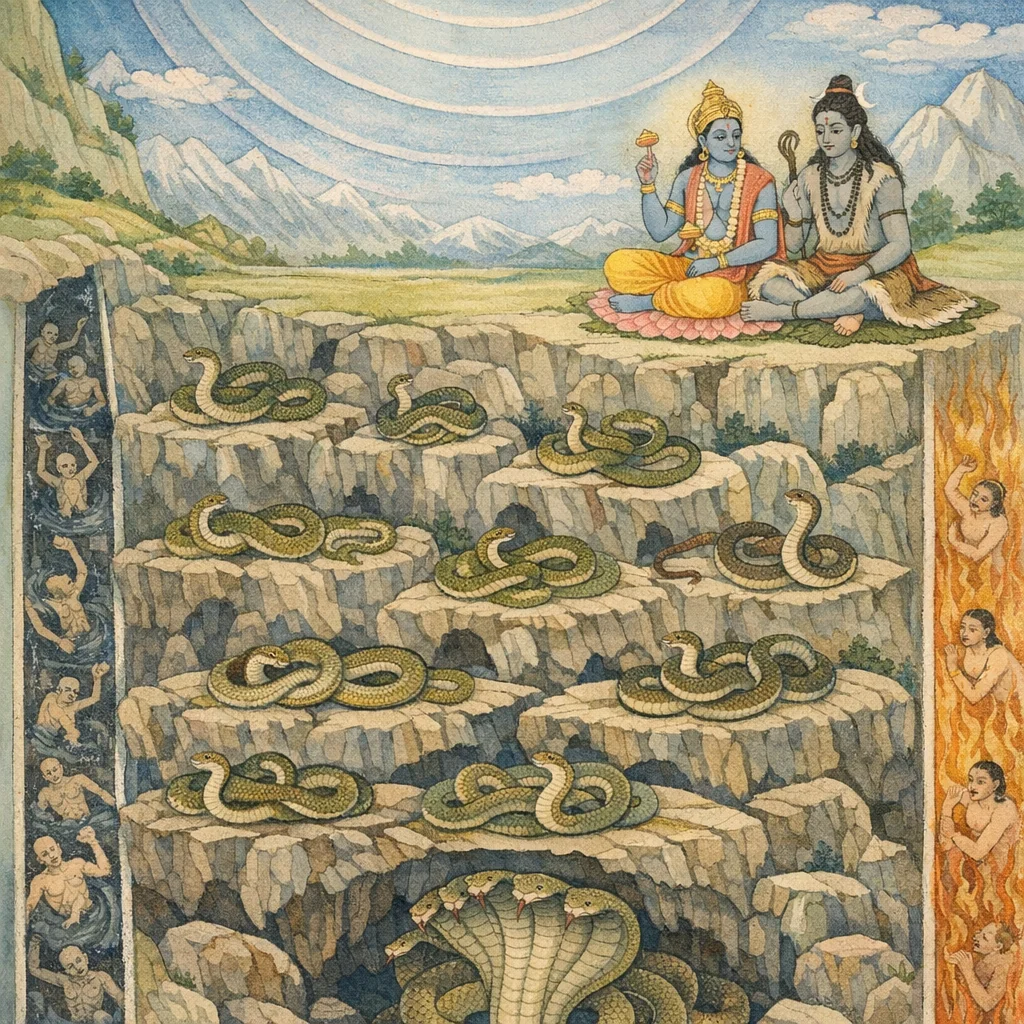
Continuing the Purāṇic mapping of post-mortem destinies, Hari addresses Rudra by first measuring the vertical extent of the earth and the underworlds, naming the seven Pātālas from Atala to Pātāla and describing their varied terrains and inhabitants such as Daityas and Nāga serpents. He then turns to the fearsome narakas within this cosmic geography, listing major hells and tormenting regions like Vaitaraṇī, Asipatravana, Pūyavaha, and Uṣṇavīci, and linking them to specific sins—poisoning, weapon-violence, and arson—thereby showing karma-vipāka as a precise moral law. From this punitive topography the discourse expands to the structure of the brahmāṇḍa, with successive enclosures of water, fire, wind, space, and subtler principles culminating in Mahat and Pradhāna. The chapter concludes by affirming that Nārāyaṇa pervades the cosmic egg, preparing the shift from localized punishments to a unified cosmological-theological vision of the universe’s ordering principle.
Shlokas
Verse 1
नाम षट्पञ्चाशत्तमो ऽध्यायः हरिरुवाच / सप्ततिस्तु सहस्राणि भूम्युच्छ्रायो ऽपि कथ्यते / दशसाहस्रमेकैकं पातालं वृषभध्वज
Hari said: “The height of the earth is also spoken of as seventy thousand yojanas. And each Pātāla, the nether realm, extends for ten thousand yojanas, O Bull-bannered One (Śiva).”
Verse 2
अतलं वितलं चैव नितलं च गभस्तिमत् / महाख्यं सुतलं चाग्र्यं पातालं चापि सप्तमम्
Atala, Vitala, and Nitala; Gabhas-timat; Mahākhya; Sutala, the excellent; and Pātāla as the seventh—these are the seven nether regions.
Verse 3
कृष्णा शुक्लारुणा पीता शर्करा शैलकाञ्चना / भूयस्तत्र दैतेया वसन्ति च भुजङ्गमाः
There are tracts that are black, white, reddish, and yellow—some like gravel, some rocky, and some golden. Moreover, Daityas dwell there, and also serpents of the Nāga kind.
Verse 4
रौद्रे तु पुष्करद्वीपे नरकाः सन्ति ताञ्छृणु / रौरवः सूकरो रोधस्तालो विनशनस्तथा
Now, in the terrible region of Puṣkaradvīpa there are hells—listen to them: Raurava, Sūkara, Rodha, Tāla, and also Vinaśana.
Verse 5
महाज्वालस्तप्तकुम्भो लवणो ऽथि विमोहितः / रुधिराख्यो वैतरणी कृमिशः कृमिभो जनः
There are realms named Mahājvāla, Taptakumbha, Lavaṇa, and also Vimohita; likewise the dreadful Rudhirākhya and Vaitaraṇī; and Kṛmiśa—where worms torment—and Kṛmibhojana, where beings are made food for worms.
Verse 6
असिपत्रवनः कृष्णो नानाभक्षश्च दारुणः / तथा पूयवहः पापो वह्निज्वालस्त्वधः शिराः
There is the dark hell called Asipatravana, a dreadful place where one is made to suffer many kinds of being devoured; likewise there are the sinful hell Pūyavaha, the blazing-fire hell Vahnijvāla, and Adhaḥśirā, where one is kept with the head turned downward.
Verse 7
संदंशः कृष्णसूत्रश्च तमश्चावीचिरेव च / श्वभोजनो ऽथाप्रतिष्ठोष्णवीचिर्नरकाः स्मृताः
Sandaṃśa, Kṛṣṇasūtra, Tamas, and Āvīci; as well as Śvabhojana, Apratiṣṭha, and Uṣṇavīci—these are remembered as the names of hells.
Verse 8
पापिनस्तेषु पच्यन्ते विषशस्त्राग्निदायिनः / उपर्युपरि वै लोका रुद्र ! भूतादयः स्थिताः
In those hellish realms the sinners are cooked—those who administer poison, those who strike with weapons, and those who set fires. And, O Rudra, above and yet above are successive worlds, where beings beginning with the Bhūtas are stationed.
Verse 9
वारिवह्न्यनिलाकाशैर्वृतं भूतादिना च तत् / तदण्डं महता रुद्र ! प्रधानेन च वेष्टितम्
That cosmic egg is enclosed by water, fire, wind, and space, and also by the elements beginning with the Bhūtas. O Rudra, that great egg is further wrapped by Mahat (the cosmic intellect) and by Pradhāna (primordial Nature).
Verse 10
अण्डं दशगुणं व्याप्तं नारायणः स्थितः
Nārāyaṇa abides, pervading the cosmic egg (the universe), expanded tenfold in magnitude.
Frequently Asked Questions
Atala, Vitala, Nitala, Gabhas-timat, Mahākhya, Sutala, and Pātāla (as the seventh) are listed as the seven nether regions.
The chapter explicitly mentions those who administer poison, those who strike with weapons, and those who set fire as being ‘cooked’ in the hellish realms, illustrating specific karma-to-result correspondence.
The cosmic egg is said to be enclosed by water, fire, wind, and space, and further wrapped by Mahat (cosmic intellect) and Pradhāna (primordial Nature), before concluding with Nārāyaṇa’s pervasion.