Adhyaya 216
Vaiśvadeva-Homa: Establishing Vaiśvānara, Sending Away Impurity, and the Svāhā Recipient-List
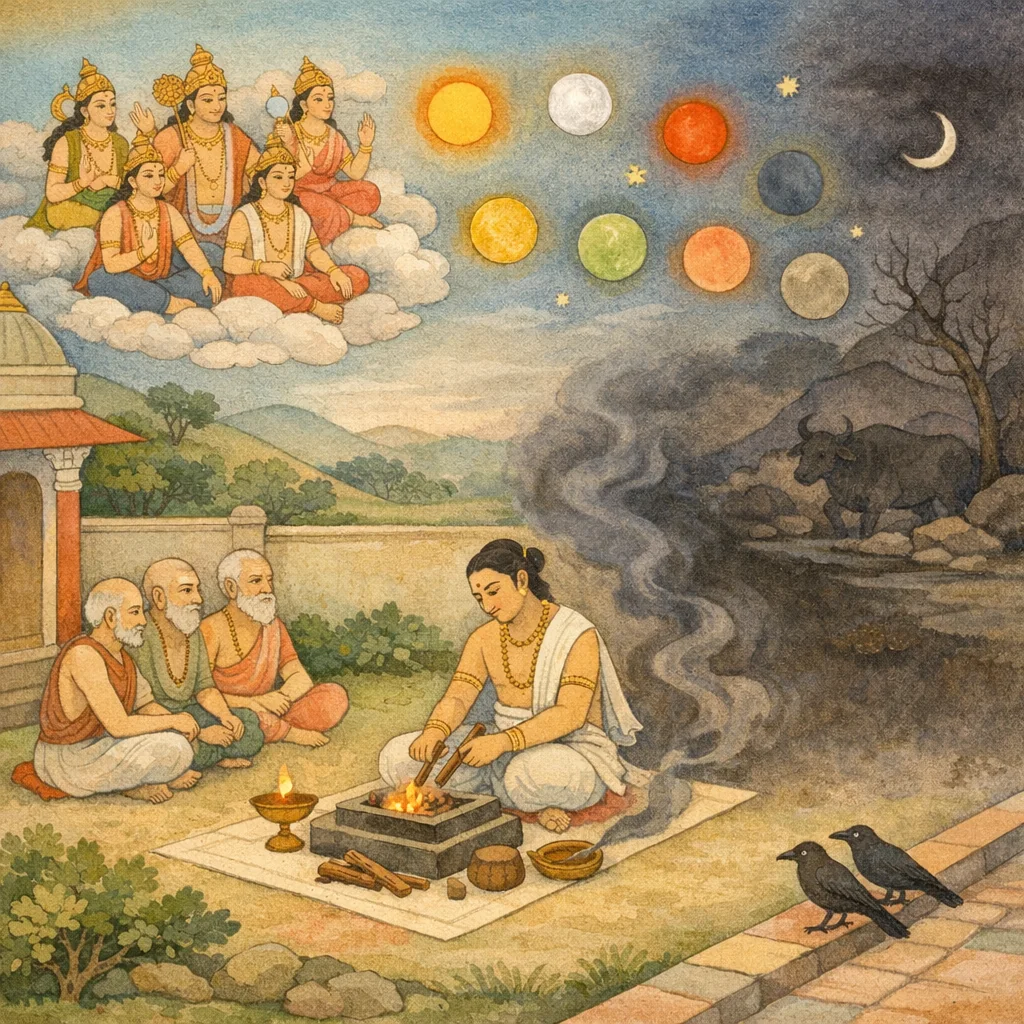
Continuing the ācāra-based teaching on daily rites, Brahmā explains the defining features of the Vaiśvadeva offering. The practitioner kindles the sacred fire, performs purificatory sprinkling, and recites mantras that (a) drive the “stream of impurity” away toward Yama’s realm and (b) establish Jātavedas/Vaiśvānara as the knowing fire that carries oblations to the Devas. Vaiśvānara is invoked as purifier and as the fire refined from the araṇis, awakened at the three appointed times. The rite then proceeds to an ordered distribution: svāhā oblations are offered to a graded list—Prajāpati through the Viśvedevas, Brahmā, the Waters, herbs and forest-lords, the powers of the Grahas, and the gods with their presiding deities—followed by Indra’s attendants, Yama and his messengers, daytime-moving beings, and earth-connected Pitṛs. The chapter ends by explicitly allotting a share to wandering, wretched, and harmful beings for their nourishment and well-being, petitioning Puṣṭipati for sustenance, extending even to outcaste realms and to crows, thus preparing the next ritual logic of pacification and comprehensive daily dharma.
Shlokas
Verse 1
नाम पञ्जदशोत्तरद्विशततमो ऽध्यायः ब्रह्मोवाच / वैश्वदेवं प्रवक्ष्यामि होमलक्षणमुत्तमम् / प्रज्वाल्य चाग्निं पर्युक्ष्य-ॐ क्रष्यादमग्निं प्रहिणोमि दूरं यमराज्यं गच्छतु रिप्रवाहः / इहैवायमितरो जातवेदा देवेभ्यो हव्यं वहतु प्रजानत् / ॐ पावक वैश्वानर इदमासनं अरणीगर्भसंस्कृततेजोरूप महाब्रह्मन् मुहूर्तास्त्रिषु वैश्वानरं प्रतिबोधयामि / ॐ वैश्वानरे न उभयं आप्रयातु परावतः अग्निर्न स्वद्युतीरूपपृष्ठो दिवि पृष्ठो ऽश्वि पृथिव्यां पृष्ठा विवेवा ओषधीचाविवेश वैश्वानरः सहसा पृष्ठो ऽग्निः नमो दिव्य स षष्ठां नक्तम्
Brahmā said: “I shall explain the supreme method and defining marks of the Vaiśvadeva (fire-offering). Having kindled the sacred fire and sprinkled it (with purifying water), one should recite: ‘Om—this fire I send far away; let the stream of impurity go to Yama’s realm. But may this other one—Jātavedas—remain here, knowing well, and carry the oblation to the Devas.’”
Verse 2
ॐ प्रजापतये स्वाहा / ॐ सोमाय स्वाहा / ॐ बृहस्पतये स्वाहा / ॐ अग्निषोमाभ्यां स्वाहा / ॐ इन्द्राग्निभ्यां स्वाहा / ॐ द्यावापृथिवीभ्यां स्वाहा / ॐ इन्द्राय स्वाहा / ॐ विश्वेभ्यो देवेभ्यः स्वाहा / ॐ ब्रह्मणे स्वाहा / ॐ अद्भ्यः स्वाहा / ॐ ओषधिवनस्पतिभ्यः स्वाहा / ॐ ग्रह्याय स्वाहा / ॐ देवदेवताभ्यः स्वाहा / ॐ इन्द्राय स्वाहा / ॐ इन्द्रपुरुषेभ्यः स्वाहा / ॐ यमाय स्वाहा / ॐ यमपुरुषाय स्वाहा / ॐ सर्वेभ्यो भूतेभ्यो दिवाचारिभ्यः स्वाहा / ॐ वसुधापितृभ्यः स्वाहा / ॐ ये भूता प्रचरन्ति दीनाच निमिहन्तो भुवनस्य मध्ये / तेभ्यो बलिं पुष्टिकामो ददामि मयि पुष्टिं पुष्टिपतिर्ददातु / ॐ आचाण्डालपतिर्ददातु आचाण्डालपतितवायसेभ्यः
Oblations are offered with “svāhā” to Prajāpati, Soma, Bṛhaspati... To those beings that wander about—wretched and harming (others) in the midst of the world—to them I give this offering, desiring nourishment and well-being. May Puṣṭipati (the Lord of nourishment) grant nourishment to me. May the lord over even the outcaste-realms grant it—(and) to those associated with that lord, even to the crows.
Frequently Asked Questions
Jātavedas is invoked as the ‘knower’ fire who remains established to convey offerings to the Devas, while Vaiśvānara is praised as the purifier and cosmic fire present in plants and herbs. Together they express Agni’s dual function: sustaining the sacrificial link upward while purifying and stabilizing life within the world.
By acknowledging Yama’s jurisdiction over impurity, death, and moral accounting, the rite ritually ‘routes’ polluting forces away from the household and pacifies liminal agencies. This is not worship of impurity but a controlled, dharmic accommodation of cosmic administration so the sacrifice remains unobstructed.
The text explicitly notes Agni’s presence in plants and herbs, implying an ecology of sacrifice: life-supporting elements are honored as divine supports of nourishment. Offering to Waters, herbs, and forest-lords integrates bodily sustenance, medicine, and environment into the daily sacred economy of the home.