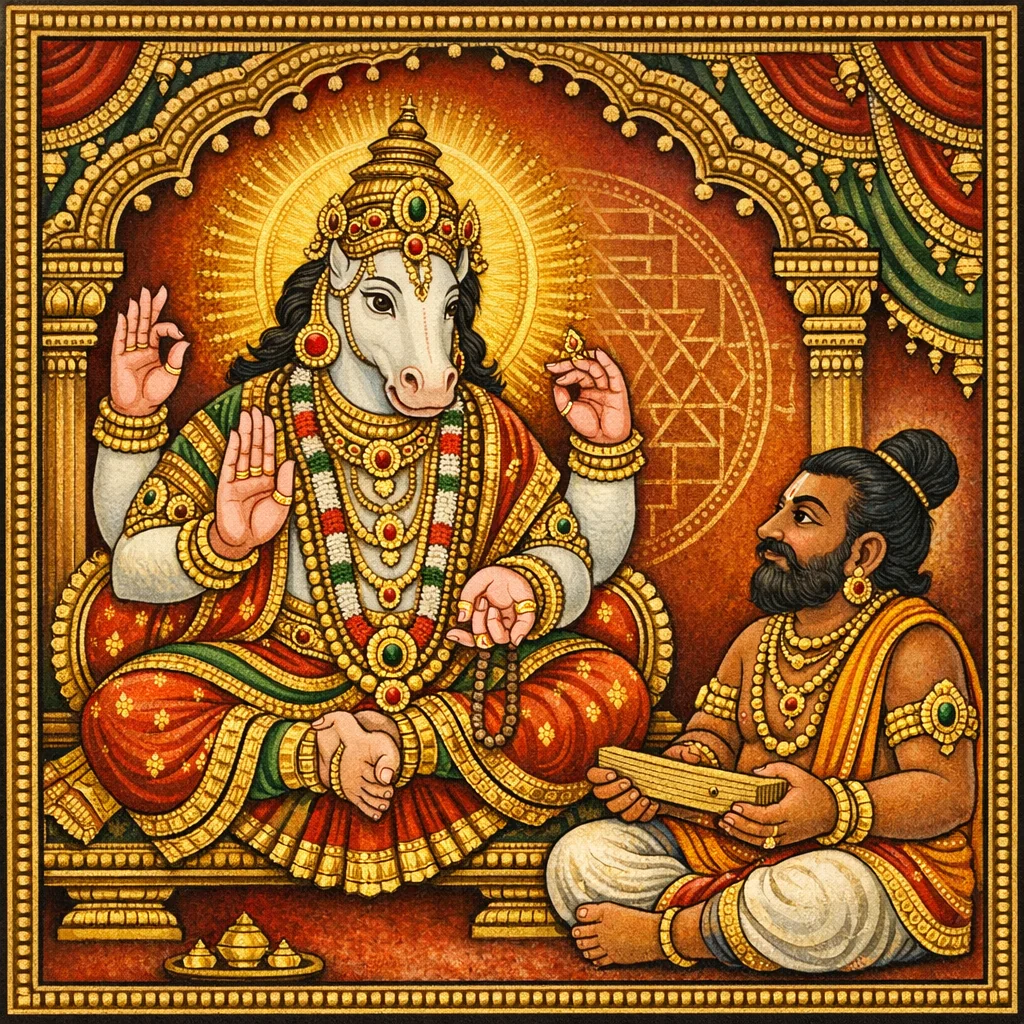
Adhyaya 42
Mudrā-vidhāna (Lalitopākhyāna): Āvāhanī–Saṃkṣobhiṇī–Ākarṣiṇī and allied Mudrās
This adhyāya, in the Uttara-bhāga of the Lalitopākhyāna within the Hayagrīva–Agastya dialogue, gives procedural teaching on mudrās—hand-seals that delight Śrī Devī. At Agastya’s request, Hayagrīva sets out a technical sequence, naming each mudrā and detailing finger placements and variants: Āvāhanī Mahāmudrā (also called Trikhaṇḍā), Saṃkṣobhiṇī with its modification Vidrāviṇī, and Ākarṣiṇī, expressly said to “attract the three worlds.” He then describes further seals such as Unmādinī, Mahāṅkuśā (praised as universally efficacious for accomplishing aims), Khecarī (supremely excellent and pleasing to yoginīs by mere knowledge), and a Bīja-mudrā that quickly initiates all siddhis. The chapter is chiefly ritual-technical (śakti-vijñāna), encoding embodied liturgy as precise, repeatable gestures in a transmitted tantric–Purāṇic instruction style.
Shlokas
Verse 1
इति श्रीब्रह्माण्डमहापुराणे उत्तरभागे हयग्रीवागस्त्यसंवादे ललितोपाख्याने एकचत्वारिंशो ऽध्यायः अगस्त्य उवाच मुद्राविरचनारीतिमश्वानन निवेदय / याभिर्विरचिताभिस्तु श्रीदेवी संप्रसीदति
Thus, in the Śrī Brahmāṇḍa Mahāpurāṇa, in the latter section, in the dialogue of Hayagrīva and Agastya, in the Lalitā narrative, begins the forty-first chapter. Agastya said: “O Aśvānana, teach me the method of forming the mudrās by which Śrī Devī is graciously pleased.”
Verse 2
हयग्रीव उवाच आवाहनी महामुद्रा त्रिखण्डेति प्रकीर्तिता / परिवृत्य करौ स्पष्टमङ्गुष्ठौ कारयेत्समौ
Hayagrīva said: “The great invoking mudrā (āvāhanī mahāmudrā) is renowned as ‘Trikhaṇḍā’. Turning both hands, one should clearly set the two thumbs evenly alike.”
Verse 3
अनामान्तर्गते कृत्वा तर्जन्यौ कुटिलाकृती / कनिष्ठिके नियुञ्जीत निजस्थाने तपोधन / संक्षोभिण्याख्यामुद्रां तु कथयाम्यधुना श्रुणु
Placing both index fingers within the ring fingers, bend them into a curved form. Then, O rich in austerity, set the little finger in its proper place. Now listen as I describe the mudrā called ‘Saṃkṣobhiṇī’.
Verse 4
मध्यमे मध्यगे कृत्वा कनिष्ठाङ्गुष्टरोधिते / तर्जन्यो दण्डवत्कृत्वा मध्यमोपर्यनामिके
Place the middle finger in the central position, with the little finger and thumb held in restraint. Make the index finger straight like a staff, and set the middle finger upon the ring finger.
Verse 5
एतस्या एव मुद्राया मध्यमे सरले यदि / क्रियते विन्ध्यदर्पारे मुद्रा विद्राविणी तथा
This very mudrā—if the middle finger is held straight in the center and it is performed upon the firm flank of the Vindhya—then it is likewise called the Vidrāviṇī Mudrā, the dispeller of obstacles.
Verse 6
मध्यमातर्जनीभ्यां तु कनिष्ठानामिके समे / अङ्कुशाकाररूपाभ्यां मध्यगे कलशोद्भव / इयमाकर्षिणी मुद्रा त्रैलोक्याकर्षणे क्षमा
O Kalaśodbhava! When the middle and index fingers are set level with the little and ring fingers, taking in the center the form of an aṅkuśa (goad-hook), this is the Ākarṣiṇī Mudrā, fit to draw in the three worlds.
Verse 7
पुटाकारौ करौ कृत्वा तर्जन्यावङ्कुशाकृती / परिवर्तक्रमेणैव मध्यमे तदधोगते
Make both hands into the puṭa (cupped) form, with both index fingers shaped like an aṅkuśa; then, by the very sequence of turning, let the middle finger come to rest beneath it.
Verse 8
क्रमेणानेन देवर्षे मध्यमामध्यगे ऽनुजे / अनामिके तु सरले तद्बहिस्तर्जनीद्वयम्
O Devarṣi! In this sequence, place the middle finger in the center and the little finger beneath it; keep the ring finger straight, and set both index fingers to the outside.
Verse 9
दण्डाकारौ ततोंऽगुष्ठौ मध्यमावर्तदेशगौ / मुद्रैषोन्मादिनी नाम्ना ख्याता वातापितापन
Then shape both thumbs like a staff (daṇḍa) and place them at the turning-point of the middle finger; this mudrā is famed by the name Unmādinī, which soothes afflictions caused by wind and heat.
Verse 10
अस्यास्त्वनामिकायुग्ममधः कृत्वाङ्कुशाकृति / तर्जन्यावपि तेनैव क्रमेण विनियोजयेत्
Bend the pair of ring fingers downward, shaping them like an aṅkuśa (the sacred goad), and in the same order arrange the index fingers as well.
Verse 11
इयं महाङ्कुशा मुद्रा सर्वकार्यार्थसाधिका
This is the Mahāṅkuśā mudrā, the accomplisher of the aims of all undertakings.
Verse 13
सव्यं दक्षिणादेशे तु दक्षिणं सव्यदेशतः / बाहू कृत्वा तु देवर्षे हस्तौ सम्परिवर्त्य च ४२।१२ / कनिष्ठानामिके युक्ते क्रमेणानेन तापस / तर्जनीभ्यां समाक्रान्ते सर्वोर्ध्वमपि मध्यमे
O devarṣi, place the left hand on the right side and the right on the left, then rotate so the hands are interchanged. O ascetic, join the little finger and ring finger in this order, and with both index fingers press and encompass the middle finger entirely, even up to its top.
Verse 14
लोपामुद्रापतेङ्गुष्ठौ कारयेत्सकलावपि / इयं तु खेचरी नाम मुद्रा सर्वोत्तमोत्तमा / एतद्विज्ञानमात्रेण योगिनीनां प्रियो भवेत्
Let both thumbs fully form the Lopā-mudrā. This mudrā is called Khecarī, the most supreme of the supreme. By the mere knowledge of this teaching, the yogin becomes dear to the yoginīs.
Verse 15
परिवर्त्य करौ स्पृष्टावर्धचन्द्रसमाकृती / तर्जन्यङ्गुष्ठयुगलं युगपद्योजयेत्ततः
Having turned the hands and brought them into contact, shape them like a half-moon; then join, at once, the pair of index fingers with the pair of thumbs.
Verse 16
अधः कनिष्ठावष्टब्धमध्यमे विनियोजयेत् / अथैते कुटिले युक्त्वा सर्वाधस्तादनामिके / बीजमुद्रेयमाचिरात्सर्वसिद्धप्रवर्तिनी
Press the little finger downward and set it upon the middle finger. Then, bending these into a curved form, place the ring finger lowest of all. This is the Bīja-mudrā, which swiftly sets all siddhis in motion.
Verse 17
मध्याग्रे कुटिलाकारे तर्जन्युपरि संस्थिते / अनामिकामध्यगते तथैव हि कनिष्टिके
Curve the tip of the middle finger and place it upon the index finger. Let the ring finger be set in the middle, and the little finger likewise.
Verse 18
सर्वा एकत्र संयोज्य चाङ्गुष्ठपरिपीडिताः / एषा तु प्रथमा मुद्रा योनिमुद्रेति संज्ञिता
Join all the fingers together in one place and press them with the thumb. This is the first mudrā, known as the Yoni-mudrā.
Verse 19
एता मुद्रास्तु देवर्षे श्रीदेव्याः प्रीतिहेतवः / पूजाकाले प्रयोक्तव्या यथानुक्रमयोगतः
O Devarṣi, these mudrās are the causes of Śrī Devī’s delight. At the time of pūjā they should be employed in their proper yogic sequence.
Frequently Asked Questions
None directly; this chapter is not a vamśa catalog. It is a Lalitopākhyāna ritual-technical unit focused on mudrā-vidhāna transmitted through the Hayagrīva → Agastya teaching line.
Key mudrās include Āvāhanī (Mahāmudrā/Trikhaṇḍā) for invocation-oriented practice, Saṃkṣobhiṇī and its variant Vidrāviṇī for ‘agitating/dispersing’ effects, Ākarṣiṇī explicitly for attraction (trailokyākarṣaṇa), Mahāṅkuśā as broadly ‘all-purpose’ for accomplishing aims, Khecarī as a highly praised yoginī-favored seal, and a Bīja-mudrā said to quickly set siddhis in motion.
It operationalizes devotion to Śrī Devī through embodied liturgy: mudrās serve as standardized “ritual interfaces” that authorize, focus, and sequence sādhana, presenting Shākta power not only as narrative theology but as repeatable practice transmitted by recognized speakers.