Adhyaya 17
Kiṃpuruṣa–Harivarṣa–Ilāvṛta-varṣa-varṇanam (Description of the Varṣas: Kiṃpuruṣa, Hari, and Ilāvṛta)
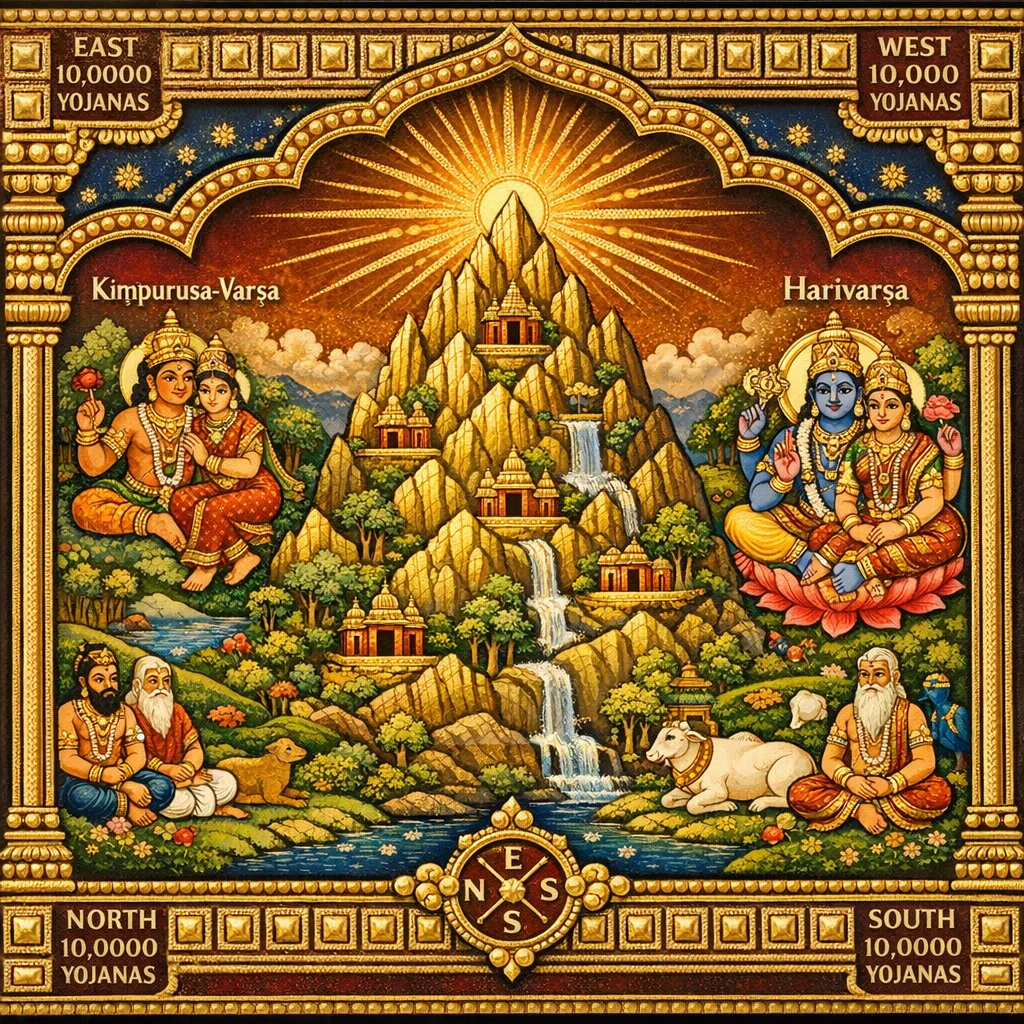
This adhyāya unfolds as a question-and-answer dialogue: the ṛṣis ask Sūta to clarify the lands adjoining Bhārata previously mentioned—Kiṃpuruṣa-varṣa and Harivarṣa—and then the central Ilāvṛta-varṣa. Sūta, conveying Purāṇic cosmography, lists each varṣa’s defining conditions: the land’s beauty and abundance, the inhabitants’ bodily traits, customary foods and tastes (rasas), and extraordinary longevity free from disease and sorrow. The account then turns to Ilāvṛta as the “middle” region in the Meru-centered world-model, describing distinctive luminous conditions (including the absence of ordinary solar heat/light, as indicated) and idealized human qualities. A technical register appears in the measurement passages, giving Meru’s extent by direction and large yojana-based dimensions as part of a systematic spatial grid rather than a travelogue. Overall, the chapter reads like a micro-atlas entry—ethnography, environment, lifespan, and measurement—anchored in didactic dialogue.
Shlokas
Verse 1
इति श्रीब्रदृमहापुराणे वायुप्रोक्ते पूर्वभागे द्वितीये ऽनुषङ्गपादे भारतवर्मतं नाम षोडशो ऽध्यायः ऋषय ऊचुः यच्च किंपुरुषं वर्षं हरिवर्षं तथैव च / आचक्ष्व नो यथातत्त्वं कीर्त्तितं भारतं त्वया
Thus, in the Śrī Brahmāṇḍa Mahāpurāṇa, in the former section spoken by Vāyu, in the second anuṣaṅga-pāda, is the sixteenth chapter called “Bhāratavarmata.” The ṛṣis said: “Tell us truly, as it is, of Kiṃpuruṣa-varṣa and likewise of Hari-varṣa; you have already praised Bhārata-varṣa.”
Verse 2
सूत उवाच शुश्रूषा यत्र वो विप्रास्तच्छृणुध्वमतन्द्रिताः / प्लक्षखण्डः किंपुरुषे सुमहान्नन्दनोपमः
Sūta said: “O vipras, listen without heedlessness to what you wish to hear. In Kiṃpuruṣa-varṣa lies Plakṣa-khaṇḍa, exceedingly vast, like the celestial grove of Nandana.”
Verse 3
दशवर्षसहस्राणि स्थितिः किंपुरुषे स्मृता / सुवर्णवर्णाः पुरुषाः स्त्रियश्चाप्सरसो पमाः
In Kiṃpuruṣa-varṣa, the span of life is remembered as ten thousand years. The men are golden-hued, and the women are like apsarās.
Verse 4
अनामया अशोकाश्च नित्यं मुदितमानसाः / जायन्ते मानवास्तत्र निस्तप्तकनकप्रभाः
There the people are free from illness and sorrow, ever of joyful mind. Those born there shine with the splendor of refined, fire-bright gold.
Verse 5
वर्षे किंपुरुषे पुण्ये वृक्षो मधुवहः शुभः / तस्य किंपुरुषाः सर्वे ऽपिबन् हि रसमुत्तमम्
In the holy Kiṃpuruṣa-varṣa stands an auspicious tree called Madhuvaha. All the kiṃpuruṣas there drink its finest essence, a supreme nectar.
Verse 6
ततः परं किंपुरुषो हरिवर्षः प्रचक्षते / महारजतसंकाशा जायन्ते तत्र मानवाः
Beyond that, past the land of the Kiṃpuruṣas, lies what is called Harivarṣa; there humans are born radiant, shining like great silver.
Verse 7
देवलोकच्युताः सर्वे देवानूकाश्च सर्वेशः / हरिवर्षे नराः सर्वे पिबन्तीक्षुरसं शुफम्
O Lord of all, there all are fallen from the world of the gods and are attendants of the Devas; in Harivarṣa all people drink the pure juice of sugarcane.
Verse 8
एकादश सहस्राणि वर्षाणां तु निरामयाः / हरिवर्षे तु जीवन्ति सर्वे मुदितमानसाः
In Harivarṣa all live free from illness for eleven thousand years, their minds filled with joy.
Verse 9
न जरा बाधते तत्र न म्रियन्ते च ते ऽचिरात् / मध्यमं यन्मया प्रोक्तं नाम्ना वर्षमिलावृतम्
There old age does not trouble them, nor do they die quickly. The central varṣa of which I have spoken is named Ilāvṛta.
Verse 10
न तत्र सूर्यस्तपति न तु जीर्यन्ति मानवाः / चन्द्रसूर्यै सनक्षत्रौ न प्रकाशाविला वृते
There the sun does not scorch, and humans do not grow old; in Ilāvṛta there is no light of moon or sun, nor even of the stars.
Verse 11
पद्मप्रभाः पद्बवर्णास्तथा पद्बनिभेक्षणाः / पद्मपत्रसुगन्धाश्च जायन्ते तत्र मानवाः
There, humans are born with lotus-like radiance, lotus hue, lotus-like eyes, and the sweet fragrance of lotus leaves.
Verse 12
जंबूफलरसाहारा अनिष्यन्दाः सुगन्धिनः / मनस्विनो भुक्तभोगाः सत्कर्मफलभोगिनः
They live on the juice of the jambu fruit, free from decline, fragrant, strong-minded; having enjoyed delights, they partake of the fruits of righteous deeds.
Verse 13
देवलोकच्यताश्चैव महारजतवाससः / त्रयोदशसहस्राणि वर्षाणां ते नरोत्तमाः
Though fallen from the realm of the gods, they wear splendid silver garments; those best of men live for thirteen thousand years.
Verse 14
आयुः प्रमाणं जीवन्ति ये तु वर्ष इलावृते / मेरोः प्रतिदिशं यच्च नवसाहस्रविस्तृतम्
Those who dwell in Ilāvṛta-varṣa live out the full measure of their lifespan; and from Mount Meru in every direction, the expanse extends nine thousand yojanas.
Verse 15
योजनानां सहस्राणि षट्त्रिंशत्तस्य विस्तरः / यतुरस्रं समन्ताच्च शरावाकारसंस्थितम्
Its breadth is thirty-six thousand yojanas; it is square on all sides and set in the form of a bowl (śarāva).
Verse 16
मेरोः पश्चिमभागे तु नवसाहस्रसम्मिते / चतुस्त्रिंशत्सहस्राणि गन्धमादनपर्वतः
On the western side of Mount Meru, in a region measured as nine thousand yojanas, the Gandhamādana Mountain extends for thirty-two thousand yojanas.
Verse 17
उदग्दक्षिणतश्चैव आनीलनिषधायतः / चत्वारिंशत्सहस्राणि परिवृद्धो महीतलात्
To the north and to the south, in accordance with the extent of the Ānīla and Niṣadha ranges, it rises from the earth’s surface to a height of forty thousand yojanas.
Verse 18
सहस्रमवगाढश्च तावदेव च विस्तृतः / पूर्वेण माल्यवाञ्छैलस्तत्प्रमाणः प्रकीर्त्तितः
It is sunk to a depth of one thousand yojanas and is spread as wide as that; to the east, the Mālyavān Mountain is declared to be of the same measure.
Verse 19
दक्षिणेन तु नीलश्च निषधश्चोत्तरेण तु / तेषां मध्ये महामेरुः स्वैः प्रमाणैः प्रतिष्ठितः
To the south is the Nīla Mountain and to the north the Niṣadha Mountain; between them stands Mahāmeru, established according to its own measures.
Verse 20
सर्वेषामेव शैलानामवगाढो यथा भवेत् / विस्तरस्तत्प्रमाणः स्यादायामो नियुतं स्मृतः
For all mountains, whatever their depth of sinking (avagāha) may be, that is to be taken as the measure of their breadth; their length is remembered as ‘niyuta’ in the tradition.
Verse 21
वृत्तभावास्समुद्रस्य महीमण्डलभावतः / आयामाः परिहीयन्ते चतुरस्रसमाः स्मृताः
By the ocean’s circular nature and the condition of the earth-disc, its stretches diminish in measure; they are remembered as equal to a quadrangle.
Verse 22
इलावृतं चतुष्कोणं भिन्दन्ती मध्यभागतः / प्रभिन्नाञ्जनसंकाशा जम्बूरसवती नदी
From the very middle it cleaves Ilāvṛta, the four-cornered land; the river Jambūrasavatī flows, darkly lustrous like shattered anjana stone.
Verse 23
मेरोस्तु दक्षिणे पार्श्वे निषधस्योत्तरेण च / सुदर्शनो नाम महाञ्जम्बूवृक्षः सनातनः
On the southern side of Meru, and to the north of Niṣadha, stands the eternal great jambu tree named Sudarśana.
Verse 24
नित्यपुष्पफलोपेतः सिद्धचारणसेवितः / तस्य नाम्ना समा ख्यातो जम्बूद्वीपो वनस्पतेः
Ever adorned with flowers and fruits, and attended by Siddhas and Cāraṇas; by the name of that sacred tree this land is famed as Jambūdvīpa.
Verse 25
योजनानां सहस्रं च शतं चान्यन्महात्मनः / उत्सेधो वृक्षराजस्य दिवं स्पृशति सर्वतः
The height of that great-souled king of trees is a thousand and a further hundred yojanas; on every side it touches the heavens.
Verse 26
अरत्नीनां शतान्यष्टावेकषष्ट्यधिकानि तु / फलप्रमाणं संख्यातमृषिभिस्तत्त्वदर्शिभिः
The seers who behold the truth have reckoned its measure: the Jambū fruit is said to be eight hundred and sixty-eight aratnis in size.
Verse 27
पतमानानि तान्युर्व्यां कुर्वन्ति विपुलं स्वनम् / तस्या जम्ब्वाः फलरसो नदी भूत्वा प्रसर्प्पति
As those fruits fall upon the earth, they raise a mighty sound; and the juice of that Jambū fruit spreads forth, becoming a river.
Verse 28
मेरुं प्रदक्षिणं कृत्वा जम्बूमूलं विशत्यधः / तं पिबन्ति सदा त्दृष्टा जंबूरसमिलावृते
That river, having circumambulated Meru, descends and enters beneath the root of the Jambū tree; the dwellers in Ilāvṛta ever drink of it.
Verse 29
जंबूफलरसे पीते न जरा बाधते तु तान् / न क्षुधा न श्रमश्चापि न मृत्युर्न च तन्द्रि तम्
When the juice of the Jambū fruit is drunk, old age does not afflict them; neither hunger nor weariness arises—nor death, nor slothful drowsiness.
Verse 30
तत्र जांबूनदं नाम कनकं देवभूषमम् / इन्द्रगोपकसंकाशं जायते भास्वरं तु तत्
There arises gold called Jāmbūnada, fit for the adornment of the gods; it shines brilliantly, like the indragopaka insect.
Verse 31
सर्वेषां वर्षवृक्षाणां शुभः फलरसः स्तुतः / स्कन्नं भवति तच्छुभ्रं कनकं देवभूषणम्
Of all the trees in the regions, the auspicious juice of their fruits is praised; when it flows down, it becomes pure, radiant gold—an ornament of the gods.
Verse 32
तेषां मूत्रं पुरीषं च दिक्षु सर्वासु सर्वशः / ईश्वरानुग्रहाद्भूमिर्मृताश्च ग्रसते तु तान्
Their urine and dung spread everywhere in all directions; by the grace of the Lord, the earth—and even the dead—swallow them up.
Verse 33
रक्षःपिशाचयक्षाश्च सर्वे हैमवतः स्मृताः / हेमकूटे तु गन्धर्वा विज्ञेयाः साप्सरोगणाः
Rākṣasas, piśācas, and yakṣas are all remembered as dwelling in Haimavata; on Hemakūṭa, know the gandharvas together with the hosts of apsarās.
Verse 34
सर्वे नागस्तु निषधे शेषवासुकितक्षकाः / महामेरौ त्रयस्त्रिंशत्क्रीडन्ते यज्ञियाः सुराः
In Niṣadha dwell all the nāgas—Śeṣa, Vāsuki, and Takṣaka; upon Mahāmeru the thirty-three gods, worthy of yajña, sport in delight.
Verse 35
नीले तु वैदूर्यमये सिद्धा ब्रह्मर्षयो ऽमलाः / दैत्यानां दानवानां चर् श्वेतः पर्वत उच्यते
On Nīla, the mountain of vaidūrya gems, dwell the stainless siddhas and brahmarṣis; and the abode of the daityas and dānavas is called the White Mountain, Śveta.
Verse 36
शृङ्गवान्पर्वतश्रेष्ठः पितॄणां प्रतिसंचरः / नवस्वेतेषु वर्षेषु यथाभागं स्थितेषु वै
Śṛṅgavān, the foremost of mountains, is the path of passage for the Pitṛs; and in those nine Śveta-varṣas they abide, each according to its allotted share.
Verse 37
भूतान्युपनिविष्टानि गतिमन्ति ध्रुवाणि च / तेषां विवृद्धिर्बहुधा दृश्यते दिव्यमानुषी / न संख्या परिसंख्यातुं श्रद्धेया तु बुभूषताम्
There dwell countless beings—some in motion, some steadfast; their increase is seen in many ways, in forms both divine and human. Their number cannot be fully reckoned; seekers of understanding should receive this with faithful reverence.
Frequently Asked Questions
Kiṃpuruṣa-varṣa, Harivarṣa, and the central Ilāvṛta-varṣa are presented as adjacent/related zones within Jambūdvīpa’s Meru-centered arrangement, enabling a comparative cosmographic profile around Bhārata-varṣa.
The sample indicates Meru’s directional spread (prati-diśam) and yojana-based dimensions (including very large numerical extents and a described geometric form), reflecting the Purāṇic practice of mapping space via standardized units.
No. The provided verses are predominantly geographic and ethnographic (varṣa descriptions, lifespans, environmental features, Meru measurements) rather than dynastic catalogs or Śākta narrative cycles like Lalitopākhyāna.