Adhyaya 33
Trailokya-vijaya Kavacha (Śrī Kṛṣṇa-kavaca) — त्रैलोक्यविजयकवचम्
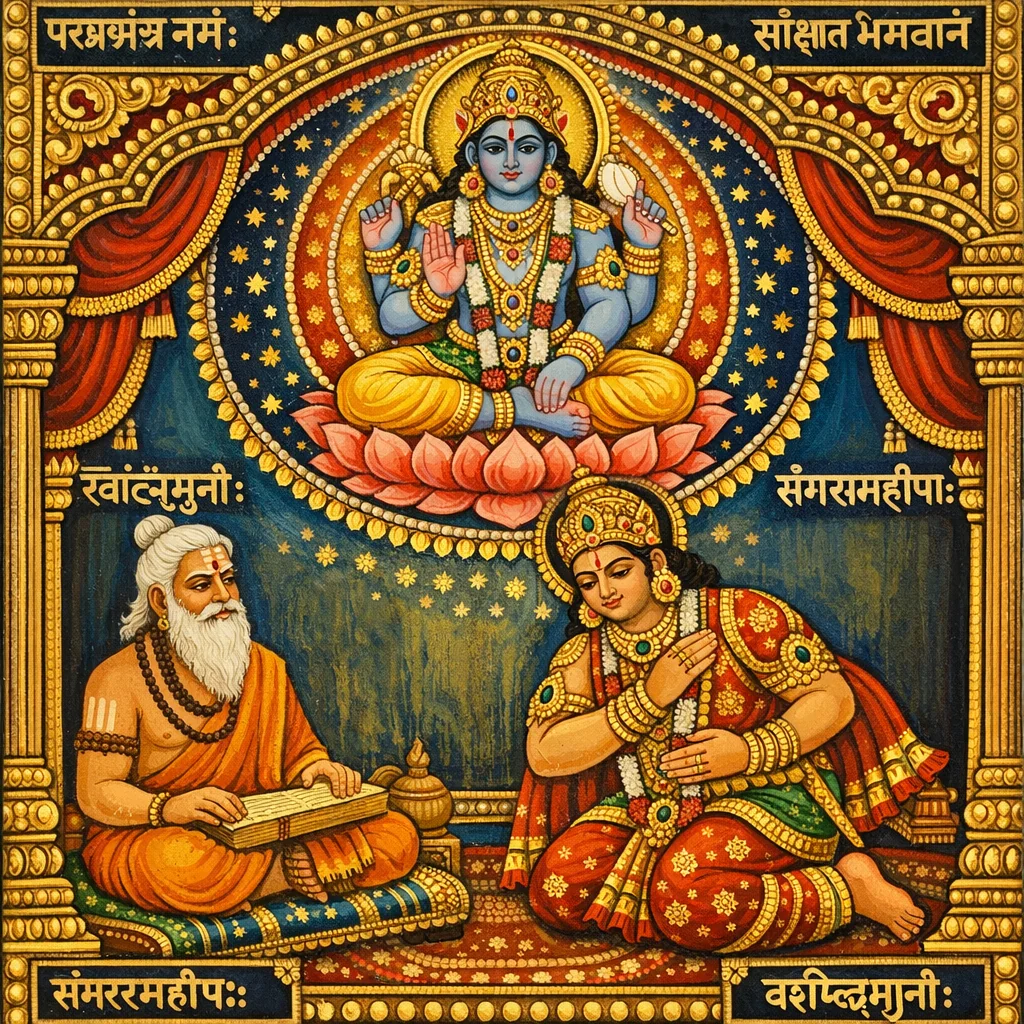
This chapter is cast as a dialogue: King Sagara asks for a universally effective protective armor (kavaca) said to grant “trailokya-vijaya”—victory and safeguarding across the three worlds. Sage Vasiṣṭha replies by teaching a supremely wondrous (paramādbhuta) kavaca and its mantra-method: (i) a daśārṇa mahāmantra ending in svāhā, (ii) the standard mantra-śāstra details of ṛṣi, chandas, devatā, and viniyoga, and (iii) an aṅga-nyāsa mapping that assigns Kṛṣṇa’s sacred names—along with epithets such as Govinda, Gopāla, Mukunda, Hari, Viṣṇu, Rāmeśvara, Rādhikeśa, and others—to protect specific body parts from head and eyes to arms and hands. The adhyāya thus serves as a ritual manual within Purāṇic narrative, encoding protection, devotion, and sacral kingship through precise recitation cues and affirming Kṛṣṇa as the all-encompassing protector for worldly well-being (bhukti) and liberation (mukti).
Shlokas
Verse 1
इति श्रीब्रह्माण्डे महापुराणे वायुप्रोक्ते मध्यभागे तृतीय उपोद्धातपादे भार्गवचरिते द्वात्रिंशत्तमो ऽध्यायः // ३२// सगर उवाच श्रुतं सर्वं मुनिश्रेष्ठ कीर्त्यमानं त्वया विभो / कवचं वद सर्वत्र त्रैलोक्यविजयप्रदम्
Thus, in the Śrī Brahmāṇḍa Mahāpurāṇa, in the middle section spoken by Vāyu, in the third introductory division, in the Bhārgava narrative, ends the thirty-second chapter. Sagara said: “O best of sages, I have heard all that you have recounted; O Lord, speak the kavaca that grants victory over the three worlds everywhere.”
Verse 2
वसिष्ठ उवाच शृणु वत्स प्रवक्ष्यामि कवचं परमाद्भुतम् / मन्त्र च सिद्धिद शश्वत्साधकानां सुखावहम्
Vasiṣṭha said: “Listen, my child; I shall proclaim a most wondrous kavaca. It is a mantra that bestows siddhi and ever brings happiness to practitioners.”
Verse 3
गोपीजनपदस्यात वल्लभाय समुच्चरेत् / स्वाहान्तो ऽयं महामन्त्रो दशार्णो भुक्तिमुक्तिदः
One should recite: “gopī-janapadasyāt vallabhāya.” This ten-syllabled great mantra, ending with “svāhā,” bestows both worldly enjoyment and liberation.
Verse 4
सदाशिवस्त्वस्य ऋषिः पङ्क्तिश्छन्द उदाहृतम् / देवता कृष्ण उदितो विनियोगो ऽखिलाप्तये
The seer (ṛṣi) of this mantra is Sadāśiva; its metre is declared to be Paṅkti. The presiding deity is Kṛṣṇa, the Manifest One; its application is for the attainment of all blessings.
Verse 5
त्रैलोक्यविजयस्याथ कवचस्य प्रजापतिः / ऋषिश्छन्दश्च जगती देवो राजेश्वरः स्वयम्
For the kavaca of the Victory over the Three Worlds, the seer is Prajāpati. The metre is Jagatī; the deity is Rājeśvara Himself.
Verse 6
त्रैलोक्यविजयप्राप्तौ विनियोगः प्रकीर्त्तितः / प्रणवो मेशिरः पातु श्रीकृष्णाय नमः सदा
Its application is declared for attaining victory over the three worlds. May the Praṇava guard my head; ever, salutations to Śrī Kṛṣṇa.
Verse 7
पायात्कपालं कृष्णाय स्वाहेति सततं मम / कृष्णेति पातु नेत्रे मे कृष्णस्वाहेति तारकाम्
May “Kṛṣṇāya svāhā” ever protect my skull and brow. May “Kṛṣṇa” guard my eyes; and may “Kṛṣṇasvāhā” protect my pupils (tārakā).
Verse 8
हरये नम इत्येष भ्रूलतां पातु मे सदा / ॐ गोविन्दाय स्वाहेति नासिकां पातु संततम्
May “Haraye namaḥ” ever protect my eyebrows. May “Oṁ Govindāya svāhā” continually protect my nose.
Verse 9
गोपालाय नमो गण्डं पातु मे सततं मनुः / क्लीं कृष्णाय नमः कर्णौं पातु कल्पतरुर्मम
Homage to Gopāla—may this mantra ever protect my cheeks. “Klīṃ, salutations to Kṛṣṇa”—may the wish-fulfilling Kalpataru guard my ears.
Verse 10
श्रीं कृष्णाय नमः पातु नित्यं मे ऽधरयुग्मकम् / ॐ गोपीशाय स्वाहेति दन्तपङ्क्तिं ममावतु
“Śrīṃ, salutations to Kṛṣṇa”—may it ever protect my pair of lips. “Oṃ, to Gopīśa, svāhā”—may it safeguard my row of teeth.
Verse 11
श्रीकृष्णेति रदच्छिद्रं पातुमे त्र्यक्षरो मनुः / ॐ श्रीकृष्णाय स्वाहेति जिह्विकां पातु मे सदा
“Śrīkṛṣṇa”—may this three-syllabled mantra protect the spaces of my teeth. “Oṃ, to Śrīkṛṣṇa, svāhā”—may it ever guard my tongue.
Verse 12
रामेश्वराय स्वाहेति तालुकं पातु मे सदा / राधिकेशाय स्वाहेति कण्ठं मे पातु सर्वदा
“To Rāmeśvara, svāhā”—may it ever protect my palate. “To Rādhikeśa, svāhā”—may it always guard my throat.
Verse 13
नमो गोपीगणेशाय ग्रीवां मे पातु सर्वदा / ॐ गोपेशाय स्वाहेति स्कन्धौ पातु सदा मम
Homage to Gopīgaṇeśa—may he ever protect my neck. “Oṃ, to Gopeśa, svāhā”—may he always guard my shoulders.
Verse 14
नमः किशोरवेषाय स्वाहा पृष्ठं ममावतु / उदरं पातु मे नित्यं मुकुन्दाय नमो मनुः
Homage to the Lord in youthful guise, svāhā—may He protect my back. Salutation to Mukunda—may He ever guard my belly.
Verse 15
ह्नीं श्रीङ्क्लीङ्कृष्णाय स्वाहा करौ पातु सदा मम / ॐ विष्णवे नमः स्वाहा बाहुयुग्मं ममावतु
Hnīṃ śrīṃ klīṃ to Kṛṣṇa, svāhā—may He ever protect my hands. Oṃ, obeisance to Viṣṇu, svāhā—may He guard my pair of arms.
Verse 16
ॐ ह्रींभगवते स्वाहा नखपङ्क्तिं ममावतु / नमो नारायणायेति नखरन्ध्रं ममावतु
Oṃ hrīṃ to the Blessed Lord, svāhā—may He protect the rows of my nails. With “namo Nārāyaṇāya”—may He guard the nail-beds and their crevices.
Verse 17
ॐ ह्रींश्रींपद्मनाभाय नाभिं पातु सदा मम / ॐ सर्वेशाय स्वाहेति केशान्मम सदावतु
Oṃ hrīṃ śrīṃ to Padmanābha—may He ever protect my navel. Oṃ to Sarveśa, svāhā—may He always guard my hair.
Verse 18
नमः कृष्णाय स्वाहेति ब्रह्मरन्ध्रं सदावतु / ॐ माधवाय स्वाहेति भालं मे सर्वदावतु
With “namaḥ Kṛṣṇāya, svāhā”—may my brahmarandhra be protected always. With “oṃ Mādhavāya, svāhā”—may my forehead be guarded at all times.
Verse 19
ॐ ह्रींश्रींरसिकेशाय कटिं मम सदावतु / नमो गोपीजनेशाय ऊरू पातु सदा मम
Om hrim-srim, homage to Rasikeśa; may He ever protect my waist. Homage to Gopījaneśa; may He always guard my thighs.
Verse 20
ॐ नमो दैत्यनाशाय स्वाहेत्यवतु जानुनी / यशोदानन्दनायेति नमोतो जङ्घके ऽवतु
Om, homage to the Destroyer of the daityas; with the cry “svāhā” may He protect my knees. Homage to Yaśodā’s Son; may He guard my shins.
Verse 21
रासारंभप्रियायेति स्वाहान्तो हीं ममावतु / वृन्दाप्रियाय स्वाहेति सकलाङ्गानि मे ऽवतु
Uttering “Beloved of the Rāsa’s beginning” and ending with “svāhā… hīṃ”, may this japa protect me. Uttering “Beloved of Vṛndā” with “svāhā”, may it guard all my limbs.
Verse 22
परिबुर्णमनाः कृष्मः प्राच्यां मां सर्वदावतु / स्वयं गोलोकनाथो मामाग्नेय्यां दिशि रक्षतु
May Kṛṣṇa, whose mind is wholly fulfilled, ever protect me in the eastern quarter. May Golokanātha Himself guard me in the southeast, the direction of Agni.
Verse 23
पूर्णब्रह्मस्वरूपश्च दक्षिणे मां सदावतु / नैरृत्यां पातु मां कृष्णाः पश्चिमे पातु मां हरिः
May the Lord, whose very form is the Full Brahman, ever protect me in the southern quarter. In the southwest may Kṛṣṇa guard me; in the west may Hari protect me.
Verse 24
गोविन्दः पातु वायव्यामुत्तरे रसिकेश्वरः / ऐशान्यां मे सदा पातु वृन्दावनविहार कृत्
May Govinda protect me in the northwest; in the north, Rasikeśvara, Lord of divine relish. In the northeast, may the Lord who sports in Vṛndāvana ever protect me.
Verse 25
वृन्दाप्राणेश्वरः शश्वत्पातु मामूर्द्ध्वदेशतः / सदैव मामधः पातु बलिध्वंसी महाबलः
From above, may Vṛndāprāṇeśvara ever protect me. From below, may the mighty Balidhvaṃsī, of great power, always guard me.
Verse 26
जले स्थले चान्तरिक्षे नृसिंहः पातु मां सदा / स्वप्ने जागरणे चैव पातु मां माधवः स्वयम्
In water, on land, and in the mid‑sky, may Nṛsiṃha ever protect me. In dream and in waking alike, may Mādhava Himself guard me.
Verse 27
सर्वान्तरात्मा निर्लिप्तः पातु मां सर्वतो विभुः / इति ते कथितं भूप सर्वाघौघविनाशनम्
May the all‑pervading Lord—inner Self of all, untouched and stainless—protect me on every side. O king, thus has it been told to you: it destroys the entire host of sins.
Verse 28
त्रैलोक्यविजयं नाम कवचं परमेशितुः / मया श्रुतं शिवमुखात्प्रवक्तव्यं न कस्यचित्
This is the sacred armor of the Supreme Lord, called “Trailokyavijaya”—Victory over the three worlds. I heard it from Śiva’s own lips; it is not to be disclosed to anyone.
Verse 29
गुरुमभ्यर्च्य विधिवत्कवचं धारयेत्तु यः / कण्ठे वा दक्षिणे बाहौ सो ऽपि विष्णुर्न संशयः
Whoever duly worships the Guru and then wears the kavacha on the neck or on the right arm—he too is Vishnu; of this there is no doubt.
Verse 30
स साधको ऽवसद्यत्र तत्र वाणीरमे स्थिते / यदि स्यात्सिद्धकवचो जीवन्मुक्तो न संशयः
Wherever that sādhaka dwells, there Vāṇī-rama (the abode of Sarasvatī) stands established; if his kavacha is perfected, he is a jīvanmukta—without doubt.
Verse 31
निश्चितं कोटिवर्षाणां पूजायाः फलमाप्नुयात् / राजसूर्यसहस्राणि वाजपेयशतानि च
He surely attains the fruit of worship spanning millions of years—equal to thousands of Rājasūya rites and hundreds of Vājapeya sacrifices.
Verse 32
महादानानि यान्येव भुवश्चापि प्रदक्षिणा / त्रैलोक्यविजयस्यास्य कलां नार्हन्ति षोडशीम्
No great gifts, nor even circumambulation of the earth, can equal even a sixteenth part of this ‘Conquest of the Three Worlds’.
Verse 33
व्रतोपवासनियमाः स्वाध्यायाध्ययने तथा / स्नानं च सर्वतीर्थेषु नास्यार्हन्ति कलामपि
Vows, fasts, and disciplines; sacred recitation and study; and bathing at all tīrthas—none of these is worthy even of a fraction of it.
Verse 34
सिद्धत्वममरत्वं च दासत्वं श्रीहरेरपि / यदि स्यात्सिद्धकवचः सर्वं प्राप्नोति निश्चितम्
Siddhi, immortality, and even devoted servitude to Śrī Hari—if one possesses the perfected Kavacha, one surely attains everything.
Verse 35
स भवेत्सिद्धकवचो दशलक्षं जपेत्तु यः / यो भवेत्सिद्धकवचो विजयी स भवेद् ध्रुवम्
He who performs ten lakhs of japa becomes one endowed with the perfected Kavacha; and whoever bears that perfected Kavacha is surely victorious.
Verse 36
राज्यं देयं शिरो देयं प्राणा देयाश्च भूपते / एतत्तु कवचं वत्स न देयं संकटे ऽपि च
O king, one may give away a kingdom, one may give one’s head, one may even give one’s life; but, dear child, this Kavacha must not be given away—even in distress.
Verse 37
मया प्रकाशितं यत्ते चैतेषां त्राणकारणात् / ममाज्ञाकरणाच्चैव तद्विद्धि कुलभास्कर / इदं धृत्वा तु कवचं चक्रवर्त्ती भवान्भव
O Kulabhāskara, I have revealed this to you for their protection and for the carrying out of my command—know it thus. Wearing this Kavacha, become a cakravartin.
Frequently Asked Questions
King Sagara petitions Vasiṣṭha for a kavaca described as ‘sarvatra’ effective and ‘trailokya-vijaya-prada’—protective power/victory extending across the three worlds.
The chapter explicitly supplies mantra metadata: one segment assigns Sadāśiva as ṛṣi with Paṅkti chandas and Kṛṣṇa as devatā for all-attainment; another frames the Trailokya-vijaya kavaca with Prajāpati as ṛṣi, Jagatī as chandas, and a sovereign deity-form (Rājeśvara) with viniyoga aimed at attaining tri-loka victory.
Through a systematic body-part mapping (nyāsa-like structure) where specific names/mantras of Kṛṣṇa and related epithets are recited to ‘guard’ the head, eyes, nose, ears, mouth, tongue, throat, shoulders, back, abdomen, hands, and arms—turning devotion into an all-limbs protective enclosure.