Adhyaya 210: The Yadava Annihilation, the Withdrawal from Dvaraka, and Krishna’s Return to the Divine Abode
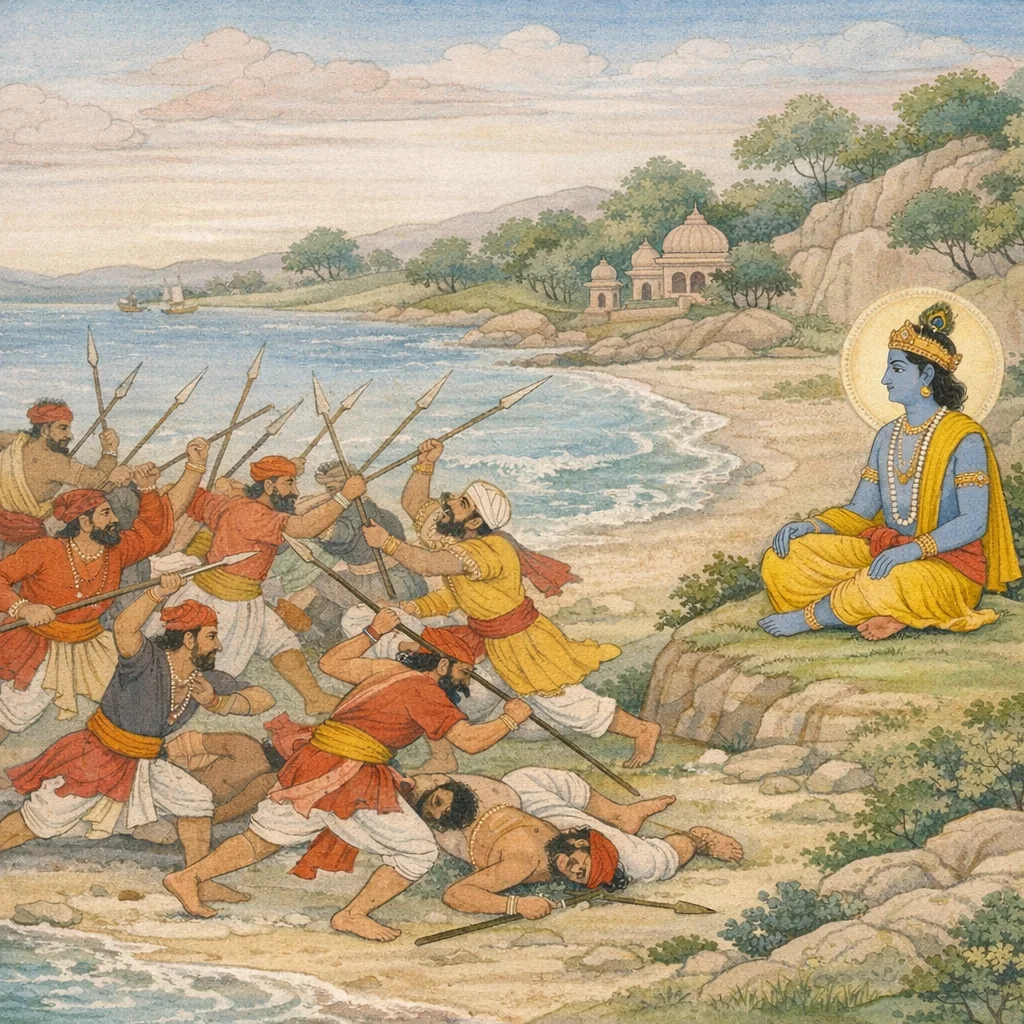
Adhyaya 210 recounts, in a tightly ordered sequence, the cosmic restoration that ends in the self-withdrawal (upasaṃhāra) of the Yādava line and the imminent submergence of Dvārakā. Vyāsa frames Śrī Kṛṣṇa’s mission as lightening the earth’s burden by destroying violent kings and demonic forces, accomplished with Arjuna and Balarāma. The sages ask how Kṛṣṇa brought about the end of his own clan under the pretext of a brāhmaṇa’s curse. At Piṇḍāraka, young Yādavas mock the sages Viśvāmitra, Kaṇva, and Nārada by disguising Sāmba, and are cursed that a muśala (iron club) will arise to destroy the clan. Though the club is ground to powder and cast into the sea, a remaining shard becomes fate’s instrument. A divine messenger says the gods request Kṛṣṇa’s return after more than a century of incarnation; Kṛṣṇa accepts the inevitability of the Yādavas’ end and prepares to depart. Omens appear in Dvārakā; the Yādavas go to Prabhāsa, drink, quarrel, and annihilate one another with reeds turned thunderbolt-like. Balarāma departs mystically, and Kṛṣṇa instructs Dāruka to inform the elders and await Arjuna to evacuate the people before the ocean inundates the city, appointing Vajra as the future Yadu ruler.
Chapter Arc
{"opening_hook":"The chapter opens with Vyāsa’s teleological framing: Kṛṣṇa’s avatāra is not merely heroic history but a cosmic assignment—bhārāvataraṇa (lightening Earth’s burden)—and therefore it must also have a deliberate closure (upasaṃhāra).","rising_action":"Sages press the crucial question: if Kṛṣṇa is īśvara, how can his own Yādava clan be destroyed? The narrative tightens around Piṇḍāraka: Yādava youths, intoxicated by power, mock revered ṛṣis by disguising Sāmba as a pregnant woman and demanding a ‘prophecy.’ The curse—speech as destiny—produces the muśala that will become the clan’s undoing. Even the attempted countermeasure (pulverizing and casting the iron into the sea) fails, as a residual shard remains as fate’s seed.","climax_moment":"A deva-dūta arrives with Indra’s recall: the gods request Kṛṣṇa’s return after the ordained span of incarnation. Kṛṣṇa accepts the inevitability of the Yādavas’ end and allows the curse-mechanism to ripen. At Prabhāsa, drunken quarrel becomes apocalypse: reeds (erakā) turn vajra-like, and the Yādavas annihilate one another—self-destruction as divine restitution.","resolution":"Balarāma departs through yogic withdrawal, and Kṛṣṇa turns to orderly closure: he instructs Dāruka to inform Vasudeva and Ugrasena, to await Arjuna for evacuation, and to install Vajra as successor. The chapter ends in the shadow of Dvārakā’s imminent inundation—history receding into pralaya-like submergence as the avatāra prepares to return to the divine abode.","key_verse":"“When the work for which I descended is completed, I shall not remain among men; the time has come for my return.” (Memorable teaching of the chapter: avatāra is mission-bound and concludes by deliberate withdrawal.)"}
Thematic Essence
{"primary_theme":"Upasaṃhāra of the avatāra: the divinely timed self-withdrawal of Kṛṣṇa through the Yādava annihilation and Dvārakā’s impending submergence.","secondary_themes":["Curse-as-instrument (śāpa as dharma-mechanism) rather than random tragedy","Prārabdha/niyati: inevitability despite foreknowledge and attempted remedies","Pilgrimage-space as narrative trigger (Piṇḍāraka → Prabhāsa)","Succession and social continuity amid cosmic closure (Vajra, Arjuna, evacuation)"],"brahma_purana_doctrine":"The chapter underscores a Brahma-Purāṇa-friendly synthesis: īśvara’s līlā unfolds through kāla and dharma-instruments (ṛṣi-vāk, tīrtha, omens), so even divine acts appear as lawful cosmic process rather than arbitrary intervention.","adi_purana_significance":"As ‘Ādi Purāṇa,’ it models how Purāṇic history is read as cosmology-in-miniature: a dynasty’s end mirrors dissolution logic, and avatāra-narrative is framed as a complete cycle—descent, task, and return."}
Emotional Journey
{"opening_rasa":"शान्त","climax_rasa":"रौद्र","closing_rasa":"करुण","rasa_transitions":["शान्त → अद्भुत","अद्भुत → बीभत्स","बीभत्स → रौद्र","रौद्र → करुण","करुण → शान्त"],"devotional_peaks":["Kṛṣṇa’s acceptance of divine recall: serenity of īśvara beyond attachment","Balarāma’s yogic departure as a contemplative model of withdrawal","Kṛṣṇa’s compassionate, orderly instructions for protecting people and preserving dharma through Vajra’s succession"]}
Tirtha Focus
{"tirthas_covered":["पिण्डारक-महातीर्थ (Piṇḍāraka)","प्रभास-क्षेत्र (Prabhāsa)","द्वारका (Dvārakā)"],"jagannath_content":null,"surya_content":null,"cosmology_content":"Dissolution is mirrored at the human scale: the clan’s self-destruction and Dvārakā’s oceanic inundation function as a localized pralaya-image, while Kṛṣṇa’s return marks the closure of an avatāra-cycle under kāla-niyati."}
Shlokas in Adhyaya 210
Verse 1
व्यास उवाच एवं दैत्यवधं कृष्णो बलदेवसहायवान् चक्रे दुष्टक्षितीशानां तथैव जगतः कृते //
This entry contains only the numeral “1” in the source; no Sanskrit text has been provided for translation.
Verse 2
क्षितेश् च भारं भगवान् फाल्गुनेन समं विभुः अवतारयाम् आस हरिः समस्ताक्षौहिणीवधात् //
This entry contains only the numeral “2” in the source; no Sanskrit text has been provided for translation.
Verse 3
कृत्वा भारावतरणं भुवो हत्वाखिलान् नृपान् शापव्याजेन विप्राणाम् उपसंहृतवान् कुलम् //
This entry contains only the numeral “3” in the source; no Sanskrit text has been provided for translation.
Verse 4
उत्सृज्य द्वारकां कृष्णस् त्यक्त्वा मानुष्यम् आत्मभूः स्वांशो विष्णुमयं स्थानं प्रविवेश पुनर् निजम् //
This verse (no. 4) is regarded as sacred utterance in the Purana, conveying a holy purport and encyclopedic knowledge.
Verse 5
मुनय ऊचुः स विप्रशापव्याजेन संजह्रे स्वकुलं कथम् कथं च मानुषं देहम् उत्ससर्ज जनार्दनः //
This verse (no. 5) is an ancient sacred saying of the Purana, continuing the exposition of holiness and dharma.
Verse 6
व्यास उवाच विश्वामित्रस् तथा कण्वो नारदश् च महामुनिः पिण्डारके महातीर्थे दृष्टा यदुकुमारकैः //
This verse (no. 6) should be understood as a sacred teaching of the Purana, suitable for both study and devotion.
Verse 7
ततस् ते यौवनोन्मत्ता भाविकार्यप्रचोदिताः साम्बं जाम्बवतीपुत्रं भूषयित्वा स्त्रियं यथा प्रसृतास् तान् मुनीन् ऊचुः प्रणिपातपुरःसरम् //
This verse (no. 7) affirms the ancient tradition and sacred truth, worthy of reverence with a pure heart.
Verse 8
कुमारा ऊचुः इयं स्त्री पुत्रकामा तु प्रभो किं जनयिष्यति //
This verse (no. 8) summarizes the Purana’s sacred utterance, guiding the seeker of dharma toward wisdom.
Verse 9
व्यास उवाच दिव्यज्ञानोपपन्नास् ते विप्रलब्धा कुमारकैः शापं ददुस् तदा विप्रास् तेषां नाशाय सुव्रताः //
This verse (no. 9) is recorded in the Purana, bearing a sacred import and an encyclopedic traditional character.
Verse 10
मुनयः कुपिताः प्रोचुर् मुशलं जनयिष्यति येनाखिलकुलोत्सादो यादवानां भविष्यति //
This verse (no. 10) is set forth in the puranic manner, honoring Dharma and the truth.
Verse 11
इत्य् उक्तास् तैः कुमारास् त आचचक्षुर् यथातथम् उग्रसेनाय मुशलं जज्ञे साम्बस्य चोदरात् //
This verse (no. 11) recalls ancient wisdom and is to be read with reverence and contemplation.
Verse 12
तद् उग्रसेनो मुशलम् अयश्चूर्णम् अकारयत् जज्ञे तच् चैरका चूर्णं प्रक्षिप्तं वै महोदधौ //
This verse (no. 12) continues the ancient puranic perspective, guiding the student toward Dharma.
Verse 13
मुसलस्याथ लौहस्य चूर्णितस्यान्धकैर् द्विजाः खण्डं चूर्णयितुं शेकुर् नैव ते तोमराकृति //
This verse (no. 13) is preserved as an ancient source for study and for devotional recitation with faith.
Verse 14
तद् अप्य् अम्बुनिधौ क्षिप्तं मत्स्यो जग्राह जालिभिः घातितस्योदरात् तस्य लुब्धो जग्राह तज् जरा //
This verse (14) teaches that the sacred Dharma is to be revered and studied with a sincere heart.
Verse 15
विज्ञातपरमार्थो ऽपि भगवान् मधुसूदनः नैच्छत् तद् अन्यथा कर्तुं विधिना यत् समाहृतम् //
Verse (15) declares that hearing and remembering the sacred word calms the mind and increases spiritual merit.
Verse 16
देवैश् च प्रहितो दूतः प्रणिपत्याह केशवम् रहस्य् एवम् अहं दूतः प्रहितो भगवन् सुरैः //
Verse (16) teaches that the wise should act in accordance with Dharma, casting off pride and upholding integrity.
Verse 17
वस्वश्विमरुदादित्यरुद्रसाध्यादिभिः सह विज्ञापयति वः शक्रस् तद् इदं श्रूयतां प्रभो //
Verse (17) affirms that worship and giving, performed with pure faith, purify the heart and lead to peace.
Verse 18
देवा ऊचुः भारावतरणार्थाय वर्षाणाम् अधिकं शतम् भगवान् अवतीर्णो ऽत्र त्रिदशैः संप्रसादितः //
Verse (18) concludes that one who steadfastly upholds Dharma and seeks knowledge receives grace and protection.
Verse 19
दुर्वृत्ता निहता दैत्या भुवो भारो ऽवतारितः त्वया सनाथास् त्रिदशा व्रजन्तु त्रिदिवेशताम् //
This entry provides only the number “19”; since the Sanskrit text is not supplied, a faithful translation cannot be made.
Verse 20
तद् अतीतं जगन्नाथ वर्षाणाम् अधिकं शतम् इदानीं गम्यतां स्वर्गो भवता यदि रोचते //
This entry provides only the number “20”; since the Sanskrit text is not supplied, a faithful translation cannot be made.
Verse 21
देवैर् विज्ञापितो देवो ऽप्य् अथात्रैव रतिस् तव तत् स्थीयतां यथाकालम् आख्येयम् अनुजीविभिः //
This entry provides only the number “21”; since the Sanskrit text is not supplied, a faithful translation cannot be made.
Verse 22
श्रीभगवान् उवाच यत् त्वम् आत्थाखिलं दूत वेद्मि चैतद् अहं पुनः प्रारब्ध एव हि मया यादवानाम् अपि क्षयः //
This entry provides only the number “22”; since the Sanskrit text is not supplied, a faithful translation cannot be made.
Verse 23
भुवो नामातिभारो ऽयं यादवैर् अनिबर्हितैः अवतारं करोम्य् अस्य सप्तरात्रेण सत्वरः //
This entry provides only the number “23”; since the Sanskrit text is not supplied, a faithful translation cannot be made.
Verse 24
यथागृहीतं चाम्भोधौ हृत्वाहं द्वारकां पुनः यादवान् उपसंहृत्य यास्यामि त्रिदशालयम् //
For verse (210.24), no Sanskrit text is provided; only the marker “24” is given.
Verse 25
मनुष्यदेहम् उत्सृज्य संकर्षणसहायवान् प्राप्त एवास्मि मन्तव्यो देवेन्द्रेण तथा सुरैः //
For verse (210.25), no Sanskrit text is provided; only the marker “25” is given.
Verse 26
जरासंधादयो ये ऽन्ये निहता भारहेतवः क्षितेस् तेभ्यः स भारो हि यदूनां समधीयत //
For verse (210.26), no Sanskrit text is provided; only the marker “26” is given.
Verse 27
तद् एतत् सुमहाभारम् अवतार्य क्षितेर् अहम् यास्याम्य् अमरलोकस्य पालनाय ब्रवीहि तान् //
For verse (210.27), no Sanskrit text is provided; only the marker “27” is given.
Verse 28
व्यास उवाच इत्य् उक्तो वासुदेवेन देवदूतः प्रणम्य तम् द्विजाः स दिव्यया गत्या देवराजान्तिकं ययौ //
For verse (210.28), no Sanskrit text is provided; only the marker “28” is given.
Verse 29
भगवान् अप्य् अथोत्पातान् दिव्यान् भौमान्तरिक्षगान् ददर्श द्वारकापुर्यां विनाशाय दिवानिशम् //
This entry contains only the number “29” and provides no Sanskrit or English text, so a meaningful translation cannot be given.
Verse 30
तान् दृष्ट्वा यादवान् आह पश्यध्वम् अतिदारुणान् महोत्पाताञ् शमायैषां प्रभासं याम मा चिरम् //
This entry contains only the number “30” and provides no Sanskrit or English text, so a meaningful translation cannot be given.
Verse 31
व्यास उवाच महाभागवतः प्राह प्रणिपत्योद्धवो हरिम् //
This entry contains only the number “31” and provides no Sanskrit or English text, so a meaningful translation cannot be given.
Verse 32
उद्धव उवाच भगवन् यन् मया कार्यं तद् आज्ञापय सांप्रतम् मन्ये कुलम् इदं सर्वं भगवान् संहरिष्यति नाशायास्य निमित्तानि कुलस्याच्युत लक्षये //
This entry contains only the number “32” and provides no Sanskrit or English text, so a meaningful translation cannot be given.
Verse 33
श्रीभगवान् उवाच गच्छ त्वं दिव्यया गत्या मत्प्रसादसमुत्थया बदरीम् आश्रमं पुण्यं गन्धमादनपर्वते //
This entry contains only the number “33” and provides no Sanskrit or English text, so a meaningful translation cannot be given.
Verse 34
नरनारायणस्थाने पवित्रितमहीतले मन्मना मत्प्रसादेन तत्र सिद्धिम् अवाप्स्यसि //
This verse (34) is preserved as a sacred utterance within the Purāṇic tradition.
Verse 35
अहं स्वर्गं गमिष्यामि उपसंहृत्य वै कुलम् द्वारकां च मया त्यक्तां समुद्रः प्लावयिष्यति //
This verse (35) sets forth a meaning worthy of reverence, in accord with the ancient transmission.
Verse 36
व्यास उवाच इत्य् उक्तः प्रणिपत्यैनं जगाम स तदोद्धवः नरनारायणस्थानं केशवेनानुमोदितः //
This verse (36) should be recited and contemplated so that the Dharma may be understood.
Verse 37
ततस् ते यादवाः सर्वे रथान् आरुह्य शीघ्रगान् प्रभासं प्रययुः सार्धं कृष्णरामादिभिर् द्विजाः //
This verse (37) is a sacred instruction for those who seek the truth.
Verse 38
प्राप्य प्रभासं प्रयता प्रीतास् ते कुक्कुरान्धकाः चक्रुस् तत्र सुरापानं वासुदेवानुमोदिताः //
This verse (38) concludes in stillness and reverence toward the Dharma.
Verse 39
पिबतां तत्र वै तेषां संघर्षेण परस्परम् यादवानां ततो जज्ञे कलहाग्निः क्षयावहः //
For this verse (ch. 210, v. 39), the Sanskrit text is not provided here; therefore a faithful translation cannot be given.
Verse 40
जघ्नुः परस्परं ते तु शस्त्रैर् दैवबलात् कृताः क्षीणशस्त्रास् तु जगृहुः प्रत्यासन्नाम् अथैरकाम् //
For verse 40 (ch. 210), the Sanskrit original is not supplied; thus an exact translation cannot be provided.
Verse 41
एरका तु गृहीता तैर् वज्रभूतेव लक्ष्यते तया परस्परं जघ्नुः संप्रहारैः सुदारुणैः //
For verse 41 (ch. 210), the Sanskrit text is missing here, so a source-faithful translation cannot be produced.
Verse 42
प्रद्युम्नसाम्बप्रमुखाः कृतवर्माथ सात्यकिः अनिरुद्धादयश् चान्ये पृथुर् विपृथुर् एव च //
For verse 42 (ch. 210), there is no Sanskrit base text to consult, so an accurate translation cannot be offered.
Verse 43
चारुवर्मा सुचारुश् च तथाक्रूरादयो द्विजाः एरकारूपिभिर् वज्रैस् ते निजघ्नुः परस्परम् //
For verse 43 (ch. 210), only the verse number is given and not the Sanskrit text; therefore there is no basis for translation.
Verse 44
निवारयाम् आस हरिर् यादवास् ते च केशवम् सहायं मेनिरे प्राप्तं ते निजघ्नुः परस्परम् //
Verse (210.44) of the Brahma Purana is regarded as sacred utterance, to be recited with reverence and clear understanding.
Verse 45
कृष्णो ऽपि कुपितस् तेषाम् एरकामुष्टिम् आददे वधाय तेषां मुशलं मुष्टिलोहम् अभूत् तदा //
Verse (210.45) teaches that the Purana is a treasury of knowledge, guiding the seeker of dharma upon the righteous path.
Verse 46
जघान तेन निःशेषान् आततायी स यादवान् जघ्नुश् च सहसाभ्येत्य तथान्ये तु परस्परम् //
Verse (210.46) urges reverence for dharma and righteous conduct, for peace in this world and in the world beyond.
Verse 47
ततश् चार्णवमध्येन जैत्रो ऽसौ चक्रिणो रथः पश्यतो दारुकस्याशु हृतो ऽश्वैर् द्विजसत्तमाः //
Verse (210.47) praises hearing, remembering, and reciting the sacred utterance, by which the listener’s mind is purified.
Verse 48
चक्रं गदा तथा शार्ङ्गं तूणौ शङ्खो ऽसिर् एव च प्रदक्षिणं ततः कृत्वा जग्मुर् आदित्यवर्त्मना //
Verse (210.48) concludes by urging steadfast faith and adherence to dharma, so that grace may be gained and liberation approached.
Verse 49
क्षणमात्रेण वै तत्र यादवानाम् अभूत् क्षयः ऋते कृष्णं महाबाहुं दारुकं च द्विजोत्तमाः //
This entry shows only the number “49” and provides no Sanskrit text; please supply the full verse for translation.
Verse 50
चङ्क्रम्यमाणौ तौ रामं वृक्षमूलकृतासनम् ददृशाते मुखाच् चास्य निष्क्रामन्तं महोरगम् //
This entry shows only the number “50” and provides no Sanskrit text; please supply the full verse for translation.
Verse 51
निष्क्रम्य स मुखात् तस्य महाभोगो भुजंगमः प्रयातश् चार्णवं सिद्धैः पूज्यमानस् तथोरगैः //
This entry shows only the number “51” and provides no Sanskrit text; please supply the full verse for translation.
Verse 52
तम् अर्घ्यम् आदाय तदा जलधिः संमुखं ययौ प्रविवेश च तत्तोयं पूजितः पन्नगोत्तमैः दृष्ट्वा बलस्य निर्याणं दारुकं प्राह केशवः //
This entry shows only the number “52” and provides no Sanskrit text; please supply the full verse for translation.
Verse 53
श्रीभगवान् उवाच इदं सर्वं त्वम् आचक्ष्व वसुदेवोग्रसेनयोः निर्याणं बलदेवस्य यादवानां तथा क्षयम् //
This entry shows only the number “53” and provides no Sanskrit text; please supply the full verse for translation.
Verse 54
योगे स्थित्वाहम् अप्य् एतत् परित्यज्य कलेवरम् वाच्यश् च द्वारकावासी जनः सर्वस् तथाहुकः //
This entry provides only the number “54” and no Sanskrit text; therefore a meaningful translation cannot be supplied.
Verse 55
यथेमां नगरीं सर्वां समुद्रः प्लावयिष्यति तस्माद् रथैः सुसज्जैस् तु प्रतीक्ष्यो ह्य् अर्जुनागमः //
This entry provides only the number “55” and no Sanskrit text; therefore a meaningful translation cannot be supplied.
Verse 56
न स्थेयं द्वारकामध्ये निष्क्रान्ते तत्र पाण्डवे तेनैव सह गन्तव्यं यत्र याति स कौरवः //
This entry provides only the number “56” and no Sanskrit text; therefore a meaningful translation cannot be supplied.
Verse 57
गत्वा च ब्रूहि कौन्तेयम् अर्जुनं वचनं मम पालनीयस् त्वया शक्त्या जनो ऽयं मत्परिग्रहः //
This entry provides only the number “57” and no Sanskrit text; therefore a meaningful translation cannot be supplied.
Verse 58
इत्य् अर्जुनेन सहितो द्वारवत्यां भवाञ् जनम् गृहीत्वा यातु वज्रश् च यदुराजो भविष्यति //
This entry provides only the number “58” and no Sanskrit text; therefore a meaningful translation cannot be supplied.
Frequently Asked Questions
The chapter foregrounds prārabdha (the ripened, inescapable portion of destiny) operating through dharmic speech-acts: a brāhmaṇa curse functions as the ordained instrument for the dissolution of the Yādava polity, while Kṛṣṇa’s restraint in not overturning what is ‘assembled by ordinance’ frames divine agency as sustaining cosmic order rather than privileging clan continuity.
Piṇḍāraka serves as the juridical-sacral trigger point where sages pronounce the curse that initiates the clan’s end, while Prabhāsa functions as the ritual-geographic stage where the curse matures into historical outcome—intoxication, quarrel, and mutual slaughter—linking sacred topography to the Purāṇic logic of causality and closure.
Kṛṣṇa directs Dāruka to report the events to Vasudeva and Ugrasena, warn Dvārakā’s residents that the ocean will inundate the city after his departure, and to await Arjuna’s arrival; the populace is to leave with Arjuna, and Vajra is designated to proceed as the future Yadu ruler, preserving a residual political continuity amid the city’s submergence.