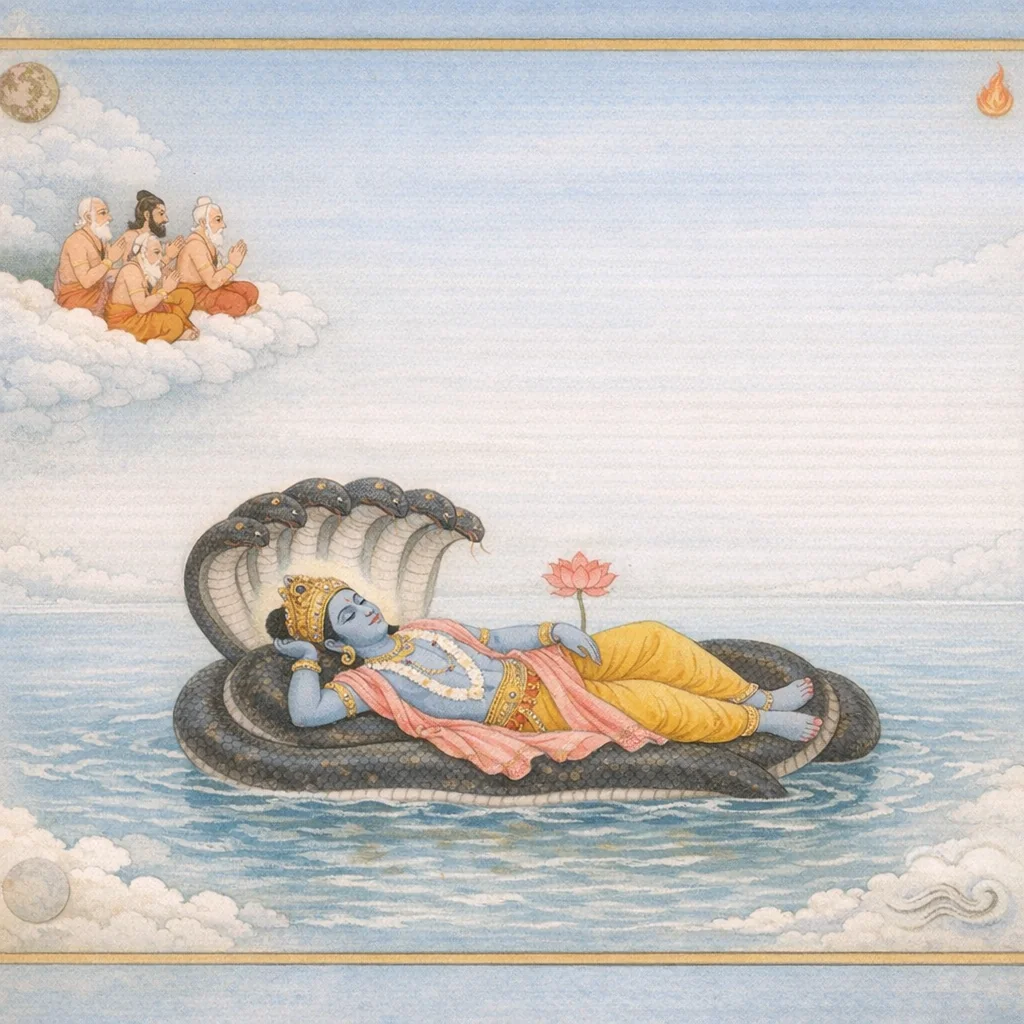
Adhyaya 233: The Naimittika and Prākṛta Dissolutions: Cosmic Absorption into Viṣṇu
Adhyāya 233, in Vyāsa’s discourse to the twice-born sages, gives a systematic account of cosmic dissolution (pralaya). It first describes the naimittika dissolution at the end of Brahmā’s day: the three worlds become a single ocean (ekārṇava), clouds are scattered by the wind born of Viṣṇu’s breath, and Hari—assuming a Brahmā-form—reposes on Śeṣa in yoganidrā, praised by Siddhas such as Sanaka. It then explains the prākṛta (elemental) dissolution as a sequential re-absorption of tattvas: earth’s qualities are consumed by water, water by fire, fire by wind, wind by space, and space by the egoic principle bhūtādi (ahaṃkāra), culminating in Mahat and finally Prakṛti as the guṇas return to equilibrium. The chapter concludes with a Vedāntic affirmation that Viṣṇu/Paramātman is the ultimate ground in which both Prakṛti and Puruṣa dissolve, beyond any literal day–night distinction.
Chapter Arc
{"opening_hook":"Vyāsa, addressing the twice-born sages, pivots from creation to its inevitable counter-movement: the “night” of Brahmā when all worlds lose their contours and become one undifferentiated ocean (ekārṇava). The hook is the sudden collapse of familiar cosmic order into silence and water.","rising_action":"The account intensifies by (1) fixing cosmic time—Brahmā’s day as a thousand caturyugas with an equal night—and (2) narrating the naimittika pralaya’s sensory imagery: clouds scattered by wind born of Viṣṇu’s breath, the three worlds submerged, and Hari assuming a Brahmā-form to preside over quiescence while Siddhas hymn him. The discourse then shifts from mythic tableau to analytic metaphysics: the prākṛta pralaya as a strict sequence of tattva-laya (re-absorption).","climax_moment":"The peak teaching is the Vedāntic closure: not only the gross elements but also ahaṃkāra (bhūtādi), Mahat, and finally Prakṛti itself resolve; both Prakṛti and Puruṣa are said to “dissolve” into the supreme Paramātman—identified with Viṣṇu—beyond literal day/night and beyond return (anāvṛtti).","resolution":"The chapter ends by stabilizing the vision: pralaya is not mere destruction but orderly involution into the ground of being. Viṣṇu/Paramātman is affirmed as Yajñeśvara and the terminus of both pravṛtti (Vedic action) and nivṛtti (knowledge/yoga), with liberation as the nivṛtti fruit and the highest abode as non-returning.","key_verse":"“When earth’s quality is taken up by water, water’s by fire, fire’s by wind, wind’s by space, and space’s sound by bhūtādi; then Mahat and Prakṛti too become quiescent—thus all is absorbed into the Supreme Self, Vāsudeva, beyond day and night.” (memorable teaching, paraphrased translation)"}
Thematic Essence
{"primary_theme":"Pralaya-vicāra (systematic doctrine of dissolution) culminating in Vaiṣṇava Vedānta.","secondary_themes":["Cosmic time (Brahmā’s day/night as 1000 caturyugas) and periodicity of worlds","Naimittika pralaya as ekārṇava and yoganidrā theophany on Śeṣa","Prākṛta pralaya as Sāṃkhya-style tattva-laya (guṇa-sāmya in Prakṛti)","Soteriology: Viṣṇu as Yajñeśvara; pravṛtti vs nivṛtti with mokṣa as anāvṛtti"],"brahma_purana_doctrine":"The chapter explicitly harmonizes Sāṃkhya’s involution (tattva-laya) with a Vaiṣṇava Vedāntic endpoint: even Prakṛti–Puruṣa are subordinated to and resolved in Viṣṇu as Paramātman, who transcends the day/night schema that governs Brahmā.","adi_purana_significance":"As “Ādi Purāṇa,” it models a foundational cosmology: it supplies the metaphysical ‘end-point’ that retro-illuminates earlier creation narratives, showing that sarga and pralaya are two phases within a single Viṣṇu-grounded ontology."}
Emotional Journey
{"opening_rasa":"अद्भुत (adbhuta)","climax_rasa":"शान्त (shanta)","closing_rasa":"शान्त (shanta)","rasa_transitions":["adbhuta → भयानक (bhayanaka) → शान्त (shanta)"],"devotional_peaks":["Hari lying on Śeṣa in yoganidrā while Siddhas/Sanaka hymn him—devotion within cosmic silence","The final identification of Viṣṇu with Paramātman/Brahman as the non-returning highest abode (anāvṛtti)"]}
Tirtha Focus
{"tirthas_covered":[],"jagannath_content":null,"surya_content":null,"cosmology_content":"Detailed two-tier pralaya doctrine: (1) naimittika dissolution at Brahmā’s night—three worlds become ekārṇava; clouds dispersed by wind from Viṣṇu’s breath; Hari in Brahmā-form rests on Śeṣa in yoganidrā; creation resumes when the Sarvātmā awakens; (2) prākṛta dissolution as sequential absorption of qualities/tattvas—gandha→water, rasa→fire, rūpa→wind, sparśa→ākāśa, śabda→bhūtādi/ahaṃkāra, then Mahat→Prakṛti with guṇa-sāmya—culminating in Paramātman/Viṣṇu beyond temporal dualities."}
Shlokas in Adhyaya 233
Verse 1
व्यास उवाच सप्तर्षिस्थानम् आक्रम्य स्थिते ऽम्भसि द्विजोत्तमाः एकार्णवं भवत्य् एतत् त्रैलोक्यम् अखिलं ततः //
Verse (233.1) is recited to recall Dharma and the virtue of righteousness.
Verse 2
अथ निःश्वासजो विष्णोर् वायुस् ताञ् जलदांस् ततः नाशं नयति भो विप्रा वर्षाणाम् अधिकं शतम् //
Verse (233.2) speaks of reverence for the Divine and of living in accordance with Dharma.
Verse 3
सर्वभूतमयो ऽचिन्त्यो भगवान् भूतभावनः अनादिर् आदिर् विश्वस्य पीत्वा वायुम् अशेषतः //
Verse (233.3) praises grace and the path of self-offering undertaken for the sake of peace.
Verse 4
एकार्णवे ततस् तस्मिञ् शेषशय्यास्थितः प्रभुः ब्रह्मरूपधरः शेते भगवान् आदिकृद् धरिः //
Verse “4” is given without the Sanskrit original; please provide the full text so it may be translated accurately and reverently.
Verse 5
जनलोकगतैः सिद्धैः सनकाद्यैर् अभिष्टुतः ब्रह्मलोकगतैश् चैव चिन्त्यमानो मुमुक्षुभिः //
Verse “5” is missing the Sanskrit source text; please share the complete passage for an accurate, reverent translation.
Verse 6
आत्ममायामयीं दिव्यां योगनिद्रां समास्थितः आत्मानं वासुदेवाख्यं चिन्तयन् परमेश्वरः //
Verse “6” lacks the Sanskrit base text; please provide the full original so the translation can remain sacred in tone and academically precise.
Verse 7
एष नैमित्तिको नाम विप्रेन्द्राः प्रतिसंचरः निमित्तं तत्र यच् छेते ब्रह्मरूपधरो हरिः //
Verse “7” is provided without the Sanskrit; please send the complete original for a full and respectful translation.
Verse 8
यदा जागर्ति सर्वात्मा स तदा चेष्टते जगत् निमीलत्य् एतद् अखिलं मायाशय्याशये ऽच्युते //
Verse “8” is missing the Sanskrit original; please provide the complete text so the translation may accord with the Purāṇic classical spirit.
Verse 9
पद्मयोनेर् दिनं यत् तु चतुर्युगसहस्रवत् एकार्णवकृते लोके तावती रात्रिर् उच्यते //
This verse (9) is revered as sacred utterance within the Purāṇic tradition.
Verse 10
ततः प्रबुद्धो रात्र्यन्ते पुनः सृष्टिं करोत्य् अजः ब्रह्मस्वरूपधृग् विष्णुर् यथा वः कथितं पुरा //
This verse (10) sets forth ancient wisdom, worthy of reverence and study.
Verse 11
इत्य् एष कल्पसंहारो अन्तरप्रलयो द्विजाः नैमित्तिको वः कथितः शृणुध्वं प्राकृतं परम् //
This verse (11) should be recited with devotion and examined with careful scholarship.
Verse 12
अवृष्ट्यग्न्यादिभिः सम्यक् कृते शय्यालये द्विजाः समस्तेष्व् एव लोकेषु पातालेष्व् अखिलेषु च //
This verse (12) is part of the Purāṇa, teaching Dharma and the world’s sacred history.
Verse 13
महदादेर् विकारस्य विशेषात् तत्र संक्षये कृष्णेच्छाकारिते तस्मिन् प्रवृत्ते प्रतिसंचरे //
This verse (13) offers a blessing: may listeners and readers gain wisdom and well-being through Dharma.
Verse 14
आपो ग्रसन्ति वै पूर्वं भूमेर् गन्धादिकं गुणम् आत्तगन्धा ततो भूमिः प्रलयाय प्रकल्पते //
This verse (no. 14) is preserved as a sacred utterance of the Purana, fit for devotion and study.
Verse 15
प्रनष्टे गन्धतन्मात्रे भवत्य् उर्वी जलात्मिका आपस् तदा प्रवृत्तास् तु वेगवत्यो महास्वनाः //
This verse (no. 15) is a sacred word of the Purana, suitable for devotional recitation and scholarly inquiry.
Verse 16
सर्वम् आपूरयन्तीदं तिष्ठन्ति विचरन्ति च सलिलेनैवोर्मिमता लोकालोकः समन्ततः //
This verse (no. 16) should be read with reverence, as a sacred record within the Purana.
Verse 17
अपाम् अपि गुणो यस् तु ज्योतिषा पीयते तु सः नश्यन्त्य् आपः सुतप्ताश् च रसतन्मात्रसंक्षयात् //
This verse (no. 17) sets forth a sacred meaning of the Purana, worthy of respect and contemplation.
Verse 18
ततश् चापो ऽमृतरसा ज्योतिष्ट्वं प्राप्नुवन्ति वै अग्न्यवस्थे तु सलिले तेजसा सर्वतो वृते //
This verse (no. 18) is a sacred passage of the Purana, suitable for ritual reading and research.
Verse 19
स चाग्निः सर्वतो व्याप्य आदत्ते तज् जलं तदा सर्वम् आपूर्यतो चाभिस् तदा जगद् इदं शनैः //
This entry provides only the number “19” and no Sanskrit text; therefore a meaningful translation cannot be given.
Verse 20
अर्चिभिः संतते तस्मिंस् तिर्यग् ऊर्ध्वम् अधस् तथा ज्योतिषो ऽपि परं रूपं वायुर् अत्ति प्रभाकरम् //
This entry provides only the number “20” and no Sanskrit text; therefore a meaningful translation cannot be given.
Verse 21
प्रलीने च ततस् तस्मिन् वायुभूते ऽखिलात्मके प्रनष्टे रूपतन्मात्रे कृतरूपो विभावसुः //
This entry provides only the number “21” and no Sanskrit text; therefore a meaningful translation cannot be given.
Verse 22
प्रशाम्यति तदा ज्योतिर् वायुर् दोधूयते महान् निरालोके तदा लोके वायुसंस्थे च तेजसि //
This entry provides only the number “22” and no Sanskrit text; therefore a meaningful translation cannot be given.
Verse 23
ततः प्रलयम् आसाद्य वायुसंभवम् आत्मनः ऊर्ध्वं च वायुस् तिर्यक् च दोधवीति दिशो दश //
This entry provides only the number “23” and no Sanskrit text; therefore a meaningful translation cannot be given.
Verse 24
वायोस् त्व् अपि गुणं स्पर्शम् आकाशं ग्रसते ततः प्रशाम्यति तदा वायुः खं तु तिष्ठत्य् अनावृतम् //
This verse (24) is preserved as a numbered entry in the Sanskrit source, but its full text is not provided here for a faithful translation.
Verse 25
अरूपम् अरसस्पर्शम् अगन्धवद् अमूर्तिमत् सर्वम् आपूरयच् चैव सुमहत् तत् प्रकाशते //
Verse (25) is given only as a number in the Sanskrit reference; without the original wording, a precise sacred translation cannot be supplied.
Verse 26
परिमण्डलतस् तत् तु आकाशं शब्दलक्षणम् शब्दमात्रं तथाकाशं सर्वम् आवृत्य तिष्ठति //
Verse (26) is listed by number in the source, but the Sanskrit text is not supplied; therefore a faithful translation cannot be produced.
Verse 27
ततः शब्दगुणं तस्य भूतादिर् ग्रसते पुनः भूतेन्द्रियेषु युगपद् भूतादौ संस्थितेषु वै //
Verse (27) is present only as a numbered listing; since the Sanskrit original is missing, no translation into other languages can be responsibly given.
Verse 28
अभिमानात्मको ह्य् एष भूतादिस् तामसः स्मृतः भूतादिं ग्रसते चापि महाबुद्धिर् विचक्षणा //
Verse (28) is marked by number in the source, but the Sanskrit text is not included here; therefore a reliable translation cannot be made.
Verse 29
उर्वी महांश् च जगतः प्रान्ते ऽन्तर् बाह्यतस् तथा एवं सप्त महाबुद्धिः क्रमात् प्रकृतयस् तथा //
This entry provides only the numeral “29” without the Sanskrit text, so a faithful translation cannot be produced.
Verse 30
प्रत्याहारैस् तु ताः सर्वाः प्रविशन्ति परस्परम् येनेदम् आवृतं सर्वम् अण्डम् अप्सु प्रलीयते //
This entry provides only the numeral “30” without the Sanskrit text, so a faithful translation cannot be produced.
Verse 31
सप्तद्वीपसमुद्रान्तं सप्तलोकं सपर्वतम् उदकावरणं ह्य् अत्र ज्योतिषा पीयते तु तत् //
This entry provides only the numeral “31” without the Sanskrit text, so a faithful translation cannot be produced.
Verse 32
ज्योतिर् वायौ लयं याति यात्य् आकाशे समीरणः आकाशं चैव भूतादिर् ग्रसते तं तथा महान् //
This entry provides only the numeral “32” without the Sanskrit text, so a faithful translation cannot be produced.
Verse 33
महान्तम् एभिः सहितं प्रकृतिर् ग्रसते द्विजाः गुणसाम्यम् अनुद्रिक्तम् अन्यूनं च द्विजोत्तमाः //
This entry provides only the numeral “33” without the Sanskrit text, so a faithful translation cannot be produced.
Verse 34
प्रोच्यते प्रकृतिर् हेतुः प्रधानं कारणं परम् इत्य् एषा प्रकृतिः सर्वा व्यक्ताव्यक्तस्वरूपिणी //
This verse (no. 34) is regarded as sacred utterance within the Purāṇic tradition.
Verse 35
व्यक्तस्वरूपम् अव्यक्ते तस्यां विप्राः प्रलीयते एकः शुद्धो ऽक्षरो नित्यः सर्वव्यापी तथा पुनः //
This verse (no. 35) sets forth a sacred meaning in accordance with the ancient Purāṇic manner.
Verse 36
सो ऽप्य् अंशः सर्वभूतस्य द्विजेन्द्राः परमात्मनः नश्यन्ति सर्वा यत्रापि नामजात्यादिकल्पनाः //
This verse (no. 36) should be read with reverence, to understand Dharma and the ancient tradition.
Verse 37
सत्तामात्रात्मके ज्ञेये ज्ञानात्मन्य् आत्मनः परे स ब्रह्म तत् परं धाम परमात्मा परेश्वरः //
This verse (no. 37) is part of an ancient teaching, handed down through religious tradition.
Verse 38
स विष्णुः सर्वम् एवेदं यतो नावर्तते पुनः प्रकृतिर् या मयाख्याता व्यक्ताव्यक्तस्वरूपिणी //
May this verse (no. 38) be contemplated with sincerity by the wise and by those devoted to Dharma.
Verse 39
पुरुषश् चाप्य् उभाव् एतौ लीयेते परमात्मनि परमात्मा च सर्वेषाम् आधारः परमेश्वरः //
This verse (no. 39) is remembered as a sacred utterance within the Purāṇa, solemn and instructive in character.
Verse 40
विष्णुनाम्ना स वेदेषु वेदान्तेषु च गीयते प्रवृत्तं च निवृत्तं च द्विविधं कर्म वैदिकम् //
This verse (no. 40) sets forth a pure teaching, preserved in the Purāṇa.
Verse 41
ताभ्याम् उभाभ्यां पुरुषैर् यज्ञमूर्तिः स इज्यते ऋग्यजुःसामभिर् मार्गैः प्रवृत्तैर् इज्यते ह्य् असौ //
This verse (no. 41) is recited with reverence to understand Dharma and the ancient tradition.
Verse 42
यज्ञेश्वरो यज्ञपुमान् पुरुषैः पुरुषोत्तमः ज्ञानात्मा ज्ञानयोगेन ज्ञानमूर्तिः स इज्यते //
This verse (no. 42) speaks in a sacred tone of the knowledge and guidance contained in the Purāṇa.
Verse 43
निवृत्तैर् योगमार्गैश् च विष्णुर् मुक्तिफलप्रदः ह्रस्वदीर्घप्लुतैर् यत् तु किंचिद् वस्त्व् अभिधीयते //
This verse (no. 43) concludes the passage, reminding one to honor Dharma and uphold virtue.
Verse 44
यच् च वाचाम् अविषयस् तत् सर्वं विष्णुर् अव्ययः व्यक्तः स एवम् अव्यक्तः स एव पुरुषो ऽव्ययः //
This verse (no. 44) belongs to the Brahma Purana, but the Sanskrit source text is not provided here for a faithful translation.
Verse 45
परमात्मा च विश्वात्मा विश्वरूपधरो हरिः व्यक्ताव्यक्तात्मिका तस्मिन् प्रकृतिः सा विलीयते //
Verse (no. 45) is recorded in the Purana, but without the Sanskrit original here, a faithful translation cannot be produced.
Verse 46
पुरुषश् चापि भो विप्रा यस् तद् अव्याकृतात्मनि द्विपरार्धात्मकः कालः कथितो यो मया द्विजाः //
This verse (no. 46) is part of the Brahma Purana, but the Sanskrit text is not supplied here, so it cannot be translated.
Verse 47
तद् अहस् तस्य विप्रेन्द्रा विष्णोर् ईशस्य कथ्यते व्यक्ते तु प्रकृतौ लीने प्रकृत्यां पुरुषे तथा //
Verse (no. 47) is found in the Purana, but since the Sanskrit original is missing here, no faithful and clear translation can be given.
Verse 48
तत्रास्थिते निशा तस्य तत्प्रमाणा तपोधनाः नैवाहस् तस्य च निशा नित्यस्य परमात्मनः //
This verse (no. 48) is part of the Brahma Purana, but since the Sanskrit text is not included here, it cannot be translated.
Verse 49
उपचारात् तथाप्य् एतत् तस्येशस्य तु कथ्यते इत्य् एष मुनिशार्दूलाः कथितः प्राकृतो लयः //
This verse (49) is regarded as a sacred utterance in the Purāṇa, suited to both devotion and learned study.
Frequently Asked Questions
The chapter’s central theme is metaphysical: the impermanence of manifested worlds and the orderly reabsorption of the cosmos into its causal principles, culminating in Viṣṇu/Paramātman as the ultimate, unconditioned ground beyond name-form and beyond literal day-night distinctions.
Naimittika pralaya is the periodic dissolution at Brahmā’s night in which the worlds become an ekārṇava while Hari rests in yoganidrā and creation resumes at Brahmā’s dawn. Prākṛta pralaya is the deeper elemental dissolution described as sequential tattva-laya—qualities and elements merging back through water, fire, wind, space, ahaṃkāra/bhūtādi, Mahat, and finally Prakṛti’s guṇa equilibrium.
None is inaugurated here. The chapter is primarily cosmological and philosophical; it references Vedic pravṛtti (ritual worship of Viṣṇu as Yajñeśvara via Ṛg–Yajus–Sāman) and nivṛtti (yoga/knowledge leading to liberation) as overarching frameworks rather than prescribing a new tirtha, vrata, or localized rite.