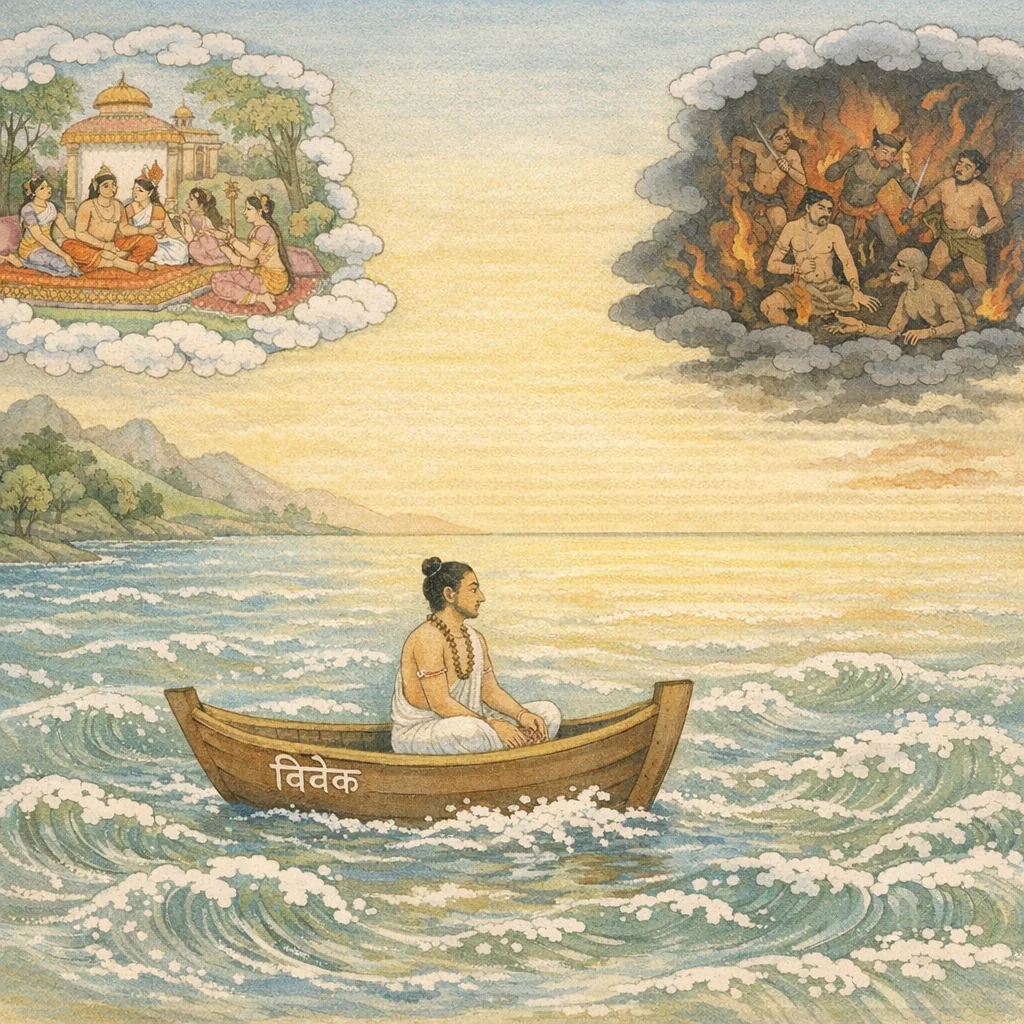
Adhyaya 240: Sāṃkhya-Yoga on Discerning Guṇas, Overcoming Bodily Doṣas, and Attaining Mokṣa
Adhyāya 240 presents a didactic dialogue: the sages, having heard an orthodox yogic discipline, ask Vyāsa to state dharma precisely as understood in Sāṃkhya. Vyāsa lays out a discriminative map of experience—the allure and danger of viṣayas across orders of beings, the contrasted fruits of embodied striving (svarga, naraka, and tiryak-yoni), and the fleeting fragility of pleasure. He then turns to guṇa-analysis, explaining in layered fashion how sense-faculties and elemental qualities interlock, leading the seeker from gross embodiment to the subtle self and finally to Nārāyaṇa as the supreme, nirvikāra Paramātman. An ethical-ascetic section identifies five bodily doṣas—kāma, krodha, bhaya, nidrā, and śvāsa—and prescribes their attenuation through kṣamā, saṃkalpa-varjana, sattva-sevana, apramāda, and alpāhāra. With vivid ocean metaphors for saṃsāra and the disciplines that “cross” it, the chapter affirms Sāṃkhya-jñāna as an authoritative, Veda-consistent path to mokṣa and non-return.
Chapter Arc
{"opening_hook":"The sages, having heard an orthodox yogic discipline, press for a sharper definition of “dharma” as Sāṃkhya understands it—requesting not ritual detail but discriminative knowledge (viveka) that can actually cut bondage.","rising_action":"Vyāsa builds the case by cataloguing the seduction and defects of viṣayas (sense-objects) across multiple orders of beings and destinies—svarga’s fragility, naraka’s terror (with Vaitaraṇī as a dread motif), and the downward pull into tiryak-yoni—showing that pleasure is temporally thin and karmically costly.","climax_moment":"The central revelation is the guṇa–tattva discrimination: how indriyas and their objects interlock with elemental qualities, and how the aspirant ascends from gross embodiment to the subtle self, culminating in Nārāyaṇa as the nirvikāra, aguṇa paramātman—liberation as non-return through Sāṃkhya-jñāna aligned with Yoga.","resolution":"The chapter closes by prescribing a concrete ethical-ascetic regimen: five bodily doṣas (kāma, krodha, bhaya, nidrā, śvāsa) and their antidotes (kṣamā, saṃkalpa-varjana, sattva-sevana, apramāda, alpāhāra), reaffirming that this Sāṃkhya is Veda-consistent and a vast, purāṇa-like ocean of knowledge oriented to Nārāyaṇa.","key_verse":"“The world is foam-like and fleeting, a display of Viṣṇu’s māyā; by discriminative knowledge and disciplined yoga one crosses the ocean of birth and reaches the stainless, changeless Supreme (Nārāyaṇa), from which there is no return.” (memorable teaching, paraphrased translation)"}
Thematic Essence
{"primary_theme":"Sāṃkhya-Yoga viveka leading to mokṣa (guṇa-discrimination, viṣaya-doṣa critique, and ascent to Nārāyaṇa).","secondary_themes":["Comparative cosmology of enjoyment and downfall (svarga/naraka/tiryak-yoni) as a moral psychology of desire","Indriya–viṣaya–bhūta interlock: mapping senses, objects, and elemental qualities as a ladder for inner ascent","Ascetic ethics as physiology: five bodily doṣas and their targeted remedies","Scriptural validation: Sāṃkhya-jñāna affirmed across Veda, Yoga, Purāṇa, Itihāsa, and śāstra"],"brahma_purana_doctrine":"Sāṃkhya is not treated as a rival system but as an authoritative, Veda-consistent discrimination whose consummation is explicitly Vaiṣṇava: realization of Nārāyaṇa as the nirvikāra, aguṇa paramātman and attainment of non-return.","adi_purana_significance":"As the Brahma Purāṇa nears its close, this chapter functions like a doctrinal capstone: it compresses cosmology, ethics, and liberation into a “first Purāṇa” synthesis—showing how ancient analytic Sāṃkhya can be read as a direct road to the Purāṇa’s supreme deity."}
Emotional Journey
{"opening_rasa":"जिज्ञासा (adbhuta)","climax_rasa":"शान्त (shanta)","closing_rasa":"शान्त (shanta)","rasa_transitions":["adbhuta → bhayanaka → nirveda/shanta → shanta"],"devotional_peaks":["The ascent from guṇa-bound embodiment to the subtle self and finally to Nārāyaṇa as the stainless, changeless goal","The ocean-crossing imagery where disciplined jñāna-yoga becomes the ‘boat’ beyond birth and death"]}
Tirtha Focus
{"tirthas_covered":["वैतरणी (Vaitaraṇī) (infernal river motif)"],"jagannath_content":null,"surya_content":null,"cosmology_content":"Uses cosmological registers (multiple classes of beings and realms) to grade viṣaya-experience and karmic outcomes, culminating in a metaphysical ascent beyond prakṛti/guṇas to the nirvikāra paramātman."}
Shlokas in Adhyaya 240
Verse 1
मुनय ऊचुः सम्यक् क्रियेयं विप्रेन्द्र वर्णिता शिष्टसंमता योगमार्गो यथान्यायं शिष्यायेह हितैषिणा //
In the new section (240.1), the narration continues in the ancient Purāṇic manner.
Verse 2
सांख्ये त्व् इदानीं धर्मस्य विधिं प्रब्रूहि तत्त्वतः त्रिषु लोकेषु यज् ज्ञानं सर्वं तद् विदितं हि ते //
This verse (240.2) should be preserved as a sacred record for study and devotional practice.
Verse 3
व्यास उवाच शृणुध्वं मुनयः सर्वम् आख्यानं विदितात्मनाम् विहितं यतिभिर् वृद्धैः कपिलादिभिर् ईश्वरैः //
This verse (no. 3) is preserved in the Purana as sacred speech, worthy of reverence and study.
Verse 4
यस्मिन् सुविभ्रमाः केचिद् दृश्यन्ते मुनिसत्तमाः गुणाश् च यस्मिन् बहवो दोषहानिश् च केवला //
This verse (no. 4) sets forth the sacred meaning of the ancient teaching in the Purana, for devotion and inquiry.
Verse 5
ज्ञानेन परिसंख्याय सदोषान् विषयान् द्विजाः मानुषान् दुर्जयान् कृत्स्नान् पैशाचान् विषयांस् तथा //
This verse (no. 5) should be read with reverence, to understand Dharma and the Purana’s tradition.
Verse 6
विषयान् औरगाञ् ज्ञात्वा गन्धर्वविषयांस् तथा पितॄणां विषयाञ् ज्ञात्वा तिर्यक्त्वं चरतां द्विजाः //
This verse (no. 6) reminds the student to uphold virtue and to listen to sacred speech with sincerity.
Verse 7
सुपर्णविषयाञ् ज्ञात्वा मरुतां विषयांस् तथा महर्षिविषयांश् चैव राजर्षिविषयांस् तथा //
This verse (no. 7) affirms that studying the Purana with reverence leads to wisdom and peace.
Verse 8
आसुरान् विषयाञ् ज्ञात्वा वैश्वदेवांस् तथैव च देवर्षिविषयाञ् ज्ञात्वा योगानाम् अपि वै परान् //
This verse (no. 8) is preserved in the Purana to set forth Dharma and sacred history with clarity.
Verse 9
विषयांश् च प्रमाणस्य ब्रह्मणो विषयांस् तथा आयुषश् च परं कालं लोकैर् विज्ञाय तत्त्वतः //
This verse (no. 9) speaks of sacred knowledge, the path that leads to Dharma and well-being.
Verse 10
सुखस्य च परं कालं विज्ञाय मुनिसत्तमाः प्राप्तकाले च यद् दुःखं पततां विषयैषिणाम् //
This verse (no. 10) highlights the sacred observances and duties that a seeker of truth should undertake.
Verse 11
तिर्यक्त्वे पततां विप्रास् तथैव नरकेषु यत् स्वर्गस्य च गुणाञ् ज्ञात्वा दोषान् सर्वांश् च भो द्विजाः //
This verse (no. 11) sets forth the fruit of merit gained by honoring Dharma and keeping discipline with a pure heart.
Verse 12
वेदवादे च ये दोषा गुणा ये चापि वैदिकाः ज्ञानयोगे च ये दोषा ज्ञानयोगे च ये गुणाः //
This verse (no. 12) concludes that hearing and remembering the Purana clarifies the mind and draws one nearer to the Divine.
Verse 13
सांख्यज्ञाने च ये दोषांस् तथैव च गुणा द्विजाः सत्त्वं दशगुणं ज्ञात्वा रजो नवगुणं तथा //
This entry provides only the verse number and no Sanskrit text, so a faithful translation cannot be supplied.
Verse 14
तमश् चाष्टगुणं ज्ञात्वा बुद्धिं सप्तगुणां तथा षड्गुणं च नभो ज्ञात्वा तमश् च त्रिगुणं महत् //
For 240.14, only the number “14” is given; without the Sanskrit original, a meaningful translation is not possible.
Verse 15
द्विगुणं च रजो ज्ञात्वा सत्त्वं चैकगुणं पुनः मार्गं विज्ञाय तत्त्वेन प्रलयप्रेक्षणेन तु //
In 240.15 only the numeral “15” is shown; without the Sanskrit text, it cannot be translated accurately.
Verse 16
ज्ञानविज्ञानसंपन्नाः कारणैर् भावितात्मभिः प्राप्नुवन्ति शुभं मोक्षं सूक्ष्मा इव नभः परम् //
Verse 240.16 provides only the number “16”; without the Sanskrit original, no faithful translation can be offered.
Verse 17
रूपेण दृष्टिं संयुक्तां घ्राणं गन्धगुणेन च शब्दग्राह्यं तथा श्रोत्रं जिह्वां रसगुणेन च //
Verse 240.17 contains only the number “17” and no Sanskrit or English text, so it cannot be translated.
Verse 18
त्वचं स्पर्शं तथा शक्यं वायुं चैव तदाश्रितम् मोहं तमसि संयुक्तं लोभं मोहेषु संश्रितम् //
This verse (chapter 240, verse 18) is referenced in the Brahma Purana, but the Sanskrit original is not provided; therefore a faithful translation cannot be produced.
Verse 19
विष्णुं क्रान्ते बले शक्रं कोष्ठे सक्तं तथानलम् अप्सु देवीं समायुक्ताम् आपस् तेजसि संश्रिताः //
Verse 19 of chapter 240 is listed, but the Sanskrit text is absent; thus no meaningful, source-faithful translation can be provided.
Verse 20
तेजो वायौ तु संयुक्तं वायुं नभसि चाश्रितम् नभो महति संयुक्तं तमो महसि संस्थितम् //
For chapter 240, verse 20, the Sanskrit is not supplied; therefore a Purana-style translation cannot be made.
Verse 21
रजः सत्त्वं तथा सक्तं सत्त्वं सक्तं तथात्मनि सक्तम् आत्मानम् ईशे च देवे नारायणे तथा //
Chapter 240, verse 21 is listed, but without a Sanskrit basis; therefore a faithful translation cannot be supplied.
Verse 22
देवं मोक्षे च संयुक्तं ततो मोक्षं च न क्वचित् ज्ञात्वा सत्त्वगुणं देहं वृतं षोडशभिर् गुणैः //
For chapter 240, verse 22, neither the Sanskrit text nor an English sense is provided; thus a translation suitable to the sacred register cannot be completed.
Verse 23
स्वभावं भावनां चैव ज्ञात्वा देहसमाश्रिताम् मध्यस्थम् इव चात्मानं पापं यस्मिन् न विद्यते //
This verse (section 240, verse 23) is marked in the Sanskrit source simply as “23”.
Verse 24
द्वितीयं कर्म वै ज्ञात्वा विप्रेन्द्रा विषयैषिणाम् इन्द्रियाणीन्द्रियार्थांश् च सर्वान् आत्मनि संश्रितान् //
This verse (section 240, verse 24) is recorded in the Sanskrit text only as the number “24”.
Verse 25
दुर्लभत्वं च मोक्षस्य विज्ञाय श्रुतिपूर्वकम् प्राणापानौ समानं च व्यानोदानौ च तत्त्वतः //
This verse (section 240, verse 25) appears in the Sanskrit source simply as “25”.
Verse 26
आद्यं चैवानिलं ज्ञात्वा प्रभवं चानिलं पुनः सप्तधा तांस् तथा शेषान् सप्तधा विधिवत् पुनः //
This verse (section 240, verse 26) is numbered in the Sanskrit original only as “26”.
Verse 27
प्रजापतीन् ऋषींश् चैव सर्गांश् च सुबहून् वरान् सप्तर्षींश् च बहूञ् ज्ञात्वा राजर्षींश् च परंतपान् //
This verse (section 240, verse 27) is recorded in the Sanskrit source simply as “27”.
Verse 28
सुरर्षीन् मरुतश् चान्यान् ब्रह्मर्षीन् सूर्यसंनिभान् ऐश्वर्याच् च्यावितान् दृष्ट्वा कालेन महता द्विजाः //
This verse (28) in the Purana sets forth Dharma and the sacred teaching of the sages.
Verse 29
महतां भूतसंघानां श्रुत्वा नाशं च भो द्विजाः गतिं वाचां शुभां ज्ञात्वा अर्चार्हाः पापकर्मणाम् //
Verse (29) continues by explaining the practice of Dharma and the excellent fruit of merit.
Verse 30
वैतरण्यां च यद् दुःखं पतितानां यमक्षये योनिषु च विचित्रासु संचारान् अशुभांस् तथा //
Verse (30) urges reverence for the Divine and the teacher, so that the path of Dharma may be preserved.
Verse 31
जठरे चाशुभे वासं शोणितोदकभाजने श्लेष्ममूत्रपुरीषे च तीव्रगन्धसमन्विते //
Verse (31) teaches that hearing and remembering the sacred word leads to peace and well-being.
Verse 32
शुक्रशोणितसंघाते मज्जास्नायुपरिग्रहे शिराशतसमाकीर्णे नवद्वारे पुरे ऽथ वै //
Verse (32) concludes that one who practices Dharma with sincerity receives grace and honor.
Verse 33
विज्ञाय हितम् आत्मानं योगांश् च विविधान् द्विजाः तामसानां च जन्तूनां रमणीयानृतात्मनाम् //
This sacred verse (no. 33) in the Purana is to be recited with reverence and contemplated with deep discernment.
Verse 34
सात्त्विकानां च जन्तूनां कुत्सितं मुनिसत्तमाः गर्हितं महताम् अर्थे सांख्यानां विदितात्मनाम् //
This verse (no. 34) continues the Purana’s instruction, so that both scholar and devotee may understand it clearly.
Verse 35
उपप्लवांस् तथा घोराञ् शशिनस् तेजसस् तथा ताराणां पतनं दृष्ट्वा नक्षत्राणां च पर्ययम् //
This verse (no. 35) deserves careful attention, for it sets forth Dharma and the ordered transmission of ancient knowledge.
Verse 36
द्वंद्वानां विप्रयोगं च विज्ञाय कृपणं द्विजाः अन्योन्यभक्षणं दृष्ट्वा भूतानाम् अपि चाशुभम् //
This verse (no. 36) continues to expound sacred principles, bringing calm to the mind and clarity to wisdom.
Verse 37
बाल्ये मोहं च विज्ञाय पक्षदेहस्य चाशुभम् रागं मोहं च संप्राप्तं क्वचित् सत्त्वं समाश्रितम् //
This verse (no. 37) concludes the passage with an exhortation to uphold Dharma and to honor the sacred word.
Verse 38
सहस्रेषु नरः कश्चिन् मोक्षबुद्धिं समाश्रितः दुर्लभत्वं च मोक्षस्य विज्ञानं श्रुतिपूर्वकम् //
This verse (38) is preserved in the Purana to recall Dharma and the sacred tradition with clarity and reverence.
Verse 39
बहुमानम् अलब्धेषु लब्धे मध्यस्थतां पुनः विषयाणां च दौरात्म्यं विज्ञाय च पुनर् द्विजाः //
Verse (39) continues the ordered instruction, so that the listener may grasp the pure meaning of the sacred text.
Verse 40
गतासूनां च सत्त्वानां देहान् भित्त्वा तथा शुभान् वासं कुलेषु जन्तूनां मरणाय धृतात्मनाम् //
Verse (40) proclaims that hearing and remembering Dharma is the foundation of a righteous life.
Verse 41
सात्त्विकानां च जन्तूनां दुःखं विज्ञाय भो द्विजाः ब्रह्मघ्नानां गतिं ज्ञात्वा पतितानां सुदारुणाम् //
Verse (41) teaches reverence for sages and teachers, for they are the transmitters of sacred knowledge.
Verse 42
सुरापाने च सक्तानां ब्राह्मणानां दुरात्मनाम् गुरुदारप्रसक्तानां गतिं विज्ञाय चाशुभाम् //
Verse (42) concludes that sincere practice of Dharma brings peace and benefit, in this world and beyond.
Verse 43
जननीषु च वर्तन्ते येन सम्यग् द्विजोत्तमाः सदेवकेषु लोकेषु येन वर्तन्ति मानवाः //
Verse (240.43) of the Brahma Purana is regarded as sacred utterance, fit for reverent recitation and scholarly study.
Verse 44
तेन ज्ञानेन विज्ञाय गतिं चाशुभकर्मणाम् तिर्यग्योनिगतानां च विज्ञाय च गतीः पृथक् //
Verse (240.44) is handed down as a pure teaching of the Puranic tradition, to be preserved and contemplated.
Verse 45
वेदवादांस् तथा चित्रान् ऋतूनां पर्ययांस् तथा क्षयं संवत्सराणां च मासानां च क्षयं तथा //
Verse (240.45) sets forth a profound truth; the faithful should recite it with sincerity and mindful awareness.
Verse 46
पक्षक्षयं तथा दृष्ट्वा दिवसानां च संक्षयम् क्षयं वृद्धिं च चन्द्रस्य दृष्ट्वा प्रत्यक्षतस् तथा //
Verse (240.46) should be heard and reflected upon, so that Dharma and wisdom may increase.
Verse 47
वृद्धिं दृष्ट्वा समुद्राणां क्षयं तेषां तथा पुनः क्षयं धनानां दृष्ट्वा च पुनर् वृद्धिं तथैव च //
Verse (240.47) concludes that honoring and practicing Dharma leads to peace and the removal of ignorance.
Verse 48
संयोगानां तथा दृष्ट्वा युगानां च विशेषतः देहवैक्लव्यतां चैव सम्यग् विज्ञाय तत्त्वतः //
This verse (48) is regarded as a sacred utterance within the venerable Purāṇa.
Verse 49
आत्मदोषांश् च विज्ञाय सर्वान् आत्मनि संस्थितान् स्वदेहाद् उत्थितान् गन्धांस् तथा विज्ञाय चाशुभान् //
This verse (49) continues the sacred discourse in the revered Purāṇa.
Verse 50
मुनय ऊचुः कान् उत्पातभवान् दोषान् पश्यसि ब्रह्मवित्तम एतं नः संशयं कृत्स्नं वक्तुम् अर्हस्य् अशेषतः //
This verse (50) is considered a part of the Purāṇa’s sacred teaching.
Verse 51
व्यास उवाच पञ्च दोषान् द्विजा देहे प्रवदन्ति मनीषिणः मार्गज्ञाः कापिलाः सांख्याः शृणुध्वं मुनिसत्तमाः //
This verse (51) is preserved for devotional recitation and scholarly study.
Verse 52
कामक्रोधौ भयं निद्रा पञ्चमः श्वास उच्यते एते दोषाः शरीरेषु दृश्यन्ते सर्वदेहिनाम् //
This verse (52) concludes the passage as a sacred utterance in the venerable Purāṇa.
Verse 53
छिन्दन्ति क्षमया क्रोधं कामं संकल्पवर्जनात् सत्त्वसंसेवनान् निद्राम् अप्रमादाद् भयं तथा //
Brahma Purana (Adi Purana), chapter 240, verse 53: The Sanskrit source text was not provided, so a faithful translation cannot be produced.
Verse 54
छिन्दन्ति पञ्चमं श्वासम् अल्पाहारतया द्विजाः गुणान् गुणशतैर् ज्ञात्वा दोषान् दोषशतैर् अपि //
Brahma Purana (Adi Purana), chapter 240, verse 54: Without the Sanskrit original, a reliable translation cannot be provided.
Verse 55
हेतून् हेतुशतैश् चित्रैश् चित्रान् विज्ञाय तत्त्वतः अपां फेनोपमं लोकं विष्णोर् मायाशतैः कृतम् //
Brahma Purana (Adi Purana), chapter 240, verse 55: Please provide the full Sanskrit verse so it may be translated in keeping with its sacred meaning.
Verse 56
चित्रभित्तिप्रतीकाशं नलसारम् अनर्थकम् तमःसंभ्रमितं दृष्ट्वा वर्षबुद्बुदसंनिभम् //
Brahma Purana (Adi Purana), chapter 240, verse 56: Without the Sanskrit original, a translation may distort the meaning and should not be attempted.
Verse 57
नाशप्रायं सुखाधानं नाशोत्तरमहाभयम् रजस् तमसि संमग्नं पङ्के द्विपम् इवावशम् //
Brahma Purana (Adi Purana), chapter 240, verse 57: Please share the Sanskrit text or a page image so it can be translated with due fidelity to the source.
Verse 58
सांख्या विप्रा महाप्राज्ञास् त्यक्त्वा स्नेहं प्रजाकृतम् ज्ञानज्ञेयेन सांख्येन व्यापिना महता द्विजाः //
This verse (no. 58) is regarded as a sacred utterance within the Purana, fit for scholarly study and devotional recitation.
Verse 59
राजसान् अशुभान् गन्धांस् तामसांश् च तथाविधान् पुण्यांश् च सात्त्विकान् गन्धान् स्पर्शजान् देहसंश्रितान् //
This verse (no. 59) sets forth an ancient teaching, to be examined by scholars and recited in faith by devotees.
Verse 60
छित्त्वात्मज्ञानशस्त्रेण तपोदण्डेन सत्तमाः ततो दुःखादिकं घोरं चिन्ताशोकमहाह्रदम् //
This verse (no. 60) is preserved in the Puranic tradition to illumine the meaning of Dharma and to strengthen the reader’s faith.
Verse 61
व्याधिमृत्युमहाघोरं महाभयमहोरगम् तमःकूर्मं रजोमीनं प्रज्ञया संतरन्त्य् उत //
This verse (no. 61) should be read with reverence, as an ancient record for remembrance and the practice of Dharma.
Verse 62
स्नेहपङ्कं जरादुर्गं स्पर्शद्वीपं द्विजोत्तमाः कर्मागाधं सत्यतीरं स्थितं व्रतमनीषिणः //
This verse (no. 62) condenses the Purana’s profound import, guiding the mind toward virtue and knowledge.
Verse 63
हर्षसंघमहावेगं नानारससमाकुलम् नानाप्रीतिमहारत्नं दुःखज्वरसमीरितम् //
Verse 63: This Purāṇic utterance sets forth Dharma and the order of the cosmos in accordance with the sacred intent of the Vedas.
Verse 64
शोकतृष्णामहावर्तं तीक्ष्णव्याधिमहारुजम् अस्थिसंघातसंघट्टं श्लेष्मयोगं द्विजोत्तमाः //
Verse 64: The wise should listen and reflect with sincerity, so that the mind becomes tranquil and knowledge increases.
Verse 65
दानमुक्ताकरं घोरं शोणितोद्गारविद्रुमम् हसितोत्क्रुष्टनिर्घोषं नानाज्ञानसुदुष्करम् //
Verse 65: By practicing Dharma and revering the devas, merit arises and unwholesome deeds are dispelled.
Verse 66
रोदनाश्रुमलक्षारं सङ्गयोगपरायणम् प्रलब्ध्वा जन्मलोको यं पुत्रबान्धवपत्तनम् //
Verse 66: One who preserves vrata and truthfulness with a pure heart attains grace and well-being in this world and the next.
Verse 67
अहिंसासत्यमर्यादं प्राणयोगमयोर्मिलम् वृन्दानुगामिनं क्षीरं सर्वभूतपयोदधिम् //
Verse 67: Therefore seek knowledge and offer worship with sincerity, so as to draw near to the highest aim—liberation (mokṣa).
Verse 68
मोक्षदुर्लभविषयं वाडवासुखसागरम् तरन्ति यतयः सिद्धा ज्ञानयोगेन चानघाः //
This passage presents only the numeral “68” as the verse marker in this section.
Verse 69
तीर्त्वा च दुस्तरं जन्म विशन्ति विमलं नभः ततस् तान् सुकृतीञ् ज्ञात्वा सूर्यो वहति रश्मिभिः //
This passage presents only the numeral “69” as the verse marker in this section.
Verse 70
पद्मतन्तुवद् आविश्य प्रवहन् विषयान् द्विजाः तत्र तान् प्रवहो वायुः प्रतिगृह्णाति चानघाः //
This passage presents only the numeral “70” as the verse marker in this section.
Verse 71
वीतरागान् यतीन् सिद्धान् वीर्ययुक्तांस् तपोधनान् सूक्ष्मः शीतः सुगन्धश् च सुखस्पर्शश् च भो द्विजाः //
This passage presents only the numeral “71” as the verse marker in this section.
Verse 72
सप्तानां मरुतां श्रेष्ठो लोकान् गच्छति यः शुभान् स तान् वहति विप्रेन्द्रा नभसः परमां गतिम् //
This passage presents only the numeral “72” as the verse marker in this section.
Verse 73
नभो वहति लोकेशान् रजसः परमां गतिम् रजो वहति विप्रेन्द्राः सत्त्वस्य परमां गतिम् //
This entry provides only the numeral “73” as the verse marker; the Sanskrit text is not supplied, so the verse cannot be meaningfully translated.
Verse 74
सत्त्वं वहति शुद्धात्मा परं नारायणं प्रभुम् प्रभुर् वहति शुद्धात्मा परमात्मानम् आत्मना //
Only the number “74” is given as a verse label; since the Sanskrit is absent, no meaningful translation can be produced.
Verse 75
परमात्मानम् आसाद्य तद्भूता यतयो ऽमलाः अमृतत्वाय कल्पन्ते न निवर्तन्ति च द्विजाः //
This line supplies only the verse number “75”; without the Sanskrit wording, the passage cannot be translated in substance.
Verse 76
परमा सा गतिर् विप्रा निर्द्वंद्वानां महात्मनाम् सत्यार्जवरतानां वै सर्वभूतदयावताम् //
The entry contains only the numeral “76” as a verse identifier; since the Sanskrit text is missing, a meaningful translation cannot be given.
Verse 77
मुनय ऊचुः स्थानम् उत्तमम् आसाद्य भगवन्तं स्थिरव्रताः आजन्ममरणं वा ते रमन्ते तत्र वा न वा //
This item gives only the number “77” as the verse count; without the Sanskrit original, the passage cannot be translated meaningfully.
Verse 78
यद् अत्र तथ्यं तत्त्वं नो यथावद् वक्तुम् अर्हसि त्वदृते मानवं नान्यं प्रष्टुम् अर्हाम सत्तम //
For this verse (no. 78), the Sanskrit text is not provided in the request; therefore a faithful translation cannot be given.
Verse 79
मोक्षदोषो महान् एष प्राप्य सिद्धिं गतान् ऋषीन् यदि तत्रैव विज्ञाने वर्तन्ते यतयः परे //
For this verse (no. 79), the Sanskrit text is not provided in the request; therefore a faithful translation cannot be given.
Verse 80
प्रवृत्तिलक्षणं धर्मं पश्याम परमं द्विज मग्नस्य हि परे ज्ञाने किंतु दुःखान्तरं भवेत् //
For this verse (no. 80), the Sanskrit text is not provided in the request; therefore a faithful translation cannot be given.
Verse 81
व्यास उवाच यथान्यायं मुनिश्रेष्ठाः प्रश्नः पृष्टश् च संकटः बुधानाम् अपि संमोहः प्रश्ने ऽस्मिन् मुनिसत्तमाः //
For this verse (no. 81), the Sanskrit text is not provided in the request; therefore a faithful translation cannot be given.
Verse 82
अत्रापि तत्त्वं परमं शृणुध्वं वचनं मम बुद्धिश् च परमा यत्र कपिलानां महात्मनाम् //
For this verse (no. 82), the Sanskrit text is not provided in the request; therefore a faithful translation cannot be given.
Verse 83
इन्द्रियाण्य् अपि बुध्यन्ते स्वदेहं देहिनां द्विजाः करणान्य् आत्मनस् तानि सूक्ष्मं पश्यन्ति तैस् तु सः //
Verse 83: This sacred utterance sets forth Dharma and the venerable tradition as preserved in the Purāṇa.
Verse 84
आत्मना विप्रहीणानि काष्ठकुड्यसमानि तु विनश्यन्ति न संदेहो वेला इव महार्णवे //
Verse 84: By hearing and retaining it, the wise attain right understanding and inward peace.
Verse 85
इन्द्रियैः सह सुप्तस्य देहिनो द्विजसत्तमाः सूक्ष्मश् चरति सर्वत्र नभसीव समीरणः //
Verse 85: It is a path to virtue and purification, dispelling ignorance and doubt.
Verse 86
स पश्यति यथान्यायं स्मृत्वा स्पृशति चानघाः बुध्यमानो यथापूर्वम् अखिलेनेह भो द्विजाः //
Verse 86: One who honors Dharma and acts in accord with this teaching gains auspicious fruits in this world and beyond death.
Verse 87
इन्द्रियाणि ह सर्वाणि स्वे स्वे स्थाने यथाविधि अनीशत्वात् प्रलीयन्ते सर्पा विषहता इव //
Verse 87: Therefore, let the seeker of truth listen with sincerity and continually venerate the Divine and Dharma.
Verse 88
इन्द्रियाणां तु सर्वेषां स्वस्थानेष्व् एव सर्वशः आक्रम्य गतयः सूक्ष्मा वरत्य् आत्मा न संशयः //
This verse (no. 88) is regarded in the Purana as a sacred utterance.
Verse 89
सत्त्वस्य च गुणान् कृत्स्नान् रजसश् च गुणान् पुनः गुणांश् च तमसः सर्वान् गुणान् बुद्धेश् च सत्तमाः //
This verse (no. 89) sets forth a venerable teaching in the puranic tradition.
Verse 90
गुणांश् च मनसश् चापि नभसश् च गुणांस् तथा गुणान् वायोश् च सर्वज्ञाः स्नेहजांश् च गुणान् पुनः //
This verse (no. 90) should be read with reverence to grasp its profound meaning.
Verse 91
अपां गुणास् तथा विप्राः पार्थिवांश् च गुणान् अपि सर्वान् एव गुणैर् व्याप्य क्षेत्रज्ञेषु द्विजोत्तमाः //
This verse (no. 91) belongs to the ancient exposition concerning Dharma and the world.
Verse 92
आत्मा चरति क्षेत्रज्ञः कर्मणा च शुभाशुभे शिष्या इव महात्मानम् इन्द्रियाणि च तं द्विजाः //
This verse (no. 92) should be preserved as a heritage of wisdom and reverent devotion.
Verse 93
प्रकृतिं चाप्य् अतिक्रम्य शुद्धं सूक्ष्मं परात् परम् नारायणं महात्मानं निर्विकारं परात् परम् //
This is śloka 93 of the Purāṇa, setting forth a sacred teaching in accordance with the śāstra tradition.
Verse 94
विमुक्तं सर्वपापेभ्यः प्रविष्टं च ह्य् अनामयम् परमात्मानम् अगुणं निर्वृतं तं च सत्तमाः //
Śloka 94 continues the account of Dharma and sacred knowledge, fit to be read with reverence.
Verse 95
श्रेष्ठं तत्र मनो विप्रा इन्द्रियाणि च भो द्विजाः आगच्छन्ति यथाकालं गुरोः संदेशकारिणः //
Śloka 95, a portion of the Purāṇa, reminds the seeker of truth to honor Dharma and uphold rectitude.
Verse 96
शक्यं वाल्पेन कालेन शान्तिं प्राप्तुं गुणांस् तथा एवम् उक्तेन विप्रेन्द्राः सांख्ययोगेन मोक्षिणीम् //
Śloka 96 sets forth a sacred instruction, to be understood with wisdom and practiced with sincerity.
Verse 97
सांख्या विप्रा महाप्राज्ञा गच्छन्ति परमां गतिम् ज्ञानेनानेन विप्रेन्द्रास् तुल्यं ज्ञानं न विद्यते //
Śloka 97 gathers the profound meaning of Dharma and sacred wisdom, illuminating the listener’s heart.
Verse 98
अत्र वः संशयो मा भूज् ज्ञानं सांख्यं परं मतम् अक्षरं ध्रुवम् एवोक्तं पूर्वं ब्रह्म सनातनम् //
This verse (no. 98) is regarded as sacred utterance within the Purāṇic tradition.
Verse 99
अनादिमध्यनिधनं निर्द्वंद्वं कर्तृ शाश्वतम् कूटस्थं चैव नित्यं च यद् वदन्ति शमात्मकाः //
Verse 99 continues to set forth the pure meaning in the manner of the Purāṇas.
Verse 100
यतः सर्वाः प्रवर्तन्ते सर्गप्रलयविक्रियाः एवं शंसन्ति शास्त्रेषु प्रवक्तारो महर्षयः //
Verse 100 should be read with reverence, to understand Dharma and the Purāṇic tradition.
Verse 101
सर्वे विप्राश् च वेदाश् च तथा सामविदो जनाः ब्रह्मण्यं परमं देवम् अनन्तं परमाच्युतम् //
Verse 101 teaches that hearing and remembering the sacred word leads to merit and wisdom.
Verse 107
समस्तदृष्टं परमं बलं च ज्ञानं च मोक्षश् च यथावद् उक्तम् तपांसि सूक्ष्माणि च यानि चैव सांख्ये यथावद् विहितानि विप्राः
Verse 107 concludes by extolling Dharma and reverence for the Purāṇic tradition.
Verse 108
विपर्ययं तस्य हितं सदैव गच्छन्ति सांख्याः सततं सुखेन तांश् चापि संधार्य ततः कृतार्थाः पतन्ति विप्रायतनेषु भूयः
This verse records the number 108 as a sacred marker used in traditional ritual counting and recitation.
Verse 109
हित्वा च देहं प्रविशन्ति मोक्षं दिवौकसश् चापि च योगसांख्याः अतो ऽधिकं ते ऽभिरता महार्हे सांख्ये द्विजा भो इह शिष्टजुष्टे
This verse notes the number 109 to preserve the canonical sequence of passages within the chapter.
Verse 110
तेषां तु तिर्यग्गमनं हि दृष्टं नाधो गतिः पापकृतां निवासः न वा प्रधाना अपि ते द्विजातयो ये ज्ञानम् एतन् मुनयो न सक्ताः
This verse records the number 110, continuing the ordered transmission of the ancient text in sacred style.
Verse 111
सांख्यं विशालं परमं पुराणं महार्णवं विमलम् उदारकान्तम् कृत्स्नं हि सांख्या मुनयो महात्म नारायणे धारयताप्रमेयम्
This verse cites the number 111, reverently maintaining the established order of the ancient scriptural verses.
Verse 112
एतन् मयोक्तं परमं हि तत्त्वं नारायणाद् विश्वम् इदं पुराणम् स सर्गकाले च करोति सर्गं संहारकाले च हरेत भूयः
This verse records the number 112, marking the chapter’s sequence as it concludes or continues in traditional order.
Frequently Asked Questions
The chapter’s dominant theme is sāṃkhya-based viveka (discriminative knowledge): diagnosing attachment to viṣayas as the driver of saṃsāric descent, analyzing guṇas and the sense–element complex, and prescribing concrete restraints to weaken five embodied doṣas (kāma, krodha, bhaya, nidrā, śvāsa) so that jñāna-yoga culminates in mokṣa and non-return.
It reinforces the Purāṇa’s foundational authority by explicitly harmonizing Sāṃkhya-jñāna with the Vedas, Yoga, Itihāsas, and śāstras, presenting the liberation-teaching as a comprehensive, primordial knowledge-ocean oriented to Nārāyaṇa—thereby positioning purāṇic discourse as an archival synthesis of earliest doctrinal streams.
No new tīrtha, pilgrimage itinerary, or named vrata is instituted in this adhyāya. Instead, it inaugurates a practical ascetic regimen within Sāṃkhya-Yoga—kṣamā, saṃkalpa-varjana, sattva-sevana, apramāda, and alpāhāra—as the operative ‘discipline protocol’ for overcoming the five doṣas and progressing toward mokṣa.