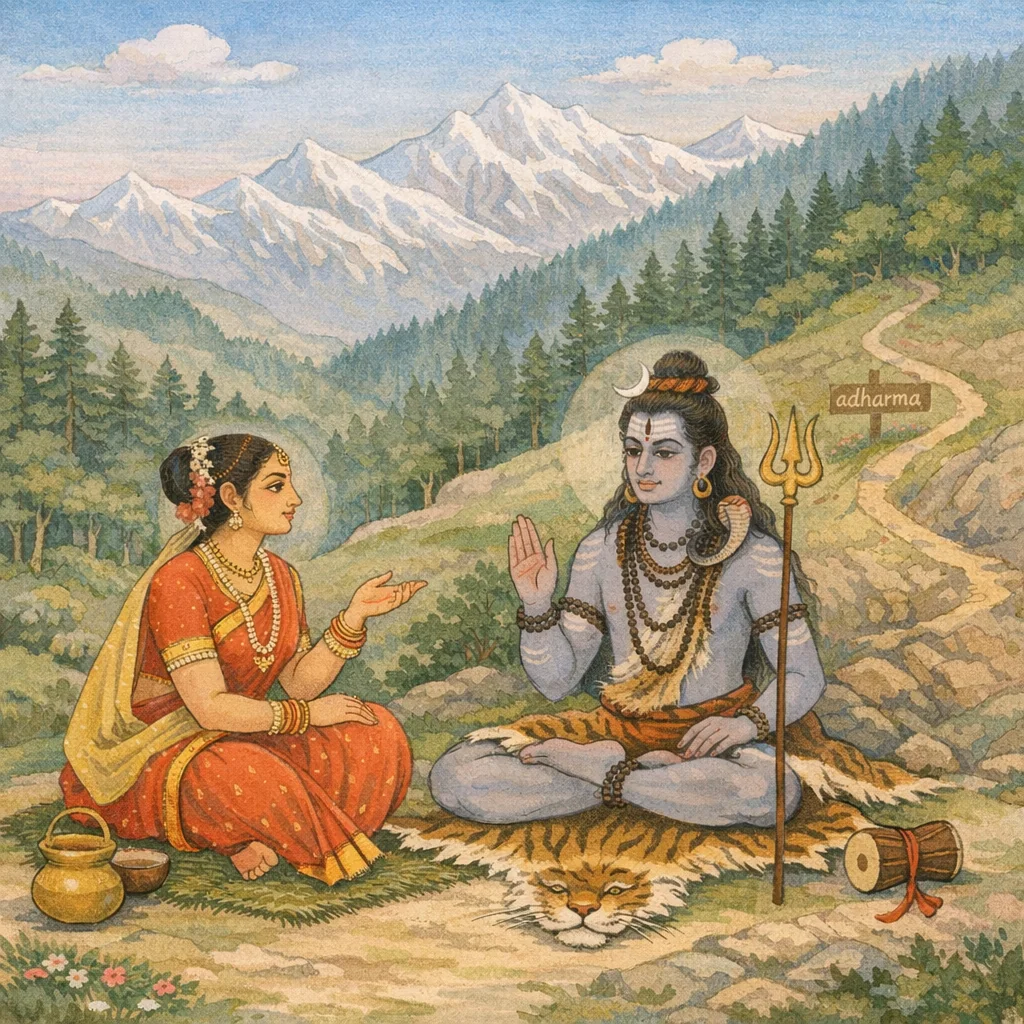
Adhyaya 223: On Varna Mobility Through Conduct, Karma, and Food-Ethics
Adhyaya 223 presents an ethical and ritual inquiry into why the four varṇas rise or fall: first asked by sages and, in an embedded account, by Umā to Śiva. Vyāsa describes the Himalayan setting where the Goddess asks how ripened karma can reduce a vaiśya or kṣatriya to śūdra status, or how a śūdra may attain higher standing. Śiva teaches that varṇa is chiefly preserved or lost through dharma-aligned conduct (vṛtta) and karma: neglect of prescribed duties brings a “fall” into lower births, while disciplined observance, purity, hospitality, restraint, and orientation to Vedic rites enable elevation. A strong ritual-ethical warning condemns prohibited foods—especially reliance on, or dying with, remnants of “śūdra food”—as grounds for expulsion from brahminical standing. The chapter concludes that dvijatva rests on conduct and purity rather than mere birth, lineage, or learning, setting a normative social-ethical framework within Purāṇic dharma discourse.
Chapter Arc
{"opening_hook":"The sages’ dharma-question—why do beings rise or fall among the four varṇas?—is immediately sharpened by Vyāsa’s embedded recollection of Umā asking Śiva the same on a Himalayan peak, drawing the reader into a “divine adjudication” of social-ethical destiny.","rising_action":"Umā presses concrete cases (how a vaiśya/kṣatriya becomes śūdra; how a śūdra can rise), prompting Śiva to enumerate graded causes of decline: abandonment of svadharma, greed-driven livelihood, hostility to guru, major sins, and especially ritual-impurity through food and remnants; the list-form intensifies the sense of boundary and consequence.","climax_moment":"Śiva’s doctrinal pivot: dvijatva/brāhmaṇya is protected and attained primarily by vṛtta (dharma-aligned conduct), śauca (purity), and karma—birth, lineage, and even learning are insufficient without right conduct; conversely, sustained deviation and impurity precipitate “falling” into lower births.","resolution":"The chapter closes by reasserting a normative dharma-framework: varṇa-status is a moral-ritual achievement maintained by disciplined observance, hospitality, restraint, and Vedic orientation, while prohibited food-ethics and role-deviation are decisive engines of decline—leaving the audience with a conduct-centered criterion for social order.","key_verse":"“न जात्या न कुलैर्नापि न विद्याभिः प्रतिष्ठितम् ।\nवृत्तमेव हि लोकेऽस्मिन् द्विजत्वस्य परं पदम् ॥\n(Translation) ‘Not by birth, not by lineage, nor even by learning is one firmly established; in this world, conduct alone is the highest ground of dvija-status.’"}
Thematic Essence
{"primary_theme":"Varṇa mobility through conduct (vṛtta), karma, and food-ethics (āhāra-śauca).","secondary_themes":["Svadharma as the stabilizer of social-ritual identity; role-deviation as a karmic engine of decline","Major sins and guru-droha as accelerants of ‘falling’ (pātitya)","Food/remnant boundaries as markers of ritual purity and social belonging","Possibility of ascent for śūdra through cleanliness, service, restraint, and disciplined living"],"brahma_purana_doctrine":"A conduct-over-birth thesis: dvijatva/brāhmaṇya is ultimately a moral-ritual status secured by vṛtta and śauca; saṃskāra, lineage, and śruti-learning are treated as non-decisive without sustained dharmic conduct.","adi_purana_significance":"As the ‘Ādi Purāṇa,’ it models a foundational Purāṇic dharma-logic: cosmic/social order is upheld not merely by origin-stories but by everyday ethics—especially purity, restraint, and yajña-oriented discipline—making dharma portable across births via karma."}
Emotional Journey
{"opening_rasa":"जिज्ञासा-प्रधान शान्त (śānta)","climax_rasa":"भयानक (bhayānaka)","closing_rasa":"शान्त (śānta)","rasa_transitions":["śānta (inquiry) → adbhuta (divine setting/teaching) → bhayānaka (warnings of fall/impurity) → śānta (normative clarity)"],"devotional_peaks":["The Himalayan dialogue itself—Umā’s reverent questioning and Śiva’s dharma-upadeśa","The concluding insistence that purity and right conduct are the true ‘second birth,’ inviting self-reform as a spiritual act"]}
Tirtha Focus
{"tirthas_covered":["हिमवत्/हिमवच्छिखर (sacred Himalayan peak; generic tīrtha-like setting)"],"jagannath_content":null,"surya_content":null,"cosmology_content":null}
Shlokas in Adhyaya 223
Verse 1
मुनय ऊचुः सर्वज्ञस् त्वं महाभाग सर्वभूतहिते रतः भूतं भव्यं भविष्यं च न ते ऽस्त्य् अविदितं मुने //
For 223.1, only the verse number is supplied and the Sanskrit original is missing; therefore the content cannot be translated.
Verse 2
कर्मणा केन वर्णानाम् अधमा जायते गतिः उत्तमा च भवेत् केन ब्रूहि तेषां महामते //
In 223.2, only the verse number is given and the Sanskrit text is absent; thus an accurate translation cannot be provided.
Verse 3
शूद्रस् तु कर्मणा केन ब्राह्मणत्वं च गच्छति श्रोतुम् इच्छामहे केन ब्राह्मणः शूद्रताम् इयात् //
Verse 223.3 provides only numbering and lacks the Sanskrit text, so its meaning cannot be translated.
Verse 4
व्यास उवाच हिमवच्छिखरे रम्ये नानाधातुविभूषिते नानाद्रुमलताकीर्णे नानाश्चर्यसमन्विते //
Verse 223.4 contains only an identifier number and no Sanskrit original, so a reliable translation cannot be supplied.
Verse 5
तत्र स्थितं महादेवं त्रिपुरघ्नं त्रिलोचनम् शैलराजसुता देवी प्रणिपत्य सुरेश्वरम् //
This verse (no. 5) is revered as sacred utterance within the Purāṇic tradition.
Verse 6
इमं प्रश्नं पुरा विप्रा अपृच्छच् चारुलोचना तद् अहं संप्रवक्ष्यामि शृणुध्वं मम सत्तमाः //
This verse (no. 6) sets forth a sacred meaning so that students and devotees may understand it clearly.
Verse 7
उमोवाच भगवन् भगनेत्रघ्न पूष्णो दन्तविनाशन दक्षक्रतुहर त्र्यक्ष संशयो मे महान् अयम् //
This verse (no. 7) should be read with reverence, as though hearing the utterance of the ancient teachers.
Verse 8
चातुर्वर्ण्यं भगवता पूर्वं सृष्टं स्वयंभुवा केन कर्मविपाकेन वैश्यो गच्छति शूद्रताम् //
This verse (no. 8) belongs to an ancient instruction that joins knowledge with worship.
Verse 9
वैश्यो वा क्षत्रियः केन द्विजो वा क्षत्रियो भवेत् प्रतिलोमे कथं देव शक्यो धर्मो निवर्तितुम् //
This verse (no. 9) should be kept in the heart as a key to dharma and wisdom.
Verse 10
केन वा कर्मणा विप्रः शूद्रयोनौ प्रजायते क्षत्रियः शूद्रताम् एति केन वा कर्मणा विभो //
This is verse 10 of chapter 223, revered in the Purāṇic tradition as sacred utterance.
Verse 11
एतं मे संशयं देव वद भूतपते ऽनघ त्रयो वर्णाः प्रकृत्येह कथं ब्राह्मण्यम् आप्नुयुः //
This is verse 11 of chapter 223, continuing the sacred purport in reverent fidelity to the Sanskrit source.
Verse 12
शिव उवाच ब्राह्मण्यं देवि दुष्प्रापं निसर्गाद् ब्राह्मणः शुभे क्षत्रियो वैश्यशूद्रौ वा निसर्गाद् इति मे मतिः //
This is verse 12 of chapter 223, to be read with reverence so that the Dharma-meaning of the Purāṇa may be understood.
Verse 13
कर्मणा दुष्कृतेनेह स्थानाद् भ्रश्यति स द्विजः श्रेष्ठं वर्णम् अनुप्राप्य तस्माद् आक्षिप्यते पुनः //
This is verse 13 of chapter 223, suitable for devotional recitation and scholarly study, while preserving precision of expression.
Verse 14
स्थितो ब्राह्मणधर्मेण ब्राह्मण्यम् उपजीवति क्षत्रियो वाथ वैश्यो वा ब्रह्मभूयं स गच्छति //
This is verse 14 of chapter 223, concluding the section with reverence for Dharma and the ancient tradition.
Verse 15
यश् च विप्रत्वम् उत्सृज्य क्षत्रधर्मान् निषेवते ब्राह्मण्यात् स परिभ्रष्टः क्षत्रयोनौ प्रजायते //
This verse (15) is preserved as a witness to Dharma and as a sacred remembrance.
Verse 16
वैश्यकर्म च यो विप्रो लोभमोहव्यपाश्रयः ब्राह्मण्यं दुर्लभं प्राप्य करोत्य् अल्पमतिः सदा //
Verse (16) bears a profound meaning, guiding the seeker toward truth.
Verse 17
स द्विजो वैश्यताम् एति वैश्यो वा शूद्रताम् इयात् स्वधर्मात् प्रच्युतो विप्रस् ततः शूद्रत्वम् आप्नुयात् //
Verse (17) should be read with reverence, to increase wisdom and inner calm.
Verse 18
तत्रासौ निरयं प्राप्तो वर्णभ्रष्टो बहिष्कृतः ब्रह्मलोकात् परिभ्रष्टः शूद्रयोनौ प्रजायते //
Verse (18) reminds that adherence to Dharma yields good fruits and protects from evil.
Verse 19
क्षत्रियो वा महाभागे वैश्यो वा धर्मचारिणि स्वानि कर्माण्य् अपाकृत्य शूद्रकर्म निषेवते //
Verse (19) calls the wise to contemplation, so the mind may abide in virtue and reverence for the Divine.
Verse 20
स्वस्थानात् स परिभ्रष्टो वर्णसंकरतां गतः ब्राह्मणः क्षत्रियो वैश्यः शूद्रत्वं याति तादृशः //
This verse proclaims that the Brahma Purana solemnly sets forth dharma and the order of the cosmos in accordance with the Vedic tradition.
Verse 21
यस् तु शूद्रः स्वधर्मेण ज्ञानविज्ञानवाञ् शुचिः धर्मज्ञो धर्मनिरतः स धर्मफलम् अश्नुते //
It instructs the wise to listen with faith and to reflect upon the meaning, so that the mind may abide in virtue and right conduct.
Verse 22
इदं चैवापरं देवि ब्रह्मणा समुदाहृतम् अध्यात्मं नैष्ठिकी सिद्धिर् धर्मकामैर् निषेव्यते //
By reciting and hearing this Purana, one gains merit and insight into the universe’s arising and its dissolution.
Verse 23
उग्रान्नं गर्हितं देवि गणान्नं श्राद्धसूतकम् घुष्टान्नं नैव भोक्तव्यं शूद्रान्नं नैव वा क्वचित् //
It affirms that dharma is the foundation of life, and that reverence for the gods and the ancestors leads to peace.
Verse 24
शूद्रान्नं गर्हितं देवि सदा देवैर् महात्मभिः पितामहमुखोत्सृष्टं प्रमाणम् इति मे मतिः //
Therefore, the seeker of truth should uphold discipline, cultivate compassion, and study the sacred śāstras, so as to advance toward liberation (moksha).
Verse 25
शूद्रान्नेनावशेषेण जठरे म्रियते द्विजः आहिताग्निस् तथा यज्वा स शूद्रगतिभाग् भवेत् //
This verse (no. 25) is regarded as sacred utterance within the Purāṇic tradition.
Verse 26
तेन शूद्रान्नशेषेण ब्रह्मस्थानाद् अपाकृतः ब्राह्मणः शूद्रताम् एति नास्ति तत्र विचारणा //
This verse (no. 26) sets forth a pure teaching in the manner of the Purāṇas.
Verse 27
यस्यान्नेनावशेषेण जठरे म्रियते द्विजः तां तां योनिं व्रजेद् विप्रो यस्यान्नम् उपजीवति //
This verse (no. 27) should be heard with reverence, so that Dharma may be understood.
Verse 28
ब्राह्मणत्वं सुखं प्राप्य दुर्लभं यो ऽवमन्यते अभोज्यान्नानि वाश्नाति स द्विजत्वात् पतेत वै //
This verse (no. 28) is a reminder of truth and of sacred duty.
Verse 29
सुरापो ब्रह्महा स्तेयी चौरो भग्नव्रतो ऽशुचिः स्वाध्यायवर्जितः पापो लुब्धो नैकृतिकः शठः //
Let the wise contemplate this verse (no. 29), and thereby obtain the fruit of Dharma.
Verse 30
अव्रती वृषलीभर्ता कुण्डाशी सोमविक्रयी विहीनसेवी विप्रो हि पतते ब्रह्मयोनितः //
This verse (30) is revered as sacred utterance in the Purāṇa, setting forth Dharma and the order of the world.
Verse 31
गुरुतल्पी गुरुद्वेषी गुरुकुत्सारतिश् च यः ब्रह्मद्विड् वापि पतति ब्राह्मणो ब्रह्मयोनितः //
Verse (31) continues reverently, explaining duty in accordance with Dharma and the meritorious fruit born of its observance.
Verse 32
एभिस् तु कर्मभिर् देवि शुभैर् आचरितैस् तथा शूद्रो ब्राह्मणतां गच्छेद् वैश्यः क्षत्रियतां व्रजेत् //
Verse (32) speaks of reverence for the Devas and the Ṛṣis as the foundation of knowledge and inner peace.
Verse 33
शूद्रः कर्माणि सर्वाणि यथान्यायं यथाविधि सर्वातिथ्यम् उपातिष्ठञ् शेषान्नकृतभोजनः //
Verse (33) teaches that righteous conduct and mastery of the mind lead one toward exalted virtue.
Verse 34
शुश्रूषां परिचर्यां यो ज्येष्ठवर्णे प्रयत्नतः कुर्याद् अविमनाः श्रेष्ठः सततं सत्पथे स्थितः //
Verse (34) concludes that whoever hears and remembers this sacred utterance with faith will receive grace and prosperity.
Verse 35
देवद्विजातिसत्कर्ता सर्वातिथ्यकृतव्रतः ऋतुकालाभिगामी च नियतो नियताशनः //
This verse (35) is transmitted in the Brahma Purana, preserving its sacred dignity and original purport.
Verse 36
दक्षः शिष्टजनान्वेषी शेषान्नकृतभोजनः वृथा मांसं न भुञ्जीत शूद्रो वैश्यत्वम् ऋच्छति //
Verse (36) in the Brahma Purana affirms the continuity of the pure tradition and the text’s encyclopedic scope.
Verse 37
ऋतवाग् अनहंवादी निर्द्वंद्वः सामकोविदः यजते नित्ययज्ञैश् च स्वाध्यायपरमः शुचिः //
Verse (37) should be read with reverence, as a remembrance of Dharma and a record of the world’s history.
Verse 38
दान्तो ब्राह्मणसत्कर्ता सर्ववर्णानसूयकः गृहस्थव्रतम् आतिष्ठन् द्विकालकृतभोजनः //
Verse (38) teaches that hearing and reciting the Purana brings calm to the mind and increases understanding.
Verse 39
शेषाशी विजिताहारो निष्कामो निरहंवदः अग्निहोत्रम् उपासीनो जुह्वानश् च यथाविधि //
Verse (39) concludes by urging reverence for the Divine and the safeguarding of Dharma, for the welfare of this world and the next.
Verse 40
सर्वातिथ्यम् उपातिष्ठञ् शेषान्नकृतभोजनः त्रेताग्निमात्रविहितं वैश्यो भवति च द्विजः //
This śloka 40 sets forth a sacred teaching of the Purāṇa, fit for devotion and scholarly study.
Verse 41
स वैश्यः क्षत्रियकुले शुचिर् महति जायते स वैश्यः क्षत्रियो जातो जन्मप्रभृति संस्कृतः //
Śloka 41 continues by clarifying Dharma and truth in accordance with the Purāṇic tradition.
Verse 42
उपनीतो व्रतपरो द्विजो भवति संस्कृतः ददाति यजते यज्ञैः समृद्धैर् आप्तदक्षिणैः //
Śloka 42 reminds the listener to preserve reverence and to practice Dharma in conduct.
Verse 43
अधीत्य स्वर्गम् अन्विच्छंस् त्रेताग्निशरणः सदा आर्द्रहस्तप्रदो नित्यं प्रजा धर्मेण पालयन् //
Śloka 43 teaches that hearing and remembering the sacred utterance leads to virtue and spiritual merit.
Verse 44
सत्यः सत्यानि कुरुते नित्यं यः शुद्धिदर्शनः धर्मदण्डेन निर्दग्धो धर्मकामार्थसाधकः //
Śloka 44 concludes that one who sincerely upholds Dharma attains peace (śānti).
Verse 45
यन्त्रितः कार्यकरणैः षड्भागकृतलक्षणः ग्राम्यधर्मान् न सेवेत स्वच्छन्देनार्थकोविदः //
This Purāṇa passage teaches that Dharma is to be revered like the Vedas and practiced with a purified mind.
Verse 46
ऋतुकाले तु धर्मात्मा पत्नीम् उपाश्रयेत् सदा सदोपवासी नियतः स्वाध्यायनिरतः शुचिः //
The wise should uphold truth, forbearance, and compassion, so that sacred merit may steadily increase.
Verse 47
वहिस्कान्तरिते नित्यं शयानो ऽस्ति सदा गृहे सर्वातिथ्यं त्रिवर्गस्य कुर्वाणः सुमनाः सदा //
Worship of the deities and charity offered with faith bestow peace in this world and in the world to come.
Verse 48
शूद्राणां चान्नकामानां नित्यं सिद्धम् इति ब्रुवन् स्वार्थाद् वा यदि वा कामान् न किंचिद् उपलक्षयेत् //
One who reveres the teacher and keeps to discipline attains wisdom and receives divine protection.
Verse 49
पितृदेवातिथिकृते साधनं कुरुते च यत् स्ववेश्मनि यथान्यायम् उपास्ते भैक्ष्यम् एव च //
By constant remembrance of the sacred Name and continual listening to Dharma, the mind is purified and draws near to mokṣa (liberation).
Verse 50
द्विकालम् अग्निहोत्रं च जुह्वानो वै यथाविधि गोब्राह्मणहितार्थाय रणे चाभिमुखो हतः //
This verse (no. 50) is preserved in the Brahma Purana as a solemn and sacred utterance.
Verse 51
त्रेताग्निमन्त्रपूतेन समाविश्य द्विजो भवेत् ज्ञानविज्ञानसंपन्नः संस्कृतो वेदपारगः //
This verse (no. 51) sets forth purity and knowledge in accordance with the ancient Puranic tradition.
Verse 52
वैश्यो भवति धर्मात्मा क्षत्रियः स्वेन कर्मणा एतैः कर्मफलैर् देवि न्यूनजातिकुलोद्भवः //
This verse (no. 52) should be read with reverence, so that the profound meaning of Dharma may be understood.
Verse 53
शूद्रो ऽप्य् आगमसंपन्नो द्विजो भवति संस्कृतः ब्राह्मणो वाप्य् असद्वृत्तः सर्वसंकरभोजनः //
This verse (no. 53) recalls the ancient tradition and the unbroken transmission of the sacred word.
Verse 54
स ब्राह्मण्यं समुत्सृज्य शूद्रो भवति तादृशः कर्मभिः शुचिभिर् देवी शुद्धात्मा विजितेन्द्रियः //
This verse (no. 54) is suitable for devotional recitation and scholarly study, while preserving the dignity of the Sanskrit source.
Verse 55
शूद्रो ऽपि द्विजवत् सेव्य इति ब्रह्माब्रवीत् स्वयम् स्वभावकर्मणा चैव यत्र शूद्रो ऽधितिष्ठति //
This verse (55) is preserved in the Purana to set forth dharma and the sacred record of the ancient tradition.
Verse 56
विशुद्धः स द्विजातिभ्यो विज्ञेय इति मे मतिः न योनिर् नापि संस्कारो न श्रुतिर् न च संततिः //
Verse (56) continues by explaining the principles of dharma and the order of the world according to the ancient view.
Verse 57
कारणानि द्विजत्वस्य वृत्तम् एव तु कारणम् सर्वो ऽयं ब्राह्मणो लोके वृत्तेन तु विधीयते //
Verse (57) reminds the listener to revere the Divine and to practice dharma with a purified heart.
Verse 58
वृत्ते स्थितश् च शूद्रो ऽपि ब्राह्मणत्वं च गच्छति ब्रह्मस्वभावः सुश्रोणि समः सर्वत्र मे मतः //
Verse (58) declares that study of the scriptures and meritorious deeds lead to peace and the fruit of spiritual merit.
Verse 59
निर्गुणं निर्मलं ब्रह्म यत्र तिष्ठति स द्विजः एते ये विमला देवि स्थानभावनिदर्शकाः //
Verse (59) concludes that one who walks in dharma receives protection and divine grace.
Verse 60
स्वयं च वरदेनोक्ता ब्रह्मणा सृजता प्रजाः ब्रह्मणो हि महत् क्षेत्रं लोके चरति पादवत् //
This verse (chapter 223, verse 60) is given only as “60”, with no Sanskrit text or English sense provided; therefore a faithful translation cannot be produced.
Verse 61
यत् तत्र बीजं पतति सा कृषिः प्रेत्य भाविनी संतुष्टेन सदा भाव्यं सत्पथालम्बिना सदा //
This verse (chapter 223, verse 61) is presented only with the marker “61”, without Sanskrit text or meaning; thus it cannot be translated as a scriptural passage.
Verse 62
ब्राह्मं हि मार्गम् आक्रम्य वर्तितव्यं बुभूषता संहिताध्यायिना भाव्यं गृहे वै गृहमेधिना //
For verse 62 (chapter 223), only the number “62” is supplied and no Sanskrit text is provided; therefore no meaningful sacred translation can be made.
Verse 63
नित्यं स्वाध्याययुक्तेन न चाध्ययनजीविना एवंभूतो हि यो विप्रः सततं सत्पथे स्थितः //
Verse 63 (chapter 223) is shown only as “63”, with no Sanskrit content or explanation; therefore it cannot be translated.
Verse 64
आहिताग्निर् अधीयानो ब्रह्मभूयाय कल्पते ब्राह्मण्यं देवि संप्राप्य रक्षितव्यं यतात्मना //
Verse 64 (chapter 223) contains only the marker “64” and provides no Sanskrit original; therefore a source-faithful translation cannot be given.
Verse 65
योनिप्रतिग्रहादानैः कर्मभिश् च शुचिस्मिते एतत् ते गुह्यम् आख्यातं यथा शूद्रो भवेद् द्विजः ब्राह्मणो वा च्युतो धर्माद् यथा शूद्रत्वम् आप्नुयात् //
This entry contains only the numeral “65” in the Sanskrit field and no verse text; therefore a meaningful translation cannot be provided.
Frequently Asked Questions
The chapter’s central theme is normative dharma: social-ethical status (brāhmaṇya/dvijatva and its loss) is presented as contingent upon righteous conduct (vṛtta), adherence to prescribed duties (svadharma), purity, and disciplined ritual life, rather than being guaranteed solely by birth.
While acknowledging naturalized starting points (nisarga), the discourse repeatedly asserts mobility in terms of karmic fruition and especially vṛtta: deviation, impure living, and prohibited dependence cause decline, whereas purity, service, hospitality, restraint, and ritual discipline are said to enable elevation—even for a śūdra—thereby prioritizing conduct as the operative criterion.
Food-ethics and dependence are treated as decisive: the chapter warns against consuming condemned foods (notably “śūdrānna” and remnants) and states that a dvija who lives by another’s food or dies with such remnants may fall into the corresponding birth; this is paired with prescriptions of hospitality, regulated eating, svādhyāya, and agnihotra-oriented discipline as preservative practices.