Adhyaya 141: Kapilāsaṅgama Tīrtha and the Pṛthu–Earth Covenant
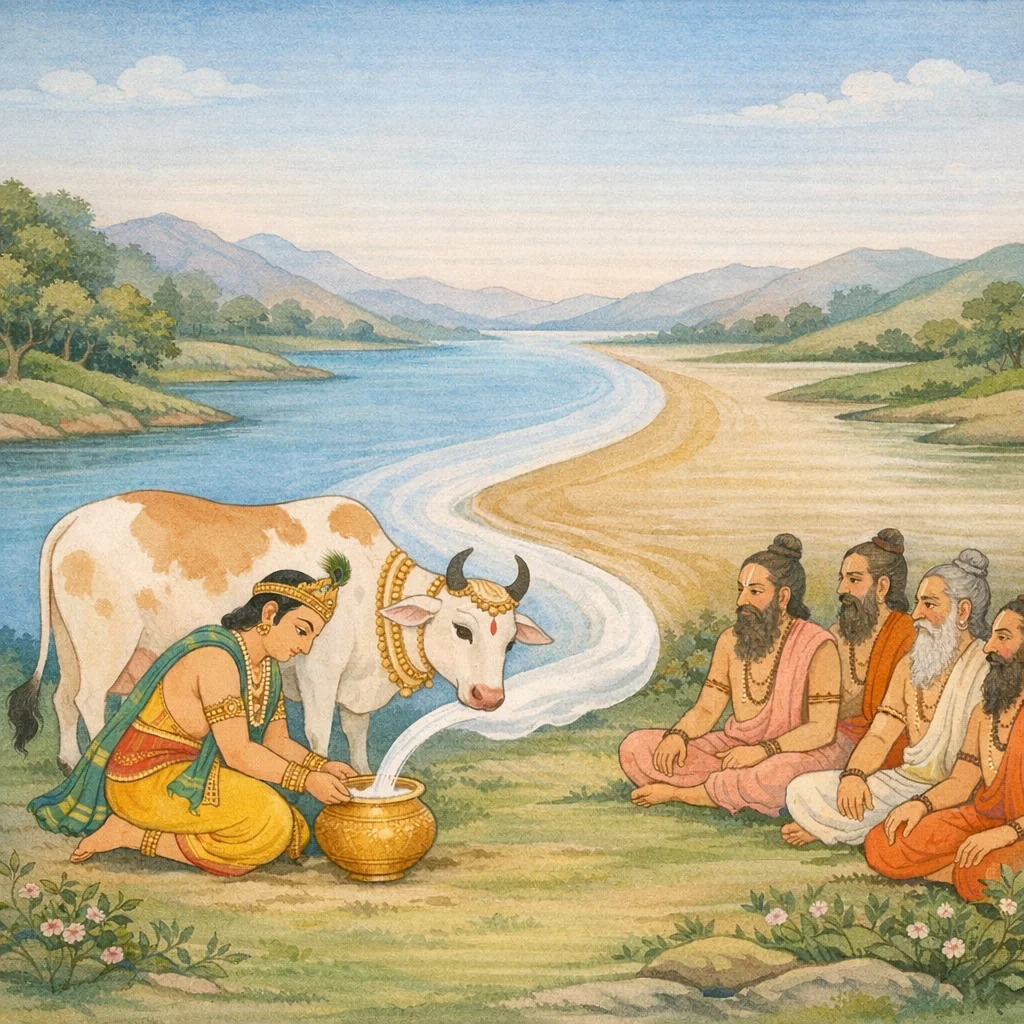
Adhyāya 141 presents a sacred-topographical account of the famed tīrtha Kapilāsaṅgama, which Brahmā relates to Nārada as a highly meritorious tradition. It recalls the collapse of dharma after King Vena’s downfall and the sages’ search for a restoring polity, during which the realized ascetic Kapila is consulted. By churning Vena’s body the sages first bring forth the Niṣāda figure and then manifest Pṛthu, endowed with auspicious royal marks and empowered by Brahmā’s potency. Devas and sages bestow weapons and mantras on Pṛthu and ask him to recover the life-sustaining herbs swallowed by the Earth. A tense ethical dialogue follows: Pṛthu threatens coercion while Earth argues her indispensability; the text advances a “one for many” consequentialist rationale, tempered by divine mediation. Earth then assumes cow-form and yields nourishment as “milk,” producing sanctified waters across major rivers—especially at the Gautamī—thereby establishing Kapilāsaṅgama as a renowned confluence-tīrtha in Purāṇic sacred geography.
Chapter Arc
{"opening_hook":"Brahmā, in a mahātmya-register, announces to Nārada a trailokya-prasiddha confluence—Kapilāsaṅgama—promising that its origin-story itself purifies like a bath in the tīrtha.","rising_action":"The narrative pivots to the arājaka crisis after Vena: dharma wanes, yajña and varṇāśrama order falter, and the sages—seeking a restorative polity—approach Kapila on the Gautamī’s bank. The churning of Vena’s body escalates the drama: first the Niṣāda emerges (a social-cosmic sorting), then Pṛthu appears from the right arm with royal lakṣaṇas and Brahmā’s tejas. Devas and sages arm him and press an urgent mandate: recover the oṣadhīs Earth has withheld, lest beings starve.","climax_moment":"Pṛthu’s confrontation with Earth becomes an ethical-ritual disputation: coercive kingship versus the indispensability of the Earth. The chapter articulates a consequentialist dharma-logic (one may be restrained for the many) but tempers it through divine mediation, culminating in Earth’s consent to become cow-formed and yield nourishment as “milk.”","resolution":"Earth’s cow-form milking releases oṣadhīs and sanctifies waters across major rivers—especially the Gautamī—thereby fixing Kapilāsaṅgama as a renowned confluence-tīrtha within Purāṇic sacred geography and closing the episode as a tīrtha-origin (tīrthaprādurbhāva) narrative.","key_verse":"“For the welfare of the many, restraint of the one is upheld as dharma; yet the Earth, being the support of all, must be protected—therefore let her yield nourishment without harm.” (Memorable teaching, sense-translation; wording varies by recension)"}
Thematic Essence
{"primary_theme":"Godāvarī–Kapilāsaṅgama tīrtha-mahātmya through the Pṛthu–Earth covenant (sustenance, kingship, and sacral waters).","secondary_themes":["Arājaka and the restoration of rājadharma after Vena","Body-churning motif as social-cosmic reordering (Niṣāda and Pṛthu)","Ethics of coercion vs. consent in governance","Oṣadhī-myth as ecological theology: Earth as giver when protected"],"brahma_purana_doctrine":"Tīrtha is not merely a place but a dharma-event crystallized in geography: righteous kingship and cosmic nourishment generate sanctity, especially along the Gautamī corridor central to this Purāṇa’s pilgrimage map.","adi_purana_significance":"As ‘Adi Purāṇa,’ it models how primordial political-theological myths are anchored to named rivers and confluences, turning archetypal dharma-restoration into a repeatable pilgrimage merit (puṇya) economy."}
Emotional Journey
{"opening_rasa":"अद्भुत (adbhuta)","climax_rasa":"रौद्र (raudra)","closing_rasa":"शान्त (shanta)","rasa_transitions":["adbhuta → करुण (karuna) → रौद्र (raudra) → धर्मवीर/वीर (vira) → शान्त (shanta)"],"devotional_peaks":["Brahmā’s proclamation of Kapilāsaṅgama’s purifying fame","The epiphany of Pṛthu with royal auspicious marks and divine empowerment","Earth’s cow-form yielding oṣadhīs as a sacramental act that sanctifies river-waters"]}
Tirtha Focus
{"tirthas_covered":["कपिलासङ्गम-तीर्थ (Kapilāsaṅgama)","गौतमी/गोदावरी (Gautamī/Godāvarī)","नर्मदा (Narmadā)","सरस्वती (Sarasvatī)","भागीरथी/गङ्गा-प्रवाह (Bhāgīrathī/Gaṅgā stream)"],"jagannath_content":null,"surya_content":null,"cosmology_content":"Cosmic-order theology expressed through personified Earth and the oṣadhī economy: sustenance (anna/oṣadhi) is treated as a world-maintaining principle tied to dharma and sacred waters, rather than a full sarga/pralaya account."}
Shlokas in Adhyaya 141
Verse 1
ब्रह्मोवाच कपिलासंगमं नाम तीर्थं त्रैलोक्यविश्रुतम् तत्र नारद वक्ष्यामि कथां पुण्याम् अनुत्तमाम् //
This entry provides only the numeral “1”; since no Sanskrit text is supplied, a meaningful translation cannot be given.
Verse 2
कपिलो नाम तत्त्वज्ञो मुनिर् आसीन् महायशाः क्रूरश् चापि प्रसन्नश् च तपोव्रतपरायणः //
This entry provides only the numeral “2”; since no Sanskrit text is supplied, a meaningful translation cannot be given.
Verse 3
तपस्यन्तं मुनिश्रेष्ठं गौतमीतीरम् आश्रितम् तम् आगत्य महात्मानं वामदेवादयो ऽब्रुवन् //
This entry provides only the numeral “3”; since no Sanskrit text is supplied, a meaningful translation cannot be given.
Verse 4
हत्वा वेनं ब्रह्मशापैर् नष्टधर्मे त्व् अराजके कपिलं सिद्धम् आचार्यम् ऊचुर् मुनिगणास् तदा //
This verse (141.4) is cited as sacred speech within the Purāṇa, yet the Sanskrit original is not provided here.
Verse 10
वेनबाहुं ममन्थुस् ते दक्षिणं धर्मसंहितम् ततः पृथुस्वरश् चैव सर्वलक्षणलक्षितः //
This verse (141.10) is regarded as a sacred stanza of the Purāṇa, but the Sanskrit source text is not included in this data.
Verse 11
राजाभवत् पृथुः श्रीमान् ब्रह्मसामर्थ्यसंयुतः तम् आगत्य सुराः सर्वे अभिनन्द्य वराञ् शुभान् //
This verse (141.11) is referenced as a passage of the Purāṇa, but the Sanskrit original needed for translation is not available.
Verse 12
तस्मै ददुस् तथास्त्राणि मन्त्राणि गुणवन्ति च ततो ऽब्रुवन् मुनिगणास् तं पृथुं कपिलेन च //
This verse (141.12) is numbered in the Purāṇa, but the Sanskrit text is not shown, so a word-for-word translation cannot be made.
Verse 13
मुनय ऊचुः आहारं देहि जीवेभ्यो भुवा ग्रस्तौषधीर् अपि //
This verse (141.13) is listed as a stanza of the Purāṇa, but without the Sanskrit original, a complete translation cannot be provided.
Verse 14
ब्रह्मोवाच ततः स धनुर् आदाय भुवम् आह नृपोत्तमः //
This verse (14) sets forth the sacred Dharma and the proper order of practice, guiding the seeker of truth toward peace and the highest good.
Verse 15
पृथुर् उवाच ओषधीर् देहि या ग्रस्ताः प्रजानां हितकाम्यया //
This verse (15) praises Brahmā and the devas as guardians of the world and as lights that illumine the heart toward knowledge.
Verse 16
ब्रह्मोवाच तम् उवाच मही भीता पृथुं तं पृथुलोचनम् //
This verse (16) teaches worship, yajña, and giving performed with a pure mind, to increase merit and dispel ignorance.
Verse 17
मह्य् उवाच मयि जीर्णा महौषध्यः कथं दातुम् अहं क्षमा //
This verse (17) reminds that honoring the teacher and studying the Vedas are sources of wisdom and the path to the supreme Dharma.
Verse 18
ब्रह्मोवाच ततः सकोपो नृपतिस् ताम् आह पृथिवीं पुनः //
This verse (18) concludes that one who practices Dharma with sincerity receives grace and advances toward liberation (mokṣa).
Verse 19
पृथुर् उवाच नो चेद् ददास्य् अद्य त्वां वै हत्वा दास्ये महौषधीः //
Verse 141.19 is regarded as a sacred utterance in the Brahma Purana, but the Sanskrit original is not provided, so a faithful translation cannot be made.
Verse 20
भूमिर् उवाच कथं हंसि स्त्रियं राजञ् ज्ञानी भूत्वा नृपोत्तम विना मया कथं चेमाः प्रजाः संधारयिष्यसि //
Verse 141.20 is revered as a sacred passage, but without the Sanskrit original it cannot be translated with precision.
Verse 21
पृथुर् उवाच यत्रोपकारो ऽनेकानाम् एकनाशे भविष्यति न दोषस् तत्र पृथिवि तपसा धारये प्रजाः //
For 141.21 only the verse number is given; without the Sanskrit text, the original meaning cannot be translated.
Verse 22
न दोषम् अत्र पश्यामि नाचक्षे ऽनर्थकं वचः यस्मिन् निपातिते सौख्यं बहूनाम् उपजायते मुनयस् तद्वधं प्राहुर् अश्वमेधशताधिकम् //
Verse 141.22 belongs to the Puranic corpus, but since the Sanskrit original is missing, an authentic translation cannot be provided.
Verse 23
ब्रह्मोवाच ततो देवाश् च ऋषयः सान्त्वयित्वा नृपोत्तमम् महीं च मातरं देवीम् ऊचुः सुरगणास् तदा //
For 141.23 only the verse identifier is provided; without the Sanskrit text, a faithful translation into other languages is not possible.
Verse 24
देवा ऊचुः भूमे गोरूपिणी भूत्वा पयोरूपा महौषधीः देहि त्वं पृथवे राज्ञे ततः प्रीतो भवेन् नृपः प्रजासंरक्षणं च स्यात् ततः क्षेमं भविष्यति //
This verse (141.24) is revered as sacred utterance in the Brahma Purana; it should be read with śraddhā, faith and contemplation.
Verse 25
ब्रह्मोवाच ततो गोरूपम् आस्थाय भूम्य् आसीत् कपिलान्तिके दुदोह च महौषध्यो राजा वेनकरोद्भवः //
Verse (141.25) is preserved in the Brahma Purana as a sacred passage; listen and read with a tranquil mind.
Verse 26
यत्र देवाः सगन्धर्वा ऋषयः कपिलो मुनिः महीं गोरूपम् आपन्नां नर्मदायां महामुने //
Verse (141.26) is part of the ancient instruction of the Brahma Purana; it should be interpreted with reverence for Dharma.
Verse 27
सरस्वत्यां भागीरथ्यां गोदावर्यां विशेषतः महानदीषु सर्वासु दुदुहे ऽसौ पयो महत् //
Verse (141.27) is regarded as an ancient record of sacred knowledge in the Brahma Purana; read it with due reverence.
Verse 28
सा दुह्यमाना पृथुना पुण्यतोयाभवन् नदी गौतम्या संगता चाभूत् तद् अद्भुतम् इवाभवत् //
Verse (141.28) concludes a section of sacred admonition in the Brahma Purana; practice listening and reading with faith.
Verse 29
ततः प्रभृति तत् तीर्थं कपिलासंगमं विदुः तत्राष्टाशीतिः पूज्यानि सहस्राणि महामते //
This verse (29) is regarded as a sacred passage of the Brahma Purana, offering an encyclopedic and solemn exposition.
Verse 30
तीर्थान्य् आहुर् मुनिगणाः स्मरणाद् अपि नारद पावनानि जगत्य् अस्मिंस् तानि सर्वाण्य् अनुक्रमात् //
This verse (30) continues the sacred puranic narration, intended to illuminate Dharma and the body of knowledge.
Frequently Asked Questions
The chapter foregrounds dharma-restoration through righteous kingship (Pṛthu) and debates coercion versus cosmic responsibility in governance. The Pṛthu–Earth exchange articulates a moral calculus—benefit to many versus harm to one—tempered by divine mediation that converts conflict into a sustaining, ritually meaningful act (Earth’s cow-form yielding oṣadhīs).
Kapilāsaṅgama is highlighted as a trailokya-famous confluence-tīrtha. Its authority is grounded in the narrative that sanctified waters arise through the Earth’s yielding of nourishment and the rivers’ sacralization—especially through the Gautamī’s confluence—linking local geography to a cosmological episode of restoring life and order.
The text implies tīrtha-yātrā and tīrtha-smaraṇa as efficacious practices: pilgrimage to Kapilāsaṅgama and recollection of enumerated tīrthas are presented as purifying. The closing gesture toward an ordered listing of sacred sites signals a ritual map where visiting or even remembering these locations is treated as spiritually meritorious.