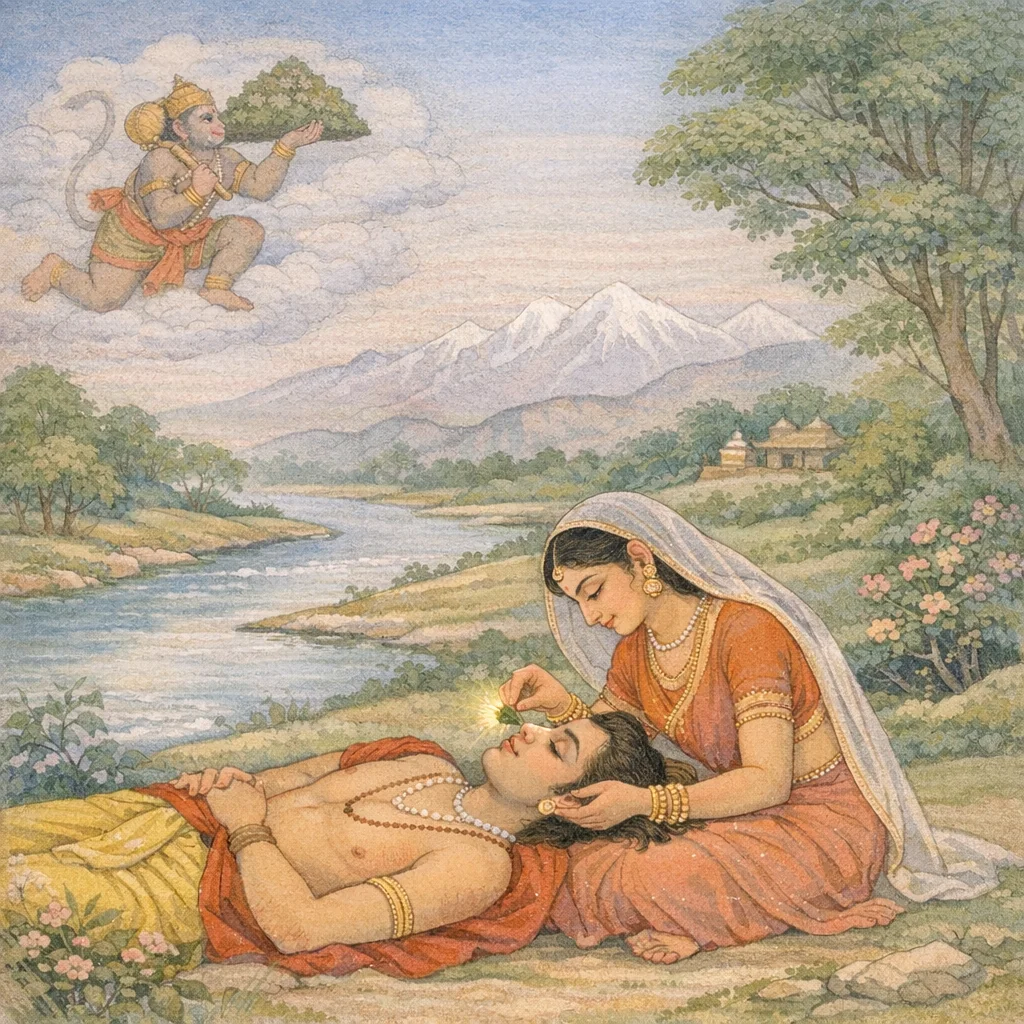
Adhyaya 170: Cakṣus-tīrtha at Yogeśvara: Dharma Tested, Sight Restored
Adhyāya 170 praises Cakṣus-tīrtha on the southern bank of the Gautamī, where Yogeśvara Hari is worshipped, through an ethical tale affirming dharma’s superiority over adharma. It introduces a region linked with Bhauvana-pura and a brāhmaṇa line—Vṛddhakauśika and his son Gautama. The wealthy vaiśya Maṇikuṇḍala becomes Gautama’s companion, but the unequal friendship turns into a moral contest when Gautama’s greed and cynicism drive him toward theft and the disparagement of dharma. A public disputation ends in violent wagers, leaving the vaiśya mutilated and blinded, yet unwavering in praising dharma. Divine aid comes through Vibhīṣaṇa and his son, who apply a fragment of viśalyakaraṇī—an extraordinary herb tied to Hanumān’s mountain episode—restoring the vaiśya’s limbs and sight. He later restores a princess’s vision and gains a kingdom, but keeps compassion for his former friend and finally guides him to purification at Yogeśvara. The tīrtha is thereafter famed as Mṛtasaṃjīvana and Cakṣus-tīrtha; even remembrance is meritorious, granting mental clarity and removing ill-will.
Chapter Arc
{"opening_hook":"The chapter opens in tīrtha-māhātmya mode: Brahmā’s narration pivots to a specific, name-bearing sacred spot—Cakṣus-tīrtha on the Gautamī’s southern bank—where Yogeśvara Hari is worshipped, promising merit even by mere remembrance.","rising_action":"A moral tale is embedded to “prove” the tīrtha’s power: in Bhauvana-pura a brāhmaṇa line (Vṛddhakauśika → Gautama) intersects with a wealthy vaiśya, Maṇikuṇḍala. Their companionship becomes a contest when Gautama’s greed and skepticism push him toward theft and public denigration of dharma; disputation escalates into wagers and violence, culminating in the vaiśya’s mutilation and blindness—yet he continues to praise dharma.","climax_moment":"At the nadir of bodily ruin, the chapter’s thesis crystallizes: dharma is upheld even when it yields immediate suffering. Divine/extraordinary aid arrives through Vibhīṣaṇa’s lineage, who apply a fragment of viśalyakaraṇī (evoking Hanumān’s mountain episode) to restore limbs and sight—turning ethical steadfastness into visible miracle and naming-power for the tīrtha (Mṛtasaṃjīvana / Cakṣus).","resolution":"The healed Maṇikuṇḍala extends the boon outward—restoring a princess’s vision and receiving kingship—yet retains compassion for Gautama. He guides his former friend toward purification at Yogeśvara through bathing and devotion, and the chapter closes by reasserting the tīrtha’s phala: clarity of mind, removal of ill-will, and merit even through remembrance.","key_verse":"Sanskrit (representative teaching, paraphrased from the chapter’s thrust): “धर्म एव परो लोके धर्मे सत्यं प्रतिष्ठितम् । धर्मेण सुखमाप्नोति धर्मेणैव परा गतिः ॥” Translation: “Dharma alone is supreme in the world; truth stands established in dharma. By dharma one attains happiness, and by dharma alone the highest goal.”"}
Thematic Essence
{"primary_theme":"Godāvarī–Gautamī tīrtha-māhātmya: Cakṣus-tīrtha / Mṛtasaṃjīvana at Yogeśvara as a place where dharma is tested and sight (outer and inner) is restored.","secondary_themes":["Dharma vs. adharma staged as public disputation and wagered violence","Ritual-therapeutic miracle: viśalyakaraṇī and the logic of sacred medicine","Compassion and reconciliation: the healed benefactor guides the wrongdoer to purification","Merit by remembrance (smaraṇa-mātra-phala) and the cleansing of ill-will (dveṣa)"],"brahma_purana_doctrine":"The chapter advances a characteristic Purāṇic doctrine of ‘ethical verification through geography’: a tīrtha is not merely a place to bathe, but a moral instrument where dharma’s truth becomes empirically manifest (healing, clarity, removal of malice), and where even remembrance participates in that efficacy.","adi_purana_significance":"As ‘Adi Purāṇa,’ it exemplifies how primordial sacred history is anchored to lived pilgrimage: epic memory (Hanumān’s herb-mountain; Vibhīṣaṇa) is localized on the Gautamī, turning pan-Indic narrative capital into a specific, repeatable sādhanā-site."}
Emotional Journey
{"opening_rasa":"शान्त","climax_rasa":"अद्भुत","closing_rasa":"शान्त","rasa_transitions":["शान्त → विवाद-उत्कर्ष (रौद्र/वीर मिश्र) → करुण → अद्भुत → शान्त"],"devotional_peaks":["The blinded, mutilated Maṇikuṇḍala continuing to extol dharma despite suffering","The application of viśalyakaraṇī and the sudden restoration of limbs and sight as a revelation of divine order","Purificatory bathing and turning toward Yogeśvara as the final act of reconciliation and inner cleansing"]}
Tirtha Focus
{"tirthas_covered":["चक्षुस्तीर्थ (Cakṣus-tīrtha)","मृतसञ्जीवन-तीर्थ (Mṛtasaṃjīvana)","योगेश्वर-क्षेत्र (Yogeśvara shrine/locale)","गौतमी (दक्षिणतट)"],"jagannath_content":null,"surya_content":null,"cosmology_content":null}
Shlokas in Adhyaya 170
Verse 1
ब्रह्मोवाच चक्षुस्तीर्थम् इति ख्यातं रूपसौभाग्यदायकम् यत्र योगेश्वरो देवो गौतम्या दक्षिणे तटे //
This verse (1) is regarded as a sacred utterance within the venerable Purāṇa.
Verse 2
पुरं भौवनम् आख्यातं गिरिमूर्ध्न्य् अभिधीयते यत्रासौ भौवनो राजा क्षत्रधर्मपरायणः //
Verse (2) sets forth a profound meaning in accordance with the śāstra tradition.
Verse 3
तस्मिन् पुरवरे कश्चिद् ब्राह्मणो वृद्धकौशिकः तत्पुत्रो गौतम इति ख्यातो वेदविदुत्तमः //
Verse (3) should be recited with reverence, so that Dharma may be kept in remembrance.
Verse 4
तस्य मातुर् मनोदोषाद् विपरीतो ऽभवद् द्विजः सखा तस्य वणिक् कश्चिन् मणिकुण्डल उच्यते //
Verse (4) praises the Supreme Lord and the ordered law that governs the world.
Verse 5
तेन सख्यं द्विजस्यासीद् विषमं द्विजवैश्ययोः श्रीमद्दरिद्रयोर् नित्यं परस्परहितैषिणोः //
Verse (5) stands as a wellspring of knowledge for both the scholar and the devoted faithful.
Verse 6
कदाचिद् गौतमो वैश्यं वित्तेशं मणिकुण्डलम् प्राहेदं वचनं प्रीत्या रहः स्थित्वा पुनः पुनः //
This verse (no. 6) is preserved in the Purāṇa with a solemn, sacred tenor and clear import.
Verse 7
गौतम उवाच गच्छामो धनम् आदातुं पर्वतान् उदधीन् अपि यौवनं तद् वृथा ज्ञेयं विना सौख्यानुकूल्यतः धनं विना तत् कथं स्याद् अहो धिङ् निर्धनं नरम् //
This verse (no. 7) continues the instruction, preserving sacred dignity and clarity of meaning.
Verse 8
ब्रह्मोवाच कुण्डलो द्विजम् आहेदं मत्पित्रोपार्जितं धनम् बह्व् अस्ति किं धनेनाद्य करिष्ये द्विजसत्तम द्विजः पुनर् उवाचेदं मणिकुण्डलम् ओजसा //
This verse (no. 8) is to be recited with reverence, so that the Purāṇa’s deeper meaning may be understood.
Verse 9
गौतम उवाच धर्मार्थज्ञानकामानां को नु तृप्तः प्रशस्यते उत्कर्षप्राप्तिर् एवैषां सखे श्लाघ्या शरीरिणाम् //
This verse (no. 9), in the Purāṇic manner, sets forth dharma with sacred authority.
Verse 10
स्वेनैव व्यवसायेन धन्या जीवन्ति जन्तवः परदत्तार्थसंतुष्टाः कष्टजीविन एव ते //
This verse (no. 10) concludes the passage with a reverent summary in keeping with Purāṇic tradition.
Verse 11
स पुत्रः शस्यते लोके पितृभिश् चाभिनन्द्यते यः पैत्र्यम् अभिलिप्सेत न वाचापि तु कुण्डल //
This verse (11) is preserved in the Brahma Purana as a sacred passage for scholarly study and devotional recitation.
Verse 12
स्वबाहुबलम् आश्रित्य यो ऽर्थान् अर्जयते सुतः स कृतार्थो भवेल् लोके पैत्र्यं वित्तं न तु स्पृशेत् //
Verse (12) is part of a sacred teaching that transmits traditional knowledge and should be read with reverence.
Verse 13
स्वयम् आर्ज्य सुतो वित्तं पित्रे दास्यति बन्धवे तं तु पुत्रं विजानीयाद् इतरो योनिकीटकः //
Verse (13) is preserved in the Purana to clarify the meaning and to guide seekers of Dharma.
Verse 14
ब्रह्मोवाच एतच् छ्रुत्वा तु तद् वाक्यं ब्राह्मणस्याभिलाषिणः तथेति मत्वा तद्वाक्यं रत्नान्य् आदाय सत्वरः //
Verse (14) is a reminder of sacred truth, worthy to be heard, recited, and contemplated with sincerity.
Verse 15
आत्मकीयानि वित्तानि गौतमाय न्यवेदयत् धनेनैतेन देशांश् च परिभ्रम्य यथासुखम् //
Verse (15) concludes this section, preserving the Purana’s dignity and offering instruction to the reader.
Verse 16
धनान्य् आदाय वित्तानि पुनर् एष्यामहे गृहम् सत्यम् एव वणिग् वक्ति स तु विप्रः प्रतारकः //
This is verse 16 of chapter 170 of the Brahma Purana (Adi Purana), according to the text’s numbering.
Verse 17
पापात्मा पापचित्तं च न बुबोध वणिग् द्विजम् तौ परस्परम् आमन्त्र्य मातापित्रोर् अजानतोः //
This is verse 17 of chapter 170 of the Brahma Purana, marked according to the manuscript numbering.
Verse 18
देशाद् देशान्तरं यातौ धनार्थं तौ वणिग्द्विजौ वणिग्घस्तस्थितं वित्तं ब्राह्मणो हर्तुम् इच्छति //
This is verse 18 of chapter 170 of the Brahma Purana, presented according to the numbering system.
Verse 24
वृद्धिं सुखम् अभीष्टानि प्राप्नुवन्ति न संशयः धर्मिष्ठाः प्राणिनो लोके दृश्यन्ते दुःखभागिनः //
This is verse 24 of chapter 170 of the Brahma Purana, part of the text as traditionally numbered.
Verse 25
तस्माद् धर्मेण किं तेन दुःखैकफलहेतुना //
This is verse 25 of chapter 170 of the Brahma Purana, arranged according to the traditional order of the text.
Verse 26
ब्रह्मोवाच नेत्य् उवाच ततो वैश्यः सुखं धर्मे प्रतिष्ठितम् पापे दुःखं भयं शोको दारिद्र्यं क्लेश एव च यतो धर्मस् ततो मुक्तिः स्वधर्मः किं विनश्यति //
This entry provides only the numeral “26” and no Sanskrit text; therefore a meaningful translation cannot be given.
Verse 27
ब्रह्मोवाच एवं विवदतोस् तत्र संपरायस् तयोर् अभूत् यस्य पक्षो भवेज् ज्यायान् स परार्थम् अवाप्नुयात् //
This entry provides only the numeral “27” and no Sanskrit text; therefore a meaningful translation cannot be given.
Verse 28
पृच्छावः कस्य प्राबल्यं धर्मिणो वाप्य् अधर्मिणः वेदात् तु लौकिकं ज्येष्ठं लोके धर्मात् सुखं भवेत् //
This entry provides only the numeral “28” and no Sanskrit text; therefore a meaningful translation cannot be given.
Verse 29
एवं विवदमानौ ताव् ऊचतुः सकलाञ् जनान् धर्मस्य वाप्य् अधर्मस्य प्राबल्यम् अनयोर् भुवि //
This entry provides only the numeral “29” and no Sanskrit text; therefore a meaningful translation cannot be given.
Verse 30
तद् वदन्तु यथावृत्तम् एवम् ऊचतुर् ओजसा एवं तत्रोचिरे केचिद् ये धर्मेणानुवर्तिनः //
This entry provides only the numeral “30” and no Sanskrit text; therefore a meaningful translation cannot be given.
Verse 31
तैर् दुःखम् अनुभूयते पापिष्ठाः सुखिनो जनाः संपराये धनं सर्वं जितं विप्रे न्यवेदयत् //
This entry provides only the numeral “31” and no Sanskrit text; therefore a meaningful translation cannot be given.
Verse 32
मणिमान् धर्मविच्छ्रेष्ठः पुनर् धर्मं प्रशंसति मणिमन्तं द्विजः प्राह किं धर्मम् अनुशंससि ब्रह्मोवाच तथेति चेत्य् आह वैश्यो ब्राह्मणः पुनर् अब्रवीत् //
This entry contains only the number “32” and no Sanskrit wording; thus its meaning cannot be translated.
Verse 33
ब्राह्मण उवाच जितं मया धनं वैश्य निर्लज्जः किं नु भाषसे मयैव विजितो धर्मो यथेष्टचरणात्मना //
Only the numeral “33” is given here, with no Sanskrit text; therefore no faithful translation can be provided.
Verse 34
ब्रह्मोवाच तद् ब्राह्मणवचः श्रुत्वा वैश्यः सस्मित ऊचिवान् //
This verse shows only the number “34” and provides no Sanskrit text; hence its content cannot be translated.
Verse 35
वैश्य उवाच पुलाका इव धान्येषु पुत्तिका इव पक्षिषु तथैव तान् सखे मन्ये येषां धर्मो न विद्यते //
Only the number “35” is provided here, without any Sanskrit text; therefore a meaningful translation cannot be supplied.
Verse 36
चतुर्णां पुरुषार्थानां धर्मः प्रथम उच्यते पश्चाद् अर्थश् च कामश् च स धर्मो मयि तिष्ठति कथं ब्रूषे द्विजश्रेष्ठ मया विजितम् इत्य् अदः //
This entry provides only the numeral “36” and no Sanskrit text; therefore the verse’s meaning cannot be translated.
Verse 37
ब्रह्मोवाच द्विजो वैश्यं पुनः प्राह हस्ताभ्यां जायतां पणः तथेति मन्यते वैश्यस् तौ गत्वा पुनर् ऊचतुः //
This entry provides only the numeral “37” and no Sanskrit text; therefore the verse’s meaning cannot be translated.
Verse 38
पूर्ववल् लौकिकान् गत्वा जितम् इत्य् अब्रवीद् द्विजः करौ छित्त्वा ततः प्राह कथं धर्मं तु मन्यसे आक्षिप्तो ब्राह्मणेनैवं वैश्यो वचनम् अब्रवीत् //
This entry provides only the numeral “38” and no Sanskrit text; therefore the verse’s meaning cannot be translated.
Verse 39
वैश्य उवाच धर्मम् एव परं मन्ये प्राणैः कण्ठगतैर् अपि माता पिता सुहृद् बन्धुर् धर्म एव शरीरिणाम् //
This entry provides only the numeral “39” and no Sanskrit text; therefore the verse’s meaning cannot be translated.
Verse 40
ब्रह्मोवाच एवं विवदमानौ ताव् अर्थवान् ब्राह्मणो ऽभवत् विमुक्तो वैश्यकस् तत्र बाहुभ्यां च धनेन च //
This entry provides only the numeral “40” and no Sanskrit text; therefore the verse’s meaning cannot be translated.
Verse 41
एवं भ्रमन्तौ संप्राप्तौ गङ्गां योगेश्वरं हरिम् यदृच्छया मुनिश्रेष्ठ मिथस् ताव् ऊचतुः पुनः //
This verse (no. 41) belongs to the Brahma Purana; however, the Sanskrit original is not provided here, so a faithful line-by-line translation cannot be given.
Verse 42
वैश्यो गङ्गां तु योगेशं धर्मम् एव प्रशंसति अतिकोपाद् द्विजो वैश्यम् आक्षिपन् पुनर् अब्रवीत् //
This verse (no. 42) is a sacred passage of the Brahma Purana, yet the Sanskrit source text is not included here, preventing an exact translation.
Verse 43
ब्राह्मण उवाच गतं धनं करौ छिन्नाव् अवशिष्टो शुभिर् भवान् त्वम् अन्यथा यदि ब्रूष आहरिष्ये ऽसिना शिरः //
This verse (no. 43) is from the Brahma Purana; without the Sanskrit original, a precise translation cannot be produced.
Verse 44
ब्रह्मोवाच विहस्य पुनर् आहेदं वैश्यो गौतमम् अञ्जसा //
This verse (no. 44) is a sacred excerpt of the Brahma Purana; but the Sanskrit text is absent here, so its meaning cannot be translated.
Verse 45
वैश्य उवाच धर्मम् एव परं मन्ये यथेच्छसि तथा कुरु ब्राह्मणांश् च गुरून् देवान् वेदान् धर्मं जनार्दनम् //
This verse (no. 45) is referenced in the Brahma Purana; however, since the Sanskrit original is not shown, a source-based translation cannot be provided.
Verse 46
यस् तु निन्दयते पापो नासौ स्पृश्यो ऽथ पापकृत् उपेक्षणीयो दुर्वृत्तः पापात्मा धर्मदूषकः //
Verse (170.46) is noted as a sacred passage of the Purana, but the Sanskrit original is not provided, so a faithful translation cannot be produced.
Verse 47
ब्रह्मोवाच ततः प्राह स कोपेन धर्मं यद्य् अनुशंससि आवयोः प्राणयोर् अत्र पणः स्याद् इति वै मुने //
Verse (170.47) is listed as a sacred citation in the Purana, but without the Sanskrit original an accurate translation is not possible.
Verse 48
एवम् उक्ते गौतमेन तथेत्य् आह वणिक् तदा पुनर् अप्य् ऊचतुर् उभौ लोकांल् लोकास् तथोचिरे //
Verse (170.48) is regarded as sacred speech in the Purana, but since the Sanskrit text is not supplied, an exact translation cannot be given.
Verse 49
योगेश्वरस्य पुरतो गौतम्या दक्षिणे तटे तं निपात्य विशं विप्रश् चक्षुर् उत्पाट्य चाब्रवीत् //
Verse (170.49) is presented as part of the Purana, but without the Sanskrit original it cannot be translated.
Verse 50
विप्र उवाच गतो ऽसीमां दशां वैश्य नित्यं धर्मप्रशंसया गतं धनं गतं चक्षुश् छेदितौ करपल्लवौ पृष्टो ऽसि मित्र गच्छामि मैवं ब्रूयाः कथान्तरे //
Verse (170.50) is included in the Purana, but the Sanskrit text is not shown; therefore a faithful translation cannot be provided.
Verse 51
ब्रह्मोवाच तस्मिन् प्रयाते वैश्यो ऽसौ चिन्तयाम् आस चेतसि हा कष्टं मे किम् अभवद् धर्मैकमनसो हरे //
This verse (51), in the Brahma Purana, is revered as a sacred statement for scholarly study and devotional contemplation.
Verse 52
स कुण्डलो वणिक्श्रेष्ठो निर्धनो गतबाहुकः गतनेत्रः शुचं प्राप्तो धर्मम् एवानुसंस्मरन् //
This verse (52) in the Brahma Purana is preserved to disclose pure knowledge and dharma to seekers of truth.
Verse 53
एवं बहुविधां चिन्तां कुर्वन्न् आस्ते महीतले निश्चेष्टो ऽथ निरुत्साहः पतितः शोकसागरे //
This verse (53) is part of the ancient narration, teaching the principles of dharma and reverence toward the Divine Lord.
Verse 54
दिनावसाने शर्वर्याम् उदिते चन्द्रमण्डले एकादश्यां शुक्लपक्षे तत्रायाति विभीषणः //
This verse (54) continues to unfold the profound meaning of dharma, so that the reader may understand and practice it with integrity.
Verse 55
स तु योगेश्वरं देवं पूजयित्वा यथाविधि स्नात्वा तु गौतमीं गङ्गां सपुत्रो राक्षसैर् वृतः //
This verse (55) is revered as a concise summation of the ancient teaching, bringing clarity of wisdom and inner peace.
Verse 56
विभीषणस्य हि सुतो विभीषण इवापरः वैभीषणिर् इति ख्यातस् तम् अपश्यद् उवाच ह //
This is verse 56 of chapter 170 of the Brahma Purana (Adi Purana), preserved as a sacred passage for devotional recitation and scholarly study.
Verse 57
वैश्यस्य वचनं श्रुत्वा यथावृत्तं स धर्मवित् पित्रे निवेदयाम् आस लङ्केशाय महात्मने स तु लङ्केश्वरः प्राह पुत्रं प्रीत्या गुणाकरम् //
Verse 57 reflects the sacred puranic intent; it is to be read with reverence and contemplated with discerning wisdom.
Verse 58
विभीषण उवाच श्रीमान् रामो मम गुरुस् तस्य मान्यः सखा मम हनुमान् इति विख्यातस् तेनानीतो गिरिर् महान् //
Verse 58 is regarded as part of ancient learning, continuing to teach Dharma and the way of life grounded in righteousness.
Verse 59
पुरा कार्यान्तरे प्राप्ते सर्वौषध्याश्रयो ऽचलः जाते कार्ये तम् आदाय हिमवन्तम् अथागमत् //
Verse 59 should be heard and read with a tranquil mind, so that its ancient meaning may illumine the heart within.
Verse 60
विशल्यकरणी चेति मृतसंजीवनीति च तदानीय महाबुद्धी रामायाक्लिष्टकर्मणे //
Verse 60 concludes this sequence, affirming that the study of the Puranas increases Dharma and spiritual merit.
Verse 61
निवेदयित्वा तत् साध्यं तस्मिन् वृत्ते समागतः पुनर् गिरिं समादाय आगच्छद् देवपर्वतम् //
This verse (61) is regarded as sacred utterance within the Purāṇa, solemn and instructive.
Verse 62
ताम् आनीयास्य हृदये निवेशय हरिं स्मरन् ततः प्राप्स्यत्य् अयं सर्वम् अपेक्षितम् उदारधीः //
Verse (62) continues the ancient tradition, clarifying the pure meaning in accordance with Purāṇic teaching.
Verse 63
गच्छतस् तस्य वेगेन विशल्यकरणी पुनः अपतद् गौतमीतीरे यत्र योगेश्वरो हरिः //
Verse (63) is to be read with reverence, so that Dharma and the traditional record may be understood.
Verse 64
वैभीषणिर् उवाच ताम् ओषधीं मम पितर् दर्शयाशु विलम्ब मा परार्तिशमनाद् अन्यच् छ्रेयो न भुवनत्रये //
Verse (64) sets forth the connection between knowledge and worship within the Purāṇic tradition.
Verse 65
ब्रह्मोवाच विभीषणस् तथेत्य् उक्त्वा तां पुत्रस्याप्य् अदर्शयत् इषे त्वेत्य् अस्य वृक्षस्य शाखां चिच्छेद तत्सुतः वैश्यस्य चापि वै प्रीत्या सन्तः परहिते रताः //
Verse (65) concludes with reverence for Dharma and for the ancient sacred utterance preserved in the Purāṇa.
Verse 66
विभीषण उवाच यत्रापतन् नगे चास्मिन् स वृक्षस् तु प्रतापवान् तस्य शाखां समादाय हृदये ऽस्य निवेशय तत्स्पृष्टमात्र एवासौ स्वकं रूपम् अवाप्नुयात् //
This verse (no. 66) is preserved in the Brahma Purana (Adi Purana) as a sacred record of dharma and ancient tradition.
Verse 67
ब्रह्मोवाच एतच् छ्रुत्वा पितुर् वाक्यं वैभीषणिर् उदारधीः तथा चकार वै सम्यक् काष्ठखण्डं न्यवेशयत् //
Verse 67 continues the puranic narration, extolling dharma and affirming reverence for the devas and the rishis.
Verse 68
हृदये स तु वैश्यो ऽपि सचक्षुः सकरो ऽभवत् मणिमन्त्रौषधीनां हि वीर्यं को ऽपि न बुध्यते //
Verse 68 is to be read with a purified mind, so that one may understand the order of the world and one’s duties according to dharma.
Verse 69
तद् एव काष्ठम् आदाय धर्मम् एवानुसंस्मरन् स्नात्वा तु गौतमीं गङ्गां तथा योगेश्वरं हरिम् //
Verse 69 states that hearing and remembering the sacred word gives rise to merit (puṇya) and wisdom.
Verse 70
नमस्कृत्वा पुनर् अगात् काष्ठखण्डेन वैश्यकः परिभ्रमन् नृपपुरं महापुरम् इति श्रुतम् //
Verse 70 concludes by urging the practice of dharma, for peace in the world and the path toward liberation (moksha).
Verse 71
महाराज इति ख्यातस् तत्र राजा महाबलः तस्य नास्ति सुतः कश्चित् पुत्रिका नष्टलोचना //
This is verse 71 of the Brahma Purana (Adi Purana), revered as sacred utterance, fit for devotional recitation and scholarly study.
Verse 72
सैव तस्य सुता पुत्रस् तस्यापि व्रतम् ईदृशम् देवो वा दानवो वापि ब्राह्मणः क्षत्रियो भवेत् //
This is verse 72 of the Brahma Purana (Adi Purana), honored as sacred teaching for devotional recitation and research.
Verse 73
वैश्यो वा शूद्रयोनिर् वा सगुणो निर्गुणो ऽपि वा तस्मै देया इयं पुत्री यो नेत्रे आहरिष्यति //
This is verse 73 of the Brahma Purana (Adi Purana), preserved as sacred text for faithful reading and disciplined study.
Verse 74
राज्येन सह देयेयम् इति राजा ह्य् अघोषयत् अहर्निशम् असौ वैश्यः श्रुत्वा घोषम् अथाब्रवीत् //
This is verse 74 of the Brahma Purana (Adi Purana), regarded as sacred instruction for worship and wise contemplation.
Verse 75
वैश्य उवाच अहं नेत्रे आहरिष्ये राजपुत्र्या असंशयम् //
This is verse 75 of the Brahma Purana (Adi Purana), a sacred passage to be read with devotion and studied to understand Dharma.
Verse 76
ब्रह्मोवाच तं वैश्यं तरसादाय महाराज्ञे न्यवेदयत् तत्काष्ठस्पर्शमात्रेण सनेत्राभून् नृपात्मजा //
This verse (no. 76) is set down in the Purāṇa in accordance with the sacred order of the tradition.
Verse 77
ततः सविस्मयो राजा को भवान् इति चाब्रवीत् वैश्यो राज्ञे यथावृत्तं न्यवेदयद् अशेषतः //
This verse (no. 77) continues the account, preserving the dignity and purity of Dharma.
Verse 78
वैश्य उवाच ब्राह्मणानां प्रसादेन धर्मस्य तपसस् तथा दानप्रभावाद् यज्ञैश् च विविधैर् भूरिदक्षिणैः दिव्यौषधिप्रभावेन मम सामर्थ्यम् ईदृशम् //
This verse (no. 78) should be read with a tranquil mind, so that the profound meaning of the Purāṇa may be understood.
Verse 79
ब्रह्मोवाच एतद् वैश्यवचः श्रुत्वा विस्मितो ऽभून् महीपतिः //
This verse (no. 79) declares that remembrance of the Divine Name and attentive hearing of Dharma are a path to spiritual merit.
Verse 80
राजोवाच अहो महानुभावो ऽयं प्रायो वृन्दारको भवेत् अन्यथैतादृग् अन्यस्य सामर्थ्यं दृश्यते कथम् तस्माद् अस्मै तु तां कन्यां प्रदास्ये राज्यपूर्विकाम् //
This verse (no. 80) concludes with an exhortation to honor Dharma and to preserve the sacred tradition.
Verse 81
ब्रह्मोवाच इति संकल्प्य मनसि कन्यां राज्यं च दत्तवान् विहारार्थं गतः स्वैरं परं खेदम् उपागतः //
This entry provides only the number “81” and no Sanskrit text; therefore a meaningful translation cannot be given.
Verse 82
न मित्रेण विना राज्यं न मित्रेण विना सुखम् तम् एव सततं विप्रं चिन्तयन् वैश्यनन्दनः //
This entry provides only the number “82” and no Sanskrit text; therefore a meaningful translation cannot be given.
Verse 83
एतद् एव सुजातानां लक्षणं भुवि देहिनाम् कृपार्द्रं यन् मनो नित्यं तेषाम् अप्य् अहितेषु हि //
This entry provides only the number “83” and no Sanskrit text; therefore a meaningful translation cannot be given.
Verse 84
महानृपो वनं प्रायात् स राजा मणिकुण्डलः तस्मिञ् शासति राज्यं तु कदाचिद् गौतमं द्विजम् //
This entry provides only the number “84” and no Sanskrit text; therefore a meaningful translation cannot be given.
Verse 85
हृतस्वं द्यूतकैः पापैर् अपश्यन् मणिकुण्डलः तम् आदाय द्विजं मित्रं पूजयाम् आस धर्मवित् //
This entry provides only the number “85” and no Sanskrit text; therefore a meaningful translation cannot be given.
Verse 86
धर्माणां तु प्रभावं तं तस्मै सर्वं न्यवेदयत् स्नापयाम् आस गङ्गायां तं सर्वाघनिवृत्तये //
This verse (no. 86) is preserved in the Purana in its traditional sequence, with reverence for Dharma.
Verse 87
तेन विप्रेण सर्वैस् तैः स्वकीयैर् गोत्रजैर् वृतः वैश्यैः स्वदेशसंभूतैर् ब्राह्मणस्य तु बान्धवैः //
This verse (no. 87) continues the Purāṇic exposition, clarifying the meaning of Dharma.
Verse 88
वृद्धकौशिकमुख्यैश् च तस्मिन् योगेश्वरान्तिके यज्ञान् इष्ट्वा सुरान् पूज्य ततः स्वर्गम् उपेयिवान् //
This verse (no. 88) is to be read with devotion and respect, in keeping with the ancient study of the Purāṇas.
Verse 89
ततः प्रभृति तत् तीर्थं मृतसंजीवनं विदुः चक्षुस्तीर्थं सयोगेशं स्मरणाद् अपि पुण्यदम् मनःप्रसादजननं सर्वदुर्भावनाशनम् //
This verse (no. 89) marks the continuity of ancient wisdom and points seekers toward the path of Dharma.
Frequently Asked Questions
The chapter foregrounds dharma as the supreme and sustaining principle, tested against greed and moral skepticism. Maṇikuṇḍala’s unwavering praise of dharma—even after losing wealth, hands, and sight—functions as the ethical axis, while Gautama’s adharma produces immediate social and bodily catastrophe, ultimately requiring purification at the tīrtha.
Cakṣus-tīrtha at Yogeśvara Hari on the southern bank of the Gautamī is glorified. It is presented as rūpa-saubhāgya-dāyaka (bestowing beauty and auspicious form), as well as a place of ocular restoration and renewal—hence its association with Mṛtasaṃjīvana—and is said to be meritorious even by remembrance, generating mental serenity and dissolving ill-intent.
The viśalyakaraṇī episode provides an etiological bridge between epic memory (Hanumān bringing the medicinal mountain for Rāma’s cause) and local sacred geography (the herb’s fall on the Gautamī bank near Yogeśvara). Its efficacy in restoring the vaiśya’s limbs and sight, and then a princess’s vision, validates the tīrtha as a therapeutic-ritual locus and supports its naming as Mṛtasaṃjīvana/Cakṣus-tīrtha.