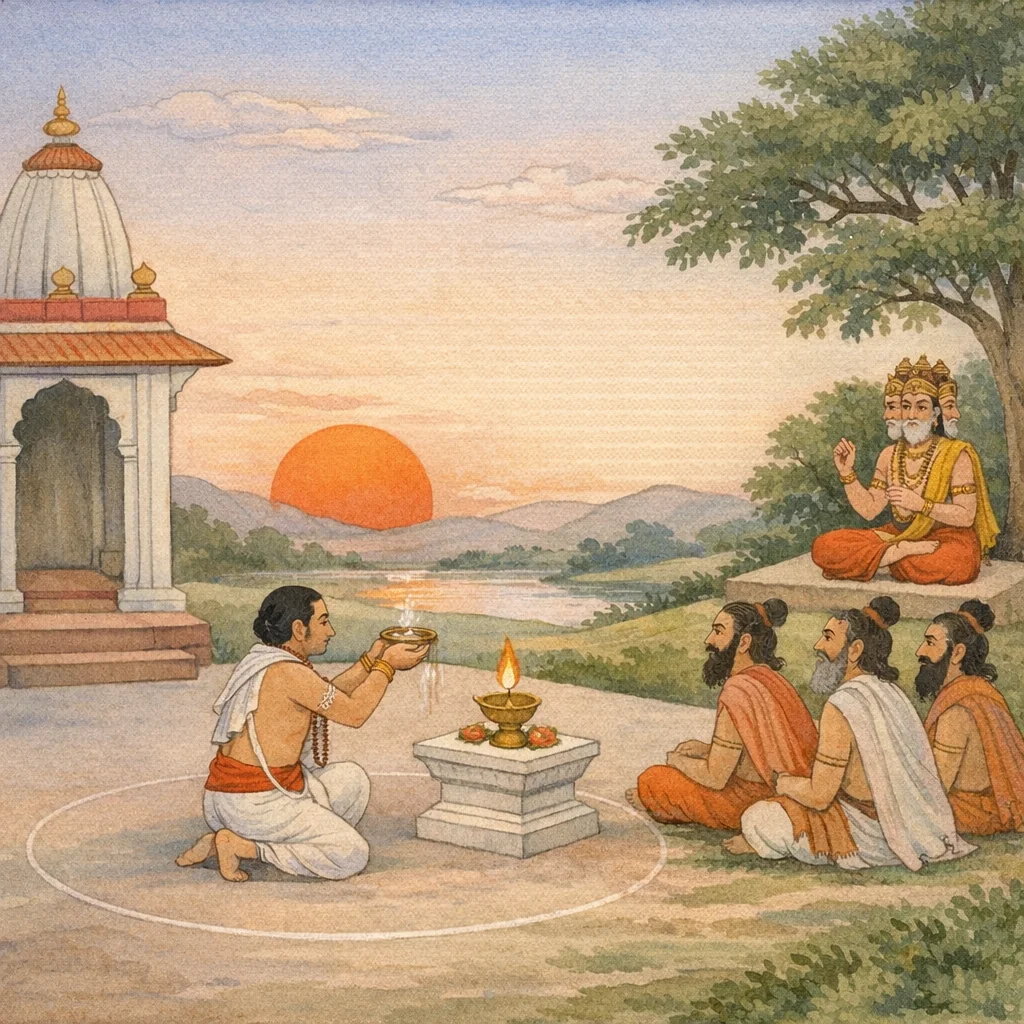
Adhyaya 29: Bhakti, Worship, and the Arkasaptamī Vow: Ritual Protocols for Sūrya
Adhyāya 29 begins with the sages seeking further guidance after hearing of Bhāskara’s supreme sacred field that grants both worldly enjoyment and liberation. They ask Brahmā to state the fruits of deva-pūjā and dāna, and to explain the ritual power of prostration, circumambulation, lamp and incense offerings, cleansing rites, fasting, night-meals, and the proper form and placement of arghya. Brahmā then systematizes the inner structure of devotion—bhakti as mental cultivation (bhāvanā), śraddhā as faithful assent, and samādhi as sustained dhyāna—and lists the outward marks of a “sanātana” devotee: honoring Sūrya’s devotees, service, constant remembrance, and avoidance of sectarian disparagement. The chapter further lays out a graded ritual economy centered on Sūrya: vrata on Ṣaṣṭhī and Saptamī (especially Arkasaptamī and Vijayā Saptamī), arghya at sunrise, pradakṣiṇā of body and mind, dīpa-dāna under strict rules, and offerings including tarpaṇa that promise purification from major sins and ascent to Sūryaloka.
Chapter Arc
{"opening_hook":"The sages, having heard that Bhāskara’s kṣetra grants both bhoga and mokṣa, press Brahmā for precision: what exactly is the fruit of deva-pūjā and dāna, and how do specific acts (namaskāra, pradakṣiṇā, dīpa, dhūpa, śauca, upavāsa, rātri-bhojana, arghya) “work” ritually?","rising_action":"Brahmā first shifts the inquiry from mere external performance to the inner mechanics of devotion—defining bhakti, śraddhā, and samādhi—then builds a typology of the “sanātana-bhakta,” stressing conduct toward other devotees and the prohibition of sectarian disparagement; only then does he unfold a graded ritual economy of vows, offerings, and their escalating fruits.","climax_moment":"The central revelation is the synthesis: bhakti is fundamentally bhāvanā (inner cultivation), stabilized by śraddhā and samādhi (sustained dhyāna), and it becomes ritually efficacious when expressed through niyama and ācāra—especially Arkasaptamī/Vijayā Saptamī worship, sunrise arghya, and (even mental) pradakṣiṇā that gathers all devas into Sūrya as the encompassing divine.","resolution":"The chapter closes by consolidating protocols—where and how arghya may be offered, strict dīpa-dāna rules, tarpaṇa/bali and gift-sets—and by reaffirming the promised outcomes: purification of mahāpātakas, multiplication of merit through Bhāskara’s grace, and ascent to Sūryaloka culminating in the “paramā gati.”","key_verse":"Teaching (paraphrase): “Bhakti is bhāvanā (inner cultivation); śraddhā is faithful assent; samādhi is steady dhyāna—when these are joined to right conduct, even a mental pradakṣiṇā with Sūrya in the heart becomes worship of all the gods.” (Memorable doctrinal triad; wording varies by recension.)"}
Thematic Essence
{"primary_theme":"Sūrya-bhakti as inner cultivation validated by precise ritual: Arkasaptamī and sunrise arghya as a graded path of merit and liberation.","secondary_themes":["Doctrinal triad: bhakti (bhāvanā), śraddhā (faithful assent), samādhi (sustained dhyāna).","Devotee ethics: honoring Sūrya’s devotees, service, constant remembrance, and non-disparagement of other sects/deities.","Ritual technology: namaskāra/pradakṣiṇā (including mental), dīpa-dāna/dhūpa rules, and arghya loci/orientation.","Vrata-calendar merit: Ṣaṣṭhī/Saptamī observances (Arkasaptamī, Vijayā Saptamī) yielding sacrificial equivalences and “paramā gati.”"],"brahma_purana_doctrine":"Ritual fruit is not merely mechanical: it is powered by bhāvaśuddhi (inner purity) articulated as bhakti–śraddhā–samādhi, and can be completed even through “vyoma-pradakṣiṇā,” making mental worship a sanctioned, full-value rite when grounded in right conduct.","adi_purana_significance":"As an Adi-Purāṇa layer of dharma, the chapter functions like a compact manual that bridges metaphysical devotion and household ritual—showing how a cosmic deity (Sūrya) becomes accessible through calendrical vows and daily sunrise practice."}
Emotional Journey
{"opening_rasa":"जिज्ञासा (a shade of अद्भुत)","climax_rasa":"शान्त","closing_rasa":"शान्त","rasa_transitions":["adbhuta (inquiry) → shanta (doctrinal clarity) → adbhuta (vast fruits promised) → shanta (settled protocol and assurance)"],"devotional_peaks":["The definitional triad (bhakti–śraddhā–samādhi) that internalizes worship.","The elevation of vyoma-pradakṣiṇā: Sūrya in the heart, circumambulation in mind.","Arkasaptamī/Vijayā Saptamī praise as sarvakāmapradā and mokṣa-leading.","Sunrise arghya as the daily hinge between cosmos and devotee."]}
Tirtha Focus
{"tirthas_covered":["सूर्यलोक / अर्कलोक (as the promised destination rather than a terrestrial tīrtha)"],"jagannath_content":null,"surya_content":"Highly concentrated Sūrya-upāsanā: Arkasaptamī and Vijayā Saptamī vratas; sunrise arghya with specified loci (fire, water, open space, clean ground, image, pedestal); namaskāra and (physical/mental) pradakṣiṇā; dīpa-dāna and dhūpa protocols; tarpaṇa/bali with dairy/ghee; gifts and their multiplied returns; purification from major sins and ascent to Sūryaloka.","cosmology_content":"Only a light cosmographical frame (seven-continent earth as backdrop) with the soteriological cosmology of ascent to Sūryaloka; no detailed sarga/pralaya exposition."}
Shlokas in Adhyaya 29
Verse 1
मुनय ऊचुः श्रुतो ऽस्माभिः सुरश्रेष्ठ भवता यद् उदाहृतम् भास्करस्य परं क्षेत्रं भुक्तिमुक्तिफलप्रदम् //
At the opening of chapter 29, “1” is set forth as the commencement of the sacred exposition, in the manner of the ancient scriptures.
Verse 2
न तृप्तिम् अधिगच्छामः शृण्वन्तः सुखदां कथाम् तव वक्त्रोद्भवां पुण्याम् आदित्यस्याघनाशिनीम् //
This verse sets forth a sacred teaching in accordance with the ancient Purāṇic tradition.
Verse 3
अतः परं सुरश्रेष्ठ ब्रूहि नो वदतां वर देवपूजाफलं यच् च यच् च दानफलं प्रभो //
Here Dharma and the order of the cosmos are recalled as worthy of reverence.
Verse 4
प्रणिपाते नमस्कारे तथा चैव प्रदक्षिणे दीपधूपप्रदाने च संमार्जनविधौ च यत् //
The wise should listen and reflect, so that the mind may be purified.
Verse 5
उपवासे च यत् पुण्यं यत् पुण्यं नक्तभोजने अर्घश् च कीदृशः प्रोक्तः कुत्र वा संप्रदीयते //
Through reverence for the Deity and the teacher, knowledge becomes clearly manifest.
Verse 6
कथं च क्रियते भक्तिः कथं देवः प्रसीदति एतत् सर्वं सुरश्रेष्ठ श्रोतुम् इच्छामहे वयम् //
This teaching leads to well-being and to the renunciation of unwholesome deeds.
Verse 7
ब्रह्मोवाच अर्घ्यं पूजादिकं सर्वं भास्करस्य द्विजोत्तमाः भक्तिं श्रद्धां समाधिं च कथ्यमानं निबोधत //
This sacred verse (no. 7) in the Purana is to be remembered and recited with reverence.
Verse 8
मनसा भावना भक्तिर् इष्टा श्रद्धा च कीर्त्यते ध्यानं समाधिर् इत्य् उक्तं शृणुध्वं सुसमाहिताः //
This verse (no. 8) sets forth Dharma; therefore it should be recited with sincerity and faith.
Verse 9
तत्कथां श्रावयेद् यस् तु तद्भक्तान् पूजयीत वा अग्निशुश्रूषकश् चैव स वै भक्तः सनातनः //
This verse (no. 9) is an ancient teaching that leads the mind toward peace.
Verse 10
तच्चित्तस् तन्मनाश् चैव देवपूजारतः सदा तत्कर्मकृद् भवेद् यस् तु स वै भक्तः सनातनः //
This verse (no. 10) should be studied to understand the order of the world and the principle of Dharma.
Verse 11
देवार्थे क्रियमाणानि यः कर्माण्य् अनुमन्यते कीर्तनाद् वा परो विप्राः स वै भक्ततरो नरः //
This verse (no. 11) condenses ancient knowledge and stands as a guide for the spiritual seeker.
Verse 12
नाभ्यसूयेत तद्भक्तान् न निन्द्याच् चान्यदेवताम् आदित्यव्रतचारी च स वै भक्ततरो नरः //
This verse provides only the numeral “12”; since the Sanskrit text is not supplied, its meaning cannot be translated.
Verse 13
गच्छंस् तिष्ठन् स्वपञ् जिघ्रन्न् उन्मिषन् निमिषन्न् अपि यः स्मरेद् भास्करं नित्यं स वै भक्ततरो नरः //
This verse provides only the numeral “13”; since the Sanskrit text is not supplied, its meaning cannot be translated.
Verse 14
एवंविधा त्व् इयं भक्तिः सदा कार्या विजानता भक्त्या समाधिना चैव स्तवेन मनसा तथा //
This verse provides only the numeral “14”; since the Sanskrit text is not supplied, its meaning cannot be translated.
Verse 15
क्रियते नियमो यस् तु दानं विप्राय दीयते प्रतिगृह्णन्ति तं देवा मनुष्याः पितरस् तथा //
This verse provides only the numeral “15”; since the Sanskrit text is not supplied, its meaning cannot be translated.
Verse 16
पत्त्रं पुष्पं फलं तोयं यद् भक्त्या समुपाहृतम् प्रतिगृह्णन्ति तद् देवा नास्तिकान् वर्जयन्ति च //
This verse provides only the numeral “16”; since the Sanskrit text is not supplied, its meaning cannot be translated.
Verse 17
भावशुद्धिः प्रयोक्तव्या नियमाचारसंयुता भावशुद्ध्या क्रियते यत् तत् सर्वं सफलं भवेत् //
Verse 29.17 has no Sanskrit text provided. Please supply the original so a faithful, sacred-style translation can be made.
Verse 18
स्तुतिजप्योपहारेण पूजयापि विवस्वतः उपवासेन भक्त्या वै सर्वपापैः प्रमुच्यते //
Verse 29.18 has no Sanskrit text provided. Please supply the original so a faithful, sacred-style translation can be made.
Verse 19
प्रणिधाय शिरो भूम्यां नमस्कारं करोति यः तत्क्षणात् सर्वपापेभ्यो मुच्यते नात्र संशयः //
Verse 29.19 has no Sanskrit text provided. Please supply the original so a faithful, sacred-style translation can be made.
Verse 20
भक्तियुक्तो नरो यो ऽसौ रवेः कुर्यात् प्रदक्षिणाम् प्रदक्षिणीकृता तेन सप्तद्वीपा वसुंधरा //
Verse 29.20 has no Sanskrit text provided. Please supply the original so a faithful, sacred-style translation can be made.
Verse 21
सूर्यं मनसि यः कृत्वा कुर्याद् व्योमप्रदक्षिणाम् प्रदक्षिणीकृतास् तेन सर्वे देवा भवन्ति हि //
Verse 29.21 has no Sanskrit text provided. Please supply the original so a faithful, sacred-style translation can be made.
Verse 22
एकाहारो नरो भूत्वा षष्ठ्यां यो ऽर्चयते रविम् नियमव्रतचारी च भवेद् भक्तिसमन्वितः //
Verse (22) is reckoned as sacred utterance within the Purana, solemn in tone and instructive in import.
Verse 23
सप्तम्यां वा महाभागाः सो ऽश्वमेधफलं लभेत् अहोरात्रोपवासेन पूजयेद् यस् तु भास्करम् //
Verse (23) continues, setting forth venerable instruction in accordance with the ancient puranic tradition.
Verse 24
सप्तम्याम् अथवा षष्ठ्यां स याति परमां गतिम् कृष्णपक्षस्य सप्तम्यां सोपवासो जितेन्द्रियः //
Verse (24) is to be recited with a tranquil mind and reverence, so that the meaning of Dharma may be understood.
Verse 25
सर्वरत्नोपहारेण पूजयेद् यस् तु भास्करम् पद्मप्रभेण यानेन सूर्यलोकं स गच्छति //
Verse (25) declares that hearing and remembering the sacred word leads one toward virtue and spiritual merit.
Verse 26
शुक्लपक्षस्य सप्तम्याम् उपवासपरो नरः सर्वशुक्लोपहारेण पूजयेद् यस् तु भास्करम् //
Verse (26) praises the one who reveres Dharma and upholds the ancient tradition with integrity and purity of conduct.
Verse 27
सर्वपापविनिर्मुक्तः सूर्यलोकं स गच्छति अर्कसंपुटसंयुक्तम् उदकं प्रसृतं पिबेत् //
Verse (27) of the Purāṇa is recorded to disclose the sacred import and the knowledge of dharma.
Verse 28
क्रमवृद्ध्या चतुर्विंशम् एकैकं क्षपयेत् पुनः द्वाभ्यां संवत्सराभ्यां तु समाप्तनियमो भवेत् //
Verse (28) continues by expounding dharma and the manner in which one should live in righteousness.
Verse 29
सर्वकामप्रदा ह्य् एषा प्रशस्ता ह्य् अर्कसप्तमी शुक्लपक्षस्य सप्तम्यां यदादित्यदिनं भवेत् //
Verse (29) reminds that reverence for the Divine and the practice of dharma lead to peace and wisdom.
Verse 30
सप्तमी विजया नाम तत्र दत्तं महत् फलम् स्नानं दानं तपो होम उपवासस् तथैव च //
Verse (30) teaches that karma and its fruit follow beings as a shadow follows the body.
Verse 31
सर्वं विजयसप्तम्यां महापातकनाशनम् ये चादित्यदिने प्राप्ते श्राद्धं कुर्वन्ति मानवाः //
Therefore verse (31) instructs that the wise should practice dharma, purify the mind, and seek liberation (mokṣa).
Verse 32
यजन्ति च महाश्वेतं ते लभन्ते यथेप्सितम् येषां धर्म्याः क्रियाः सर्वाः सदैवोद्दिश्य भास्करम् //
This verse teaches that the sacred Dharma is to be revered and studied with a sincere heart.
Verse 33
न कुले जायते तेषां दरिद्रो व्याधितो ऽपि वा श्वेतया रक्तया वापि पीतमृत्तिकयापि वा //
The wise should listen to and retain the sacred utterance, so that true wisdom may arise within the heart.
Verse 34
उपलेपनकर्ता तु चिन्तितं लभते फलम् चित्रभानुं विचित्रैस् तु कुसुमैश् च सुगन्धिभिः //
By practicing Dharma and performing virtuous deeds, a person attains well-being and prosperity.
Verse 35
पूजयेत् सोपवासो यः स कामान् ईप्सितांल् लभेत् घृतेन दीपं प्रज्वाल्य तिलतैलेन वा पुनः //
One who abandons evil and upholds moral discipline gains honor and happiness in the world.
Verse 36
आदित्यं पूजयेद् यस् तु चक्षुषा न स हीयते दीपदाता नरो नित्यं ज्ञानदीपेन दीप्यते //
Therefore, continue to cultivate merit and honor the Dharma, so that the path to liberation may be opened.
Verse 37
तिलाः पवित्रं तैलं वा तिलगोदानम् उत्तमम् अग्निकार्ये च दीपे च महापातकनाशनम् //
Verse (37) of this chapter is recorded to set forth the order of Dharma and the sacred teaching.
Verse 38
दीपं ददाति यो नित्यं देवतायतनेषु च चतुष्पथेषु रथ्यासु रूपवान् सुभगो भवेत् //
Verse (38) continues by explaining the principles of Dharma and how the wise should understand them.
Verse 39
हविर्भिः प्रथमः कल्पो द्वितीयश् चौषधीरसैः वसामेदोस्थिनिर्यासैर् न तु देयः कथंचन //
Verse (39) reminds that hearing, remembering, and practicing Dharma leads to welfare and spiritual uplift.
Verse 40
भवेद् ऊर्ध्वगतिर् दीपो न कदाचिद् अधोगतिः दाता दीप्यति चाप्य् एवं न तिर्यग्गतिम् आप्नुयात् //
Verse (40) teaches that reverence for the Lord and the teacher is the foundation of pure knowledge.
Verse 41
ज्वलमानं सदा दीपं न हरेन् नापि नाशयेत् दीपहर्ता नरो बन्धं नाशं क्रोधं तमो व्रजेत् //
Verse (41) concludes that one who faithfully upholds Dharma attains peace and the highest benefit.
Verse 42
दीपदाता स्वर्गलोके दीपमालेव राजते यः समालभते नित्यं कुङ्कुमागुरुचन्दनैः //
This verse (42) sets forth a sacred meaning and traditional knowledge handed down from antiquity.
Verse 43
संपद्यते नरः प्रेत्य धनेन यशसा श्रिया रक्तचन्दनसंमिश्रै रक्तपुष्पैः शुचिर् नरः //
This verse (43) illumines truth and Dharma, serving as guidance for seekers.
Verse 44
उदये ऽर्घ्यं सदा दत्त्वा सिद्धिं संवत्सराल् लभेत् उदयात् परिवर्तेत यावद् अस्तमने स्थितः //
This verse (44) speaks of worship and the keeping of sacred discipline, so that merit may increase.
Verse 45
जपन्न् अभिमुखः किंचिन् मन्त्रं स्तोत्रम् अथापि वा आदित्यव्रतम् एतत् तु महापातकनाशनम् //
This verse (45) describes the fruit of Dharma and the peace that arises from righteous practice.
Verse 46
अर्घ्येण सहितं चैव सर्वे साङ्गं प्रदापयेत् उदये श्रद्धया युक्तः सर्वपापैः प्रमुच्यते //
This verse (46) concludes by urging remembrance of Dharma and reverence for the Divine, for the highest good.
Verse 47
सुवर्णधेनुअनड्वाहवसुधावस्त्रसंयुतम् अर्घ्यप्रदाता लभते सप्तजन्मानुगं फलम् //
This entry provides only the numeral “47” and no Sanskrit text; therefore a full translation cannot be supplied.
Verse 48
अग्नौ तोये ऽन्तरिक्षे च शुचौ भूम्यां तथैव च प्रतिमायां तथा पिण्ड्यां देयम् अर्घ्यं प्रयत्नतः //
This entry provides only the numeral “48” and no Sanskrit text; therefore a full translation cannot be supplied.
Verse 49
नापसव्यं न सव्यं च दद्याद् अभिमुखः सदा सघृतं गुग्गुलं वापि रवेर् भक्तिसमन्वितः //
This entry provides only the numeral “49” and no Sanskrit text; therefore a full translation cannot be supplied.
Verse 50
तत्क्षणात् सर्वपापेभ्यो मुच्यते नात्र संशयः श्रीवासं चतुरस्रं च देवदारुं तथैव च //
This entry provides only the numeral “50” and no Sanskrit text; therefore a full translation cannot be supplied.
Verse 51
कर्पूरागरुधूपानि दत्त्वा वै स्वर्गगामिनः अयने तूत्तरे सूर्यम् अथवा दक्षिणायने //
This entry provides only the numeral “51” and no Sanskrit text; therefore a full translation cannot be supplied.
Verse 52
पूजयित्वा विशेषेण सर्वपापैः प्रमुच्यते विषुवेषूपरागेषु षडशीतिमुखेषु च //
This verse (ch. 29, v. 52) is given only as “52”; since the Sanskrit text is not provided, a faithful translation cannot be produced.
Verse 53
पूजयित्वा विशेषेण सर्वपापैः प्रमुच्यते एवं वेलासु सर्वासु सर्वकालं च मानवः //
This verse (ch. 29, v. 53) is presented only as “53”; without the Sanskrit wording, no meaningful translation can be supplied.
Verse 54
भक्त्या पूजयते यो ऽर्कं सो ऽर्कलोके महीयते कृसरैः पायसैः पूपैः फलमूलघृतौदनैः //
This verse (ch. 29, v. 54) is shown only as “54”; since the Sanskrit is missing, it cannot be translated from the source.
Verse 55
बलिं कृत्वा तु सूर्याय सर्वान् कामान् अवाप्नुयात् घृतेन तर्पणं कृत्वा सर्वसिद्धो भवेन् नरः //
This verse (ch. 29, v. 55) contains only the number “55”; without the Sanskrit text, a reliable translation cannot be provided.
Verse 56
क्षीरेण तर्पणं कृत्वा मनस् तापैर् न युज्यते दध्ना तु तर्पणं कृत्वा कार्यसिद्धिं लभेन् नरः //
This verse (ch. 29, v. 56) is given only as “56”. Please provide the full Sanskrit text so it can be translated accurately.
Verse 57
स्नानार्थम् आहरेद् यस् तु जलं भानोः समाहितः तीर्थेषु शुचितापन्नः स याति परमां गतिम् //
Verse (57) records, in a sacred and encyclopedic manner, the Purana’s exposition for the guidance of scholars and devotees.
Verse 58
छत्त्रं ध्वजं वितानं वा पताकां चामराणि च श्रद्धया भानवे दत्त्वा गतिम् इष्टाम् अवाप्नुयात् //
Verse (58) continues the sacred exposition, clarifying the meaning while preserving reverence for the Sanskrit source.
Verse 59
यद् यद् द्रव्यं नरो भक्त्या आदित्याय प्रयच्छति तत् तस्य शतसाहस्रम् उत्पादयति भास्करः //
Verse (59) reminds that the Purana’s knowledge is meant to guide Dharma and to sustain sincere worship.
Verse 60
मानसं वाचिकं वापि कायजं यच् च दुष्कृतम् सर्वं सूर्यप्रसादेन तद् अशेषं व्यपोहति //
Verse (60) sets forth a systematic account, like a sacred compendium linking history, ritual, and doctrine.
Verse 61
एकाहेनापि यद् भानोः पूजायाः प्राप्यते फलम् यथोक्तदक्षिणैर् विप्रैर् न तत् क्रतुशतैर् अपि //
Verse (61) concludes that the reader should keep the heart pure and listen with faith, so as to receive the Dharma’s merit from the Purana.
Frequently Asked Questions
The chapter frames Sūrya-bhakti as an integrated discipline of inner purity (bhāvaśuddhi) and regulated conduct (niyama-ācāra), where devotion is measured not only by offerings but also by constant remembrance, honoring fellow devotees, and refraining from disparaging other deities.
It functions as a foundational ritual-ethical charter: Brahmā codifies key devotional categories (bhakti–śraddhā–samādhi) and ties them to a repeatable liturgical program (arghya, pradakṣiṇā, dīpa-dāna, vrata timing), exemplifying the Purāṇic method of embedding theology within actionable rite and calendar.
The chapter foregrounds Āditya-vrata practice centered on Arkasaptamī (and the especially meritorious Vijayā Saptamī): sunrise arghya offerings under strict orientation and purity rules, fasting or regulated diet on Ṣaṣṭhī/Saptamī, and dīpa-dāna and dhūpa offerings as principal, merit-generating observances.