Adhyaya 8
Nārāyaṇa-kavaca — The Armor of Lord Nārāyaṇa
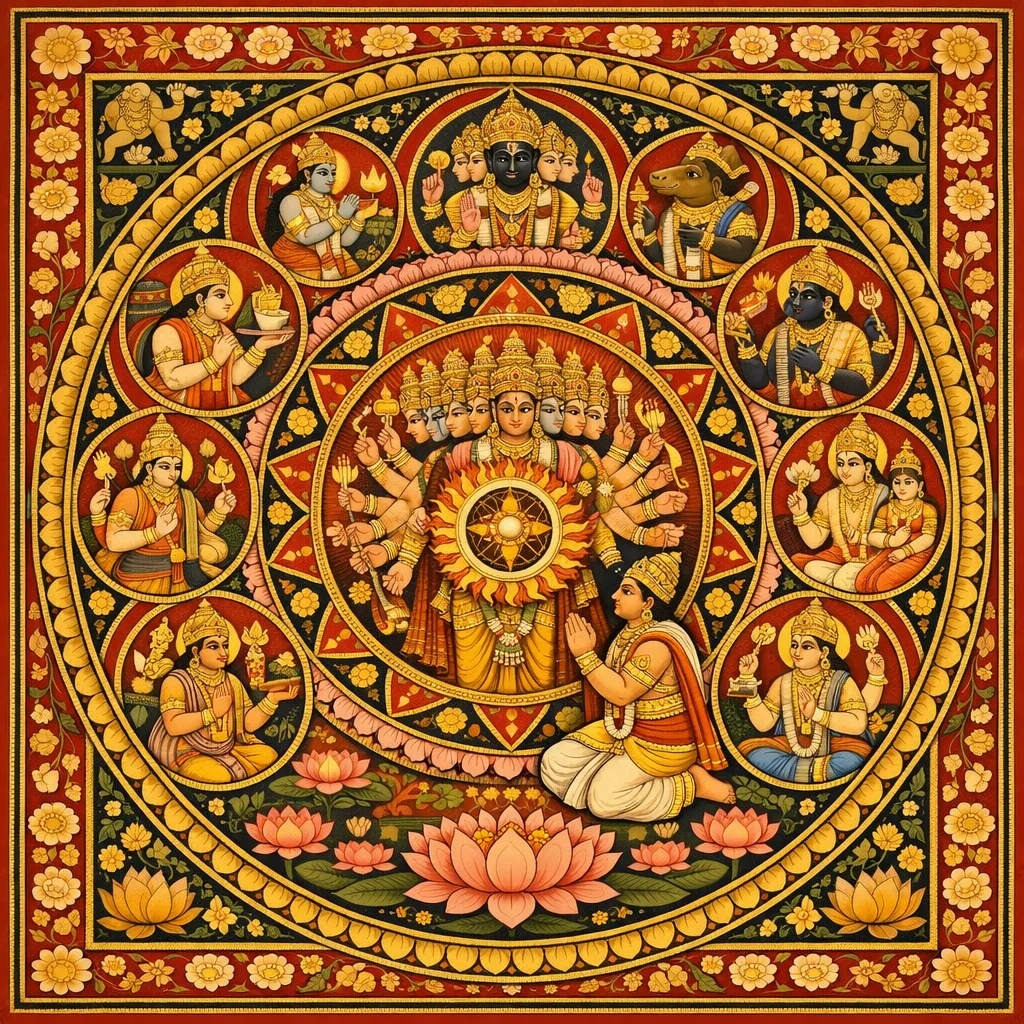
Continuing the Indra–asura conflict cycle of Skandha 6, Mahārāja Parīkṣit asks Śukadeva Gosvāmī to explain the protective Viṣṇu mantra-armor by which Indra conquered his foes and regained sovereignty. Śukadeva tells how Indra approached Viśvarūpa, appointed priest of the devatās, and received the Nārāyaṇa-kavaca. Viśvarūpa teaches a disciplined rite—purification (ācamana), proper posture and direction, and nyāsa using the aṣṭākṣarī (oṁ namo nārāyaṇāya), dvādaśākṣarī (oṁ namo bhagavate vāsudevāya), and ṣaḍakṣarī (oṁ viṣṇave namaḥ)—culminating in dig-bandhana and weapon-mantras. The kavaca then unfolds as a litany of divine protections, invoking the Lord’s avatāras (Matsya, Vāmana, Nṛsiṁha, Varāha, Rāma, etc.), His names across divisions of time, and His weapons (Sudarśana, club, conch, sword, shield). The chapter ends with claims of efficacy and an illustrative history (Kauśika and Citraratha), as Śukadeva affirms that faithful hearing or practice removes dangers and grants honor, preparing for Indra’s renewed success against the demons.
Shlokas
Verse 1
श्रीराजोवाच यया गुप्त: सहस्राक्ष: सवाहान् रिपुसैनिकान् । क्रीडन्निव विनिर्जित्य त्रिलोक्या बुभुजे श्रियम् ॥ १ ॥ भगवंस्तन्ममाख्याहि वर्म नारायणात्मकम् । यथाततायिन: शत्रून्येन गुप्तोऽजयन्मृधे ॥ २ ॥
King Parīkṣit said: O Bhagavān, please explain to me the Viṣṇu mantra armor by which thousand-eyed Indra, protected, defeated the enemy armies with their mounts as if in play and then enjoyed the splendor of the three worlds. Kindly describe that Nārāyaṇa-kavaca, by whose shelter Indra conquered in battle the foes who sought to kill him.
Verse 2
श्रीराजोवाच यया गुप्त: सहस्राक्ष: सवाहान् रिपुसैनिकान् । क्रीडन्निव विनिर्जित्य त्रिलोक्या बुभुजे श्रियम् ॥ १ ॥ भगवंस्तन्ममाख्याहि वर्म नारायणात्मकम् । यथाततायिन: शत्रून्येन गुप्तोऽजयन्मृधे ॥ २ ॥
King Parīkṣit said: O Bhagavān, please explain to me the Viṣṇu mantra armor by which thousand-eyed Indra, protected, defeated the enemy armies with their mounts as if in play and then enjoyed the splendor of the three worlds. Kindly describe that Nārāyaṇa-kavaca, by whose shelter Indra conquered in battle the foes who sought to kill him.
Verse 3
श्रीबादरायणिरुवाच वृत: पुरोहितस्त्वाष्ट्रो महेन्द्रायानुपृच्छते । नारायणाख्यं वर्माह तदिहैकमना: शृणु ॥ ३ ॥
Śukadeva Gosvāmī said: Viśvarūpa, the son of Tvaṣṭā, was appointed by the devas as their priest. When Mahendra Indra asked about the armor called Nārāyaṇa-kavaca, Viśvarūpa replied. Now hear with single-pointed attention.
Verse 4
श्रीविश्वरूप उवाच धौताङ्घ्रिपाणिराचम्य सपवित्र उदङ्मुख: । कृतस्वाङ्गकरन्यासो मन्त्राभ्यां वाग्यत: शुचि: ॥ ४ ॥ नारायणपरं वर्म सन्नह्येद् भय आगते । पादयोर्जानुनोरूर्वोरुदरे हृद्यथोरसि ॥ ५ ॥ मुखे शिरस्यानुपूर्व्यादोंङ्कारादीनि विन्यसेत् । ॐ नमो नारायणायेति विपर्ययमथापि वा ॥ ६ ॥
Viśvarūpa said: When fear arises, first wash the hands and feet and perform ācamana; touch sacred kuśa and sit facing north, silent and purified. Then, by performing nyāsa on the limbs and on the hands with the eight-syllable mantra “oṁ namo nārāyaṇāya” and the twelve-syllable mantra, one should don the armor devoted to Nārāyaṇa. Beginning with the praṇava, place the syllables in order upon the feet, knees, thighs, abdomen, heart, chest, mouth, and head, and then place them again in reverse order.
Verse 5
श्रीविश्वरूप उवाच धौताङ्घ्रिपाणिराचम्य सपवित्र उदङ्मुख: । कृतस्वाङ्गकरन्यासो मन्त्राभ्यां वाग्यत: शुचि: ॥ ४ ॥ नारायणपरं वर्म सन्नह्येद् भय आगते । पादयोर्जानुनोरूर्वोरुदरे हृद्यथोरसि ॥ ५ ॥ मुखे शिरस्यानुपूर्व्यादोंङ्कारादीनि विन्यसेत् । ॐ नमो नारायणायेति विपर्ययमथापि वा ॥ ६ ॥
Viśvarūpa said: When fear arises, first wash the hands and feet and perform ācamana to become pure; sit solemnly facing north, touch kuśa grass, and keep silence. Then, by the eight-syllable and twelve-syllable mantras, perform kara- and aṅga-nyāsa and thus bind on the armor of Nārāyaṇa. While chanting “oṁ namo nārāyaṇāya,” place the mantra in order upon the feet, knees, thighs, abdomen, heart, chest, mouth, and head; then place it again in reverse order.
Verse 6
श्रीविश्वरूप उवाच धौताङ्घ्रिपाणिराचम्य सपवित्र उदङ्मुख: । कृतस्वाङ्गकरन्यासो मन्त्राभ्यां वाग्यत: शुचि: ॥ ४ ॥ नारायणपरं वर्म सन्नह्येद् भय आगते । पादयोर्जानुनोरूर्वोरुदरे हृद्यथोरसि ॥ ५ ॥ मुखे शिरस्यानुपूर्व्यादोंङ्कारादीनि विन्यसेत् । ॐ नमो नारायणायेति विपर्ययमथापि वा ॥ ६ ॥
Viśvarūpa said: In a time of fear, wash hands and feet, perform ācamana to become pure, sit facing north, touch kuśa grass, and remain silent. Then perform nyāsa with the eight- and twelve-syllable mantras and don the kavaca of Nārāyaṇa. While chanting “oṁ namo nārāyaṇāya,” place the nyāsa from the feet up to the head in order, and then repeat it in reverse order.
Verse 7
करन्यासं तत: कुर्याद् द्वादशाक्षरविद्यया । प्रणवादियकारान्तमङ्गुल्यङ्गुष्ठपर्वसु ॥ ७ ॥
Then one should perform kara-nyāsa with the twelve-syllable vidyā, “oṁ namo bhagavate vāsudevāya.” Prefixing each syllable with the oṁkāra, place the syllables upon the fingertips, beginning with the right index finger and ending with the left index finger. The remaining four syllables are to be placed upon the joints of the thumbs.
Verse 8
न्यसेद्धृदय ओंङ्कारं विकारमनु मूर्धनि । षकारं तु भ्रुवोर्मध्ये णकारं शिखया न्यसेत् ॥ ८ ॥ वेकारं नेत्रयोर्युञ्ज्यान्नकारं सर्वसन्धिषु । मकारमस्त्रमुद्दिश्य मन्त्रमूर्तिर्भवेद् बुध: ॥ ९ ॥ सविसर्गं फडन्तं तत्सर्वदिक्षु विनिर्दिशेत् । ॐ विष्णवे नम इति ॥ १० ॥
One should then chant the six-syllable mantra, “oṁ viṣṇave namaḥ.” Place “oṁ” upon the heart, “vi” upon the crown of the head, “ṣa” between the eyebrows, “ṇa” upon the śikhā (tuft), and “ve” between the eyes. Then place “na” upon all the joints of the body and meditate on “ma” as a weapon; thus the chanter becomes the very form of the mantra. Finally, adding the visarga to “ma,” one should utter “maḥ astrāya phaṭ” in all directions, beginning from the east, binding the quarters with the mantra’s protective armor.
Verse 9
न्यसेद्धृदय ओंङ्कारं विकारमनु मूर्धनि । षकारं तु भ्रुवोर्मध्ये णकारं शिखया न्यसेत् ॥ ८ ॥ वेकारं नेत्रयोर्युञ्ज्यान्नकारं सर्वसन्धिषु । मकारमस्त्रमुद्दिश्य मन्त्रमूर्तिर्भवेद् बुध: ॥ ९ ॥ सविसर्गं फडन्तं तत्सर्वदिक्षु विनिर्दिशेत् । ॐ विष्णवे नम इति ॥ १० ॥
While chanting the six-syllable mantra “oṁ viṣṇave namaḥ,” place “oṁ” in the heart, “vi” on the crown, “ṣa” between the eyebrows, “ṇa” on the śikhā, and “ve” between the eyes. Then place “na” upon all the joints and meditate on “ma” as a weapon; thus the devotee becomes the mantra’s embodied form. Finally, adding the visarga to “ma,” recite “maḥ astrāya phaṭ” in every direction, beginning from the east.
Verse 10
न्यसेद्धृदय ओंङ्कारं विकारमनु मूर्धनि । षकारं तु भ्रुवोर्मध्ये णकारं शिखया न्यसेत् ॥ ८ ॥ वेकारं नेत्रयोर्युञ्ज्यान्नकारं सर्वसन्धिषु । मकारमस्त्रमुद्दिश्य मन्त्रमूर्तिर्भवेद् बुध: ॥ ९ ॥ सविसर्गं फडन्तं तत्सर्वदिक्षु विनिर्दिशेत् । ॐ विष्णवे नम इति ॥ १० ॥
Then one should chant the six-syllabled mantra, “oṁ viṣṇave namaḥ.” Place “oṁ” upon the heart, “vi” upon the crown of the head, “ṣa” between the eyebrows, “na” upon the śikhā (tuft), and “ve” between the eyes. Place “na” upon all the joints of the body and meditate on “ma” as a weapon; thus the chanter becomes the very form of the mantra. Thereafter, adding the visarga, one should utter “maḥ astrāya phaṭ” in all directions, beginning from the east, binding every quarter with the mantra’s protective armor.
Verse 11
आत्मानं परमं ध्यायेद् ध्येयं षट्शक्तिभिर्युतम् । विद्यातेजस्तपोमूर्तिमिमं मन्त्रमुदाहरेत् ॥ ११ ॥
After completing the chanting, one should meditate that, in quality, he is one with the Supreme Personality, the Paramapuruṣa—endowed with the six opulences and worthy of meditation. Holding Him in the heart as the embodiment of sacred knowledge, divine splendor, and austerity, one should then recite this protective prayer to Lord Nārāyaṇa, the Nārāyaṇa-kavaca.
Verse 12
ॐ हरिर्विदध्यान्मम सर्वरक्षां न्यस्ताङ्घ्रिपद्म: पतगेन्द्रपृष्ठे । दरारिचर्मासिगदेषुचाप- पाशान् दधानोऽष्टगुणोऽष्टबाहु: ॥ १२ ॥
Oṁ. May Hari arrange my complete protection. Seated upon the back of Garuḍa, resting His lotus feet upon him, He bears eight weapons—conchshell, disc, shield, sword, club, arrows, bow, and noose. With eight arms and fully endowed with the eight mystic perfections, may that all-powerful Lord protect me at all times.
Verse 13
जलेषु मां रक्षतु मत्स्यमूर्ति- र्यादोगणेभ्यो वरुणस्य पाशात् । स्थलेषु मायावटुवामनोऽव्यात् त्रिविक्रम: खेऽवतु विश्वरूप: ॥ १३ ॥
In the waters, may the Lord in His great Fish incarnation protect me—from Varuṇa’s noose and from the fierce aquatic beings. On the earth, may Vāmana, who expanded His māyā and assumed the form of the dwarf brahmacārī, protect me. In the sky, may Trivikrama, the all-universal Viśvarūpa who conquers the three worlds, protect me.
Verse 14
दुर्गेष्वटव्याजिमुखादिषु प्रभु: पायान्नृसिंहोऽसुरयूथपारि: । विमुञ्चतो यस्य महाट्टहासं दिशो विनेदुर्न्यपतंश्च गर्भा: ॥ १४ ॥
In perilous places—forests, difficult passes, and the very face of battle—may Lord Nṛsiṁhadeva protect me, the foe of the asura chieftain Hiraṇyakaśipu. When His mighty laughter burst forth, the directions thundered and the pregnancies of the asuras’ wives were cast down. May that compassionate Lord kindly protect me everywhere, especially in times of hardship.
Verse 15
रक्षत्वसौ माध्वनि यज्ञकल्प: स्वदंष्ट्रयोन्नीतधरो वराह: । रामोऽद्रिकूटेष्वथ विप्रवासे सलक्ष्मणोऽव्याद् भरताग्रजोऽस्मान् ॥ १५ ॥
May the Lord Yajñeśvara, the very form of sacrifice, as Varāha who lifted the earth upon His sharp tusks, protect me from rogues upon the road. May Paraśurāma protect me on mountain peaks, and may Śrī Rāmacandra, Bharata’s elder brother, together with Lakṣmaṇa, protect us in foreign lands.
Verse 16
मामुग्रधर्मादखिलात्प्रमादा- न्नारायण: पातु नरश्च हासात् । दत्तस्त्वयोगादथ योगनाथ: पायाद्गुणेश: कपिल: कर्मबन्धात् ॥ १६ ॥
May Nārāyaṇa protect me from straying into harsh, false paths of religion and from heedlessness that makes me fall from my duty; and may the Lord as Nara protect me from pride. May Dattātreya, master of yoga, guard me from stumbling in bhakti-yoga, and may Kapila, lord of virtues, free me from the bondage of karma.
Verse 17
सनत्कुमारोऽवतु कामदेवा- द्धयशीर्षा मां पथि देवहेलनात् । देवर्षिवर्य: पुरुषार्चनान्तरात् कूर्मो हरिर्मां निरयादशेषात् ॥ १७ ॥
May Sanat-kumāra protect me from lust. As I begin auspicious acts, may the Lord Hayagrīva protect me on the path from the offense of neglecting reverent obeisance to the Supreme. May Devarṣi Nārada protect me from offenses in Deity worship, and may Hari as Kūrma protect me from falling into the limitless hellish realms.
Verse 18
धन्वन्तरिर्भगवान् पात्वपथ्याद् द्वन्द्वाद् भयादृषभो निर्जितात्मा । यज्ञश्च लोकादवताज्जनान्ताद् बलो गणात् क्रोधवशादहीन्द्र: ॥ १८ ॥
May Bhagavān Dhanvantari protect me from unwholesome food and from the fear of disease. May Ṛṣabhadeva, conqueror of the senses, protect me from the fear born of heat and cold. May Yajña protect me from slander and harm from the populace, and may Balarāma as Ahi-indra (Śeṣa) protect me from envious serpents and wrathful foes.
Verse 19
द्वैपायनो भगवानप्रबोधाद् बुद्धस्तु पाषण्डगणप्रमादात् । कल्कि: कले: कालमलात् प्रपातु धर्मावनायोरुकृतावतार: ॥ १९ ॥
May Bhagavān Dvaipāyana Vyāsa protect me from the ignorance born of lacking Vedic knowledge. May Buddhadeva protect me from the heedlessness of heretical ways and from acts opposed to Vedic principles. And may Kalki, the great avatāra who descends to uphold dharma, protect me from the grime of the Age of Kali.
Verse 20
मां केशवो गदया प्रातरव्याद् गोविन्द आसङ्गवमात्तवेणु: । नारायण: प्राह्ण उदात्तशक्ति- र्मध्यन्दिने विष्णुररीन्द्रपाणि: ॥ २० ॥
May Lord Keśava protect me with His club in the first part of the day; may Govinda, ever engaged in playing His flute, protect me in the second. May Nārāyaṇa, endowed with exalted potency, protect me in the third; and at midday may Viṣṇu, bearing the enemy-slaying disc, protect me.
Verse 21
देवोऽपराह्णे मधुहोग्रधन्वा सायं त्रिधामावतु माधवो माम् । दोषे हृषीकेश उतार्धरात्रे निशीथ एकोऽवतु पद्मनाभ: ॥ २१ ॥
May Madhusūdana, bearing a bow dreadful to the asuras, protect me in the fifth part of the day. In the evening may Mādhava, manifest as the threefold Lord, protect me; at the onset of night may Hṛṣīkeśa protect me; and in the deep midnight may Padmanābha alone protect me.
Verse 22
श्रीवत्सधामापररात्र ईश: प्रत्यूष ईशोऽसिधरो जनार्दन: । दामोदरोऽव्यादनुसन्ध्यं प्रभाते विश्वेश्वरो भगवान् कालमूर्ति: ॥ २२ ॥
May the Lord who bears the Śrīvatsa upon His chest protect me after midnight until the sky blushes with dawn. May Janārdana, sword in hand, protect me at the end of night. May Dāmodara protect me in the early morning, and may Viśveśvara—Bhagavān as the very form of Time—protect me at the junctions of day and night.
Verse 23
चक्रं युगान्तानलतिग्मनेमि भ्रमत् समन्ताद् भगवत्प्रयुक्तम् । दन्दग्धि दन्दग्ध्यरिसैन्यमाशु कक्षं यथा वातसखो हुताश: ॥ २३ ॥
Set in motion by Bhagavān and roaming in all directions, the Lord’s disc bears edges as keen and ruinous as the fire of dissolution at the end of the age. As blazing fire, aided by the wind, reduces dry grass to ash, may that Sudarśana-cakra swiftly burn our enemy hosts to ashes.
Verse 24
गदेऽशनिस्पर्शनविस्फुलिङ्गे निष्पिण्ढि निष्पिण्ढ्यजितप्रियासि । कुष्माण्डवैनायकयक्षरक्षो- भूतग्रहांश्चूर्णय चूर्णयारीन् ॥ २४ ॥
O club in the hand of Bhagavān, you shower sparks like the touch of a thunderbolt and are most dear to the unconquered Lord. Therefore, crush—crush—my foes. Pulverize the Kuṣmāṇḍas, Vaināyakas, Yakṣas, Rākṣasas, Bhūtas and Grahas; grind these enemies to dust.
Verse 25
त्वं यातुधानप्रमथप्रेतमातृ- पिशाचविप्रग्रहघोरदृष्टीन् । दरेन्द्र विद्रावय कृष्णपूरितो भीमस्वनोऽरेर्हृदयानि कम्पयन् ॥ २५ ॥
O best of conchshells, Pāñcajanya in the Lord’s hand, you are ever filled with the breath of Śrī Kṛṣṇa. Therefore your dreadful roar makes the hearts of enemies—Rākṣasas, pramatha spirits, Pretas, Mātās, Piśācas, and brahmaṇa-ghosts of terrifying gaze—tremble and flee.
Verse 26
त्वं तिग्मधारासिवरारिसैन्य- मीशप्रयुक्तो मम छिन्धि छिन्धि । चक्षूंषि चर्मञ्छतचन्द्र छादय द्विषामघोनां हर पापचक्षुषाम् ॥ २६ ॥
O finest sword with razor edge, wielded by the Supreme Lord—cut down the soldiers of my enemies, cut them down! O shield marked with a hundred moonlike circles, cover the eyes of the sinful foes and tear away their sinful gaze.
Verse 27
यन्नो भयं ग्रहेभ्योऽभूत् केतुभ्यो नृभ्य एव च । सरीसृपेभ्यो दंष्ट्रिभ्यो भूतेभ्योंहोभ्य एव च ॥ २७ ॥ सर्वाण्येतानि भगवन्नामरूपानुकीर्तनात् । प्रयान्तु सङ्क्षयं सद्यो ये न: श्रेय:प्रतीपका: ॥ २८ ॥
May the glorification of the Supreme Lord’s transcendental name, form, qualities, and divine paraphernalia protect us from fear of evil planets and meteors, envious men, serpents and scorpions, and fanged beasts like tigers and wolves; from ghosts; from the elements earth, water, fire, and air; from lightning; and from our former sins. By the kīrtana of “Hare Kṛṣṇa,” may all such obstacles that oppose our welfare be destroyed at once.
Verse 28
यन्नो भयं ग्रहेभ्योऽभूत् केतुभ्यो नृभ्य एव च । सरीसृपेभ्यो दंष्ट्रिभ्यो भूतेभ्योंहोभ्य एव च ॥ २७ ॥ सर्वाण्येतानि भगवन्नामरूपानुकीर्तनात् । प्रयान्तु सङ्क्षयं सद्यो ये न: श्रेय:प्रतीपका: ॥ २८ ॥
May the glorification of the Supreme Lord’s transcendental name, form, qualities, and divine paraphernalia protect us from fear of evil planets and meteors, envious men, serpents and scorpions, and fanged beasts like tigers and wolves; from ghosts; from the elements earth, water, fire, and air; from lightning; and from our former sins. By the kīrtana of “Hare Kṛṣṇa,” may all such obstacles that oppose our welfare be destroyed at once.
Verse 29
गरुडो भगवान् स्तोत्रस्तोभश्छन्दोमय: प्रभु: । रक्षत्वशेषकृच्छ्रेभ्यो विष्वक्सेन: स्वनामभि: ॥ २९ ॥
May Lord Garuḍa, the carrier of Lord Viṣṇu—worshipful, praised by sacred stotras, and the very embodiment of the Vedas—protect us from all peril. And may Lord Viṣvaksena also guard us from every danger by the power of His holy names.
Verse 30
सर्वापद्भ्यो हरेर्नामरूपयानायुधानि न: । बुद्धीन्द्रियमन:प्राणान् पान्तु पार्षदभूषणा: ॥ ३० ॥
May Hari’s holy names, His transcendental forms, His carriers, and His weapons—adorning His personal associates—protect our intelligence, senses, mind, and life air from all dangers.
Verse 31
यथा हि भगवानेव वस्तुत: सदसच्च यत् । सत्येनानेन न: सर्वे यान्तु नाशमुपद्रवा: ॥ ३१ ॥
Though the subtle and gross cosmos is material, it is nondifferent from Bhagavān, the cause of all causes; by the power of this truth, may all our dangers be destroyed.
Verse 32
यथैकात्म्यानुभावानां विकल्परहित: स्वयम् । भूषणायुधलिङ्गाख्या धत्ते शक्ती: स्वमायया ॥ ३२ ॥ तेनैव सत्यमानेन सर्वज्ञो भगवान् हरि: । पातु सर्वै: स्वरूपैर्न: सदा सर्वत्र सर्वग: ॥ ३३ ॥
For those who realize oneness, Bhagavān Himself is free of all duality; by His own māyā-śakti He bears His powers as ornaments, weapons, emblems, and names.
Verse 33
यथैकात्म्यानुभावानां विकल्परहित: स्वयम् । भूषणायुधलिङ्गाख्या धत्ते शक्ती: स्वमायया ॥ ३२ ॥ तेनैव सत्यमानेन सर्वज्ञो भगवान् हरि: । पातु सर्वै: स्वरूपैर्न: सदा सर्वत्र सर्वग: ॥ ३३ ॥
By that very truth, may the all-knowing, all-pervading Bhagavān Hari protect us always, everywhere, through all His forms.
Verse 34
विदिक्षु दिक्षूर्ध्वमध: समन्ता- दन्तर्बहिर्भगवान्नारसिंह: । प्रहापयँल्लोकभयं स्वनेन स्वतेजसा ग्रस्तसमस्ततेजा: ॥ ३४ ॥
In all directions and corners—above and below, all around, within and without—Bhagavān Narasiṁha is present. By His roar He drives away the world’s fear, and by His transcendental splendor He overwhelms all other powers. May Śrī Narasiṁhadeva protect us everywhere.
Verse 35
मघवन्निदमाख्यातं वर्म नारायणात्मकम् । विजेष्यसेऽञ्जसा येन दंशितोऽसुरयूथपान् ॥ ३५ ॥
Viśvarūpa continued: O Maghavan (Indra), I have described to you this mystic armor whose very essence is Nārāyaṇa. By wearing this protective covering, you will surely and easily conquer the leaders of the hosts of demons.
Verse 36
एतद् धारयमाणस्तु यं यं पश्यति चक्षुषा । पदा वा संस्पृशेत् सद्य: साध्वसात् स विमुच्यते ॥ ३६ ॥
One who wears this armor—whomever he beholds with his eyes or touches with his feet—immediately frees that person from all the dangers mentioned above.
Verse 37
न कुतश्चिद्भयं तस्य विद्यां धारयतो भवेत् । राजदस्युग्रहादिभ्यो व्याध्यादिभ्यश्च कर्हिचित् ॥ ३७ ॥
For one who holds this subtle knowledge called Nārāyaṇa-kavaca, no fear arises from any quarter. He is never endangered by rulers, by plunderers, by wicked demons, or by any kind of disease.
Verse 38
इमां विद्यां पुरा कश्चित्कौशिको धारयन् द्विज: । योगधारणया स्वाङ्गं जहौ स मरुधन्वनि ॥ ३८ ॥
O King of heaven, long ago a brāhmaṇa named Kauśika held this vidyā; by the power of yogic concentration he deliberately gave up his body in the desert.
Verse 39
तस्योपरि विमानेन गन्धर्वपतिरेकदा । ययौ चित्ररथ: स्त्रीभिर्वृतो यत्र द्विजक्षय: ॥ ३९ ॥
Once, over the very spot where the brāhmaṇa’s body lay, Citraratha, king of Gandharvaloka, surrounded by many beautiful women, passed by in his celestial airplane.
Verse 40
गगनान्न्यपतत् सद्य: सविमानो ह्यवाक् शिरा: । स वालिखिल्यवचनादस्थीन्यादाय विस्मित: । प्रास्य प्राचीसरस्वत्यां स्नात्वा धाम स्वमन्वगात् ॥ ४० ॥
Suddenly Citraratha, along with his vimāna, fell from the sky headfirst. Astonished, and by the command of the great Vālikhilya sages, he took the brāhmaṇa’s bones and cast them into the nearby Prācī Sarasvatī River; after bathing there, he returned to his own abode.
Verse 41
श्रीशुक उवाच य इदं शृणुयात्काले यो धारयति चादृत: । तं नमस्यन्ति भूतानि मुच्यते सर्वतो भयात् ॥ ४१ ॥
Śrī Śukadeva Gosvāmī said: Whoever, in a time of fear, hears of this sacred armor or wears it with faith and reverence is honored by all beings and is at once freed from every danger on all sides.
Verse 42
एतां विद्यामधिगतो विश्वरूपाच्छतक्रतु: । त्रैलोक्यलक्ष्मीं बुभुजे विनिर्जित्य मृधेऽसुरान् ॥ ४२ ॥
Indra, famed as Śatakratu, learned this protective prayer from Viśvarūpa. Having conquered the demons in battle, he enjoyed the full opulence—Lakṣmī—of the three worlds.
Frequently Asked Questions
Nārāyaṇa-kavaca is a protective prayer-armor taught by Viśvarūpa to Indra, combining purification, mantra-nyāsa, directional binding, and sustained remembrance of Bhagavān’s names, avatāras, weapons, and associates. It presents protection as arising from alignment with Nārāyaṇa’s śakti rather than mere physical defense.
Utpatti-nyāsa is the forward placement of the aṣṭākṣarī (oṁ namo nārāyaṇāya) on the body from feet upward (systematically to head), establishing the mantra as ‘manifest’ on the practitioner. Saṁhāra-nyāsa reverses the syllables and the bodily order (from head downward), symbolically ‘withdrawing’ and sealing the mantra’s presence for complete protection.
Because each avatāra embodies a specific mode of divine intervention (utaya) and protection suited to distinct realms and threats—water, land, sky, forest, battlefront, moral confusion, and cosmic decline. The prayer maps fear to the Lord’s saving functions, making remembrance comprehensive rather than partial.
Sudarśana is portrayed as an all-directional, divinely propelled force that burns obstacles like a cosmic fire, destroying hostile influences—both seen (enemies) and unseen (grahas, bhūtas, rākṣasas). The text frames Sudarśana not only as a weapon but as the Lord’s protective potency active in every direction.
Yes. The kavaca culminates by asserting that glorification of the Lord’s name, form, qualities, and paraphernalia destroys impediments, explicitly highlighting the Hare Kṛṣṇa mahā-mantra as a decisive means of protection from sins, calamities, and subtle afflictions—linking ritualized kavaca to nāma-bhakti.
Kauśika is cited as a prior practitioner who employed the kavaca when relinquishing his body by yogic power in a desert. Citraratha’s sudden fall and the Vālikhilya sages’ instruction to dispose of the brāhmaṇa’s bones illustrate the kavaca’s potency and the sanctity surrounding a protected brāhmaṇa’s remains, reinforcing the prayer’s efficacy through itihāsa-style precedent.