Adhyaya 18
Diti’s Puṁsavana Vow, Indra’s Intervention, and the Birth of the Maruts
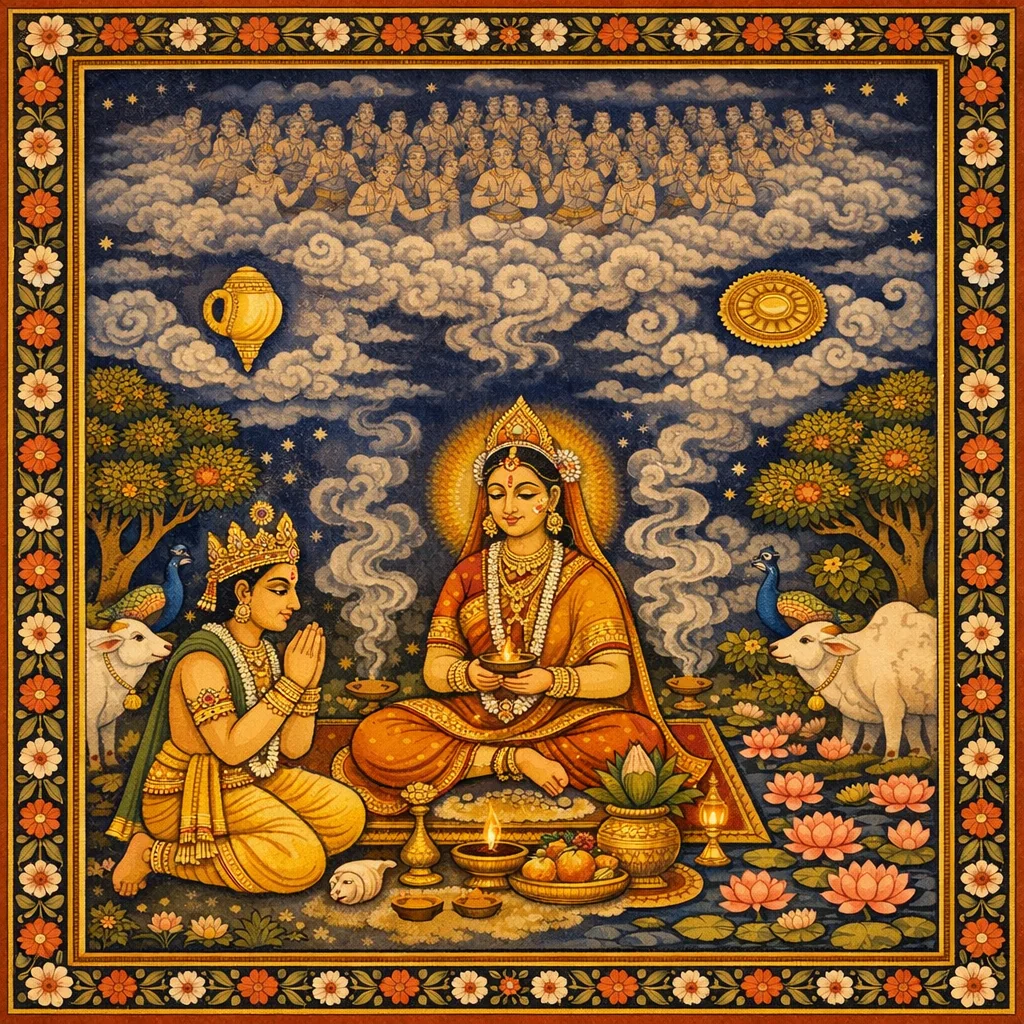
This chapter continues the vaṁśa thread by completing key branches of Aditi’s sons (the Ādityas) and then turning to Diti and the Daityas, linking cosmic genealogy with moral and devotional causality. After listing progeny tied to yajña structures and ṛṣi origins (and foreshadowing Vāmana/Urukrama’s future līlā in Skandha 8), the narrative shifts to Diti’s grief for Hiraṇyākṣa and Hiraṇyakaśipu and her resolve to conceive a son who will kill Indra. By her strategic service Diti pleases Kaśyapa, who grants a conditional boon: she must observe for one year a Vaiṣṇava-aligned puṁsavana vow. Indra, fearing for self-preservation, outwardly serves Diti while seeking a fault; when Diti inadvertently breaks etiquette at twilight, Indra enters the womb and splits the embryo—first into seven, then into forty-nine—yet by Viṣṇu’s mercy they live as Maruts and become Indra’s allies. The chapter ends with Indra’s confession, Diti’s purification and satisfaction, and Śukadeva’s invitation for Parīkṣit to inquire further, carrying the story into later discussions of deva–asura dynamics and dharmic causality.
Shlokas
Verse 1
श्रीशुक उवाच पृश्निस्तु पत्नी सवितु: सावित्रीं व्याहृतिं त्रयीम् । अग्निहोत्रं पशुं सोमं चातुर्मास्यं महामखान् ॥ १ ॥
Śrī Śukadeva Gosvāmī said: Pṛśni, the wife of Savitā, gave birth to three daughters—Sāvitrī, Vyāhṛti, and Trayī—and to sons named Agnihotra, Paśu, Soma, Cāturmāsya, and Mahāyajña.
Verse 2
सिद्धिर्भगस्य भार्याङ्ग महिमानं विभुं प्रभुम् । आशिषं च वरारोहां कन्यां प्रासूत सुव्रताम् ॥ २ ॥
O King, Siddhi, the wife of Bhaga, bore three sons—Mahimā, Vibhu, and Prabhu—and one exceedingly beautiful daughter named Āśī (Āśiṣ).
Verse 3
धातु: कुहू: सिनीवाली राका चानुमतिस्तथा । सायं दर्शमथ प्रात: पूर्णमासमनुक्रमात् ॥ ३ ॥ अग्नीन् पुरीष्यानाधत्त क्रियायां समनन्तर: । चर्षणी वरुणस्यासीद्यस्यां जातो भृगु: पुन: ॥ ४ ॥
Dhātā had four wives—Kuhū, Sinīvālī, Rākā, and Anumati—who bore, in order, sons named Sāyam, Darśa, Prātaḥ, and Pūrṇamāsa. Thereafter Vidhātā, through Kriyā, begot five fire-gods known as the Purīṣyas. Varuṇa’s wife was Carṣaṇī, in whose womb Bhṛgu, the son of Brahmā, took birth again.
Verse 4
धातु: कुहू: सिनीवाली राका चानुमतिस्तथा । सायं दर्शमथ प्रात: पूर्णमासमनुक्रमात् ॥ ३ ॥ अग्नीन् पुरीष्यानाधत्त क्रियायां समनन्तर: । चर्षणी वरुणस्यासीद्यस्यां जातो भृगु: पुन: ॥ ४ ॥
Dhātā had four wives—Kuhū, Sinīvālī, Rākā, and Anumati—who bore, in order, sons named Sāyam, Darśa, Prātaḥ, and Pūrṇamāsa. Thereafter Vidhātā, through Kriyā, begot five fire-gods known as the Purīṣyas. Varuṇa’s wife was Carṣaṇī, in whose womb Bhṛgu, the son of Brahmā, took birth again.
Verse 5
वाल्मीकिश्च महायोगी वल्मीकादभवत्किल । अगस्त्यश्च वसिष्ठश्च मित्रावरुणयोऋर्षी ॥ ५ ॥
It is said that by Varuṇa’s semen the great mystic Vālmīki was born from an anthill (valmīka). Bhṛgu and Vālmīki were Varuṇa’s particular sons, whereas the ṛṣis Agastya and Vasiṣṭha were the common sons of Mitra and Varuṇa.
Verse 6
रेत: सिषिचतु: कुम्भे उर्वश्या: सन्निधौ द्रुतम् । रेवत्यां मित्र उत्सर्गमरिष्टं पिप्पलं व्यधात् ॥ ६ ॥
In Urvaśī’s presence, Mitra and Varuṇa swiftly discharged their semen and preserved it in an earthen pot. From that pot Agastya and Vasiṣṭha later appeared; and in the womb of his wife Revatī, Mitra begot three sons—Utsarga, Ariṣṭa, and Pippala.
Verse 7
पौलोम्यामिन्द्र आधत्त त्रीन् पुत्रानिति न: श्रुतम् । जयन्तमृषभं तात तृतीयं मीढुषं प्रभु: ॥ ७ ॥
O King Parīkṣit, we have heard that Indra, lord of the heavenly realms, begot three sons in the womb of Paulomī—Jayanta, Ṛṣabha, and the third, Mīḍhuṣa.
Verse 8
उरुक्रमस्य देवस्य मायावामनरूपिण: । कीर्तौ पत्न्यां बृहच्छ्लोकस्तस्यासन् सौभगादय: ॥ ८ ॥
By His own potency, the divine Urukrama, endowed with manifold energies, appeared in the form of Vāmana, the dwarf. In the womb of His wife Kīrti He begot a son named Bṛhatśloka, who in turn had many sons, headed by Saubhaga.
Verse 9
तत्कर्मगुणवीर्याणि काश्यपस्य महात्मन: । पश्चाद्वक्ष्यामहेऽदित्यां यथैवावततार ह ॥ ९ ॥
Later (in the Eighth Canto of Śrīmad-Bhāgavatam) we shall describe how Urukrama, Lord Vāmanadeva, appeared from Aditi’s womb as the son of the great sage Kaśyapa, how He covered the three worlds in three steps, and His uncommon deeds, qualities, and power.
Verse 10
अथ कश्यपदायादान् दैतेयान् कीर्तयामि ते । यत्र भागवत: श्रीमान् प्रह्रादो बलिरेव च ॥ १० ॥
Now I shall recount the sons of Diti, begotten by Kaśyapa yet known as the Daityas; within this line appeared the illustrious devotee Prahlāda Mahārāja, and Bali Mahārāja as well.
Verse 11
दितेर्द्वावेव दायादौ दैत्यदानववन्दितौ । हिरण्यकशिपुर्नाम हिरण्याक्षश्च कीर्तितौ ॥ ११ ॥
From Diti’s womb first appeared two sons, named Hiraṇyakaśipu and Hiraṇyākṣa. Both were exceedingly powerful and were worshiped among the Daityas and Dānavas.
Verse 12
हिरण्यकशिपोर्भार्या कयाधुर्नाम दानवी । जम्भस्य तनया सा तु सुषुवे चतुर: सुतान् ॥ १२ ॥ संह्रादं प्रागनुह्रादं ह्रादं प्रह्रादमेव च । तत्स्वसा सिंहिका नाम राहुं विप्रचितोऽग्रहीत् ॥ १३ ॥
Hiraṇyakaśipu’s wife was the dānavī Kayādhu, daughter of Jambha. She bore four sons in succession—Saṁhlāda, Prāg-Anuhlāda, Hlāda, and Prahlāda. Their sister Siṁhikā married Vipracit and gave birth to Rāhu.
Verse 13
हिरण्यकशिपोर्भार्या कयाधुर्नाम दानवी । जम्भस्य तनया सा तु सुषुवे चतुर: सुतान् ॥ १२ ॥ संह्रादं प्रागनुह्रादं ह्रादं प्रह्रादमेव च । तत्स्वसा सिंहिका नाम राहुं विप्रचितोऽग्रहीत् ॥ १३ ॥
Hiraṇyakaśipu’s wife was the dānavī Kayādhu, daughter of Jambha. She bore four sons in succession—Saṁhlāda, Prāg-Anuhlāda, Hlāda, and Prahlāda. Their sister Siṁhikā married Vipracit and gave birth to Rāhu.
Verse 14
शिरोऽहरद्यस्य हरिश्चक्रेण पिबतोऽमृतम् । संह्रादस्य कृतिर्भार्यासूत पञ्चजनं तत: ॥ १४ ॥
When Rāhu, in disguise, drank the nectar among the devas, Hari severed his head with His discus. Saṁhlāda’s wife was Kṛti, and from their union a son named Pañcajana was born.
Verse 15
ह्रादस्य धमनिर्भार्यासूत वातापिमिल्वलम् । योऽगस्त्याय त्वतिथये पेचे वातापिमिल्वल: ॥ १५ ॥
Hlāda’s wife was Dhamanī, and from her were born two sons, Vātāpi and Ilvala. When the sage Agastya came as Ilvala’s guest, Ilvala served him a feast by cooking Vātāpi, who had assumed the form of a ram.
Verse 16
अनुह्रादस्य सूर्यायां बाष्कलो महिषस्तथा । विरोचनस्तु प्राह्रादिर्देव्यां तस्याभवद्बलि: ॥ १६ ॥
Anuhlāda’s wife was Sūryā, and she bore two sons, Bāṣkala and Mahiṣa. Prahlāda had one son, Virocana, and from Virocana’s wife was born Bali Mahārāja.
Verse 17
बाणज्येष्ठं पुत्रशतमशनायां ततोऽभवत् । तस्यानुभावं सुश्लोक्यं पश्चादेवाभिधास्यते ॥ १७ ॥
Thereafter, Bali Mahārāja begot one hundred sons in the womb of Aśanā, and among them King Bāṇa was the eldest. The most praiseworthy deeds of Bali Mahārāja will be described later (in the Eighth Canto).
Verse 18
बाण आराध्य गिरिशं लेभे तद्गणमुख्यताम् । यत्पार्श्वे भगवानास्ते ह्यद्यापि पुरपालक: ॥ १८ ॥
Because King Bāṇa worshiped Girīśa (Lord Śiva) with great devotion, he attained a foremost place among Śiva’s renowned associates. Even now, Bhagavān Śaṅkara stands at his side and protects Bāṇa’s capital.
Verse 19
मरुतश्च दिते: पुत्राश्चत्वारिंशन्नवाधिका: । त आसन्नप्रजा: सर्वे नीता इन्द्रेण सात्मताम् ॥ १९ ॥
The forty-nine Marut demigods were also born from Diti’s womb. None of them had offspring. Though born of Diti, King Indra granted them the status of devas and established them in that divine position.
Verse 20
श्रीराजोवाच कथं त आसुरं भावमपोह्यौत्पत्तिकं गुरो । इन्द्रेण प्रापिता: सात्म्यं किं तत्साधु कृतं हि तै: ॥ २० ॥
King Parīkṣit inquired: My dear lord, due to their birth, the forty-nine Maruts must have been obsessed with a demoniac mentality. Why did Indra, the King of heaven, convert them into demigods? Did they perform any rituals or pious activities?
Verse 21
इमे श्रद्दधते ब्रह्मन्नृषयो हि मया सह । परिज्ञानाय भगवंस्तन्नो व्याख्यातुमर्हसि ॥ २१ ॥
My dear brāhmaṇa, I and all the sages present with me are eager to know about this. Therefore, O great soul, kindly explain to us the reason.
Verse 22
श्रीसूत उवाच तद्विष्णुरातस्य स बादरायणि- र्वचो निशम्यादृतमल्पमर्थवत् । सभाजयन् सन्निभृतेन चेतसा जगाद सत्रायण सर्वदर्शन: ॥ २२ ॥
Śrī Sūta Gosvāmī said: O great sage Śaunaka, after hearing Mahārāja Parīkṣit speak respectfully and briefly on topics essential to hear, Śukadeva Gosvāmī, who was well aware of everything, praised his endeavor with great pleasure and replied.
Verse 23
श्रीशुक उवाच हतपुत्रा दिति: शक्रपार्ष्णिग्राहेण विष्णुना । मन्युना शोकदीप्तेन ज्वलन्ती पर्यचिन्तयत् ॥ २३ ॥
Śrī Śukadeva Gosvāmī said: Just to help Indra, Lord Viṣṇu killed the two brothers Hiraṇyākṣa and Hiraṇyakaśipu. Because of their being killed, their mother, Diti, overwhelmed with lamentation and anger, contemplated as follows.
Verse 24
कदा नु भ्रातृहन्तारमिन्द्रियाराममुल्बणम् । अक्लिन्नहृदयं पापं घातयित्वा शये सुखम् ॥ २४ ॥
Lord Indra, who is very much fond of sense gratification, has killed the two brothers Hiraṇyākṣa and Hiraṇyakaśipu by means of Lord Viṣṇu. Therefore Indra is cruel, hardhearted and sinful. When will I, having killed him, rest with a pacified mind?
Verse 25
कृमिविड्भस्मसंज्ञासीद्यस्येशाभिहितस्य च । भूतध्रुक् तत्कृते स्वार्थं किं वेद निरयो यत: ॥ २५ ॥
When dead, the bodies of all the rulers known as kings and great leaders will be transformed into worms, stool or ashes. If one enviously kills others for the protection of such a body, does he actually know the true interest of life? Certainly he does not, for if one is envious of other entities, he surely goes to hell.
Verse 26
आशासानस्य तस्येदं ध्रुवमुन्नद्धचेतस: । मदशोषक इन्द्रस्य भूयाद्येन सुतो हि मे ॥ २६ ॥
Diti thought: Indra considers his body eternal, and thus he has become unrestrained. I therefore wish to have a son who can remove Indra’s madness. Let me adopt some means to help me in this.
Verse 27
इति भावेन सा भर्तुराचचारासकृत्प्रियम् । शुश्रूषयानुरागेण प्रश्रयेण दमेन च ॥ २७ ॥ भक्त्या परमया राजन् मनोज्ञैर्वल्गुभाषितै: । मनो जग्राह भावज्ञा सस्मितापाङ्गवीक्षणै: ॥ २८ ॥
Thinking in this way [with a desire for a son to kill Indra], Diti began constantly acting to satisfy Kaśyapa by her pleasing behavior. O King, Diti always carried out Kaśyapa’s orders very faithfully, as he desired. With service, love, humility and control, with words spoken very sweetly to satisfy her husband, and with smiles and glances at him, Diti attracted his mind and brought it under her control.
Verse 28
इति भावेन सा भर्तुराचचारासकृत्प्रियम् । शुश्रूषयानुरागेण प्रश्रयेण दमेन च ॥ २७ ॥ भक्त्या परमया राजन् मनोज्ञैर्वल्गुभाषितै: । मनो जग्राह भावज्ञा सस्मितापाङ्गवीक्षणै: ॥ २८ ॥
Thinking in this way [with a desire for a son to kill Indra], Diti began constantly acting to satisfy Kaśyapa by her pleasing behavior. O King, Diti always carried out Kaśyapa’s orders very faithfully, as he desired. With service, love, humility and control, with words spoken very sweetly to satisfy her husband, and with smiles and glances at him, Diti attracted his mind and brought it under her control.
Verse 29
एवं स्त्रिया जडीभूतो विद्वानपि मनोज्ञया । बाढमित्याह विवशो न तच्चित्रं हि योषिति ॥ २९ ॥
Although Kaśyapa Muni was a learned scholar, he was captivated by Diti’s artificial behavior, which brought him under her control. Therefore he assured his wife that he would fulfill her desires. Such a promise by a husband is not at all astonishing.
Verse 30
विलोक्यैकान्तभूतानि भूतान्यादौ प्रजापति: । स्त्रियं चक्रे स्वदेहार्धं यया पुंसां मतिर्हृता ॥ ३० ॥
In the dawn of creation, Prajāpati Brahmā saw that all beings were unattached. To increase progeny, he fashioned woman from the nobler half of man’s body, for her nature can draw away a man’s mind.
Verse 31
एवं शुश्रूषितस्तात भगवान् कश्यप: स्त्रिया । प्रहस्य परमप्रीतो दितिमाहाभिनन्द्य च ॥ ३१ ॥
Thus the mighty sage Kaśyapa, greatly pleased by his wife Diti’s gentle service, smiled with deep delight, praised her, and spoke as follows.
Verse 32
श्रीकश्यप उवाच वरं वरय वामोरु प्रीतस्तेऽहमनिन्दिते । स्त्रिया भर्तरि सुप्रीते क: काम इह चागम: ॥ ३२ ॥
Kaśyapa Muni said: O fair-thighed, blameless lady, I am greatly pleased by your conduct. Ask of me whatever boon you desire. When a husband is satisfied, what wish is difficult for a wife to attain, in this world or the next?
Verse 33
पतिरेव हि नारीणां दैवतं परमं स्मृतम् । मानस: सर्वभूतानां वासुदेव: श्रिय: पति: ॥ ३३ ॥ स एव देवतालिङ्गैर्नामरूपविकल्पितै: । इज्यते भगवान् पुम्भि: स्त्रीभिश्च पतिरूपधृक् ॥ ३४ ॥
For a woman, the husband is remembered as the supreme deity. In the heart of every being dwells Vāsudeva, the Lord and consort of Śrī (Lakṣmī). Those who seek worldly fruits worship Him through the many names and forms of the demigods; likewise, a woman worships the same Bhagavān as present in the form of her husband.
Verse 34
पतिरेव हि नारीणां दैवतं परमं स्मृतम् । मानस: सर्वभूतानां वासुदेव: श्रिय: पति: ॥ ३३ ॥ स एव देवतालिङ्गैर्नामरूपविकल्पितै: । इज्यते भगवान् पुम्भि: स्त्रीभिश्च पतिरूपधृक् ॥ ३४ ॥
For a woman, the husband is remembered as the supreme deity. In the heart of every being dwells Vāsudeva, the Lord and consort of Śrī (Lakṣmī). Those who seek worldly fruits worship Him through the many names and forms of the demigods; likewise, a woman worships the same Bhagavān as present in the form of her husband.
Verse 35
तस्मात्पतिव्रता नार्य: श्रेयस्कामा: सुमध्यमे । यजन्तेऽनन्यभावेन पतिमात्मानमीश्वरम् ॥ ३५ ॥
Therefore, O slender-waisted wife, women who seek the highest good should remain chaste and obedient to their husband’s order, and with undivided devotion worship the husband as the representative of Vāsudeva.
Verse 36
सोऽहं त्वयार्चितो भद्रे ईदृग्भावेन भक्तित: । तं ते सम्पादये काममसतीनां सुदुर्लभम् ॥ ३६ ॥
My gentle wife, because you have worshiped me with such devotion, seeing me as the representative of the Supreme Lord, I shall grant you the fulfillment of your desire—something very difficult for an unchaste woman to obtain.
Verse 37
दितिरुवाच वरदो यदि मे ब्रह्मन् पुत्रमिन्द्रहणं वृणे । अमृत्युं मृतपुत्राहं येन मे घातितौ सुतौ ॥ ३७ ॥
Diti replied: O brāhmaṇa, bestower of boons, I have lost my sons. If you would grant me a blessing, I ask for an immortal son who can slay Indra, for Indra, aided by Viṣṇu, has killed my two sons.
Verse 38
निशम्य तद्वचो विप्रो विमना: पर्यतप्यत । अहो अधर्म: सुमहानद्य मे समुपस्थित: ॥ ३८ ॥
Hearing Diti’s words, Kaśyapa Muni became deeply distressed and pained at heart. He lamented, “Alas! Today the great danger of an adharma act—killing Indra—has come before me.”
Verse 39
अहो अर्थेन्द्रियारामो योषिन्मय्येह मायया । गृहीतचेता: कृपण: पतिष्ये नरके ध्रुवम् ॥ ३९ ॥
Kaśyapa Muni thought: “Alas, I have become absorbed in wealth and the pleasures of the senses. Taking advantage of this, the Lord’s māyā, in the form of a woman (my wife), has seized my mind. Therefore I am truly wretched, and I shall surely slide down toward hell.”
Verse 40
कोऽतिक्रमोऽनुवर्तन्त्या: स्वभावमिह योषित: । धिङ्मां बताबुधं स्वार्थे यदहं त्वजितेन्द्रिय: ॥ ४० ॥
This woman, my wife, has adopted a means that follows her nature, and therefore she is not to be blamed. But I am a man. Therefore, all condemnation upon me! I am not at all conversant with what is good for me, since I could not control my senses.
Verse 41
शरत्पद्मोत्सवं वक्त्रं वचश्च श्रवणामृतम् । हृदयं क्षुरधाराभं स्त्रीणां को वेद चेष्टितम् ॥ ४१ ॥
A woman’s face is as attractive and beautiful as a blossoming lotus flower during autumn. Her words are very sweet, and they give pleasure to the ear, but if we study a woman’s heart, we can understand it to be extremely sharp, like the blade of a razor. In these circumstances, who could understand the dealings of a woman?
Verse 42
न हि कश्चित्प्रिय: स्त्रीणामञ्जसा स्वाशिषात्मनाम् । पतिं पुत्रं भ्रातरं वा घ्नन्त्यर्थे घातयन्ति च ॥ ४२ ॥
To satisfy their own interests, women deal with men as if the men were most dear to them, but no one is actually dear to them. Women are supposed to be very saintly, but for their own interests they can kill even their husbands, sons or brothers, or cause them to be killed by others.
Verse 43
प्रतिश्रुतं ददामीति वचस्तन्न मृषा भवेत् । वधं नार्हति चेन्द्रोऽपि तत्रेदमुपकल्पते ॥ ४३ ॥
I promised to give her a benediction, and this promise cannot be violated, but Indra does not deserve to be killed. In these circumstances, the solution I have is quite suitable.
Verse 44
इति सञ्चिन्त्य भगवान्मारीच: कुरुनन्दन । उवाच किञ्चित् कुपित आत्मानं च विगर्हयन् ॥ ४४ ॥
Śrī Śukadeva Gosvāmī said: Kaśyapa Muni, thinking in this way, became somewhat angry. Condemning himself, O Mahārāja Parīkṣit, descendant of Kuru, he spoke to Diti as follows.
Verse 45
श्रीकश्यप उवाच पुत्रस्ते भविता भद्रे इन्द्रहादेवबान्धव: । संवत्सरं व्रतमिदं यद्यञ्जो धारयिष्यसि ॥ ४५ ॥
Śrī Kaśyapa said: My gentle wife, if you uphold this vow according to my instructions for one full year, you will surely obtain a son able to slay Indra; but if you deviate from this vow and its Vaiṣṇava principles, you will have a son favorable to Indra, a friend of the devas.
Verse 46
दितिरुवाच धारयिष्ये व्रतं ब्रह्मन्ब्रूहि कार्याणि यानि मे । यानि चेह निषिद्धानि न व्रतं घ्नन्ति यान्युत ॥ ४६ ॥
Diti replied: O brāhmaṇa, I will indeed observe this vow. Please tell me clearly what I must do, what is forbidden, and what actions do not break the vow.
Verse 47
श्रीकश्यप उवाच न हिंस्याद्भूतजातानि न शपेन्नानृतं वदेत् । न छिन्द्यान्नखरोमाणि न स्पृशेद्यदमङ्गलम् ॥ ४७ ॥
Śrī Kaśyapa said: My dear wife, to keep this vow, do not harm any living being. Do not curse anyone, and do not speak falsehood. Do not cut your nails or hair, and do not touch impure, inauspicious things such as skulls and bones.
Verse 48
नाप्सु स्नायान्न कुप्येत न सम्भाषेत दुर्जनै: । न वसीताधौतवास: स्रजं च विधृतां क्वचित् ॥ ४८ ॥
Śrī Kaśyapa continued: My gentle wife, while bathing do not enter into the water. Do not become angry, and do not speak with or associate with wicked people. Never wear clothing that has not been properly washed, and never put on a garland that has already been worn.
Verse 49
नोच्छिष्टं चण्डिकान्नं च सामिषं वृषलाहृतम् । भुञ्जीतोदक्यया दृष्टं पिबेन्नाञ्जलिना त्वप: ॥ ४९ ॥
Never eat leftover food (ucchiṣṭa), nor food offered to Caṇḍikā (Kālī/Durgā), nor anything tainted by meat or fish. Do not eat food brought or touched by a śūdra, nor food seen by a woman in her menstrual period. And do not drink water by joining the palms in añjali.
Verse 50
नोच्छिष्टास्पृष्टसलिला सन्ध्यायां मुक्तमूर्धजा । अनर्चितासंयतवाक्नासंवीता बहिश्चरेत् ॥ ५० ॥
After eating, one should not go out without washing the mouth, hands, and feet. One should not go out at twilight or with hair left loose, nor without proper ornaments, restrained speech, and sufficient covering.
Verse 51
नाधौतपादाप्रयता नार्द्रपादा उदक्शिरा: । शयीत नापराङ्नान्यैर्न नग्ना न च सन्ध्ययो: ॥ ५१ ॥
One should not lie down without washing both feet and becoming purified, nor with wet feet, nor with the head placed toward the north or west. One should not lie down naked, with other women, or at sunrise or sunset.
Verse 52
धौतवासा शुचिर्नित्यं सर्वमङ्गलसंयुता । पूजयेत्प्रातराशात्प्राग्गोविप्राञ् श्रियमच्युतम् ॥ ५२ ॥
Wearing washed garments, ever pure and adorned with turmeric, sandal paste, and other auspicious items, before breakfast one should worship the cows, the brāhmaṇas, Goddess Śrī (Lakṣmī), and the Supreme Lord, Acyuta.
Verse 53
स्त्रियो वीरवतीश्चार्चेत्स्रग्गन्धबलिमण्डनै: । पतिं चार्च्योपतिष्ठेत ध्यायेत्कोष्ठगतं च तम् ॥ ५३ ॥
With flower garlands, sandal paste, ornaments, and other offerings, a woman observing this vow should worship women who have sons and whose husbands are living. The pregnant wife should worship her husband, offer prayers, and meditate that he is situated within her womb.
Verse 54
सांवत्सरं पुंसवनं व्रतमेतदविप्लुतम् । धारयिष्यसि चेत्तुभ्यं शक्रहा भविता सुत: ॥ ५४ ॥
Kaśyapa Muni continued: If you perform this puṁsavana rite with faith, keeping the vow without fault for at least one year, you will bear a son destined to slay Indra. But if the vow is observed with any discrepancy, that son will become Indra’s friend.
Verse 55
बाढमित्यभ्युपेत्याथ दिती राजन्महामना: । कश्यपाद् गर्भमाधत्त व्रतं चाञ्जो दधार सा ॥ ५५ ॥
O King Parīkṣit, Diti replied, “So be it,” and accepted the purificatory vow of puṁsavana according to Kaśyapa’s instructions. Rejoicing greatly, she conceived by Kaśyapa and faithfully began to observe the vow.
Verse 56
मातृष्वसुरभिप्रायमिन्द्र आज्ञाय मानद । शुश्रूषणेनाश्रमस्थां दितिं पर्यचरत्कवि: ॥ ५६ ॥
O King, respectful to all, Indra understood the intention of his aunt Diti and devised a plan for his own advantage. Thus he engaged in attentive service to Diti as she dwelt in an āśrama.
Verse 57
नित्यं वनात्सुमनस: फलमूलसमित्कुशान् । पत्राङ्कुरमृदोऽपश्च काले काल उपाहरत् ॥ ५७ ॥
Daily he brought from the forest fragrant flowers, fruits, roots, sacrificial firewood, and kuśa grass. He also supplied leaves, sprouts, earth, and water, each exactly at the proper time.
Verse 58
एवं तस्या व्रतस्थाया व्रतच्छिद्रं हरिर्नृप । प्रेप्सु: पर्यचरज्जिह्मो मृगहेव मृगाकृति: ॥ ५८ ॥
O King Parīkṣit, just as a deer-hunter becomes like a deer by covering himself with deerskin, Indra—an enemy at heart to Diti’s sons—appeared friendly outwardly and served Diti with great care. He waited to find a flaw in her observance so he could deceive her without being detected.
Verse 59
नाध्यगच्छद्व्रतच्छिद्रं तत्परोऽथ महीपते । चिन्तां तीव्रां गत: शक्र: केन मे स्याच्छिवं त्विह ॥ ५९ ॥
O lord of the world, finding no flaw in her vow, Śakra (Indra) fell into intense anxiety and thought, “How will good fortune come to me here?”
Verse 60
एकदा सा तु सन्ध्यायामुच्छिष्टा व्रतकर्शिता । अस्पृष्टवार्यधौताङ्घ्रि: सुष्वाप विधिमोहिता ॥ ६० ॥
Having grown weak and thin because of strictly following the principles of the vow, Diti once unfortunately neglected to wash her mouth, hands and feet after eating and went to sleep during the evening twilight.
Verse 61
लब्ध्वा तदन्तरं शक्रो निद्रापहृतचेतस: । दिते: प्रविष्ट उदरं योगेशो योगमायया ॥ ६१ ॥
Finding this fault, Indra, who has all the mystic powers, entered Diti’s womb while she was unconscious, being fast asleep.
Verse 62
चकर्त सप्तधा गर्भं वज्रेण कनकप्रभम् । रुदन्तं सप्तधैकैकं मा रोदीरिति तान् पुन: ॥ ६२ ॥
After entering Diti’s womb, Indra, with the help of his thunderbolt, cut into seven pieces her embryo, which appeared like glowing gold. In seven places, seven different living beings began crying. Indra told them, “Do not cry,” and then he cut each of them into seven pieces again.
Verse 63
तमूचु: पाट्यमानास्ते सर्वे प्राञ्जलयो नृप । किं न इन्द्र जिघांससि भ्रातरो मरुतस्तव ॥ ६३ ॥
O King, being very much aggrieved, they pleaded to Indra with folded hands, saying, “Dear Indra, we are the Maruts, your brothers. Why are you trying to kill us?”
Verse 64
मा भैष्ट भ्रातरो मह्यं यूयमित्याह कौशिक: । अनन्यभावान् पार्षदानात्मनो मरुतां गणान् ॥ ६४ ॥
When Indra saw that actually they were his devoted followers, he said to them: If you are all my brothers, you have nothing more to fear from me.
Verse 65
न ममार दितेर्गर्भ: श्रीनिवासानुकम्पया । बहुधा कुलिशक्षुण्णो द्रौण्यस्त्रेण यथा भवान् ॥ ६५ ॥
Śukadeva Gosvāmī said: My dear King Parīkṣit, though you were scorched by Aśvatthāmā’s brahmāstra, you were saved when Lord Śrī Kṛṣṇa entered your mother’s womb. In the same way, Diti’s single embryo, though split into forty-nine parts by Indra’s thunderbolt, was preserved in every part by the mercy of Śrīnिवāsa, the Supreme Personality of Godhead.
Verse 66
सकृदिष्ट्वादिपुरुषं पुरुषो याति साम्यताम् । संवत्सरं किञ्चिदूनं दित्या यद्धरिरर्चित: ॥ ६६ ॥ सजूरिन्द्रेण पञ्चाशद्देवास्ते मरुतोऽभवन् । व्यपोह्य मातृदोषं ते हरिणा सोमपा: कृता: ॥ ६७ ॥
If one worships the Ādi-Puruṣa, the Supreme Personality of Godhead, even once, he gains the fruit of attaining Vaikuṇṭha and receiving bodily features like those of Viṣṇu. Diti, observing a great vow, worshiped Lord Hari for almost one year. By the strength of that devotion, the forty-nine Maruts were born.
Verse 67
सकृदिष्ट्वादिपुरुषं पुरुषो याति साम्यताम् । संवत्सरं किञ्चिदूनं दित्या यद्धरिरर्चित: ॥ ६६ ॥ सजूरिन्द्रेण पञ्चाशद्देवास्ते मरुतोऽभवन् । व्यपोह्य मातृदोषं ते हरिणा सोमपा: कृता: ॥ ६७ ॥
In the company of Indra, those forty-nine Maruts became equal to the demigods. Lord Hari removed the taint connected with their mother and made them soma-drinkers, counted among the devas. Therefore, though born from Diti’s womb, that they became godlike by the Supreme Lord’s mercy is not at all astonishing.
Verse 68
दितिरुत्थाय ददृशे कुमाराननलप्रभान् । इन्द्रेण सहितान् देवी पर्यतुष्यदनिन्दिता ॥ ६८ ॥
By worshiping the Supreme Personality of Godhead, Diti became completely purified. When she rose from her bed, she saw her forty-nine sons together with Indra. All were brilliant like fire and were bound to Indra in friendship, and thus the blameless goddess felt great joy.
Verse 69
अथेन्द्रमाह ताताहमादित्यानां भयावहम् । अपत्यमिच्छन्त्यचरं व्रतमेतत्सुदुष्करम् ॥ ६९ ॥
Thereafter Diti said to Indra: My dear son, I had become a source of fear for the Ādityas. I performed this most difficult vow only because I desired a son who would kill you—the twelve Ādityas.
Verse 70
एक: सङ्कल्पित: पुत्र: सप्त सप्ताभवन् कथम् । यदि ते विदितं पुत्र सत्यं कथय मा मृषा ॥ ७० ॥
I prayed for only one son, but now I see that there are forty-nine. How has this happened? My dear son Indra, if you know, please tell me the truth. Do not try to speak lies.
Verse 71
इन्द्र उवाच अम्ब तेऽहं व्यवसितमुपधार्यागतोऽन्तिकम् । लब्धान्तरोऽच्छिदं गर्भमर्थबुद्धिर्न धर्मदृक् ॥ ७१ ॥
Indra replied: My dear mother, because I was grossly blinded by selfish interests, I lost sight of religion. When I understood that you were observing a great vow in spiritual life, I wanted to find some fault in you. When I found such a fault, I entered your womb and cut the embryo to pieces.
Verse 72
कृत्तो मे सप्तधा गर्भ आसन् सप्त कुमारका: । तेऽपि चैकैकशो वृक्णा: सप्तधा नापि मम्रिरे ॥ ७२ ॥
First I cut the child in the womb into seven pieces, which became seven children. Then I cut each of the children into seven pieces again. By the grace of the Supreme Lord, however, none of them died.
Verse 73
ततस्तत्परमाश्चर्यं वीक्ष्य व्यवसितं मया । महापुरुषपूजाया: सिद्धि: काप्यानुषङ्गिणी ॥ ७३ ॥
My dear mother, when I saw that all forty-nine sons were alive, I was certainly struck with wonder. I decided that this was a secondary result of your having regularly executed devotional service in worship of Lord Viṣṇu.
Verse 74
आराधनं भगवत ईहमाना निराशिष: । ये तु नेच्छन्त्यपि परं ते स्वार्थकुशला: स्मृता: ॥ ७४ ॥
Although those who are interested only in worshiping the Supreme Personality of Godhead do not desire anything material from the Lord and do not even want liberation, Lord Kṛṣṇa fulfills all their desires.
Verse 75
आराध्यात्मप्रदं देवं स्वात्मानं जगदीश्वरम् । को वृणीत गुणस्पर्शं बुध: स्यान्नरकेऽपि यत् ॥ ७५ ॥
The Lord who gives His very Self to His devotees is the worshipful Jagadīśvara. How can a wise person, serving that most dear Lord, desire material happiness—available even in hell?
Verse 76
तदिदं मम दौर्जन्यं बालिशस्य महीयसि । क्षन्तुमर्हसि मातस्त्वं दिष्ट्या गर्भो मृतोत्थित: ॥ ७६ ॥
O Mother, O most exalted woman, I am foolish and wicked; please forgive my offenses. By your bhakti, the sons within your womb were born unharmed—though as an enemy I cut them to pieces, they did not die.
Verse 77
श्रीशुक उवाच इन्द्रस्तयाभ्यनुज्ञात: शुद्धभावेन तुष्टया । मरुद्भि: सह तां नत्वा जगाम त्रिदिवं प्रभु: ॥ ७७ ॥
Śrī Śukadeva Gosvāmī continued: Pleased by Indra’s pure conduct, Diti granted him permission. Indra then bowed again and again to his aunt, and with the Maruts departed for the heavenly worlds.
Verse 78
एवं ते सर्वमाख्यातं यन्मां त्वं परिपृच्छसि । मङ्गलं मरुतां जन्म किं भूय: कथयामि ते ॥ ७८ ॥
My dear King Parīkṣit, I have answered, as far as possible, what you asked—especially this pure and auspicious account of the Maruts’ birth. Now inquire further, and I shall explain more.
Frequently Asked Questions
In this chapter, the Maruts are the living beings born from Diti’s embryo after Indra splits it into seven parts and then each part into seven again, yielding forty-nine. Although the act is violent, the text emphasizes poṣaṇa: by the Supreme Lord’s mercy, none die, and they become Indra’s brothers and devoted associates, illustrating how divine protection can transform a threatened birth into a cosmic function.
Diti sought an “immortal son” to kill Indra, motivated by grief and anger over her slain sons. Kaśyapa, bound by his promise yet concerned about the sin of Indra’s death, prescribed a one-year vow aligned with Vaiṣṇava purity rules: if followed without deviation, the son would be capable of killing Indra; if broken, the son would become favorable to Indra. The condition reframes the boon through dharma and devotional discipline.
Indra served Diti carefully to find a lapse in her strict vrata. The fault occurred when Diti, weakened by austerity, neglected to wash her mouth, hands, and feet after eating and fell asleep during the evening twilight (sandhyā). Indra then used yogic powers to enter her womb while she slept, showing the narrative’s tension between political fear and religious observance.
Indra embodies a deva’s administrative anxiety and moral vulnerability: he prioritizes self-preservation and uses deception to prevent a rival’s birth, yet later confesses and seeks forgiveness when he realizes the embryo survives by Viṣṇu’s grace. The text uses his arc to teach that dharma without devotion can degrade into expediency, while recognition of divine agency can lead to humility and reconciliation.
Śukadeva explicitly attributes survival to the Supreme Lord’s mercy, paralleling Parīkṣit’s own rescue in the womb by Kṛṣṇa. The lesson is poṣaṇa: Bhagavān protects life and purpose even amid violence and error, and devotional worship (even performed with mixed motives) generates purifying strength that can override destructive intent.