Adhyaya 15
Nārada and Aṅgirā Instruct Citraketu: Impermanence, Ātma-Tattva, and Mantra-Upadeśa
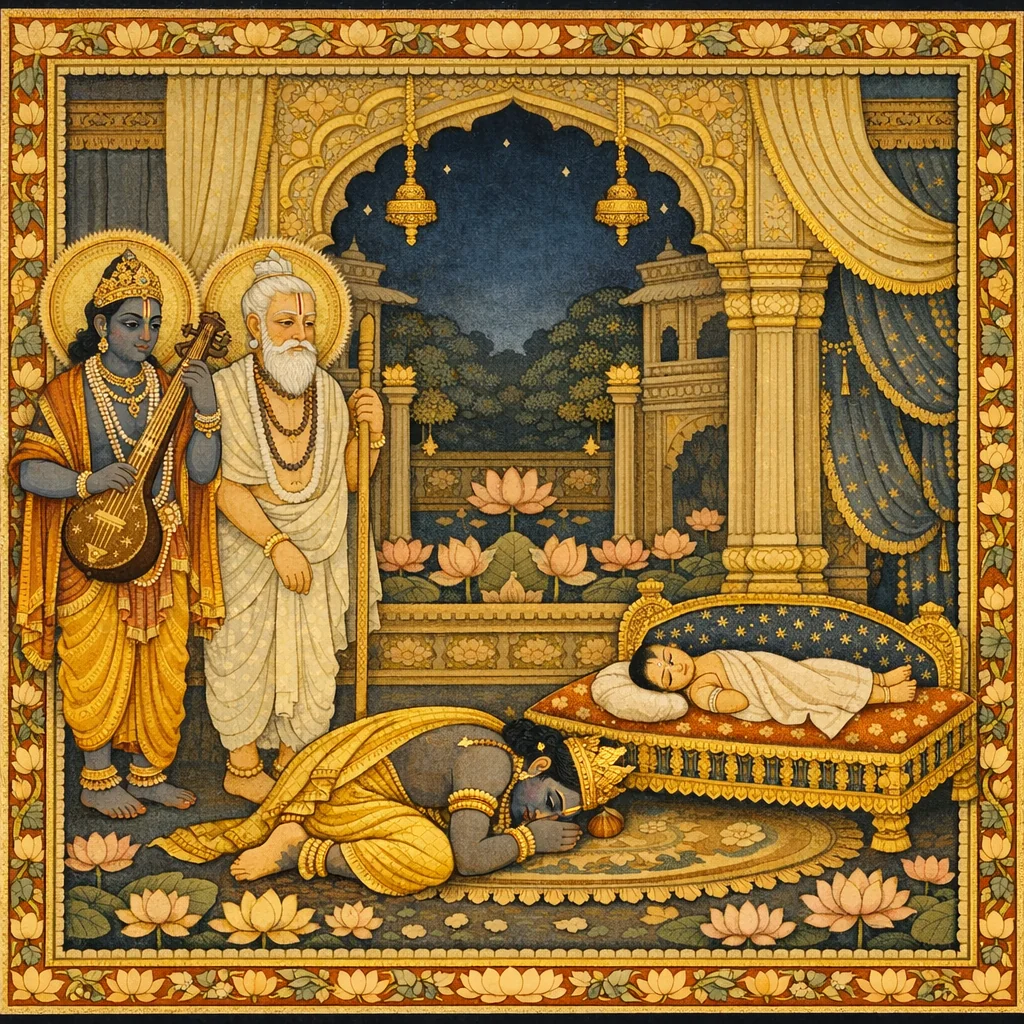
After Citraketu attains kingship and then falls into grief at his son’s death, the chapter opens with the king collapsed beside the child’s body. Nārada and Aṅgirā challenge the logic of lamentation by questioning whether the “father–son” identity is truly real and continuous across time, comparing embodied ties to the momentary meeting of sand-grains driven by waves and to seeds that bear fruit only under conditions. They affirm the world’s impermanence—real yet not eternal—and explain how Bhagavān governs creation, maintenance, and destruction through secondary agents, exposing the false ego’s claim to doership. Awakened, Citraketu recognizes the sages as avadhūta-like Vaiṣṇavas and begs for knowledge; Aṅgirā reveals who he is and reframes the earlier gift of a son as a concession to the king’s former material absorption. The sages further portray household and royal opulence as dreamlike, like a gandharva-nagara, breeding fear and distress, and urge inquiry into ātma-tattva beyond body and mind and the threefold miseries. The chapter then turns toward what follows: Nārada promises a powerful mantra by which Citraketu will gain direct darśana of the Lord within seven nights, preparing his devotional ascent and the canto’s unfolding of poṣaṇa through bhakti.
Shlokas
Verse 1
श्रीशुक उवाच ऊचतुर्मृतकोपान्ते पतितं मृतकोपमम् । शोकाभिभूतं राजानं बोधयन्तौ सदुक्तिभि: ॥ १ ॥
Śrī Śukadeva Gosvāmī said: As King Citraketu, overwhelmed by grief, lay like a corpse beside the corpse of his son, the great sages Nārada and Aṅgirā awakened him with noble words on spiritual consciousness.
Verse 2
कोऽयं स्यात्तव राजेन्द्र भवान् यमनुशोचति । त्वं चास्य कतम: सृष्टौ पुरेदानीमत: परम् ॥ २ ॥
O King, what relation does the body you lament have with you, and what relation do you have with him? You may say “father and son” now, but did this bond exist before, does it truly exist now, and will it endure in the future?
Verse 3
यथा प्रयान्ति संयान्ति स्रोतोवेगेन बालुका: । संयुज्यन्ते वियुज्यन्ते तथा कालेन देहिन: ॥ ३ ॥
O King, just as grains of sand are sometimes brought together and sometimes scattered by the force of the waves, so embodied beings are sometimes united and sometimes separated by the power of time.
Verse 4
यथा धानासु वै धाना भवन्ति न भवन्ति च । एवं भूतानि भूतेषु चोदितानीशमायया ॥ ४ ॥
As seeds sown in the earth sometimes sprout and sometimes do not, so too, impelled by the Lord’s māyā, conception sometimes succeeds and sometimes fails. Therefore do not lament over the temporary bond of parenthood, for all is governed by the Supreme Lord.
Verse 5
वयं च त्वं च ये चेमे तुल्यकालाश्चराचरा: । जन्ममृत्योर्यथा पश्चात् प्राङ्नैवमधुनापि भो: ॥ ५ ॥
O King, you and we—your advisers, queens, and ministers—along with all moving and unmoving beings in the cosmos at this time, stand in a temporary condition. Before birth it was not so, and after death it will not be so; thus the present is transient, though not unreal.
Verse 6
भूतैर्भूतानि भूतेश: सृजत्यवति हन्ति च । आत्मसृष्टैरस्वतन्त्रैरनपेक्षोऽपि बालवत् ॥ ६ ॥
The Bhūteśa, the Supreme Lord and master of all, brings about creation, maintenance, and destruction through living agents. Though He is unattached to this temporary manifestation, like a child playing on the shore He keeps all under His control and unfolds it as līlā. He employs a father for begetting, a king or government for protection, and agents such as serpents for destruction; these agents have no independent power, yet under māyā the soul imagines himself the doer.
Verse 7
देहेन देहिनो राजन् देहाद्देहोऽभिजायते । बीजादेव यथा बीजं देह्यर्थ इव शाश्वत: ॥ ७ ॥
O King, just as one seed gives rise to another seed, so from one body (the father), through another body (the mother), a third body (the son) is produced. The bodily elements continue in their stream, and the dehī—the jīva who appears through those elements—is also eternal.
Verse 8
देहदेहिविभागोऽयमविवेककृत: पुरा । जातिव्यक्तिविभागोऽयं यथा वस्तुनि कल्पित: ॥ ८ ॥
This division of “body” and “the embodied self (dehī),” and the classifications of nationality and individuality, are merely the imaginings of those not advanced in knowledge—like imposing distinctions of name and form upon one reality.
Verse 9
श्रीशुक उवाच एवमाश्वासितो राजा चित्रकेतुर्द्विजोक्तिभि: । विमृज्य पाणिना वक्त्रमाधिम्लानमभाषत ॥ ९ ॥
Śrī Śukadeva Gosvāmī continued: Thus consoled by the words of the brāhmaṇas Nārada and Aṅgirā, King Citraketu became hopeful through true knowledge. Wiping his withered face with his hand, he began to speak.
Verse 10
श्रीराजोवाच कौ युवां ज्ञानसम्पन्नौ महिष्ठौ च महीयसाम् । अवधूतेन वेषेण गूढाविह समागतौ ॥ १० ॥
King Citraketu said: You two are endowed with perfect knowledge, and among the great you are the greatest. Yet you have come here in the guise of avadhūtas, concealing your identities.
Verse 11
चरन्ति ह्यवनौ कामं ब्राह्मणा भगवत्प्रिया: । मादृशां ग्राम्यबुद्धीनां बोधायोन्मत्तलिङ्गिन: ॥ ११ ॥
Brāhmaṇas who are dear to Bhagavān—exalted Vaiṣṇavas devoted to Kṛṣṇa—wander the earth as they wish, sometimes even in the guise of madmen. They do so to awaken people like us, bound to sense pleasure, and to dispel our ignorance.
Verse 12
कुमारो नारद ऋभुरङ्गिरा देवलोऽसित: । अपान्तरतमा व्यासो मार्कण्डेयोऽथ गौतम: ॥ १२ ॥ वसिष्ठो भगवान् राम: कपिलो बादरायणि: । दुर्वासा याज्ञवल्क्यश्च जातुकर्णस्तथारुणि: ॥ १३ ॥ रोमशश्च्यवनो दत्त आसुरि: सपतञ्जलि: । ऋषिर्वेदशिरा धौम्यो मुनि: पञ्चशिखस्तथा ॥ १४ ॥ हिरण्यनाभ: कौशल्य: श्रुतदेव ऋतध्वज: । एते परे च सिद्धेशाश्चरन्ति ज्ञानहेतव: ॥ १५ ॥
O great souls, I have heard that many perfected siddhas wander the earth to awaken knowledge in those covered by ignorance—Sanat-kumāra, Nārada, Ṛbhu, Aṅgirā, Devala, Asita, Apāntaratamā (Vyāsa), Mārkaṇḍeya, Gautama, Vasiṣṭha, Bhagavān Paraśurāma, Kapila, Śukadeva, Durvāsā, Yājñavalkya, Jātukarṇa, and Aruṇi; as well as Romaśa, Cyavana, Dattātreya, Āsuri, Patañjali, the sage Dhaumya famed as the head of the Vedas, the sage Pañcaśikha, Hiraṇyanābha, Kauśalya, Śrutadeva, and Ṛtadhvaja, and others besides. You two must surely be among them.
Verse 13
कुमारो नारद ऋभुरङ्गिरा देवलोऽसित: । अपान्तरतमा व्यासो मार्कण्डेयोऽथ गौतम: ॥ १२ ॥ वसिष्ठो भगवान् राम: कपिलो बादरायणि: । दुर्वासा याज्ञवल्क्यश्च जातुकर्णस्तथारुणि: ॥ १३ ॥ रोमशश्च्यवनो दत्त आसुरि: सपतञ्जलि: । ऋषिर्वेदशिरा धौम्यो मुनि: पञ्चशिखस्तथा ॥ १४ ॥ हिरण्यनाभ: कौशल्य: श्रुतदेव ऋतध्वज: । एते परे च सिद्धेशाश्चरन्ति ज्ञानहेतव: ॥ १५ ॥
O great souls, I have heard that many perfected siddhas wander the earth to awaken knowledge in those covered by ignorance—Sanat-kumāra, Nārada, Ṛbhu, Aṅgirā, Devala, Asita, Apāntaratamā (Vyāsa), Mārkaṇḍeya, Gautama, Vasiṣṭha, Bhagavān Paraśurāma, Kapila, Śukadeva, Durvāsā, Yājñavalkya, Jātukarṇa, and Aruṇi; as well as Romaśa, Cyavana, Dattātreya, Āsuri, Patañjali, the sage Dhaumya famed as the head of the Vedas, the sage Pañcaśikha, Hiraṇyanābha, Kauśalya, Śrutadeva, and Ṛtadhvaja, and others besides. You two must surely be among them.
Verse 14
कुमारो नारद ऋभुरङ्गिरा देवलोऽसित: । अपान्तरतमा व्यासो मार्कण्डेयोऽथ गौतम: ॥ १२ ॥ वसिष्ठो भगवान् राम: कपिलो बादरायणि: । दुर्वासा याज्ञवल्क्यश्च जातुकर्णस्तथारुणि: ॥ १३ ॥ रोमशश्च्यवनो दत्त आसुरि: सपतञ्जलि: । ऋषिर्वेदशिरा धौम्यो मुनि: पञ्चशिखस्तथा ॥ १४ ॥ हिरण्यनाभ: कौशल्य: श्रुतदेव ऋतध्वज: । एते परे च सिद्धेशाश्चरन्ति ज्ञानहेतव: ॥ १५ ॥
O great souls, I have heard that among the perfected siddhas who wander the earth to awaken knowledge in those covered by ignorance are Sanat-kumāra, Nārada, Ṛbhu, Aṅgirā, Devala, Asita, Apāntaratamā (Vyāsadeva), Mārkaṇḍeya, Gautama, Vasiṣṭha, Bhagavān Paraśurāma, Kapila, Śukadeva, Durvāsā, Yājñavalkya, Jātukarṇa, and Aruṇi. Others are Romaśa, Cyavana, Dattātreya, Āsuri, Patañjali, the great sage Dhaumya—like the very head of the Vedas—along with the sage Pañcaśikha, Hiraṇyanābha, Kauśalya, Śrutadeva, and Ṛtadhvaja. Surely you too are among them.
Verse 15
कुमारो नारद ऋभुरङ्गिरा देवलोऽसित: । अपान्तरतमा व्यासो मार्कण्डेयोऽथ गौतम: ॥ १२ ॥ वसिष्ठो भगवान् राम: कपिलो बादरायणि: । दुर्वासा याज्ञवल्क्यश्च जातुकर्णस्तथारुणि: ॥ १३ ॥ रोमशश्च्यवनो दत्त आसुरि: सपतञ्जलि: । ऋषिर्वेदशिरा धौम्यो मुनि: पञ्चशिखस्तथा ॥ १४ ॥ हिरण्यनाभ: कौशल्य: श्रुतदेव ऋतध्वज: । एते परे च सिद्धेशाश्चरन्ति ज्ञानहेतव: ॥ १५ ॥
O great souls, I have heard that among the perfected siddhas who wander the earth to awaken knowledge in those covered by ignorance are Sanat-kumāra, Nārada, Ṛbhu, Aṅgirā, Devala, Asita, Apāntaratamā (Vyāsadeva), Mārkaṇḍeya, Gautama, Vasiṣṭha, Bhagavān Paraśurāma, Kapila, Śukadeva, Durvāsā, Yājñavalkya, Jātukarṇa, and Aruṇi. Others are Romaśa, Cyavana, Dattātreya, Āsuri, Patañjali, the great sage Dhaumya, the sage Pañcaśikha, Hiraṇyanābha, Kauśalya, Śrutadeva, and Ṛtadhvaja. Surely you too are among them.
Verse 16
तस्माद्युवां ग्राम्यपशोर्मम मूढधिय: प्रभू । अन्धे तमसि मग्नस्य ज्ञानदीप उदीर्यताम् ॥ १६ ॥
Therefore, O masters, you both can grant me true knowledge. I am dull-witted like a village beast—like a pig or a dog—because I am sunk in the darkness of ignorance. Please kindle the torch of knowledge to deliver me.
Verse 17
श्रीअङ्गिरा उवाच अहं ते पुत्रकामस्य पुत्रदोऽस्म्यङ्गिरा नृप । एष ब्रह्मसुत: साक्षान्नारदो भगवानृषि: ॥ १७ ॥
Aṅgirā said: My dear King, when you longed for a son, I came to you. Indeed, I am that very ṛṣi Aṅgirā who granted you this son. And this sage is Bhagavān Nārada, the great seer, the direct son of Lord Brahmā.
Verse 18
इत्थं त्वां पुत्रशोकेन मग्नं तमसि दुस्तरे । अतदर्हमनुस्मृत्य महापुरुषगोचरम् ॥ १८ ॥ अनुग्रहाय भवत: प्राप्तावावामिह प्रभो । ब्रह्मण्यो भगवद्भक्तो नावासादितुमर्हसि ॥ १९ ॥
My dear King, you have sunk into an almost impassable darkness because of grief for your son. Remembering the truth known to great souls, we have both come here to show you mercy. You are devoted to the brāhmaṇas and a bhakta of Bhagavān; therefore it does not befit you to be absorbed in lamentation over a material loss. Those advanced in spiritual knowledge are not meant to be shaken by worldly gain and loss.
Verse 19
इत्थं त्वां पुत्रशोकेन मग्नं तमसि दुस्तरे । अतदर्हमनुस्मृत्य महापुरुषगोचरम् ॥ १८ ॥ अनुग्रहाय भवत: प्राप्तावावामिह प्रभो । ब्रह्मण्यो भगवद्भक्तो नावासादितुमर्हसि ॥ १९ ॥
O King, you are an advanced devotee of Bhagavān, the Supreme Person; it does not befit you to drown in grief over a material loss. We have both come to show you mercy and free you from this false lamentation born of the darkness of ignorance. As a bhakta who honors the brāhmaṇas, you should not sink into despondency.
Verse 20
तदैव ते परं ज्ञानं ददामि गृहमागत: । ज्ञात्वान्याभिनिवेशं ते पुत्रमेव ददाम्यहम् ॥ २० ॥
When I first came to your home, I could have bestowed the supreme transcendental knowledge; but seeing your mind absorbed in material attachment, I granted you only a son—who became the cause of both jubilation and lamentation.
Verse 21
अधुना पुत्रिणां तापो भवतैवानुभूयते । एवं दारा गृहा रायो विविधैश्वर्यसम्पद: ॥ २१ ॥ शब्दादयश्च विषयाश्चला राज्यविभूतय: । मही राज्यं बलं कोषो भृत्यामात्यसुहृज्जना: ॥ २२ ॥ सर्वेऽपि शूरसेनेमे शोकमोहभयार्तिदा: । गन्धर्वनगरप्रख्या: स्वप्नमायामनोरथा: ॥ २३ ॥
O King, you are now truly tasting the misery that comes with having sons and daughters. Wife, home, royal opulence, sense objects, and all varieties of prosperity are temporary; kingdom, military power, treasury, servants, ministers, friends, and relatives become causes of fear, illusion, lamentation, and distress. They are like a gandharva-nagara—an unreal palace imagined in the forest—no better than dreams, māyā, and the mind’s inventions.
Verse 22
अधुना पुत्रिणां तापो भवतैवानुभूयते । एवं दारा गृहा रायो विविधैश्वर्यसम्पद: ॥ २१ ॥ शब्दादयश्च विषयाश्चला राज्यविभूतय: । मही राज्यं बलं कोषो भृत्यामात्यसुहृज्जना: ॥ २२ ॥ सर्वेऽपि शूरसेनेमे शोकमोहभयार्तिदा: । गन्धर्वनगरप्रख्या: स्वप्नमायामनोरथा: ॥ २३ ॥
O King, you are now truly tasting the misery that comes with having sons and daughters. Wife, home, royal opulence, sense objects, and all varieties of prosperity are temporary; kingdom, military power, treasury, servants, ministers, friends, and relatives become causes of fear, illusion, lamentation, and distress. They are like a gandharva-nagara—an unreal palace imagined in the forest—no better than dreams, māyā, and the mind’s inventions.
Verse 23
अधुना पुत्रिणां तापो भवतैवानुभूयते । एवं दारा गृहा रायो विविधैश्वर्यसम्पद: ॥ २१ ॥ शब्दादयश्च विषयाश्चला राज्यविभूतय: । मही राज्यं बलं कोषो भृत्यामात्यसुहृज्जना: ॥ २२ ॥ सर्वेऽपि शूरसेनेमे शोकमोहभयार्तिदा: । गन्धर्वनगरप्रख्या: स्वप्नमायामनोरथा: ॥ २३ ॥
O King, you are now truly tasting the misery that comes with having sons and daughters. Wife, home, royal opulence, sense objects, and all varieties of prosperity are temporary; kingdom, military power, treasury, servants, ministers, friends, and relatives become causes of fear, illusion, lamentation, and distress. They are like a gandharva-nagara—an unreal palace imagined in the forest—no better than dreams, māyā, and the mind’s inventions.
Verse 24
दृश्यमाना विनार्थेन न दृश्यन्ते मनोभवा: । कर्मभिर्ध्यायतो नानाकर्माणि मनसोऽभवन् ॥ २४ ॥
Wife, children, and property—though seen—are like a dream and the mind’s own fabrications; they have no lasting existence. By the force of past karma, many notions arise within the mind, and from those notions further actions are performed.
Verse 25
अयं हि देहिनो देहो द्रव्यज्ञानक्रियात्मक: । देहिनो विविधक्लेशसन्तापकृदुदाहृत: ॥ २५ ॥
This body of the embodied jīva is a compound of material elements, the senses of knowledge, the senses of action, and the mind. Through the mind the jīva suffers the threefold miseries—adhibhautika, adhidaivika, and adhyātmika; therefore the body is called the source of all sorrow.
Verse 26
तस्मात् स्वस्थेन मनसा विमृश्य गतिमात्मन: । द्वैते ध्रुवार्थविश्रम्भं त्यजोपशममाविश ॥ २६ ॥
Therefore, with a steady and peaceful mind, reflect upon the course of the ātman—whether you are body, mind, or soul; whence you have come, whither you go after leaving this body, and why you are ruled by material lamentation. Knowing your true position, abandon needless attachment and the belief that worldly duality is eternal, and thus attain peace.
Verse 27
श्रीनारद उवाच एतां मन्त्रोपनिषदं प्रतीच्छ प्रयतो मम । यां धारयन् सप्तरात्राद् द्रष्टा सङ्कर्षणं विभुम् ॥ २७ ॥
The great sage Nārada said: “O King, receive from me with full attention this most auspicious mantra-upaniṣad. By holding it within your heart and practice, within seven nights you will behold the all-powerful Lord Saṅkarṣaṇa face to face.”
Verse 28
यत्पादमूलमुपसृत्य नरेन्द्र पूर्वे शर्वादयो भ्रममिमं द्वितयं विसृज्य । सद्यस्तदीयमतुलानधिकं महित्वं प्रापुर्भवानपि परं न चिरादुपैति ॥ २८ ॥
My dear King, in former times Lord Śiva and other devas took shelter at the lotus feet of Saṅkarṣaṇa; casting off the delusion of duality, they at once attained unequaled and unsurpassed spiritual glory. You too will very soon reach that same supreme state.
Frequently Asked Questions
They are not denying affection; they are dismantling the metaphysical error that the self is defined by temporary bodily roles. By asking whether the relationship existed before birth or will persist after death, they redirect Citraketu from social identity (upādhi) to the eternal ātmā, thereby curing grief rooted in misidentification.
The analogy frames embodied association as a time-driven convergence and divergence rather than an ultimate union. Just as waves gather and disperse grains without personal intention, kāla brings jīvas together in families and then separates them, showing that lamentation cannot alter the law-like movement of time.
Citraketu describes exalted Vaiṣṇavas who sometimes conceal their stature by unconventional dress or behavior. Their apparent eccentricity protects them from worldly honor and allows them to move freely to enlighten conditioned souls; the emphasis is that true knowledge is measured by realization, not social presentation.
Gandharva-nagara refers to an illusory ‘city in the sky’—something perceived yet lacking enduring substance. The sages use it to show that worldly securities (kingdom, treasury, relatives) appear solid but are unstable and therefore become sources of fear, lamentation, and delusion when treated as permanent.
The analysis of impermanence clears the ground by reducing attachment and false identity; mantra-upadeśa then provides the positive spiritual method to anchor consciousness in Bhagavān. The promised darśana within seven nights illustrates poṣaṇa: when devotion is properly directed, the Lord reciprocates tangibly, transforming grief into realization.