Adhyaya 1
Prāyaścitta, the ‘Elephant Bath’ Problem, and the Opening of Ajāmila-Upākhyāna
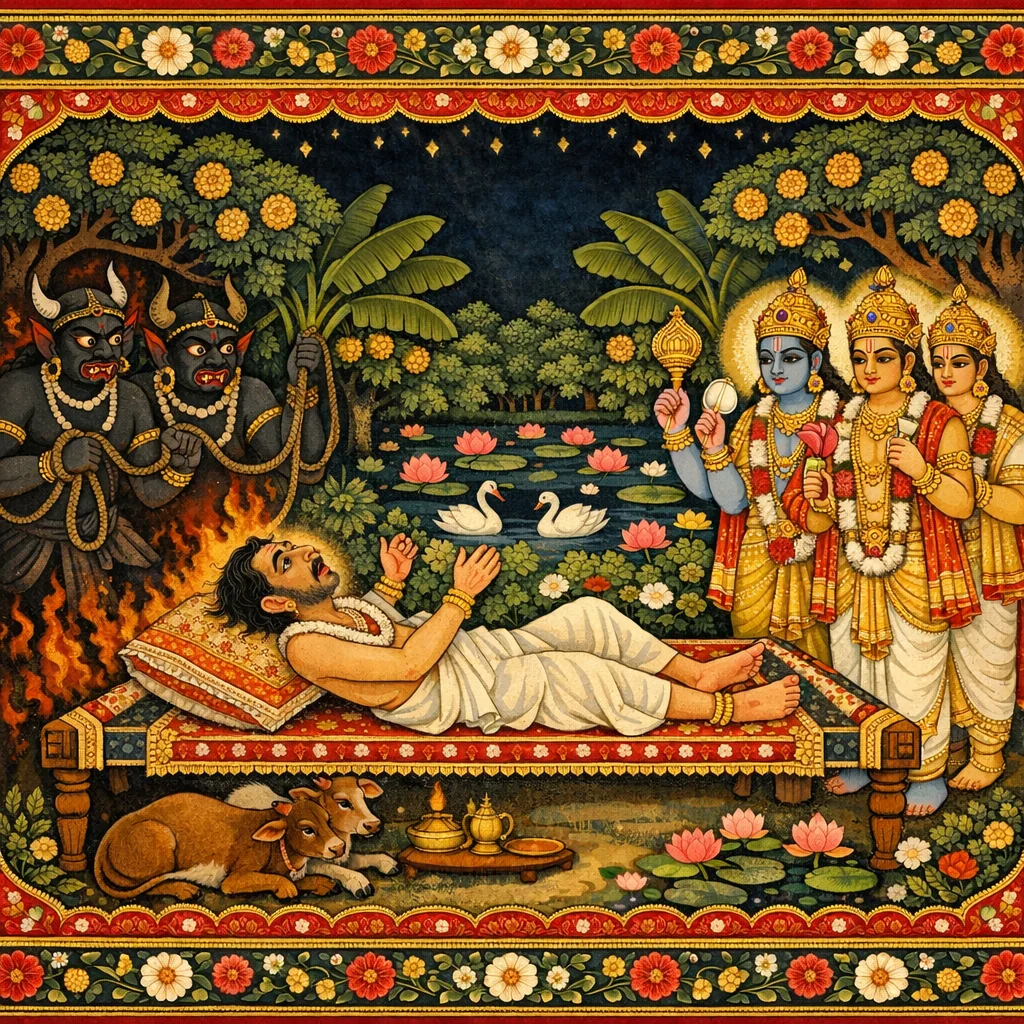
King Parīkṣit reviews Śukadeva’s earlier teachings on nivṛtti-mārga and pravṛtti-mārga, the manvantara histories, and the hellish destinations, then asks a practical question: how can people be saved from naraka? Śukadeva first replies in the style of dharma-śāstra: sinful acts must be countered before death by prescribed prāyaścitta, proportionate to the offense, like medical treatment. Parīkṣit raises a decisive objection—people knowingly sin again after atonement—so such prāyaścitta is like the “elephant bath,” washing only to soil oneself again. Śukadeva agrees, saying fruitive atonement cannot uproot the underlying tendency (vāsanā); true atonement is enlightenment that culminates in bhakti. He distinguishes temporary purification through disciplines (brahmacarya, self-control, charity, truthfulness, cleanliness, nonviolence, and nāma-kīrtana) from the complete eradication achieved by pure, unalloyed devotion. The chapter then turns to Ajāmila: a learned brāhmaṇa falls through lust and bad association, lives sinfully, and at death cries “Nārāyaṇa,” bringing the Viṣṇudūtas who stop the Yamadūtas—setting the stage for the next chapter’s debate on dharma, sin, and the holy name.
Shlokas
Verse 1
श्रीपरीक्षिदुवाच निवृत्तिमार्ग: कथित आदौ भगवता यथा । क्रमयोगोपलब्धेन ब्रह्मणा यदसंसृति: ॥ १ ॥
Mahārāja Parīkṣit said: O my lord Śukadeva Gosvāmī, you have already spoken of the path of liberation, nivṛtti-mārga. By that gradual yoga one attains Brahmaloka and, together with Lord Brahmā, is led to the supreme spiritual abode; thus the cycle of birth and death comes to an end.
Verse 2
प्रवृत्तिलक्षणश्चैव त्रैगुण्यविषयो मुने । योऽसावलीनप्रकृतेर्गुणसर्ग: पुन: पुन: ॥ २ ॥
O sage, the pravṛtti-mārga is characterized by involvement with the three modes of nature. So long as the living being remains absorbed in material prakṛti, the creation of bodies by the guṇas occurs again and again; he accepts various bodies to enjoy or suffer and, following their inclinations, travels the path of pravṛtti.
Verse 3
अधर्मलक्षणा नाना नरकाश्चानुवर्णिता: । मन्वन्तरश्च व्याख्यात आद्य: स्वायम्भुवो यत: ॥ ३ ॥
You have also described the many hellish conditions that arise from irreligious acts (adharma), and you have explained the first manvantara, presided over by Svāyambhuva Manu, the son of Lord Brahmā.
Verse 4
प्रियव्रतोत्तानपदोर्वंशस्तच्चरितानि च । द्वीपवर्षसमुद्राद्रिनद्युद्यानवनस्पतीन् ॥ ४ ॥ धरामण्डलसंस्थानं भागलक्षणमानत: । ज्योतिषां विवराणां च यथेदमसृजद्विभु: ॥ ५ ॥
My dear lord, you have described the dynasties and deeds of King Priyavrata and King Uttānapāda. The Supreme Lord (Bhagavān) created the islands and regions, seas and oceans, mountains, rivers, gardens, and trees; the arrangement of the earthly sphere with its divisions and measures; the luminaries of the heavens and the lower worlds—everything you have explained clearly, just as the Almighty fashioned it.
Verse 5
प्रियव्रतोत्तानपदोर्वंशस्तच्चरितानि च । द्वीपवर्षसमुद्राद्रिनद्युद्यानवनस्पतीन् ॥ ४ ॥ धरामण्डलसंस्थानं भागलक्षणमानत: । ज्योतिषां विवराणां च यथेदमसृजद्विभु: ॥ ५ ॥
My dear lord, you have described the dynasties and deeds of King Priyavrata and King Uttānapāda. The Supreme Lord (Bhagavān) created the islands and regions, seas and oceans, mountains, rivers, gardens, and trees; the arrangement of the earthly sphere with its divisions and measures; the luminaries of the heavens and the lower worlds—everything you have explained clearly, just as the Almighty fashioned it.
Verse 6
अधुनेह महाभाग यथैव नरकान्नर: । नानोग्रयातनान्नेयात्तन्मे व्याख्यातुमर्हसि ॥ ६ ॥
O greatly fortunate Śukadeva Gosvāmī, please explain how human beings may be saved from entering hellish conditions of terrible suffering.
Verse 7
श्रीशुक उवाच न चेदिहैवापचितिं यथांहस: कृतस्य कुर्यान्मनउक्तपाणिभि: । ध्रुवं स वै प्रेत्य नरकानुपैति ये कीर्तिता मे भवतस्तिग्मयातना: ॥ ७ ॥
Śukadeva Gosvāmī replied: O King, if in this very life one does not atone according to śāstra for sins committed by mind, speech, and body, then after death one certainly goes to the hellish worlds and suffers the terrible torments I have already described.
Verse 8
तस्मात्पुरैवाश्विह पापनिष्कृतौ यतेत मृत्योरविपद्यतात्मना । दोषस्य दृष्ट्वा गुरुलाघवं यथा भिषक् चिकित्सेत रुजां निदानवित् ॥ ८ ॥
Therefore, before death arrives—while the body is still capable—one should quickly undertake atonement as prescribed in śāstra. Just as a skilled physician treats a disease according to its severity, one should atone in proportion to the gravity of one’s sins.
Verse 9
श्रीराजोवाच दृष्टश्रुताभ्यां यत्पापं जानन्नप्यात्मनोऽहितम् । करोति भूयो विवश: प्रायश्चित्तमथो कथम् ॥ ९ ॥
Mahārāja Parīkṣit said: Though one knows by seeing and hearing that sin is harmful, one is still compelled to sin again and again. Even after atonement, why does one fall back into sin? What value, then, is such atonement?
Verse 10
क्वचिन्निवर्ततेऽभद्रात्क्वचिच्चरति तत्पुन: । प्रायश्चित्तमथोऽपार्थं मन्ये कुञ्जरशौचवत् ॥ १० ॥
Sometimes one turns away from sin, and sometimes one commits it again. Therefore I deem this repeated sinning and atoning to be useless—like an elephant’s bath: it washes thoroughly, yet as soon as it comes onto land it throws dust upon itself again.
Verse 11
श्रीबादरायणिरुवाच कर्मणा कर्मनिर्हारो न ह्यात्यन्तिक इष्यते । अविद्वदधिकारित्वात्प्रायश्चित्तं विमर्शनम् ॥ ११ ॥
Śrī Śuka said: O King, karma cannot be finally destroyed by another karma, for such atonement is itself fruitive action. Out of ignorance people cling to expiatory rules; true atonement is enlightenment through Vedānta-knowledge, by which one realizes the Supreme Absolute Truth.
Verse 12
नाश्नत: पथ्यमेवान्नं व्याधयोऽभिभवन्ति हि । एवं नियमकृद्राजन् शनै: क्षेमाय कल्पते ॥ १२ ॥
O King, just as a sick man who eats the pure diet prescribed by a physician is gradually cured and no longer touched by infection, so one who follows the regulative principles of knowledge steadily advances toward liberation from material contamination.
Verse 13
तपसा ब्रह्मचर्येण शमेन च दमेन च । त्यागेन सत्यशौचाभ्यां यमेन नियमेन वा ॥ १३ ॥ देहवाग्बुद्धिजं धीरा धर्मज्ञा: श्रद्धयान्विता: । क्षिपन्त्यघं महदपि वेणुगुल्ममिवानल: ॥ १४ ॥
By austerity, brahmacarya, tranquility and sense control, renunciation, truthfulness and purity, and by yama and niyama, a sober, faithful knower of dharma casts off even great sins done by body, speech, and mind—like fire burning the dried creepers beneath a bamboo grove.
Verse 14
तपसा ब्रह्मचर्येण शमेन च दमेन च । त्यागेन सत्यशौचाभ्यां यमेन नियमेन वा ॥ १३ ॥ देहवाग्बुद्धिजं धीरा धर्मज्ञा: श्रद्धयान्विता: । क्षिपन्त्यघं महदपि वेणुगुल्ममिवानल: ॥ १४ ॥
By austerity, brahmacarya, shama-dama, renunciation, truth and purity, and by yama and niyama, the faithful knower of dharma removes the sins of body, speech, and mind—like fire consuming the dried creepers beneath a bamboo grove.
Verse 15
केचित्केवलया भक्त्या वासुदेवपरायणा: । अघं धुन्वन्ति कार्त्स्न्येन नीहारमिव भास्कर: ॥ १५ ॥
Only a rare soul, wholly surrendered to Vāsudeva through pure, unalloyed bhakti, can uproot sin completely—just as the sun at once disperses fog by its rays.
Verse 16
न तथा ह्यघवान् राजन्पूयेत तपआदिभि: । यथा कृष्णार्पितप्राणस्तत्पुरुषनिषेवया ॥ १६ ॥
O King, a sinner is not purified so much by austerity, penance, brahmacarya and other atonements, as by serving a true devotee and offering one’s very life to the lotus feet of Śrī Kṛṣṇa.
Verse 17
सध्रीचीनो ह्ययं लोके पन्था: क्षेमोऽकुतोभय: । सुशीला: साधवो यत्र नारायणपरायणा: ॥ १७ ॥
In this world, the path trodden by pure devotees—well-behaved sādhus wholly devoted to Nārāyaṇa—is the most auspicious, safe, and free from fear; it is the path sanctioned by the śāstras.
Verse 18
प्रायश्चित्तानि चीर्णानि नारायणपराङ्मुखम् । न निष्पुनन्ति राजेन्द्र सुराकुम्भमिवापगा: ॥ १८ ॥
O King, atonements, though performed expertly, do not purify one who has turned away from Nārāyaṇa—just as a pot filled with liquor is not cleansed even when washed in the waters of many rivers.
Verse 19
सकृन्मन: कृष्णपदारविन्दयो- र्निवेशितं तद्गुणरागि यैरिह । न ते यमं पाशभृतश्च तद्भटान् स्वप्नेऽपि पश्यन्ति हि चीर्णनिष्कृता: ॥ १९ ॥
Even without fully realizing Kṛṣṇa, those who have even once wholly surrendered their hearts to His lotus feet and grown attached to His name, form, qualities, and līlās are freed from all sinful reactions—this is true atonement; such surrendered souls do not see Yamarāja or his rope-bearing servants even in dreams.
Verse 20
अत्र चोदाहरन्तीममितिहासं पुरातनम् । दूतानां विष्णुयमयो: संवादस्तं निबोध मे ॥ २० ॥
In this matter, learned sages cite an ancient historical account: hear from me the dialogue between the messengers of Lord Viṣṇu and the messengers of Yamarāja.
Verse 21
कान्यकुब्जे द्विज: कश्चिद्दासीपतिरजामिल: । नाम्ना नष्टसदाचारो दास्या: संसर्गदूषित: ॥ २१ ॥
In the city of Kānyakubja there lived a brāhmaṇa named Ajāmila, who took a prostitute maidservant as his wife. Defiled by that low association, he lost his good conduct and his brahminical virtues.
Verse 22
बन्द्यक्षै: कैतवैश्चौर्यैर्गर्हितां वृत्तिमास्थित: । बिभ्रत्कुटुम्बमशुचिर्यातयामास देहिन: ॥ २२ ॥
That fallen brāhmaṇa Ajāmila adopted a condemned livelihood—arresting people, cheating in gambling, and stealing and plundering. Unclean in conduct, he tormented other beings to maintain his wife and children.
Verse 23
एवं निवसतस्तस्य लालयानस्य तत्सुतान् । कालोऽत्यगान्महान् राजन्नष्टाशीत्यायुष: समा: ॥ २३ ॥
O King, living in this way and doting upon his sons, he spent his days in abominable, sinful deeds. Thus eighty-eight years of his life passed by.
Verse 24
तस्य प्रवयस: पुत्रा दश तेषां तु योऽवम: । बालो नारायणो नाम्ना पित्रोश्च दयितो भृशम् ॥ २४ ॥
That aged Ajāmila had ten sons, and the youngest was a baby named Nārāyaṇa. Being the youngest, he was naturally most dear to both father and mother.
Verse 25
स बद्धहृदयस्तस्मिन्नर्भके कलभाषिणि । निरीक्षमाणस्तल्लीलां मुमुदे जरठो भृशम् ॥ २५ ॥
Captivated by the child’s babbling speech and clumsy movements, Ajāmila’s heart became bound to him. The old man watched the boy’s playful līlās, cared for him, and rejoiced greatly.
Verse 26
भुञ्जान: प्रपिबन् खादन् बालकं स्नेहयन्त्रित: । भोजयन् पाययन् मूढो न वेदागतमन्तकम् ॥ २६ ॥
As Ajāmila chewed and ate, bound by affection he called the child to chew and eat; and when he drank, he called the child to drink as well. Ever absorbed in caring for the boy and repeatedly calling his name “Nārāyaṇa,” Ajāmila did not realize that his allotted time was spent and death had come upon him.
Verse 27
स एवं वर्तमानोऽज्ञो मृत्युकाल उपस्थिते । मतिं चकार तनये बाले नारायणाह्वये ॥ २७ ॥
Thus, absorbed in ignorance, when the time of death arrived, Ajāmila fixed his mind solely upon his young son, who was named Nārāyaṇa.
Verse 28
स पाशहस्तांस्त्रीन्दृष्ट्वा पुरुषानतिदारुणान् । वक्रतुण्डानूर्ध्वरोम्ण आत्मानं नेतुमागतान् ॥ २८ ॥ दूरे क्रीडनकासक्तं पुत्रं नारायणाह्वयम् । प्लावितेन स्वरेणोच्चैराजुहावाकुलेन्द्रिय: ॥ २९ ॥
Ajāmila then saw three exceedingly dreadful beings—faces twisted, hair standing on end, ropes in hand—who had come to drag him to the abode of Yamarāja. Bewildered at the sight, and attached to his son Nārāyaṇa who was playing a short distance away, he cried out loudly in a voice choked with tears; thus, somehow or other, the holy name “Nārāyaṇa” issued from his lips.
Verse 29
स पाशहस्तांस्त्रीन्दृष्ट्वा पुरुषानतिदारुणान् । वक्रतुण्डानूर्ध्वरोम्ण आत्मानं नेतुमागतान् ॥ २८ ॥ दूरे क्रीडनकासक्तं पुत्रं नारायणाह्वयम् । प्लावितेन स्वरेणोच्चैराजुहावाकुलेन्द्रिय: ॥ २९ ॥
Ajāmila saw three fearsome beings with ropes in their hands, twisted faces, and hair standing erect, come to take him to Yamarāja’s abode. Terrified and bewildered, attached to his son Nārāyaṇa playing nearby, he cried out loudly through tears—so that the holy name “Nārāyaṇa” slipped from his lips.
Verse 30
निशम्य म्रियमाणस्य मुखतो हरिकीर्तनम् । भर्तुर्नाम महाराज पार्षदा: सहसापतन् ॥ ३० ॥
O King, the moment they heard from the mouth of the dying Ajāmila the kīrtana of Hari—the holy name of their Lord—the attendants of Viṣṇu, the Viṣṇudūtas, rushed there at once.
Verse 31
विकर्षतोऽन्तर्हृदयाद्दासीपतिमजामिलम् । यमप्रेष्यान् विष्णुदूता वारयामासुरोजसा ॥ ३१ ॥
Yamarāja’s order carriers were dragging the soul of Ajāmila, the prostitute’s husband, from the core of his heart, but the Viṣṇudūtas, the messengers of Lord Viṣṇu, forbade them with resounding voices and power.
Verse 32
ऊचुर्निषेधितास्तांस्ते वैवस्वतपुर:सरा: । के यूयं प्रतिषेद्धारो धर्मराजस्य शासनम् ॥ ३२ ॥
Thus forbidden, the order carriers of Vaivasvata (Yamarāja) replied, “Sirs, who are you that dare to obstruct the command of Dharmarāja?”
Verse 33
कस्य वा कुत आयाता: कस्मादस्य निषेधथ । किं देवा उपदेवा या यूयं किं सिद्धसत्तमा: ॥ ३३ ॥
Whose servants are you, from where have you come, and why do you forbid us to touch Ajāmila? Are you gods, lesser divinities, or the most exalted among the siddhas?
Verse 34
सर्वे पद्मपलाशाक्षा: पीतकौशेयवासस: । किरीटिन: कुण्डलिनो लसत्पुष्करमालिन: ॥ ३४ ॥ सर्वे च नूत्नवयस: सर्वे चारुचतुर्भुजा: । धनुर्निषङ्गासिगदाशङ्खचक्राम्बुजश्रिय: ॥ ३५ ॥ दिशो वितिमिरालोका: कुर्वन्त: स्वेन तेजसा । किमर्थं धर्मपालस्य किङ्करान्नो निषेधथ ॥ ३६ ॥
The servants of Yama said: “Your eyes are like lotus petals; you wear yellow silk, crowns and earrings, and shining garlands of lotuses. All of you appear youthful, beautiful, and four-armed, bearing bow and quiver, sword, club, conch, disc, and lotus. Your radiance has dispelled the darkness in every direction—why, then, do you obstruct us, the servants of the protector of dharma?”
Verse 35
सर्वे पद्मपलाशाक्षा: पीतकौशेयवासस: । किरीटिन: कुण्डलिनो लसत्पुष्करमालिन: ॥ ३४ ॥ सर्वे च नूत्नवयस: सर्वे चारुचतुर्भुजा: । धनुर्निषङ्गासिगदाशङ्खचक्राम्बुजश्रिय: ॥ ३५ ॥ दिशो वितिमिरालोका: कुर्वन्त: स्वेन तेजसा । किमर्थं धर्मपालस्य किङ्करान्नो निषेधथ ॥ ३६ ॥
The servants of Yama said: “Your eyes are like lotus petals; you wear yellow silk, crowns and earrings, and shining garlands of lotuses. All of you appear youthful, beautiful, and four-armed, bearing bow and quiver, sword, club, conch, disc, and lotus. Your radiance has dispelled the darkness in every direction—why, then, do you obstruct us, the servants of the protector of dharma?”
Verse 36
सर्वे पद्मपलाशाक्षा: पीतकौशेयवासस: । किरीटिन: कुण्डलिनो लसत्पुष्करमालिन: ॥ ३४ ॥ सर्वे च नूत्नवयस: सर्वे चारुचतुर्भुजा: । धनुर्निषङ्गासिगदाशङ्खचक्राम्बुजश्रिय: ॥ ३५ ॥ दिशो वितिमिरालोका: कुर्वन्त: स्वेन तेजसा । किमर्थं धर्मपालस्य किङ्करान्नो निषेधथ ॥ ३६ ॥
The Yamadūtas said: Your eyes are like lotus petals. Clad in yellow silk, adorned with lotus garlands, wearing splendid helmets and earrings, you all appear youthful and fresh. Your four arms are beautified with bow and quiver, sword, club, conch, disc, and lotus. By your own effulgence you have driven away the darkness in every direction. Therefore, noble sirs, why do you obstruct us, the servants of Yamarāja, the protector of dharma?
Verse 37
श्रीशुक उवाच इत्युक्ते यमदूतैस्ते वासुदेवोक्तकारिण: । तान् प्रत्यूचु: प्रहस्येदं मेघनिर्ह्रादया गिरा ॥ ३७ ॥
Śukadeva Gosvāmī continued: Thus addressed by Yamarāja’s messengers, the servants who act by Vāsudeva’s command smiled and replied in voices deep as the rumbling of clouds.
Verse 38
श्रीविष्णुदूता ऊचु: यूयं वै धर्मराजस्य यदि निर्देशकारिण: । ब्रूत धर्मस्य नस्तत्त्वं यच्चाधर्मस्य लक्षणम् ॥ ३८ ॥
The Viṣṇudūtas said: If you are truly servants of Dharmarāja Yamarāja, acting by his order, then explain to us the true nature of dharma and the characteristics of adharma.
Verse 39
कथं स्विद् ध्रियते दण्ड: किं वास्य स्थानमीप्सितम् । दण्ड्या: किं कारिण: सर्वे आहो स्वित्कतिचिन्नृणाम् ॥ ३९ ॥
How is punishment administered, and what is its proper jurisdiction? Who are truly fit to be punished? Are all karmīs who act for fruitive gain punishable, or only certain persons?
Verse 40
यमदूता ऊचु: वेदप्रणिहितो धर्मो ह्यधर्मस्तद्विपर्यय: । वेदो नारायण: साक्षात्स्वयम्भूरिति शुश्रुम ॥ ४० ॥
The Yamadūtas replied: Dharma is that which is enjoined in the Vedas, and adharma is its opposite. We have heard from Yamarāja that the Vedas are directly Nārāyaṇa Himself, self-manifest (svayambhū).
Verse 41
येन स्वधाम्न्यमी भावा रज:सत्त्वतमोमया: । गुणनामक्रियारूपैर्विभाव्यन्ते यथातथम् ॥ ४१ ॥
Though Nārāyaṇa abides in His own divine abode, He governs the whole cosmos through the three guṇas—sattva, rajas, and tamas. Thus living beings receive differing qualities, names, duties, and forms; He alone is the cause of the universe.
Verse 42
सूर्योऽग्नि: खं मरुद्देव: सोम: सन्ध्याहनी दिश: । कं कु: स्वयं धर्म इति ह्येते दैह्यस्य साक्षिण: ॥ ४२ ॥
The sun, fire, sky, air, the devas, the moon, twilight, day, night, the directions, water, earth, and the Paramātmā Himself all bear witness to the living being’s deeds.
Verse 43
एतैरधर्मो विज्ञात: स्थानं दण्डस्य युज्यते । सर्वे कर्मानुरोधेन दण्डमर्हन्ति कारिण: ॥ ४३ ॥
When adharma is established by these witnesses, punishment is rightly assigned. All who act for karmic gain are fit to be punished according to their sinful deeds.
Verse 44
सम्भवन्ति हि भद्राणि विपरीतानि चानघा: । कारिणां गुणसङ्गोऽस्ति देहवान्न ह्यकर्मकृत् ॥ ४४ ॥
O residents of Vaikuṇṭha, you are sinless, yet in this material world all embodied beings are karmīs, whether their acts are pious or impious. Tainted by the three guṇas, they must act accordingly; one who has taken a body cannot remain inactive. Therefore all beings here are liable to punishment.
Verse 45
येन यावान्यथाधर्मो धर्मो वेह समीहित: । स एव तत्फलं भुङ्क्ते तथा तावदमुत्र वै ॥ ४५ ॥
To the extent and in the manner one performs dharma or adharma in this life, one must, in the next, enjoy or suffer the corresponding fruits of karma.
Verse 46
यथेह देवप्रवरास्त्रैविध्यमुपलभ्यते । भूतेषु गुणवैचित्र्यात्तथान्यत्रानुमीयते ॥ ४६ ॥
O best of the demigods, here we perceive a threefold variety among beings, arising from the differing mixture of the three guṇas of nature: peaceful, restless, and deluded; happy, distressed, and mixed; or pious, impious, and semi‑pious. Thus we may infer that in the next life these three modes will act in the same way.
Verse 47
वर्तमानोऽन्ययो: कालो गुणाभिज्ञापको यथा । एवं जन्मान्ययोरेतद्धर्माधर्मनिदर्शनम् ॥ ४७ ॥
Just as the springtime we experience now indicates the character of springtimes past and future, so this present life—of happiness, distress, or a mixture—reveals the dharmic and adharmic deeds of one’s previous and forthcoming births.
Verse 48
मनसैव पुरे देव: पूर्वरूपं विपश्यति । अनुमीमांसतेऽपूर्वं मनसा भगवानज: ॥ ४८ ॥
The omnipotent Yamarāja is equal to Lord Brahmā: though situated in his own abode, he also dwells in everyone’s heart like Paramātmā, mentally beholding a jīva’s past deeds and thereby understanding how that soul will act in future births.
Verse 49
यथाज्ञस्तमसा युक्त उपास्ते व्यक्तमेव हि । न वेद पूर्वमपरं नष्टजन्मस्मृतिस्तथा ॥ ४९ ॥
As a sleeping person, bound by the darkness of ignorance, acts according to the body manifested in dreams and accepts it as the self, so the jīva—having lost memory of former births—identifies with the present body gained through past dharmic or adharmic deeds, and cannot know past or future lives.
Verse 50
पञ्चभि: कुरुते स्वार्थान् पञ्च वेदाथ पञ्चभि: । एकस्तु षोडशेन त्रीन् स्वयं सप्तदशोऽश्नुते ॥ ५० ॥
Above the five senses of perception, the five working senses, and the five sense-objects stands the mind (manas), the sixteenth element. Above the mind is the seventeenth element, the jīva, the living soul; he, in cooperation with the other sixteen, alone enjoys the material world in three conditions—happiness, distress, and a mixture of both.
Verse 51
तदेतत्षोडशकलं लिङ्गं शक्तित्रयं महत् । धत्तेऽनुसंसृतिं पुंसि हर्षशोकभयार्तिदाम् ॥ ५१ ॥
This subtle linga-body of sixteen parts, born of the three guṇas, bears the jīva along in saṁsṛti; by the force of desire it brings jubilation, lamentation, fear, and distress.
Verse 52
देह्यज्ञोऽजितषड्वर्गो नेच्छन्कर्माणि कार्यते । कोशकार इवात्मानं कर्मणाच्छाद्य मुह्यति ॥ ५२ ॥
The ignorant embodied being, unable to conquer the sixfold host (senses and mind), is made to act by the guṇas even against his will; like a silkworm, he covers himself with his own karma and becomes bewildered and trapped.
Verse 53
न हि कश्चित्क्षणमपि जातु तिष्ठत्यकर्मकृत् । कार्यते ह्यवश: कर्म गुणै: स्वाभाविकैर्बलात् ॥ ५३ ॥
No living being can remain inactive even for a moment; by the force of innate guṇas he is helplessly driven to act according to his nature.
Verse 54
लब्ध्वा निमित्तमव्यक्तं व्यक्ताव्यक्तं भवत्युत । यथायोनि यथाबीजं स्वभावेन बलीयसा ॥ ५४ ॥
When the unseen cause (avyakta) is obtained, the manifest and unmanifest take form; by a stronger svabhāva, according to seed and womb, the jīva is born accordingly, and gross and subtle bodies arise in harmony with his desire.
Verse 55
एष प्रकृतिसङ्गेन पुरुषस्य विपर्यय: । आसीत्स एव नचिरादीशसङ्गाद्विलीयते ॥ ५५ ॥
By association with material nature the jīva falls into this perverted condition; yet in human life, by learning to associate with the Supreme Lord or His devotee, that condition is soon dissolved.
Verse 56
अयं हि श्रुतसम्पन्न: शीलवृत्तगुणालय: । धृतव्रतो मृदुर्दान्त: सत्यवाङ्मन्त्रविच्छुचि: ॥ ५६ ॥ गुर्वग्न्यतिथिवृद्धानां शुश्रूषुरनहङ्कृत: । सर्वभूतसुहृत्साधुर्मितवागनसूयक: ॥ ५७ ॥
In the beginning, the brāhmaṇa named Ajāmila had studied all the Vedic scriptures. He was a reservoir of noble character, proper conduct, and virtues—firm in Vedic vows, gentle, self-controlled in mind and senses, truthful, skilled in chanting mantras, and exceedingly pure.
Verse 57
अयं हि श्रुतसम्पन्न: शीलवृत्तगुणालय: । धृतव्रतो मृदुर्दान्त: सत्यवाङ्मन्त्रविच्छुचि: ॥ ५६ ॥ गुर्वग्न्यतिथिवृद्धानां शुश्रूषुरनहङ्कृत: । सर्वभूतसुहृत्साधुर्मितवागनसूयक: ॥ ५७ ॥
He respectfully served his spiritual master, the fire-god, guests, and the elders of his household, free from false pride. Upright and saintly, he was a well-wisher of all beings, spoke with restraint, and envied no one.
Verse 58
एकदासौ वनं यात: पितृसन्देशकृद् द्विज: । आदाय तत आवृत्त: फलपुष्पसमित्कुशान् ॥ ५८ ॥ ददर्श कामिनं कञ्चिच्छूद्रं सह भुजिष्यया । पीत्वा च मधु मैरेयं मदाघूर्णितनेत्रया ॥ ५९ ॥ मत्तया विश्लथन्नीव्या व्यपेतं निरपत्रपम् । क्रीडन्तमनुगायन्तं हसन्तमनयान्तिके ॥ ६० ॥
Once, obeying his father’s order, the dvija went to the forest and gathered fruits, flowers, sacrificial kindling (samit), and kuśa grass, then set out to return.
Verse 59
एकदासौ वनं यात: पितृसन्देशकृद् द्विज: । आदाय तत आवृत्त: फलपुष्पसमित्कुशान् ॥ ५८ ॥ ददर्श कामिनं कञ्चिच्छूद्रं सह भुजिष्यया । पीत्वा च मधु मैरेयं मदाघूर्णितनेत्रया ॥ ५९ ॥ मत्तया विश्लथन्नीव्या व्यपेतं निरपत्रपम् । क्रीडन्तमनुगायन्तं हसन्तमनयान्तिके ॥ ६० ॥
On the way he saw a lust-driven śūdra with a prostitute; both had drunk honey-wine and strong liquor (maireya), and the woman’s eyes were rolling in intoxication.
Verse 60
एकदासौ वनं यात: पितृसन्देशकृद् द्विज: । आदाय तत आवृत्त: फलपुष्पसमित्कुशान् ॥ ५८ ॥ ददर्श कामिनं कञ्चिच्छूद्रं सह भुजिष्यया । पीत्वा च मधु मैरेयं मदाघूर्णितनेत्रया ॥ ५९ ॥ मत्तया विश्लथन्नीव्या व्यपेतं निरपत्रपम् । क्रीडन्तमनुगायन्तं हसन्तमनयान्तिके ॥ ६० ॥
The woman was drunk, her garments loosened and her shame cast off; and the śūdra beside her played, sang, and laughed, indulging without restraint. Ajāmila saw them in that very condition.
Verse 61
दृष्ट्वा तां कामलिप्तेन बाहुना परिरम्भिताम् । जगाम हृच्छयवशं सहसैव विमोहित: ॥ ६१ ॥
With an arm smeared with turmeric, the śūdra was embracing the prostitute. Seeing her, Ajāmila’s dormant lust awoke within his heart, and, bewildered by illusion, he at once fell under its sway.
Verse 62
स्तम्भयन्नात्मनात्मानं यावत्सत्त्वं यथाश्रुतम् । न शशाक समाधातुं मनो मदनवेपितम् ॥ ६२ ॥
As far as he could, he tried to steady himself by remembering the śāstric injunction not even to look upon a woman. Yet, shaken by Kāmadeva’s force within his heart, he could not compose and control his mind.
Verse 63
तन्निमित्तस्मरव्याजग्रहग्रस्तो विचेतन: । तामेव मनसा ध्यायन् स्वधर्माद्विरराम ह ॥ ६३ ॥
Thus he was seized by an “eclipse” of deceptive remembrance and lost all good sense, as the sun and moon are obscured. Meditating only on that prostitute, he soon turned away from his own svadharma.
Verse 64
तामेव तोषयामास पित्र्येणार्थेन यावता । ग्राम्यैर्मनोरमै: कामै: प्रसीदेत यथा तथा ॥ ६४ ॥
Ajāmila then began to spend all the wealth inherited from his father to gratify the prostitute. To keep her pleased, he offered many charming worldly enjoyments, abandoning the duties and conduct of a brāhmaṇa.
Verse 65
विप्रां स्वभार्यामप्रौढां कुले महति लम्भिताम् । विससर्जाचिरात्पाप: स्वैरिण्यापाङ्गविद्धधी: ॥ ६५ ॥
Pierced in his intelligence by the prostitute’s lustful glance, the brāhmaṇa Ajāmila—now her victim—fell into sinful acts in her company. Before long he even abandoned his very beautiful young wife, born in a highly respectable brāhmaṇa family.
Verse 66
यतस्ततश्चोपनिन्ये न्यायतोऽन्यायतो धनम् । बभारास्या: कुटुम्बिन्या: कुटुम्बं मन्दधीरयम् ॥ ६६ ॥
Though born in a brāhmaṇa family, he became dull-witted by the company of a prostitute. Somehow—rightly or wrongly—he amassed wealth and used it to maintain her household, along with her sons and daughters.
Verse 67
यदसौ शास्त्रमुल्लङ्घ्य स्वैरचार्यतिगर्हित: । अवर्तत चिरं कालमघायुरशुचिर्मलात् ॥ ६७ ॥
He brazenly transgressed the śāstric rules and for a long time lived in condemned, self-willed ways. Eating food cooked by a prostitute, he became steeped in sin—unclean, defiled, and addicted to forbidden acts.
Verse 68
तत एनं दण्डपाणे: सकाशं कृतकिल्बिषम् । नेष्यामोऽकृतनिर्वेशं यत्र दण्डेन शुद्ध्यति ॥ ६८ ॥
Since he performed no atonement, we must take this sinner to the presence of Yamarāja, the wielder of punishment. There, according to the measure of his misdeeds, he will be chastised and thus purified.
Frequently Asked Questions
Because mechanical atonement can remove the immediate ‘dirt’ of reactions but does not remove the underlying impulse to sin (the root desire). Like an elephant that bathes and then throws dust on itself, a person may perform expiation yet return to the same habits. The Bhāgavata’s critique is that without inner transformation—knowledge culminating in devotion—atonement remains within fruitive conditioning and cannot ensure lasting purity.
The chapter emphasizes the objective potency of the Lord’s name and the extraordinary mercy connected with nāma. Ajāmila’s utterance—though prompted by attachment—was a real chanting of the divine name at the critical moment of death, and the text states it was without offense due to his intense anxiety. This invocation brings him under Viṣṇu’s protection, interrupting karmic arrest and initiating the later doctrinal clarification: bhakti and surrender shift one’s jurisdiction beyond ordinary karmic punishment.
Yamadūtas are Yamarāja’s order carriers who seize sinful souls for judgment and punishment according to dharma/adharma. Viṣṇudūtas are Viṣṇu’s messengers who protect those connected to Viṣṇu-bhakti. Their conflict centers on authority and eligibility: whether a man with grave sins who has uttered the holy name is still punishable under karma, or exempt due to taking shelter of Nārāyaṇa—an issue developed through their debate on the definition of dharma and the scope of punishment.