Adhyaya 3
Hiraṇyakaśipu’s Austerities and Brahmā’s Boons (The Architecture of ‘Conditional Immortality’)
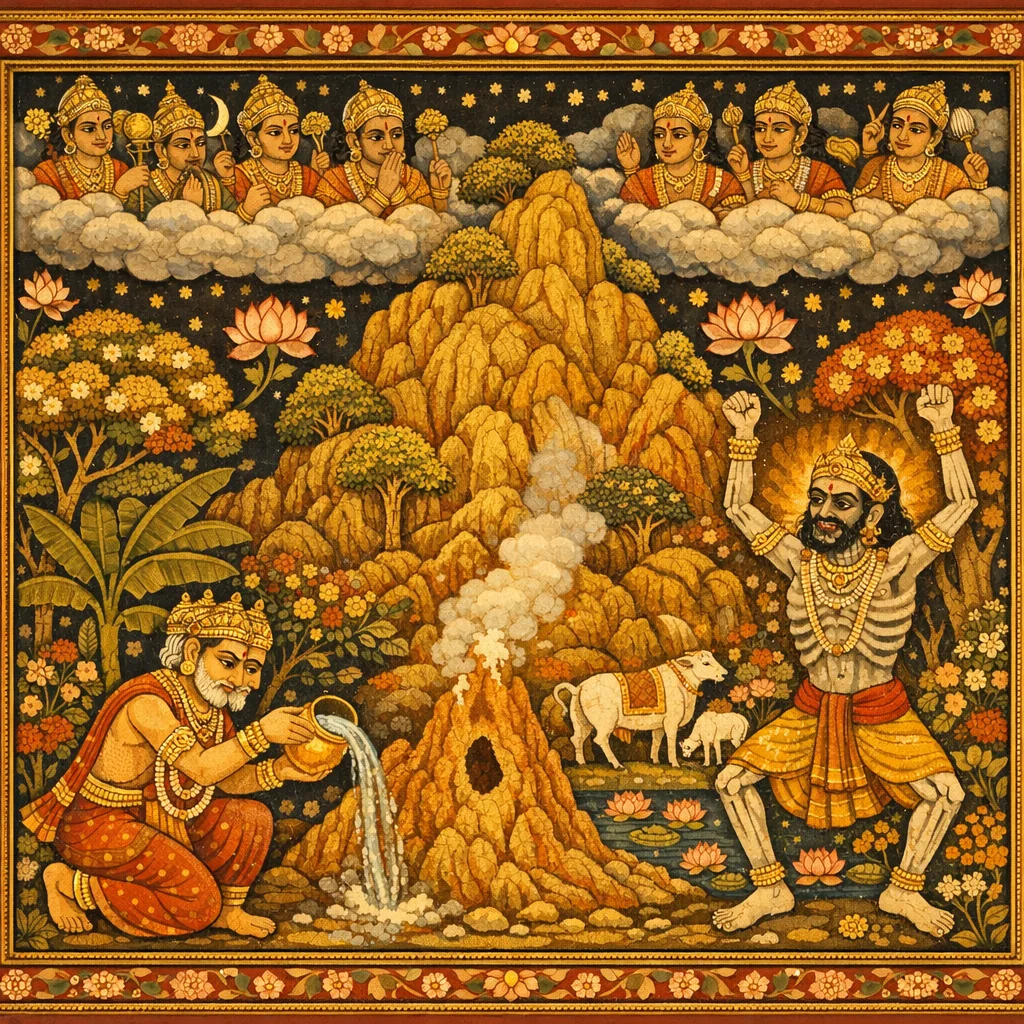
Nārada continues instructing Mahārāja Yudhiṣṭhira, describing how Hiraṇyakaśipu, burning to become unconquerable, performs terrifying tapas on Mandara Hill—standing on his toes with arms raised for a hundred celestial years. The heat and radiance of his austerity shake the cosmos: planets scorch, oceans churn, and the devas flee to Brahmā for relief. Brahmā, with sages, finds the asura encased in an anthill, revives him with water from the kamaṇḍalu, and grants a boon in admiration of his endurance. Hiraṇyakaśipu praises Brahmā as creator and controller of time, then cleverly asks for layered protections against death—negating conditions of place, time, killer, weapon, and even category of being—along with unrivaled sovereignty and yogic perfections. This chapter sets the tension for what follows: the asura’s near-impregnable boon will become the stage on which Bhagavān’s higher design is revealed, as the Lord later intervenes extraordinarily to protect Prahlāda while honoring Brahmā’s words.
Shlokas
Verse 1
श्रीनारद उवाच हिरण्यकशिपू राजन्नजेयमजरामरम् । आत्मानमप्रतिद्वन्द्वमेकराजं व्यधित्सत ॥ १ ॥
Nārada said: O King, Hiraṇyakaśipu desired to make himself unconquerable, free from old age and death, without any rival, and the sole monarch of the entire universe.
Verse 2
स तेपे मन्दरद्रोण्यां तप: परमदारुणम् । ऊर्ध्वबाहुर्नभोदृष्टि: पादाङ्गुष्ठाश्रितावनि: ॥ २ ॥
In the valley of Mandara Hill he performed exceedingly severe austerity—standing upon his toes, arms raised upward, and gaze fixed upon the sky.
Verse 3
जटादीधितिभी रेजे संवर्तार्क इवांशुभि: । तस्मिंस्तपस्तप्यमाने देवा: स्थानानि भेजिरे ॥ ३ ॥
From his matted hair there blazed an intolerable effulgence, like the sun’s rays at the time of cosmic dissolution. Seeing such terrible penance, the demigods returned to their own abodes.
Verse 4
तस्य मूर्ध्न: समुद्भूत: सधूमोऽग्निस्तपोमय: । तीर्यगूर्ध्वमधोलोकान् प्रातपद्विष्वगीरित: ॥ ४ ॥
By the force of his severe austerity, fire with smoke arose from his head and spread upward, downward, and in all directions, scorching the higher and lower worlds with intense heat.
Verse 5
चुक्षुभुर्नद्युदन्वन्त: सद्वीपाद्रिश्चचाल भू: । निपेतु: सग्रहास्तारा जज्वलुश्च दिशो दश ॥ ५ ॥
By the force of his terrible austerities, the rivers and oceans were thrown into turmoil; the earth, with its mountains and islands, began to tremble; stars and planets fell, and all ten directions blazed.
Verse 6
तेन तप्ता दिवं त्यक्त्वा ब्रह्मलोकं ययु: सुरा: । धात्रे विज्ञापयामासुर्देवदेव जगत्पते । दैत्येन्द्रतपसा तप्ता दिवि स्थातुं न शक्नुम: ॥ ६ ॥
Scorched and shaken by Hiraṇyakaśipu’s fierce penance, the demigods abandoned their abodes and went to Brahmaloka. There they appealed to the Creator: “O God of gods, Lord of the universe! The fire of austerity rising from his head burns us; we cannot remain in our worlds and have come to seek your shelter.”
Verse 7
तस्य चोपशमं भूमन् विधेहि यदि मन्यसे । लोका न यावन्नङ्क्ष्यन्ति बलिहारास्तवाभिभू: ॥ ७ ॥
O great one, if you deem it proper, please quell this ruinous disturbance before all the worlds—and your obedient subjects—are destroyed.
Verse 8
तस्यायं किल सङ्कल्पश्चरतो दुश्चरं तप: । श्रूयतां किं न विदितस्तवाथापि निवेदितम् ॥ ८ ॥
He has undertaken an exceedingly severe austerity—such is his resolve. Though his plan is not unknown to you, please hear as we submit his intentions.
Verse 9
सृष्ट्वा चराचरमिदं तपोयोगसमाधिना । अध्यास्ते सर्वधिष्ण्येभ्य: परमेष्ठी निजासनम् ॥ ९ ॥ तदहं वर्धमानेन तपोयोगसमाधिना । कालात्मनोश्च नित्यत्वात्साधयिष्ये तथात्मन: ॥ १० ॥
“By austerity, mystic yoga, and samādhi, Parameṣṭhī Brahmā created this universe of moving and nonmoving beings and then took his own throne above all abodes. Since time and the self are eternal, I too shall increase austerity, yoga, and trance through countless births, and thus attain the very post held by Brahmā.”
Verse 10
सृष्ट्वा चराचरमिदं तपोयोगसमाधिना । अध्यास्ते सर्वधिष्ण्येभ्य: परमेष्ठी निजासनम् ॥ ९ ॥ तदहं वर्धमानेन तपोयोगसमाधिना । कालात्मनोश्च नित्यत्वात्साधयिष्ये तथात्मन: ॥ १० ॥
By the power of severe austerity, yoga, and samādhi, Brahmā the Paramesthī created this moving and unmoving universe and then sat upon his own supreme seat, becoming the most worshipable within creation. Since time and the self are eternal, I too shall cultivate such austerity, mystic yoga, and trance through many births, and thus attain the very post held by Brahmā.
Verse 11
अन्यथेदं विधास्येऽहमयथा पूर्वमोजसा । किमन्यै: कालनिर्धूतै: कल्पान्ते वैष्णवादिभि: ॥ ११ ॥
By the might of my fierce austerity I shall arrange this world not as before, but otherwise, by my own power. I shall reverse the fruits of piety and sin and overturn the established ways of the world. At the end of the kalpa even Dhruvaloka is swept away by time—what use is it? I choose the post of Brahmā.
Verse 12
इति शुश्रुम निर्बन्धं तप: परममास्थित: । विधत्स्वानन्तरं युक्तं स्वयं त्रिभुवनेश्वर ॥ १२ ॥
O Lord, we have heard from trustworthy sources that Hiraṇyakaśipu has undertaken the most severe austerities to obtain your post. You are the master of the three worlds; therefore, without delay, take whatever action you deem fitting.
Verse 13
तवासनं द्विजगवां पारमेष्ठ्यं जगत्पते । भवाय श्रेयसे भूत्यै क्षेमाय विजयाय च ॥ १३ ॥
O Brahmā, Lord of the universe, your Paramesthī seat is truly auspicious for the welfare, merit, prosperity, security, and victory of all—especially for the brāhmaṇas and the cows. While you hold that post, brahminical culture and cow protection are glorified, and every kind of good fortune naturally increases; but if Hiraṇyakaśipu were to seize your throne, everything would be ruined.
Verse 14
इति विज्ञापितो देवैर्भगवानात्मभूर्नृप । परितो भृगुदक्षाद्यैर्ययौ दैत्येश्वराश्रमम् ॥ १४ ॥
O King, thus informed by the demigods, the supremely powerful Brahmā, the self-born Ātmabhū, accompanied by Bhṛgu, Dakṣa, and other great sages, at once set out for the asura-king’s hermitage where Hiraṇyakaśipu was performing his austerities.
Verse 15
न ददर्श प्रतिच्छन्नं वल्मीकतृणकीचकै: । पिपीलिकाभिराचीर्णं मेदस्त्वङ्मांसशोणितम् ॥ १५ ॥ तपन्तं तपसा लोकान् यथाभ्रापिहितं रविम् । विलक्ष्य विस्मित: प्राह हसंस्तं हंसवाहन: ॥ १६ ॥
Lord Brahmā, borne upon his swan-carrier and accompanied by the devas, at first could not discern Hiraṇyakaśipu, for his body was hidden beneath an anthill, grass, and bamboo splinters; by long austerity the ants had consumed his skin, fat, flesh, and blood. Then they beheld him like the sun veiled by clouds, heating the worlds by his tapas; Brahmā, struck with wonder, smiled and addressed him.
Verse 16
न ददर्श प्रतिच्छन्नं वल्मीकतृणकीचकै: । पिपीलिकाभिराचीर्णं मेदस्त्वङ्मांसशोणितम् ॥ १५ ॥ तपन्तं तपसा लोकान् यथाभ्रापिहितं रविम् । विलक्ष्य विस्मित: प्राह हसंस्तं हंसवाहन: ॥ १६ ॥
Lord Brahmā, borne upon his swan-carrier and accompanied by the devas, at first could not discern Hiraṇyakaśipu, for his body was hidden beneath an anthill, grass, and bamboo splinters; by long austerity the ants had consumed his skin, fat, flesh, and blood. Then they beheld him like the sun veiled by clouds, heating the worlds by his tapas; Brahmā, struck with wonder, smiled and addressed him.
Verse 17
श्रीब्रह्मोवाच उत्तिष्ठोत्तिष्ठ भद्रं ते तप:सिद्धोऽसि काश्यप । वरदोऽहमनुप्राप्तो व्रियतामीप्सितो वर: ॥ १७ ॥
Lord Brahmā said: “Rise, rise, O son of Kaśyapa; may auspiciousness be yours. You have attained perfection in austerity, and I have come as the giver of boons. Ask now the benediction you desire.”
Verse 18
अद्राक्षमहमेतं ते हृत्सारं महदद्भुतम् । दंशभक्षितदेहस्य प्राणा ह्यस्थिषु शेरते ॥ १८ ॥
I have beheld your astonishing endurance. Though worms and ants have bitten and consumed your body, your prāṇa—the life-breath—still abides and moves within your very bones. Truly, this is wondrous.
Verse 19
नैतत्पूर्वर्षयश्चक्रुर्न करिष्यन्ति चापरे । निरम्बुर्धारयेत्प्राणान् को वै दिव्यसमा: शतम् ॥ १९ ॥
Such severe austerity was not performed even by the sages of old, nor will anyone be able to do so hereafter. Who in the three worlds can sustain life without drinking even water for one hundred celestial years?
Verse 20
व्यवसायेन तेऽनेन दुष्करेण मनस्विनाम् । तपोनिष्ठेन भवता जितोऽहं दितिनन्दन ॥ २० ॥
O son of Diti, by your great resolve and severe austerity you have achieved what is difficult even for exalted sages; therefore you have certainly conquered me.
Verse 21
ततस्त आशिष: सर्वा ददाम्यसुरपुङ्गव । मर्तस्य ते ह्यमर्तस्य दर्शनं नाफलं मम ॥ २१ ॥
O best of the asuras, therefore I am ready to grant you all benedictions according to your desire. I belong to the immortal celestial realm; though you are mortal, your audience with me will not be in vain.
Verse 22
श्रीनारद उवाच इत्युक्त्वादिभवो देवो भक्षिताङ्गं पिपीलिकै: । कमण्डलुजलेनौक्षद्दिव्येनामोघराधसा ॥ २२ ॥
Śrī Nārada Muni continued: Having thus spoken, Lord Brahmā, the original being of the universe, whose power never fails, sprinkled divine spiritual water from his kamaṇḍalu upon Hiraṇyakaśipu’s body, which had been eaten away by ants and moths, and thus restored him to life.
Verse 23
स तत्कीचकवल्मीकात् सहओजोबलान्वित: । सर्वावयवसम्पन्नो वज्रसंहननो युवा । उत्थितस्तप्तहेमाभो विभावसुरिवैधस: ॥ २३ ॥
As soon as he was sprinkled with water from Brahmā’s waterpot, Hiraṇyakaśipu rose from the anthill, endowed with vigor and strength, his limbs restored and his body firm enough to bear a thunderbolt’s blow. Shining like molten gold, he emerged as a youthful man, like fire springing forth from fuel wood.
Verse 24
स निरीक्ष्याम्बरे देवं हंसवाहमुपस्थितम् । ननाम शिरसा भूमौ तद्दर्शनमहोत्सव: ॥ २४ ॥
Seeing Lord Brahmā present in the sky upon his swan carrier, Hiraṇyakaśipu was filled with great joy. Taking that darśana as a grand festival, he at once fell flat, placing his head upon the ground, and offered reverent obeisance.
Verse 25
उत्थाय प्राञ्जलि: प्रह्व ईक्षमाणो दृशा विभुम् । हर्षाश्रुपुलकोद्भेदो गिरा गद्गदयागृणात् ॥ २५ ॥
Then the leader of the Daityas rose from the ground, folded his hands, and gazed upon Lord Brahmā before him. Overwhelmed with joy—tears in his eyes, his body trembling with rapture—he began to pray humbly in a faltering voice to please Brahmā.
Verse 26
श्रीहिरण्यकशिपुरुवाच कल्पान्ते कालसृष्टेन योऽन्धेन तमसावृतम् । अभिव्यनग्जगदिदं स्वयञ्ज्योति: स्वरोचिषा ॥ २६ ॥ आत्मना त्रिवृता चेदं सृजत्यवति लुम्पति । रज:सत्त्वतमोधाम्ने पराय महते नम: ॥ २७ ॥
Hiraṇyakaśipu said: At the end of the kalpa, when this universe is covered by dense darkness created by time, the self-effulgent Lord reveals it again by His own radiance.
Verse 27
श्रीहिरण्यकशिपुरुवाच कल्पान्ते कालसृष्टेन योऽन्धेन तमसावृतम् । अभिव्यनग्जगदिदं स्वयञ्ज्योति: स्वरोचिषा ॥ २६ ॥ आत्मना त्रिवृता चेदं सृजत्यवति लुम्पति । रज:सत्त्वतमोधाम्ने पराय महते नम: ॥ २७ ॥
He alone, through material energy endowed with the three guṇas, creates, maintains, and dissolves this cosmos. Obeisances to the supremely great Brahmā, the shelter of sattva, rajas, and tamas.
Verse 28
नम आद्याय बीजाय ज्ञानविज्ञानमूर्तये । प्राणेन्द्रियमनोबुद्धिविकारैर्व्यक्तिमीयुषे ॥ २८ ॥
I offer obeisances to Brahmā, the original seed within the universe, the embodiment of knowledge and realized wisdom. Through the transformations of prāṇa, the senses, mind, and intelligence, this world becomes manifest and visible; thus he is the cause of all manifestations.
Verse 29
त्वमीशिषे जगतस्तस्थुषश्च प्राणेन मुख्येन पति: प्रजानाम् । चित्तस्य चित्तैर्मनइन्द्रियाणां पतिर्महान् भूतगुणाशयेश: ॥ २९ ॥
O Lord, You are the chief life-breath of all beings in this world, moving and unmoving, and thus their master. You awaken their consciousness and sustain the mind and the senses of action and knowledge; therefore You are the great controller of the elements, their qualities, and all desires.
Verse 30
त्वं सप्ततन्तून् वितनोषि तन्वा त्रय्या चतुर्होत्रकविद्यया च । त्वमेक आत्मात्मवतामनादि- रनन्तपार: कविरन्तरात्मा ॥ ३० ॥
O Lord, as the very embodiment of the Vedas, by the triad of Vedic revelation and the knowledge of the fourfold priestly functions, You spread the seven strands of sacrifice, headed by the Agniṣṭoma. You inspire the yajñic brāhmaṇas to perform the rites taught in the three Vedas. You are the one Supreme Soul, the indwelling Antaryāmī of all beings—beginningless, endless, and all-knowing, beyond the bounds of time and space.
Verse 31
त्वमेव कालोऽनिमिषो जनाना- मायुर्लवाद्यवयवै: क्षिणोषि । कूटस्थ आत्मा परमेष्ठ्यजो महां- स्त्वं जीवलोकस्य च जीव आत्मा ॥ ३१ ॥
O Lord, You alone are time that never blinks, ever-awake and all-seeing; through Your divisions—moments, seconds, minutes, and hours—you diminish the lifespan of all beings. Yet You remain unchanged, the Kūṭastha Paramātmā, the Witness and Supreme Lord—unborn, all-pervading, the very cause of life for every living entity.
Verse 32
त्वत्त: परं नापरमप्यनेज- देजच्च किञ्चिद्व्यतिरिक्तमस्ति । विद्या: कलास्ते तनवश्च सर्वा हिरण्यगर्भोऽसि बृहत्त्रिपृष्ठ: ॥ ३२ ॥
Nothing exists apart from You—neither higher nor lower, neither stationary nor moving. The wisdom of the Vedas, such as the Upaniṣads, together with all subsidiary limbs and arts of Vedic knowledge, forms as it were Your external body. You are Hiraṇyagarbha, the womb and reservoir of the universe; yet as the supreme controller You transcend this material world of the three guṇas.
Verse 33
व्यक्तं विभो स्थूलमिदं शरीरं येनेन्द्रियप्राणमनोगुणांस्त्वम् । भुङ्क्षे स्थितो धामनि पारमेष्ठ्ये अव्यक्त आत्मा पुरुष: पुराण: ॥ ३३ ॥
O all-powerful Lord, though You remain unchanging in Your own supreme abode, You expand within this cosmos Your manifest, universal form, as if tasting the material world through the senses, prāṇa, mind, and the guṇas. Yet You are the unmanifest Self, the primeval Puruṣa—Brahman, Paramātmā, the Personality of Godhead.
Verse 34
अनन्ताव्यक्तरूपेण येनेदमखिलं ततम् । चिदचिच्छक्तियुक्ताय तस्मै भगवते नम: ॥ ३४ ॥
I offer my obeisances to the Supreme Bhagavān, who in His unlimited, unmanifest form has pervaded and expanded this entire universe. He possesses the internal spiritual potency (cit-śakti), the external material potency (acit-śakti), and the marginal potency (taṭasthā) consisting of all jīvas.
Verse 35
यदि दास्यस्यभिमतान् वरान्मे वरदोत्तम । भूतेभ्यस्त्वद्विसृष्टेभ्यो मृत्युर्मा भून्मम प्रभो ॥ ३५ ॥
O Lord, O best of benedictors, if You will grant the boon I desire, then let my death not come from any living being created by You.
Verse 36
नान्तर्बहिर्दिवा नक्तमन्यस्मादपि चायुधै: । न भूमौ नाम्बरे मृत्युर्न नरैर्न मृगैरपि ॥ ३६ ॥
Grant that I may not die inside or outside any dwelling, neither by day nor by night, neither on the earth nor in the sky; and that my death not be caused by any weapon, nor by any human, nor by any beast.
Verse 37
व्यसुभिर्वासुमद्भिर्वा सुरासुरमहोरगै: । अप्रतिद्वन्द्वतां युद्धे ऐकपत्यं च देहिनाम् ॥ ३७ ॥ सर्वेषां लोकपालानां महिमानं यथात्मन: । तपोयोगप्रभावाणां यन्न रिष्यति कर्हिचित् ॥ ३८ ॥
Grant that I not meet death from anything, living or nonliving; and that no deva, asura, or great serpent of the lower realms may slay me. As You have no rival in battle, grant that I too be without an opponent. Bestow upon me sole dominion over all embodied beings and the guardians of the worlds, the glory of that station, and the mystic powers gained by austerity and yoga, which can never be lost.
Verse 38
व्यसुभिर्वासुमद्भिर्वा सुरासुरमहोरगै: । अप्रतिद्वन्द्वतां युद्धे ऐकपत्यं च देहिनाम् ॥ ३७ ॥ सर्वेषां लोकपालानां महिमानं यथात्मन: । तपोयोगप्रभावाणां यन्न रिष्यति कर्हिचित् ॥ ३८ ॥
Grant me the glory of all the guardians of the worlds—indeed, glory like Your own—and also the powers born of austerity and yoga, whose potency is never lost.
Frequently Asked Questions
Within Bhāgavata theology, devas like Brahmā are administrators who respond to severe tapas with boons, acknowledging the power generated by austerity. Brahmā’s granting does not imply moral approval; it reflects the cosmic rule that tapas yields results. The narrative then demonstrates that such boons remain limited and cannot override Bhagavān’s ultimate sovereignty, especially in matters of Poṣaṇa (protecting devotees).
He asks to avoid death by any being created by Brahmā, to avoid death in or out of a residence, by day or night, on earth or in the sky, by weapon, and by human or animal—plus supremacy and siddhis. It is strategic because it attempts to fence off every ordinary category through which death occurs, creating a logic of ‘conditional immortality.’ The later narrative resolves this by showing the Supreme Lord acting in a category-transcending way while still respecting the boon’s wording.
His stuti frames Brahmā as the cosmic engineer operating through material nature and time: creation, maintenance, and dissolution occur via prakṛti invested with sattva, rajas, and tamas. This aligns with Bhāgavata cosmology where Brahmā, as Hiraṇyagarbha and secondary creator, presides over visarga (secondary creation) under the Supreme’s sanction, while remaining distinct from the ultimate source.