Adhyaya 14
Gṛhastha-Dharma: How a Householder Attains Liberation by Offering All to Vāsudeva
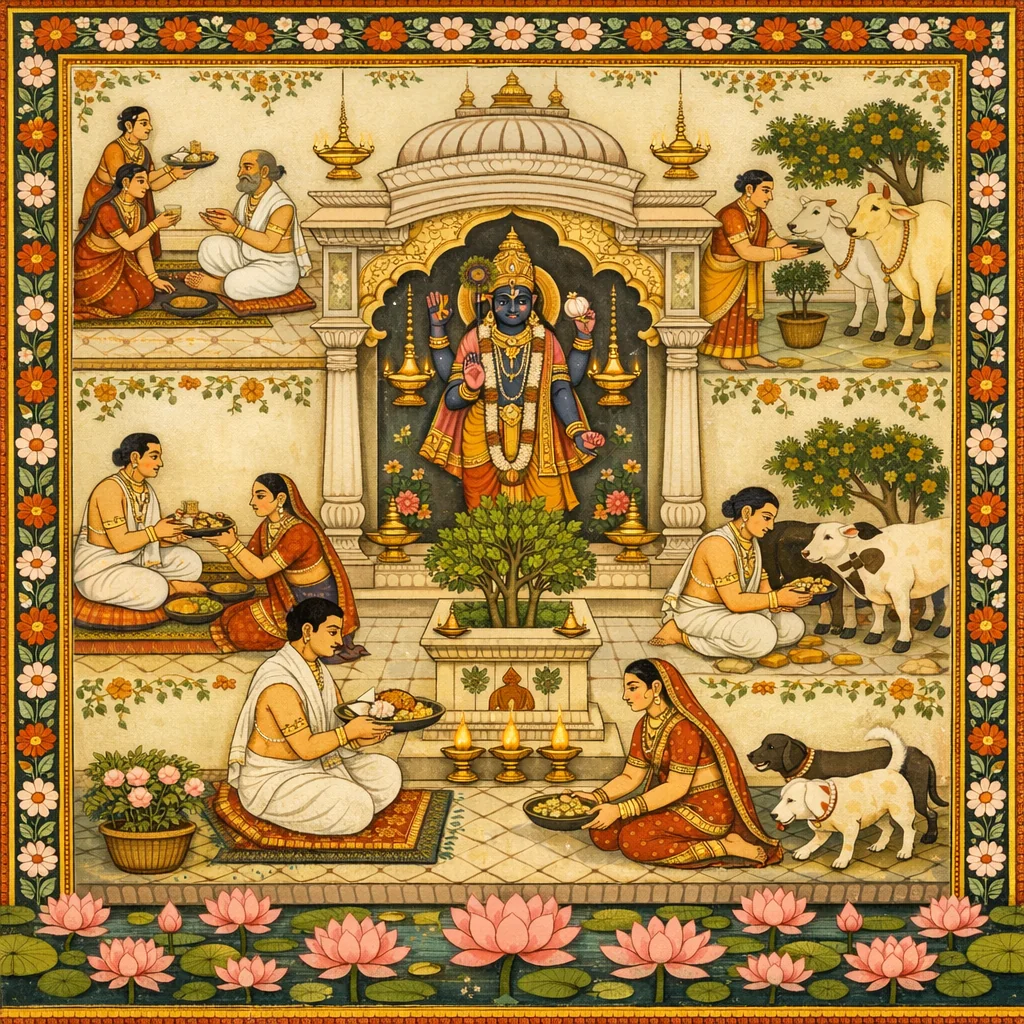
After demonstrating the Lord’s supremacy and the primacy of bhakti, Mahārāja Yudhiṣṭhira asks Nārada Muni how householders, absorbed in domestic life and unaware of life’s ultimate aim, may attain liberation according to Vedic teaching. Nārada replies that one need not abandon livelihood or social duties; rather, one should offer the fruits of all work to Kṛṣṇa (Vāsudeva), best learned through repeated association with great devotees and hearing Bhāgavata-kathā. The chapter teaches disciplined simplicity: minimal endeavor for maintenance, avoidance of ugra-karma, inner detachment while outwardly fulfilling family roles, and strict non-proprietorship—taking only what is necessary, otherwise becoming a “thief” under nature’s law. Nārada expands worship into social theology: guests, brāhmaṇas, demigods, forefathers (śrāddha), animals, and the neglected must be supported, concluding that worship of Kṛṣṇa—the root of the cosmic tree—worships all. It then turns toward temple worship, sacred times and places, and proper honor to qualified brāhmaṇas and Vaiṣṇavas as the Lord’s dear servants.
Shlokas
Verse 1
श्रीयुधिष्ठिर उवाच गृहस्थ एतां पदवीं विधिना येन चाञ्जसा । यायाद्देवऋषे ब्रूहि मादृशो गृहमूढधी: ॥ १ ॥
Mahārāja Yudhiṣṭhira said: O devarṣi, I am a householder, my understanding bewildered by home life. Please tell me, according to Vedic injunctions, how we who remain at home may easily attain liberation.
Verse 2
श्रीनारद उवाच गृहेष्ववस्थितो राजन्क्रिया: कुर्वन्यथोचिता: । वासुदेवार्पणं साक्षादुपासीत महामुनीन् ॥ २ ॥
Nārada Muni replied: O King, a householder should perform his proper duties to maintain life, yet rather than enjoying the results himself, he should offer those fruits directly to Vāsudeva, Śrī Kṛṣṇa. By the association of the Lord’s great devotees, one can perfectly understand how to worship and satisfy Vāsudeva.
Verse 3
शृण्वन्भगवतोऽभीक्ष्णमवतारकथामृतम् । श्रद्दधानो यथाकालमुपशान्तजनावृत: ॥ ३ ॥ सत्सङ्गाच्छनकै: सङ्गमात्मजायात्मजादिषु । विमुञ्चेन्मुच्यमानेषु स्वयं स्वप्नवदुत्थित: ॥ ४ ॥
A gṛhastha should, in the company of peaceful saints and at proper times, hear with faith again and again the nectar of the Lord’s avatāra pastimes. By satsaṅga he gradually releases attachment to wife, children, and the rest, like one who awakens from a dream.
Verse 4
शृण्वन्भगवतोऽभीक्ष्णमवतारकथामृतम् । श्रद्दधानो यथाकालमुपशान्तजनावृत: ॥ ३ ॥ सत्सङ्गाच्छनकै: सङ्गमात्मजायात्मजादिषु । विमुञ्चेन्मुच्यमानेषु स्वयं स्वप्नवदुत्थित: ॥ ४ ॥
A gṛhastha should, in the company of peaceful saints and at proper times, hear with faith again and again the nectar of the Lord’s avatāra pastimes. By satsaṅga he gradually releases attachment to wife, children, and the rest, like one who awakens from a dream.
Verse 5
यावदर्थमुपासीनो देहे गेहे च पण्डित: । विरक्तो रक्तवत्तत्र नृलोके नरतां न्यसेत् ॥ ५ ॥
Working only as much as needed to maintain body and home, one who is truly learned should live among men without inner attachment, though outwardly he may appear deeply engaged in family affairs.
Verse 6
ज्ञातय: पितरौ पुत्रा भ्रातर: सुहृदोऽपरे । यद्वदन्ति यदिच्छन्ति चानुमोदेत निर्मम: ॥ ६ ॥
An intelligent person should keep his way of life very simple. If friends, children, parents, brothers, or others offer suggestions, he may agree outwardly—“Yes, that is fine”—yet inwardly remain detached and resolved not to build a burdensome life that defeats life’s true purpose.
Verse 7
दिव्यं भौमं चान्तरीक्षं वित्तमच्युतनिर्मितम् । तत्सर्वमुपयुञ्जान एतत्कुर्यात्स्वतो बुध: ॥ ७ ॥
All wealth from the heavens, the earth, and the atmosphere is created by Acyuta, the Supreme Lord. Using it all to sustain the bodies and lives of every being, the wise should act in this way of their own accord.
Verse 8
यावद् भ्र्रियेत जठरं तावत् स्वत्वं हि देहिनाम् । अधिकं योऽभिमन्येत स स्तेनो दण्डमर्हति ॥ ८ ॥
A living being may claim as his own only as much as is needed to sustain body and life. One who claims more as “mine” is a thief and deserves punishment under nature’s law.
Verse 9
मृगोष्ट्रखरमर्काखुसरीसृप्खगमक्षिका: । आत्मन: पुत्रवत् पश्येत्तैरेषामन्तरं कियत् ॥ ९ ॥
One should regard creatures such as deer, camels, asses, monkeys, mice, snakes, birds, and even flies as one’s own son. How slight, in truth, is the difference between children and these innocent beings.
Verse 10
त्रिवर्गं नातिकृच्छ्रेण भजेत गृहमेध्यपि । यथादेशं यथाकालं यावद्दैवोपपादितम् ॥ १० ॥
Even as a householder, one should not strive excessively for dharma, artha, and kama. According to place and time, one should be content to maintain life with what the Lord provides through minimal endeavor, and should not engage in harsh, feverish work (ugra-karma).
Verse 11
आश्वाघान्तेऽवसायिभ्य: कामान्संविभजेद्यथा । अप्येकामात्मनो दारां नृणां स्वत्वग्रहो यत: ॥ ११ ॥
Householders should share proper necessities to maintain even dogs, fallen persons, and the untouchables such as caṇḍālas. Even one’s own wife at home, to whom one is most intimately attached, should be offered in a spirit of dedication for receiving guests and serving people in general.
Verse 12
जह्याद् यदर्थे स्वान्प्राणान्हन्याद्वा पितरं गुरुम् । तस्यां स्वत्वं स्त्रियां जह्याद्यस्तेन ह्यजितो जित: ॥ १२ ॥
A man may take his wife as his very own so strongly that for her sake he may kill himself or kill others—even his parents or his spiritual master. Therefore, one who can abandon such possessive attachment to his wife conquers Bhagavān Ajita, the Supreme Lord who is never conquered by anyone.
Verse 13
कृमिविड्भस्मनिष्ठान्तं क्वेदं तुच्छं कलेवरम् । क्व तदीयरतिर्भार्या क्वायमात्मा नभश्छदि: ॥ १३ ॥
By proper deliberation one should give up attraction to the wife’s body, for that body will ultimately become small insects, stool, or ashes. What worth is this insignificant body? How much greater is the Supreme Being, all-pervading like the sky.
Verse 14
सिद्धैर्यज्ञावशिष्टार्थै: कल्पयेद् वृत्तिमात्मन: । शेषे स्वत्वं त्यजन्प्राज्ञ: पदवीं महतामियात् ॥ १४ ॥
An intelligent person should be satisfied by eating prasāda—food offered to the Lord—or by living on what remains from yajñas such as the pañca-sūnā. By this one gives up bodily attachment and the false sense of proprietorship, and thus becomes firmly situated in the position of a mahātmā.
Verse 15
देवानृषीन् नृभूतानि पितृनात्मानमन्वहम् । स्ववृत्त्यागतवित्तेन यजेत पुरुषं पृथक् ॥ १५ ॥
Every day, with wealth obtained through one’s rightful livelihood, one should worship separately the devas, the ṛṣis, human beings, living creatures, the forefathers, and also one’s own self. In this way one worships the Supreme Puruṣa who dwells within the heart of everyone.
Verse 16
यर्ह्यात्मनोऽधिकाराद्या: सर्वा: स्युर्यज्ञसम्पद: । वैतानिकेन विधिना अग्निहोत्रादिना यजेत् ॥ १६ ॥
When wealth and knowledge are under one’s control and thus all requisites for yajña are available, one should, according to the śāstras, perform the Vaitānika rites such as agnihotra, offering oblations into the sacred fire, and thereby worship Bhagavān, the Yajña-puruṣa.
Verse 17
न ह्यग्निमुखतोऽयं वै भगवान्सर्वयज्ञभुक् । इज्येत हविषा राजन्यथा विप्रमुखे हुतै: ॥ १७ ॥
Bhagavān, the enjoyer of all sacrifices, accepts oblations offered into the mouth of fire; yet, O King, He is even more pleased when fine food made of grains and ghee is offered to Him through the mouths of qualified brāhmaṇas.
Verse 18
तस्माद् ब्राह्मणदेवेषु मर्त्यादिषु यथार्हत: । तैस्तै: कामैर्यजस्वैनं क्षेत्रज्ञं ब्राह्मणाननु ॥ १८ ॥
Therefore, O King, first offer prasāda to the brāhmaṇas and the demigods according to their due honor; after feeding them sumptuously, distribute prasāda to other living beings according to your means. Thus, through the brāhmaṇas, you will worship the Kṣetrajña—the Supreme Lord dwelling within all.
Verse 19
कुर्यादपरपक्षीयं मासि प्रौष्ठपदे द्विज: । श्राद्धं पित्रोर्यथावित्तं तद्बन्धूनां च वित्तवान् ॥ १९ ॥
A brāhmaṇa who is sufficiently wealthy should perform śrāddha for the forefathers during the dark fortnight in the latter part of the month of Bhādra, according to his means; likewise, during the mahālayā rites in Āśvina, he should offer to the forefathers’ relatives in proportion to his wealth.
Verse 20
अयने विषुवे कुर्याद् व्यतीपाते दिनक्षये । चन्द्रादित्योपरागे च द्वादश्यां श्रवणेषु च ॥ २० ॥ तृतीयायां शुक्लपक्षे नवम्यामथ कार्तिके । चतसृष्वप्यष्टकासु हेमन्ते शिशिरे तथा ॥ २१ ॥ माघे च सितसप्तम्यां मघाराकासमागमे । राकया चानुमत्या च मासर्क्षाणि युतान्यपि ॥ २२ ॥ द्वादश्यामनुराधा स्याच्छ्रवणस्तिस्र उत्तरा: । तिसृष्वेकादशी वासु जन्मर्क्षश्रोणयोगूयुक् ॥ २३ ॥
One should perform śrāddha on the saṅkrānti days of Uttarāyaṇa and Dakṣiṇāyaṇa, on the viṣuva days, in the yoga called Vyatīpāta, on the kṣaya day when three tithis converge, during lunar or solar eclipses, on dvādaśī, and when the nakṣatra is Śravaṇa. One should also perform it on Akṣaya-tṛtīyā, on the bright navamī of Kārtika, on the four aṣṭakās in the hemanta and śiśira seasons, on the bright saptamī of Māgha, when Maghā coincides with the full moon, on full or nearly full moon days (rākā and anumati) joined with the month-naming nakṣatras, on dvādaśī joined with Anurādhā, Śravaṇa or the three Uttaras, on ekādaśī joined with the three Uttaras, and finally on days joined with one’s own birth star or with Śravaṇa.
Verse 21
अयने विषुवे कुर्याद् व्यतीपाते दिनक्षये । चन्द्रादित्योपरागे च द्वादश्यां श्रवणेषु च ॥ २० ॥ तृतीयायां शुक्लपक्षे नवम्यामथ कार्तिके । चतसृष्वप्यष्टकासु हेमन्ते शिशिरे तथा ॥ २१ ॥ माघे च सितसप्तम्यां मघाराकासमागमे । राकया चानुमत्या च मासर्क्षाणि युतान्यपि ॥ २२ ॥ द्वादश्यामनुराधा स्याच्छ्रवणस्तिस्र उत्तरा: । तिसृष्वेकादशी वासु जन्मर्क्षश्रोणयोगूयुक् ॥ २३ ॥
One should perform śrāddha on Makara- and Karkaṭa-saṅkrānti, on the Meṣa and Tulā equinoxes, in the Vyatīpāta-yoga, at day’s end, when three tithis coincide, during lunar or solar eclipse, on Dvādaśī, and when the Moon is in Śravaṇa-nakṣatra.
Verse 22
अयने विषुवे कुर्याद् व्यतीपाते दिनक्षये । चन्द्रादित्योपरागे च द्वादश्यां श्रवणेषु च ॥ २० ॥ तृतीयायां शुक्लपक्षे नवम्यामथ कार्तिके । चतसृष्वप्यष्टकासु हेमन्ते शिशिरे तथा ॥ २१ ॥ माघे च सितसप्तम्यां मघाराकासमागमे । राकया चानुमत्या च मासर्क्षाणि युतान्यपि ॥ २२ ॥ द्वादश्यामनुराधा स्याच्छ्रवणस्तिस्र उत्तरा: । तिसृष्वेकादशी वासु जन्मर्क्षश्रोणयोगूयुक् ॥ २३ ॥
Śrāddha should also be performed on Akṣaya-tṛtīyā; on the bright ninth of Kārtika; on the four aṣṭakā days in hemanta and śiśira; on the bright seventh of Māgha; when Maghā-nakṣatra joins the full moon; on the full-moon days called Rākā and Anumatī; and on tithis conjoined with the month-naming nakṣatras.
Verse 23
अयने विषुवे कुर्याद् व्यतीपाते दिनक्षये । चन्द्रादित्योपरागे च द्वादश्यां श्रवणेषु च ॥ २० ॥ तृतीयायां शुक्लपक्षे नवम्यामथ कार्तिके । चतसृष्वप्यष्टकासु हेमन्ते शिशिरे तथा ॥ २१ ॥ माघे च सितसप्तम्यां मघाराकासमागमे । राकया चानुमत्या च मासर्क्षाणि युतान्यपि ॥ २२ ॥ द्वादश्यामनुराधा स्याच्छ्रवणस्तिस्र उत्तरा: । तिसृष्वेकादशी वासु जन्मर्क्षश्रोणयोगूयुक् ॥ २३ ॥
One should perform śrāddha on Dvādaśī when it is conjoined with Anurādhā, Śravaṇa, or any of the three Uttaras; and also on Ekādaśī when it is conjoined with the three Uttaras. Finally, one should do so on days joined with one’s birth star (janma-nakṣatra) or with Śravaṇa-nakṣatra.
Verse 24
त एते श्रेयस: काला नृणां श्रेयोविवर्धना: । कुर्यात्सर्वात्मनैतेषु श्रेयोऽमोघं तदायुष: ॥ २४ ॥
All these seasonal times are supremely auspicious for humankind and increase one’s highest welfare. At such times one should, with one’s whole heart, perform sacred and virtuous acts, for even within a short human life their success is never in vain.
Verse 25
एषु स्नानं जपो होमो व्रतं देवद्विजार्चनम् । पितृदेवनृभूतेभ्यो यद्दत्तं तद्ध्यनश्वरम् ॥ २५ ॥
During these sacred seasons, if one bathes in the Gaṅgā, the Yamunā, or another holy tīrtha; performs japa, homa, and vows; and worships the Supreme Lord, the brāhmaṇas, the forefathers, the devas, and all beings—then whatever charity one gives yields an imperishable, lasting benefit.
Verse 26
संस्कारकालो जायाया अपत्यस्यात्मनस्तथा । प्रेतसंस्था मृताहश्च कर्मण्यभ्युदये नृप ॥ २६ ॥
O King Yudhiṣṭhira, at the appointed time for saṁskāras for oneself, one’s wife, or one’s children—and during funeral rites and the annual śrāddha—one should duly perform the auspicious ceremonies described above, so that the fruits of one’s works may flourish.
Verse 27
अथ देशान्प्रवक्ष्यामि धर्मादिश्रेयआवहान् । स वै पुण्यतमो देश: सत्पात्रं यत्र लभ्यते ॥ २७ ॥ बिम्बं भगवतो यत्र सर्वमेतच्चराचरम् । यत्र ह ब्राह्मणकुलं तपोविद्यादयान्वितम् ॥ २८ ॥
Nārada Muni continued: Now I shall describe the places that invoke dharma and the highest good. Wherever a worthy Vaiṣṇava is found—that place is supremely holy. Where the Lord’s Deity is installed, and where brāhmaṇa families endowed with austerity, learning, and compassion reside—such a land is most auspicious and sacred.
Verse 28
अथ देशान्प्रवक्ष्यामि धर्मादिश्रेयआवहान् । स वै पुण्यतमो देश: सत्पात्रं यत्र लभ्यते ॥ २७ ॥ बिम्बं भगवतो यत्र सर्वमेतच्चराचरम् । यत्र ह ब्राह्मणकुलं तपोविद्यादयान्वितम् ॥ २८ ॥
Nārada Muni continued: Now I shall describe the places that invoke dharma and the highest good. Wherever a worthy Vaiṣṇava is found—that place is supremely holy. Where the Lord’s Deity is installed, and where brāhmaṇa families endowed with austerity, learning, and compassion reside—such a land is most auspicious and sacred.
Verse 29
यत्र यत्र हरेरर्चा स देश: श्रेयसां पदम् । यत्र गङ्गादयो नद्य: पुराणेषु च विश्रुता: ॥ २९ ॥
Wherever the worship (arcā) of Hari is duly performed, that land becomes a seat of the highest good. And where sacred rivers like the Gaṅgā—celebrated in the Purāṇas—flow, any spiritual act done there is surely most powerful and greatly fruitful.
Verse 30
सरांसि पुष्करादीनि क्षेत्राण्यर्हाश्रितान्युत । कुरुक्षेत्रं गयशिर: प्रयाग: पुलहाश्रम: ॥ ३० ॥ नैमिषं फाल्गुनं सेतु: प्रभासोऽथ कुशस्थली । वाराणसी मधुपुरी पम्पा बिन्दुसरस्तथा ॥ ३१ ॥ नारायणाश्रमो नन्दा सीतारामाश्रमादय: । सर्वे कुलाचला राजन्महेन्द्रमलयादय: ॥ ३२ ॥ एते पुण्यतमा देशा हरेरर्चाश्रिताश्च ये । एतान्देशान्निषेवेत श्रेयस्कामो ह्यभीक्ष्णश: । धर्मो ह्यत्रेहित: पुंसां सहस्राधिफलोदय: ॥ ३३ ॥
Sacred lakes such as Puṣkara, and holy places where saints reside—Kurukṣetra, Gayā-śiras, Prayāga, Pulahāśrama, Naimiṣāraṇya, the banks of the Phālgu, Setu, Prabhāsa, Kuśasthalī (Dvārakā), Vārāṇasī, Madhu-purī (Mathurā), Pampā, Bindu-sarovara, Nārāyaṇāśrama (Badarikāśrama), the banks of the Nandā, the shelters of Sītā and Rāma, and the mountain tracts of Mahendra and Malaya—all these are most pious and sacred. One who seeks spiritual good should visit again and again the places where Hari is worshiped; dharma performed there yields a thousandfold result.
Verse 31
सरांसि पुष्करादीनि क्षेत्राण्यर्हाश्रितान्युत । कुरुक्षेत्रं गयशिर: प्रयाग: पुलहाश्रम: ॥ ३० ॥ नैमिषं फाल्गुनं सेतु: प्रभासोऽथ कुशस्थली । वाराणसी मधुपुरी पम्पा बिन्दुसरस्तथा ॥ ३१ ॥ नारायणाश्रमो नन्दा सीतारामाश्रमादय: । सर्वे कुलाचला राजन्महेन्द्रमलयादय: ॥ ३२ ॥ एते पुण्यतमा देशा हरेरर्चाश्रिताश्च ये । एतान्देशान्निषेवेत श्रेयस्कामो ह्यभीक्ष्णश: । धर्मो ह्यत्रेहित: पुंसां सहस्राधिफलोदय: ॥ ३३ ॥
Sacred lakes such as Puṣkara, and holy places where saintly souls reside—Kurukṣetra, Gayā, Prayāga, Pulahāśrama; Naimiṣāraṇya, the banks of the Phālgu, Setubandha, Prabhāsa, Kuśasthalī (Dvārakā), Vārāṇasī, Madhupurī (Mathurā), Pampā, Bindu-sarovara, Nārāyaṇāśrama (Badarī), the shores of the Nandā, the refuges of Śrī Rāma and Mother Sītā such as Citrakūṭa, and the mountain tracts called Mahendra and Malaya—all these are supremely pious lands. Likewise, wherever Hari is worshiped in His Deity form (Rādhā-Kṛṣṇa), those who seek spiritual good should repeatedly visit and serve such places; dharma performed there yields a thousandfold result.
Verse 32
सरांसि पुष्करादीनि क्षेत्राण्यर्हाश्रितान्युत । कुरुक्षेत्रं गयशिर: प्रयाग: पुलहाश्रम: ॥ ३० ॥ नैमिषं फाल्गुनं सेतु: प्रभासोऽथ कुशस्थली । वाराणसी मधुपुरी पम्पा बिन्दुसरस्तथा ॥ ३१ ॥ नारायणाश्रमो नन्दा सीतारामाश्रमादय: । सर्वे कुलाचला राजन्महेन्द्रमलयादय: ॥ ३२ ॥ एते पुण्यतमा देशा हरेरर्चाश्रिताश्च ये । एतान्देशान्निषेवेत श्रेयस्कामो ह्यभीक्ष्णश: । धर्मो ह्यत्रेहित: पुंसां सहस्राधिफलोदय: ॥ ३३ ॥
In sacred tirtha-lakes like Puṣkara, and in holy places such as Kurukṣetra, Gayā, Prayāga, Pulahāśrama; Naimiṣāraṇya, the Phālgu’s banks, Setubandha, Prabhāsa, Kuśasthalī (Dvārakā), Vārāṇasī, Madhupurī (Mathurā), Pampā, Bindu-sarovara, Nārāyaṇāśrama (Badarī), the banks of the Nandā, the ashrams of Sītā-Rāma like Citrakūṭa, and the mountains Mahendra and Malaya—there abides supreme piety. And wherever arcanā worship of Hari (Rādhā-Kṛṣṇa) is established, one who seeks spiritual good should go again and again; dharma performed there yields a thousandfold fruit.
Verse 33
सरांसि पुष्करादीनि क्षेत्राण्यर्हाश्रितान्युत । कुरुक्षेत्रं गयशिर: प्रयाग: पुलहाश्रम: ॥ ३० ॥ नैमिषं फाल्गुनं सेतु: प्रभासोऽथ कुशस्थली । वाराणसी मधुपुरी पम्पा बिन्दुसरस्तथा ॥ ३१ ॥ नारायणाश्रमो नन्दा सीतारामाश्रमादय: । सर्वे कुलाचला राजन्महेन्द्रमलयादय: ॥ ३२ ॥ एते पुण्यतमा देशा हरेरर्चाश्रिताश्च ये । एतान्देशान्निषेवेत श्रेयस्कामो ह्यभीक्ष्णश: । धर्मो ह्यत्रेहित: पुंसां सहस्राधिफलोदय: ॥ ३३ ॥
O King, all these lands—sacred lakes, holy fields, mountains, and ashrams—are most purifying, especially where Hari’s Deity worship (arcanā of Rādhā-Kṛṣṇa) is established or where saints reside. One who longs for śreyas, the highest good, should repeatedly resort to such places; for dharma performed there yields a thousandfold fruit beyond what is gained elsewhere.
Verse 34
पात्रं त्वत्र निरुक्तं वै कविभि: पात्रवित्तमै: । हरिरेवैक उर्वीश यन्मयं वै चराचरम् ॥ ३४ ॥
O ruler of the earth, the wisest seers have concluded that the supreme recipient is none other than Lord Hari, Śrī Kṛṣṇa, in whom all moving and unmoving beings rest and from whom everything arises; therefore all gifts and offerings should be given to Him alone.
Verse 35
देवर्ष्यर्हत्सु वै सत्सु तत्र ब्रह्मात्मजादिषु । राजन्यदग्रपूजायां मत: पात्रतयाच्युत: ॥ ३५ ॥
O King Yudhiṣṭhira, at your Rājasūya sacrifice the devas, the divine sages, many saints—including even Brahmā’s four sons—were present; yet when the question arose of who should be worshiped first, all concluded that Acyuta, Lord Śrī Kṛṣṇa, is the most worthy recipient of the foremost honor.
Verse 36
जीवराशिभिराकीर्ण अण्डकोशाङ्घ्रिपो महान् । तन्मूलत्वादच्युतेज्या सर्वजीवात्मतर्पणम् ॥ ३६ ॥
This universe, crowded with living beings, is like a tree whose root is the Supreme Personality of Godhead, Acyuta—Śrī Kṛṣṇa. Therefore, by worshiping Kṛṣṇa alone, one worships and satisfies all living entities.
Verse 37
पुराण्यनेन सृष्टानि नृतिर्यगृषिदेवता: । शेते जीवेन रूपेण पुरेषु पुरुषो ह्यसौ ॥ ३७ ॥
The Supreme Personality of Godhead created many abodes in the form of bodies—of humans, animals, birds, sages, and demigods. Within all these innumerable forms, He dwells with the living being as Paramātmā; thus He is known as the puruṣāvatāra.
Verse 38
तेष्वेव भगवान् राजंस्तारतम्येन वर्तते । तस्मात्पात्रं हि पुरुषो यावानात्मा यथेयते ॥ ३८ ॥
O King Yudhiṣṭhira, the Supersoul within every body grants intelligence to the individual soul according to its capacity to understand. Therefore He is the chief within the body. He reveals Himself in proportion to one’s development in knowledge, austerity, atonement, and the like.
Verse 39
दृष्ट्वा तेषां मिथो नृणामवज्ञानात्मतां नृप । त्रेतादिषु हरेरर्चा क्रियायै कविभि: कृता ॥ ३९ ॥
My dear King, when the great sages saw people dealing with one another in mutual disrespect at the beginning of Tretā-yuga, they introduced temple worship of Hari in His Deity form, complete with rituals and paraphernalia.
Verse 40
ततोऽर्चायां हरिं केचित् संश्रद्धाय सपर्यया । उपासत उपास्तापि नार्थदा पुरुषद्विषाम् ॥ ४० ॥
Sometimes a neophyte devotee, with faith, offers all paraphernalia and worships Hari as the Deity, yet because he envies the authorized devotees of Viṣṇu, the Lord is never satisfied with his devotional service.
Verse 41
पुरुषेष्वपि राजेन्द्र सुपात्रं ब्राह्मणं विदु: । तपसा विद्यया तुष्टया धत्ते वेदं हरेस्तनुम् ॥ ४१ ॥
O Rajendra, among all persons the qualified brāhmaṇa is known as the best recipient, for by austerity, Vedic study, and contentment he bears the Veda as the very body of Śrī Hari.
Verse 42
नन्वस्य ब्राह्मणा राजन्कृष्णस्य जगदात्मन: । पुनन्त: पादरजसा त्रिलोकीं दैवतं महत् ॥ ४२ ॥
O King, these brāhmaṇas belong to Śrī Kṛṣṇa, the Soul of the universe; by the dust of their lotus feet they purify the three worlds, and thus they are like a great divinity—worshipable even for Kṛṣṇa.
Frequently Asked Questions
By earning only as necessary, offering the results to Vāsudeva, and repeatedly associating with sādhus to hear the Lord’s līlā from Bhāgavata and Purāṇas. Inner detachment is cultivated through śravaṇa, prasāda, yajña, charity, and avoidance of ugra-karma, so that duty becomes devotion rather than bondage.
Because nature’s resources are created by the Supreme Lord for the maintenance of all beings. Taking more than required violates dharma and incurs reaction under the ‘laws of nature’ (daiva/karma), since it is appropriation of the Lord’s property and deprivation of other dependents in the cosmic order.
Kṛṣṇa, the Supreme Personality of Godhead, is established as the foremost recipient—as affirmed at Yudhiṣṭhira’s Rājasūya. Since all beings rest in Him like a tree in its root, worship directed to Kṛṣṇa naturally includes proper honor to demigods, forefathers, humans, animals, and saints.
Deity worship was introduced to support people when social dealings declined, but the Lord is not satisfied if one worships the Deity while envying or disrespecting authorized Vaiṣṇavas. The chapter thus pairs arcana (Deity worship) with Vaiṣṇava-sevā and avoidance of aparādha.