Adhyaya 13
Paramahaṁsa-Dharma: The Avadhūta-like Sannyāsī and Prahlāda’s Dialogue with the ‘Python’ Saint
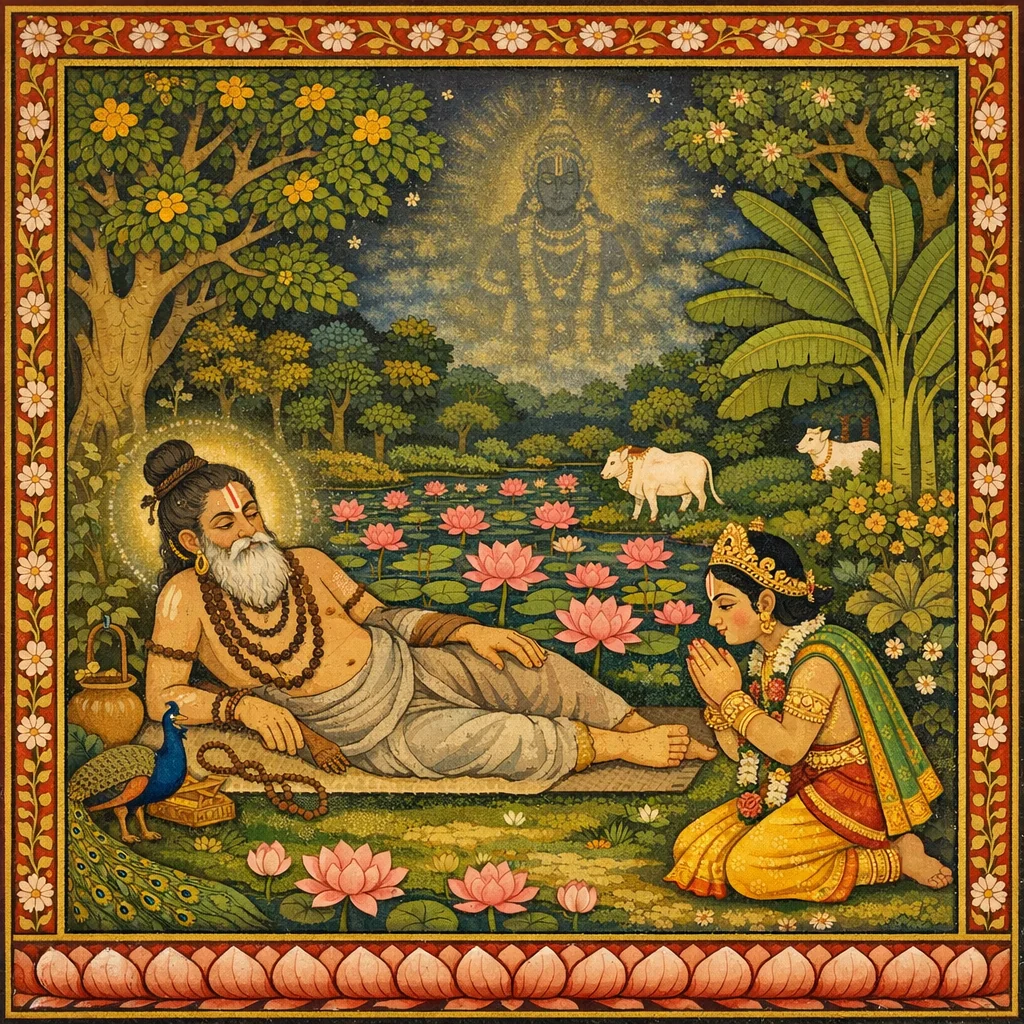
As the canto shifts from Prahlāda’s personal ordeal to his role as a teacher for society, Nārada Muni describes the conduct of a genuine renunciant (paramahaṁsa): minimal dependence, no hoarding, freedom from sectarian quarrel, and seeing the Supreme (Paramātmā/Viṣṇu) pervading all. External marks—daṇḍa, kamaṇḍalu, and dress—are secondary to inner realization, and a saint may hide his stature by appearing childish or mute to avoid worldly entanglement. Nārada then relates an illustrative itihāsa: Prahlāda, traveling to study saintly character, meets an advanced brāhmaṇa living “like a python,” inactive yet well nourished. Prahlāda’s respectful inquiry draws out a piercing diagnosis of material life: sense-driven action yields only the threefold miseries and anxiety, especially amid wealth and prestige. The saint teaches contentment through the examples of the bee (non-hoarding) and the python (patient non-endeavor), accepting whatever comes by destiny. The chapter ends with Prahlāda grasping the duties of the paramahaṁsa, preparing the narrative for further institutional and ethical teachings grounded in detachment (vairāgya) and bhakti to Kṛṣṇa/Viṣṇu.
Shlokas
Verse 1
श्रीनारद उवाच कल्पस्त्वेवं परिव्रज्य देहमात्रावशेषित: । ग्रामैकरात्रविधिना निरपेक्षश्चरेन्महीम् ॥ १ ॥
Śrī Nārada Muni said: One who can cultivate spiritual knowledge should renounce all material ties, maintaining the body only so far as it can be sustained. Following the rule of staying but one night in each village, and remaining independent of bodily needs, the sannyāsī should wander over the whole earth.
Verse 2
बिभृयाद् यद्यसौ वास: कौपीनाच्छादनं परम् । त्यक्तं न लिङ्गाद् दण्डादेरन्यत् किञ्चिदनापदि ॥ २ ॥
A sannyāsī should, as far as possible, avoid even bodily covering; if he wears anything, let it be only a loincloth. When there is no necessity, he should not accept even the daṇḍa and other insignia; apart from the daṇḍa and kamaṇḍalu, he should carry nothing.
Verse 3
एक एव चरेद्भिक्षुरात्मारामोऽनपाश्रय: । सर्वभूतसुहृच्छान्तो नारायणपरायण: ॥ ३ ॥
The mendicant sannyāsī should wander alone, satisfied in the Self and dependent on no person or place. Friendly to all beings, peaceful, and a pure devotee wholly devoted to Nārāyaṇa, he should live by alms from door to door.
Verse 4
पश्येदात्मन्यदो विश्वं परे सदसतोऽव्यये । आत्मानं च परं ब्रह्म सर्वत्र सदसन्मये ॥ ४ ॥
The sannyāsī should strive to see this universe within the Self, and to see both being and nonbeing resting upon the imperishable Supreme. He should practice beholding the ātman and the Supreme Brahman as present everywhere, pervading all that is and is not.
Verse 5
सुप्तिप्रबोधयो: सन्धावात्मनो गतिमात्मदृक् । पश्यन्बन्धं च मोक्षं च मायामात्रं न वस्तुत: ॥ ५ ॥
At the junction of sleep and wakefulness, and in the passage between them, the self-seeing sannyāsī should observe the movement of the ātman. Thus he realizes that bondage and liberation are only māyā, not ultimate fact; with such higher understanding he beholds only the Absolute Truth pervading all.
Verse 6
नाभिनन्देद् ध्रुवं मृत्युमध्रुवं वास्य जीवितम् । कालं परं प्रतीक्षेत भूतानां प्रभवाप्ययम् ॥ ६ ॥
Since death is certain and the span of life uncertain, one should praise neither death nor life. Rather, one should contemplate the Supreme factor of Time, within which living beings appear and disappear.
Verse 7
नासच्छास्त्रेषु सज्जेत नोपजीवेत जीविकाम् । वादवादांस्त्यजेत्तर्कान्पक्षं कंच न संश्रयेत् ॥ ७ ॥
Do not cling to useless writings devoid of spiritual benefit. Do not make teaching a livelihood, abandon argument and counterargument, and take shelter of no cause or faction.
Verse 8
न शिष्याननुबध्नीत ग्रन्थान्नैवाभ्यसेद् बहून् । न व्याख्यामुपयुञ्जीत नारम्भानारभेत्क्वचित् ॥ ८ ॥
A sannyāsī should not gather many disciples by alluring them with material benefits. He should not read many books unnecessarily, nor speak for livelihood, and he must never strive to increase material opulence without need.
Verse 9
न यतेराश्रम: प्रायो धर्महेतुर्महात्मन: । शान्तस्य समचित्तस्य बिभृयादुत वा त्यजेत् ॥ ९ ॥
A peaceful, equipoised mahātmā truly advanced in spiritual consciousness does not require the external emblems of sannyāsa, such as the tridaṇḍa and kamaṇḍalu. As needed, he may sometimes accept them and sometimes set them aside.
Verse 10
अव्यक्तलिङ्गो व्यक्तार्थो मनीष्युन्मत्तबालवत् । कविर्मूकवदात्मानं स दृष्टया दर्शयेन्नृणाम् ॥ १० ॥
Though a saintly person may not reveal himself to society’s gaze, his purpose becomes known through his conduct. Among people he should appear like a restless child, and though he is a profound thinker and eloquent speaker, he should present himself like a dumb man, letting his inner self be seen through his demeanor.
Verse 11
अत्राप्युदाहरन्तीममितिहासं पुरातनम् । प्रह्रादस्य च संवादं मुनेराजगरस्य च ॥ ११ ॥
As an illustration, learned sages recount an ancient history: the dialogue between Prahlāda Mahārāja and a great muni who sustained himself like a python, accepting whatever came of its own accord.
Verse 12
तं शयानं धरोपस्थे कावेर्यां सह्यसानुनि । रजस्वलैस्तनूदेशैर्निगूढामलतेजसम् ॥ १२ ॥ ददर्श लोकान्विचरन् लोकतत्त्वविवित्सया । वृतोऽमात्यै: कतिपयै: प्रह्रादो भगवत्प्रिय: ॥ १३ ॥
Prahlāda Mahārāja, the Bhagavān’s most beloved servant, traveled through the worlds with a few trusted companions to learn the true nature of saintly persons. Reaching the bank of the Kāverī near Mount Sahya, he beheld a great sage lying upon the earth, his limbs dust-covered, yet concealing within a spotless spiritual radiance.
Verse 13
तं शयानं धरोपस्थे कावेर्यां सह्यसानुनि । रजस्वलैस्तनूदेशैर्निगूढामलतेजसम् ॥ १२ ॥ ददर्श लोकान्विचरन् लोकतत्त्वविवित्सया । वृतोऽमात्यै: कतिपयै: प्रह्रादो भगवत्प्रिय: ॥ १३ ॥
Eager to know the truth of the world, Prahlāda, dear to the Bhagavān and accompanied by a few ministers, beheld that sage.
Verse 14
कर्मणाकृतिभिर्वाचा लिङ्गैर्वर्णाश्रमादिभि: । न विदन्ति जना यं वै सोऽसाविति न वेति च ॥ १४ ॥
Neither by his deeds, nor by his bodily appearance, nor by his speech, nor by the signs of varṇāśrama could people discern whether he was the same person or not.
Verse 15
तं नत्वाभ्यर्च्य विधिवत्पादयो: शिरसा स्पृशन् । विवित्सुरिदमप्राक्षीन्महाभागवतोऽसुर: ॥ १५ ॥
Prahlāda, the great bhāgavata, bowed down and worshiped the saint according to proper rites, touching his head to the sage’s lotus feet. Then, wishing to understand him, he inquired with deep humility as follows.
Verse 16
बिभर्षि कायं पीवानं सोद्यमो भोगवान्यथा ॥ १६ ॥ वित्तं चैवोद्यमवतां भोगो वित्तवतामिह । भोगिनां खलु देहोऽयं पीवा भवति नान्यथा ॥ १७ ॥
Prahlāda said: “O venerable sir, you make no endeavor for livelihood, yet you bear a stout body, like that of a worldly enjoyer. I understand that in this world the industrious gain wealth, the wealthy gain enjoyment; and the bodies of enjoyers grow fat by eating and sleeping—by no other means.”
Verse 17
बिभर्षि कायं पीवानं सोद्यमो भोगवान्यथा ॥ १६ ॥ वित्तं चैवोद्यमवतां भोगो वित्तवतामिह । भोगिनां खलु देहोऽयं पीवा भवति नान्यथा ॥ १७ ॥
You bear a very stout body, as if you were a worldly enjoyer, though you make no endeavor for your livelihood. In this world, the industrious gain wealth, the wealthy gain enjoyment; and those absorbed in enjoyment grow fat by eating and sleeping without work.
Verse 18
न ते शयानस्य निरुद्यमस्य ब्रह्मन्नु हार्थो यत एव भोग: । अभोगिनोऽयं तव विप्र देह: पीवा यतस्तद्वद न: क्षमं चेत् ॥ १८ ॥
O brāhmaṇa learned in transcendence, you lie down without endeavor, and it is understood you have no wealth for sense enjoyment. How, then, has your body become so fat? If my question is not improper, kindly explain.
Verse 19
कवि: कल्पो निपुणदृक् चित्रप्रियकथ: सम: । लोकस्य कुर्वत: कर्म शेषे तद्वीक्षितापि वा ॥ १९ ॥
You appear learned, skillful, and keenly intelligent, speaking charming words that delight the heart. You see people engaged in fruitive work, yet you lie here inactive.
Verse 20
श्रीनारद उवाच \स इत्थं दैत्यपतिना परिपृष्टो महामुनि: । स्मयमानस्तमभ्याह तद्वागमृतयन्त्रित: ॥ २० ॥
Nārada Muni continued: Thus questioned by Prahlāda Mahārāja, the king of the Daityas, the saintly sage—captivated by that shower of nectarean words—replied with a smiling face.
Verse 21
श्रीब्राह्मण उवाच वेदेदमसुरश्रेष्ठ भवान् नन्वार्यसम्मत: । ईहोपरमयोर्नृणां पदान्यध्यात्मचक्षुषा ॥ २१ ॥
The saintly brāhmaṇa said: O Prahlāda, best of the asuras and honored by the refined, by your innate spiritual vision you clearly know the stages of human life—the path of endeavor and the path of cessation—and the results of accepting or rejecting things as they are.
Verse 22
यस्य नारायणो देवो भगवान्हृद्गत: सदा । भक्त्या केवलयाज्ञानं धुनोति ध्वान्तमर्कवत् ॥ २२ ॥
By pure devotion, Lord Nārāyaṇa, Bhagavān, ever dwells within the heart, and like the sun He continually drives away the darkness of ignorance.
Verse 23
तथापि ब्रूमहे प्रश्नांस्तव राजन्यथाश्रुतम् । सम्भाषणीयो हि भवानात्मन: शुद्धिमिच्छता ॥ २३ ॥
O King, though you know all, you have asked these questions as they are heard in tradition; I shall reply according to what I have heard from authorities, for one who seeks self-purification should speak to a person like you.
Verse 24
तृष्णया भववाहिन्या योग्यै: कामैरपूर्यया । कर्माणि कार्यमाणोऽहं नानायोनिषु योजित: ॥ २४ ॥
Driven by insatiable thirst and desires that never fill, I was carried by the waves of saṁsāra, engaged in many kinds of actions, and placed among various forms of life.
Verse 25
यदृच्छया लोकमिमं प्रापित: कर्मभिर्भ्रमन् । स्वर्गापवर्गयोर्द्वारं तिरश्चां पुनरस्य च ॥ २५ ॥
Wandering under the force of karma, I have by chance attained this human form; it is a doorway to heaven and to liberation, yet it can also lead to lower species or to rebirth among humans.
Verse 26
तत्रापि दम्पतीनां च सुखायान्यापनुत्तये । कर्माणि कुर्वतां दृष्ट्वा निवृत्तोऽस्मि विपर्ययम् ॥ २६ ॥
In this human life, men and women unite for sensual pleasure and to ward off distress, yet experience shows that none become truly happy. Therefore, seeing the opposite result, I have withdrawn from materialistic activities.
Verse 27
सुखमस्यात्मनो रूपं सर्वेहोपरतिस्तनु: । मन:संस्पर्शजान् दृष्ट्वा भोगान्स्वप्स्यामि संविशन् ॥ २७ ॥
The living being’s true form is spiritual bliss, real happiness, attained only by ceasing all material pursuits. Sense enjoyment is merely the mind’s imagination; therefore I have renounced such activity and lie down here in rest.
Verse 28
इत्येतदात्मन: स्वार्थं सन्तं विस्मृत्य वै पुमान् । विचित्रामसति द्वैते घोरामाप्नोति संसृतिम् ॥ २८ ॥
Thus, identifying with the body, a person forgets his true self-interest, the welfare of the soul. Drawn to the variegated, unreal dualities of matter, he enters the dreadful course of samsaric existence.
Verse 29
जलं तदुद्भवैश्छन्नं हित्वाज्ञो जलकाम्यया । मृगतृष्णामुपाधावेत्तथान्यत्रार्थदृक् स्वत: ॥ २९ ॥
As an ignorant deer fails to see the water in a well covered by grass and runs after a mirage elsewhere, so the living being, covered by the material body, does not see the happiness within and instead chases happiness in the material world.
Verse 30
देहादिभिर्दैवतन्त्रैरात्मन: सुखमीहत: । दु:खात्ययं चानीशस्य क्रिया मोघा: कृता: कृता: ॥ ३० ॥
The living being seeks happiness and the end of distress, yet his various bodies are wholly controlled by material nature. Therefore his plans, in body after body, are repeatedly made futile.
Verse 31
आध्यात्मिकादिभिर्दु:खैरविमुक्तस्य कर्हिचित् । मर्त्यस्य कृच्छ्रोपनतैरर्थै: कामै: क्रियेत किम् ॥ ३१ ॥
For a mortal not freed from the threefold miseries—adhyātmika, adhidaivika, and adhibautika—what benefit is there in hard-won wealth, desires, or pleasures? He remains bound to birth, death, old age, disease, and the reactions of karma.
Verse 32
पश्यामि धनिनां क्लेशं लुब्धानामजितात्मनाम् । भयादलब्धनिद्राणां सर्वतोऽभिविशङ्किनाम् ॥ ३२ ॥
I see the misery of the wealthy—greedy, senses-unconquered and without self-mastery; out of fear they lose sleep and suspect danger from every side.
Verse 33
राजतश्चौरत: शत्रो: स्वजनात्पशुपक्षित: । अर्थिभ्य: कालत: स्वस्मान्नित्यं प्राणार्थवद्भयम् ॥ ३३ ॥
Even those deemed powerful and wealthy are ever anxious—fearing the king’s law, thieves, enemies, relatives, beasts and birds, beggars, the inexorable force of time, and even their own selves; thus they are always afraid.
Verse 34
शोकमोहभयक्रोधरागक्लैब्यश्रमादय: । यन्मूला: स्युर्नृणां जह्यात्स्पृहां प्राणार्थयोर्बुध: ॥ ३४ ॥
The wise should abandon the root cause of lamentation, illusion, fear, anger, attachment, poverty, and needless toil—the craving for unnecessary prestige and wealth.
Verse 35
मधुकारमहासर्पौ लोकेऽस्मिन्नो गुरूत्तमौ । वैराग्यं परितोषं च प्राप्ता यच्छिक्षया वयम् ॥ ३५ ॥
In this world, the bee and the great python are our two excellent teachers; by their instruction we have gained detachment and contentment.
Verse 36
विराग: सर्वकामेभ्य: शिक्षितो मे मधुव्रतात् । कृच्छ्राप्तं मधुवद्वित्तं हत्वाप्यन्यो हरेत्पतिम् ॥ ३६ ॥
From the bee I learned not to be attached to hoarding wealth; for wealth is like honey—hard won, yet anyone may kill its owner and carry it away.
Verse 37
अनीह: परितुष्टात्मा यदृच्छोपनतादहम् । नो चेच्छये बह्वहानि महाहिरिव सत्त्ववान् ॥ ३७ ॥
I make no endeavor to obtain anything; I am satisfied with whatever comes of its own accord. If nothing comes, I remain patient and unagitated like a great python, lying thus for many days.
Verse 38
क्वचिदल्पं क्वचिद्भूरि भुञ्जेऽन्नं स्वाद्वस्वादु वा । क्वचिद्भूरि गुणोपेतं गुणहीनमुत क्वचित् । श्रद्धयोपहृतं क्वापि कदाचिन्मानवर्जितम् । भुञ्जे भुक्त्वाथ कस्मिंश्चिद्दिवा नक्तं यदृच्छया ॥ ३८ ॥
Sometimes I eat little and sometimes much; sometimes the food is sweet and sometimes tasteless or stale. Sometimes I receive prasāda offered with reverence, and sometimes food given with neglect. Sometimes I eat by day and sometimes by night—thus I accept whatever comes easily by providence.
Verse 39
क्षौमं दुकूलमजिनं चीरं वल्कलमेव वा । वसेऽन्यदपि सम्प्राप्तं दिष्टभुक्तुष्टधीरहम् ॥ ३९ ॥
To cover my body I wear whatever comes—linen, silk, deerskin, rags, or bark—according to destiny; thus I remain content and unagitated.
Verse 40
क्वचिच्छये धरोपस्थे तृणपर्णाश्मभस्मसु । क्वचित्प्रासादपर्यङ्के कशिपौ वा परेच्छया ॥ ४० ॥
Sometimes I lie upon the earth, sometimes on grass, leaves, or stone, sometimes on a heap of ashes; and sometimes, by the will of others, I rest in a palace upon a first-class bed with pillows.
Verse 41
क्वचित्स्नातोऽनुलिप्ताङ्ग: सुवासा: स्रग्व्यलङ्कृत: । रथेभाश्वैश्चरे क्वापि दिग्वासा ग्रहवद्विभो ॥ ४१ ॥
O my Lord, sometimes I bathe nicely, anoint my limbs with sandal paste, wear fine garments, garlands, and ornaments, and travel like a king upon an elephant, chariot, or horse. Yet sometimes I wander naked, like one haunted by a spirit.
Verse 42
नाहं निन्दे न च स्तौमि स्वभावविषमं जनम् । एतेषां श्रेय आशासे उतैकात्म्यं महात्मनि ॥ ४२ ॥
People differ by nature; therefore it is not my concern to praise them or to condemn them. I seek only their welfare, hoping they will consent to become one in purpose with the Supersoul, the Supreme Personality of Godhead, Śrī Kṛṣṇa.
Verse 43
विकल्पं जुहुयाच्चित्तौ तां मनस्यर्थविभ्रमे । मनो वैकारिके हुत्वा तं मायायां जुहोत्यनु ॥ ४३ ॥
Take the mind’s concocted discrimination of good and bad as a single whole and place it within the mind; then offer the mind into the false ego, and thereafter offer the false ego into the total material energy, māyā. This is the method for battling false discrimination.
Verse 44
आत्मानुभूतौ तां मायां जुहुयात्सत्यदृङ्मुनि: । ततो निरीहो विरमेत् स्वानुभूत्यात्मनि स्थित: ॥ ४४ ॥
A learned seer, by self-realization, must know material existence to be illusion, and thus offer that māyā into the fire of truth. Then, established in realized Self, desireless and detached, one should retire from all material activities.
Verse 45
स्वात्मवृत्तं मयेत्थं ते सुगुप्तमपि वर्णितम् । व्यपेतं लोकशास्त्राभ्यां भवान्हि भगवत्पर: ॥ ४५ ॥
Prahlāda Mahārāja, you are surely self-realized and devoted to the Supreme Lord; you care neither for public opinion nor for so-called scriptures. Therefore I have described to you, without hesitation, the history of my own self-realization, though it was well concealed.
Verse 46
श्रीनारद उवाच धर्मं पारमहंस्यं वै मुने: श्रुत्वासुरेश्वर: । पूजयित्वा तत: प्रीत आमन्त्र्यप्रययौ गृहम् ॥ ४६ ॥
Nārada Muni continued: Having heard from the saint the dharma of a paramahaṁsa, Prahlāda, king of the asuras, understood and rejoiced. He duly worshiped the sage, sought his permission, took leave, and returned to his own home.
Frequently Asked Questions
Ajagara-vṛtti symbolizes radical dependence on the Lord rather than on personal enterprise: the saint does not hoard or scheme, accepts what comes of its own accord, and remains equipoised in gain and loss. The teaching is not laziness but nirodha—checking the compulsive drive for sense enjoyment—so that ātmā-jñāna and bhakti can remain unobstructed.
The chapter distinguishes inner realization from outer markers. Symbols may be adopted or set aside according to necessity, but the defining feature of a paramahaṁsa is steady absorption in the Self and devotion to Nārāyaṇa, non-violence, non-dependence, and equal vision—seeing everything resting on the Supreme.
Honey resembles wealth: it takes effort to collect, but it can be seized by others, even at the cost of the collector’s life. The bee lesson teaches aparigraha—take only what is needed—because hoarding invites fear, conflict, and loss, keeping consciousness bound to anxiety rather than to the Absolute.
Prahlāda acts as a realized examiner for the benefit of listeners. The saint explicitly notes that Prahlāda ‘knows everything’ yet asks to draw out articulated instruction (śravaṇa-paramparā) so that the principles of paramahaṁsa-dharma can be transmitted as a public teaching within the Bhāgavata’s narrative.