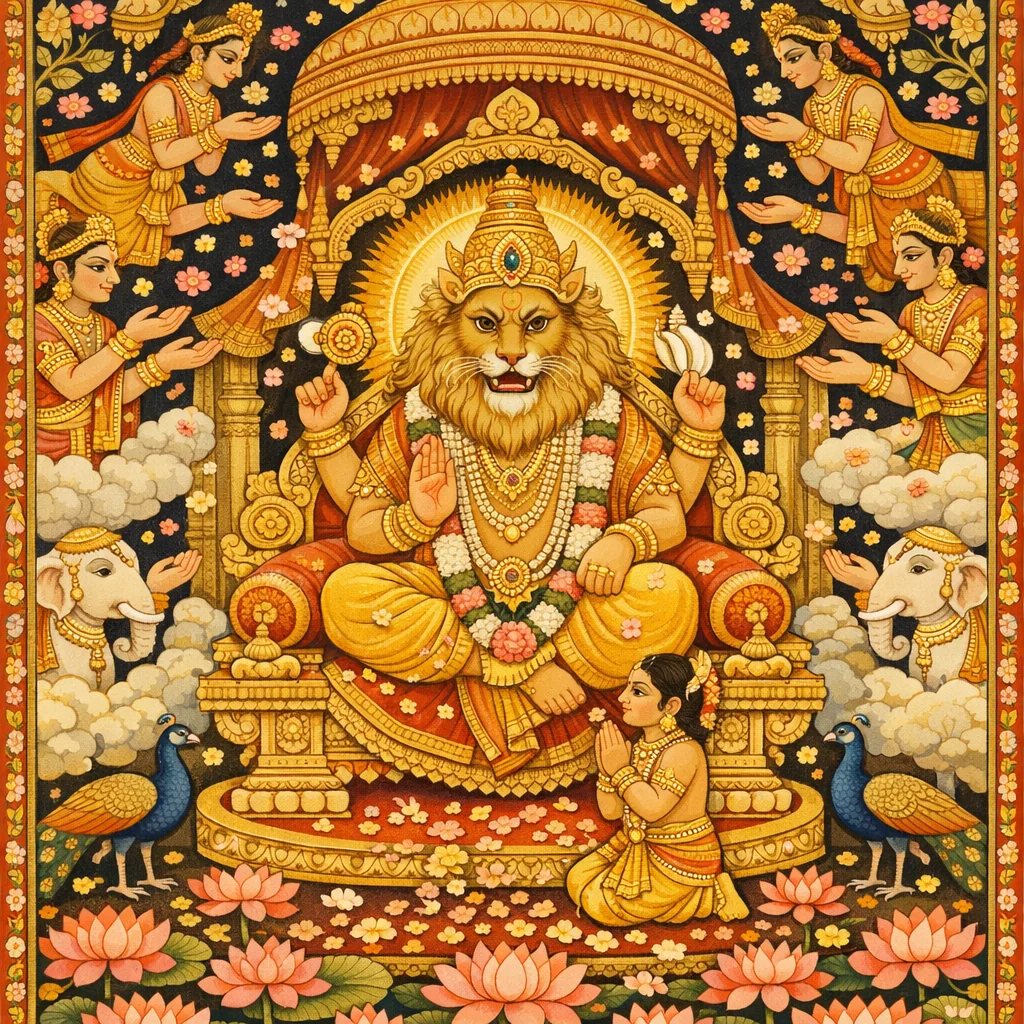
Adhyaya 10
Prahlāda Rejects Material Boons; Forgives His Father; Tripura and the Power of Remembrance
After Hiraṇyakaśipu is slain and the Lord offers benedictions, Prahlāda—though still a child—politely refuses all material rewards, seeing boons as obstacles to bhakti, and prays only for freedom from desire (niṣkāmatā). Nṛsiṁhadeva affirms his purity yet instructs him to rule the daityas as king, living in the world while remaining absorbed in hearing and remembrance, thereby exhausting karmic reactions. Prahlāda asks one boon: forgiveness for his father’s offenses; the Lord declares Hiraṇyakaśipu and twenty-one forefathers purified, showing how a devotee sanctifies a lineage and a place. Prahlāda performs śrāddha and is enthroned; Brahmā offers prayers, and the Lord warns against granting dangerous boons to demons. Nārada connects this to liberation theology: the Lord’s associates repeatedly take birth as enemies (Hiraṇyākṣa/Hiraṇyakaśipu → Rāvaṇa/Kumbhakarṇa → Śiśupāla/Dantavakra) and attain sārūpya through intense absorption. The chapter ends by turning to Yudhiṣṭhira’s question about Maya Dānava’s Tripura episode and Kṛṣṇa’s role in restoring Śiva’s glory, setting up the next narrative arc.
Shlokas
Verse 1
श्रीनारद उवाच भक्तियोगस्य तत्सर्वमन्तरायतयार्भक: । मन्यमानो हृषीकेशं स्मयमान उवाच ह ॥ १ ॥
Nārada Muni continued: Though Prahlāda was only a boy, on hearing the benedictions offered by Lord Nṛsiṁhadeva he regarded them as obstacles on the path of bhakti-yoga. Smiling gently, he spoke as follows.
Verse 2
श्रीप्रह्राद उवाच मा मां प्रलोभयोत्पत्त्या सक्तं कामेषु तैर्वरै: । तत्सङ्गभीतो निर्विण्णो मुमुक्षुस्त्वामुपाश्रित: ॥ २ ॥
Prahlāda Mahārāja said: My Lord, Supreme Personality of Godhead, please do not tempt me with these boons; by birth I am naturally inclined toward sense enjoyment. Fearing material entanglement, I am weary of it and seek liberation; therefore I have taken shelter of Your lotus feet.
Verse 3
भृत्यलक्षणजिज्ञासुर्भक्तं कामेष्वचोदयत् । भवान् संसारबीजेषु हृदयग्रन्थिषु प्रभो ॥ ३ ॥
O worshipable Lord, since the seed of lust—root of material existence—lies knotted within the heart, You have sent me into this world to display the symptoms of a pure devotee.
Verse 4
नान्यथा तेऽखिलगुरो घटेत करुणात्मन: । यस्त आशिष आशास्ते न स भृत्य: स वै वणिक् ॥ ४ ॥
O supreme teacher of the world, compassionate Lord, You would never impel Your devotee toward what is harmful. One who performs devotion seeking material gain is not a pure devotee; he is like a merchant seeking profit.
Verse 5
आशासानो न वै भृत्य: स्वामिन्याशिष आत्मन: । न स्वामी भृत्यत: स्वाम्यमिच्छन्यो राति चाशिष: ॥ ५ ॥
A servant who longs for material gain from his master is not a qualified servant or pure devotee. Likewise, a master who grants boons to preserve his own prestige as “master” is also not a pure master.
Verse 6
अहं त्वकामस्त्वद्भक्तस्त्वं च स्वाम्यनपाश्रय: । नान्यथेहावयोरर्थो राजसेवकयोरिव ॥ ६ ॥
O my Lord, I am Your desireless devotee and servant, and You are my eternal master. We need no other bond than master and servant, like a king and his attendant.
Verse 7
यदि दास्यसि मे कामान्वरांस्त्वं वरदर्षभ । कामानां हृद्यसंरोहं भवतस्तु वृणे वरम् ॥ ७ ॥
O best of benediction-givers, if You wish to grant me a boon, then I choose this: may no sprout of material desire ever arise within the core of my heart.
Verse 8
इन्द्रियाणि मन: प्राण आत्मा धर्मो धृतिर्मति: । ह्री: श्रीस्तेज: स्मृति: सत्यं यस्य नश्यन्ति जन्मना ॥ ८ ॥
O my Lord, from the very beginning of birth, lusty desire destroys one’s senses, mind, vital air, body, dharma, patience, intelligence, modesty, opulence, strength, memory, and truthfulness.
Verse 9
विमुञ्चति यदा कामान्मानवो मनसि स्थितान् । तर्ह्येव पुण्डरीकाक्ष भगवत्त्वाय कल्पते ॥ ९ ॥
O Pundarīkākṣa, when a person gives up all material desires dwelling in the mind, then indeed he becomes fit for divine opulence like Yours.
Verse 10
ॐ नमो भगवते तुभ्यं पुरुषाय महात्मने । हरयेऽद्भुतसिंहाय ब्रह्मणे परमात्मने ॥ १० ॥
Om. I offer my respectful obeisances unto You, O Bhagavān—the Supreme Person and Great Soul; O Hari who destroys all misery; O wondrous Narasiṁha, O Brahman, O Paramātmā.
Verse 11
श्रीभगवानुवाच नैकान्तिनो मे मयि जात्विहाशिष आशासतेऽमुत्र च ये भवद्विधा: । तथापि मन्वन्तरमेतदत्र दैत्येश्वराणामनुभुङ्क्ष्व भोगान् ॥ ११ ॥
The Supreme Lord said: My dear Prahlāda, an exclusive devotee like you never longs for material opulence, either in this life or the next. Nevertheless, I command you: until the end of this manvantara, enjoy the daityas’ opulences in this world and rule as their king.
Verse 12
कथा मदीया जुषमाण: प्रियास्त्व- मावेश्य मामात्मनि सन्तमेकम् । सर्वेषु भूतेष्वधियज्ञमीशं यजस्व योगेन च कर्म हिन्वन् ॥ १२ ॥
Though you are in the material world, always hear and relish My beloved teachings, and fix Me within your heart as the one Paramātmā, remaining ever absorbed in Me. I am the Lord Adhiyajña dwelling within all beings; therefore worship Me through yoga and abandon fruit-seeking actions.
Verse 13
भोगेन पुण्यं कुशलेन पापं कलेवरं कालजवेन हित्वा । कीर्तिं विशुद्धां सुरलोकगीतां विताय मामेष्यसि मुक्तबन्ध: ॥ १३ ॥
My dear Prahlāda, in this world you will exhaust the fruits of piety by experiencing happiness, and by righteous conduct you will neutralize sin. Driven by the swift force of time you will give up the body, yet your spotless fame will be sung in the heavenly realms; freed from all bondage, you will return to My abode, back to Godhead.
Verse 14
य एतत्कीर्तयेन्मह्यं त्वया गीतमिदं नर: । त्वां च मां च स्मरन्काले कर्मबन्धात्प्रमुच्यते ॥ १४ ॥
One who chants for Me this prayer you have sung, and who in due time remembers both you and Me, becomes gradually freed from the bondage of karma.
Verse 15
श्रीप्रह्राद उवाच वरं वरय एतत्ते वरदेशान्महेश्वर । यदनिन्दत्पिता मे त्वामविद्वांस्तेज ऐश्वरम् ॥ १५ ॥ विद्धामर्षाशय: साक्षात्सर्वलोकगुरुं प्रभुम् । भ्रातृहेति मृषादृष्टिस्त्वद्भक्ते मयि चाघवान् ॥ १६ ॥ तस्मात्पिता मे पूयेत दुरन्ताद् दुस्तरादघात् । पूतस्तेऽपाङ्गसंदृष्टस्तदा कृपणवत्सल ॥ १७ ॥
Prahlāda Mahārāja said: O Mahā-īśvara, bestower of boons, compassionate to the fallen, I ask only one benediction. My father, not knowing Your radiant power and supremacy, became angry and blasphemed You, falsely thinking, “You are the slayer of my brother,” and he committed grievous sin against me, Your devotee. Please forgive him those offenses.
Verse 16
श्रीप्रह्राद उवाच वरं वरय एतत्ते वरदेशान्महेश्वर । यदनिन्दत्पिता मे त्वामविद्वांस्तेज ऐश्वरम् ॥ १५ ॥ विद्धामर्षाशय: साक्षात्सर्वलोकगुरुं प्रभुम् । भ्रातृहेति मृषादृष्टिस्त्वद्भक्ते मयि चाघवान् ॥ १६ ॥ तस्मात्पिता मे पूयेत दुरन्ताद् दुस्तरादघात् । पूतस्तेऽपाङ्गसंदृष्टस्तदा कृपणवत्सल ॥ १७ ॥
Not recognizing You as the manifest Lord, the spiritual master of all worlds, he harbored anger and, with the false notion “killer of my brother,” sinned even against me, Your devotee. O Lord, please forgive his offense.
Verse 17
श्रीप्रह्राद उवाच वरं वरय एतत्ते वरदेशान्महेश्वर । यदनिन्दत्पिता मे त्वामविद्वांस्तेज ऐश्वरम् ॥ १५ ॥ विद्धामर्षाशय: साक्षात्सर्वलोकगुरुं प्रभुम् । भ्रातृहेति मृषादृष्टिस्त्वद्भक्ते मयि चाघवान् ॥ १६ ॥ तस्मात्पिता मे पूयेत दुरन्ताद् दुस्तरादघात् । पूतस्तेऽपाङ्गसंदृष्टस्तदा कृपणवत्सल ॥ १७ ॥
Therefore, may my father be fully purified of that terrible, hard-to-cross sin. O Lord, tender to the fallen, at that time he was already cleansed by Your merciful sidelong glance; still, let his purification be complete.
Verse 18
श्रीभगवानुवाच त्रि:सप्तभि: पिता पूत: पितृभि: सह तेऽनघ । यत्साधोऽस्य कुले जातो भवान्वै कुलपावन: ॥ १८ ॥
The Supreme Lord said: “O Prahlāda, sinless saint! Because you were born in this lineage, the whole dynasty is purified; your father, together with twenty-one forefathers, has been cleansed, for you are the purifier of the family.”
Verse 19
यत्र यत्र च मद्भक्ता: प्रशान्ता: समदर्शिन: । साधव: समुदाचारास्ते पूयन्तेऽपि कीकटा: ॥ १९ ॥
Wherever My devotees are—peaceful, equipoised, equal-seeing, and of noble conduct—that place and the lineages there, even if condemned, become purified.
Verse 20
सर्वात्मना न हिंसन्ति भूतग्रामेषु किञ्चन । उच्चावचेषु दैत्येन्द्र मद्भावविगतस्पृहा: ॥ २० ॥
My dear Prahlāda, king of the Daityas: absorbed in devotion to Me, My devotee never harms any living being, sees no higher or lower, and is free from envy toward all.
Verse 21
भवन्ति पुरुषा लोके मद्भक्तास्त्वामनुव्रता: । भवान्मे खलु भक्तानां सर्वेषां प्रतिरूपधृक् ॥ २१ ॥
Those in this world who follow your example will naturally become My pure devotees. You are indeed the finest model of My devotee, and others should walk in your footsteps.
Verse 22
कुरु त्वं प्रेतकृत्यानि पितु: पूतस्य सर्वश: । मदङ्गस्पर्शनेनाङ्ग लोकान्यास्यति सुप्रजा: ॥ २२ ॥
My child, perform all the post-death rites for your purified father. Though he was already cleansed by the touch of My body at his death, it is a son’s duty to offer śrāddha, so he may attain higher worlds and become a worthy citizen and devotee.
Verse 23
पित्र्यं च स्थानमातिष्ठ यथोक्तं ब्रह्मवादिभि: । मय्यावेश्य मनस्तात कुरु कर्माणि मत्पर: ॥ २३ ॥
As the brahma-vādīs have instructed, take up your father’s royal seat. My child, fix your mind upon Me; without transgressing the Vedic injunctions, perform your duties with Me as your supreme aim.
Verse 24
श्रीनारद उवाच प्रह्रादोऽपि तथा चक्रे पितुर्यत्साम्परायिकम् । यथाह भगवान् राजन्नभिषिक्तो द्विजातिभि: ॥ २४ ॥
Śrī Nārada said: O King Yudhiṣṭhira, just as Bhagavān commanded, Prahlāda performed the final rites for his father; then, as directed by the dvija brāhmaṇas, he was anointed and enthroned in Hiraṇyakaśipu’s kingdom.
Verse 25
प्रसादसुमुखं दृष्ट्वा ब्रह्मा नरहरिं हरिम् । स्तुत्वा वाग्भि: पवित्राभि: प्राह देवादिभिर्वृत: ॥ २५ ॥
Seeing Hari Nara-hari’s face bright with divine pleasure, Brahmā, surrounded by the other devas, offered pure, sanctifying prayers and then spoke his supplication.
Verse 26
श्रीब्रह्मोवाच देवदेवाखिलाध्यक्ष भूतभावन पूर्वज । दिष्टया ते निहत: पापो लोकसन्तापनोऽसुर: ॥ २६ ॥
Lord Brahmā said: O God of gods, Lord of the entire universe, benefactor of all beings, O Ādi-puruṣa—by our good fortune You have slain that sinful asura who was tormenting all the worlds.
Verse 27
योऽसौ लब्धवरो मत्तो न वध्यो मम सृष्टिभि: । तपोयोगबलोन्नद्ध: समस्तनिगमानहन् ॥ २७ ॥
That asura, Hiraṇyakaśipu, had received from me the boon that no living being within my creation could kill him. Relying on that assurance, and intoxicated by the power of austerity and yoga, he grew exceedingly proud and violated all Vedic injunctions.
Verse 28
दिष्टया तत्तनय: साधुर्महाभागवतोऽर्भक: । त्वया विमोचितो मृत्योर्दिष्टया त्वां समितोऽधुना ॥ २८ ॥
By great fortune, Prahlāda Mahārāja, the son of Hiraṇyakaśipu, though only a child, is an exalted devotee and has now been freed from death. Now he rests fully under the shelter of Your lotus feet.
Verse 29
एतद् वपुस्ते भगवन्ध्यायत: परमात्मन: । सर्वतो गोप्तृ सन्त्रासान्मृत्योरपि जिघांसत: ॥ २९ ॥
My dear Lord, O Supreme Personality of Godhead, O Paramātmā, You are the protector in all directions. One who meditates upon Your transcendental form is naturally safeguarded from every fear, even from the imminent peril of death.
Verse 30
श्रीभगवानुवाच मैवं विभोऽसुराणां ते प्रदेय: पद्मसम्भव । वर: क्रूरनिसर्गाणामहीनाममृतं यथा ॥ ३० ॥
The Supreme Lord replied: O Brahmā, born from the lotus, do not grant boons to the asuras; to bless those who are by nature cruel and envious is like feeding milk to a serpent—most dangerous. Therefore, do not again give such benedictions to any demon.
Verse 31
श्रीनारद उवाच इत्युक्त्वा भगवान् राजंस्ततश्चान्तर्दधे हरि: । अदृश्य: सर्वभूतानां पूजित: परमेष्ठिना ॥ ३१ ॥
Nārada Muni continued: O King Yudhiṣṭhira, having spoken thus to instruct Lord Brahmā, Hari—unseen by ordinary beings—was worshiped by Brahmā and then disappeared from that place.
Verse 32
तत: सम्पूज्य शिरसा ववन्दे परमेष्ठिनम् । भवं प्रजापतीन्देवान्प्रह्रादो भगवत्कला: ॥ ३२ ॥
Thereafter Prahlāda, a partial manifestation (kalā) of the Lord, bowed his head and offered reverence to Pārameṣṭhī Brahmā; he also paid homage to Śiva, the prajāpatis, and all the devas, for they are all parts of the Supreme Lord.
Verse 33
तत: काव्यादिभि: सार्धं मुनिभि: कमलासन: । दैत्यानां दानवानां च प्रह्रादमकरोत्पतिम् ॥ ३३ ॥
Thereafter, accompanied by Śukrācārya and other great sages, lotus-seated Lord Brahmā installed Prahlāda as the sovereign of all the Daityas and Dānavas.
Verse 34
प्रतिनन्द्य ततो देवा: प्रयुज्य परमाशिष: । स्वधामानि ययू राजन्ब्रह्माद्या: प्रतिपूजिता: ॥ ३४ ॥
O King, once Prahlāda had properly worshiped the demigods headed by Lord Brahmā, they bestowed their highest blessings upon him and returned to their own abodes.
Verse 35
एवं च पार्षदौ विष्णो: पुत्रत्वं प्रापितौ दिते: । हृदि स्थितेन हरिणा वैरभावेन तौ हतौ ॥ ३५ ॥
Thus the two attendants of Lord Viṣṇu, who had become Hiraṇyākṣa and Hiraṇyakaśipu, the sons of Diti, were both slain, for in delusion they regarded Hari, dwelling in the heart, as their enemy.
Verse 36
पुनश्च विप्रशापेन राक्षसौ तौ बभूवतु: । कुम्भकर्णदशग्रीवौ हतौ तौ रामविक्रमै: ॥ ३६ ॥
Again, by the curse of the brāhmaṇas, those two were born as the Rākṣasas Kumbhakarṇa and ten-headed Rāvaṇa, and both were slain by the extraordinary prowess of Lord Rāmacandra.
Verse 37
शयानौ युधि निर्भिन्नहृदयौ रामशायकै: । तच्चित्तौ जहतुर्देहं यथा प्राक्तनजन्मनि ॥ ३७ ॥
Pierced in battle by the arrows of Lord Rāmacandra, their hearts torn asunder, they lay upon the ground and, their minds absorbed in the Lord, abandoned their bodies—just as in their former births.
Verse 38
ताविहाथ पुनर्जातौ शिशुपालकरूषजौ । हरौ वैरानुबन्धेन पश्यतस्ते समीयतु: ॥ ३८ ॥
The two were born again among men as Śiśupāla and Dantavakra, bound by the same enmity toward Hari; and in your very presence, at the end, they merged into the Lord’s own body.
Verse 39
एन: पूर्वकृतं यत् तद् राजान: कृष्णवैरिण: । जहुस्तेऽन्ते तदात्मान: कीट: पेशस्कृतो यथा ॥ ३९ ॥
Not only Śiśupāla and Dantavakra—many kings who were enemies of Kṛṣṇa also cast off their former sin at death. Because their minds dwelt on the Lord, they received spiritual forms like His, just as worms seized by a black drone attain a body of the same kind as the drone.
Verse 40
यथा यथा भगवतो भक्त्या परमयाभिदा । नृपाश्चैद्यादय: सात्म्यं हरेस्तच्चिन्तया ययु: ॥ ४० ॥
By pure devotional service, those devotees who ceaselessly meditate on the Supreme Personality of Godhead attain a form like His—this is called sārūpya-mukti. Though Śiśupāla, Dantavakra, and other kings thought of Kṛṣṇa as an enemy, they too achieved the same result.
Verse 41
आख्यातं सर्वमेतत्ते यन्मां त्वं परिपृष्टवान् । दमघोषसुतादीनां हरे: सात्म्यमपि द्विषाम् ॥ ४१ ॥
I have now explained to you everything you asked—how the son of Damaghoṣa and other inimical souls nonetheless attained oneness in likeness with Hari.
Verse 42
एषा ब्रह्मण्यदेवस्य कृष्णस्य च महात्मन: । अवतारकथा पुण्या वधो यत्रादिदैत्ययो: ॥ ४२ ॥
This is the sacred narration of Śrī Kṛṣṇa, the great Brahmaṇya-deva—the Supreme Personality of Godhead—wherein the Lord’s various expansions and incarnations are described, and also the slaying of the two primeval demons Hiraṇyākṣa and Hiraṇyakaśipu is recounted.
Verse 43
प्रह्रादस्यानुचरितं महाभागवतस्य च । भक्तिर्ज्ञानं विरक्तिश्च याथार्थ्यं चास्य वै हरे: ॥ ४३ ॥ सर्गस्थित्यप्ययेशस्य गुणकर्मानुवर्णनम् । परावरेषां स्थानानां कालेन व्यत्ययो महान् ॥ ४४ ॥
Here is told the life of Prahlāda Mahārāja, the great bhāgavata—his unwavering devotional service, perfect spiritual knowledge, complete detachment from material taint, and the true nature of Śrī Hari.
Verse 44
प्रह्रादस्यानुचरितं महाभागवतस्य च । भक्तिर्ज्ञानं विरक्तिश्च याथार्थ्यं चास्य वै हरे: ॥ ४३ ॥ सर्गस्थित्यप्ययेशस्य गुणकर्मानुवर्णनम् । परावरेषां स्थानानां कालेन व्यत्ययो महान् ॥ ४४ ॥
It also proclaims the Supreme Lord as the cause of creation, maintenance, and dissolution, praises His transcendental qualities and deeds, and shows that the abodes of devas and asuras—however opulent—are undone by time by the Lord’s mere command.
Verse 45
धर्मो भागवतानां च भगवान्येन गम्यते । आख्यानेऽस्मिन्समाम्नातमाध्यात्मिकमशेषत: ॥ ४५ ॥
The religious principles by which one truly understands the Supreme Personality of Godhead are called bhāgavata-dharma; thus, in this narration the full spiritual truth is properly set forth.
Verse 46
य एतत्पुण्यमाख्यानं विष्णोर्वीर्योपबृंहितम् । कीर्तयेच्छ्रद्धया श्रुत्वा कर्मपाशैर्विमुच्यते ॥ ४६ ॥
Whoever, with faith, hears and chants this sacred narration glorifying Viṣṇu’s omnipotence is certainly freed from the bonds of karma.
Verse 47
एतद्य आदिपुरुषस्य मृगेन्द्रलीलां दैत्येन्द्रयूथपवधं प्रयत: पठेत । दैत्यात्मजस्य च सतां प्रवरस्य पुण्यं श्रुत्वानुभावमकुतोभयमेति लोकम् ॥ ४७ ॥
Prahlāda, best among exalted devotees: whoever attentively reads or devotionally hears of the Ādi-Puruṣa Nṛsiṁhadeva’s lionlike līlā, the slaying of Hiraṇyakaśipu, and Prahlāda’s holy glory surely attains Vaikuṇṭha, the fearless spiritual world.
Verse 48
यूयं नृलोके बत भूरिभागा लोकं पुनाना मुनयोऽभियन्ति । येषां गृहानावसतीति साक्षाद् गूढं परं ब्रह्म मनुष्यलिङ्गम् ॥ ४८ ॥
Nārada Muni said: O Mahārāja Yudhiṣṭhira, you Pāṇḍavas are most fortunate, for Śrī Kṛṣṇa—the hidden Supreme Brahman—dwells in your palace in human guise. Knowing this, the great sages who purify the world continually visit your home.
Verse 49
स वा अयं ब्रह्म महद्विमृग्य- कैवल्यनिर्वाणसुखानुभूति: । प्रिय: सुहृद् व: खलु मातुलेय आत्मार्हणीयो विधिकृद्गुरुश्च ॥ ४९ ॥
Kṛṣṇa Himself is Brahman, for He is the very source of the impersonal Brahman. From Him arises the bliss of kaivalya and nirvāṇa sought by great sages; yet that same Supreme Person is your dearest friend and constant well-wisher, intimately related to you as your maternal cousin. He is as your very body and soul—worshipable, yet acting as your servant and at times as your spiritual master.
Verse 50
न यस्य साक्षाद्भवपद्मजादिभी रूपं धिया वस्तुतयोपवर्णितम् । मौनेन भक्त्योपशमेन पूजित: प्रसीदतामेष स सात्वतां पति: ॥ ५० ॥
Even exalted beings like Śiva and Brahmā could not properly describe the truth of His form. May Śrī Kṛṣṇa, Lord of the Sātvatas and protector of the bhaktas—worshiped by sages through vows of silence, meditation, devotion, and renunciation—be pleased with us.
Verse 51
स एष भगवान् राजन्व्यतनोद्विहतं यश: । पुरा रुद्रस्य देवस्य मयेनानन्तमायिना ॥ ५१ ॥
O King Yudhiṣṭhira, long ago the demon Maya Dānava, endowed with limitless mystic illusion, diminished the fame of Lord Rudra (Śiva). At that time, Bhagavān Śrī Kṛṣṇa saved Śiva and restored his injured glory.
Verse 52
राजोवाच कस्मिन्कर्मणि देवस्य मयोऽहञ्जगदीशितु: । यथा चोपचिता कीर्ति: कृष्णेनानेन कथ्यताम् ॥ ५२ ॥
Mahārāja Yudhiṣṭhira said: By what deed did Maya Dānava undermine the fame of Lord Rudra (Śiva), the ruler of the universe? And how did Śrī Kṛṣṇa save Śiva and cause his glory to flourish again? Kindly describe these events.
Verse 53
श्रीनारद उवाच निर्जिता असुरा देवैर्युध्यनेनोपबृंहितै: । मायिनां परमाचार्यं मयं शरणमाययु: ॥ ५३ ॥
Śrī Nārada said: When the demigods, empowered by the mercy of Lord Kṛṣṇa, fought the asuras, the asuras were defeated; therefore they took shelter of Maya Dānava, the foremost master of illusion among the demons.
Verse 54
स निर्माय पुरस्तिस्रो हैमीरौप्यायसीर्विभु: । दुर्लक्ष्यापायसंयोगा दुर्वितर्क्यपरिच्छदा: ॥ ५४ ॥ ताभिस्तेऽसुरसेनान्यो लोकांस्त्रीन् सेश्वरान्नृप । स्मरन्तो नाशयां चक्रु: पूर्ववैरमलक्षिता: ॥ ५५ ॥
Maya Dānava fashioned three residences—of gold, silver, and iron—hard to perceive and furnished with wondrous implements; by them the asura commanders remained unseen by the demigods.
Verse 55
स निर्माय पुरस्तिस्रो हैमीरौप्यायसीर्विभु: । दुर्लक्ष्यापायसंयोगा दुर्वितर्क्यपरिच्छदा: ॥ ५४ ॥ ताभिस्तेऽसुरसेनान्यो लोकांस्त्रीन् सेश्वरान्नृप । स्मरन्तो नाशयां चक्रु: पूर्ववैरमलक्षिता: ॥ ५५ ॥
O King, by those three residences the asura commanders remained invisible to the demigods; remembering their former enmity, they began to devastate the three worlds—upper, middle, and lower—along with their rulers.
Verse 56
ततस्ते सेश्वरा लोका उपासाद्येश्वरं नता: । त्राहि नस्तावकान्देव विनष्टांस्त्रिपुरालयै: ॥ ५६ ॥
Thereafter the rulers of the three worlds approached Lord Śiva, bowed down, and said: “Save us, O Deva. We are yours, yet the dwellers of Tripura are about to destroy us.”
Verse 57
अथानुगृह्य भगवान्मा भैष्टेति सुरान्विभु: । शरं धनुषि सन्धाय पुरेष्वस्त्रं व्यमुञ्चत ॥ ५७ ॥
Then the all-powerful Lord Śiva, showing them mercy, said, “Do not be afraid.” Fixing an arrow to his bow, he released his weapon toward the three demonic residences.
Verse 58
ततोऽग्निवर्णा इषव उत्पेतु: सूर्यमण्डलात् । यथा मयूखसन्दोहा नादृश्यन्त पुरो यत: ॥ ५८ ॥
Then, from the sun globe, fiery-hued arrows sprang forth like clustered sunbeams and shrouded Tripura’s three aerial dwellings, so that they could no longer be seen.
Verse 59
तै: स्पृष्टा व्यसव: सर्वे निपेतु: स्म पुरौकस: । तानानीय महायोगी मय: कूपरसेऽक्षिपत् ॥ ५९ ॥
Struck by those arrows, all the demoniac residents of Tripura lost their lives and fell. Then the great mystic Maya Dānava gathered them and cast them into the nectarean well he had made.
Verse 60
सिद्धामृतरसस्पृष्टा वज्रसारा महौजस: । उत्तस्थुर्मेघदलना वैद्युता इव वह्नय: ॥ ६० ॥
When their bodies touched the perfected nectar, they became adamant like the vajra—invincible and filled with great might—and rose again like lightning piercing the clouds.
Verse 61
विलोक्य भग्नसङ्कल्पं विमनस्कं वृषध्वजम् । तदायं भगवान्विष्णुस्तत्रोपायमकल्पयत् ॥ ६१ ॥
Seeing Śiva, the bearer of the bull banner, distressed and disheartened by his thwarted resolve, Lord Viṣṇu considered a means to end the disturbance wrought by Maya Dānava.
Verse 62
वत्सश्चासीत्तदा ब्रह्मा स्वयं विष्णुरयं हि गौ: । प्रविश्य त्रिपुरं काले रसकूपामृतं पपौ ॥ ६२ ॥
Then Brahmā became a calf and Viṣṇu Himself became a cow; at noon they entered Tripura and drank up all the nectar in the well.
Verse 63
तेऽसुरा ह्यपि पश्यन्तो न न्यषेधन्विमोहिता: । तद्विज्ञाय महायोगी रसपालानिदं जगौ । स्मयन्विशोक: शोकार्तान्स्मरन्दैवगतिं च ताम् ॥ ६३ ॥
Although the demons saw the calf and the cow, bewildered by the Supreme Lord’s māyā they could not forbid them. The great mystic Maya Dānava understood that they were drinking the nectar and perceived in it the unseen force of divine providence; thus, smiling and free from grief, he spoke to the demons who were lamenting.
Verse 64
देवोऽसुरो नरोऽन्यो वा नेश्वरोऽस्तीह कश्चन । आत्मनोऽन्यस्य वा दिष्टं दैवेनापोहितुं द्वयो: ॥ ६४ ॥
Maya Dānava said: Whether one is a deva, an asura, a human, or anyone else, no one anywhere can undo what divine destiny has ordained—for oneself, for another, or for both.
Verse 65
अथासौ शक्तिभि: स्वाभि: शम्भो: प्राधानिकं व्यधात् । धर्मज्ञानविरक्त्यृद्धितपोविद्याक्रियादिभि: ॥ ६५ ॥ रथं सूतं ध्वजं वाहान्धनुर्वर्मशरादि यत् । सन्नद्धो रथमास्थाय शरं धनुरुपाददे ॥ ६६ ॥
Nārada Muni continued: Thereafter, Lord Kṛṣṇa, by His own personal potencies—dharma, knowledge, renunciation, opulence, austerity, learning, and sacred action—equipped Śambhu (Lord Śiva) with the chief implements of war: a chariot, a charioteer, a banner, mounts, a bow, armor, and arrows. Fully armed, Śiva mounted the chariot and took up his bow and arrows.
Verse 66
अथासौ शक्तिभि: स्वाभि: शम्भो: प्राधानिकं व्यधात् । धर्मज्ञानविरक्त्यृद्धितपोविद्याक्रियादिभि: ॥ ६५ ॥ रथं सूतं ध्वजं वाहान्धनुर्वर्मशरादि यत् । सन्नद्धो रथमास्थाय शरं धनुरुपाददे ॥ ६६ ॥
Nārada Muni continued: Thereafter, Lord Kṛṣṇa, by His own personal potencies—dharma, knowledge, renunciation, opulence, austerity, learning, and sacred action—equipped Śambhu (Lord Śiva) with the chief implements of war: a chariot, a charioteer, a banner, mounts, a bow, armor, and arrows. Fully armed, Śiva mounted the chariot and took up his bow and arrows.
Verse 67
शरं धनुषि सन्धाय मुहूर्तेऽभिजितीश्वर: । ददाह तेन दुर्भेद्या हरोऽथ त्रिपुरो नृप ॥ ६७ ॥
My dear King Yudhiṣṭhira, the supremely powerful Lord Śiva set an arrow to his bow at the Abhijit hour (midday) and, by that arrow, burned and destroyed the impregnable Tripura.
Verse 68
दिवि दुन्दुभयो नेदुर्विमानशतसङ्कुला: । देवर्षिपितृसिद्धेशा जयेति कुसुमोत्करै: । अवाकिरञ्जगुर्हृष्टा ननृतुश्चाप्सरोगणा: ॥ ६८ ॥
In the heavens, the residents of the higher worlds, seated in countless vimānas, resounded the dundubhi drums. The devas, devarṣis, pitṛs, siddhas, and other great beings cried “Jaya!” and showered Lord Śiva’s head with heaps of flowers, while the apsarās sang and danced in delight.
Verse 69
एवं दग्ध्वा पुरस्तिस्रो भगवान्पुरहा नृप । ब्रह्मादिभि: स्तूयमान: स्वं धाम प्रत्यपद्यत ॥ ६९ ॥
O King, thus, after burning the three cities to ashes, Lord Śiva became renowned as Tripurāri, the destroyer of Tripura. Worshiped and praised by the devas headed by Lord Brahmā, Śiva returned to his own abode.
Verse 70
एवं विधान्यस्य हरे: स्वमायया विडम्बमानस्य नृलोकमात्मन: । वीर्याणि गीतान्यृषिभिर्जगद्गुरो- र्लोकं पुनानान्यपरं वदामि किम् ॥ ७० ॥
Thus the Lord, Śrī Kṛṣṇa, by His own yogamāyā, appeared in the human world as if an ordinary man, yet displayed many rare and wondrous deeds. These glories of the Jagad-guru have already been sung by the ṛṣis and they purify the world; what more can I say? Simply by hearing them from the proper source, one becomes cleansed.
Frequently Asked Questions
Prahlāda views material boons as impediments because they nourish the seed of desire (kāma-bīja) that sustains saṁsāra. His devotion is unmotivated (ahaitukī), so he refuses a merchant-like exchange and asks only that no material desire remain in his heart—preserving the purity of bhakti.
The Lord instructs Prahlāda to rule as duty (dharma) without fruitive mentality, continuously hearing and remembering Him as the indwelling Supersoul. In this way, rulership becomes service (sevā), karmic reactions are exhausted under the time factor, and consciousness remains fixed in bhakti rather than in enjoyment or prestige.
The Lord states that Prahlāda’s father and twenty-one forefathers are purified; moreover, places and dynasties become purified wherever peaceful, well-behaved devotees reside. The principle is that bhakti is supremely purifying (pāvana) and that saintly association sanctifies even condemned lineages by connecting them to Bhagavān.
Nārada explains that intense absorption in the Lord—even through hostility—fixes the mind on Him at death, leading to liberation and, in these cases, sārūpya (a form similar to the Lord’s). This does not equate enmity with devotion as a practice; it demonstrates the Lord’s absolute position and the transformative power of uninterrupted remembrance.
The Lord compares it to feeding milk to a snake: the gift increases the recipient’s capacity for harm when their nature is jealous and violent. The warning teaches discernment in cosmic administration and underscores that power without purification of consciousness leads to adharma and universal disturbance.