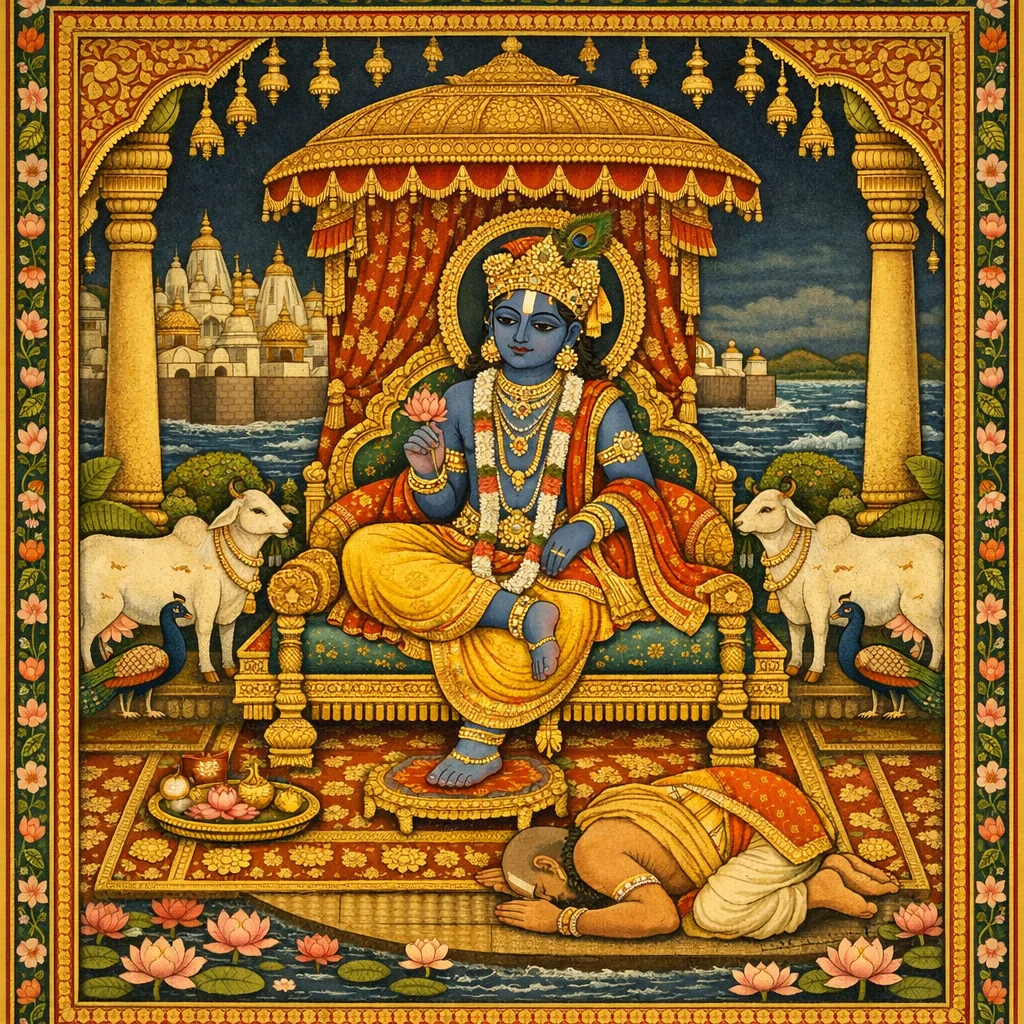
Adhyaya 7
Kṛṣṇa’s Impending Departure; Uddhava’s Surrender; King Yadu and the Avadhūta’s Twenty-Four Gurus (Beginnings)
Lord Kṛṣṇa affirms Uddhava’s insight that the Yadu dynasty will be withdrawn and that the devas pray for His return to Vaikuṇṭha. He foretells the Yadus’ ruin through internecine strife born of the brāhmaṇas’ curse, and predicts Dvārakā’s inundation within seven days. Seeing Kali-yuga’s ascendancy, Kṛṣṇa instructs Uddhava to depart, renounce attachment to kin and social identity, cultivate equal vision, and regard the world as māyā—temporary objects misconstrued through the dualities of good and evil. Uddhava confesses his bondage to bodily identification and begs for an easy means of renunciation, surrendering to Kṛṣṇa as the only perfect Teacher. The Lord then introduces a model teaching: at times one’s own sharpened intelligence becomes an instructing guru, and He turns to an ancient narration—King Yadu’s meeting with an avadhūta brāhmaṇa. The avadhūta declares he learned from twenty-four gurus in nature and society, beginning with lessons from earth, wind, sky, water, fire, moon, and sun, and concluding here with the cautionary pigeon allegory against excessive family attachment. Thus this chapter bridges Kṛṣṇa’s final counsel to Uddhava with the avadhūta’s extended instruction that continues in later chapters.
Shlokas
Verse 1
श्रीभगवानुवाच । यद् āt्था मां महाभाग तच्चिकīर्षितम् एव मे । ब्रह्मा भवो लोकपालाः स्वर्-वाःसं मे अभिकाङ्क्षिणः ॥ १ ॥
The Supreme Lord said: O most fortunate Uddhava, you have rightly spoken My intent—to withdraw the Yadu dynasty from the earth and return to My own abode, Vaikuṇṭha; therefore Brahmā, Bhava (Śiva), and the rulers of the worlds now pray for Me to resume My residence there.
Verse 2
मया निष्पादितं ह्यत्र देवकार्यमशेषत: । यदर्थमवतीर्णोऽहमंशेन ब्रह्मणार्थित: ॥ २ ॥
I have now fully carried out the work of the devas in this world; the purpose for which I descended at Brahmā’s request, together with My plenary portion Lord Baladeva, has been accomplished.
Verse 3
कुलं वै शापनिर्दग्धं नङ्क्ष्यत्यन्योन्यविग्रहात् । समुद्र: सप्तमे ह्येनां पुरीं च प्लावयिष्यति ॥ ३ ॥
By the brāhmaṇas’ curse, the Yadu dynasty will surely perish through mutual strife; and on the seventh day from today the ocean will rise and inundate the city of Dvārakā.
Verse 4
यर्ह्येवायं मया त्यक्तो लोकोऽयं नष्टमङ्गल: । भविष्यत्यचिरात्साधो कलिनापि निराकृत: ॥ ४ ॥
O saintly Uddhava, when I abandon this world, the earth will soon be overwhelmed by the Age of Kali and will be bereft of all piety and auspiciousness.
Verse 5
न वस्तव्यं त्वयैवेह मया त्यक्ते महीतले । जनोऽभद्ररुचिर्भद्र भविष्यति कलौ युगे ॥ ५ ॥
My dear Uddhava, once I have left this earth you should not remain here. O sinless devotee, in Kali‑yuga people will become addicted to all kinds of sinful acts; therefore do not stay.
Verse 6
त्वं तु सर्वं परित्यज्य स्नेहं स्वजनबन्धुषु । मय्यावेश्य मन: सम्यक् समदृग् विचरस्व गाम् ॥ ६ ॥
Completely giving up all attachment to friends and relatives, fix your mind firmly on Me. Then, seeing all things with equal vision, wander throughout the earth.
Verse 7
यदिदं मनसा वाचा चक्षुर्भ्यां श्रवणादिभि: । नश्वरं गृह्यमाणं च विद्धि मायामनोमयम् ॥ ७ ॥
My dear Uddhava, this material universe perceived through mind, speech, eyes, ears and the other senses should be known as a māyā-born, perishable fabrication; all objects of the senses are temporary.
Verse 8
पुंसोऽयुक्तस्य नानार्थो भ्रम: स गुणदोषभाक् । कर्माकर्मविकर्मेति गुणदोषधियो भिदा ॥ ८ ॥
One whose consciousness is unyoked by māyā sees many differences of meaning and worth in material things; thus bound by notions of good and evil, he dwells on karma, akarma, and vikarma.
Verse 9
तस्माद् युक्तेन्द्रियग्रामो युक्तचित्त इदम् जगत् । आत्मनीक्षस्व विततमात्मानं मय्यधीश्वरे ॥ ९ ॥
Therefore, controlling all the senses and steadying the mind, see this entire world as resting within the all-pervading Self, and see the individual self as resting within Me, the Supreme Lord.
Verse 10
ज्ञानविज्ञानसंयुक्त आत्मभूत: शरीरिणाम् । आत्मानुभवतुष्टात्मा नान्तरायैर्विहन्यसे ॥ १० ॥
Endowed with decisive knowledge and realized wisdom, you will perceive the pure Self within all embodied beings; satisfied by direct self-experience, you will not be hindered by any disturbance.
Verse 11
दोषबुद्ध्योभयातीतो निषेधान्न निवर्तते । गुणबुद्ध्या च विहितं न करोति यथार्भक: ॥ ११ ॥
One who has gone beyond the duality of good and evil neither turns to forbidden acts nor performs prescribed duties by calculating “virtue”; like an innocent child, he follows dharma spontaneously.
Verse 12
सर्वभूतसुहृच्छान्तो ज्ञानविज्ञाननिश्चय: । पश्यन् मदात्मकं विश्वं न विपद्येत वै पुन: ॥ १२ ॥
One who is a gentle well-wisher of all beings, peaceful and firmly established in knowledge and realization, sees the entire universe as pervaded by Me; such a devotee never again falls into the cycle of birth and death.
Verse 13
श्रीशुक उवाच इत्यादिष्टो भगवता महाभागवतो नृप । उद्धव: प्रणिपत्याह तत्त्वंजिज्ञासुरच्युतम् ॥ १३ ॥
Śrī Śukadeva Gosvāmī said: O King, the Supreme Lord, Śrī Kṛṣṇa, thus instructed His most fortunate pure devotee Uddhava, who longed to know the truth. Uddhava then bowed to Acyuta and spoke as follows.
Verse 14
श्रीउद्धव उवाच योगेश योगविन्यास योगात्मन् योगसम्भव । नि:श्रेयसाय मे प्रोक्तस्त्याग: सन्न्यासलक्षण: ॥ १४ ॥
Śrī Uddhava said: O Yogīśa, arranger of all yoga, the very Soul of yoga and the source of its mystic power— for my highest good You have explained tyāga, renunciation marked by sannyāsa.
Verse 15
त्यागोऽयं दुष्करो भूमन् कामानां विषयात्मभि: । सुतरां त्वयि सर्वात्मन्नभक्तैरिति मे मति: ॥ १५ ॥
O Bhūman, for those absorbed in desire and attached to sense objects—and especially, O Sarvātman, for those without bhakti to You—such renunciation is exceedingly difficult; that is my opinion.
Verse 16
सोऽहं ममाहमिति मूढमतिर्विगाढ- स्त्वन्मायया विरचितात्मनि सानुबन्धे । तत्त्वञ्जसा निगदितं भवता यथाहं संसाधयामि भगवन्ननुशाधि भृत्यम् ॥ १६ ॥
O Bhagavān, I am truly foolish, for my consciousness is sunk into the body and its bonds, fashioned by Your māyā, and I think, “I am this,” and “these are mine.” Therefore, Lord, please instruct Your servant: how may I easily carry out what You have taught?
Verse 17
सत्यस्य ते स्वदृश आत्मन आत्मनोऽन्यं वक्तारमीश विबुधेष्वपि नानुचक्षे । सर्वे विमोहितधियस्तव माययेमे ब्रह्मादयस्तनुभृतो बहिरर्थभावा: ॥ १७ ॥
My Lord Īśa, You are the Absolute Truth, the Supreme Personality, and You reveal Yourself to Your devotees. Apart from You I see no one who can teach me perfect knowledge—not even among the devas. Indeed, all embodied beings, headed by Brahmā, are bewildered by Your māyā and take external things to be the highest truth.
Verse 18
तस्माद् भवन्तमनवद्यमनन्तपारं सर्वज्ञमीश्वरमकुण्ठविकुण्ठधिष्ण्यम् । निर्विण्णधीरहमु हे वृजिनाभितप्तो नारायणं नरसखं शरणं प्रपद्ये ॥ १८ ॥
Therefore, O Lord, weary of material life and scorched by its miseries, I take shelter of You. You are flawless, limitless, all-knowing, the Supreme Controller; Your abode, Vaikuṇṭha, is free from all disturbance. You are Nārāyaṇa, the true friend of every living being.
Verse 19
श्रीभगवानुवाच प्रायेण मनुजा लोके लोकतत्त्वविचक्षणा: । समुद्धरन्ति ह्यात्मानमात्मनैवाशुभाशयात् ॥ १९ ॥
The Supreme Lord said: Generally, those human beings who can skillfully discern the true condition of this world can, by their own intelligence, lift themselves beyond the inauspicious life of gross material enjoyment.
Verse 20
आत्मनो गुरुरात्मैव पुरुषस्य विशेषत: । यत् प्रत्यक्षानुमानाभ्यां श्रेयोऽसावनुविन्दते ॥ २० ॥
For a person, especially, the self can become one’s own guru, for by direct perception and sound reasoning one discovers true benefit.
Verse 21
पुरुषत्वे च मां धीरा: साङ्ख्ययोगविशारदा: । आविस्तरां प्रपश्यन्ति सर्वशक्त्युपबृंहितम् ॥ २१ ॥
In the human form of life, those who are steady, self-controlled, and expert in the spiritual science of Sāṅkhya-yoga can directly see Me, together with all of My potencies.
Verse 22
एकद्वित्रिचतुष्पादो बहुपादस्तथापद: । बह्व्य: सन्ति पुर: सृष्टास्तासां मे पौरुषी प्रिया ॥ २२ ॥
In this world there are many created bodies—some with one leg, others with two, three, four, many legs, and even none—yet among them all, the human form is truly dear to Me.
Verse 23
अत्र मां मृगयन्त्यद्धा युक्ता हेतुभिरीश्वरम् । गृह्यमाणैर्गुणैर्लिङ्गैरग्राह्यमनुमानत: ॥ २३ ॥
I, the Supreme Lord, can never be seized by ordinary sense perception; yet human beings may search for Me with intelligence and other faculties, through signs that are evident and those known by inference.
Verse 24
अत्राप्युदाहरन्तीममितिहासं पुरातनम् । अवधूतस्य संवादं यदोरमिततेजस: ॥ २४ ॥
In this connection, the sages cite an ancient narration: the conversation between the immensely powerful King Yadu and an avadhūta.
Verse 25
अवधूतं द्विजं कञ्चिच्चरन्तमकुतोभयम् । कविं निरीक्ष्य तरुणं यदु: पप्रच्छ धर्मवित् ॥ २५ ॥
Mahārāja Yadu once saw a brāhmaṇa avadhūta wandering without fear, appearing youthful and learned like a sage-poet. The king, well versed in dharma, then questioned him.
Verse 26
श्रीयदुरुवाच कुतो बुद्धिरियं ब्रह्मन्नकर्तु: सुविशारदा । यामासाद्य भवाल्लोकं विद्वांश्चरति बालवत् ॥ २६ ॥
Śrī Yadu said: O brāhmaṇa, I see you are not engaged in outward religious work, and yet you possess a most expert understanding of everything in this world. Please tell me—how did you gain this extraordinary intelligence, and why do you wander freely as if you were a child?
Verse 27
प्रायो धर्मार्थकामेषु विवित्सायां च मानवा: । हेतुनैव समीहन्त आयुषो यशस: श्रिय: ॥ २७ ॥
Generally, people labor to cultivate dharma, artha, kāma, and even knowledge of the self; and their usual motive is to prolong life, gain fame, and enjoy material opulence.
Verse 28
त्वं तु कल्प: कविर्दक्ष: सुभगोऽमृतभाषण: । न कर्ता नेहसे किञ्चिज्जडोन्मत्तपिशाचवत् ॥ २८ ॥
You are capable, learned, expert, handsome, and your speech is like nectar; yet you do nothing and desire nothing, appearing dull and mad, as if a ghostly being.
Verse 29
जनेषु दह्यमानेषु कामलोभदवाग्निना । न तप्यसेऽग्निना मुक्तो गङ्गाम्भ:स्थ इव द्विप: ॥ २९ ॥
While people burn in the forest fire of lust and greed, you remain liberated and are not scorched by it—like an elephant standing in the waters of the Ganges to escape a wildfire.
Verse 30
त्वं हि न: पृच्छतां ब्रह्मन्नात्मन्यानन्दकारणम् । ब्रूहि स्पर्शविहीनस्य भवत: केवलात्मन: ॥ ३० ॥
O brāhmaṇa, we see you untouched by material enjoyment, established as the pure Self, wandering alone without companion or family. Since we inquire sincerely, please tell us the cause of the great ecstasy within you.
Verse 31
श्रीभगवानुवाच यदुनैवं महाभागो ब्रह्मण्येन सुमेधसा । पृष्ट: सभाजित: प्राह प्रश्रयावनतं द्विज: ॥ ३१ ॥
Lord Kṛṣṇa continued: Intelligent King Yadu, ever respectful to the brāhmaṇas, thus questioned and honored the greatly fortunate brāhmaṇa. Pleased by the king’s humility, the dvija began to reply.
Verse 32
श्रीब्राह्मण उवाच सन्ति मे गुरवो राजन् बहवो बुद्ध्युपाश्रिता: । यतो बुद्धिमुपादाय मुक्तोऽटामीह तान् शृणु ॥ ३२ ॥
The brāhmaṇa said: O King, I have many spiritual masters, whom I have taken shelter of through my intelligence. Receiving transcendental understanding from them, I now wander the earth in a liberated state. Please hear as I describe them to you.
Verse 33
पृथिवी वायुराकाशमापोऽग्निश्चन्द्रमा रवि: । कपोतोऽजगर: सिन्धु: पतङ्गो मधुकृद् गज: ॥ ३३ ॥ मधुहाहरिणो मीन: पिङ्गला कुररोऽर्भक: । कुमारी शरकृत् सर्प ऊर्णनाभि: सुपेशकृत् ॥ ३४ ॥ एते मे गुरवो राजन् चतुर्विंशतिराश्रिता: । शिक्षा वृत्तिभिरेतेषामन्वशिक्षमिहात्मन: ॥ ३५ ॥
O King, I have taken shelter of twenty-four gurus: the earth, air, sky, water, fire, the moon, the sun, the pigeon and the python; the sea, the moth, the honeybee, the elephant and the honey thief; the deer, the fish, the courtesan Piṅgalā, the kurara bird and the child; and the young girl, the arrow maker, the serpent, the spider and the wasp. By contemplating their ways, I have learned the science of the Self.
Verse 34
पृथिवी वायुराकाशमापोऽग्निश्चन्द्रमा रवि: । कपोतोऽजगर: सिन्धु: पतङ्गो मधुकृद् गज: ॥ ३३ ॥ मधुहाहरिणो मीन: पिङ्गला कुररोऽर्भक: । कुमारी शरकृत् सर्प ऊर्णनाभि: सुपेशकृत् ॥ ३४ ॥ एते मे गुरवो राजन् चतुर्विंशतिराश्रिता: । शिक्षा वृत्तिभिरेतेषामन्वशिक्षमिहात्मन: ॥ ३५ ॥
O King, I have taken shelter of twenty-four gurus: the earth, air, sky, water, fire, the moon, the sun, the pigeon and the python; the sea, the moth, the honeybee, the elephant and the honey thief; the deer, the fish, the courtesan Piṅgalā, the kurara bird and the child; and the young girl, the arrow maker, the serpent, the spider and the wasp. By contemplating their ways, I have learned the science of the Self.
Verse 35
पृथिवी वायुराकाशमापोऽग्निश्चन्द्रमा रवि: । कपोतोऽजगर: सिन्धु: पतङ्गो मधुकृद् गज: ॥ ३३ ॥ मधुहाहरिणो मीन: पिङ्गला कुररोऽर्भक: । कुमारी शरकृत् सर्प ऊर्णनाभि: सुपेशकृत् ॥ ३४ ॥ एते मे गुरवो राजन् चतुर्विंशतिराश्रिता: । शिक्षा वृत्तिभिरेतेषामन्वशिक्षमिहात्मन: ॥ ३५ ॥
O King, these are the twenty-four gurus in whom I have taken shelter. By studying their dispositions and deeds, I have learned here the science of the Self (ātman).
Verse 36
यतो यदनुशिक्षामि यथा वा नाहुषात्मज । तत्तथा पुरुषव्याघ्र निबोध कथयामि ते ॥ ३६ ॥
O son of Nahusha, O tiger among men, listen as I tell you—just as it is—what I learned from each of these gurus.
Verse 37
भूतैराक्रम्यमाणोऽपि धीरो दैववशानुगै: । तद् विद्वान्न चलेन्मार्गादन्वशिक्षं क्षितेर्व्रतम् ॥ ३७ ॥
A sober person, even when harassed by other beings, should know that the aggressors act helplessly under God’s control; therefore he should not deviate from his own path of progress. This vow I learned from the earth.
Verse 38
शश्वत्परार्थसर्वेह: परार्थैकान्तसम्भव: । साधु: शिक्षेत भूभृत्तो नगशिष्य: परात्मताम् ॥ ३८ ॥
A saint should learn from the mountain to devote all endeavor to the service of others, making their welfare the sole purpose of his existence. Likewise, as a disciple of the tree, he should offer himself for the benefit of all.
Verse 39
प्राणवृत्त्यैव सन्तुष्येन्मुनिर्नैवेन्द्रियप्रियै: । ज्ञानं यथा न नश्येत नावकीर्येत वाङ्मन: ॥ ३९ ॥
A learned sage should be satisfied with the bare maintenance of life and not seek delight in gratifying the material senses. He should care for the body so that higher knowledge is not ruined and so that speech and mind do not stray from self-realization.
Verse 40
विषयेष्वाविशन् योगी नानाधर्मेषु सर्वत: । गुणदोषव्यपेतात्मा न विषज्जेत वायुवत् ॥ ४० ॥
Though a yogi moves among countless material objects, each bearing good and bad qualities, one who has transcended virtue and vice should not be entangled even in contact with them; rather, he should move like the wind.
Verse 41
पार्थिवेष्विह देहेषु प्रविष्टस्तद्गुणाश्रय: । गुणैर्न युज्यते योगी गन्धैर्वायुरिवात्मदृक् ॥ ४१ ॥
Although a self-realized soul may dwell in various material bodies in this world and experience their qualities and functions, he is never entangled—just as the wind carries many aromas yet does not mix with them.
Verse 42
अन्तर्हितश्च स्थिरजङ्गमेषु ब्रह्मात्मभावेन समन्वयेन । व्याप्त्याव्यवच्छेदमसङ्गमात्मनो मुनिर्नभस्त्वं विततस्य भावयेत् ॥ ४२ ॥
A thoughtful sage, though dwelling within a material body, should know himself as the pure soul in Brahman consciousness. He should see that the individual soul enters all beings, moving and unmoving, and that the Supreme Personality of Godhead, as Paramatma, is simultaneously present within everything as the indwelling Lord. Both the soul and the Supersoul may be understood like the sky: all-pervading, sheltering all, yet never mixing with anything nor being divided by anything.
Verse 43
तेजोऽबन्नमयैर्भावैर्मेघाद्यैर्वायुनेरितै: । न स्पृश्यते नभस्तद्वत् कालसृष्टैर्गुणै: पुमान् ॥ ४३ ॥
As clouds and storms driven by the wind never taint the sky, so the spirit soul is not truly altered or stained by contact with the time-born modes of material nature.
Verse 44
स्वच्छ: प्रकृतित: स्निग्धो माधुर्यस्तीर्थभूर्नृणाम् । मुनि: पुनात्यपां मित्रमीक्षोपस्पर्शकीर्तनै: ॥ ४४ ॥
O King, the saint is like pure water—spotless, gentle by nature, and sweet in speech. By seeing him, touching him, or hearing his kīrtana of the Lord’s glories, one is purified; like a tīrtha, he sanctifies all who approach.
Verse 45
तेजस्वी तपसा दीप्तो दुर्धर्षोदरभाजन: । सर्वभक्ष्योऽपि युक्तात्मा नादत्ते मलमग्निवत् ॥ ४५ ॥
By austerity the saints become radiant and unassailable; seeking no worldly enjoyment, they accept whatever food destiny brings, and even if it is impure they are not tainted—like fire that consumes contamination.
Verse 46
क्वचिच्छन्न: क्वचित् स्पष्ट उपास्य: श्रेय इच्छताम् । भुङ्क्ते सर्वत्र दातृणां दहन् प्रागुत्तराशुभम् ॥ ४६ ॥
Like fire, a saint is sometimes hidden and sometimes manifest. For the welfare of those who seek true happiness, he may accept the worshipable role of spiritual master, and by mercifully receiving their offerings he burns away, like fire, the sinful reactions of past and future.
Verse 47
स्वमायया सृष्टमिदं सदसल्लक्षणं विभु: । प्रविष्ट ईयते तत्तत्स्वरूपोऽग्निरिवैधसि ॥ ४७ ॥
In this world of sat and asat fashioned by His own māyā, the omnipotent Supreme Soul enters all bodies; and just as fire appears differently in different kinds of wood, He seems to assume the identity of each.
Verse 48
विसर्गाद्या: श्मशानान्ता भावा देहस्य नात्मन: । कलानामिव चन्द्रस्य कालेनाव्यक्तवर्त्मना ॥ ४८ ॥
All phases of material life, from birth to the cremation ground, belong to the body and not to the soul. Just as the moon seems to wax and wane by the unseen course of time, the moon itself is not affected.
Verse 49
कालेन ह्योघवेगेन भूतानां प्रभवाप्ययौ । नित्यावपि न दृश्येते आत्मनोऽग्नेर्यथार्चिषाम् ॥ ४९ ॥
In the fierce current of time, the birth and destruction of beings occur constantly, yet they are not noticed—just as a fire’s flames appear and vanish at every moment without being observed. In the same way, the waves of time imperceptibly bring about the birth, growth, and death of innumerable bodies, while the soul fails to perceive time’s action.
Verse 50
गुणैर्गुणानुपादत्ते यथाकालं विमुञ्चति । न तेषु युज्यते योगी गोभिर्गा इव गोपति: ॥ ५० ॥
The yogi accepts sense objects through the senses according to the modes of nature, and at the proper time he releases them; yet he is not entangled. Like a cowherd among his cows, he remains unattached amid the guṇas.
Verse 51
बुध्यते स्वे न भेदेन व्यक्तिस्थ इव तद्गत: । लक्ष्यते स्थूलमतिभिरात्मा चावस्थितोऽर्कवत् ॥ ५१ ॥
Even when reflected in many objects, the sun is neither divided nor absorbed into its reflections; only dull minds imagine it so. Likewise, though the soul seems reflected through different bodies, it remains undivided and nonmaterial, steady like the sun.
Verse 52
नातिस्नेह: प्रसङ्गो वा कर्तव्य: क्वापि केनचित् । कुर्वन् विन्देत सन्तापं कपोत इव दीनधी: ॥ ५२ ॥
One should never indulge in excessive affection or attachment to anyone or anything; otherwise one must suffer greatly. Just like the foolish pigeon, a dull-minded person is scorched by the pain born of attachment.
Verse 53
कपोत: कश्चनारण्ये कृतनीडो वनस्पतौ । कपोत्या भार्यया सार्धमुवास कतिचित् समा: ॥ ५३ ॥
Once in the forest, a pigeon built a nest in a tree and lived there for several years in the company of his wife.
Verse 54
कपोतौ स्नेहगुणितहृदयौ गृहधर्मिणौ । दृष्टिं दृष्ट्याङ्गमङ्गेन बुद्धिं बुद्ध्या बबन्धतु: ॥ ५४ ॥
The two pigeons were devoted to household dharma; their hearts entwined by affection, they were drawn to each other’s glances, forms, and thoughts, and thus became wholly bound in love.
Verse 55
शय्यासनाटनस्थानवार्ताक्रीडाशनादिकम् । मिथुनीभूय विश्रब्धौ चेरतुर्वनराजिषु ॥ ५५ ॥
Trusting the future in their innocence, the loving pair among the forest trees passed their days in resting, sitting, walking, standing, conversing, playing, eating, and the like, without fear.
Verse 56
यं यं वाञ्छति सा राजन् तर्पयन्त्यनुकम्पिता । तं तं समनयत् कामं कृच्छ्रेणाप्यजितेन्द्रिय: ॥ ५६ ॥
O King, whenever she desired something, the she-pigeon would tenderly coax her husband, and he—unable to master his senses—fulfilled each wish even at great personal hardship.
Verse 57
कपोती प्रथमं गर्भं गृह्णन्ती काल आगते । अण्डानि सुषुवे नीडे स्वपत्यु: सन्निधौ सती ॥ ५७ ॥
Then the she-pigeon conceived for the first time, and when the time came, the chaste wife laid several eggs in the nest in the presence of her husband.
Verse 58
प्रजा: पुपुषतु: प्रीतौ दम्पती पुत्रवत्सलौ । शृण्वन्तौ कूजितं तासां निवृतौ कलभाषितै: ॥ ५९ ॥
When the time was ripe, from those eggs were born baby pigeons with tender limbs and feathers, fashioned by the Lord’s inconceivable potency.
Verse 59
तासां पतत्रै: सुस्पर्शै: कूजितैर्मुग्धचेष्टितै: । प्रत्युद्गमैरदीनानां पितरौ मुदमापतु: ॥ ६० ॥
Feeling the soft touch of their chicks’ wings, hearing their sweet chirping, and watching their innocent movements and eager greetings, the parent pigeons were filled with joy.
Verse 60
तासां पतत्रै: सुस्पर्शै: कूजितैर्मुग्धचेष्टितै: । प्रत्युद्गमैरदीनानां पितरौ मुदमापतु: ॥ ६० ॥
Watching their chicks’ soft wings, their chirping, their innocent movements in the nest, and their attempts to hop up and fly, the parents rejoiced; seeing their children happy, they too were happy.
Verse 61
स्नेहानुबद्धहृदयावन्योन्यं विष्णुमायया । विमोहितौ दीनधियौ शिशून् पुपुषतु: प्रजा: ॥ ६१ ॥
Their hearts bound to each other by affection, the foolish birds—utterly bewildered by Śrī Viṣṇu’s māyā—continued to care for the young they had begotten, with feeble understanding.
Verse 62
एकदा जग्मतुस्तासामन्नार्थं तौ कुटुम्बिनौ । परित: कानने तस्मिन्नर्थिनौ चेरतुश्चिरम् ॥ ६२ ॥
One day the two heads of the family went out to find food for their chicks; anxious to feed them properly, they wandered throughout the forest for a long time.
Verse 63
दृष्ट्वा तान् लुब्धक: कश्चिद् यदृच्छातो वनेचर: । जगृहे जालमातत्य चरत: स्वालयान्तिके ॥ ६३ ॥
Just then a hunter, wandering through the forest by chance, saw the young pigeons moving about near their nest. Spreading his net, he captured them all.
Verse 64
कपोतश्च कपोती च प्रजापोषे सदोत्सुकौ । गतौ पोषणमादाय स्वनीडमुपजग्मतु: ॥ ६४ ॥
The pigeon and his mate, ever anxious to nourish their young, had been roaming the forest for food. Having obtained suitable fare, they now returned to their nest.
Verse 65
कपोती स्वात्मजान् वीक्ष्य बालकान् जालसंवृतान् । तानभ्यधावत् क्रोशन्ती क्रोशतो भृशदु:खिता ॥ ६५ ॥
When the mother pigeon saw her own chicks trapped in the hunter’s net, she was overwhelmed with grief. Crying out, she rushed toward them, and they cried back to her.
Verse 66
सासकृत्स्नेहगुणिता दीनचित्ताजमायया । स्वयं चाबध्यत शिचा बद्धान् पश्यन्त्यपस्मृति: ॥ ६६ ॥
Bound again and again by the cords of intense material affection, the mother pigeon’s mind was crushed by sorrow. Seized by the Lord’s illusory energy, she forgot herself and, rushing toward her helpless chicks, was at once caught in the net.
Verse 67
कपोत: स्वात्मजान् बद्धानात्मनोऽप्यधिकान् प्रियान् । भार्यां चात्मसमां दीनो विललापातिदु:खित: ॥ ६७ ॥
Seeing his chicks—dearer to him than life itself—bound in the hunter’s net, and also his beloved wife, whom he regarded as equal to himself, likewise captured, the poor male pigeon lamented bitterly in overwhelming sorrow.
Verse 68
अहो मे पश्यतापायमल्पपुण्यस्य दुर्मते: । अतृप्तस्याकृतार्थस्य गृहस्त्रैवर्गिकोहत: ॥ ६८ ॥
The male pigeon said: Alas, just see how I am now destroyed! I am obviously a great fool, for I did not properly execute pious activities. I could not satisfy myself, nor could I fulfill the purpose of life. My dear family, which was the basis of my religiosity, economic development and sense gratification, is now hopelessly ruined.
Verse 69
अनुरूपानुकूला च यस्य मे पतिदेवता । शून्ये गृहे मां सन्त्यज्य पुत्रै: स्वर्याति साधुभि: ॥ ६९ ॥
My wife and I were an ideal match. She always faithfully obeyed me and in fact accepted me as her worshipable deity. But now, seeing her children lost and her home empty, she has left me behind and gone to heaven with our saintly children.
Verse 70
सोऽहं शून्ये गृहे दीनो मृतदारो मृतप्रज: । जिजीविषे किमर्थं वा विधुरो दु:खजीवित: ॥ ७० ॥
Now I am a wretched person living in an empty home. My wife is dead; my children are dead. Why should I possibly want to live? My heart is so pained by separation from my family that life itself has become simply suffering.
Verse 71
तांस्तथैवावृतान् शिग्भिर्मृत्युग्रस्तान् विचेष्टत: । स्वयं च कृपण: शिक्षु पश्यन्नप्यबुधोऽपतत् ॥ ७१ ॥
As the father pigeon wretchedly stared at his poor children trapped in the net and on the verge of death, pathetically struggling to free themselves, his mind went blank, and thus he himself fell into the hunter’s net.
Verse 72
तं लब्ध्वा लुब्धक: क्रूर: कपोतं गृहमेधिनम् । कपोतकान् कपोतीं च सिद्धार्थ: प्रययौ गृहम् ॥ ७२ ॥
The cruel hunter, having fulfilled his desire by capturing the head pigeon, his wife and all of their children, set off for his own home.
Verse 73
एवं कुटुम्ब्यशान्तात्मा द्वन्द्वाराम: पतत्रिवत् । पुष्णन् कुटुम्बं कृपण: सानुबन्धोऽवसीदति ॥ ७३ ॥
Thus one who is overly attached to family life becomes restless at heart. Like the pigeon, he delights in duality and seeks pleasure in worldly sex attraction; busily maintaining his household, the miser is destined to suffer greatly along with all his family members.
Verse 74
य: प्राप्य मानुषं लोकं मुक्तिद्वारमपावृतम् । गृहेषु खगवत् सक्तस्तमारूढच्युतं विदु: ॥ ७४ ॥
For one who has attained human life, the gate of liberation stands open. But if a person clings to household life like the foolish bird in this tale, he should be known as one who climbed high only to stumble and fall.
Frequently Asked Questions
Kṛṣṇa indicates that after His disappearance Kali-yuga will overwhelm society, and people will become addicted to sinful life. Although Uddhava is personally sinless, remaining amid pervasive Kali influences would distract his realization and service. Therefore the Lord instructs him to renounce social attachments, maintain equal vision, and wander with exclusive remembrance of Bhagavān—preserving Poṣaṇa (divine protection) through obedience to the Lord’s final directive.
The Lord explains that a human being capable of sober analysis and sound logic can discern the miseries and instability of sense gratification and thereby rise beyond it. This does not replace śāstra and sādhus; rather, it describes buddhi refined by experience, scriptural principles, and self-control, which can instruct one inwardly to abandon inauspicious habits and seek the Supreme through direct and indirect symptoms.
The avadhūta is a liberated brāhmaṇa mendicant encountered by King Yadu. His method is distinctive because he presents ‘nature and ordinary beings’ as instructors—twenty-four gurus—extracting spiritual axioms from their behaviors. This frames Vedic wisdom as universally legible: the world itself becomes a classroom when viewed through viveka (discernment) and detachment.
The list establishes a structured curriculum of realization: endurance and non-retaliation (earth), non-entanglement (wind/sky), purity and beneficence (water), austerity and transformative power (fire), non-identification amid change (moon/time), and so on. It also signals that the avadhūta’s discourse will unfold progressively across following verses/chapters, making 11.7 the narrative gateway to one of the Bhāgavata’s most cited renunciation and wisdom sections.
The pigeon allegory warns against excessive affection and identity-absorption in spouse and offspring, which produces blindness to mortality and leads to ruin when inevitable loss arrives. The teaching is not a blanket condemnation of household life; rather, it critiques gṛhastha-āsakti (possessive attachment) that eclipses dharma and self-realization. The ‘doors of liberation’ are open in human life, but they close experientially when one lives only for maintenance and sensual bonding.