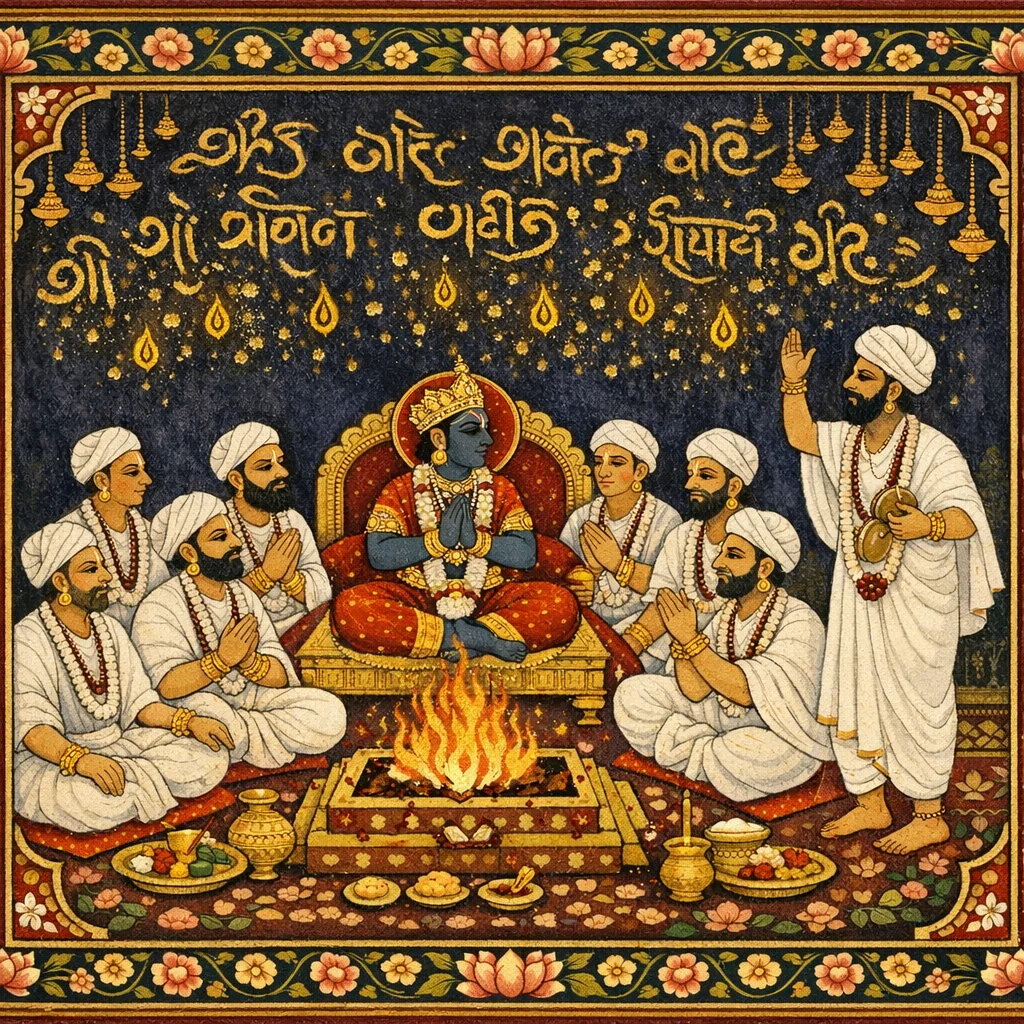
Adhyaya 5
Nimi Questions the Yogendras: Varṇāśrama’s Purpose, Ritualism’s Fall, and Yuga-Avatāras with Kali-yuga Saṅkīrtana
In the continuing royal dialogue, King Nimi asks the Yogendras about the fate of those who neglect worship of Hari. Camasa explains that varṇāśrama originates from the Lord, and that disrespect for Him brings spiritual and karmic ruin—especially when Vedic ritualism is pursued for passion, pride, violence, and household indulgence rather than purification. The sages clarify that scriptural concessions regarding sex, meat, and intoxication are meant to guide gradual renunciation, not to license exploitation; cruelty and false piety bind one to hellish reactions. Nimi then asks how the Lord is worshiped in each yuga. Karabhājana describes the Lord’s yuga-forms—colors, names, and methods of worship: meditation in Satya, sacrifice in Tretā, and arcana under Vedic-tantric regulation in Dvāpara—culminating in Kali-yuga’s supreme process, saṅkīrtana, the congregational chanting of Kṛṣṇa’s names, and identifying the Kali-yuga avatāra who spreads nāma. The chapter ends by praising Kali-yuga’s unique accessibility, noting bhakti’s flourishing in South India, and affirming that full surrender to Mukunda frees one from all other debts. This teaching transitions into a broader consolidation of bhakti principles and their exemplary practice by devotees in the surrounding narrative.
Shlokas
Verse 1
श्रीराजोवाच भगवन्तं हरिं प्रायो न भजन्त्यात्मवित्तमा: । तेषामशान्तकामानां क निष्ठाविजितात्मनाम् ॥ १ ॥
King Nimi said: O Yogendras, you are perfected in knowledge of the self; therefore please explain the destination of those who generally do not worship Bhagavān Hari, whose desires remain unpacified and who lack self-control.
Verse 2
श्रीचमस उवाच मुखबाहूरुपादेभ्य: पुरुषस्याश्रमै: सह । चत्वारो जज्ञिरे वर्णा गुणैर्विप्रादय: पृथक् ॥ २ ॥
Śrī Camasa said: From the face, arms, thighs, and feet of the Supreme Lord’s universal form—through differing combinations of the guṇas—arose the four varṇas headed by the brāhmaṇas; and along with them the four āśramas also came forth.
Verse 3
य एषां पुरुषं साक्षादात्मप्रभवमीश्वरम् । न भजन्त्यवजानन्ति स्थानाद् भ्रष्टा: पतन्त्यध: ॥ ३ ॥
If any member of the varṇas and āśramas fails to worship, or deliberately disrespects, Purushottama—the Lord directly present and the source of their own creation—he falls from his position into a hellish condition.
Verse 4
दूरे हरिकथा: केचिद् दूरे चाच्युतकीर्तना: । स्त्रिय: शूद्रादयश्चैव तेऽनुकम्प्या भवादृशाम् ॥ ४ ॥
Some are far from hari-kathā and far as well from chanting the infallible glories of Acyuta; women, śūdras, and others like them are especially worthy of the mercy of great souls such as you.
Verse 5
विप्रो राजन्यवैश्यौ वा हरे: प्राप्ता: पदान्तिकम् । श्रौतेन जन्मनाथापि मुह्यन्त्याम्नायवादिन: ॥ ५ ॥
O King, even brāhmaṇas, kṣatriyas and vaiśyas, though granted the second birth by Vedic initiation and thus allowed to approach the lotus feet of Hari, may become bewildered by scriptural formalism and take up materialistic doctrines.
Verse 6
कर्मण्यकोविदा: स्तब्धा मूर्खा: पण्डितमानिन: । वदन्ति चाटुकान् मूढा यया माध्व्या गिरोत्सुका: ॥ ६ ॥
Unskilled in the true science of karma, such stiff-necked fools, imagining themselves learned, become thrilled by the Vedas’ sweet speech and offer flattering petitions to the demigods.
Verse 7
रजसा घोरसङ्कल्पा: कामुका अहिमन्यव: । दाम्भिका मानिन: पापा विहसन्त्यच्युतप्रियान् ॥ ७ ॥
Driven by the mode of passion, they form dreadful intentions, become excessively lustful, and their anger strikes like a serpent’s. Deceitful, proud, and sinful, they mock the devotees dear to Lord Acyuta.
Verse 8
वदन्ति तेऽन्योन्यमुपासितस्त्रियो गृहेषु मैथुन्यपरेषु चाशिष: । यजन्त्यसृष्टान्नविधानदक्षिणं वृत्त्यै परं घ्नन्ति पशूनतद्विद: ॥ ८ ॥
Abandoning the Lord’s worship, they virtually worship their wives, and thus their homes become devoted to sex life; such materialistic householders encourage one another in this whim. Taking sacrifice to be merely for bodily maintenance, they perform unauthorized rites without food distribution or charity, and, ignorant of the dark results, cruelly slaughter goats and other animals.
Verse 9
श्रिया विभूत्याभिजनेन विद्यया त्यागेन रूपेण बलेन कर्मणा । जातस्मयेनान्धधिय: सहेश्वरान् सतोऽवमन्यन्ति हरिप्रियान् खला: ॥ ९ ॥
The intelligence of cruel-hearted people is blinded by false pride in wealth, opulence, noble birth, learning, renunciation, beauty, strength, and success in Vedic rites. Intoxicated by that pride, they blaspheme the Supreme Personality of Godhead and insult the devotees dear to Hari.
Verse 10
सर्वेषु शश्वत्तनुभृत्स्ववस्थितं यथा खमात्मानमभीष्टमीश्वरम् । वेदोपगीतं च न शृण्वतेऽबुधा मनोरथानां प्रवदन्ति वार्तया ॥ १० ॥
The Supreme Lord is eternally present within the heart of every embodied being, yet He remains unattached and distinct, like the all-pervading sky that never mixes with matter. Though the Vedas glorify Him in many ways, the unintelligent do not wish to hear of Him and instead waste time in talk born of their own mental fantasies of sense enjoyment.
Verse 11
लोके व्यवायामिषमद्यसेवा नित्या हि जन्तोर्न हि तत्र चोदना । व्यवस्थितिस्तेषु विवाहयज्ञ- सुराग्रहैरासु निवृत्तिरिष्टा ॥ ११ ॥
In this world the conditioned soul is naturally drawn to sex, meat-eating, and intoxication; therefore the scriptures do not truly promote such acts. Even the regulated allowances—sex within sacred marriage, meat through sacrificial offerings, and wine through ritual cups—are meant ultimately to lead one to renunciation.
Verse 12
धनं च धर्मैकफलं यतो वै ज्ञानं सविज्ञानमनुप्रशान्ति । गृहेषु युञ्जन्ति कलेवरस्य मृत्युं न पश्यन्ति दुरन्तवीर्यम् ॥ १२ ॥
The proper fruit of wealth is dharma alone; upon that foundation, knowledge and realized wisdom mature into direct perception of the Absolute Truth and peace. But materialists spend their riches only to improve home and family, failing to see that unconquerable death will soon destroy this fragile body.
Verse 13
यद् घ्राणभक्षो विहित: सुराया- स्तथा पशोरालभनं न हिंसा । एवं व्यवाय: प्रजया न रत्या इमं विशुद्धं न विदु: स्वधर्मम् ॥ १३ ॥
By Vedic injunction, wine offered in sacrifice is to be accepted afterward by smelling, not by drinking; and animal offerings are permitted, but not wholesale slaughter. Likewise, sex is allowed in marriage for begetting children, not for lustful enjoyment. Yet the less intelligent do not understand this pure duty of life.
Verse 14
ये त्वनेवंविदोऽसन्त: स्तब्धा: सदभिमानिन: । पशून् द्रुह्यन्ति विश्रब्धा: प्रेत्य खादन्ति ते च तान् ॥ १४ ॥
Sinful persons who do not know true religious principles, yet proudly think themselves very pious, commit violence against innocent animals that trust them. In their next lives, they will be eaten by the very creatures they have killed in this world.
Verse 15
द्विषन्त: परकायेषु स्वात्मानं हरिमीश्वरम् । मृतके सानुबन्धेऽस्मिन् बद्धस्नेहा: पतन्त्यध: ॥ १५ ॥
The conditioned souls become tightly bound by affection to their own corpselike bodies and to the relatives and paraphernalia connected with them. In proud folly they envy other beings and even Lord Hari, the Supreme Controller dwelling in everyone’s heart; by such envious offense they gradually fall down into hell.
Verse 16
ये कैवल्यमसम्प्राप्ता ये चातीताश्च मूढताम् । त्रैवर्गिका ह्यक्षणिका आत्मानं घातयन्ति ते ॥ १६ ॥
Those who have not attained knowledge of the Absolute, yet are not sunk in the darkest ignorance, generally follow the threefold course of dharma, artha, and kama. Lacking time to reflect on the highest purpose, they become killers of their own soul.
Verse 17
एत आत्महनोऽशान्ता अज्ञाने ज्ञानमानिन: । सीदन्त्यकृतकृत्या वै कालध्वस्तमनोरथा: ॥ १७ ॥
These killers of the soul are never peaceful, for in ignorance they pride themselves on knowledge and think human intelligence is meant only to expand material life. Neglecting their true spiritual duties, they remain in distress; though filled with great hopes and dreams, these are always shattered by the inevitable march of time.
Verse 18
हित्वात्ममायारचिता गृहापत्यसुहृत्स्त्रिय: । तमो विशन्त्यनिच्छन्तो वासुदेवपराङ्मुखा: ॥ १८ ॥
Those who turn away from the Supreme Lord, Vāsudeva, fall under His illusory energy and become attached to home, children, friends, and lovers—things fashioned by that very māyā. In the end, by the force of time, they are compelled to abandon all this and, against their will, enter the darkest regions of the universe.
Verse 19
श्री राजोवाच कस्मिन् काले स भगवान् किं वर्ण: कीदृशो नृभि: । नाम्ना वा केन विधिना पूज्यते तदिहोच्यताम् ॥ १९ ॥
King Nimi inquired: In each age, at what time does the Supreme Lord appear, and in what color and form? By what name, and by what methods and regulative principles, is He worshiped within human society? Please speak of this here.
Verse 20
श्रीकरभाजन उवाच कृतं त्रेता द्वापरं च कलिरित्येषु केशव: । नानावर्णाभिधाकारो नानैव विधिनेज्यते ॥ २० ॥
Śrī Karabhājana replied: In the ages of Kṛta, Tretā, Dvāpara and Kali, Lord Keśava appears with various complexions, names and forms, and thus He is worshiped by different sacred processes.
Verse 21
कृते शुक्लश्चतुर्बाहुर्जटिलो वल्कलाम्बर: । कृष्णाजिनोपवीताक्षान् बिभ्रद् दण्डकमण्डलू ॥ २१ ॥
In Satya-yuga the Lord is white and four-armed, with matted locks and garments of tree bark. He bears a black deerskin, the sacred thread, prayer beads, and the staff and waterpot of a brahmacārī.
Verse 22
मनुष्यास्तु तदा शान्ता निर्वैरा: सुहृद: समा: । यजन्ति तपसा देवं शमेन च दमेन च ॥ २२ ॥
In that age people are peaceful, free from enmity, friendly to all beings, and steady in every situation. They worship the Supreme Lord through austere meditation and through śama and dama—inner and outer control of the senses.
Verse 23
हंस: सुपर्णो वैकुण्ठो धर्मो योगेश्वरोऽमल: । ईश्वर: पुरुषोऽव्यक्त: परमात्मेति गीयते ॥ २३ ॥
In Satya-yuga the Lord is glorified by the names Haṁsa, Suparṇa, Vaikuṇṭha, Dharma, Yogeśvara, Amala, Īśvara, Puruṣa, Avyakta and Paramātmā.
Verse 24
त्रेतायां रक्तवर्णोऽसौ चतुर्बाहुस्त्रिमेखल: । हिरण्यकेशस्त्रय्यात्मा स्रुक्स्रुवाद्युपलक्षण: ॥ २४ ॥
In Tretā-yuga the Lord appears with a red complexion, four arms, golden hair, and a triple belt symbolizing initiation into the three Vedas. As the embodiment of worship through Vedic sacrifice, His emblems are the ladle, spoon, and other sacrificial implements.
Verse 25
तं तदा मनुजा देवं सर्वदेवमयं हरिम् । यजन्ति विद्यया त्रय्या धर्मिष्ठा ब्रह्मवादिन: ॥ २५ ॥
In Tretā-yuga, men steadfast in dharma and intent on realizing the Absolute Truth worship Lord Hari, who contains all the devas within Himself, by the sacrificial rites taught in the three Vedas.
Verse 26
विष्णुर्यज्ञ: पृश्निगर्भ: सर्वदेव उरुक्रम: । वृषाकपिर्जयन्तश्च उरुगाय इतीर्यते ॥ २६ ॥
In Tretā-yuga the Lord is praised by the names Viṣṇu, Yajña, Pṛśnigarbha, Sarvadeva, Urukrama, Vṛṣākapi, Jayanta and Urugāya.
Verse 27
द्वापरे भगवाञ्श्याम: पीतवासा निजायुध: । श्रीवत्सादिभिरङ्कैश्च लक्षणैरुपलक्षित: ॥ २७ ॥
In Dvāpara-yuga the Supreme Lord appears dark blue, clad in yellow garments; His transcendental body bears the mark of Śrīvatsa and other distinctive ornaments, and He reveals His personal weapons.
Verse 28
तं तदा पुरुषं मर्त्या महाराजोपलक्षणम् । यजन्ति वेदतन्त्राभ्यां परं जिज्ञासवो नृप ॥ २८ ॥
My dear King, in Dvāpara-yuga those who long to know the Supreme Person worship Him with the reverence due a great monarch, following the ordinances of both the Vedas and the tantras.
Verse 29
नमस्ते वासुदेवाय नम: सङ्कर्षणाय च । प्रद्युम्नायानिरुद्धाय तुभ्यं भगवते नम: ॥ २९ ॥ नारायणाय ऋषये पुरुषाय महात्मने । विश्वेश्वराय विश्वाय सर्वभूतात्मने नम: ॥ ३० ॥
Obeisances to You, O Vāsudeva; obeisances to Saṅkarṣaṇa, to Pradyumna and to Aniruddha—unto You, O Bhagavān, my salutations. O Nārāyaṇa Ṛṣi, O great-souled Purusha, Lord of the universe, the universe itself, and the indwelling Supersoul of all beings—unto You I bow.
Verse 30
नमस्ते वासुदेवाय नम: सङ्कर्षणाय च । प्रद्युम्नायानिरुद्धाय तुभ्यं भगवते नम: ॥ २९ ॥ नारायणाय ऋषये पुरुषाय महात्मने । विश्वेश्वराय विश्वाय सर्वभूतात्मने नम: ॥ ३० ॥
Obeisances to You, O Supreme Lord Vāsudeva, and to Your forms Saṅkarṣaṇa, Pradyumna, and Aniruddha. O Bhagavān, Supreme Personality of Godhead, I bow to You again and again. O Nārāyaṇa Ṛṣi, O Mahāpuruṣa, Lord of the universe, the universe itself, and the Supersoul within all beings—unto You be my homage.
Verse 31
इति द्वापर उर्वीश स्तुवन्ति जगदीश्वरम् । नानातन्त्रविधानेन कलावपि तथा शृणु ॥ ३१ ॥
O King, in this way the people of Dvāpara-yuga glorified Jagadīśvara, the Lord of the universe. And in Kali-yuga as well, following various injunctions of the revealed scriptures, they worship Bhagavān, the Supreme Personality of Godhead. Now hear this from me.
Verse 32
कृष्णवर्णं त्विषाकृष्णं साङ्गोपाङ्गास्त्रपार्षदम् । यज्ञै: सङ्कीर्तनप्रायैर्यजन्ति हि सुमेधस: ॥ ३२ ॥
In the age of Kali, the truly intelligent worship that incarnation chiefly by the sacrifice of saṅkīrtana—congregational chanting—because He constantly sings the names of Kṛṣṇa. Though His bodily luster is not blackish, He is Kṛṣṇa Himself. He appears with His associates, attendants, weapons, and confidential companions.
Verse 33
ध्येयं सदा परिभवघ्नमभीष्टदोहं तीर्थास्पदं शिवविरिञ्चिनुतं शरण्यम् । भृत्यार्तिहं प्रणतपाल भवाब्धिपोतं वन्दे महापुरुष ते चरणारविन्दम् ॥ ३३ ॥
My Lord, You are the Mahāpuruṣa, and I worship Your lotus feet—the eternal object of meditation. Those feet destroy the humiliations and miseries of material life and freely bestow the soul’s highest desire: pure prema-bhakti, love of God. They are the shelter of all holy places, honored by the saints of the bhakti lineage, and revered even by Śiva and Brahmā. You protect those who bow to You and relieve the distress of Your servants; Your feet are the boat that carries one across the ocean of birth and death.
Verse 34
त्यक्त्वा सुदुस्त्यजसुरेप्सितराज्यलक्ष्मीं धर्मिष्ठ आर्यवचसा यदगादरण्यम् । मायामृगं दयितयेप्सितमन्वधावद् वन्दे महापुरुष ते चरणारविन्दम् ॥ ३४ ॥
O Mahāpuruṣa, I worship Your lotus feet. You renounced royal fortune and the splendor of Lakṣmī—so difficult to give up and desired even by the devas. Steadfast in dharma, You went to the forest in obedience to the word/curse of a brāhmaṇa. Out of compassion You pursued the fallen souls running after the “deer of māyā,” and at the same time You were engaged in seeking Your beloved, desired Lord—Śyāmasundara.
Verse 35
एवं युगानुरूपाभ्यां भगवान् युगवर्तिभि: । मनुजैरिज्यते राजन् श्रेयसामीश्वरोहरि: ॥ ३५ ॥
O King, in each age the Supreme Lord Hari manifests suitable names and forms; wise human beings worship Him accordingly, for He is the bestower of all true auspiciousness.
Verse 36
कलिं सभाजयन्त्यार्या गुणज्ञा: सारभागिन: । यत्र सङ्कीर्तनेनैव सर्वस्वार्थोऽभिलभ्यते ॥ ३६ ॥
Those noble souls who know true qualities and grasp the essence honor Kali-yuga, for in this age, by saṅkīrtana alone, all perfection and life’s highest aim are easily attained.
Verse 37
न ह्यत: परमो लाभो देहिनां भ्राम्यतामिह । यतो विन्देत परमां शान्तिं नश्यति संसृति: ॥ ३७ ॥
Indeed, for embodied souls wandering in this world there is no higher gain than the Lord’s saṅkīrtana; by it one attains supreme peace and the cycle of birth and death is destroyed.
Verse 38
कृतादिषु प्रजा राजन् कलाविच्छन्ति सम्भवम् । कलौ खलु भविष्यन्ति नारायणपरायणा: । क्वचित् क्वचिन्महाराज द्रविडेषु च भूरिश: ॥ ३८ ॥ ताम्रपर्णी नदी यत्र कृतमाला पयस्विनी । कावेरी च महापुण्या प्रतीची च महानदी ॥ ३९ ॥ ये पिबन्ति जलं तासां मनुजा मनुजेश्वर । प्रायो भक्ता भगवति वासुदेवेऽमलाशया: ॥ ४० ॥
O King, the people of Kṛta and the other ages long to be born in Kali-yuga, for in Kali there will be many devotees wholly devoted to Nārāyaṇa; they will appear in many places, but especially in the Draviḍa lands of the South.
Verse 39
कृतादिषु प्रजा राजन् कलाविच्छन्ति सम्भवम् । कलौ खलु भविष्यन्ति नारायणपरायणा: । क्वचित् क्वचिन्महाराज द्रविडेषु च भूरिश: ॥ ३८ ॥ ताम्रपर्णी नदी यत्र कृतमाला पयस्विनी । कावेरी च महापुण्या प्रतीची च महानदी ॥ ३९ ॥ ये पिबन्ति जलं तासां मनुजा मनुजेश्वर । प्रायो भक्ता भगवति वासुदेवेऽमलाशया: ॥ ४० ॥
There flow the sacred rivers Tāmraparṇī, Kṛtamālā, Payasvinī, the supremely holy Kāverī, and the great river Pratīcī Mahānadī.
Verse 40
कृतादिषु प्रजा राजन् कलाविच्छन्ति सम्भवम् । कलौ खलु भविष्यन्ति नारायणपरायणा: । क्वचित् क्वचिन्महाराज द्रविडेषु च भूरिश: ॥ ३८ ॥ ताम्रपर्णी नदी यत्र कृतमाला पयस्विनी । कावेरी च महापुण्या प्रतीची च महानदी ॥ ३९ ॥ ये पिबन्ति जलं तासां मनुजा मनुजेश्वर । प्रायो भक्ता भगवति वासुदेवेऽमलाशया: ॥ ४० ॥
My dear King, the people of Satya-yuga and the other ages long to be born in Kali-yuga, for in this age many devotees devoted to Lord Nārāyaṇa will appear, especially in the Draviḍa lands of the South. Those who drink the holy waters of rivers such as the Tāmraparṇī, Kṛtamālā, Payasvinī, the supremely pious Kāverī, and the Pratīcī Mahānadī will, for the most part, become purehearted devotees of Vāsudeva, the Supreme Personality of Godhead.
Verse 41
देवर्षिभूताप्तनृणां पितृणां न किङ्करो नायमृणी च राजन् । सर्वात्मना य: शरणं शरण्यं गतो मुकुन्दं परिहृत्य कर्तम् ॥ ४१ ॥
O King, one who has abandoned all material duties and taken full shelter of Mukunda’s lotus feet—He who is the refuge of all—is neither servant nor debtor to the demigods, great sages, living beings, relatives and friends, mankind, or even the departed forefathers. Since all are parts of the Supreme Lord, one surrendered to His service need not serve them separately.
Verse 42
स्वपादमूलं भजत: प्रियस्य त्यक्तान्यभावस्य हरि: परेश: । विकर्म यच्चोत्पतितं कथञ्चिद् धुनोति सर्वं हृदि सन्निविष्ट: ॥ ४२ ॥
One who has abandoned all other engagements and worships the root of the lotus feet of Hari, the Supreme Lord, becomes very dear to Him. Even if such a surrendered soul accidentally commits a sinful act, the Supreme Personality of Godhead, seated within everyone’s heart, at once removes the reaction to that sin.
Verse 43
श्रीनारद उवाच धर्मान् भागवतानित्थं श्रुत्वाथ मिथिलेश्वर: । जायन्तेयान् मुनीन् प्रीत: सोपाध्यायो ह्यपूजयत् ॥ ४३ ॥
Nārada Muni said: Having thus heard the principles of bhāgavata-dharma, the science of devotional service, Nimi, the King of Mithilā, became greatly pleased and, together with the sacrificial priests, respectfully worshiped the wise sons of Jayantī.
Verse 44
ततोऽन्तर्दधिरे सिद्धा: सर्वलोकस्य पश्यत: । राजा धर्मानुपातिष्ठन्नवाप परमां गतिम् ॥ ४४ ॥
The perfect sages then disappeared before the eyes of all. King Nimi faithfully practiced the principles of spiritual life he had learned from them, and thus he attained the supreme destination—the Lord’s highest abode.
Verse 45
त्वमप्येतान् महाभाग धर्मान् भागवतान् श्रुतान् । आस्थित: श्रद्धया युक्तो नि:सङ्गो यास्यसे परम् ॥ ४५ ॥
O greatly fortunate Vasudeva, with faith adopt these principles of bhāgavata-dharma you have heard; becoming free from material association, you will attain the Supreme.
Verse 46
युवयो: खलु दम्पत्योर्यशसा पूरितं जगत् । पुत्रतामगमद् यद् वां भगवानीश्वरोहरि: ॥ ४६ ॥
Indeed, the whole world is filled with the glory of you two as husband and wife, because Bhagavān, the Lord Hari, has taken the position of your son.
Verse 47
दर्शनालिङ्गनालापै: शयनासनभोजनै: । आत्मा वां पावित: कृष्णे पुत्रस्नेहं प्रकुर्वतो: ॥ ४७ ॥
My dear Vasudeva, you and your good wife Devakī have shown profound transcendental love for Kṛṣṇa as your son—seeing Him, embracing Him, speaking with Him, resting and sitting with Him, and taking meals with Him. By such intimate, affectionate association with the Lord, your hearts are completely purified; you are already perfect.
Verse 48
वैरेण यं नृपतय: शिशुपालपौण्ड्र- शाल्वादयो गतिविलासविलोकनाद्यै: । ध्यायन्त आकृतधिय: शयनासनादौ तत्साम्यमापुरनुरक्तधियां पुन: किम् ॥ ४८ ॥
Inimical kings like Śiśupāla, Pauṇḍraka and Śālva were always thinking of Lord Kṛṣṇa. Even while lying down, sitting, or engaged in other acts, they enviously meditated on His movements, His playful līlās, His loving glances upon devotees, and other enchanting features. Thus absorbed in Kṛṣṇa, they attained liberation in His own abode. What, then, can be said of the blessings granted to those who constantly fix their minds on Kṛṣṇa in favorable, loving devotion?
Verse 49
मापत्यबुद्धिमकृथा: कृष्णे सर्वात्मनीश्वरे । मायामनुष्यभावेन गूढैश्वर्ये परेऽव्यये ॥ ४९ ॥
Do not think of Kṛṣṇa as an ordinary child, for He is Īśvara, the Soul of all beings—supreme and inexhaustible Bhagavān. Concealing His inconceivable opulences, He appears outwardly in humanlike form by the power of māyā.
Verse 50
भूभारासुरराजन्यहन्तवे गुप्तये सताम् । अवतीर्णस्य निर्वृत्यै यशो लोके वितन्यते ॥ ५० ॥
The Supreme Lord descended to slay the asuric kings who burdened the earth and to protect the saintly bhaktas. Yet by His mercy both the wicked and the devoted are granted liberation; thus His transcendental fame has spread throughout the universe.
Verse 51
श्रीशुक उवाच एतच्छ्रुत्वा महाभागो वसुदेवोऽतिविस्मित: । देवकी च महाभागा जहतुर्मोहमात्मन: ॥ ५१ ॥
Śrī Śukadeva Gosvāmī said: Hearing this narration, the greatly fortunate Vasudeva was struck with wonder. And with the most blessed Devakī, they both cast off the illusion and anxiety that had entered their hearts.
Verse 52
इतिहासमिमं पुण्यं धारयेद् य: समाहित: । स विधूयेह शमलं ब्रह्मभूयाय कल्पते ॥ ५२ ॥
Anyone who, with steady attention, holds and meditates upon this pious historical narration will cleanse away all contamination in this very life and become fit for the highest perfection—the state of Brahman.
Frequently Asked Questions
Because the chapter targets karma-kāṇḍa pursued under rajas for pride, lust, and violence—where sacrifice becomes a tool for sense-gratification and demigod-appeasement rather than a purification meant to culminate in Hari-bhakti. The Vedic allowances (marriage, sacrificial meat, ritual wine) are framed as regulated concessions designed to lead to renunciation (nivṛtti) and devotion, not as independent goals.
It presents a yuga-wise progression: Satya-yuga emphasizes meditation and sense-control with the Lord described as white and ascetic; Tretā-yuga emphasizes yajña taught in the three Vedas with the Lord described as red and sacrificially equipped; Dvāpara-yuga emphasizes regulated arcana honoring the Lord as a royal person, integrating Vedic and tantric prescriptions with the Lord described as dark-blue with ornaments and weapons; Kali-yuga emphasizes saṅkīrtana—congregational chanting of Kṛṣṇa’s names—as the most accessible means to perfection.
The verse describes an incarnation who promotes congregational chanting of Kṛṣṇa’s names, is Kṛṣṇa Himself though not blackish in complexion, and is accompanied by associates and confidential companions. In the Gauḍīya Vaiṣṇava reading, this is understood as Śrī Caitanya Mahāprabhu, the yuga-avatāra who inaugurates the saṅkīrtana movement.
It means that when one takes exclusive shelter of Mukunda and serves Him directly, one fulfills the ultimate obligation to all beings because all are parts of the Supreme. Thus separate, independent servicing of demigods, forefathers, or social claims is no longer binding as a debt; devotion to the Lord becomes the integrating fulfillment of duties.