Adhyaya 3
Nimi Questions the Yogendras: Māyā, Cosmic Dissolution, Guru-Śaraṇāgati, Bhakti, and Deity Worship
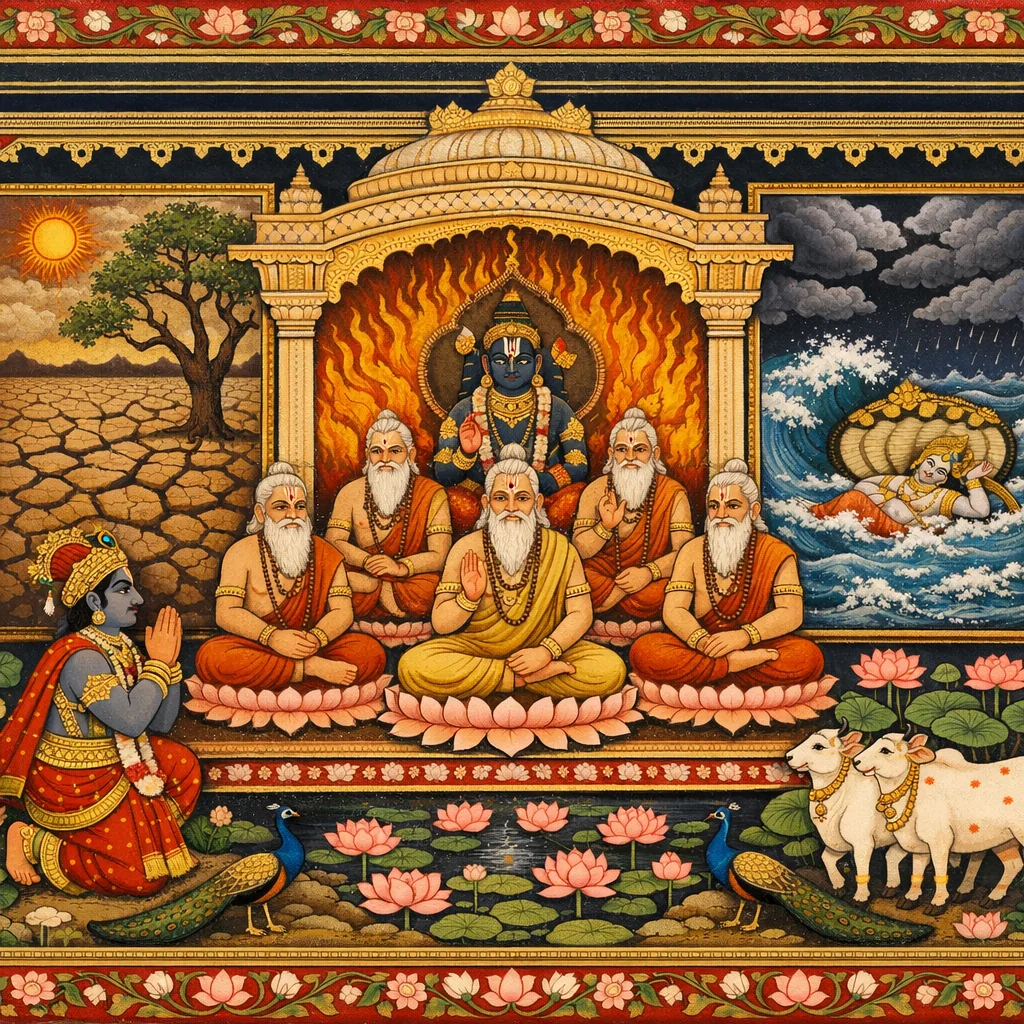
Continuing King Nimi’s dialogue with the nine Yogendras, this chapter opens with his question about Viṣṇu’s māyā—so subtle it bewilders even perfected mystics. Antarīkṣa explains the chain of bondage: the Supersoul sets mind and senses in motion, the jīva chases guṇa-made objects, mistakes the body for the self, and thus wanders through karma and repeated birth and death. The teaching then turns to nirodha, describing cosmic dissolution—drought, a conflagration from Saṅkarṣaṇa, a deluge, and the stepwise merging of elements and faculties back into their subtle causes, culminating in the mahat-tattva—revealing annihilation as the Lord’s time potency. Nimi asks how a “foolish materialist” can cross māyā; Prabuddha critiques household pleasure, wealth, and heaven-seeking, and prescribes shelter of a bona fide guru, disciplined bhakti, saintly association, and compassion. Next, Nimi inquires into the Lord’s transcendence; Pippalāyana establishes Nārāyaṇa as the causeless cause beyond waking/dream/sleep and beyond words, yet knowable through bhakti. Finally, Nimi asks about karma-yoga; Āvirhotra explains Vedic authority, why karma is given for the immature, and culminates in arcana (Deity worship) as regulated devotion, leading into the fuller sādhana teachings that follow.
Shlokas
Verse 1
श्रीराजोवाच परस्य विष्णोरीशस्य मायिनामपि मोहिनीम् । मायां वेदितुमिच्छामो भगवन्तो ब्रुवन्तु न: ॥ १ ॥
King Nimi said: O venerable lords, we wish to understand the illusory potency (māyā) of the Supreme Lord Śrī Viṣṇu, which bewilders even great mystics. Please speak to us on this subject.
Verse 2
नानुतृप्ये जुषन्युष्मद्वचोहरिकथामृतम् । संसारतापनिस्तप्तो मर्त्यस्तत्तापभेषजम् ॥ २ ॥
Though I drink the nectar of your words—harikathā—my thirst is still not satisfied. For I am a mortal scorched by the heat of saṁsāra, and these nectarean narrations of the Lord and His devotees are the true medicine for that burning.
Verse 3
श्रीअन्तरीक्ष उवाच एभिर्भूतानि भूतात्मा महाभूतैर्महाभुज । ससर्जोच्चावचान्याद्य: स्वमात्रात्मप्रसिद्धये ॥ ३ ॥
Śrī Antarīkṣa said: O mighty-armed King, by setting the great material elements in motion, the primeval Soul—the Self of all beings—brought forth living creatures in higher and lower species, so they may pursue enjoyment or liberation according to their desire.
Verse 4
एवं सृष्टानि भूतानि प्रविष्ट: पञ्चधातुभि: । एकधा दशधात्मानं विभजन्जुषते गुणान् ॥ ४ ॥
Thus the Paramātmā enters the bodies of the created beings through the five elements, activating mind and senses; though one, He appears to divide the self into ten functions and leads the conditioned soul to associate with the guṇas for sense enjoyment.
Verse 5
गुणैर्गुणान्स भुञ्जान आत्मप्रद्योतितै: प्रभु: । मन्यमान इदं सृष्टमात्मानमिह सज्जते ॥ ५ ॥
The individual jīva, using the senses illumined by the Paramātmā, seeks to enjoy sense objects made of the three guṇas. Thus he mistakes the created body for the self, binds the unborn eternal ātman to matter, and becomes entangled in the Lord’s māyā.
Verse 6
कर्माणि कर्मभि: कुर्वन्सनिमित्तानि देहभृत् । तत्तत्कर्मफलं गृह्णन्भ्रमतीह सुखेतरम् ॥ ६ ॥
Driven by deep-rooted desires, the embodied being engages his active senses in fruitive work; then, taking the results of those actions, he wanders in this world amid so-called happiness and distress.
Verse 7
इत्थं कर्मगतीर्गच्छन्बह्वभद्रवहा: पुमान् । आभूतसम्प्लवात्सर्गप्रलयावश्नुतेऽवश: ॥ ७ ॥
Thus, traveling the paths of karma and carrying many inauspicious burdens, the conditioned being is driven by the reactions of his own deeds and helplessly undergoes repeated birth and death from the dawn of creation until cosmic annihilation.
Verse 8
धातूपप्लव आसन्ने व्यक्तं द्रव्यगुणात्मकम् । अनादिनिधन: कालो ह्यव्यक्तायापकर्षति ॥ ८ ॥
When the dissolution of the material elements draws near, the Bhagavān, as eternal Time without beginning or end, withdraws the manifest cosmos—gross and subtle—and the whole universe merges into the unmanifest.
Verse 9
शतवर्षा ह्यनावृष्टिर्भविष्यत्युल्बणा भुवि । तत्कालोपचितोष्णार्को लोकांस्त्रीन्प्रतपिष्यति ॥ ९ ॥
As cosmic annihilation approaches, a dreadful drought afflicts the earth for one hundred years. During that time the sun’s heat steadily increases, and its blazing fire torments the three worlds.
Verse 10
पातालतलमारभ्य सङ्कर्षणमुखानल: । दहन्नूर्ध्वशिखो विष्वग्वर्धते वायुनेरित: ॥ १० ॥
Beginning from Pātālaloka, a fire issues from the mouth of Lord Saṅkarṣaṇa and grows. Driven by mighty winds, its flames shoot upward and scorch everything in all directions.
Verse 11
संवर्तको मेघगणो वर्षति स्म शतं समा: । धाराभिर्हस्तिहस्ताभिर्लीयते सलिले विराट् ॥ ११ ॥
Hordes of clouds called Saṁvartaka pour torrential rain for one hundred years. Falling in streams as long as an elephant’s trunk, the deluge submerges the entire universe in water.
Verse 12
ततो विराजमुत्सृज्य वैराज: पुरुषो नृप । अव्यक्तं विशते सूक्ष्मं निरिन्धन इवानल: ॥ १२ ॥
Then, O King, Vairāja Brahmā—the soul of the universal form—relinquishes his cosmic body and enters the subtle unmanifest nature, like a fire that dies out when its fuel is exhausted.
Verse 13
वायुना हृतगन्धा भू: सलिलत्वाय कल्पते । सलिलं तद्धृतरसं ज्योतिष्ट्वायोपकल्पते ॥ १३ ॥
When the wind deprives earth of its fragrance, earth becomes water; and when that same wind deprives water of its taste, water merges into fire.
Verse 14
हृतरूपं तु तमसा वायौ ज्योति: प्रलीयते । हृतस्पर्शोऽवकाशेन वायुर्नभसि लीयते । कालात्मना हृतगुणं नभ आत्मनि लीयते ॥ १४ ॥
When darkness deprives fire of form, fire dissolves into air. When air, stripped of touch by the influence of space, merges into space; and when space is deprived of its quality by the Paramatma as Time, space merges into tamasic false ego.
Verse 15
इन्द्रियाणि मनो बुद्धि: सह वैकारिकैर्नृप । प्रविशन्ति ह्यहङ्कारं स्वगुणैरहमात्मनि ॥ १५ ॥
O King, the material senses and intelligence, with their respective qualities, enter the rajasic false ego from which they arose; and the mind, along with the devas, merges into the sattvic false ego. Then the total false ego, with all its qualities, dissolves into the mahat-tattva.
Verse 16
एषा माया भगवत: सर्गस्थित्यन्तकारिणी । त्रिवर्णा वर्णितास्माभि: किं भूय: श्रोतुमिच्छसि ॥ १६ ॥
This is the māyā of Bhagavan, the power that brings about creation, maintenance, and dissolution. I have described this threefold, guṇa-made illusion; what more do you wish to hear?
Verse 17
श्रीराजोवाच यथैतामैश्वरीं मायां दुस्तरामकृतात्मभि: । तरन्त्यञ्ज: स्थूलधियो महर्ष इदमुच्यताम् ॥ १७ ॥
King Nimi said: O great sage, please tell how even a gross-minded materialist may easily cross the Lord’s sovereign māyā, which is ever insurmountable for those who lack self-control.
Verse 18
श्रीप्रबुद्ध उवाच कर्माण्यारभमाणानां दु:खहत्यै सुखाय च । पश्येत् पाकविपर्यासं मिथुनीचारिणां नृणाम् ॥ १८ ॥
Śrī Prabuddha said: Accepting the roles of male and female, conditioned souls unite in lustful union and ceaselessly strive to destroy misery and expand pleasure; yet one should see the reversal of the result—happiness inevitably dwindles, and as age advances, material distress increases.
Verse 19
नित्यार्तिदेन वित्तेन दुर्लभेनात्ममृत्युना । गृहापत्याप्तपशुभि: का प्रीति: साधितैश्चलै: ॥ १९ ॥
Wealth brings perpetual distress, is hard to obtain, and for the soul is like death itself. What real satisfaction does money give? And how can one find ultimate or lasting happiness in home, children, relatives, and domestic animals, all sustained by that painfully earned wealth?
Verse 20
एवं लोकं परं विद्यान्नश्वरं कर्मनिर्मितम् । सतुल्यातिशयध्वंसं यथा मण्डलवर्तिनाम् ॥ २० ॥
Thus one should know that even the heavenly worlds of the next life are perishable, being fashioned by karma. There one is troubled by rivalry with equals, envy of superiors, and fear of the fall from heaven when pious merit is exhausted—like kings admired by commoners yet harassed by enemy kings, never attaining real happiness.
Verse 21
तस्माद् गुरुं प्रपद्येत जिज्ञासु: श्रेय उत्तमम् । शाब्दे परे च निष्णातं ब्रह्मण्युपशमाश्रयम् ॥ २१ ॥
Therefore, one who longs to know the highest good must approach a bona fide spiritual master and take shelter of him through initiation. The true guru is deeply learned in the revealed scriptures and the Supreme Truth, has realized the scriptural conclusions by careful deliberation, and—having taken refuge in the Supreme Lord—has set aside material considerations and abides in inner peace.
Verse 22
तत्र भागवतान् धर्मान् शिक्षेद् गुर्वात्मदैवत: । अमाययानुवृत्त्या यैस्तुष्येदात्मात्मदोहरि: ॥ २२ ॥
There the disciple, accepting the guru as his very life and worshipable deity, should learn the Bhāgavata dharmas—the path of pure devotional service. Serving without duplicity, with faithful and favorable intent, he should please Hari, the Soul of all souls; for when satisfied, Hari offers His very Self to His pure devotee.
Verse 23
सर्वतो मनसोऽसङ्गमादौ सङ्गं च साधुषु । दयां मैत्रीं प्रश्रयं च भूतेष्वद्धा यथोचितम् ॥ २३ ॥
A sincere disciple should learn to free the mind from all material attachment and, instead, cultivate holy association with the spiritual master and saintly devotees. He should show mercy to those below him, friendship to those equal, and humble service to those spiritually superior; thus he learns proper dealings with all living beings.
Verse 24
शौचं तपस्तितिक्षां च मौनं स्वाध्यायमार्जवम् । ब्रह्मचर्यमहिंसां च समत्वं द्वन्द्वसंज्ञयो: ॥ २४ ॥
To serve the spiritual master, the disciple should learn cleanliness, austerity, tolerance, sacred silence, study of Vedic wisdom, simplicity, celibacy (brahmacarya), nonviolence, and equanimity amid dualities such as heat and cold, happiness and distress.
Verse 25
सर्वत्रात्मेश्वरान्वीक्षां कैवल्यमनिकेतताम् । विविक्तचीरवसनं सन्तोषं येन केनचित् ॥ २५ ॥
One should practice meditation by always seeing oneself as the eternal, conscious spirit soul and seeing the Lord as the absolute controller of all. To deepen meditation, one should live in seclusion and give up false attachment to home and household things. Renouncing the adornments of the temporary body, one may wear discarded cloth or tree bark, and thus learn contentment in any condition.
Verse 26
श्रद्धां भागवते शास्त्रेऽनिन्दामन्यत्र चापि हि । मनोवाक्कर्मदण्डं च सत्यं शमदमावपि ॥ २६ ॥
One should have firm faith in the Bhāgavata scriptures, knowing that by following the teachings that glorify Bhagavān one attains all success in life. At the same time, one should not blaspheme other scriptures. One must strictly control mind, speech, and action, always speak truth, and fully master the mind and senses (śama-dama).
Verse 27
श्रवणं कीर्तनं ध्यानं हरेरद्भुतकर्मण: । जन्मकर्मगुणानां च तदर्थेऽखिलचेष्टितम् ॥ २७ ॥ इष्टं दत्तं तपो जप्तं वृत्तं यच्चात्मन: प्रियम् । दारान् सुतान् गृहान् प्राणान् यत्परस्मै निवेदनम् ॥ २८ ॥
One should hear, glorify, and meditate upon the wondrous transcendental deeds of Hari, becoming especially absorbed in the Lord’s appearance, pastimes, qualities, and holy names. Thus inspired, one should perform all daily activities as an offering to Him. Sacrifice, charity, austerity, japa, and every religious act should be done solely for His satisfaction; and whatever one finds pleasing should be offered at once to the Supreme—indeed, even one’s spouse, children, home, and very life-breath should be surrendered at the lotus feet of the Supreme Personality of Godhead.
Verse 28
श्रवणं कीर्तनं ध्यानं हरेरद्भुतकर्मण: । जन्मकर्मगुणानां च तदर्थेऽखिलचेष्टितम् ॥ २७ ॥ इष्टं दत्तं तपो जप्तं वृत्तं यच्चात्मन: प्रियम् । दारान् सुतान् गृहान् प्राणान् यत्परस्मै निवेदनम् ॥ २८ ॥
One should hear, chant, and meditate upon the Lord Hari’s wondrous transcendental deeds. Becoming especially absorbed in the Supreme Personality of Godhead’s appearance, pastimes, qualities, and holy names, one should perform all daily activities in a spirit of offering to Him. Sacrifice, charity, austerity, and japa should be done solely for the Lord’s satisfaction, and one should recite only those mantras that glorify Bhagavān. Whatever one finds pleasing and enjoyable should be immediately offered to the Supreme—indeed, even one’s wife, children, home, and very life-breath should be surrendered at the lotus feet of the Supreme Personality of Godhead.
Verse 29
एवं कृष्णात्मनाथेषु मनुष्येषु च सौहृदम् । परिचर्यां चोभयत्र महत्सु नृषु साधुषु ॥ २९ ॥
One who seeks the highest good should cultivate friendship with those who have accepted Kṛṣṇa as the Lord of their life. One should also develop a spirit of service toward all living beings. Especially, one should try to help those in human life, and among them those who accept the principles of dharma. And among religious persons, one should render special service to the pure devotees of the Supreme Personality of Godhead.
Verse 30
परस्परानुकथनं पावनं भगवद्यश: । मिथो रतिर्मिथस्तुष्टिर्निवृत्तिर्मिथ आत्मन: ॥ ३० ॥
One should associate with the Lord’s devotees by gathering with them to chant and speak the Lord’s glories, for this is most purifying. As loving friendship grows, they feel mutual happiness and satisfaction. Encouraging one another in this way, they can give up material sense gratification, the cause of all suffering.
Verse 31
स्मरन्त: स्मारयन्तश्च मिथोऽघौघहरं हरिम् । भक्त्या सञ्जातया भक्त्या बिभ्रत्युत्पुलकां तनुम् ॥ ३१ ॥
The devotees constantly speak among themselves of Bhagavān’s glories. Thus they always remember the Lord and remind one another of His qualities and pastimes. By devotion born of the principles of bhakti-yoga, they please Hari, who removes all inauspiciousness. Purified of obstacles, they awaken to pure love of Godhead, and even in this world their bodies show signs of transcendental ecstasy, such as hairs standing on end.
Verse 32
क्वचिद् रुदन्त्यच्युतचिन्तया क्वचि- द्धसन्ति नन्दन्ति वदन्त्यलौकिका: । नृत्यन्ति गायन्त्यनुशीलयन्त्यजं भवन्ति तूष्णीं परमेत्य निवृता: ॥ ३२ ॥
Having attained love of Godhead, the devotees sometimes weep loudly, absorbed in thought of Acyuta, the infallible Lord. Sometimes they laugh, rejoice, and speak to the Lord in words beyond ordinary convention. Sometimes they dance and sing; and sometimes, following the Unborn Supreme, they enact His pastimes as if imitating them. And sometimes, upon gaining His personal audience, they become detached, peaceful, and silent.
Verse 33
इति भागवतान् धर्मान् शिक्षन् भक्त्या तदुत्थया । नारायणपरो मायामञ्जस्तरति दुस्तराम् ॥ ३३ ॥
Thus, by learning the Bhāgavata dharmas and practicing them with the bhakti born of that teaching, the devotee attains love of God. Fully devoted to Nārāyaṇa, the Supreme Lord, he easily crosses the exceedingly difficult ocean of māyā.
Verse 34
श्रीराजोवाच नारायणाभिधानस्य ब्रह्मण: परमात्मन: । निष्ठामर्हथ नो वक्तुं यूयं हि ब्रह्मवित्तमा: ॥ ३४ ॥
King Nimi inquired: Please describe to me the transcendental position of the Supreme Lord, Nārāyaṇa, who is Himself the Absolute Truth and the Paramātmā within all beings. Since you are the most learned in spiritual knowledge, you are fit to speak of this.
Verse 35
श्रीपिप्पलायन उवाच स्थित्युद्भवप्रलयहेतुरहेतुरस्य यत् स्वप्नजागरसुषुप्तिषु सद् बहिश्च । देहेन्द्रियासुहृदयानि चरन्ति येन सञ्जीवितानि तदवेहि परं नरेन्द्र ॥ ३५ ॥
Śrī Pippalāyana said: The Supreme Personality of Godhead is the cause of this universe’s creation, maintenance, and dissolution, yet He Himself has no prior cause. He pervades waking, dreaming, and deep sleep, and also exists beyond them. Entering every body as Paramātmā, He enlivens the body, senses, life airs, and mind; O King, know Him as the Supreme.
Verse 36
नैतन्मनो विशति वागुत चक्षुरात्मा प्राणेन्द्रियाणि च यथानलमर्चिष: स्वा: । शब्दोऽपि बोधकनिषेधतयात्ममूल- मर्थोक्तमाह यदृते न निषेधसिद्धि: ॥ ३६ ॥
Neither mind, speech, sight, intelligence, prāṇa, nor any of the senses can penetrate that Supreme Truth, just as tiny sparks cannot affect the original fire from which they arise. Even the authoritative language of the Vedas cannot perfectly describe Him, for the Vedas themselves deny that the Truth can be fully expressed in words. Yet by indirect indication, Vedic sound stands as evidence of that Supreme Truth; without Him, the Vedic rules and prohibitions would have no ultimate purpose.
Verse 37
सत्त्वं रजस्तम इति त्रिवृदेकमादौ सूत्रं महानहमिति प्रवदन्ति जीवम् । ज्ञानक्रियार्थफलरूपतयोरुशक्ति ब्रह्मैव भाति सदसच्च तयो: परं यत् ॥ ३७ ॥
Originally one, Brahman is spoken of as threefold—goodness, passion, and ignorance. Expanding His potency, He manifests as sūtra, mahat, and false ego, which covers the conditioned soul’s true identity. As knowledge, action, objects, and results, His vast power appears as the devas (embodiments of knowledge), the senses and their objects, and the fruits of karma—happiness and distress. Thus the world unfolds as subtle cause and gross effect; yet Brahman, the source of both, remains simultaneously beyond them, absolute and complete.
Verse 38
नात्मा जजान न मरिष्यति नैधतेऽसौ न क्षीयते सवनविद् व्यभिचारिणां हि । सर्वत्र शश्वदनपाय्युपलब्धिमात्रं प्राणो यथेन्द्रियबलेन विकल्पितं सत् ॥ ३८ ॥
The Ātman, of Brahman nature, is never born and never dies; it neither grows nor diminishes. It is the witness and knower of the body’s childhood, youth, old age, and death. Ever-present everywhere and at all times, it is pure consciousness and cannot be destroyed. Just as the one prāṇa appears as many when associated with the various senses, so the one soul, in contact with the material body, seems to take on many material designations.
Verse 39
अण्डेषु पेशिषु तरुष्वविनिश्चितेषु प्राणो हि जीवमुपधावति तत्र तत्र । सन्ने यदिन्द्रियगणेऽहमि च प्रसुप्ते कूटस्थ आशयमृते तदनुस्मृतिर्न: ॥ ३९ ॥
Whether in beings born from eggs, embryos, plant seeds, or perspiration, prāṇa follows the jīva from body to body. Prāṇa remains unchanged; even while moving to another body it does not transform. In the same way, the soul is eternally the same. This is known by experience: in deep, dreamless sleep the senses fall inactive, and even the mind and false ego lie dormant; yet upon waking one remembers, “I slept peacefully,” because the unchanging Ātman remained within.
Verse 40
यर्ह्यब्जनाभचरणैषणयोरुभक्त्या चेतोमलानि विधमेद् गुणकर्मजानि । तस्मिन् विशुद्ध उपलभ्यत आत्मतत्त्वं साक्षाद् यथामलदृशो: सवितृप्रकाश: ॥ ४० ॥
When one earnestly engages in devotional service, fixing within the heart the lotus feet of Padmanābha Śrī Kṛṣṇa as life’s sole aim, the heart’s impurities born of the guṇas and of karma—countless unholy desires—are swiftly washed away. When the heart is thus purified, one directly perceives both the Supreme Lord and one’s own self as transcendental realities, just as healthy eyes directly experience the sunshine.
Verse 41
श्रीराजोवाच कर्मयोगं वदत न: पुरुषो येन संस्कृत: । विधूयेहाशु कर्माणि नैष्कर्म्यं विन्दते परम् ॥ ४१ ॥
King Nimi said: “O great sages, please speak to us of karma-yoga, by which a person becomes purified. By this yoga, even in this very life one quickly casts off all material activities and attains the supreme naiṣkarmya, living purely on the transcendental platform.”
Verse 42
एवं प्रश्नमृषीन् पूर्वमपृच्छं पितुरन्तिके । नाब्रुवन् ब्रह्मण: पुत्रास्तत्र कारणमुच्यताम् ॥ ४२ ॥
In the past, in the presence of my father, Mahārāja Ikṣvāku, I posed a similar question to four great sages, sons of Lord Brahmā. But they did not answer me. Please explain the reason—why did they remain silent?
Verse 43
श्रीआविर्होत्र उवाच कर्माकर्मविकर्मेति वेदवादो न लौकिक: । वेदस्य चेश्वरात्मत्वात् तत्र मुह्यन्ति सूरय: ॥ ४३ ॥
Śrī Āvirhotra replied: The discernment of karma, akarma, and vikarma is known only through the authority of the Vedas, never by mundane speculation. The Vedas are the sound-incarnation of Bhagavān Himself; therefore Vedic knowledge is perfect, and even great scholars become bewildered about the science of action when they neglect that authority.
Verse 44
परोक्षवादो वेदोऽयं बालानामनुशासनम् । कर्ममोक्षाय कर्माणि विधत्ते ह्यगदं यथा ॥ ४४ ॥
This Veda speaks indirectly to discipline those of childish understanding. To free one from bondage to karma, it first prescribes fruitive religious acts—just as a father promises sweets so a child will take medicine.
Verse 45
नाचरेद् यस्तु वेदोक्तं स्वयमज्ञोऽजितेन्द्रिय: । विकर्मणा ह्यधर्मेण मृत्योर्मृत्युमुपैति स: ॥ ४५ ॥
If an ignorant person who has not conquered the senses fails to follow the Vedic injunctions, he will surely fall into vikarma and adharma; thus his reward is “death upon death”—repeated birth and death.
Verse 46
वेदोक्तमेव कुर्वाणो नि:सङ्गोऽर्पितमीश्वरे । नैष्कर्म्यां लभते सिद्धिं रोचनार्था फलश्रुति: ॥ ४६ ॥
By performing the Vedic duties without attachment and offering their results to the Supreme Lord, one attains naiṣkarmya-siddhi—freedom from bondage to material work. The fruitive rewards mentioned in revealed scripture are meant only to awaken the performer’s interest, not as the ultimate aim of Vedic knowledge.
Verse 47
य आशु हृदयग्रन्थिं निर्जिहीर्षु: परात्मन: । विधिनोपचरेद् देवं तन्त्रोक्तेन च केशवम् ॥ ४७ ॥
One who longs to quickly cut the heart’s knot—the bondage of false ego that binds the soul—should worship the Supreme Lord, Keśava, according to the regulations taught in Vedic literatures such as the tantras.
Verse 48
लब्ध्वानुग्रह आचार्यात् तेन सन्दर्शितागम: । महापुरुषमभ्यर्चेन्मूर्त्याभिमतयात्मन: ॥ ४८ ॥
Having received the mercy of the spiritual master, who reveals the scriptural injunctions, the devotee should worship the Supreme Personality of Godhead in the personal form of the Lord that is most dear to his heart.
Verse 49
शुचि: सम्मुखमासीन: प्राणसंयमनादिभि: । पिण्डं विशोध्य सन्न्यासकृतरक्षोऽर्चयेद्धरिम् ॥ ४९ ॥
After becoming clean and sitting before the Deity, one should purify the body by prāṇāyāma and other processes, apply protective tilaka, and then worship Śrī Hari.
Verse 50
अर्चादौ हृदये चापि यथालब्धोपचारकै: । द्रव्यक्षित्यात्मलिङ्गानि निष्पाद्य प्रोक्ष्य चासनम् ॥ ५० ॥ पाद्यादीनुपकल्प्याथ सन्निधाप्य समाहित: । हृदादिभि: कृतन्यासो मूलमन्त्रेण चार्चयेत् ॥ ५१ ॥
The devotee should gather whatever worship items are available, prepare the offerings, the place, the mind and the Deity, sprinkle the seat with purifying water, and arrange the foot-washing water and other paraphernalia. Then, installing the Deity properly—outwardly and within the heart—he should concentrate, perform nyāsa/tilaka on the heart and other parts, and worship with the root mantra.
Verse 51
अर्चादौ हृदये चापि यथालब्धोपचारकै: । द्रव्यक्षित्यात्मलिङ्गानि निष्पाद्य प्रोक्ष्य चासनम् ॥ ५० ॥ पाद्यादीनुपकल्प्याथ सन्निधाप्य समाहित: । हृदादिभि: कृतन्यासो मूलमन्त्रेण चार्चयेत् ॥ ५१ ॥
The devotee should gather whatever worship items are available, prepare the offerings, the place, the mind and the Deity, sprinkle the seat with purifying water, and arrange the foot-washing water and other paraphernalia. Then, installing the Deity properly—outwardly and within the heart—he should concentrate, perform nyāsa/tilaka on the heart and other parts, and worship with the root mantra.
Verse 52
साङ्गोपाङ्गां सपार्षदां तां तां मूर्तिं स्वमन्त्रत: । पाद्यार्घ्याचमनीयाद्यै: स्नानवासोविभूषणै: ॥ ५२ ॥ गन्धमाल्याक्षतस्रग्भिर्धूपदीपोपहारकै: । साङ्गंसम्पूज्य विधिवत् स्तवै: स्तुत्वा नमेद्धरिम् ॥ ५३ ॥
One should worship the Deity together with the limbs of His transcendental body, His weapons such as the Sudarśana cakra, His divine features and His personal associates. Each is honored with its own mantra and with offerings of foot-washing water, scented water, water for rinsing the mouth, bathing water, fine garments and ornaments, fragrances, garlands, unbroken grains, flower wreaths, incense and lamps. Having thus completed the worship in all respects according to rule, one should glorify Śrī Hari with prayers and bow down in obeisance.
Verse 53
साङ्गोपाङ्गां सपार्षदां तां तां मूर्तिं स्वमन्त्रत: । पाद्यार्घ्याचमनीयाद्यै: स्नानवासोविभूषणै: ॥ ५२ ॥ गन्धमाल्याक्षतस्रग्भिर्धूपदीपोपहारकै: । साङ्गंसम्पूज्य विधिवत् स्तवै: स्तुत्वा नमेद्धरिम् ॥ ५३ ॥
One should worship the Deity of Lord Hari together with His limbs and subsidiary features, His weapons, and His personal associates, honoring each by its own mantra. Offer water for the feet, arghya, water for sipping, bathing water, fine garments and ornaments, fragrances, necklaces and garlands, unbroken grains, incense and lamps. Having thus completed the worship in all respects according to rule, one should praise Him with hymns and bow down in obeisance to Hari.
Verse 54
आत्मानम् तन्मयं ध्यायन् मूर्तिं सम्पूजयेद्धरे: । शेषामाधाय शिरसा स्वधाम्न्युद्वास्य सत्कृतम् ॥ ५४ ॥
Meditating that he is the Lord’s own, an eternal servant absorbed in Him, the worshiper should perfectly worship the Deity of Hari, remembering that the same Deity is also seated within the heart. Then, placing upon his head the remnants of the Lord’s paraphernalia, such as flower garlands, he should respectfully return the Deity to His proper place, thus concluding the worship.
Verse 55
एवमग्न्यर्कतोयादावतिथौ हृदये च य: । यजतीश्वरमात्मानमचिरान्मुच्यते हि स: ॥ ५५ ॥
Thus, recognizing the Supreme Lord as all-pervading, one should worship Him in His presence within fire, the sun, water and other elements, within the heart of the guest received at home, and within one’s own heart. By such worship one very soon attains liberation.
Frequently Asked Questions
The Supersoul’s activation provides the field and capacity for experience, but bondage arises when the jīva, driven by vāsanā (deep-rooted desire), claims proprietorship and identifies the guṇa-made body as the self. Thus responsibility remains with the jīva’s desire and karmic choice, while the Lord remains the impartial regulator and inner witness (Paramātmā).
The pralaya sequence functions as nirodha teaching: it reveals the temporality of all compounded forms, dismantles false security in worldly achievement, and redirects the seeker to āśraya—Bhagavān beyond time and modes. The cosmology is therefore a spiritual pedagogy producing vairāgya and urgency for bhakti.
A bona fide guru is one who has realized the conclusions of śāstra through deliberation, can convincingly teach those conclusions, and has taken shelter of the Supreme Lord, having relinquished material motivations. The chapter emphasizes initiation (dīkṣā/śaraṇāgati) and learning pure devotional service without duplicity.
By taking shelter of a realized spiritual master, practicing regulated devotion (hearing, chanting, remembering, offering daily work), cultivating saintly association, and gradually giving up sense gratification through higher taste. The text presents bhakti as the direct and ‘easy’ crossing because it invokes the Lord’s personal help.
Heaven is impermanent and mixed with anxiety—rivalry, envy, and fear of falling once merit is exhausted. Ritual merit is acknowledged as a Vedic incentive for the immature, but the chapter’s thrust is that true happiness requires transcendence of karma through dedication to the Lord and eventual pure bhakti.
Because many people are initially attached to fruitive results; the Vedas prescribe regulated karma to discipline them and gradually redirect their motivation toward freedom from action’s bondage—like a father coaxing a child to take medicine. The culmination is offering results to Bhagavān and engaging in devotion.
Arcana is presented as regulated worship (often via tantra-vidhi) that trains attention, purity, and offering mentality. It concretizes karma-yoga—actions performed without attachment and dedicated to Keśava—and matures into bhakti by remembering the Lord as all-pervading (in the Deity, elements, guests, and the heart).