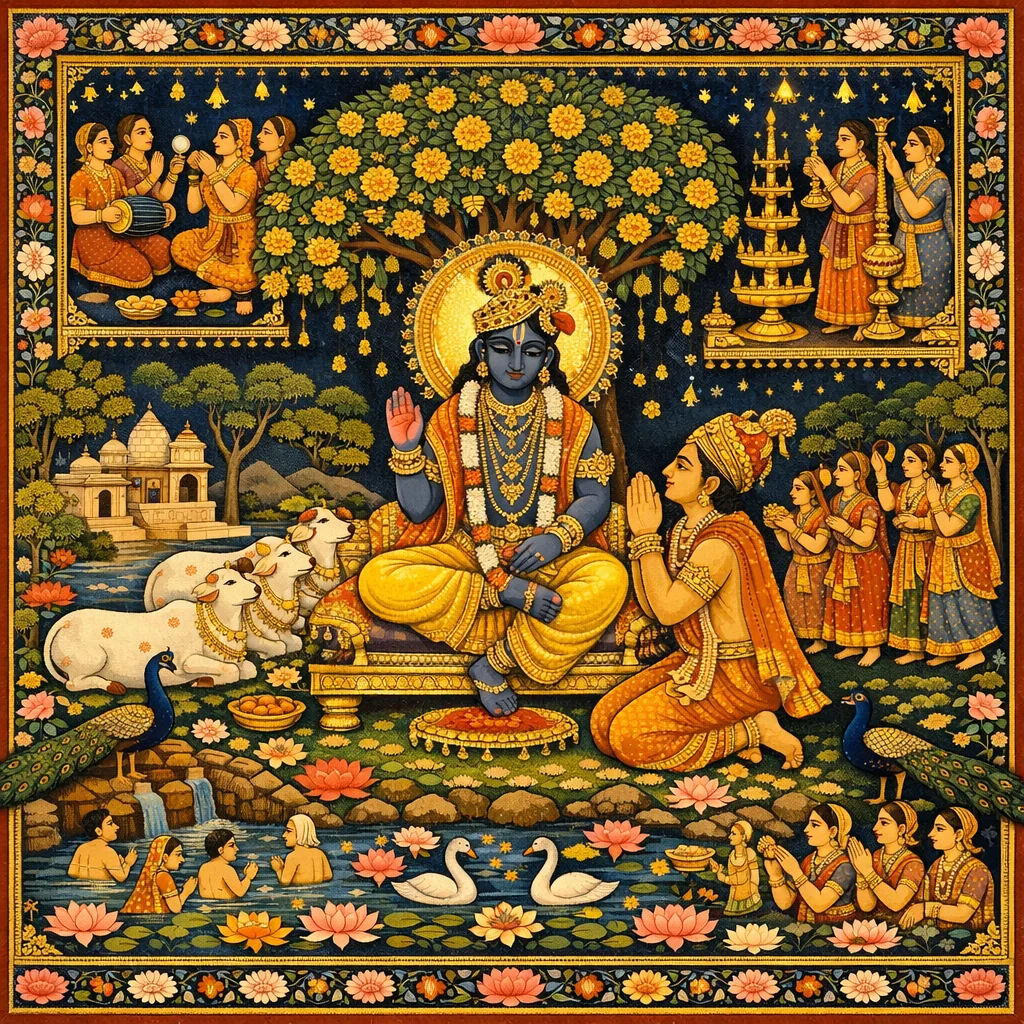
Adhyaya 29
Bhakti as the Easy and Supreme Yoga: Seeing Kṛṣṇa in All and Uddhava’s Departure to Badarikāśrama
Continuing the Uddhava-gītā’s final teachings, Uddhava admits that classical yogic mind-control is hard for the restless and asks for a simpler, workable path (1–3). He praises exclusive śaraṇāgati, citing Rāma’s special love for Hanumān beyond even exalted devas, and glorifies the Lord’s mercy as both the outer ācārya and the inner Paramātmā (4–6). Kṛṣṇa replies by defining death-conquering bhakti-sādhana: constant remembrance, offering one’s duties to Him, living near holy places and devotees, and celebrating festivals with kīrtana and public worship (8–11). The heart of practice is sama-darśana—seeing the Supreme Soul within all beings—bringing humility and respectful conduct and swiftly destroying envy and false ego; until perfected, one continues worship with mind, speech, and body (12–19). Kṛṣṇa extols this as His own established, unfailing path, praises faithful hearing and dissemination, yet restricts teaching to qualified, humble devotees (20–32). He concludes that all aims sought through karma, yoga, politics, or commerce are easily found in Him by the bhakta, and that full surrender grants liberation and shared opulence (33–34). Overwhelmed, Uddhava gives thanks and seeks unwavering attachment; Kṛṣṇa sends him to Badarikāśrama for purification, austerity, and steady meditation, and Uddhava departs in tearful separation—linking the chapter to the canto’s final turn: the Lord’s withdrawal (nirodha) and the safeguarding of liberating knowledge through Uddhava’s mission (35–49).
Shlokas
Verse 1
श्रीउद्धव उवाच सुदुस्तरामिमां मन्ये योगचर्यामनात्मन: । यथाञ्जसा पुमान् सिद्ध्येत् तन्मे ब्रूह्यञ्जसाच्युत ॥ १ ॥
Śrī Uddhava said: O Lord Acyuta, for one who cannot control the mind, the yoga practice You have described seems exceedingly difficult. Please explain in simple terms how a person may perform it more easily and attain success.
Verse 2
प्रायश: पुण्डरीकाक्ष युञ्जन्ते योगिनो मन: । विषीदन्त्यसमाधानान्मनोनिग्रहकर्शिता: ॥ २ ॥
O lotus-eyed Lord, most yogīs try to steady the mind, but because they cannot perfect samādhi they become discouraged and grow weary from the struggle of controlling the mind.
Verse 3
अथात आनन्ददुघं पदाम्बुजं हंसा: श्रयेरन्नरविन्दलोचन । सुखं नु विश्वेश्वर योगकर्मभि- स्त्वन्माययामी विहता न मानिन: ॥ ३ ॥
Therefore, O lotus-eyed Lord of the universe, swanlike saints joyfully take shelter of Your lotus feet, which pour forth transcendental bliss. But those proud of their attainments in yoga and karma do not seek Your refuge and are defeated by Your māyā.
Verse 4
किं चित्रमच्युत तवैतदशेषबन्धोदासेष्वनन्यशरणेषु यदात्मसात्त्वम् । योऽरोचयत् सह मृगै: स्वयमीश्वराणांश्रीमत्किरीटतटपीडितपादपीठ: ॥ ४ ॥
O Acyuta, what is astonishing in this—that You draw near and make Your own those servants who take exclusive shelter of You? Even when You appeared as Lord Rāmacandra, while Brahmā and other devas competed to place the shining tips of their crowns upon the footstool where Your lotus feet rested, You showed special affection for monkeys such as Hanumān, for they had taken refuge in You alone.
Verse 5
तं त्वाखिलात्मदयितेश्वरमाश्रितानां सर्वार्थदं स्वकृतविद् विसृजेत को नु । को वा भजेत् किमपि विस्मृतयेऽनु भूत्यै किं वा भवेन्न तव पादरजोजुषां न: ॥ ५ ॥
You are the Soul of all, the dearest object of worship, and the Supreme Lord; to those who take shelter of You, You grant every goal and perfection. Who could dare abandon You, knowing Your beneficence? Who would worship something else for material enjoyment that only brings forgetfulness of You? And for us, engaged in serving the dust of Your lotus feet, what could possibly be lacking?
Verse 6
नैवोपयन्त्यपचितिं कवयस्तवेश ब्रह्मायुषापि कृतमृद्धमुद: स्मरन्त: । योऽन्तर्बहिस्तनुभृतामशुभं विधुन्वन्न आचार्यचैत्त्यवपुषा स्वगतिं व्यनक्ति ॥ ६ ॥
O Lord, even transcendental poets and masters of spiritual science could not fully repay their debt to You, even with a lifespan as long as Brahmā’s. For You appear in two ways—externally as the ācārya and internally as the indwelling Paramātmā—cleansing the embodied beings of impurity within and without, and showing them the path by which they may come to You.
Verse 7
श्रीशुक उवाच इत्युद्धवेनात्यनुरक्तचेतसा पृष्टो जगत्क्रीडनक: स्वशक्तिभि: । गृहीतमूर्तित्रय ईश्वरेश्वरो जगाद सप्रेममनोहरस्मित: ॥ ७ ॥
Śukadeva Gosvāmī said: Thus questioned by Uddhava, whose heart was deeply devoted, Lord Kṛṣṇa—the controller of all controllers, who plays with the universe as His pastime and, by His energies, assumes the three forms of Brahmā, Viṣṇu, and Śiva—began to reply, showing a charming smile filled with love.
Verse 8
श्रीभगवानुवाच हन्त ते कथयिष्यामि मम धर्मान् सुमङ्गलान् । यान् श्रद्धयाचरन् मर्त्यो मृत्युं जयति दुर्जयम् ॥ ८ ॥
The Supreme Lord said: Yes, I shall tell you My auspicious principles of devotion; by practicing them with faith, a mortal person conquers unconquerable death.
Verse 9
कुर्यात् सर्वाणि कर्माणि मदर्थं शनकै: स्मरन् । मय्यर्पितमनश्चित्तो मद्धर्मात्ममनोरति: ॥ ९ ॥
Always remembering Me, one should perform all duties for My sake without haste. Offering mind and intelligence to Me, one should fix the heart in loving attraction to My devotional service.
Verse 10
देशान् पुण्यानाश्रयेत मद्भक्तै: साधुभि: श्रितान् । देवासुरमनुष्येषु मद्भक्ताचरितानि च ॥ १० ॥
One should take shelter of holy places where My saintly devotees reside, and be guided by the exemplary conduct of My devotees, who appear among the devas, asuras, and human beings.
Verse 11
पृथक् सत्रेण वा मह्यं पर्वयात्रामहोत्सवान् । कारयेद् गीतनृत्याद्यैर्महाराजविभूतिभि: ॥ ११ ॥
Either alone or in public gatherings, with singing, dancing, and displays of royal opulence, one should arrange celebrations of the holy days, ceremonies, pilgrimages, and festivals set aside for My worship.
Verse 12
मामेव सर्वभूतेषु बहिरन्तरपावृतम् । ईक्षेतात्मनि चात्मानं यथा खममलाशय: ॥ १२ ॥
With a pure heart one should see Me, the Supreme Soul, within all beings and also within oneself—present everywhere, outwardly and inwardly, and untouched by matter, like the all-pervading sky.
Verse 13
इति सर्वाणि भूतानि मद्भावेन महाद्युते । सभाजयन् मन्यमानो ज्ञानं केवलमाश्रित: ॥ १३ ॥ ब्राह्मणे पुक्कसे स्तेने ब्रह्मण्येऽर्के स्फुलिङ्गके । अक्रूरे क्रूरके चैव समदृक् पण्डितो मत: ॥ १४ ॥
O brilliant Uddhava, one who thus views all beings with the understanding that I am present within each of them, and who, taking shelter of this divine knowledge, offers due respect to everyone, is truly wise. Such a person sees equally the brāhmaṇa and the outcaste, the thief and the supporter of brahminical culture, the sun and a tiny spark of fire, the gentle and the cruel.
Verse 14
इति सर्वाणि भूतानि मद्भावेन महाद्युते । सभाजयन् मन्यमानो ज्ञानं केवलमाश्रित: ॥ १३ ॥ ब्राह्मणे पुक्कसे स्तेने ब्रह्मण्येऽर्के स्फुलिङ्गके । अक्रूरे क्रूरके चैव समदृक् पण्डितो मत: ॥ १४ ॥
O brilliant Uddhava, one who beholds all beings with the understanding that I am present within each, and who, taking shelter of this divine knowledge, offers due honor to everyone, is truly considered wise. Such a person sees with equal vision the brāhmaṇa and the outcaste, the thief and the upholder of brahminical culture, the sun and a tiny spark of fire, the gentle and the cruel.
Verse 15
नरेष्वभीक्ष्णं मद्भावं पुंसो भावयतोऽचिरात् । स्पर्धासूयातिरस्कारा: साहङ्कारा वियन्ति हि ॥ १५ ॥
For one who constantly meditates on My presence within all persons, the evil tendencies of rivalry, envy, and contempt, along with false ego, are very quickly destroyed.
Verse 16
विसृज्य स्मयमानान् स्वान् दृशं व्रीडां च दैहिकीम् । प्रणमेद् दण्डवद् भूमावाश्वचाण्डालगोखरम् ॥ १६ ॥
Disregarding the ridicule of one’s companions, one should give up bodily identification and the embarrassment that follows from it. Then, falling flat upon the ground like a rod (daṇḍavat), one should offer obeisances before all— even dogs, outcastes, cows, and asses.
Verse 17
यावत् सर्वेषु भूतेषु मद्भावो नोपजायते । तावदेवमुपासीत वाङ्मन:कायवृत्तिभि: ॥ १७ ॥
Until one has fully developed the ability to see Me within all living beings, one must continue to worship Me by this method through the activities of speech, mind, and body.
Verse 18
सर्वं ब्रह्मात्मकं तस्य विद्ययात्ममनीषया । परिपश्यन्नुपरमेत् सर्वतो मुक्तसंशय: ॥ १८ ॥
By such transcendental knowledge of the all-pervading Supreme Personality of Godhead, and by the wisdom of the self, one sees the Absolute Truth everywhere as Brahman’s very essence. Freed from all doubts, one then gives up fruitive, result-seeking activities.
Verse 19
अयं हि सर्वकल्पानां सध्रीचीनो मतो मम । मद्भाव: सर्वभूतेषु मनोवाक्कायवृत्तिभि: ॥ १९ ॥
I deem this the most auspicious of all methods: to employ one’s mind, words, and bodily acts to realize Me, present within all living beings.
Verse 20
न ह्यङ्गोपक्रमे ध्वंसो मद्धर्मस्योद्धवाण्वपि । मया व्यवसित: सम्यङ्निर्गुणत्वादनाशिष: ॥ २० ॥
My dear Uddhava, there is never any loss in beginning My dharma, for I Myself have established it perfectly; it is beyond the modes and free of selfish desire. Thus the devotee suffers not the slightest diminution.
Verse 21
यो यो मयि परे धर्म: कल्प्यते निष्फलाय चेत् । तदायासो निरर्थ: स्याद् भयादेरिव सत्तम ॥ २१ ॥
O Uddhava, best of saints, any ‘religion’ devised for Me with a fruitless aim is mere toil—like fear and lament in danger that change nothing. But action offered to Me without selfish motive, even if outwardly useless, is the true process of religion.
Verse 22
एषा बुद्धिमतां बुद्धिर्मनीषा च मनीषिणाम् । यत् सत्यमनृतेनेह मर्त्येनाप्नोति मामृतम् ॥ २२ ॥
This is the highest intelligence of the intelligent and the finest skill of the most discerning: that in this very life the mortal can use the temporary and unreal to attain Me, the immortal and eternal Reality.
Verse 23
एष तेऽभिहित: कृत्स्नो ब्रह्मवादस्य सङ्ग्रह: । समासव्यासविधिना देवानामपि दुर्गम: ॥ २३ ॥
Thus I have spoken to you—both succinctly and in detail—a complete compendium of the science of Brahman, the Absolute Truth. Even for the demigods, this knowledge is difficult to grasp.
Verse 24
अभीक्ष्णशस्ते गदितं ज्ञानं विस्पष्टयुक्तिमत् । एतद् विज्ञाय मुच्येत पुरुषो नष्टसंशय: ॥ २४ ॥
I have repeatedly spoken this knowledge to you with clear reasoning. One who properly understands it becomes free of all doubts and attains liberation.
Verse 25
सुविविक्तं तव प्रश्नं मयैतदपि धारयेत् । सनातनं ब्रह्मगुह्यं परं ब्रह्माधिगच्छति ॥ २५ ॥
These answers to your questions are most clear. One who fixes attention upon them attains the eternal, confidential goal of the Vedas—the Supreme Absolute Truth, Parabrahman.
Verse 26
य एतन्मम भक्तेषु सम्प्रदद्यात् सुपुष्कलम् । तस्याहं ब्रह्मदायस्य ददाम्यात्मानमात्मना ॥ २६ ॥
One who liberally disseminates this knowledge among My devotees bestows the Absolute Truth, and to such a person I give My very own self.
Verse 27
य एतत् समधीयीत पवित्रं परमं शुचि । स पूयेताहरहर्मां ज्ञानदीपेन दर्शयन् ॥ २७ ॥
One who loudly recites this supreme, most lucid and purifying knowledge becomes purified day by day, for with the lamp of transcendental knowledge he reveals Me to others.
Verse 28
य एतच्छ्रद्धया नित्यमव्यग्र: शृणुयान्नर: । मयि भक्तिं परां कुर्वन् कर्मभिर्न स बध्यते ॥ २८ ॥
Anyone who regularly listens to this knowledge with faith and attentive focus, while engaging in pure devotional service to Me, is never bound by the reactions of material work.
Verse 29
अप्युद्धव त्वया ब्रह्म सखे समवधारितम् । अपि ते विगतो मोह: शोकश्चासौ मनोभव: ॥ २९ ॥
My dear friend Uddhava, have you now fully understood this transcendental Brahman-knowledge? Have the delusion and sorrow that arose within your mind been dispelled?
Verse 30
नैतत्त्वया दाम्भिकाय नास्तिकाय शठाय च । अशुश्रूषोरभक्ताय दुर्विनीताय दीयताम् ॥ ३० ॥
Do not give this instruction to one who is hypocritical, atheistic, or deceitful; nor to one who will not listen with faithful attention, who lacks devotion, or who is without humility.
Verse 31
एतैर्दोषैर्विहीनाय ब्रह्मण्याय प्रियाय च । साधवे शुचये ब्रूयाद् भक्ति: स्याच्छूद्रयोषिताम् ॥ ३१ ॥
Teach this knowledge to one free from these faults—one devoted to the welfare of the brāhmaṇas, affectionate, saintly, and pure. And if common workers and women are found to have devotion to the Supreme Lord, they too should be accepted as qualified hearers.
Verse 32
नैतद् विज्ञाय जिज्ञासोर्ज्ञातव्यमवशिष्यते । पीत्वा पीयूषममृतं पातव्यं नावशिष्यते ॥ ३२ ॥
When an inquisitive seeker understands this knowledge, nothing further remains to be known. For one who has drunk the sweetest nectar of immortality cannot still remain thirsty.
Verse 33
ज्ञाने कर्मणि योगे च वार्तायां दण्डधारणे । यावानर्थो नृणां तात तावांस्तेऽहं चतुर्विध: ॥ ३३ ॥
My child, through analytic knowledge, ritual work, mystic yoga, worldly livelihood, and political rule, people seek dharma, artha, kāma, and mokṣa. But because you are My devotee, whatever men can achieve by these many paths you will very easily find within Me.
Verse 34
मर्त्यो यदा त्यक्तसमस्तकर्मा निवेदितात्मा विचिकीर्षितो मे । तदामृतत्त्वं प्रतिपद्यमानो मयात्मभूयाय च कल्पते वै ॥ ३४ ॥
When a mortal renounces all fruit-seeking work and offers his very self to Me, eager to serve Me, he attains freedom from birth and death and is raised to share in My own divine opulences.
Verse 35
श्रीशुक उवाच स एवमादर्शितयोगमार्ग- स्तदोत्तम:श्लोकवचो निशम्य । बद्धाञ्जलि: प्रीत्युपरुद्धकण्ठो न किञ्चिदूचेऽश्रुपरिप्लुताक्ष: ॥ ३५ ॥
Śukadeva Gosvāmī said: Hearing these words of Lord Kṛṣṇa and thus being shown the full path of yoga, Uddhava folded his hands in reverence. But his throat choked with love and his eyes brimmed with tears, so he could not speak.
Verse 36
विष्टभ्य चित्तं प्रणयावघूर्णं धैर्येण राजन् बहु मन्यमान: । कृताञ्जलि: प्राह यदुप्रवीरं शीर्ष्णा स्पृशंस्तच्चरणारविन्दम् ॥ ३६ ॥
O King, steadying with resolve his mind overwhelmed by love, Uddhava felt profound gratitude to Lord Śrī Kṛṣṇa, the foremost hero of the Yadus. With folded hands he bowed, touched the Lord’s lotus feet with his head, and then spoke.
Verse 37
श्रीउद्धव उवाच विद्रावितो मोहमहान्धकारो य आश्रितो मे तव सन्निधानात् । विभावसो: किं नु समीपगस्य शीतं तमो भी: प्रभवन्त्यजाद्य ॥ ३७ ॥
Śrī Uddhava said: O unborn, primeval Lord, the great darkness of delusion that had seized me has been driven away by Your merciful presence. How can cold, darkness, and fear prevail over one who has drawn near the radiant sun?
Verse 38
प्रत्यर्पितो मे भवतानुकम्पिना भृत्याय विज्ञानमय: प्रदीप: । हित्वा कृतज्ञस्तव पादमूलं कोऽन्यं समीयाच्छरणं त्वदीयम् ॥ ३८ ॥
In Your compassion, in return for my meager surrender, You have bestowed upon me—Your servant—the lamp of transcendental knowledge. Therefore, what grateful devotee could abandon Your lotus feet and seek shelter of another master?
Verse 39
वृक्णश्च मे सुदृढ: स्नेहपाशो दाशार्हवृष्ण्यन्धकसात्वतेषु । प्रसारित: सृष्टिविवृद्धये त्वया स्वमायया ह्यात्मसुबोधहेतिना ॥ ३९ ॥
The tightly binding rope of my affection for the Dāśārhas, Vṛṣṇis, Andhakas, and Sātvatas—cast by You through Your own māyā for the expansion of creation—has now been cut by the weapon of realized knowledge of the Self.
Verse 40
नमोऽस्तु ते महायोगिन् प्रपन्नमनुशाधि माम् । यथा त्वच्चरणाम्भोजे रति: स्यादनपायिनी ॥ ४० ॥
Obeisances to You, O Mahāyogī. Please instruct me, who has surrendered to You, so that my loving attachment to Your lotus feet may be unwavering and never lost.
Verse 41
श्रीभगवानुवाच गच्छोद्धव मयादिष्टो बदर्याख्यं ममाश्रमम् । तत्र मत्पादतीर्थोदे स्नानोपस्पर्शनै: शुचि: ॥ ४१ ॥ ईक्षयालकनन्दाया विधूताशेषकल्मष: । वसानो वल्कलान्यङ्ग वन्यभुक् सुखनि:स्पृह: ॥ ४२ ॥ तितिक्षुर्द्वन्द्वमात्राणां सुशील: संयतेन्द्रिय: । शान्त: समाहितधिया ज्ञानविज्ञानसंयुत: ॥ ४३ ॥ मत्तोऽनुशिक्षितं यत्ते विविक्तमनुभावयन् । मय्यावेशितवाक्चित्तो मद्धर्मनिरतो भव । अतिव्रज्य गतीस्तिस्रो मामेष्यसि तत: परम् ॥ ४४ ॥
The Supreme Lord said: “My dear Uddhava, obey My command and go to My āśrama called Badarikā. There, purify yourself by touching and bathing in the sacred waters that have flowed from My lotus feet, and by beholding the holy Alakanandā River wash away all sin. Wear bark garments and eat what the forest naturally provides; remain content and free from desire. Be tolerant of dualities, gentle in conduct, self-controlled, peaceful, with a mind well-collected, endowed with transcendental knowledge and realized wisdom. In solitude, constantly contemplate the essence of the instructions I have given you; immerse your speech and mind in Me and be devoted to My dharma. Thus you will pass beyond the destinations of the three guṇas and finally return to Me.”
Verse 42
श्रीभगवानुवाच गच्छोद्धव मयादिष्टो बदर्याख्यं ममाश्रमम् । तत्र मत्पादतीर्थोदे स्नानोपस्पर्शनै: शुचि: ॥ ४१ ॥ ईक्षयालकनन्दाया विधूताशेषकल्मष: । वसानो वल्कलान्यङ्ग वन्यभुक् सुखनि:स्पृह: ॥ ४२ ॥ तितिक्षुर्द्वन्द्वमात्राणां सुशील: संयतेन्द्रिय: । शान्त: समाहितधिया ज्ञानविज्ञानसंयुत: ॥ ४३ ॥ मत्तोऽनुशिक्षितं यत्ते विविक्तमनुभावयन् । मय्यावेशितवाक्चित्तो मद्धर्मनिरतो भव । अतिव्रज्य गतीस्तिस्रो मामेष्यसि तत: परम् ॥ ४४ ॥
By beholding the Alakanandā River, let all impurity be washed away. Wear bark garments, eat what the forest naturally provides, and remain desireless even toward pleasure.
Verse 43
श्रीभगवानुवाच गच्छोद्धव मयादिष्टो बदर्याख्यं ममाश्रमम् । तत्र मत्पादतीर्थोदे स्नानोपस्पर्शनै: शुचि: ॥ ४१ ॥ ईक्षयालकनन्दाया विधूताशेषकल्मष: । वसानो वल्कलान्यङ्ग वन्यभुक् सुखनि:स्पृह: ॥ ४२ ॥ तितिक्षुर्द्वन्द्वमात्राणां सुशील: संयतेन्द्रिय: । शान्त: समाहितधिया ज्ञानविज्ञानसंयुत: ॥ ४३ ॥ मत्तोऽनुशिक्षितं यत्ते विविक्तमनुभावयन् । मय्यावेशितवाक्चित्तो मद्धर्मनिरतो भव । अतिव्रज्य गतीस्तिस्रो मामेष्यसि तत: परम् ॥ ४४ ॥
Be tolerant of dualities, gentle in conduct, and self-controlled; be peaceful, with a well-collected mind, endowed with knowledge and realized wisdom.
Verse 44
श्रीभगवानुवाच गच्छोद्धव मयादिष्टो बदर्याख्यं ममाश्रमम् । तत्र मत्पादतीर्थोदे स्नानोपस्पर्शनै: शुचि: ॥ ४१ ॥ ईक्षयालकनन्दाया विधूताशेषकल्मष: । वसानो वल्कलान्यङ्ग वन्यभुक् सुखनि:स्पृह: ॥ ४२ ॥ तितिक्षुर्द्वन्द्वमात्राणां सुशील: संयतेन्द्रिय: । शान्त: समाहितधिया ज्ञानविज्ञानसंयुत: ॥ ४३ ॥ मत्तोऽनुशिक्षितं यत्ते विविक्तमनुभावयन् । मय्यावेशितवाक्चित्तो मद्धर्मनिरतो भव । अतिव्रज्य गतीस्तिस्रो मामेष्यसि तत: परम् ॥ ४४ ॥
The Supreme Lord said: “My dear Uddhava, accept My command and go to My āśrama called Badarikā. There, purify yourself by touching and bathing in the sacred waters that have flowed from My lotus feet. By beholding the holy Alakanandā, all sin and impurity will be washed away. Wear bark garments, eat what the forest naturally provides, and remain content and free from desire. Be tolerant of dualities, gentle in conduct, self-controlled, peaceful, and endowed with spiritual knowledge and realized wisdom. With steady attention, meditate on the essence of the instructions I have given you; fix your words and mind upon Me and be devoted to My dharma. Thus you will transcend the destinations of the three guṇas and, in the end, come back to Me.”
Verse 45
श्रीशुक उवाच स एवमुक्तो हरिमेधसोद्धव: प्रदक्षिणं तं परिसृत्य पादयो: । शिरो निधायाश्रुकलाभिरार्द्रधी- र्न्यषिञ्चदद्वन्द्वपरोऽप्यपक्रमे ॥ ४५ ॥
Śukadeva Gosvāmī said: Thus addressed by Śrī Hari, whose wisdom destroys the suffering of material life, Uddhava circumambulated the Lord and then fell down, placing his head upon His feet. Though Uddhava was beyond all material dualities, at the moment of departure his heart broke, and with a mind drenched in tears he soaked the Lord’s lotus feet with his weeping.
Verse 46
सुदुस्त्यजस्नेहवियोगकातरो न शक्नुवंस्तं परिहातुमातुर: । कृच्छ्रं ययौ मूर्धनि भर्तृपादुके बिभ्रन्नमस्कृत्य ययौ पुन: पुन: ॥ ४६ ॥
Overwhelmed by the fear of separation from the Lord he loved so indestructibly, Uddhava could not give up the Lord’s company. At last, in great anguish, he bowed down again and again, placed his master’s slippers upon his head, and departed, stricken with sorrow.
Verse 47
ततस्तमन्तर्हृदि सन्निवेश्य गतो महाभागवतो विशालाम् । यथोपदिष्टां जगदेकबन्धुना तप: समास्थाय हरेरगाद् गतिम् ॥ ४७ ॥
Thereupon the great devotee Uddhava placed the Lord deep within his heart and went to Badarikāśrama. There, practicing austerity as instructed by Kṛṣṇa, the only friend of the universe, he attained the supreme destination—the personal abode of Hari.
Verse 48
य एतदानन्दसमुद्रसम्भृतं ज्ञानामृतं भागवताय भाषितम् । कृष्णेन योगेश्वरसेविताङ्घ्रिणा सच्छ्रद्धयासेव्य जगद् विमुच्यते ॥ ४८ ॥
This is the nectarean knowledge, brimming like an ocean of spiritual bliss, spoken by Kṛṣṇa—whose lotus feet are served by the greatest masters of yoga—to His devotee. Whoever in this universe receives this narration with sincere faith, by hearing and honoring it, is assured of liberation.
Verse 49
भवभयमपहन्तुं ज्ञानविज्ञानसारं निगमकृदुपजह्रे भृङ्गवद् वेदसारम् । अमृतमुदधितश्चापाययद् भृत्यवर्गान् पुरुषमृषभमाद्यं कृष्णसंज्ञं नतोऽस्मि ॥ ४९ ॥
I bow to Śrī Kṛṣṇa, the original and supreme Person. To destroy His devotees’ fear of saṁsāra, the author of the Vedas gathered, like a bee, the Vedic essence—the nectar of knowledge and realized wisdom—and from the ocean of bliss bestowed it upon His servants, who drank it by His mercy.
Frequently Asked Questions
Uddhava observes that many yogīs become frustrated trying to steady the mind and perfect samādhi. Kṛṣṇa therefore presents bhakti-centered yoga: remembrance of Him, offering all duties to Him, associating with devotees, celebrating His worship through kīrtana and festivals, and cultivating Paramātmā-darśana—seeing Him within all beings—so the mind becomes naturally absorbed by devotion rather than forced restraint.
It is operationalized through conduct: honoring every being because the Lord is present within, abandoning rivalry and envy, and practicing radical humility (daṇḍavat obeisances even to socially disregarded beings). The text states that until this vision is fully mature, one should continue deliberate worship with speech, mind, and body—so inner realization and outer discipline reinforce each other.
Kṛṣṇa restricts it from hypocritical, atheistic, dishonest, non-devotional, faithless, or proud hearers. It should be taught to the pure and saintly, kindly disposed, and dedicated to the welfare of brāhmaṇas; additionally, common workers and women are included if they possess devotion—indicating bhakti as the decisive qualification (adhikāra), not social status.
Badarikāśrama is prescribed as a place of purification and steady sādhana: bathing in sacred waters (Alakanandā), living simply, tolerating dualities, and meditating on Kṛṣṇa’s instructions with fixed attention. The outcome is transcendence of the three guṇas and return to the Lord’s abode—showing a concrete post-instruction regimen that stabilizes realization and completes the path to mukti.
It dramatizes viraha-bhakti (devotion in separation) and marks the narrative pivot into nirodha: as Kṛṣṇa’s earthly līlā nears withdrawal, the Lord entrusts His essence-teaching to Uddhava, who carries it forward through practice and transmission. The devotee’s grief is not ignorance but intensified love, while the instruction ensures liberation for faithful hearers.