Adhyaya 27
Arcana-vidhi: The Method of Deity Worship (Vedic, Tantric, and Mixed)
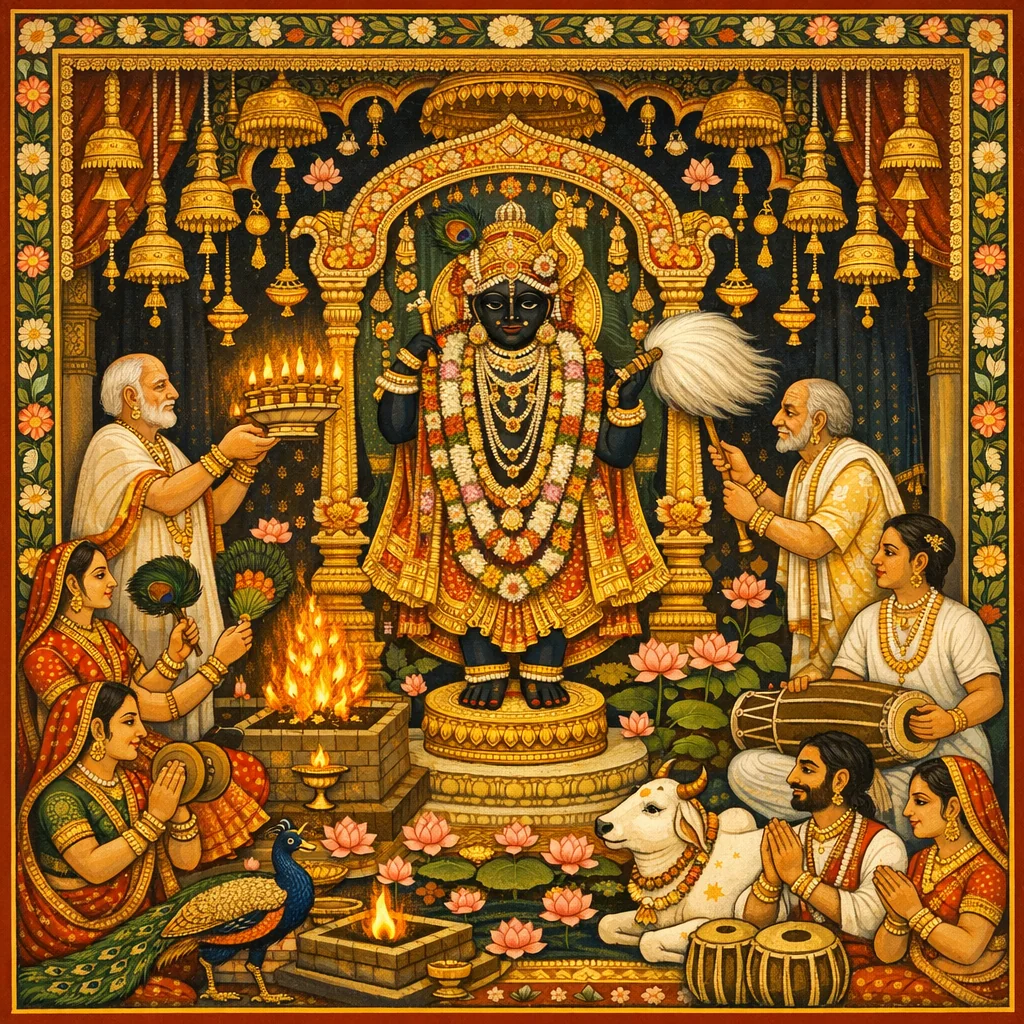
Continuing the Lord’s systematic instruction to Uddhava on dependable practices that turn daily life into bhakti, this chapter shifts from general spiritual cultivation to the concrete liturgy of arcana (Deity worship). Uddhava asks about eligibility, scriptural authority, and procedure, noting that sages like Nārada and Vyāsa praise Deity worship as supremely beneficial and widely accessible. Kṛṣṇa replies that the rules are vast, so He outlines a stepwise method: choosing Vedic, tantric, or mixed worship; purifying the body; recognizing multiple seats of worship (Deity, fire, sun, water, heart); and understanding Deity materials and installation (temporary or permanent). He details preparation, nyāsa, sanctifying vessels, invoking the Lord, offering pādya/ācamanīya/arghya, worshiping the Lord’s weapons and associates, and daily bathing, decoration, food offerings, festivals, and song‑dance‑kathā. A homa sequence follows, then prayers, honoring prasāda, and, when appropriate, dismissal. The chapter links personal worship to institutional support—temples, gardens, endowments—promising results while warning against theft of sacred property and setting ethical boundaries for sustaining worship as the narrative moves toward Kṛṣṇa’s concluding instructions.
Shlokas
Verse 1
श्रीउद्धव उवाच क्रियायोगं समाचक्ष्व भवदाराधनं प्रभो । यस्मात्त्वां ये यथार्चन्ति सात्वता: सात्वतर्षभ ॥ १ ॥
Śrī Uddhava said: O Lord, master of the devotees, please teach me the kriyā-yoga—the prescribed method for worshiping You in Your Deity form. O best of the Sātvatas, what are the qualifications of those who worship, on what basis is such worship established, and what is its specific procedure?
Verse 2
एतद् वदन्ति मुनयो मुहुर्नि:श्रेयसं नृणाम् । नारदो भगवान् व्यास आचार्योऽङ्गिरस: सुत: ॥ २ ॥
The great sages repeatedly proclaim that such worship bestows the highest good for human life. This is the view of Nārada Muni, of Bhagavān Vyāsadeva, and also of my own spiritual master, Bṛhaspati.
Verse 3
नि:सृतं ते मुखाम्भोजाद् यदाह भगवानज: । पुत्रेभ्यो भृगुमुख्येभ्यो देव्यै च भगवान् भव: ॥ ३ ॥ एतद् वै सर्ववर्णानामाश्रमाणां च सम्मतम् । श्रेयसामुत्तमं मन्ये स्त्रीशूद्राणां च मानद ॥ ४ ॥
O most magnanimous Lord, the teachings of this method of worshiping You as the Deity first issued from Your lotus mouth. Thereafter the blessed Aja, Brahmā, spoke them to his sons headed by Bhṛgu, and Lord Śiva taught them to the goddess Pārvatī. This process is accepted and fitting for all varṇas and āśramas; therefore I deem worship of Your Arca form the highest benefit among spiritual practices, even for women and śūdras.
Verse 4
नि:सृतं ते मुखाम्भोजाद् यदाह भगवानज: । पुत्रेभ्यो भृगुमुख्येभ्यो देव्यै च भगवान् भव: ॥ ३ ॥ एतद् वै सर्ववर्णानामाश्रमाणां च सम्मतम् । श्रेयसामुत्तमं मन्ये स्त्रीशूद्राणां च मानद ॥ ४ ॥
O most magnanimous Lord, the teachings of this method of worshiping You as the Deity first issued from Your lotus mouth. Thereafter the blessed Aja, Brahmā, spoke them to his sons headed by Bhṛgu, and Lord Śiva taught them to the goddess Pārvatī. This process is accepted and fitting for all varṇas and āśramas; therefore I deem worship of Your Arca form the highest benefit among spiritual practices, even for women and śūdras.
Verse 5
एतत् कमलपत्राक्ष कर्मबन्धविमोचनम् । भक्ताय चानुरक्ताय ब्रूहि विश्वेश्वरेश्वर ॥ ५ ॥
O lotus-eyed one, O Supreme Lord of all the lords of the universe, please explain properly to Your devoted and affectionate servant this means of liberation from the bondage of karma.
Verse 6
श्रीभगवानुवाच न ह्यन्तोऽनन्तपारस्य कर्मकाण्डस्य चोद्धव । सङ्क्षिप्तं वर्णयिष्यामि यथावदनुपूर्वश: ॥ ६ ॥
The Supreme Lord said: My dear Uddhava, there is no end to the innumerable Vedic prescriptions concerning worship in the Arca form; therefore I shall describe it to you briefly, properly, and step by step.
Verse 7
वैदिकस्तान्त्रिको मिश्र इति मे त्रिविधो मख: । त्रयाणामीप्सितेनैव विधिना मां समर्चरेत् ॥ ७ ॥
There are three ways by which I accept sacrifice: Vedic, tantric, and mixed. One should worship Me carefully by choosing whichever of these three procedures is desired and following its proper rules.
Verse 8
यदा स्वनिगमेनोक्तं द्विजत्वं प्राप्य पूरुष: । यथा यजेत मां भक्त्या श्रद्धया तन्निबोध मे ॥ ८ ॥
Now listen with faith: I will explain precisely how one who has attained the status of a twice-born (dvija) by Vedic injunctions should worship Me with devotion.
Verse 9
अर्चायां स्थण्डिलेऽग्नौ वा सूर्ये वाप्सु हृदि द्विज: । द्रव्येण भक्तियुक्तोऽर्चेत् स्वगुरुं माममायया ॥ ९ ॥
A twice-born person should worship Me—his worshipable Lord and the very form of his guru—without duplicity, offering suitable paraphernalia in devotion, whether in My Deity, upon the ground, in fire, in the sun, in water, or within his own heart.
Verse 10
पूर्वं स्नानं प्रकुर्वीत धौतदन्तोऽङ्गशुद्धये । उभयैरपि च स्नानं मन्त्रैर्मृद्ग्रहणादिना ॥ १० ॥
One should first purify the body by cleaning the teeth and bathing. Then one should perform a second purification by applying earth and chanting both Vedic and tantric mantras.
Verse 11
सन्ध्योपास्त्यादिकर्माणि वेदेनाचोदितानि मे । पूजां तै: कल्पयेत् सम्यक् सङ्कल्प: कर्मपावनीम् ॥ ११ ॥
Fixing the mind on Me, one should worship Me through the duties enjoined by the Vedas—such as the sandhyā worship and recitation of the Gāyatrī—making a proper sankalpa. Such acts purify the reactions born of fruit-seeking karma.
Verse 12
शैली दारुमयी लौही लेप्या लेख्या च सैकती । मनोमयी मणिमयी प्रतिमाष्टविधा स्मृता ॥ १२ ॥
The Lord’s Deity form is remembered as eightfold: made of stone, wood, metal, clay, plastered or coated, painted, formed of sand, conceived within the mind, or fashioned from jewels.
Verse 13
चलाचलेति द्विविधा प्रतिष्ठा जीवमन्दिरम् । उद्वासावाहने न स्त: स्थिरायामुद्धवार्चने ॥ १३ ॥
The Lord’s Deity form, shelter of all beings, is established in two ways: temporary and permanent. But, dear Uddhava, a Deity installed permanently, once invoked, is never sent away.
Verse 14
अस्थिरायां विकल्प: स्यात् स्थण्डिले तु भवेद् द्वयम् । स्नपनं त्वविलेप्यायामन्यत्र परिमार्जनम् ॥ १४ ॥
For a temporary installation, invocation and dismissal may be done optionally; but when the Deity is drawn upon the sacred ground, both rites must always be performed. Bathing is done with water, except for forms of clay, paint, or wood, for which thorough cleansing without water is prescribed.
Verse 15
द्रव्यै: प्रसिद्धैर्मद्याग: प्रतिमादिष्वमायिन: । भक्तस्य च यथालब्धैर्हृदि भावेन चैव हि ॥ १५ ॥
One should worship Me in My Deity forms with the finest known offerings, without deceit. Yet a devotee free from material desire may worship Me with whatever he can obtain, and may even worship Me within the heart, with mental offerings and bhāva.
Verse 16
स्नानालङ्करणं प्रेष्ठमर्चायामेव तूद्धव । स्थण्डिले तत्त्वविन्यासो वह्नावाज्यप्लुतं हवि: ॥ १६ ॥ सूर्ये चाभ्यर्हणं प्रेष्ठं सलिले सलिलादिभि: । श्रद्धयोपाहृतं प्रेष्ठं भक्तेन मम वार्यपि ॥ १७ ॥
My dear Uddhava, in worship of the temple Deity, bathing and ornamentation are most pleasing to Me. For the Deity traced upon sacred ground, tattva-vinyāsa is most dear; for the sacrificial fire, sesame and barley soaked in ghee are preferred; for the sun, upasthāna and arghya are preferred; and in the form of water, I am worshiped by offering water itself. Indeed, whatever My devotee offers with faith—even a little water—is most dear to Me.
Verse 17
स्नानालङ्करणं प्रेष्ठमर्चायामेव तूद्धव । स्थण्डिले तत्त्वविन्यासो वह्नावाज्यप्लुतं हवि: ॥ १६ ॥ सूर्ये चाभ्यर्हणं प्रेष्ठं सलिले सलिलादिभि: । श्रद्धयोपाहृतं प्रेष्ठं भक्तेन मम वार्यपि ॥ १७ ॥
My dear Uddhava, in worship of the temple Deity, bathing and ornamentation are most pleasing to Me. For the Deity traced upon sacred ground, tattva-vinyāsa is most dear; for the sacrificial fire, sesame and barley soaked in ghee are preferred; for the sun, upasthāna and arghya are preferred; and in the form of water, I am worshiped by offering water itself. Indeed, whatever My devotee offers with faith—even a little water—is most dear to Me.
Verse 18
भूर्यप्यभक्तोपाहृतं न मे तोषाय कल्पते । गन्धो धूप: सुमनसो दीपोऽन्नाद्यं च किं पुन: ॥ १८ ॥
Even the most opulent offerings do not please Me when brought by those without bhakti. But the smallest gift offered with love by My devotees delights Me; and I am especially pleased when fragrant oil, incense, flowers, lamps, and tasteful foods are presented in loving devotion.
Verse 19
शुचि: सम्भृतसम्भार: प्राग्दर्भै: कल्पितासन: । आसीन: प्रागुदग् वार्चेदर्चायां त्वथ सम्मुख: ॥ १९ ॥
Having purified himself and gathered the paraphernalia, the worshiper should arrange his seat with kuśa grass, its tips pointing east. He should then sit facing east or north; or, if the Deity is fixed in one place, he should sit directly facing the Deity.
Verse 20
कृतन्यास: कृतन्यासां मदर्चां पाणिना मृजेत् । कलशं प्रोक्षणीयं च यथावदुपसाधयेत् ॥ २० ॥
Having performed nyāsa, the devotee should sanctify the parts of his body by touching them while chanting mantras. He should do the same for My arca form, and then with his hands cleanse the Deity by removing old flowers and remnants of previous offerings. Next he should properly prepare the kalaśa and the prokṣaṇīya vessel for sprinkling.
Verse 21
तदद्भिर्देवयजनं द्रव्याण्यात्मानमेव च । प्रोक्ष्य पात्राणि त्रीण्यद्भिस्तैस्तैर्द्रव्यैश्च साधयेत् ॥ २१ ॥
Then, using the water from the prokṣaṇīya vessel, he should sprinkle the place of worship, the offerings to be presented, and his own body. Next, according to proper procedure, he should adorn with auspicious substances three vessels filled with water.
Verse 22
पाद्यार्घ्याचमनीयार्थं त्रीणि पात्राणि देशिक: । हृदा शीर्ष्णाथ शिखया गायत्र्या चाभिमन्त्रयेत् ॥ २२ ॥
For pādya, arghya, and ācamana, the worshiper should set out three vessels. He should consecrate the pādya vessel with “hṛdayāya namaḥ”, the arghya vessel with “śirase svāhā”, and the ācamana vessel with “śikhāyai vaṣaṭ”; and he should also chant the Gāyatrī mantra over all three.
Verse 23
पिण्डे वाय्वग्निसंशुद्धे हृत्पद्मस्थां परां मम । अण्वीं जीवकलां ध्यायेन्नादान्ते सिद्धभाविताम् ॥ २३ ॥
The worshiper should meditate on My supreme subtle form, dwelling in the heart-lotus within one’s own body purified by air and fire, as the source of all living beings; self-realized siddhas experience it at the end of the sacred vibration of Om.
Verse 24
तयात्मभूतया पिण्डे व्याप्ते सम्पूज्य तन्मय: । आवाह्यार्चादिषु स्थाप्य न्यस्ताङ्गं मां प्रपूजयेत् ॥ २४ ॥
The devotee should conceive the Supersoul, who pervades one’s body as the very Self, in a form corresponding to one’s realization, worshiping to the full of one’s capacity and becoming absorbed in Him. Then, touching the Deity’s limbs while chanting the proper mantras, one should invite the Supersoul into the arca form and worship Me.
Verse 25
पाद्योपस्पर्शार्हणादीनुपचारान् प्रकल्पयेत् । धर्मादिभिश्च नवभि: कल्पयित्वासनं मम ॥ २५ ॥ पद्ममष्टदलं तत्र कर्णिकाकेसरोज्ज्वलम् । उभाभ्यां वेदतन्त्राभ्यां मह्यं तूभयसिद्धये ॥ २६ ॥
The worshiper should arrange the offerings—water for washing the feet, water for rinsing the mouth, arghya, and other services. First, one should conceive My seat as adorned with the personified deities of religion, knowledge, renunciation, and opulence, together with My nine spiritual energies—an eight-petaled lotus radiant with saffron filaments in its whorl. Then, following both Vedic and tantric rules, one should offer Me padya, acamaniya, arghya, and the rest; by this one attains both worldly enjoyment and liberation.
Verse 26
पाद्योपस्पर्शार्हणादीनुपचारान् प्रकल्पयेत् । धर्मादिभिश्च नवभि: कल्पयित्वासनं मम ॥ २५ ॥ पद्ममष्टदलं तत्र कर्णिकाकेसरोज्ज्वलम् । उभाभ्यां वेदतन्त्राभ्यां मह्यं तूभयसिद्धये ॥ २६ ॥
The worshiper should arrange the offerings—water for washing the feet, water for rinsing the mouth, arghya, and other services. First, one should conceive My seat as adorned with the personified deities of religion, knowledge, renunciation, and opulence, together with My nine spiritual energies—an eight-petaled lotus radiant with saffron filaments in its whorl. Then, following both Vedic and tantric rules, one should offer Me padya, acamaniya, arghya, and the rest; by this one attains both worldly enjoyment and liberation.
Verse 27
सुदर्शनं पाञ्चजन्यं गदासीषुधनुर्हलान् । मुषलं कौस्तुभं मालां श्रीवत्सं चानुपूजयेत् ॥ २७ ॥
Then, in order, one should worship the Lord’s Sudarśana disc, His Pāñcajanya conchshell, His club, sword, bow, arrows and plow, His muṣala weapon, His Kaustubha gem, His flower garland, and the Śrīvatsa mark upon His chest.
Verse 28
नन्दं सुनन्दं गरुडं प्रचण्डं चण्डमेव च । महाबलं बलं चैव कुमुदं कमुदेक्षणम् ॥ २८ ॥
One should also worship the Lord’s attendants—Nanda and Sunanda, Garuḍa, Pracaṇḍa and Caṇḍa, Mahābala and Bala, and Kumuda and Kumudekṣaṇa.
Verse 29
दुर्गां विनायकं व्यासं विष्वक्सेनं गुरून्सुरान् । स्वे स्वे स्थाने त्वभिमुखान् पूजयेत् प्रोक्षणादिभि: ॥ २९ ॥
With offerings such as prokṣaṇa, one should worship Durgā, Vināyaka, Vyāsa, Viṣvaksena, the spiritual masters, and the various devas, each situated in his proper place and facing the Lord’s Deity.
Verse 30
चन्दनोशीरकर्पूरकुङ्कुमागुरुवासितै: । सलिलै: स्नापयेन्मन्त्रैर्नित्यदा विभवे सति ॥ ३० ॥ स्वर्णघर्मानुवाकेन महापुरुषविद्यया । पौरुषेणापि सूक्तेन सामभी राजनादिभि: ॥ ३१ ॥
Each day, as opulently as his means allow, the worshiper should bathe the Lord’s Deity with water scented with sandalwood, uśīra, camphor, kuṅkuma, and aguru, while chanting mantras; and he should recite Vedic hymns such as the Svarṇa-gharma anuvāka, the Mahāpuruṣa-vidyā, the Puruṣa-sūkta, and Sāma Veda songs like the Rājana and Rohiṇya.
Verse 31
चन्दनोशीरकर्पूरकुङ्कुमागुरुवासितै: । सलिलै: स्नापयेन्मन्त्रैर्नित्यदा विभवे सति ॥ ३० ॥ स्वर्णघर्मानुवाकेन महापुरुषविद्यया । पौरुषेणापि सूक्तेन सामभी राजनादिभि: ॥ ३१ ॥
Each day, as opulently as his means allow, the worshiper should bathe the Lord’s Deity with water scented with sandalwood, uśīra, camphor, kuṅkuma, and aguru, while chanting mantras; and he should recite Vedic hymns such as the Svarṇa-gharma anuvāka, the Mahāpuruṣa-vidyā, the Puruṣa-sūkta, and Sāma Veda songs like the Rājana and Rohiṇya.
Verse 32
वस्त्रोपवीताभरणपत्रस्रग्गन्धलेपनै: । अलङ्कुर्वीत सप्रेम मद्भक्तो मां यथोचितम् ॥ ३२ ॥
Then My devotee should lovingly, in the prescribed manner, adorn Me with garments, the sacred thread (upavīta), various ornaments, tilaka marks and garlands, and anoint My body with fragrant oils.
Verse 33
पाद्यमाचमनीयं च गन्धं सुमनसोऽक्षतान् । धूपदीपोपहार्याणि दद्यान्मे श्रद्धयार्चक: ॥ ३३ ॥
With faithful devotion, the worshiper should offer Me water for washing My feet and for ācaman, fragrant scents, flowers and akṣata, along with incense, lamps, and other sacred offerings.
Verse 34
गुडपायससर्पींषि शष्कुल्यापूपमोदकान् । संयावदधिसूपांश्च नैवेद्यं सति कल्पयेत् ॥ ३४ ॥
According to his means, the devotee should prepare naivedya for Me—jaggery, sweet pāyasa, ghee, śaṣkulī cakes, āpūpa sweets, modaka, saṁyāva, yogurt, vegetable soups, and other pleasing foods.
Verse 35
अभ्यङ्गोन्मर्दनादर्शदन्तधावाभिषेचनम् । अन्नाद्यगीतनृत्यानि पर्वणि स्युरुतान्वहम् ॥ ३५ ॥
On special occasions—and daily, if possible—the Deity should be anointed and massaged, shown a mirror, offered a dantadhāvan twig for cleansing the teeth, bathed with pañcāmṛta, served abundant foods, and delighted with devotional singing and dancing.
Verse 36
विधिना विहिते कुण्डे मेखलागर्तवेदिभि: । अग्निमाधाय परित: समूहेत् पाणिनोदितम् ॥ ३६ ॥
In a kuṇḍa prepared according to scriptural rule—with the sacred boundary, the sacrificial pit, and the altar mound—the devotee should kindle the yajña fire, and with his own hands pile the wood all around until it blazes.
Verse 37
परिस्तीर्याथ पर्युक्षेदन्वाधाय यथाविधि । प्रोक्षण्यासाद्य द्रव्याणि प्रोक्ष्याग्नौ भावयेत माम् ॥ ३७ ॥
After spreading kuśa grass on the ground and sprinkling it with water, one should perform the anvādhāna rite as prescribed. Then, arranging the oblation items and sanctifying them with water from the sprinkling vessel, the worshiper should meditate upon Me within the fire.
Verse 38
तप्तजाम्बूनदप्रख्यं शङ्खचक्रगदाम्बुजै: । लसच्चतुर्भुजं शान्तं पद्मकिञ्जल्कवाससम् ॥ ३८ ॥ स्फुरत्किरीटकटककटिसूत्रवराङ्गदम् । श्रीवत्सवक्षसं भ्राजत्कौस्तुभं वनमालिनम् ॥ ३९ ॥ ध्यायन्नभ्यर्च्य दारूणि हविषाभिघृतानि च । प्रास्याज्यभागावाघारौ दत्त्वा चाज्यप्लुतं हवि: ॥ ४० ॥ जुहुयान्मूलमन्त्रेण षोडशर्चावदानत: । धर्मादिभ्यो यथान्यायं मन्त्रै: स्विष्टिकृतं बुध: ॥ ४१ ॥
The wise devotee should meditate on the Lord whose hue is like molten gold, whose four radiant arms bear conchshell, disc, club, and lotus, who is ever serene and clad in garments the color of lotus filaments.
Verse 39
तप्तजाम्बूनदप्रख्यं शङ्खचक्रगदाम्बुजै: । लसच्चतुर्भुजं शान्तं पद्मकिञ्जल्कवाससम् ॥ ३८ ॥ स्फुरत्किरीटकटककटिसूत्रवराङ्गदम् । श्रीवत्सवक्षसं भ्राजत्कौस्तुभं वनमालिनम् ॥ ३९ ॥ ध्यायन्नभ्यर्च्य दारूणि हविषाभिघृतानि च । प्रास्याज्यभागावाघारौ दत्त्वा चाज्यप्लुतं हवि: ॥ ४० ॥ जुहुयान्मूलमन्त्रेण षोडशर्चावदानत: । धर्मादिभ्यो यथान्यायं मन्त्रै: स्विष्टिकृतं बुध: ॥ ४१ ॥
He should meditate on Hari whose crown, bracelets, belt, and fine armlets flash with splendor; on His chest shines the Śrīvatsa mark, the radiant Kaustubha gem, and a garland of forest flowers.
Verse 40
तप्तजाम्बूनदप्रख्यं शङ्खचक्रगदाम्बुजै: । लसच्चतुर्भुजं शान्तं पद्मकिञ्जल्कवाससम् ॥ ३८ ॥ स्फुरत्किरीटकटककटिसूत्रवराङ्गदम् । श्रीवत्सवक्षसं भ्राजत्कौस्तुभं वनमालिनम् ॥ ३९ ॥ ध्यायन्नभ्यर्च्य दारूणि हविषाभिघृतानि च । प्रास्याज्यभागावाघारौ दत्त्वा चाज्यप्लुतं हवि: ॥ ४० ॥ जुहुयान्मूलमन्त्रेण षोडशर्चावदानत: । धर्मादिभ्यो यथान्यायं मन्त्रै: स्विष्टिकृतं बुध: ॥ ४१ ॥
Having thus meditated and worshiped, he should cast into the fire pieces of wood soaked in sacrificial ghee; then, performing the āghāra and the ghee portions, he should duly offer the oblation drenched in ghee.
Verse 41
तप्तजाम्बूनदप्रख्यं शङ्खचक्रगदाम्बुजै: । लसच्चतुर्भुजं शान्तं पद्मकिञ्जल्कवाससम् ॥ ३८ ॥ स्फुरत्किरीटकटककटिसूत्रवराङ्गदम् । श्रीवत्सवक्षसं भ्राजत्कौस्तुभं वनमालिनम् ॥ ३९ ॥ ध्यायन्नभ्यर्च्य दारूणि हविषाभिघृतानि च । प्रास्याज्यभागावाघारौ दत्त्वा चाज्यप्लुतं हवि: ॥ ४० ॥ जुहुयान्मूलमन्त्रेण षोडशर्चावदानत: । धर्मादिभ्यो यथान्यायं मन्त्रै: स्विष्टिकृतं बुध: ॥ ४१ ॥
The learned should offer oblations with the mūla-mantra according to the sixteenfold arcana; and, as prescribed, present the ‘sviṣṭi-kṛt’ offering to Dharma and the other deities, reciting their respective mantras.
Verse 42
अभ्यर्च्याथ नमस्कृत्य पार्षदेभ्यो बलिं हरेत् । मूलमन्त्रं जपेद् ब्रह्म स्मरन्नारायणात्मकम् ॥ ४२ ॥
Having worshiped and bowed down, he should offer bali to the Lord’s personal associates. Then he should softly chant the Deity’s mūla-mantra, remembering the Absolute Truth as Nārāyaṇa, the Supreme Person.
Verse 43
दत्त्वाचमनमुच्छेषं विष्वक्सेनाय कल्पयेत् । मुखवासं सुरभिमत् ताम्बूलाद्यमथार्हयेत् ॥ ४३ ॥
Once again he should offer the Deity ācaman water for cleansing the mouth, and he should present the remnants of the Lord’s food to Viṣvaksena. Then he should offer fragrant mukhavāsa and prepared tāmbūla (betel) and other suitable items.
Verse 44
उपगायन् गृणन् नृत्यन् कर्माण्यभिनयन् मम । मत्कथा: श्रावयन् शृण्वन् मुहूर्तं क्षणिको भवेत् ॥ ४४ ॥
Singing with others, chanting aloud and dancing, acting out My transcendental pastimes, and hearing and reciting narrations about Me, the devotee should for some time become absorbed in such festive devotion.
Verse 45
स्तवैरुच्चावचै: स्तोत्रै: पौराणै: प्राकृतैरपि । स्तुत्वा प्रसीद भगवन्निति वन्देत दण्डवत् ॥ ४५ ॥
The devotee should honor the Lord with hymns and prayers of every kind—those from the Purāṇas and other ancient scriptures, and also those found in common tradition. Praying, “O Bhagavān, please be merciful to me,” he should offer daṇḍavat obeisances, falling flat like a rod.
Verse 46
शिरो मत्पादयो: कृत्वा बाहुभ्यां च परस्परम् । प्रपन्नं पाहि मामीश भीतं मृत्युग्रहार्णवात् ॥ ४६ ॥
Placing his head at the Deity’s feet, he should then stand before the Lord with folded hands and pray: “O Īśa, protect me, for I am surrendered to You. I fear this ocean of saṁsāra, as if I were standing in the mouth of death.”
Verse 47
इति शेषां मया दत्तां शिरस्याधाय सादरम् । उद्वासयेच्चेदुद्वास्यं ज्योतिर्ज्योतिषि तत् पुन: ॥ ४७ ॥
Having prayed in this way, the devotee should respectfully place upon his head the remnants I grant him. And if that particular Deity is to be sent off at the end of worship, he should perform the udvāsana, once again placing the light of the Deity’s presence within the light of the lotus in his own heart.
Verse 48
अर्चादिषु यदा यत्र श्रद्धा मां तत्र चार्चयेत् । सर्वभूतेष्वात्मनि च सर्वात्माहमवस्थित: ॥ ४८ ॥
Whenever and wherever faith arises in Me—in My Arca Deity form or in any other bona fide manifestation—one should worship Me in that very form. I exist within the self of all beings and also separately in My original form, for I am the Supreme Soul of all.
Verse 49
एवं क्रियायोगपथै: पुमान् वैदिकतान्त्रिकै: । अर्चन्नुभयत: सिद्धिं मत्तो विन्दत्यभीप्सिताम् ॥ ४९ ॥
Thus, by worshiping Me through the paths of kriyā-yoga taught in the Vedas and tantras, a person attains from Me the perfection he desires, both in this life and in the next.
Verse 50
मदर्चां सम्प्रतिष्ठाप्य मन्दिरं कारयेद् दृढम् । पुष्पोद्यानानि रम्याणि पूजायात्रोत्सवाश्रितान् ॥ ५० ॥
The devotee should firmly establish My Arca Deity and build a solid temple, along with beautiful flower gardens set aside to supply blossoms for daily worship, Deity processions, and sacred festivals.
Verse 51
पूजादीनां प्रवाहार्थं महापर्वस्वथान्वहम् । क्षेत्रापणपुरग्रामान् दत्त्वा मत्सार्ष्टितामियात् ॥ ५१ ॥
One who donates land, markets, cities, and villages to the Deity so that daily worship and great festivals may continue without interruption will attain opulence equal to My own.
Verse 52
प्रतिष्ठया सार्वभौमं सद्मना भुवनत्रयम् । पूजादिना ब्रह्मलोकं त्रिभिर्मत्साम्यतामियात् ॥ ५२ ॥
By installing the Lord’s Deity one becomes sovereign over the earth; by building a temple for the Lord one becomes ruler of the three worlds; by worshiping and serving the Deity one attains Brahmaloka; and by performing all three, one achieves a transcendental form like My own.
Verse 53
मामेव नैरपेक्ष्येण भक्तियोगेन विन्दति । भक्तियोगं स लभत एवं य: पूजयेत माम् ॥ ५३ ॥
One who, without desire for results, attains Me alone through selfless bhakti-yoga truly reaches Me. Thus, whoever worships Me by the method I have taught ultimately gains pure devotion unto Me.
Verse 54
य: स्वदत्तां परैर्दत्तां हरेत सुरविप्रयो: । वृत्तिं स जायते विड्भुग् वर्षाणामयुतायुतम् ॥ ५४ ॥
Whoever steals the property of the demigods or the brāhmaṇas—whether once given by himself or by another—must in the next life live as a worm in stool for one hundred million years.
Verse 55
कर्तुश्च सारथेर्हेतोरनुमोदितुरेव च । कर्मणां भागिन: प्रेत्य भूयो भूयसि तत् फलम् ॥ ५५ ॥
Not only the thief, but also one who assists, instigates, or even merely approves the act, shares its karmic reaction in the next life. According to the degree of involvement, each suffers a proportionate consequence.
Frequently Asked Questions
It presents a sequential arcana-vidhi: bodily purification and mantra-based sanctification; arranging seat and paraphernalia; prokṣaṇa (sprinkling) and preparing vessels for pādya, arghya, and ācamanīya; meditation and invocation of the Lord into the Deity; offering regulated upacāras (bath, dress, ornaments, incense, lamp, food); optional homa with prescribed hymns; concluding prayers, honoring prasāda, and (for temporary installations) respectful dismissal.
Because the Bhāgavata frames worship as a relationship grounded in bhakti (faith and loving intention). Material abundance without devotion is external display lacking surrender, whereas even a simple offering—such as water—offered with faith is accepted as the devotee’s love and thus reaches the Lord’s purpose in arcana.
The chapter acknowledges formal Vedic eligibility for detailed procedures (e.g., the twice-born following prescribed rites), yet it also emphasizes the broad appropriateness of Deity worship across social and spiritual orders when grounded in devotion, and it explicitly highlights that sincere worship is beneficial even for those traditionally restricted in other ritual domains.
A temporarily established Deity may be invoked and respectfully dismissed according to need, whereas a permanently installed Deity, once called, is not to be ‘sent away.’ The distinction safeguards the continuity and gravity of temple worship and defines when dismissal rites are appropriate.
Because sustaining arcana depends on protected sacred resources and ethical stewardship. The warning establishes a dharmic perimeter around temple assets and priestly endowments, indicating that violations harm both social order and the worshiper’s spiritual progress, leading to severe karmic reactions.