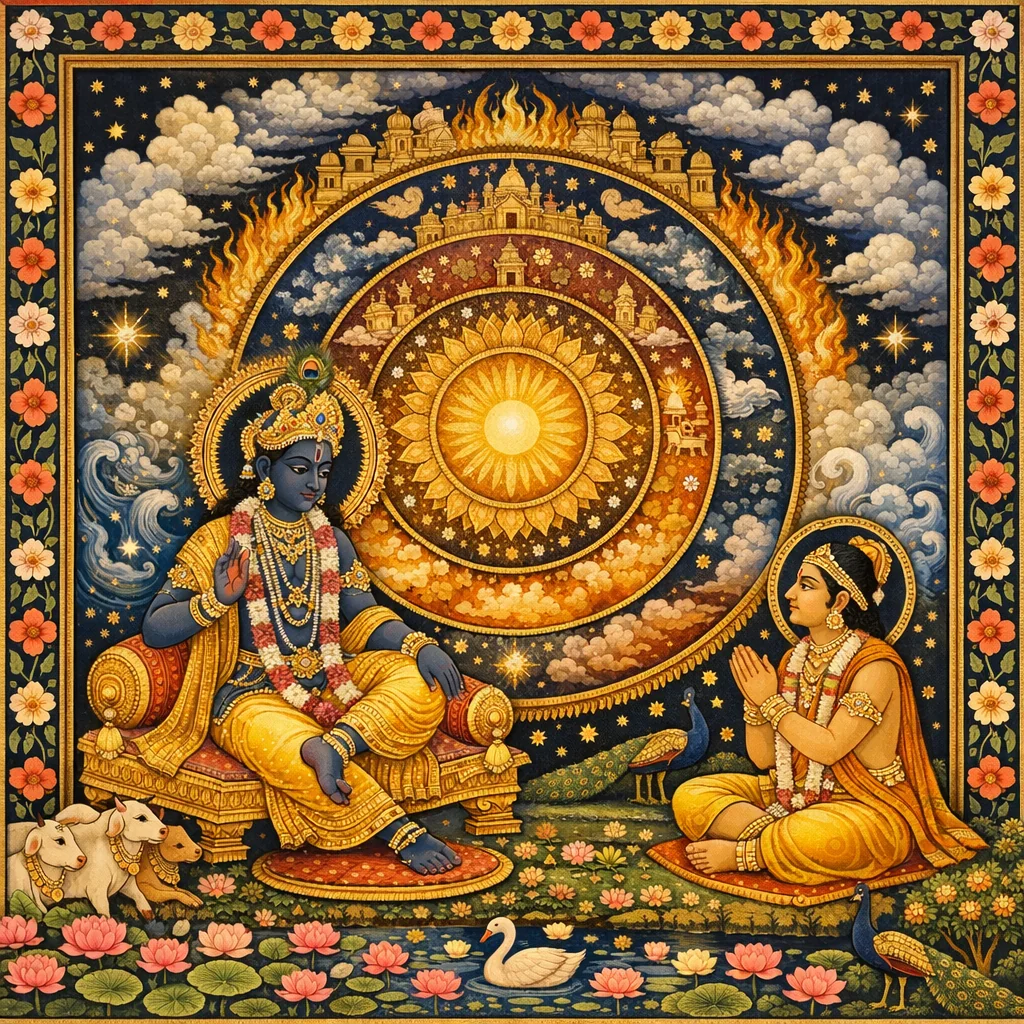
Adhyaya 24
Sāṅkhya of Creation and Annihilation (Sarga–Nirodha-viveka)
Continuing Śrī Kṛṣṇa’s systematic instruction to Uddhava, this chapter presents a rigorous Sāṅkhya analysis meant to end bheda-bhrama, the illusion of duality. Kṛṣṇa establishes that before manifestation the seer and the seen are non-different in the one Absolute; for līlā and the conditioned jīvas’ urge to enjoy, the Absolute appears as prakṛti (material nature) and jīva (the conscious enjoyer). Stirred by the Lord’s glance, the guṇas unfold into sūtra/mahat, ahaṅkāra, tanmātras, gross elements, senses and their presiding deities, culminating in the cosmic egg and Brahmā’s secondary creation of worlds and destinations. The teaching then turns from sarga/visarga to nirodha, describing stepwise dissolution as body and cosmos merge back through elements, qualities, deities, mind, ego, guṇas, unmanifest nature, time, Mahā-puruṣa, and finally the Supreme Self alone. Kṛṣṇa concludes that this knowledge is like sunrise—dispelling darkness and preventing duality from returning—leading naturally toward steady bhakti and freedom from doubt.
Shlokas
Verse 1
श्रीभगवानुवाच अथ ते सम्प्रवक्ष्यामि साङ्ख्यं पूर्वैर्विनिश्चितम् । यद् विज्ञाय पुमान् सद्यो जह्याद् वैकल्पिकं भ्रमम् ॥ १ ॥
Lord Śrī Kṛṣṇa said: Now I shall explain to you the science of Sāṅkhya, perfectly established by the ancient authorities. By understanding it, one can at once abandon the illusion of material duality.
Verse 2
आसीज्ज्ञानमथो अर्थ एकमेवाविकल्पितम् । यदा विवेकनिपुणा आदौ कृतयुगेऽयुगे ॥ २ ॥
In the beginning, in the Kṛta-yuga—when all were skilled in spiritual discernment—and even before that, at the time of dissolution, knowledge and its object were one, without division. The seer existed alone, nondifferent from what was seen.
Verse 3
तन्मायाफलरूपेण केवलं निर्विकल्पितम् । वाङ्मनोऽगोचरं सत्यं द्विधा समभवद् बृहत् ॥ ३ ॥
That one Absolute Truth, though appearing as the result of Māyā, remains free of all duality, beyond speech and mind, vast and real; He manifested in two—material nature (prakṛti) and the living beings (jīvas) who seek to enjoy her displays.
Verse 4
तयोरेकतरो ह्यर्थः प्रकृतिः सोभयात्मिका । ज्ञानं त्वन्यतमो भावः पुरुषः सोऽभिधीयते ॥ ४ ॥
Of these two manifestations, one is material nature (prakṛti), containing both the subtle causes and the manifest products of matter. The other is the conscious living being (puruṣa, the jīva), known as the enjoyer.
Verse 5
तमो रजः सत्त्वमिति प्रकृतेरभवन् गुणाः । मया प्रक्षोभ्यमाणायाः पुरुषानुमतेन च ॥ ५ ॥
When material nature (prakṛti) was stirred by My glance, and with the consent of the puruṣa (the jīva), the three guṇas—sattva, rajas, and tamas—became manifest to fulfill the lingering desires of the conditioned souls.
Verse 6
तेभ्यः समभवत् सूत्रं महान् सूत्रेण संयुतः । ततो विकुर्वतो जातो योऽहङ्कारो विमोहनः ॥ ६ ॥
From those modes arose the primal sūtra (pradhāna), together with the mahat-tattva joined to it. From the transformation of the mahat-tattva was born false ego (ahaṅkāra), the cause of the jīvas’ bewilderment.
Verse 7
वैकारिकस्तैजसश्च तामसश्चेत्यहं त्रिवृत् । तन्मात्रेन्द्रियमनसां कारणं चिदचिन्मयः ॥ ७ ॥
False ego (ahaṅkāra), the cause of the tanmātras, the senses, and the mind, spans both spirit and matter and appears in three forms: vaikarika (in goodness), taijasa (in passion), and tāmasa (in ignorance).
Verse 8
अर्थस्तन्मात्रिकाज्जज्ञे तामसादिन्द्रियाणि च । तैजसाद् देवता आसन्नेकादश च वैकृतात् ॥ ८ ॥
From false ego in ignorance arose the tan-mātras, and from them the gross elements were generated. From false ego in passion came the senses, and from false ego in goodness (vaikṛta) arose the eleven presiding demigods.
Verse 9
मया सञ्चोदिता भावाः सर्वे संहत्यकारिणः । अण्डमुत्पादयामासुर्ममायतनमुत्तमम् ॥ ९ ॥
Impelled by Me, all these elements combined in proper order to function, and together they gave birth to the universal egg, My most excellent abode.
Verse 10
तस्मिन्नहं समभवमण्डे सलिलसंस्थितौ । मम नाभ्यामभूत् पद्मं विश्वाख्यं तत्र चात्मभूः ॥ १० ॥
Within that egg, floating upon the causal waters, I Myself appeared. From My navel arose the universal lotus, and there was born self-born Brahmā.
Verse 11
सोऽसृजत्तपसा युक्तो रजसा मदनुग्रहात् । लोकान् सपालान् विश्वात्मा भूर्भुवः स्वरिति त्रिधा ॥ ११ ॥
Lord Brahmā, the soul of the universe, by My mercy was endowed with passion and performed great austerities; thus he created the three planetary divisions—Bhūr, Bhuvar and Svar—along with their presiding deities.
Verse 12
देवानामोक आसीत् स्वर्भूतानां च भुवः पदम् । मर्त्यादीनां च भूर्लोकः सिद्धानां त्रितयात् परम् ॥ १२ ॥
Heaven (Svarloka) was established as the residence of the demigods, Bhuvarloka as that of ghostly spirits, and Bhūrloka as the place of human beings and other mortal creatures. Those siddhas who strive for liberation are promoted beyond these three divisions.
Verse 13
अधोऽसुराणां नागानां भूमेरोकोऽसृजत् प्रभुः । त्रिलोक्यां गतयः सर्वाः कर्मणां त्रिगुणात्मनाम् ॥ १३ ॥
Lord Brahmā created the region beneath the earth for the demons and the Nāga serpents. Thus, throughout the three worlds, all destinations are arranged as the corresponding results of work performed within the three modes of nature.
Verse 14
योगस्य तपसश्चैव न्यासस्य गतयोऽमलाः । महर्जनस्तपः सत्यं भक्तियोगस्य मद्गतिः ॥ १४ ॥
By mystic yoga, severe austerity, and the renounced order, one attains the pure destinations of Maharloka, Janoloka, Tapoloka, and Satyaloka. But by bhakti-yoga one reaches My own transcendental abode.
Verse 15
मया कालात्मना धात्रा कर्मयुक्तमिदं जगत् । गुणप्रवाह एतस्मिन्नुन्मज्जति निमज्जति ॥ १५ ॥
I, the supreme creator acting as the power of time, have arranged within this world all the results of karma. Thus, in the mighty current of the modes of nature, one sometimes rises and sometimes again submerges.
Verse 16
अणुर्बृहत् कृशः स्थूलो यो यो भावः प्रसिध्यति । सर्वोऽप्युभयसंयुक्तः प्रकृत्या पुरुषेण च ॥ १६ ॥
Whatever features are visibly found in this world—small or great, thin or stout—certainly contain both material nature (prakṛti) and its enjoyer, the spirit soul (puruṣa).
Verse 17
यस्तु यस्यादिरन्तश्च स वै मध्यं च तस्य सन् । विकारो व्यवहारार्थो यथा तैजसपार्थिवाः ॥ १७ ॥
That which is a thing’s beginning and its end is also present in its middle. Transformation is merely a name and form for practical dealings—like bracelets and earrings made of gold, or pots and saucers made of earth. Since gold and earth exist before the products appear and remain after they are destroyed, they must also be present during the manifest phase, supporting the product as its very basis.
Verse 18
यदुपादाय पूर्वस्तु भावो विकुरुतेऽपरम् । आदिरन्तो यदा यस्य तत् सत्यमभिधीयते ॥ १८ ॥
When one thing takes a prior substance as its material cause and transforms into another, and its beginning and end rest in that same basis, it is called real (satya).
Verse 19
प्रकृतिर्यस्योपादानमाधारः पुरुषः परः । सतोऽभिव्यञ्जकः कालो ब्रह्म तत्त्रितयं त्वहम् ॥ १९ ॥
The material cosmos is called real: its ingredient is prakṛti, its shelter is Mahā-Viṣṇu, and time (kāla) makes it manifest. Thus prakṛti, Viṣṇu, and time are not different from Me, the Supreme Absolute Truth.
Verse 20
सर्गः प्रवर्तते तावत् पौर्वापर्येण नित्यशः । महान् गुणविसर्गार्थः स्थित्यन्तो यावदीक्षणम् ॥ २० ॥
As long as the Supreme Lord continues to cast His glance upon prakṛti, the material world endures, ever manifesting in sequence as the great and variegated flow of creation through the guṇas.
Verse 21
विराण्मयासाद्यमानो लोककल्पविकल्पकः । पञ्चत्वाय विशेषाय कल्पते भुवनैः सह ॥ २१ ॥
I am the foundation of the universal form (virāṭ-rūpa), which displays endless variety through the repeated creation, maintenance, and dissolution of the planetary systems. By arranging the coordinated union of the five elements, it manifests the diverse forms of created existence along with all worlds.
Verse 22
अन्ने प्रलीयते मर्त्यमन्नं धानासु लीयते । धाना भूमौ प्रलीयन्ते भूमिर्गन्धे प्रलीयते ॥ २२ ॥ अप्सु प्रलीयते गन्ध आपश्च स्वगुणे रसे । लीयते ज्योतिषि रसो ज्योती रूपे प्रलीयते ॥ २३ ॥ रूपं वायौ स च स्पर्शे लीयते सोऽपि चाम्बरे । अम्बरं शब्दतन्मात्र इन्द्रियाणि स्वयोनिषु ॥ २४ ॥ योनिर्वैकारिके सौम्य लीयते मनसीश्वरे । शब्दो भूतादिमप्येति भूतादिर्महति प्रभुः ॥ २५ ॥ स लीयते महान् स्वेषु गुणेषु गुणवत्तमः । तेऽव्यक्ते सम्प्रलीयन्ते तत् काले लीयतेऽव्यये ॥ २६ ॥ कालो मायामये जीवे जीव आत्मनि मय्यजे । आत्मा केवल आत्मस्थो विकल्पापायलक्षणः ॥ २७ ॥
At dissolution, the mortal body merges into food; food into grain, grain into earth, and earth into its subtle essence, fragrance. Fragrance merges into water, water into taste, taste into fire, and fire into form; form into touch, touch into air, air into ether, and ether into the tanmātra of sound. The senses merge into their presiding devas; the devas into the mind; the mind into sattvic false ego; sound into tamasic false ego and then into mahat-tattva. Mahat dissolves into the guṇas, the guṇas into the unmanifest, the unmanifest into time; time into the Mahā-puruṣa, the awakener of all jīvas; and that source of life merges into Me, the unborn Supreme Ātman. I alone remain, established within Myself, from whom creation and annihilation are revealed.
Verse 23
अन्ने प्रलीयते मर्त्यमन्नं धानासु लीयते । धाना भूमौ प्रलीयन्ते भूमिर्गन्धे प्रलीयते ॥ २२ ॥ अप्सु प्रलीयते गन्ध आपश्च स्वगुणे रसे । लीयते ज्योतिषि रसो ज्योती रूपे प्रलीयते ॥ २३ ॥ रूपं वायौ स च स्पर्शे लीयते सोऽपि चाम्बरे । अम्बरं शब्दतन्मात्र इन्द्रियाणि स्वयोनिषु ॥ २४ ॥ योनिर्वैकारिके सौम्य लीयते मनसीश्वरे । शब्दो भूतादिमप्येति भूतादिर्महति प्रभुः ॥ २५ ॥ स लीयते महान् स्वेषु गुणेषु गुणवत्तमः । तेऽव्यक्ते सम्प्रलीयन्ते तत् काले लीयतेऽव्यये ॥ २६ ॥ कालो मायामये जीवे जीव आत्मनि मय्यजे । आत्मा केवल आत्मस्थो विकल्पापायलक्षणः ॥ २७ ॥
Fragrance merges into water, and water further merges into its own quality, taste. That taste merges into fire, which merges into form.
Verse 24
अन्ने प्रलीयते मर्त्यमन्नं धानासु लीयते । धाना भूमौ प्रलीयन्ते भूमिर्गन्धे प्रलीयते ॥ २२ ॥ अप्सु प्रलीयते गन्ध आपश्च स्वगुणे रसे । लीयते ज्योतिषि रसो ज्योती रूपे प्रलीयते ॥ २३ ॥ रूपं वायौ स च स्पर्शे लीयते सोऽपि चाम्बरे । अम्बरं शब्दतन्मात्र इन्द्रियाणि स्वयोनिषु ॥ २४ ॥ योनिर्वैकारिके सौम्य लीयते मनसीश्वरे । शब्दो भूतादिमप्येति भूतादिर्महति प्रभुः ॥ २५ ॥ स लीयते महान् स्वेषु गुणेषु गुणवत्तमः । तेऽव्यक्ते सम्प्रलीयन्ते तत् काले लीयतेऽव्यये ॥ २६ ॥ कालो मायामये जीवे जीव आत्मनि मय्यजे । आत्मा केवल आत्मस्थो विकल्पापायलक्षणः ॥ २७ ॥
Form merges into air, and air merges into touch. Touch merges into ether, and ether into sound. The senses merge into their origins, the presiding deities.
Verse 25
अन्ने प्रलीयते मर्त्यमन्नं धानासु लीयते । धाना भूमौ प्रलीयन्ते भूमिर्गन्धे प्रलीयते ॥ २२ ॥ अप्सु प्रलीयते गन्ध आपश्च स्वगुणे रसे । लीयते ज्योतिषि रसो ज्योती रूपे प्रलीयते ॥ २३ ॥ रूपं वायौ स च स्पर्शे लीयते सोऽपि चाम्बरे । अम्बरं शब्दतन्मात्र इन्द्रियाणि स्वयोनिषु ॥ २४ ॥ योनिर्वैकारिके सौम्य लीयते मनसीश्वरे । शब्दो भूतादिमप्येति भूतादिर्महति प्रभुः ॥ २५ ॥ स लीयते महान् स्वेषु गुणेषु गुणवत्तमः । तेऽव्यक्ते सम्प्रलीयन्ते तत् काले लीयतेऽव्यये ॥ २६ ॥ कालो मायामये जीवे जीव आत्मनि मय्यजे । आत्मा केवल आत्मस्थो विकल्पापायलक्षणः ॥ २७ ॥
The origins of the senses merge into the mind. Sound merges into false ego in ignorance, and that ego merges into the total material energy (Mahat-tattva).
Verse 26
अन्ने प्रलीयते मर्त्यमन्नं धानासु लीयते । धाना भूमौ प्रलीयन्ते भूमिर्गन्धे प्रलीयते ॥ २२ ॥ अप्सु प्रलीयते गन्ध आपश्च स्वगुणे रसे । लीयते ज्योतिषि रसो ज्योती रूपे प्रलीयते ॥ २३ ॥ रूपं वायौ स च स्पर्शे लीयते सोऽपि चाम्बरे । अम्बरं शब्दतन्मात्र इन्द्रियाणि स्वयोनिषु ॥ २४ ॥ योनिर्वैकारिके सौम्य लीयते मनसीश्वरे । शब्दो भूतादिमप्येति भूतादिर्महति प्रभुः ॥ २५ ॥ स लीयते महान् स्वेषु गुणेषु गुणवत्तमः । तेऽव्यक्ते सम्प्रलीयन्ते तत् काले लीयतेऽव्यये ॥ २६ ॥ कालो मायामये जीवे जीव आत्मनि मय्यजे । आत्मा केवल आत्मस्थो विकल्पापायलक्षणः ॥ २७ ॥
The total material nature merges into the modes. These modes merge into the unmanifest form of nature, and that unmanifest form merges into time.
Verse 27
अन्ने प्रलीयते मर्त्यमन्नं धानासु लीयते । धाना भूमौ प्रलीयन्ते भूमिर्गन्धे प्रलीयते ॥ २२ ॥ अप्सु प्रलीयते गन्ध आपश्च स्वगुणे रसे । लीयते ज्योतिषि रसो ज्योती रूपे प्रलीयते ॥ २३ ॥ रूपं वायौ स च स्पर्शे लीयते सोऽपि चाम्बरे । अम्बरं शब्दतन्मात्र इन्द्रियाणि स्वयोनिषु ॥ २४ ॥ योनिर्वैकारिके सौम्य लीयते मनसीश्वरे । शब्दो भूतादिमप्येति भूतादिर्महति प्रभुः ॥ २५ ॥ स लीयते महान् स्वेषु गुणेषु गुणवत्तमः । तेऽव्यक्ते सम्प्रलीयन्ते तत् काले लीयतेऽव्यये ॥ २६ ॥ कालो मायामये जीवे जीव आत्मनि मय्यजे । आत्मा केवल आत्मस्थो विकल्पापायलक्षणः ॥ २७ ॥
Time merges into the Supreme Lord (Maha-purusa), and He merges into Me, the unborn Supreme Soul, who remains alone, established within Himself.
Verse 28
एवमन्वीक्षमाणस्य कथं वैकल्पिको भ्रमः । मनसो हृदि तिष्ठेत व्योम्नीवार्कोदये तमः ॥ २८ ॥
As the darkness of the sky is dispelled by the rising sun, so this knowledge of cosmic dissolution drives out from the mind of the earnest student all illusory duality. Even if māyā somehow enters his heart, she cannot remain there.
Verse 29
एष साङ्ख्यविधिः प्रोक्तः संशयग्रन्थिभेदनः । प्रतिलोमानुलोमाभ्यां परावरदृशा मया ॥ २९ ॥
Thus I, the perfect seer of both the material and the spiritual, have spoken this method of Sāṅkhya through direct and reverse analysis of creation and annihilation; it cuts the knot of doubt and destroys illusion.
Frequently Asked Questions
Kṛṣṇa teaches Sāṅkhya here as a curative science: by enumerating how prakṛti, guṇas, mind, senses, and elements arise and dissolve under the Lord’s supervision, the student stops misidentifying the Self with changing categories. The goal is immediate abandonment of dvaita-bhrama (material duality) and firm establishment of consciousness in the Supreme āśraya.
It presents a theistic Sāṅkhya sequence: the Lord’s glance agitates prakṛti; the guṇas manifest; from them arise sūtra and mahat; from mahat comes ahaṅkāra (threefold by guṇa); from tamasic ego come tanmātras and gross elements; from rajasic ego come the senses; from sattvic ego arise the presiding deities; these combine into the cosmic egg, within which the Lord appears and from whose navel Brahmā is born to perform secondary creation.
The universal egg (brahmāṇḍa) signifies the organized cosmos formed from coordinated elements. Kṛṣṇa’s entrance emphasizes that the universe is not self-sufficient: consciousness and order depend on the Supreme Person as indwelling controller. Brahmā’s birth from the lotus further marks visarga—secondary creation—occurring by divine empowerment rather than independent material causation.
Pralaya is explained as a graded laya: body merges into food and progressively into earth, subtle qualities, elements, sense-powers and their deities, mind, ego, total nature, guṇas, unmanifest nature, time, Mahā-puruṣa, and finally the Supreme Self alone. The repetition in the provided input likely reflects a textual duplication artifact; conceptually, the intended teaching is a single, continuous dissolution ladder meant for contemplative assimilation.
Mahā-puruṣa is the omniscient cosmic person who activates creation through time and oversees the living beings’ manifestation. In SB 11.24, Kṛṣṇa identifies the chain of causality—nature, time, Mahā-Viṣṇu/Mahā-puruṣa—as non-different from Himself in the sense that they rest upon and operate by His supreme identity as the Absolute Truth (āśraya).