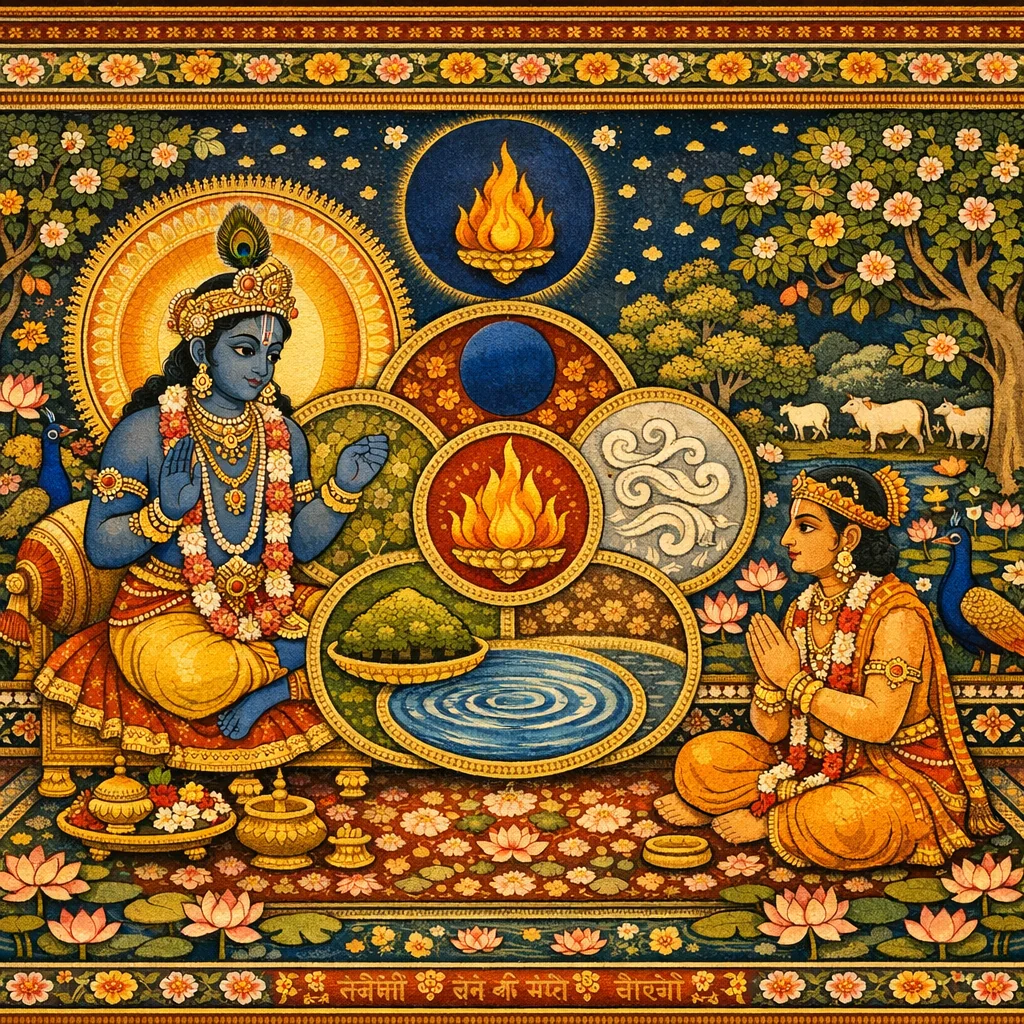
Adhyaya 21
Dharma, Purity, and the Inner Purpose of the Vedas (Karma-kāṇḍa Reoriented to Bhakti)
Continuing Kṛṣṇa’s systematic instruction to Uddhava on regulating and transcending conditioned life, this chapter moves from general discipline to a precise taxonomy of dharma/adharma and śuddhi/aśuddhi. The Lord teaches that abandoning authorized paths—bhakti, sāṅkhya-like analysis, and prescribed duty—leads to saṁsāra, while steadiness in one’s proper position is piety. He then explains how purity is judged according to place, time, substance, and circumstance, including rules for contaminated lands, auspicious times, and purification by earth, water, fire, wind, time, and mantra. The chapter culminates in a critique of “flowery” Vedic promises: fruitive statements entice the materially attached but do not define the ultimate good. Kṛṣṇa reveals the deeper hermeneutic: the Veda’s sound (oṁkāra and meters) arises from Him and returns to Him; karma-kāṇḍa, upāsanā-kāṇḍa, and jñāna-kāṇḍa all secretly indicate Him alone. This prepares for the next movement of the Uddhava-gītā, where external regulation is further internalized into direct God-centered realization and surrender.
Shlokas
Verse 1
श्रीभगवानुवाच य एतान् मत्पथो हित्वा भक्तिज्ञानक्रियात्मकान् । क्षुद्रान् कामांश्चलै: प्राणैर्जुषन्त: संसरन्ति ते ॥ १ ॥
The Supreme Lord said: Those who abandon these paths to Me—comprising bhakti, spiritual knowledge, and regulated duty—and, driven by restless senses, pursue petty pleasures, surely wander in the ceaseless cycle of samsara.
Verse 2
स्वे स्वेऽधिकारे या निष्ठा स गुण: परिकीर्तित: । विपर्ययस्तु दोष: स्यादुभयोरेष निश्चय: ॥ २ ॥
Steadiness in one’s own rightful duty and position (svadharma) is proclaimed as virtue and merit; deviation from it is fault and sin. Thus both are definitively ascertained.
Verse 3
शुद्ध्यशुद्धी विधीयेते समानेष्वपि वस्तुषु । द्रव्यस्य विचिकित्सार्थं गुणदोषौ शुभाशुभौ । धर्मार्थं व्यवहारार्थं यात्रार्थमिति चानघ ॥ ३ ॥
O sinless Uddhava, even among things of the same kind, purity and impurity are prescribed by weighing their virtues and faults, the auspicious and the inauspicious—so that dharma may be understood, worldly dealings may proceed rightly, and one’s life-journey may be sustained.
Verse 4
दर्शितोऽयं मयाचारो धर्ममुद्वहतां धुरम् ॥ ४ ॥
I have revealed this rule of conduct for those who bear the burden of worldly religious duties.
Verse 5
भूम्यम्ब्वग्न्यनिलाकाशा भूतानां पञ्चधातव: । आब्रह्मस्थावरादीनां शारीरा आत्मसंयुता: ॥ ५ ॥
Earth, water, fire, air, and ether are the five elements that form the bodies of all bound souls, from Brahmā down to the unmoving beings; and all these elements emanate from the one Supreme Personality, Bhagavān.
Verse 6
वेदेन नामरूपाणि विषमाणि समेष्वपि । धातुषूद्धव कल्प्यन्त एतेषां स्वार्थसिद्धये ॥ ६ ॥
My dear Uddhava, although all bodies are made of the same five elements and are thus equal in substance, the Vedas assign diverse names and forms so that living beings may attain life’s true goal.
Verse 7
देशकालादिभावानां वस्तूनां मम सत्तम । गुणदोषौ विधीयेते नियमार्थं हि कर्मणाम् ॥ ७ ॥
O saintly Uddhava, to curb materialistic action I have established, in all material things—including time, place, and physical objects—what is proper and improper, virtue and fault.
Verse 8
अकृष्णसारो देशानामब्रह्मण्योऽशुचिर्भवेत् । कृष्णसारोऽप्यसौवीरकीकटासंस्कृतेरिणम् ॥ ८ ॥
Among places, those bereft of the spotted antelope, those devoid of devotion to the brāhmaṇas, those possessing spotted antelopes but bereft of respectable men, provinces like Kīkaṭa and places where cleanliness and purificatory rites are neglected, where meat-eaters are prominent or where the earth is barren, are all considered to be contaminated lands.
Verse 9
कर्मण्यो गुणवान् कालो द्रव्यत: स्वत एव वा । यतो निवर्तते कर्म स दोषोऽकर्मक: स्मृत: ॥ ९ ॥
A specific time is considered pure when it is appropriate, either by its own nature or through achievement of suitable paraphernalia, for the performance of one’s prescribed duty. That time which impedes the performance of one’s duty is considered impure.
Verse 10
द्रव्यस्य शुद्ध्यशुद्धी च द्रव्येण वचनेन च । संस्कारेणाथ कालेन महत्वाल्पतयाथवा ॥ १० ॥
An object’s purity or impurity is established by application of another object, by words, by rituals, by the effects of time or according to relative magnitude.
Verse 11
शक्त्याशक्त्याथ वा बुद्ध्या समृद्ध्या च यदात्मने । अघं कुर्वन्ति हि यथा देशावस्थानुसारत: ॥ ११ ॥
Impure things may or may not impose sinful reactions upon a person, depending on that person’s strength or weakness, intelligence, wealth, location and physical condition.
Verse 12
धान्यदार्वस्थितन्तूनां रसतैजसचर्मणाम् । कालवाय्वग्निमृत्तोयै: पार्थिवानां युतायुतै: ॥ १२ ॥
Various objects such as grains, wooden utensils, things made of bone, thread, liquids, objects derived from fire, skins and earthy objects are all purified by time, by the wind, by fire, by earth and by water, either separately or in combination.
Verse 13
अमेध्यलिप्तं यद् येन गन्धलेपं व्यपोहति । भजते प्रकृतिं तस्य तच्छौचं तावदिष्यते ॥ १३ ॥
A purifying agent is deemed proper when, by its use, it removes the foul odor or dirty covering from a contaminated object and restores it to its original nature.
Verse 14
स्नानदानतपोऽवस्थावीर्यसंस्कारकर्मभि: । मत्स्मृत्या चात्मन: शौचं शुद्ध: कर्माचरेद्द्विज: ॥ १४ ॥
The self is cleansed by bathing, charity, austerity, maturity, personal strength, purificatory rites and prescribed duties—and above all by remembrance of Me. Therefore the twice-born should be purified before performing their proper activities.
Verse 15
मन्त्रस्य च परिज्ञानं कर्मशुद्धिर्मदर्पणम् । धर्म: सम्पद्यते षड्भिरधर्मस्तु विपर्यय: ॥ १५ ॥
A mantra is purified when chanted with proper understanding, and one’s work is purified when offered to Me. Thus, by purifying place, time, substance, the performer, the mantras and the work—these six—one becomes righteous; by neglecting them one becomes irreligious.
Verse 16
क्वचिद् गुणोऽपि दोष: स्याद् दोषोऽपि विधिना गुण: । गुणदोषार्थनियमस्तद्भिदामेव बाधते ॥ १६ ॥
Sometimes, by the force of Vedic injunctions, virtue becomes fault, and what is ordinarily fault becomes virtue. Such special rules effectively blur the clear distinction between piety and sin.
Verse 17
समानकर्माचरणं पतितानां न पातकम् । औत्पत्तिको गुण: सङ्गो न शयान: पतत्यध: ॥ १७ ॥
The same activities that would degrade an elevated person do not cause further downfall for those already fallen, for one lying on the ground cannot fall lower. Material association dictated by one’s own nature is thus considered an innate good quality.
Verse 18
यतो यतो निवर्तेत विमुच्येत ततस्तत: । एष धर्मो नृणां क्षेम: शोकमोहभयापह: ॥ १८ ॥
By turning back from each sinful or materialistic act, one is freed from that very bondage. Such renunciation is the dharma that brings true welfare to human beings, driving away sorrow, delusion, and fear.
Verse 19
विषयेषु गुणाध्यासात् पुंस: सङ्गस्ततो भवेत् । सङ्गात्तत्र भवेत् काम: कामादेव कलिर्नृणाम् ॥ १९ ॥
By superimposing attractive qualities upon sense objects, a person becomes attached to them. From attachment arises lust, and from lust alone quarrel is born among men.
Verse 20
कलेर्दुर्विषह: क्रोधस्तमस्तमनुवर्तते । तमसा ग्रस्यते पुंसश्चेतना व्यापिनी द्रुतम् ॥ २० ॥
From quarrel arises intolerable anger, and after it comes the darkness of ignorance. That darkness quickly overwhelms a man’s broad intelligence.
Verse 21
तया विरहित: साधो जन्तु: शून्याय कल्पते । ततोऽस्य स्वार्थविभ्रंशो मूर्च्छितस्य मृतस्य च ॥ २१ ॥
O saintly Uddhava, one bereft of real intelligence is considered as good as empty. Deviated from life’s true purpose, he becomes dull, like one unconscious or dead.
Verse 22
विषयाभिनिवेशेन नात्मानं वेद नापरम् । वृक्षजीविकया जीवन् व्यर्थं भस्त्रोव य: श्वसन् ॥ २२ ॥
Absorbed in sense gratification, one knows neither oneself nor others. Living uselessly in ignorance like a tree, one merely breathes, like a bellows.
Verse 23
फलश्रुतिरियं नृणां न श्रेयो रोचनं परम् । श्रेयोविवक्षया प्रोक्तं यथा भैषज्यरोचनम् ॥ २३ ॥
Scriptural statements promising rewards do not prescribe the supreme good for human beings; they are enticing words meant to draw one into beneficial dharmic duties, like promising sweets to make a child take wholesome medicine.
Verse 24
उत्पत्त्यैव हि कामेषु प्राणेषु स्वजनेषु च । आसक्तमनसो मर्त्या आत्मनोऽनर्थहेतुषु ॥ २४ ॥
By mere material birth, mortals become mentally attached to sense enjoyment, preserving life, and their own kinsmen; thus the mind is absorbed in causes of misfortune that defeat one’s true self-interest.
Verse 25
न तानविदुष: स्वार्थं भ्राम्यतो वृजिनाध्वनि । कथं युञ्ज्यात् पुनस्तेषु तांस्तमो विशतो बुध: ॥ २५ ॥
Those ignorant of their true self-interest wander the troubled road of material existence, moving gradually toward darkness; why should the wise have the Vedas further encourage them in sense gratification, even if such fools still heed Vedic injunctions?
Verse 26
एवं व्यवसितं केचिदविज्ञाय कुबुद्धय: । फलश्रुतिं कुसुमितां न वेदज्ञा वदन्ति हि ॥ २६ ॥
Not understanding the true purpose of Vedic knowledge, some with perverted intelligence proclaim the Vedas’ flowery promises of material reward as the highest truth; but those who truly know the Vedas never speak that way.
Verse 27
कामिन: कृपणा लुब्धा: पुष्पेषु फलबुद्धय: । अग्निमुग्धा धूमतान्ता: स्वं लोकं न विदन्ति ते ॥ २७ ॥
Those filled with lust, miserliness, and greed mistake mere flowers for life’s true fruit; dazzled by fire’s glare and choked by its smoke, they fail to recognize their own real identity.
Verse 28
न ते मामङ्ग जानन्ति हृदिस्थं य इदं यत: । उक्थशस्त्रा ह्यसुतृपो यथा नीहारचक्षुष: ॥ २८ ॥
My dear Uddhava, those devoted to sense pleasure through honoring Vedic rituals do not know that I dwell within everyone’s heart, and that the whole universe emanates from Me and is nondifferent from Me. They are like people whose eyes are veiled by fog.
Verse 29
ते मे मतमविज्ञाय परोक्षं विषयात्मका: । हिंसायां यदि राग: स्याद् यज्ञ एव न चोदना ॥ २९ ॥ हिंसाविहारा ह्यालब्धै: पशुभि: स्वसुखेच्छया । यजन्ते देवता यज्ञै: पितृभूतपतीन् खला: ॥ ३० ॥
Those sworn to sense gratification cannot grasp the confidential conclusion of Vedic knowledge as I have taught it. If delight in violence were sanctioned in yajña, there would be such an injunction; yet the wicked, seeking their own pleasure, cruelly slaughter innocent animals and by sacrifices worship demigods, forefathers, and leaders among ghostly beings.
Verse 30
ते मे मतमविज्ञाय परोक्षं विषयात्मका: । हिंसायां यदि राग: स्याद् यज्ञ एव न चोदना ॥ २९ ॥ हिंसाविहारा ह्यालब्धै: पशुभि: स्वसुखेच्छया । यजन्ते देवता यज्ञै: पितृभूतपतीन् खला: ॥ ३० ॥
Those sworn to sense gratification cannot grasp the confidential conclusion of Vedic knowledge as I have taught it. If delight in violence were sanctioned in yajña, there would be such an injunction; yet the wicked, seeking their own pleasure, cruelly slaughter innocent animals and by sacrifices worship demigods, forefathers, and leaders among ghostly beings.
Verse 31
स्वप्नोपमममुं लोकमसन्तं श्रवणप्रियम् । आशिषो हृदि सङ्कल्प्य त्यजन्त्यर्थान् यथा वणिक् ॥ ३१ ॥
This world is like a dream—pleasing to hear of, yet truly unreal. Just as a foolish merchant abandons real wealth for useless speculation, bewildered people give up what is genuinely valuable in life and chase promotion to material heaven, imagining within their hearts all manner of worldly blessings.
Verse 32
रज:सत्त्वतमोनिष्ठा रज:सत्त्वतमोजुष: । उपासत इन्द्रमुख्यान् देवादीन् न यथैव माम् ॥ ३२ ॥
Those established in passion, goodness, and ignorance worship the demigods and other deities—headed by Indra—who manifest those same modes. Yet they do not properly worship Me.
Verse 33
इष्ट्वेह देवता यज्ञैर्गत्वा रंस्यामहे दिवि । तस्यान्त इह भूयास्म महाशाला महाकुला: ॥ ३३ ॥ एवं पुष्पितया वाचा व्याक्षिप्तमनसां नृणाम् । मानिनां चातिलुब्धानां मद्वार्तापि न रोचते ॥ ३४ ॥
Worshipers of the demigods think, “In this life we shall worship the devas by sacrifice, go to heaven and enjoy there; when that enjoyment is finished, we shall return here and be born as wealthy householders in aristocratic families.” Bewildered by the Vedas’ flowery words, and swollen with pride and greed, such people find no taste even for topics about Me, the Supreme Lord.
Verse 34
इष्ट्वेह देवता यज्ञैर्गत्वा रंस्यामहे दिवि । तस्यान्त इह भूयास्म महाशाला महाकुला: ॥ ३३ ॥ एवं पुष्पितया वाचा व्याक्षिप्तमनसां नृणाम् । मानिनां चातिलुब्धानां मद्वार्तापि न रोचते ॥ ३४ ॥
Thus, those whose minds are diverted by the Vedas’ flowery speech—being overly proud and greedy—find no relish even in speaking about Me, for the taste of bhakti does not awaken within them.
Verse 35
वेदा ब्रह्मात्मविषयास्त्रिकाण्डविषया इमे । परोक्षवादा ऋषय: परोक्षं मम च प्रियम् ॥ ३५ ॥
Although divided into three sections, the Vedas ultimately disclose the truth of brahman and the ātman. Yet the seers and mantras speak in indirect, esoteric terms, and such confidential, veiled descriptions are also pleasing to Me.
Verse 36
शब्दब्रह्म सुदुर्बोधं प्राणेन्द्रियमनोमयम् । अनन्तपारं गम्भीरं दुर्विगाह्यं समुद्रवत् ॥ ३६ ॥
Śabda-brahma, the Vedas’ transcendental sound, is very difficult to comprehend and manifests on various levels within the prāṇa, the senses, and the mind. This Vedic sound is limitless, profound, and hard to fathom—like the ocean.
Verse 37
मयोपबृंहितं भूम्ना ब्रह्मणानन्तशक्तिना । भूतेषु घोषरूपेण बिसेषूर्णेव लक्ष्यते ॥ ३७ ॥
I, the Supreme Personality of Godhead with infinite potency, dwelling within all beings, personally establish the Vedic sound vibration as oṁkāra within every living entity. It is perceived most subtly—like a single strand of fiber upon a lotus stalk.
Verse 38
यथोर्णनाभिर्हृदयादूर्णामुद्वमते मुखात् । आकाशाद् घोषवान् प्राणो मनसा स्पर्शरूपिणा ॥ ३८ ॥ छन्दोमयोऽमृतमय: सहस्रपदवीं प्रभु: । ओङ्काराद् व्यञ्जितस्पर्शस्वरोष्मान्त स्थभूषिताम् ॥ ३९ ॥ विचित्रभाषाविततां छन्दोभिश्चतुरुत्तरै: । अनन्तपारां बृहतीं सृजत्याक्षिपते स्वयम् ॥ ४० ॥
As a spider draws its web from its own heart and sends it forth through its mouth, so the Supreme Lord Bhagavān, from the sky of His heart, manifests the resounding primordial prāṇa through His mind, which conceives the touch-sounds (sparśas). That vital air is composed of all Vedic meters and is filled with amṛta-like transcendental bliss.
Verse 39
यथोर्णनाभिर्हृदयादूर्णामुद्वमते मुखात् । आकाशाद् घोषवान् प्राणो मनसा स्पर्शरूपिणा ॥ ३८ ॥ छन्दोमयोऽमृतमय: सहस्रपदवीं प्रभु: । ओङ्काराद् व्यञ्जितस्पर्शस्वरोष्मान्त स्थभूषिताम् ॥ ३९ ॥ विचित्रभाषाविततां छन्दोभिश्चतुरुत्तरै: । अनन्तपारां बृहतीं सृजत्याक्षिपते स्वयम् ॥ ४० ॥
That Lord, composed of sacred meters and filled with amṛta, expands the Vedic sound into thousands of paths, adorning it with the letters unfolded from Oṁkāra—consonants, vowels, sibilants, and semivowels.
Verse 40
यथोर्णनाभिर्हृदयादूर्णामुद्वमते मुखात् । आकाशाद् घोषवान् प्राणो मनसा स्पर्शरूपिणा ॥ ३८ ॥ छन्दोमयोऽमृतमय: सहस्रपदवीं प्रभु: । ओङ्काराद् व्यञ्जितस्पर्शस्वरोष्मान्त स्थभूषिताम् ॥ ३९ ॥ विचित्रभाषाविततां छन्दोभिश्चतुरुत्तरै: । अनन्तपारां बृहतीं सृजत्याक्षिपते स्वयम् ॥ ४० ॥
Thus He creates the vast Vedic speech, spread into many verbal forms and expressed in meters that each add four syllables to the previous, becoming a great sound without end; and finally the Lord Himself draws that manifestation of Vedic sound back into His own being.
Verse 41
गायत्र्युष्णिगनुष्टुप् च बृहती पङ्क्तिरेव च । त्रिष्टुब्जगत्यतिच्छन्दो ह्यत्यष्ट्यतिजगद् विराट् ॥ ४१ ॥
The Vedic meters are Gāyatrī, Uṣṇik, Anuṣṭup, Bṛhatī, Paṅkti, Triṣṭup, Jagatī, Aticchanda, Atyaṣṭi, Atijagatī, and Ativirāṭ.
Verse 42
किं विधत्ते किमाचष्टे किमनूद्य विकल्पयेत् । इत्यस्या हृदयं लोके नान्यो मद् वेद कश्चन ॥ ४२ ॥
The confidential heart of Vedic knowledge—what it truly enjoins, what it indicates, what it reiterates, and what it proposes as alternative reasoning—is in this world understood by no one but Me.
Verse 43
मां विधत्तेऽभिधत्ते मां विकल्प्यापोह्यते त्वहम् । एतावान् सर्ववेदार्थ: शब्द आस्थाय मां भिदाम् । मायामात्रमनूद्यान्ते प्रतिषिध्य प्रसीदति ॥ ४३ ॥
I alone am the sacrifice enjoined by the Vedas, and I alone am the worshipable Deity. I am set forth as many philosophical alternatives, and I alone am then refuted by analysis. Thus the transcendental Vedic sound establishes Me as the very essence of all Vedic meaning. The Vedas scrutinize material duality as nothing but My māyā-potency, and in the end they wholly negate that duality and find their own fulfillment.
Frequently Asked Questions
Because for conditioned souls burdened by mundane dharma, regulated distinctions of purity help restrain sense-driven behavior and stabilize svadharma. The chapter simultaneously subordinates these rules to the higher purifier—remembrance of Kṛṣṇa—showing that external śuddhi is a pedagogical support meant to mature into internal God-consciousness.
It treats such statements as inducements (arthavāda): they motivate materially attached people to perform regulated, beneficial duties rather than unrestrained vice. Yet they are not the Veda’s confidential conclusion; the final purport is realization of Bhagavān, who is the sacrifice, the worshipable object, and the meaning established after philosophical analysis.
Kṛṣṇa states that only He fully knows the Vedas’ confidential purpose—what karma-kāṇḍa rituals actually aim at, what upāsanā-kāṇḍa worship formulas truly indicate, and what jñāna-kāṇḍa hypotheses ultimately resolve—because all three are meant to converge upon Him as āśraya.
Acceptance of sense objects as desirable produces attachment; attachment generates lust; lust leads to quarrel; quarrel produces anger; anger deepens ignorance; and ignorance eclipses intelligence—leaving the person ‘dead-like,’ forgetful of self and others, and trapped in saṁsāra.