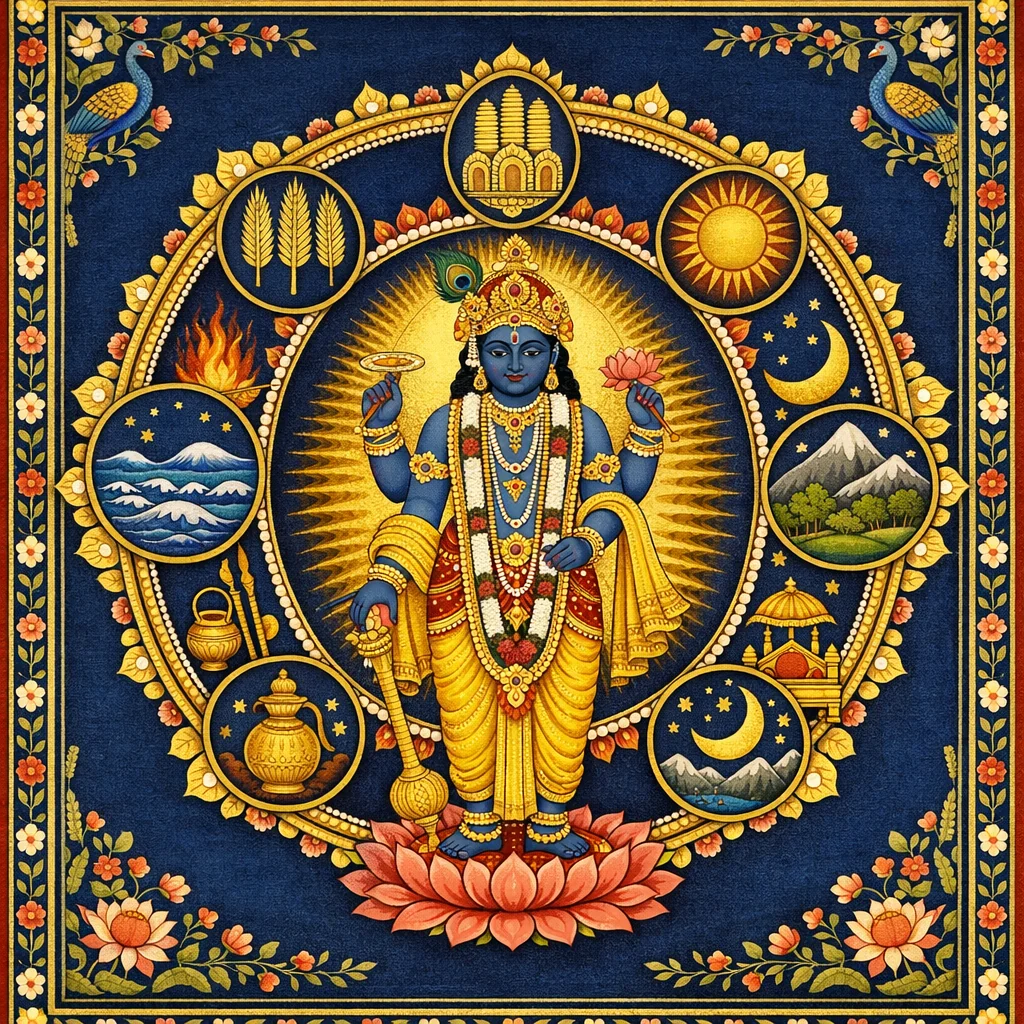
Adhyaya 16
Vibhūti-yoga in the Bhāgavata: The Lord’s Manifest Opulences and the Discipline of Control
Continuing Uddhava’s earnest inquiry into the Lord’s hidden presence as Paramātmā, this chapter opens with Uddhava praising Kṛṣṇa as beginningless, endless, and the life of all beings, then requesting knowledge of the siddhis gained through bhakti and the divine forms worshiped by sages. The Lord answers by linking the question to Arjuna’s inquiry at Kurukṣetra, affirming continuity with the Gītā’s teaching on vibhūti, the Lord’s divine excellences. Kṛṣṇa then lists representative manifestations—among the Vedas, meters, deities, sages, kings, celestial beings, natural forces, divisions of time, virtues, and cosmic principles—showing that whatever is supreme, beautiful, powerful, or purifying is an expansion of His opulence. The discourse culminates in a practical command: control speech, mind, prāṇa, and the senses through purified intelligence, for without such mastery vows and austerities leak away like water from an unbaked pot. Thus the chapter moves from metaphysical recognition (“everything is His vibhūti”) to the next sādhana imperative (“therefore, control and surrender”).
Shlokas
Verse 1
श्रीउद्धव उवाच त्वं ब्रह्म परमं साक्षादनाद्यन्तमपावृतम् । सर्वेषामपि भावानां त्राणस्थित्यप्ययोद्भव: ॥ १ ॥
Śrī Uddhava said: My Lord, You are the Supreme Brahman Himself—without beginning or end, and limited by nothing. You are the protector and sustainer, the destroyer, and the very cause of the arising of all that exists.
Verse 2
उच्चावचेषु भूतेषु दुर्ज्ञेयमकृतात्मभि: । उपासते त्वां भगवन् याथातथ्येन ब्राह्मणा: ॥ २ ॥
O Bhagavān, it is difficult for the impure-hearted to understand that You are situated within all creations, higher and lower; yet the brāhmaṇas who know the Vedic conclusion worship You in truth.
Verse 3
येषु येषु च भूतेषु भक्त्या त्वां परमर्षय: । उपासीना: प्रपद्यन्ते संसिद्धिं तद् वदस्व मे ॥ ३ ॥
Please tell me what perfections the great sages attain by worshiping You with devotion, and kindly explain as well which of Your various forms they worship.
Verse 4
गूढश्चरसि भूतात्मा भूतानां भूतभावन । न त्वां पश्यन्ति भूतानि पश्यन्तं मोहितानि ते ॥ ४ ॥
O Soul of all beings, nourisher of all, You move about hidden within the living entities. You see them, yet, bewildered by Your māyā, they cannot see You, though You are seeing them.
Verse 5
या: काश्च भूमौ दिवि वै रसायां विभूतयो दिक्षु महाविभूते । ता मह्यमाख्याह्यनुभावितास्ते नमामि ते तीर्थपदाङ्घ्रिपद्मम् ॥ ५ ॥
O Lord of supreme potency, please describe to me Your innumerable vibhūtis, which You manifest on earth, in heaven, in the lower worlds, and in all directions. I bow to Your lotus feet, the shelter of all holy places.
Verse 6
श्रीभगवानुवाच एवमेतदहं पृष्ट: प्रश्नं प्रश्नविदां वर । युयुत्सुना विनशने सपत्नैरर्जुनेन वै ॥ ६ ॥
The Supreme Lord said: O best among those who know how to inquire, it is indeed so; previously I was asked this same question. On the destructive battlefield of Kurukṣetra, Arjuna, eager to fight his rivals, asked Me this very thing.
Verse 7
ज्ञात्वा ज्ञातिवधं गर्ह्यमधर्मं राज्यहेतुकम् । ततो निवृत्तो हन्ताहं हतोऽयमिति लौकिक: ॥ ७ ॥
On the battlefield of Kurukṣetra, Arjuna considered the killing of his relatives to be abominable and adharma, driven only by the desire for a kingdom. Therefore he withdrew from the fight, thinking, “I would be the slayer of my own kin; they would be destroyed.” Thus Arjuna was afflicted with mundane consciousness.
Verse 8
स तदा पुरुषव्याघ्रो युक्त्या मे प्रतिबोधित: । अभ्यभाषत मामेवं यथा त्वं रणमूर्धनि ॥ ८ ॥
At that time I enlightened Arjuna, the tiger among men, with sound reasoning. Then, at the very front of the battle, he questioned Me in the same way you are now inquiring.
Verse 9
अहमात्मोद्धवामीषां भूतानां सुहृदीश्वर: । अहं सर्वाणि भूतानि तेषां स्थित्युद्भवाप्यय: ॥ ९ ॥
My dear Uddhava, I am the Paramātmā, the Supersoul, of all living beings; therefore I am naturally their well-wisher and supreme controller. As the creator, maintainer, and annihilator of all entities, I am not different from them.
Verse 10
अहं गतिर्गतिमतां काल: कलयतामहम् । गुणानां चाप्यहं साम्यं गुणिन्यौत्पत्तिको गुण: ॥ १० ॥
I am the supreme destination of all who seek advancement, and among the self-controlled I am Time. Among the guṇas I am their equilibrium, and among the pious I am natural virtue.
Verse 11
गुणिनामप्यहं सूत्रं महतां च महानहम् । सूक्ष्माणामप्यहं जीवो दुर्जयानामहं मन: ॥ ११ ॥
Among things endowed with qualities, I am nature’s primal thread, and among the great I am the Mahat-tattva. Among the subtle I am the jīva, and among the hard to conquer I am the mind.
Verse 12
हिरण्यगर्भो वेदानां मन्त्राणां प्रणवस्त्रिवृत् । अक्षराणामकारोऽस्मि पदानिच्छन्दसामहम् ॥ १२ ॥
Among the Vedas I am their original teacher, Hiraṇyagarbha (Lord Brahmā), and among mantras I am the three-syllabled praṇava, Oṁ. Among letters I am ‘a’, and among sacred meters I am the Gāyatrī.
Verse 13
इन्द्रोऽहं सर्वदेवानां वसूनामस्मि हव्यवाट् । आदित्यानामहं विष्णू रुद्राणां नीललोहित: ॥ १३ ॥
Among all the devas I am Indra, and among the Vasus I am Havyavāh, Agni the fire-god. Among the Ādityas I am Viṣṇu, and among the Rudras I am Nīlalohita, Lord Śiva.
Verse 14
ब्रह्मर्षीणां भृगुरहं राजर्षीणामहं मनु: । देवर्षीणां नारदोऽहं हविर्धान्यस्मि धेनुषु ॥ १४ ॥
Among the Brahmarṣis I am Bhṛgu, and among the Rājarṣis I am Manu. Among the Devarṣis I am Nārada, and among cows I am Kāmadhenu.
Verse 15
सिद्धेश्वराणां कपिल: सुपर्णोऽहं पतत्रिणाम् । प्रजापतीनां दक्षोऽहं पितृणामहमर्यमा ॥ १५ ॥
Among the perfected beings I am Lord Kapila, and among birds I am Suparṇa, Garuḍa. Among the Prajāpatis I am Dakṣa, and among the Pitṛs (forefathers) I am Aryamā.
Verse 16
मां विद्ध्युद्धव दैत्यानां प्रह्लादमसुरेश्वरम् । सोमं नक्षत्रौषधीनां धनेशं यक्षरक्षसाम् ॥ १६ ॥
My dear Uddhava, among the Daityas know Me as Prahlāda Mahārāja, the saintly lord of the Asuras. Among the stars and healing herbs I am Soma—Candra, the moon—and among Yakṣas and Rākṣasas I am Dhanesha Kuvera, the lord of wealth.
Verse 17
ऐरावतं गजेन्द्राणां यादसां वरुणं प्रभुम् । तपतां द्युमतां सूर्यं मनुष्याणां च भूपतिम् ॥ १७ ॥
Among the lordly elephants I am Airāvata, and among aquatic beings I am Varuṇa, the master of the seas. Among all that gives heat and light I am the sun, and among human beings I am the king.
Verse 18
उच्चै:श्रवास्तुरङ्गाणां धातूनामस्मि काञ्चनम् । यम: संयमतां चाहम् सर्पाणामस्मि वासुकि: ॥ १८ ॥
Among horses I am Uccaiḥśravā, and among metals I am kāñcana, gold. Among those who restrain and punish I am Yamarāja, and among serpents I am Vāsuki.
Verse 19
नागेन्द्राणामनन्तोऽहं मृगेन्द्र: शृङ्गिदंष्ट्रिणाम् । आश्रमाणामहं तुर्यो वर्णानां प्रथमोऽनघ ॥ १९ ॥
O sinless Uddhava, among the kings of serpents I am Anantadeva, and among beasts with sharp horns or teeth I am the lion, king of animals. Among the āśramas I am the fourth, sannyāsa (renunciation), and among the varṇas I am the first, the brāhmaṇas.
Verse 20
तीर्थानां स्रोतसां गङ्गा समुद्र: सरसामहम् । आयुधानां धनुरहं त्रिपुरघ्नो धनुष्मताम् ॥ २० ॥
Among sacred places and flowing waters I am the holy, purifying Gaṅgā, and among still bodies of water I am the ocean. Among weapons I am the bow, and among those who wield weapons I am Lord Śiva, the destroyer of Tripura.
Verse 21
धिष्ण्यानामस्म्यहं मेरुर्गहनानां हिमालय: । वनस्पतीनामश्वत्थ ओषधीनामहं यव: ॥ २१ ॥
Among residences I am Mount Meru, and among places difficult to penetrate I am the Himalayas. Among trees I am the sacred aśvattha, and among plants I am yava—those that bear grain.
Verse 22
पुरोधसां वसिष्ठोऽहं ब्रह्मिष्ठानां बृहस्पति: । स्कन्दोऽहं सर्वसेनान्यामग्रण्यां भगवानज: ॥ २२ ॥
Among priests I am Vasiṣṭha Muni, and among those most eminent in Vedic culture I am Bṛhaspati. Among great military leaders I am Skanda (Kārtikeya), and among those who lead the superior ways of life I am Bhagavān Aja—Lord Brahmā.
Verse 23
यज्ञानां ब्रह्मयज्ञोऽहं व्रतानामविहिंसनम् । वाय्वग्न्यर्काम्बुवागात्मा शुचीनामप्यहं शुचि: ॥ २३ ॥
Among sacrifices I am brahma-yajña, the study of the Veda, and among vows I am nonviolence. Among all that purifies I am the wind, fire, the sun, water, and sacred speech; even among the pure I am the supreme purity.
Verse 24
योगानामात्मसंरोधो मन्त्रोऽस्मि विजिगीषताम् । आन्वीक्षिकी कौशलानां विकल्प: ख्यातिवादिनाम् ॥ २४ ॥
Among the stages of yoga I am complete self-restraint—samādhi—where the soul is wholly separated from illusion. Among those who seek victory I am prudent political counsel, and among expert methods of discrimination I am ānvīkṣikī, the science of the ātman by which spirit is distinguished from matter. Among speculative philosophers I am the diversity of perception.
Verse 25
स्त्रीणां तु शतरूपाहं पुंसां स्वायम्भुवो मनु: । नारायणो मुनीनां च कुमारो ब्रह्मचारिणाम् ॥ २५ ॥
Among women I am Śatarūpā, and among men I am her husband, Svāyambhuva Manu. Among sages I am Nārāyaṇa, and among brahmacārīs I am Sanat-kumāra.
Verse 26
धर्माणामस्मि संन्यास: क्षेमाणामबहिर्मति: । गुह्यानां सुनृतं मौनं मिथुनानामजस्त्वहम् ॥ २६ ॥
Among religious principles I am renunciation, and among all forms of security I am awareness of the eternal soul within. Among secrets I am pleasing truthful speech and silence, and among sexual pairs I am Aja (Brahmā).
Verse 27
संवत्सरोऽस्म्यनिमिषामृतूनां मधुमाधवौ । मासानां मार्गशीर्षोऽहं नक्षत्राणां तथाभिजित् ॥ २७ ॥
Among the vigilant cycles of time I am the year, and among seasons I am Madhu-Mādhava, the spring. Among months I am Mārgaśīrṣa, and among lunar mansions I am the auspicious Abhijit.
Verse 28
अहं युगानां च कृतं धीराणां देवलोऽसित: । द्वैपायनोऽस्मि व्यासानां कवीनां काव्य आत्मवान् ॥ २८ ॥
Among ages I am Kṛta (Satya)-yuga, and among steady sages I am Devala and Asita. Among the Vyāsas who divided the Vedas I am Kṛṣṇa Dvaipāyana Vedavyāsa, and among learned poet-scholars I am Kāvya (Śukrācārya), knower of spiritual science.
Verse 29
वासुदेवो भगवतां त्वं तु भागवतेष्वहम् । किम्पुरुषाणां हनुमान् विद्याध्राणां सुदर्शन: ॥ २९ ॥
Among those entitled to the name Bhagavān I am Vāsudeva, and among the devotees, O Uddhava, you represent Me. Among the Kimpuruṣas I am Hanumān, and among the Vidyādharas I am Sudarśana.
Verse 30
रत्नानां पद्मरागोऽस्मि पद्मकोश: सुपेशसाम् । कुशोऽस्मि दर्भजातीनां गव्यमाज्यं हवि:ष्वहम् ॥ ३० ॥
Among jewels I am the padmarāga ruby, and among beautiful things I am the lotus cup. Among grasses I am the sacred kuśa, and among oblations I am ghee and other offerings obtained from the cow.
Verse 31
व्यवसायिनामहं लक्ष्मी: कितवानां छलग्रह: । तितिक्षास्मि तितिक्षूणां सत्त्वं सत्त्ववतामहम् ॥ ३१ ॥
Among the enterprising I am Lakṣmī, fortune itself, and among cheaters I am gambling. I am the forgiveness of the tolerant, and I am the sattvic qualities of those established in goodness.
Verse 32
ओज: सहो बलवतां कर्माहं विद्धि सात्वताम् । सात्वतां नवमूर्तीनामादिमूर्तिरहं परा ॥ ३२ ॥
Of the powerful I am ojas and saha—strength of body and mind—and know that the devotional works of My Sātvata devotees are also Me. My devotees worship Me in nine forms, among which I am the original and foremost form, Vāsudeva.
Verse 33
विश्वावसु: पूर्वचित्तिर्गन्धर्वाप्सरसामहम् । भूधराणामहं स्थैर्यं गन्धमात्रमहं भुव: ॥ ३३ ॥
Among the Gandharvas I am Viśvāvasu, and among the heavenly Apsarās I am Pūrvacitti. Among mountains I am their steadiness, and within the earth I am the very essence of fragrance.
Verse 34
अपां रसश्च परमस्तेजिष्ठानां विभावसु: । प्रभा सूर्येन्दुताराणां शब्दोऽहं नभस: पर: ॥ ३४ ॥
In water I am the supreme taste, its sweetness; among the brilliant I am Vibhāvasu, the sun. I am the radiance of the sun, moon, and stars, and I am the transcendental sound that vibrates in the sky.
Verse 35
ब्रह्मण्यानां बलिरहं वीराणामहमर्जुन: । भूतानां स्थितिरुत्पत्तिरहं वै प्रतिसङ्क्रम: ॥ ३५ ॥
Among those devoted to brahminical culture, I am Bali Mahārāja, son of Virocana; and among heroes, I am Arjuna. Indeed, the creation, maintenance, and annihilation of all living beings are also Me.
Verse 36
गत्युक्त्युत्सर्गोपादानमानन्दस्पर्शलक्षणम् । आस्वादश्रुत्यवघ्राणमहं सर्वेन्द्रियेन्द्रियम् ॥ ३६ ॥
I am the functions of the five working senses—legs, speech, anus, hands, and genitals—as well as those of the five knowledge-acquiring senses—touch, sight, taste, hearing, and smell. I am also the potency by which each sense experiences its own object.
Verse 37
पृथिवी वायुराकाश आपो ज्योतिरहं महान् । विकार: पुरुषोऽव्यक्तं रज: सत्त्वं तम: परम् । अहमेतत्प्रसङ्ख्यानं ज्ञानं तत्त्वविनिश्चय: ॥ ३७ ॥
I am form, taste, aroma, touch, and sound; false ego; the mahat-tattva; earth, water, fire, air, and sky; the living being; unmanifest material nature; the modes of goodness, passion, and ignorance; and the transcendental Lord. All these, together with knowledge of their distinct symptoms and the steady conviction born of such knowledge, represent Me.
Verse 38
मयेश्वरेण जीवेन गुणेन गुणिना विना । सर्वात्मनापि सर्वेण न भावो विद्यते क्वचित् ॥ ३८ ॥
As the Supreme Lord, I am the basis of the living being, of the modes of nature, and of the mahat-tattva. Thus I am everything, and nothing whatsoever can exist without Me.
Verse 39
सङ्ख्यानं परमाणूनां कालेन क्रियते मया । न तथा मे विभूतीनां सृजतोऽण्डानि कोटिश: ॥ ३९ ॥
Even if, over the course of time, I could count all the atoms of the universe, I still could not count all My opulences (vibhūtis) that I manifest within innumerable universes.
Verse 40
तेज: श्री: कीर्तिरैश्वर्यं ह्रीस्त्याग: सौभगं भग: । वीर्यं तितिक्षा विज्ञानं यत्र यत्र स मेंऽशक: ॥ ४० ॥
Wherever there is power, beauty, fame, opulence, humility, renunciation, inner joy, good fortune, strength, tolerance, or spiritual knowledge, it is simply an expansion of My own divine opulence.
Verse 41
एतास्ते कीर्तिता: सर्वा: सङ्क्षेपेण विभूतय: । मनोविकारा एवैते यथा वाचाभिधीयते ॥ ४१ ॥
Thus I have briefly described all My spiritual opulences to you; and the wondrous material features of My creation are also merely transformations perceived by the mind and spoken of in various ways according to circumstance.
Verse 42
वाचं यच्छ मनो यच्छ प्राणान् यच्छेन्द्रियाणि च । आत्मानमात्मना यच्छ न भूय: कल्पसेऽध्वने ॥ ४२ ॥
Therefore restrain your speech, subdue the mind, master the life air (prāṇa), and regulate the senses; and with purified intelligence bring yourself under control—thus you will never again fall onto the path of material existence.
Verse 43
यो वै वाङ्मनसी सम्यगसंयच्छन् धिया यति: । तस्य व्रतं तपो दानं स्रवत्यामघटाम्बुवत् ॥ ४३ ॥
A transcendentalist who does not fully control his words and mind by superior intelligence will find that his vows, austerities, and charity leak away like water from an unbaked clay pot.
Verse 44
तस्माद्वचोमन:प्राणान् नियच्छेन्मत्परायण: । मद्भक्तियुक्तया बुद्ध्या तत: परिसमाप्यते ॥ ४४ ॥
Therefore, one who is surrendered to Me should control speech, mind, and prāṇa; then, with intelligence joined to loving bhakti for Me, one will completely fulfill the mission of life.
Frequently Asked Questions
By invoking Kurukṣetra, Kṛṣṇa frames Uddhava’s inquiry within a recognized śāstric template: the vibhūti teaching that converts abstract theism into perceivable recognition of the Lord’s presence everywhere. The reference also signals that the same Absolute Truth who guided Arjuna through dharma-conflict now guides Uddhava through the subtler task of nirodha—withdrawal from material identification—by learning to see all excellences as rooted in Bhagavān.
The list is not mere poetry or mythology; it is a theological method (upāsanā-sāhitya) teaching that the supreme exemplar within any category points to the category’s source. By recognizing the ‘best’ (śreṣṭha) or governing principle in each domain—Veda, mantra, deity, time, element, virtue, ruler—one learns to trace perception back to āśraya (Kṛṣṇa). This transforms ordinary cognition into devotional discrimination: the world becomes a map of vibhūtis rather than a field of separate enjoyables.
The chapter’s conclusion shows the practical consequence of vibhūti-knowledge: if everything is Kṛṣṇa’s expansion, then the sādhaka must stop dissipating consciousness through uncontrolled talk, restless mind, and unregulated senses. Kṛṣṇa states that without such mastery, vows, austerities, and charity ‘leak away’ like water from an unbaked pot—indicating lack of inner consolidation (saṁskāra). Control is not repression but disciplined offering (yukta-vairāgya) performed in surrender, culminating in bhakti guided by ‘loving devotional intelligence.’