Adhyaya 11
Bondage and Liberation Under Māyā; Two Birds Analogy; Marks of the Saintly Devotee
Continuing Kṛṣṇa’s concluding guidance to Uddhava within the Uddhava-gītā, this chapter clarifies that “bondage” and “liberation” arise from the guṇas of prakṛti under the Lord’s māyā, while the ātman remains essentially untouched. Kṛṣṇa uses dream and space/sun/wind analogies to show the unreality of material lamentation and the witness-position of the self-realized soul. He contrasts the enlightened person—who sees the senses acting upon sense objects—with the ignorant doer-ego bound by karma. The famous image of two birds in one tree distinguishes the jīva (enjoyer of fruits) from Paramātmā (non-enjoying witness and knower). The chapter then turns from jñāna and vairāgya to bhakti: scholarship devoid of the Lord’s līlā is sterile, whereas dedicating action and mind to Him purifies existence. Uddhava’s inquiry about the true devotee leads into Kṛṣṇa’s definition of saintly qualities, preparing the next teachings on approved devotion and the excellence of unalloyed love.
Shlokas
Verse 1
श्रीभगवानुवाच बद्धो मुक्त इति व्याख्या गुणतो मे न वस्तुत: । गुणस्य मायामूलत्वान्न मे मोक्षो न बन्धनम् ॥ १ ॥
The Supreme Lord said: My dear Uddhava, under the influence of the material guṇas, which are under My control, the jīva is sometimes labeled “conditioned” and sometimes “liberated.” In truth, however, the soul is never actually bound or freed. And since I am the Supreme Lord of māyā, the source of the guṇas, I too am never to be considered in bondage or in liberation.
Verse 2
शोकमोहौ सुखं दु:खं देहापत्तिश्च मायया । स्वप्नो यथात्मन: ख्याति: संसृतिर्न तु वास्तवी ॥ २ ॥
Lamentation and delusion, happiness and distress, and even the acceptance of a material body under the sway of māyā—all these are creations of My illusory potency. Just as a dream is merely a projection of one’s intelligence and has no real substance, so material existence (saṁsāra) has no essential reality.
Verse 3
विद्याविद्ये मम तनू विद्ध्युद्धव शरीरिणाम् । मोक्षबन्धकरी आद्ये मायया मे विनिर्मिते ॥ ३ ॥
O Uddhava, know that both knowledge and ignorance are embodiments of My potency, expansions of My divine energy. Fashioned by My māyā, they are without beginning, and for embodied beings they bestow, respectively, liberation and bondage.
Verse 4
एकस्यैव ममांशस्य जीवस्यैव महामते । बन्धोऽस्याविद्ययानादिर्विद्यया च तथेतर: ॥ ४ ॥
O most intelligent Uddhava, the jīva is indeed My own part and parcel. Yet by ignorance he has suffered material bondage since time without beginning. By knowledge, however, he can attain liberation.
Verse 5
अथ बद्धस्य मुक्तस्य वैलक्षण्यं वदामि ते । विरुद्धधर्मिणोस्तात स्थितयोरेकधर्मिणि ॥ ५ ॥
Now, dear Uddhava, I shall describe to you the distinguishing traits of the conditioned soul and the eternally liberated Supreme Lord. In the same body, opposite qualities such as happiness and distress appear because within it dwell both Bhagavān, ever free, and the bound jīva.
Verse 6
सुपर्णावेतौ सदृशौ सखायौ यदृच्छयैतौ कृतनीडौ च वृक्षे । एकस्तयो: खादति पिप्पलान्न- मन्यो निरन्नोऽपि बलेन भूयान् ॥ ६ ॥
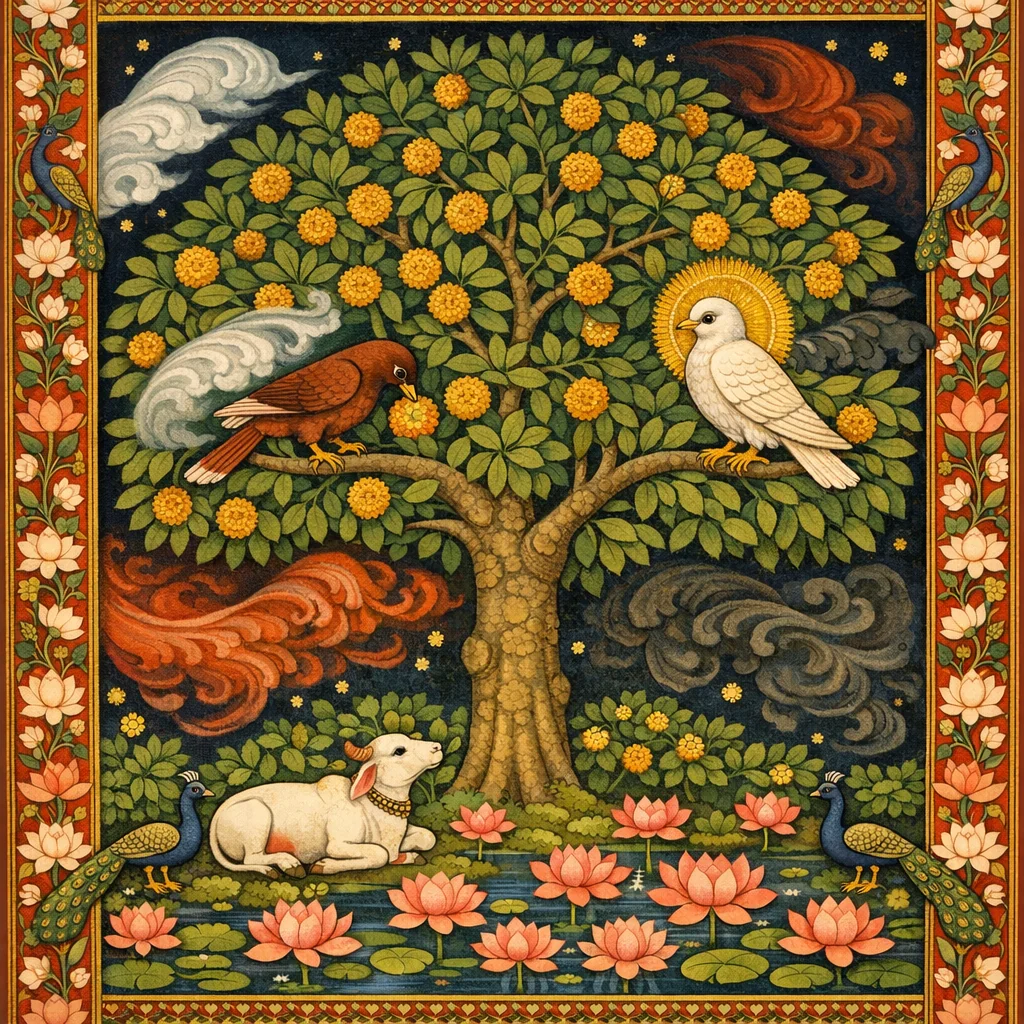
By chance, two birds of similar nature, friends, have built a nest in the same tree. One eats the tree’s fruits, while the other does not eat, yet stands in a superior position by His potency.
Verse 7
आत्मानमन्यं च स वेद विद्वा- नपिप्पलादो न तु पिप्पलाद: । योऽविद्यया युक् स तु नित्यबद्धो विद्यामयो य: स तु नित्यमुक्त: ॥ ७ ॥
The bird that does not eat the fruits is the omniscient Supreme Lord, who perfectly knows His own position and that of the conditioned being, represented by the eating bird. The eating jīva knows neither himself nor the Lord; covered by avidyā he is called eternally bound, whereas Bhagavān, full of perfect knowledge, is eternally liberated.
Verse 8
देहस्थोऽपि न देहस्थो विद्वान् स्वप्नाद् यथोत्थित: । अदेहस्थोऽपि देहस्थ: कुमति: स्वप्नदृग् यथा ॥ ८ ॥
One enlightened in self-realization, though dwelling within the material body, does not see himself as bodily—just as one who awakens from a dream abandons identification with the dream body. A foolish person, however, though actually distinct from and beyond the body, imagines himself situated in it, like a dreamer seeing himself in an illusory body.
Verse 9
इन्द्रियैरिन्द्रियार्थेषु गुणैरपि गुणेषु च । गृह्यमाणेष्वहं कुर्यान्न विद्वान् यस्त्वविक्रिय: ॥ ९ ॥
An enlightened person, free from the taint of material desire, does not consider himself the doer of bodily activities. He knows that in all actions it is only the senses, born of nature’s guṇas, contacting sense objects born of those same guṇas.
Verse 10
दैवाधीने शरीरेऽस्मिन् गुणभाव्येन कर्मणा । वर्तमानोऽबुधस्तत्र कर्तास्मीति निबध्यते ॥ १० ॥
The unintelligent soul, dwelling in this body governed by divine arrangement and shaped by past karma, imagines, “I am the doer.” Bewildered by false ego, he becomes bound by fruitive work, which is actually carried out by the modes of material nature.
Verse 11
एवं विरक्त: शयन आसनाटनमज्जने । दर्शनस्पर्शनघ्राणभोजनश्रवणादिषु । न तथा बध्यते विद्वान् तत्र तत्रादयन् गुणान् ॥ ११ ॥
Thus the wise, established in detachment, engages the body in lying down, sitting, walking, bathing, seeing, touching, smelling, eating, hearing, and so on, yet is not bound. Remaining as a witness, he simply lets the senses deal with their objects and does not become entangled.
Verse 12
प्रकृतिस्थोऽप्यसंसक्तो यथा खं सवितानिल: । वैशारद्येक्षयासङ्गशितया छिन्नसंशय: ॥ १२ ॥ प्रतिबुद्ध इव स्वप्नान्नानात्वाद् विनिवर्तते ॥ १३ ॥
Though space supports all things, it never mixes with them nor becomes entangled; the sun reflected in countless waters is not attached to water; and the mighty wind that blows everywhere is untouched by innumerable aromas. In the same way, the self-realized soul remains completely detached from the body and the world. With vision sharpened by detachment, he cuts all doubts by knowledge of the Self and, like one awakened from a dream, withdraws consciousness from the spread of material variety.
Verse 13
प्रकृतिस्थोऽप्यसंसक्तो यथा खं सवितानिल: । वैशारद्येक्षयासङ्गशितया छिन्नसंशय: ॥ १२ ॥ प्रतिबुद्ध इव स्वप्नान्नानात्वाद् विनिवर्तते ॥ १३ ॥
He turns away from variety like one awakened from a dream. With vision sharpened by detachment, the knower of the Self cuts doubts with the sword of knowledge and draws the mind back from outward expansion.
Verse 14
यस्य स्युर्वीतसङ्कल्पा: प्राणेन्द्रियमनोधियाम् । वृत्तय: स विनिर्मुक्तो देहस्थोऽपि हि तद्गुणै: ॥ १४ ॥
One is considered fully liberated when the functions of prana, senses, mind, and intelligence proceed without material desire. Though situated within the body, he is not entangled by its qualities.
Verse 15
यस्यात्मा हिंस्यते हिंस्रैर्येन किञ्चिद् यदृच्छया । अर्च्यते वा क्वचित्तत्र न व्यतिक्रियते बुध: ॥ १५ ॥
Sometimes, without any apparent cause, one’s body is attacked by cruel people or violent animals; at other times, elsewhere, one is suddenly honored or even worshiped. He who is neither angry when harmed nor pleased when adored is truly intelligent.
Verse 16
न स्तुवीत न निन्देत कुर्वत: साध्वसाधु वा । वदतो गुणदोषाभ्यां वर्जित: समदृङ्मुनि: ॥ १६ ॥
A saintly sage, seeing with equal vision, is not swayed by what is materially good or bad. Though he observes others acting well or poorly and speaking rightly or wrongly, he neither praises nor criticizes anyone.
Verse 17
न कुर्यान्न वदेत् किञ्चिन्न ध्यायेत् साध्वसाधु वा । आत्मारामोऽनया वृत्त्या विचरेज्जडवन्मुनि: ॥ १७ ॥
Even to maintain his body, a liberated sage should not act, speak, or think in terms of material ‘good’ and ‘bad’. Detached in all circumstances and delighting in self-realization, he should wander in this liberated way of life, appearing dull-minded to outsiders.
Verse 18
शब्दब्रह्मणि निष्णातो न निष्णायात् परे यदि । श्रमस्तस्य श्रमफलो ह्यधेनुमिव रक्षत: ॥ १८ ॥
If one becomes expert in śabda-brahman, the Vedic word, yet makes no endeavor to fix the mind on Bhagavān, the Supreme Personality of Godhead, then one’s labor bears only labor as its fruit—like diligently caring for a cow that gives no milk.
Verse 19
गां दुग्धदोहामसतीं च भार्यां देहं पराधीनमसत्प्रजां च । वित्तं त्वतीर्थीकृतमङ्ग वाचं हीनां मया रक्षति दु:खदु:खी ॥ १९ ॥
My dear Uddhava, most miserable indeed is the man who maintains a cow that gives no milk, an unchaste wife, a body wholly dependent on others, useless children, or wealth not employed for the proper sacred purpose. Likewise, one who studies Vedic knowledge devoid of My glories is also most miserable.
Verse 20
यस्यां न मे पावनमङ्ग कर्म स्थित्युद्भवप्राणनिरोधमस्य । लीलावतारेप्सितजन्म वा स्याद् वन्ध्यां गिरं तां बिभृयान्न धीर: ॥ २० ॥
My dear Uddhava, any literature that does not describe My purifying pastimes and deeds—by which the creation, maintenance, and dissolution of the universe are revealed, and in which My most beloved incarnations, Kṛṣṇa and Balarāma, are not honored—is barren speech; the truly intelligent do not accept it.
Verse 21
एवं जिज्ञासयापोह्य नानात्वभ्रममात्मनि । उपारमेत विरजं मनो मय्यर्प्य सर्वगे ॥ २१ ॥
Thus, by sincere inquiry, one should remove from the self the delusion of material variety imposed upon the soul and come to rest from worldly existence. Let the mind, free from passion, be offered and fixed in Me, for I am all-pervading.
Verse 22
यद्यनीशो धारयितुं मनो ब्रह्मणि निश्चलम् । मयि सर्वाणि कर्माणि निरपेक्ष: समाचर ॥ २२ ॥
My dear Uddhava, if you cannot free the mind from all disturbance and hold it steady in Brahman, then perform all your activities as an offering to Me, without expectation of their fruits.
Verse 23
श्रद्धालुर्मत्कथा: शृण्वन् सुभद्रा लोकपावनी: । गायन्ननुस्मरन् कर्म जन्म चाभिनयन् मुहु: ॥ २३ ॥ मदर्थे धर्मकामार्थानाचरन् मदपाश्रय: । लभते निश्चलां भक्तिं मय्युद्धव सनातने ॥ २४ ॥
My dear Uddhava, narrations of My pastimes and qualities are supremely auspicious and purify the entire universe. One who, with faith, constantly hears, chants, and remembers them, who repeatedly relives My līlās—beginning with My appearance—through devotional performances, and who takes full shelter of Me, dedicating even dharma, kāma, and artha to My satisfaction, surely attains unflinching devotion to Me, the eternal Supreme Lord.
Verse 24
श्रद्धालुर्मत्कथा: शृण्वन् सुभद्रा लोकपावनी: । गायन्ननुस्मरन् कर्म जन्म चाभिनयन् मुहु: ॥ २३ ॥ मदर्थे धर्मकामार्थानाचरन् मदपाश्रय: । लभते निश्चलां भक्तिं मय्युद्धव सनातने ॥ २४ ॥
My dear Uddhava, narrations of My pastimes and qualities are supremely auspicious and purify the entire universe. One who, with faith, constantly hears, chants, and remembers them, who repeatedly relives My līlās—beginning with My appearance—through devotional performances, and who takes full shelter of Me, dedicating even dharma, kāma, and artha to My satisfaction, surely attains unflinching devotion to Me, the eternal Supreme Lord.
Verse 25
सत्सङ्गलब्धया भक्त्या मयि मां स उपासिता । स वै मे दर्शितं सद्भिरञ्जसा विन्दते पदम् ॥ २५ ॥
One who, by the holy association of My devotees, attains pure bhakti and constantly worships Me, very easily reaches My abode, as revealed by the pure devotees.
Verse 26
श्रीउद्धव उवाच साधुस्तवोत्तमश्लोक मत: कीदृग्विध: प्रभो । भक्तिस्त्वय्युपयुज्येत कीदृशी सद्भिरादृता ॥ २६ ॥ एतन्मे पुरुषाध्यक्ष लोकाध्यक्ष जगत्प्रभो । प्रणतायानुरक्ताय प्रपन्नाय च कथ्यताम् ॥ २७ ॥
Śrī Uddhava said: O Lord praised by the finest hymns, what kind of person do You regard as a true saintly devotee, and what kind of bhakti-service do the great devotees honor as fit to be offered to You?
Verse 27
श्रीउद्धव उवाच साधुस्तवोत्तमश्लोक मत: कीदृग्विध: प्रभो । भक्तिस्त्वय्युपयुज्येत कीदृशी सद्भिरादृता ॥ २६ ॥ एतन्मे पुरुषाध्यक्ष लोकाध्यक्ष जगत्प्रभो । प्रणतायानुरक्ताय प्रपन्नाय च कथ्यताम् ॥ २७ ॥
O Lord of all beings, ruler of the rulers and master of the universe, I bow to You in love and take complete shelter in You alone; therefore, please explain this to me.
Verse 28
त्वं ब्रह्म परमं व्योम पुरुष: प्रकृते: पर: । अवतीर्णोऽसि भगवन् स्वेच्छोपात्तपृथग्वपु: ॥ २८ ॥
My Lord, You are the supreme Brahman, untouched like the sky and transcendent to material nature; yet, conquered by Your devotees’ love, You assume many forms and descend according to their desire.
Verse 29
श्रीभगवानुवाच कृपालुरकृतद्रोहस्तितिक्षु: सर्वदेहिनाम् । सत्यसारोऽनवद्यात्मा सम: सर्वोपकारक: ॥ २९ ॥ कामैरहतधीर्दान्तो मृदु: शुचिरकिञ्चन: । अनीहो मितभुक् शान्त: स्थिरो मच्छरणो मुनि: ॥ ३० ॥ अप्रमत्तो गभीरात्मा धृतिमाञ्जितषड्गुण: । अमानी मानद: कल्यो मैत्र: कारुणिक: कवि: ॥ ३१ ॥ आज्ञायैवं गुणान् दोषान् मयादिष्टानपि स्वकान् । धर्मान् सन्त्यज्य य: सर्वान् मां भजेत स तु सत्तम: ॥ ३२ ॥
The Supreme Lord said: O Uddhava, a saintly person is merciful, never harms others, and is tolerant toward all beings. Truth is his very substance; his heart is spotless; he is equal in happiness and distress and dedicates himself to the welfare of all. Material desires do not bewilder his intelligence; he has controlled his senses; he is gentle, pure, and free from possessiveness. He does not strive for worldly pursuits; he eats moderately; he remains peaceful and steady, taking Me alone as his shelter. He is vigilant, deep-hearted, patient, and has conquered six conditions—hunger, thirst, lamentation, illusion, old age, and death. He does not seek honor but gives honor to others; he is auspicious, friendly, compassionate, and poetically wise. Knowing the virtues and faults I have described, and taking complete refuge at My lotus feet, he ultimately renounces ordinary religious duties and worships Me alone; thus he is considered the best among all living beings.
Verse 30
श्रीभगवानुवाच कृपालुरकृतद्रोहस्तितिक्षु: सर्वदेहिनाम् । सत्यसारोऽनवद्यात्मा सम: सर्वोपकारक: ॥ २९ ॥ कामैरहतधीर्दान्तो मृदु: शुचिरकिञ्चन: । अनीहो मितभुक् शान्त: स्थिरो मच्छरणो मुनि: ॥ ३० ॥ अप्रमत्तो गभीरात्मा धृतिमाञ्जितषड्गुण: । अमानी मानद: कल्यो मैत्र: कारुणिक: कवि: ॥ ३१ ॥ आज्ञायैवं गुणान् दोषान् मयादिष्टानपि स्वकान् । धर्मान् सन्त्यज्य य: सर्वान् मां भजेत स तु सत्तम: ॥ ३२ ॥
The Supreme Lord said: O Uddhava, a saintly person is merciful, never malicious, and tolerant toward all beings. Rooted in truth, pure at heart, equal in happiness and distress, he works for the welfare of others; his intelligence is not shaken by desire, he controls the senses, is gentle and clean, free from possessiveness, moderate in eating, peaceful and steady, and he accepts Me alone as his shelter.
Verse 31
श्रीभगवानुवाच कृपालुरकृतद्रोहस्तितिक्षु: सर्वदेहिनाम् । सत्यसारोऽनवद्यात्मा सम: सर्वोपकारक: ॥ २९ ॥ कामैरहतधीर्दान्तो मृदु: शुचिरकिञ्चन: । अनीहो मितभुक् शान्त: स्थिरो मच्छरणो मुनि: ॥ ३० ॥ अप्रमत्तो गभीरात्मा धृतिमाञ्जितषड्गुण: । अमानी मानद: कल्यो मैत्र: कारुणिक: कवि: ॥ ३१ ॥ आज्ञायैवं गुणान् दोषान् मयादिष्टानपि स्वकान् । धर्मान् सन्त्यज्य य: सर्वान् मां भजेत स तु सत्तम: ॥ ३२ ॥
He is ever vigilant, deep-hearted, and steadfast, having conquered the six conditions—hunger, thirst, lamentation, illusion, old age, and death. He seeks no prestige yet honors others; he is auspicious, friendly, compassionate, and truly wise (kavi).
Verse 32
श्रीभगवानुवाच कृपालुरकृतद्रोहस्तितिक्षु: सर्वदेहिनाम् । सत्यसारोऽनवद्यात्मा सम: सर्वोपकारक: ॥ २९ ॥ कामैरहतधीर्दान्तो मृदु: शुचिरकिञ्चन: । अनीहो मितभुक् शान्त: स्थिरो मच्छरणो मुनि: ॥ ३० ॥ अप्रमत्तो गभीरात्मा धृतिमाञ्जितषड्गुण: । अमानी मानद: कल्यो मैत्र: कारुणिक: कवि: ॥ ३१ ॥ आज्ञायैवं गुणान् दोषान् मयादिष्टानपि स्वकान् । धर्मान् सन्त्यज्य य: सर्वान् मां भजेत स तु सत्तम: ॥ ३२ ॥
Even understanding the virtues and faults I have described, and the ordinary duties prescribed for oneself, one who takes full shelter of My lotus feet, renounces all such conventional dharmas, and worships Me alone is considered the best among living beings.
Verse 33
ज्ञात्वाज्ञात्वाथ ये वै मां यावान् यश्चास्मि यादृश: । भजन्त्यनन्यभावेन ते मे भक्ततमा मता: ॥ ३३ ॥
Whether My devotees know or do not know precisely who I am and how I exist, if they worship Me with exclusive, unalloyed love, I consider them the best of devotees.
Frequently Asked Questions
The two birds symbolize the jīva and Paramātmā residing within the same ‘tree’ of the body. The fruit-eating bird represents the conditioned soul who experiences karma-phala (happiness and distress) and forgets his identity. The non-eating bird represents the Supreme Lord as the omniscient witness and controller, never entangled. The teaching is that bondage is due to ignorance and misidentification, while the Lord remains eternally liberated and can be known when the jīva turns from enjoyment to realization and devotion.
Kṛṣṇa explains that ‘bondage’ and ‘liberation’ are designations produced by māyā operating through the modes of nature. Like dream experiences, material happiness, distress, and bodily identification appear real to the conditioned mind but lack ultimate substance. The ātmā is intrinsically transcendental; liberation is the removal of ignorance and false doership, wherein one remains a witness and offers action to the Lord.
The chapter states that learning becomes barren when it does not culminate in fixing the mind on Bhagavān and hearing His glories (Hari-kathā). Such study is compared to maintaining a cow that gives no milk: the labor remains, but the essential fruit—purification, devotion, and realization—does not arise. The Bhāgavata’s criterion is transformation of consciousness toward the Lord, not mere textual mastery.
A true devotee is described through sādhu-lakṣaṇa: mercy and nonviolence, tolerance, truthfulness, freedom from envy, equanimity in happiness and distress, control of senses and eating, absence of possessiveness and prestige-seeking, honoring others, steadiness amid reversals, and compassionate work for others’ welfare. Most decisively, such a person takes exclusive shelter of the Lord’s lotus feet and worships Him alone, with unalloyed love, even if he may not articulate metaphysics perfectly.