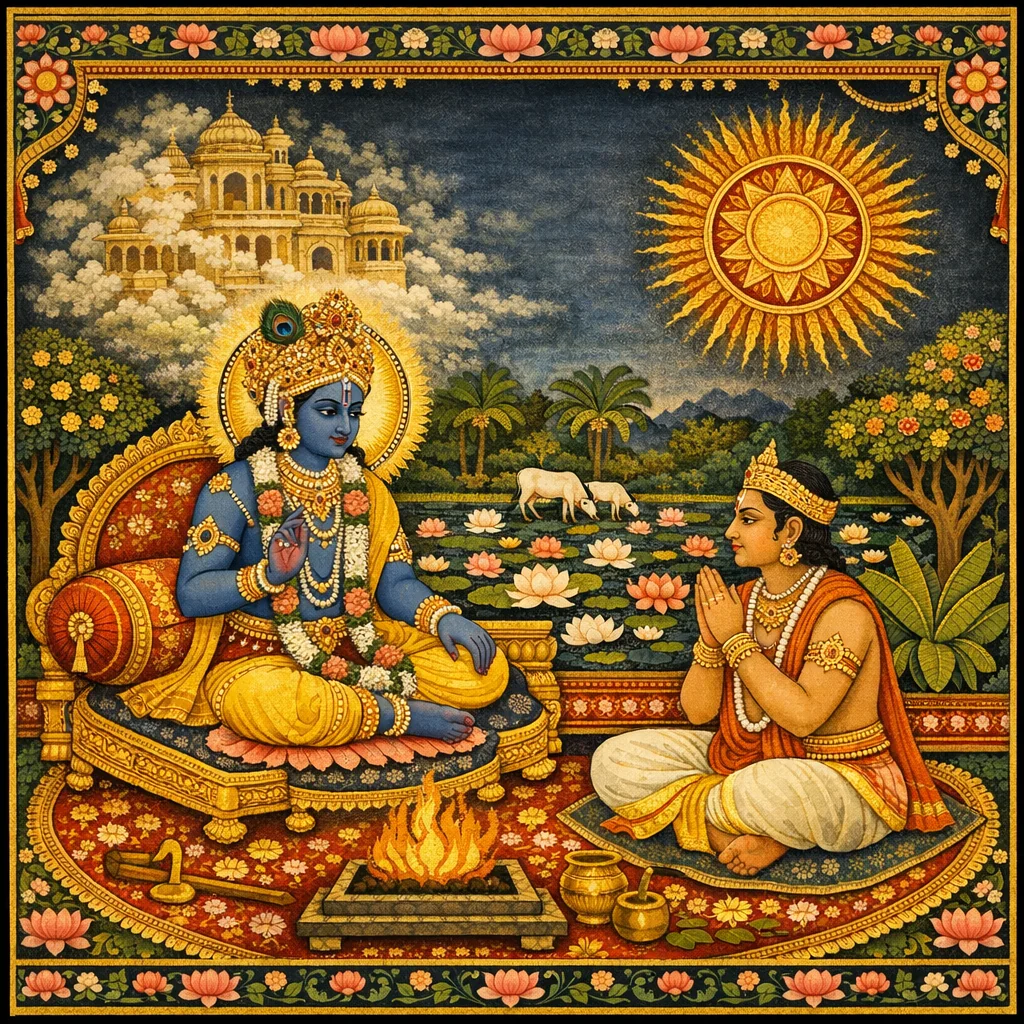
Adhyaya 10
Karma-vāda Critiqued, Varṇāśrama Reframed, and the Soul’s Distinction from the Body
Continuing Kṛṣṇa’s instruction to Uddhava on the progressive spiritual path, this chapter defines the proper stance toward varṇāśrama: take full shelter of Bhagavān, fix the mind in bhakti-service, and live without personal desire while performing regulated duties. Kṛṣṇa then exposes the futility of pursuits rooted in sense gratification, likening worldly enjoyment to dream-objects—mind-made and produced by māyā, thus ultimately useless. He presents a progression: regulated action that purifies; then, when one is fully intent on seeking the soul’s ultimate truth, renouncing fruitive injunctions; and finally approaching a bona fide guru. The disciple’s character is described—humility, non-possessiveness, diligence, freedom from envy and idle talk. Philosophically, Kṛṣṇa distinguishes the self from gross and subtle bodies through the fire-and-fuel analogy and explains bondage as false identification with guṇa-produced bodies, removable by knowledge. He refutes karma-vāda and heavenly reward narratives by showing that time destroys all results; sin leads to hellish degradation; and even Brahmā fears time. The chapter ends with Uddhava’s question of how the soul can be said to be both bound and free, preparing the next chapter’s clarification of conditioned and liberated symptoms.
Shlokas
Verse 1
श्रीभगवानुवाच मयोदितेष्ववहित: स्वधर्मेषु मदाश्रय: । वर्णाश्रमकुलाचारमकामात्मा समाचरेत् ॥ १ ॥
The Supreme Lord said: Taking full shelter in Me, with careful attention to the duties I have taught, one should be free of personal desire and practice varṇāśrama and the proper conduct of one’s lineage.
Verse 2
अन्वीक्षेत विशुद्धात्मा देहिनां विषयात्मनाम् । गुणेषु तत्त्वध्यानेन सर्वारम्भविपर्ययम् ॥ २ ॥
A purified soul should perceive that embodied beings devoted to sense pleasure have falsely taken the objects of the senses to be truth; therefore, by contemplating reality within the guṇas, all their undertakings are overturned and end in failure.
Verse 3
सुप्तस्य विषयालोको ध्यायतो वा मनोरथ: । नानात्मकत्वाद् विफलस्तथा भेदात्मधीर्गुणै: ॥ ३ ॥
Just as a sleeping person beholds many objects of enjoyment in a dream, and the meditator’s fancies, being manifold, prove futile, so the jīva asleep to his spiritual identity—seeing through the guṇas with a mind of difference—perceives countless sense objects, temporary creations of the Lord’s māyā. Driven by the senses, he meditates on them and wastes his intelligence.
Verse 4
निवृत्तं कर्म सेवेत प्रवृत्तं मत्परस्त्यजेत् । जिज्ञासायां सम्प्रवृत्तो नाद्रियेत् कर्मचोदनाम् ॥ ४ ॥
One who has fixed Me in the mind as life’s goal should abandon acts born of sense gratification and instead perform regulated work for spiritual progress. But when one is wholly engaged in inquiring into the soul’s ultimate truth, one should not accept scriptural injunctions that impel fruitive action.
Verse 5
यमानभीक्ष्णं सेवेत नियमान् मत्पर: क्वचित् । मदभिज्ञं गुरुं शान्तमुपासीत मदात्मकम् ॥ ५ ॥
One who has accepted Me as the supreme goal should constantly observe the yamas that forbid sin and, as far as possible, practice the niyamas such as purity. Yet ultimately one should approach a genuine sad-guru who knows Me as I am, is peaceful, and by spiritual elevation is not different from Me.
Verse 6
अमान्यमत्सरो दक्षो निर्ममोदृढसौहृद: । असत्वरोऽर्थजिज्ञासुरनसूयुरमोघवाक् ॥ ६ ॥
The servant or disciple of the spiritual master should be free from false prestige, without envy, capable and never lazy, and should abandon all possessiveness toward sense objects, including wife, children, home, and society. He should cherish firm, loving friendship for the guru and never become deviated or confused. Always eager for spiritual understanding, he should envy no one and avoid useless talk.
Verse 7
जायापत्यगृहक्षेत्रस्वजनद्रविणादिषु । उदासीन: समं पश्यन् सर्वेष्वर्थमिवात्मन: ॥ ७ ॥
Regarding wife, children, home, land, kinsmen, friends, wealth and the like, one should see with equal vision one’s true good of the Self and thus remain detached.
Verse 8
विलक्षण: स्थूलसूक्ष्माद् देहादात्मेक्षिता स्वदृक् । यथाग्निर्दारुणो दाह्याद् दाहकोऽन्य: प्रकाशक: ॥ ८ ॥
The self-luminous soul, the inner seer, is distinct from the gross and subtle body—just as fire, which burns and illumines, is different from the firewood that is burned.
Verse 9
निरोधोत्पत्त्यणुबृहन्नानात्वं तत्कृतान् गुणान् । अन्त:प्रविष्ट आधत्त एवं देहगुणान् पर: ॥ ९ ॥
As fire appears dormant, manifest, weak, brilliant and so on according to its fuel, so the soul enters a material body and seems to take on that body’s particular qualities.
Verse 10
योऽसौ गुणैर्विरचितो देहोऽयं पुरुषस्य हि । संसारस्तन्निबन्धोऽयं पुंसो विद्याच्छिदात्मन: ॥ १० ॥
The gross and subtle bodies, fashioned by the material modes, are the very bondage of samsara; when the living being falsely claims the body’s qualities as his own nature, illusion arises—yet it is cut down by true knowledge.
Verse 11
तस्माज्जिज्ञासयात्मानमात्मस्थं केवलं परम् । सङ्गम्य निरसेदेतद्वस्तुबुद्धिं यथाक्रमम् ॥ ११ ॥
Therefore, by cultivating knowledge, one should approach the Supreme Lord dwelling within; realizing His pure, transcendental being, one should gradually abandon the false notion that the world is an independent reality.
Verse 12
आचार्योऽरणिराद्य: स्यादन्तेवास्युत्तरारणि: । तत्सन्धानं प्रवचनं विद्यासन्धि: सुखावह: ॥ १२ ॥
The ācārya is like the lower kindling stick, the disciple like the upper stick, and the guru’s instruction like the third stick placed between them. From their contact arises the fire of transcendental knowledge, which burns the darkness of ignorance to ashes and brings great bliss to both guru and disciple.
Verse 13
वैशारदी सातिविशुद्धबुद्धि- र्धुनोति मायां गुणसम्प्रसूताम् । गुणांश्च सन्दह्य यदात्ममेतत् स्वयं च शाम्यत्यसमिद् यथाग्नि: ॥ १३ ॥
By humbly hearing from an expert spiritual master, the qualified disciple awakens supremely pure knowledge, which drives away the assault of māyā born of the three guṇas. That pure knowledge then burns up the guṇas and finally becomes quiet itself, just as fire ceases when its fuel is exhausted.
Verse 14
अथैषाम् कर्मकर्तृणां भोक्तृणां सुखदु:खयो: । नानात्वमथ नित्यत्वं लोककालागमात्मनाम् ॥ १४ ॥ मन्यसे सर्वभावानां संस्था ह्यौत्पत्तिकी यथा । तत्तदाकृतिभेदेन जायते भिद्यते च धी: ॥ १५ ॥ एवमप्यङ्ग सर्वेषां देहिनां देहयोगत: । कालावयवत: सन्ति भावा जन्मादयोऽसकृत् ॥ १६ ॥
My dear Uddhava, some philosophers challenge My conclusion. They say the living being is by nature a doer of fruitive work and the enjoyer of the happiness and distress that arise from his own actions; and they claim that the world, time, revealed scripture, and the self are variegated and eternal, flowing as ceaseless transformations. They further argue that knowledge cannot be one or everlasting, since it arises from the changing forms of objects and thus itself changes. Yet even if one accepts such a view, birth, death, old age, and disease will still recur again and again, because all embodied beings must take a material body subject to the power of time.
Verse 15
अथैषाम् कर्मकर्तृणां भोक्तृणां सुखदु:खयो: । नानात्वमथ नित्यत्वं लोककालागमात्मनाम् ॥ १४ ॥ मन्यसे सर्वभावानां संस्था ह्यौत्पत्तिकी यथा । तत्तदाकृतिभेदेन जायते भिद्यते च धी: ॥ १५ ॥ एवमप्यङ्ग सर्वेषां देहिनां देहयोगत: । कालावयवत: सन्ति भावा जन्मादयोऽसकृत् ॥ १६ ॥
They also hold that the condition of all things is merely a natural arising: because objects differ in form, intelligence is born, divided, and altered. Therefore, they say, knowledge is neither one nor eternal.
Verse 16
अथैषाम् कर्मकर्तृणां भोक्तृणां सुखदु:खयो: । नानात्वमथ नित्यत्वं लोककालागमात्मनाम् ॥ १४ ॥ मन्यसे सर्वभावानां संस्था ह्यौत्पत्तिकी यथा । तत्तदाकृतिभेदेन जायते भिद्यते च धी: ॥ १५ ॥ एवमप्यङ्ग सर्वेषां देहिनां देहयोगत: । कालावयवत: सन्ति भावा जन्मादयोऽसकृत् ॥ १६ ॥
Even so, dear one, all embodied beings, because of their connection with the material body and their subjection to time, repeatedly undergo conditions beginning with birth—birth, death, old age, and disease. Therefore the wheel of saṁsāra does not stop.
Verse 17
तत्रापि कर्मणां कर्तुरस्वातन्त्र्यं च लक्ष्यते । भोक्तुश्च दु:खसुखयो: को न्वर्थो विवशं भजेत् ॥ १७ ॥
Even there one clearly sees that the doer of karma is not independent. If the experiencer of happiness and distress is always under a higher control, what truly valuable result can he expect from actions performed in helplessness?
Verse 18
न देहिनां सुखं किञ्चिद् विद्यते विदुषामपि । तथा च दु:खं मूढानां वृथाहङ्करणं परम् ॥ १८ ॥
In this material world one sees that sometimes even the intelligent are not happy, and sometimes even great fools are happy. The notion that happiness comes from expertly performed material work is merely a useless display of false ego.
Verse 19
यदि प्राप्तिं विघातं च जानन्ति सुखदु:खयो: । तेऽप्यद्धा न विदुर्योगं मृत्युर्न प्रभवेद् यथा ॥ १९ ॥
Even if people know how to gain happiness and avoid distress, they still do not know the path of yoga by which death will be unable to wield its power over them.
Verse 20
कोऽन्वर्थ: सुखयत्येनं कामो वा मृत्युरन्तिके । आघातं नीयमानस्य वध्यस्येव न तुष्टिद: ॥ २० ॥
With death so near, how can desire or objects of enjoyment make one happy? Like a condemned man being led to execution, no material pleasure can grant true satisfaction.
Verse 21
श्रुतं च दृष्टवद् दुष्टं स्पर्धासूयात्ययव्ययै: । बह्वन्तरायकामत्वात् कृषिवच्चापि निष्फलम् ॥ २१ ॥
The material happiness we hear of—such as rising to heaven for celestial enjoyment—is the same as the happiness we have already seen: both are tainted by rivalry, envy, decay, and death. Thus, just as farming becomes fruitless amid many troubles like disease, pests, or drought, the pursuit of material happiness on earth or in heaven is always futile because of countless obstacles.
Verse 22
अन्तरायैरविहितो यदि धर्म: स्वनुष्ठित: । तेनापि निर्जितं स्थानं यथा गच्छति तच्छृणु ॥ २२ ॥
If one flawlessly performs one’s prescribed dharma and Vedic rites, one attains a heavenly station; yet even that hard-won fruit is conquered by Time. Now hear this.
Verse 23
इष्ट्वेह देवता यज्ञै: स्वर्लोकं याति याज्ञिक: । भुञ्जीत देववत्तत्र भोगान् दिव्यान् निजार्जितान् ॥ २३ ॥
One who on earth performs sacrifices to satisfy the demigods goes to the heavenly worlds and there, like a deva, enjoys the divine pleasures earned by his own rites.
Verse 24
स्वपुण्योपचिते शुभ्रे विमान उपगीयते । गन्धर्वैर्विहरन् मध्ये देवीनां हृद्यवेषधृक् ॥ २४ ॥
Reaching heaven, he roams in a radiant vimāna gained by his earthly piety; praised in song by the Gandharvas and clad in charming attire, he delights amid celestial goddesses.
Verse 25
स्त्रीभि: कामगयानेन किङ्किणीजालमालिना । क्रीडन् न वेदात्मपातं सुराक्रीडेषु निर्वृत: ॥ २५ ॥
Accompanied by heavenly women, he sports in a wish-fulfilling vimāna adorned with tinkling bells. Relaxed in heaven’s pleasure gardens, he fails to see that his merit is being spent and that he will soon fall back to the mortal world.
Verse 26
तावत् स मोदते स्वर्गे यावत् पुण्यं समाप्यते । क्षीणपुण्य: पतत्यर्वागनिच्छन् कालचालित: ॥ २६ ॥
So long as his piety remains, he rejoices in heaven. But when that merit is exhausted, though unwilling, he falls downward, driven by the force of Time.
Verse 27
यद्यधर्मरत: सङ्गादसतां वाजितेन्द्रिय: । कामात्मा कृपणो लुब्ध: स्त्रैणो भूतविहिंसक: ॥ २७ ॥ पशूनविधिनालभ्य प्रेतभूतगणान् यजन् । नरकानवशो जन्तुर्गत्वा यात्युल्बणं तम: ॥ २८ ॥ कर्माणि दु:खोदर्काणि कुर्वन् देहेन तै: पुन: । देहमाभजते तत्र किं सुखं मर्त्यधर्मिण: ॥ २९ ॥
If a person, by bad association or by failing to restrain the senses, delights in adharma, he becomes driven by material desire—miserly, greedy, addicted to exploiting women, and violent toward living beings. Disregarding Vedic injunctions, he slaughters innocent animals for sense pleasure and worships pretas and bhūtas; thus the bewildered jīva falls into hell and receives a body steeped in the darkest tamas. In that degraded body he again performs inauspicious acts that yield only suffering, and so he repeatedly accepts a similar body—what happiness can there be for one whose deeds inevitably end in death?
Verse 28
यद्यधर्मरत: सङ्गादसतां वाजितेन्द्रिय: । कामात्मा कृपणो लुब्ध: स्त्रैणो भूतविहिंसक: ॥ २७ ॥ पशूनविधिनालभ्य प्रेतभूतगणान् यजन् । नरकानवशो जन्तुर्गत्वा यात्युल्बणं तम: ॥ २८ ॥ कर्माणि दु:खोदर्काणि कुर्वन् देहेन तै: पुन: । देहमाभजते तत्र किं सुखं मर्त्यधर्मिण: ॥ २९ ॥
Defying Vedic law, he kills animals by unauthorized means and worships pretas and bhūtas; thus the bewildered jīva falls into hell and enters dreadful darkness, receiving a body thickly tainted by tamas.
Verse 29
यद्यधर्मरत: सङ्गादसतां वाजितेन्द्रिय: । कामात्मा कृपणो लुब्ध: स्त्रैणो भूतविहिंसक: ॥ २७ ॥ पशूनविधिनालभ्य प्रेतभूतगणान् यजन् । नरकानवशो जन्तुर्गत्वा यात्युल्बणं तम: ॥ २८ ॥ कर्माणि दु:खोदर्काणि कुर्वन् देहेन तै: पुन: । देहमाभजते तत्र किं सुखं मर्त्यधर्मिण: ॥ २९ ॥
By the fruit of those deeds, the jīva, with that very body, keeps performing acts that ripen into suffering, and thus again and again accepts a similar body. How can there be happiness for one absorbed in actions that ultimately end in death?
Verse 30
लोकानां लोकपालानां मद्भयं कल्पजीविनाम् । ब्रह्मणोऽपि भयं मत्तो द्विपरार्धपरायुष: ॥ ३० ॥
Throughout all worlds, from heaven to hell, and among the great lokapālas who live for a full kalpa, there is fear of Me in My form as Time. Even Brahmā, whose lifespan extends to two parārdhas, is afraid of Me.
Verse 31
गुणा: सृजन्ति कर्माणि गुणोऽनुसृजते गुणान् । जीवस्तु गुणसंयुक्तो भुङ्क्ते कर्मफलान्यसौ ॥ ३१ ॥
The guṇas create activities, and guṇa follows upon guṇa. The jīva, joined to the guṇas, tastes the fruits of karma—he experiences the results of actions set in motion by sattva, rajas, and tamas.
Verse 32
यावत् स्याद् गुणवैषम्यं तावन्नानात्वमात्मन: । नानात्वमात्मनो यावत् पारतन्त्र्यं तदैव हि ॥ ३२ ॥
So long as the living being deems the modes of material nature to be separately real, he must accept many births in diverse forms and taste the varieties of material existence. Thus he remains wholly dependent on karmic results under the sway of the guṇas.
Verse 33
यावदस्यास्वतन्त्रत्वं तावदीश्वरतो भयम् । य एतत् समुपासीरंस्ते मुह्यन्ति शुचार्पिता: ॥ ३३ ॥
As long as the soul remains unfree, he continues to fear Me, the Supreme Lord, for I award the results of karma. Those who embrace the material outlook—taking the guṇas’ variegation as factual—devote themselves to enjoyment and thus are ever absorbed in lamentation and grief.
Verse 34
काल आत्मागमो लोक: स्वभावो धर्म एव च । इति मां बहुधा प्राहुर्गुणव्यतिकरे सति ॥ ३४ ॥
When the guṇas stir and intermingle, living beings speak of Me in many ways— as all-powerful Time, as the Self, as Vedic revelation, as the universe, as one’s own nature, as religious rites, and so on.
Verse 35
श्रीउद्धव उवाच गुणेषु वर्तमानोऽपि देहजेष्वनपावृत: । गुणैर्न बध्यते देही बध्यते वा कथं विभो ॥ ३५ ॥
Śrī Uddhava said: O mighty Lord, though the embodied soul dwells amid the bodily guṇas and the pleasure and pain they produce, how can he not be bound by them? And if the soul is ultimately eternal and transcendental, how can he ever be bound by prakṛti at all?
Verse 36
कथं वर्तेत विहरेत् कैर्वा ज्ञायेत लक्षणै: । किं भुञ्जीतोत विसृजेच्छयीतासीत याति वा ॥ ३६ ॥ एतदच्युत मे ब्रूहि प्रश्नं प्रश्नविदां वर । नित्यबद्धो नित्यमुक्त एक एवेति मे भ्रम: ॥ ३७ ॥
How does he live and move about, and by what signs may he be known? What does he eat, how does he evacuate, how does he lie down, sit, or walk? O Acyuta, best of all who answer questions, please tell me. I am bewildered that the same soul is described as eternally bound and also eternally liberated.
Verse 37
कथं वर्तेत विहरेत् कैर्वा ज्ञायेत लक्षणै: । किं भुञ्जीतोत विसृजेच्छयीतासीत याति वा ॥ ३६ ॥ एतदच्युत मे ब्रूहि प्रश्नं प्रश्नविदां वर । नित्यबद्धो नित्यमुक्त एक एवेति मे भ्रम: ॥ ३७ ॥
O Acyuta, infallible Lord, the same jīva is sometimes spoken of as eternally conditioned and sometimes as eternally liberated; thus I cannot grasp the soul’s true situation. You are the foremost among those who answer questions of tattva—please tell me the distinguishing symptoms of the nitya-baddha and the nitya-mukta. How do they remain situated and move about; by what signs are they known; what do they enjoy and eat, what do they evacuate, and how do they lie down, sit, or walk?
Frequently Asked Questions
It presents varṇāśrama as a regulated framework meant to support purification when performed without personal desire and with full shelter in Bhagavān. Duties are not the final goal; they are subordinated to fixing the mind in devotional service and advancing toward realized truth.
Because dream-objects appear real to a sleeping person but are mental constructions with no lasting substance. Similarly, sense objects pursued by one “asleep” to spiritual identity are māyā’s temporary manifestations; meditation on them, driven by the senses, misuses intelligence and yields no permanent gain.
Kṛṣṇa indicates that when one is fully engaged in searching out the ultimate truth of the soul (ātma-tattva-vicāra) and not motivated by sense gratification, one should not accept injunctions governing fruitive activities (karma-kāṇḍa), while still maintaining purity and approaching a realized guru.
The guru is described as fully knowledgeable of Kṛṣṇa as He is, peaceful, and spiritually elevated—so aligned with the Lord’s will that he is said to be ‘not different’ in the sense of representing the Lord’s instruction and presence without personal agenda.
Using the fire-and-fuel analogy: fire (the conscious seer) is distinct from firewood (the body to be illumined). The soul is self-luminous consciousness, while gross and subtle bodies are guṇa-made instruments mistakenly taken as the self.
They are karma-vādīs who claim the living entity’s natural position is fruitive action and that he is the independent enjoyer of results. The chapter argues this view cannot remove birth and death and is contradicted by observation: results are controlled, happiness is inconsistent, and time ultimately destroys all fruits.
Because svarga results depend on exhaustible piety and are vanquished by time. The chapter describes heavenly luxury to show its impermanence: when merit ends, the soul falls against his desire, proving that karma cannot grant lasting fearlessness or liberation.
Uddhava asks how the soul can be described as both eternally conditioned and eternally liberated, and how bondage occurs if the self is transcendental. This directly sets up the subsequent explanation of the symptoms and lived characteristics of conditioned versus liberated beings.