Adhyaya 1
The Curse on the Yadus Begins: Kṛṣṇa’s Plan to Withdraw His Dynasty
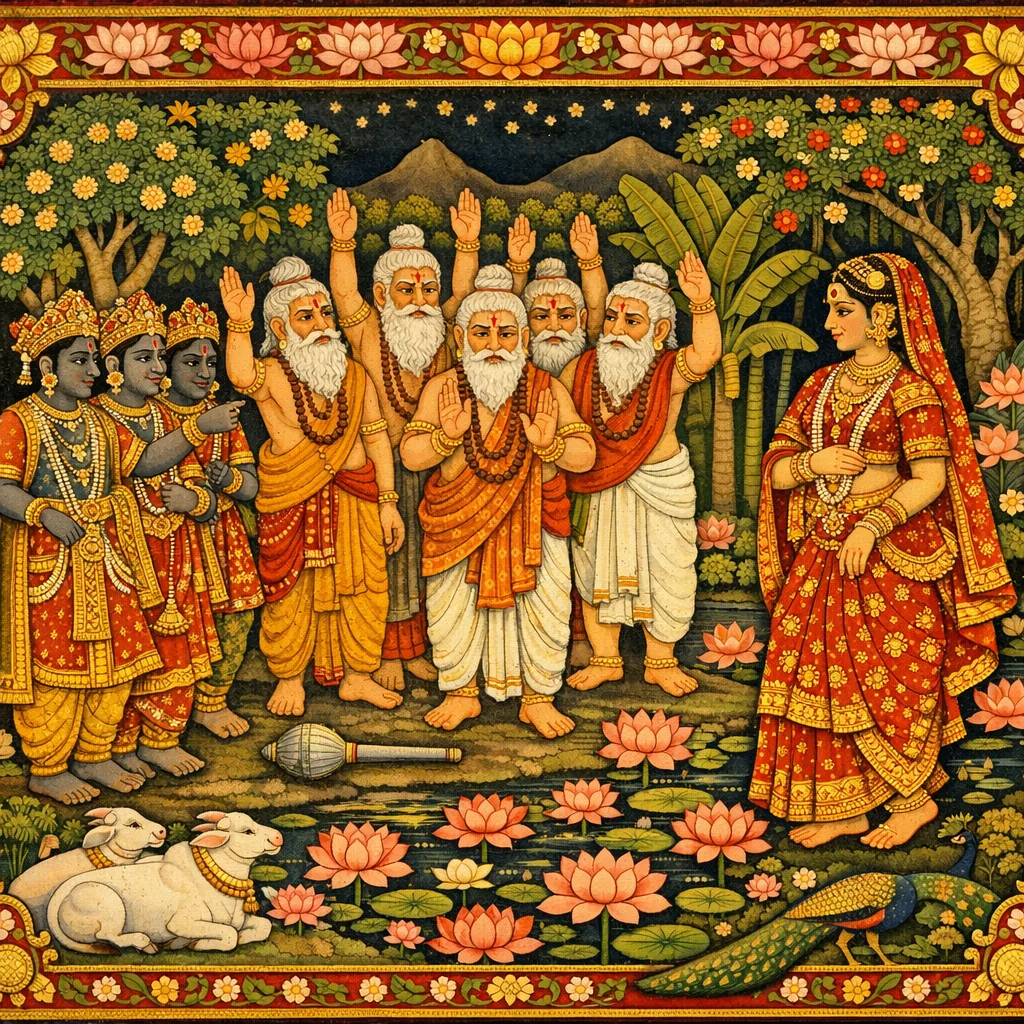
Śukadeva tells Parīkṣit that Śrī Kṛṣṇa first relieved the earth’s burden by arranging the Kurukṣetra war through the Pāṇḍavas, then turned to the remaining “burden”: the extraordinarily powerful Yādavas themselves. Knowing no outside force could defeat them, the Lord resolves to kindle an internal quarrel—like bamboo igniting by friction—and uses a brāhmaṇa curse as the pretext for the dynasty’s withdrawal. Parīkṣit asks how the brāhmaṇa-respecting Vṛṣṇis could be cursed, and what the curse was. Śukadeva recounts how great sages visited Vasudeva’s sacrifices and later came to Piṇḍāraka, where Yadu youths mocked them by disguising Sāmba as a pregnant woman. Enraged, the sages cursed that an iron club would be “born” to destroy the line. The club appeared, was reported to Ugrasena, ground up and thrown into the sea; reeds grew from the filings, and the remaining iron became an arrowhead for the hunter Jarā. Though Kṛṣṇa knew all and could stop it, He sanctioned it as the working of Time, setting the stage for the Yādavas’ self-destruction and the Lord’s departure.
Shlokas
Verse 1
श्रीशुक उवाच कृत्वा दैत्यवधं कृष्ण: सरामो यदुभिर्वृत: । भुवोऽवतारयद् भारं जविष्ठं जनयन् कलिम् ॥ १ ॥
Śrī Śukadeva said: Śrī Kṛṣṇa, accompanied by Balarāma and surrounded by the Yadus, carried out the slaying of demons. Then, to relieve the earth of her burden, He swiftly arranged the great conflict that would give rise to Kali.
Verse 2
ये कोपिता: सुबहु पाण्डुसुता: सपत्नै- र्दुर्द्यूतहेलनकचग्रहणादिभिस्तान् । कृत्वा निमित्तमितरेतरत: समेतान् हत्वा नृपान् निरहरत् क्षितिभारमीश: ॥ २ ॥
Enraged by their enemies’ many offenses—cheating at dice, harsh insults, the seizing of Draupadī’s hair, and other cruel acts—the sons of Pāṇḍu rose in wrath. The Supreme Lord made the Pāṇḍavas His immediate instrument: on the pretext of the Kurukṣetra war He gathered the kings with their armies on opposing sides and, through the agency of battle, destroyed them, thus relieving the earth of her burden.
Verse 3
भूभारराजपृतना यदुभिर्निरस्य गुप्तै: स्वबाहुभिरचिन्तयदप्रमेय: । मन्येऽवनेर्ननु गतोऽप्यगतं हि भारं यद् यादवं कुलमहो अविषह्यमास्ते ॥ ३ ॥
The immeasurable Lord used the Yadu dynasty—protected by His own arms—to drive away the kings and their armies who burdened the earth. Then He reflected: “Though some may say the earth’s burden is gone, in My view it is not yet gone, for the Yādava clan itself remains, and its power is unbearable for the earth.”
Verse 4
नैवान्यत: परिभवोऽस्य भवेत् कथञ्चिन् मत्संश्रयस्य विभवोन्नहनस्य नित्यम् । अन्त:कलिं यदुकुलस्य विधाय वेणु- स्तम्बस्य वह्निमिव शान्तिमुपैमि धाम ॥ ४ ॥
Lord Kṛṣṇa thought: “No external power could ever defeat this Yadu dynasty, whose members are always surrendered to Me and unrestrained in opulence. Therefore I shall kindle quarrel within the clan; like fire born from the friction of bamboo in a grove, it will consume them and bring quiet. Then I will fulfill My true purpose and return to My eternal abode.”
Verse 5
एवं व्यवसितो राजन् सत्यसङ्कल्प ईश्वर: । शापव्याजेन विप्राणां सञ्जह्रे स्वकुलं विभु: ॥ ५ ॥
O King Parīkṣit, having thus resolved, the almighty Lord—whose every intention unfailingly comes to pass—withdrew His own family on the pretext of a curse spoken by an assembly of brāhmaṇas.
Verse 6
स्वमूर्त्या लोकलावण्यनिर्मुक्त्या लोचनं नृणाम् । गीर्भिस्ता: स्मरतां चित्तं पदैस्तानीक्षतां क्रिया: ॥ ६ ॥ आच्छिद्य कीर्तिं सुश्लोकां वितत्य ह्यञ्जसा नु कौ । तमोऽनया तरिष्यन्तीत्यगात् स्वं पदमीश्वर: ॥ ७ ॥
Kṛṣṇa, the Supreme Personality of Godhead, is the reservoir of all beauty; His personal form was so enchanting that it stole the eyes of all people from every other object, which then seemed bereft of charm before Him. His words drew the minds of those who remembered them, and by seeing the marks of His footsteps people longed to follow Him, offering their bodily acts in the Lord’s service. Thus He easily spread His spotless fame, sung in the most essential and sublime Vedic verses, and He considered that by hearing and chanting these glories, souls born in future ages would cross beyond the darkness of ignorance. Content with this arrangement, the Lord departed for His desired destination—His eternal abode.
Verse 7
स्वमूर्त्या लोकलावण्यनिर्मुक्त्या लोचनं नृणाम् । गीर्भिस्ता: स्मरतां चित्तं पदैस्तानीक्षतां क्रिया: ॥ ६ ॥ आच्छिद्य कीर्तिं सुश्लोकां वितत्य ह्यञ्जसा नु कौ । तमोऽनया तरिष्यन्तीत्यगात् स्वं पदमीश्वर: ॥ ७ ॥
Lord Śrī Kṛṣṇa, the Supreme Personality of Godhead, is the very reservoir of all beauty. His divine form steals the eyes of all, making everything else seem bereft of charm beside Him. His words draw the hearts of those who remember them, and the sight of His footprints inspires people to follow Him and offer their actions in devoted service. Thus He effortlessly spread His spotless fame, sung throughout the world in the most essential Vedic verses. Knowing that future souls would cross the darkness of ignorance simply by hearing and chanting these glories, the Lord, satisfied, departed for His own desired abode.
Verse 8
श्रीराजोवाच ब्रह्मण्यानां वदान्यानां नित्यं वृद्धोपसेविनाम् । विप्रशाप: कथमभूद् वृष्णीनां कृष्णचेतसाम् ॥ ८ ॥
King Parīkṣit asked: How could the brāhmaṇas curse the Vṛṣṇis, who always honored the brāhmaṇas, were generous, constantly served elders and exalted souls, and whose minds were ever absorbed in Lord Kṛṣṇa?
Verse 9
यन्निमित्त: स वै शापो यादृशो द्विजसत्तम । कथमेकात्मनां भेद एतत् सर्वं वदस्व मे ॥ ९ ॥
O best of the twice-born, what was the cause of that curse, and what did it entail? And how could discord arise among the Yadus, who all shared a single aim? Please tell me everything.
Verse 10
श्रीबादरायणिरुवाच बिभ्रद् वपु: सकलसुन्दरसन्निवेशं कर्माचरन् भुवि सुमङ्गलमाप्तकाम: । आस्थाय धाम रममाण उदारकीर्ति: संहर्तुमैच्छत कुलं स्थितकृत्यशेष: ॥ १० ॥
Śukadeva Gosvāmī said: Bearing a form in which all beauty is perfectly arranged, the Lord performed supremely auspicious deeds upon the earth, though in truth He is āptakāma, fully satisfied without endeavor. Dwelling in His own abode and enjoying, the Lord of magnanimous fame now desired to annihilate His dynasty, for a small remnant of duty still remained to be completed.
Verse 11
कर्माणि पुण्यनिवहानि सुमङ्गलानि गायज्जगत्कलिमलापहराणि कृत्वा । कालात्मना निवसता यदुदेवगेहे पिण्डारकं समगमन् मुनयो निसृष्टा: ॥ ११ ॥ विश्वामित्रोऽसित: कण्वो दुर्वासा भृगुरङ्गिरा: । कश्यपो वामदेवोऽत्रिर्वसिष्ठो नारदादय: ॥ १२ ॥
The sages performed, in the home of Vasudeva, chief of the Yadus, sacrificial rites that bestow abundant merit and supreme auspiciousness, and that, when merely sung and recounted, remove the sins of Kali-yuga for the whole world. There the Lord Śrī Kṛṣṇa was residing as Time personified. When the ceremonies were completed and the Lord respectfully sent the sages on their way, they departed for the holy place called Piṇḍāraka. Among them were Viśvāmitra, Asita, Kaṇva, Durvāsā, Bhṛgu, Aṅgirā, Kaśyapa, Vāmadeva, Atri, Vasiṣṭha, along with Nārada and others.
Verse 12
कर्माणि पुण्यनिवहानि सुमङ्गलानि गायज्जगत्कलिमलापहराणि कृत्वा । कालात्मना निवसता यदुदेवगेहे पिण्डारकं समगमन् मुनयो निसृष्टा: ॥ ११ ॥ विश्वामित्रोऽसित: कण्वो दुर्वासा भृगुरङ्गिरा: । कश्यपो वामदेवोऽत्रिर्वसिष्ठो नारदादय: ॥ १२ ॥
The sages Viśvāmitra, Asita, Kaṇva, Durvāsā, Bhṛgu, Aṅgirā, Kaśyapa, Vāmadeva, Atri and Vasiṣṭha, together with Nārada and others, performed supremely auspicious rites that bestow abundant piety, and whose very recitation removes the sins of Kali-yuga from the world. They duly completed these ceremonies in the home of Vasudeva, chief of the Yadus, where Śrī Kṛṣṇa dwelt as Time personified; and, respectfully sent off by Śrī Kṛṣṇa at the conclusion, the sages went to the holy place called Piṇḍāraka.
Verse 13
क्रीडन्तस्तानुपव्रज्य कुमारा यदुनन्दना: । उपसङ्गृह्य पप्रच्छुरविनीता विनीतवत् ॥ १३ ॥ ते वेषयित्वा स्त्रीवेषै: साम्बं जाम्बवतीसुतम् । एषा पृच्छति वो विप्रा अन्तर्वत्न्यसितेक्षणा ॥ १४ ॥ प्रष्टुं विलज्जती साक्षात् प्रब्रूतामोघदर्शना: । प्रसोष्यन्ती पुत्रकामा किंस्वित् सञ्जनयिष्यति ॥ १५ ॥
The young boys of the Yadu line, sporting about, approached the assembly of sages. Dressing Sāmba, the son of Jāmbavatī, in a woman’s attire, they seized the sages’ feet and, though insolent, feigned humility as they said: “O learned brāhmaṇas, this black-eyed pregnant woman wishes to ask you something, but she is too shy to speak herself. O great seers of unfailing vision, she is about to give birth and longs for a son—tell us, will she bear a boy or a girl?”
Verse 14
क्रीडन्तस्तानुपव्रज्य कुमारा यदुनन्दना: । उपसङ्गृह्य पप्रच्छुरविनीता विनीतवत् ॥ १३ ॥ ते वेषयित्वा स्त्रीवेषै: साम्बं जाम्बवतीसुतम् । एषा पृच्छति वो विप्रा अन्तर्वत्न्यसितेक्षणा ॥ १४ ॥ प्रष्टुं विलज्जती साक्षात् प्रब्रूतामोघदर्शना: । प्रसोष्यन्ती पुत्रकामा किंस्वित् सञ्जनयिष्यति ॥ १५ ॥
The young boys of the Yadu line, sporting about, approached the assembly of sages. Dressing Sāmba, the son of Jāmbavatī, in a woman’s attire, they seized the sages’ feet and, though insolent, feigned humility as they said: “O learned brāhmaṇas, this black-eyed pregnant woman wishes to ask you something, but she is too shy to speak herself. O great seers of unfailing vision, she is about to give birth and longs for a son—tell us, will she bear a boy or a girl?”
Verse 15
क्रीडन्तस्तानुपव्रज्य कुमारा यदुनन्दना: । उपसङ्गृह्य पप्रच्छुरविनीता विनीतवत् ॥ १३ ॥ ते वेषयित्वा स्त्रीवेषै: साम्बं जाम्बवतीसुतम् । एषा पृच्छति वो विप्रा अन्तर्वत्न्यसितेक्षणा ॥ १४ ॥ प्रष्टुं विलज्जती साक्षात् प्रब्रूतामोघदर्शना: । प्रसोष्यन्ती पुत्रकामा किंस्वित् सञ्जनयिष्यति ॥ १५ ॥
The young boys of the Yadu line, sporting about, approached the assembly of sages. Dressing Sāmba, the son of Jāmbavatī, in a woman’s attire, they seized the sages’ feet and, though insolent, feigned humility as they said: “O learned brāhmaṇas, this black-eyed pregnant woman wishes to ask you something, but she is too shy to speak herself. O great seers of unfailing vision, she is about to give birth and longs for a son—tell us, will she bear a boy or a girl?”
Verse 16
एवं प्रलब्धा मुनयस्तानूचु: कुपिता नृप । जनयिष्यति वो मन्दा मुषलं कुलनाशनम् ॥ १६ ॥
Thus mocked by deceit, the sages became angry, O King, and told the boys: “Fools! She will bear for you a muṣala—an iron club—that will destroy your entire dynasty.”
Verse 17
तच्छ्रुत्वा तेऽतिसन्त्रस्ता विमुच्य सहसोदरम् । साम्बस्य ददृशुस्तस्मिन् मुषलं खल्वयस्मयम् ॥ १७ ॥
Hearing the sages’ curse, the terrified youths quickly uncovered Sāmba’s belly, and there they indeed saw an iron club.
Verse 18
किं कृतं मन्दभाग्यैर्न: किं वदिष्यन्ति नो जना: । इति विह्वलिता गेहानादाय मुषलं ययु: ॥ १८ ॥
The Yadu youths cried, “Alas, what have we done? How unfortunate we are! What will our people say of us?” Thus shaken, they returned home, taking the club with them.
Verse 19
तच्चोपनीय सदसि परिम्लानमुखश्रिय: । राज्ञ आवेदयांचक्रु: सर्वयादवसन्निधौ ॥ १९ ॥
Their faces drained of luster, they brought the club into the royal assembly and, before all the Yādavas, reported to King Ugrasena what had occurred.
Verse 20
श्रुत्वामोघं विप्रशापं दृष्ट्वा च मुषलं नृप । विस्मिता भयसन्त्रस्ता बभूवुर्द्वारकौकस: ॥ २० ॥
O King Parīkṣit, when the people of Dvārakā heard the brāhmaṇas’ unfailing curse and saw the club, they were astonished and shaken with fear.
Verse 21
तच्चूर्णयित्वा मुषलं यदुराज: स आहुक: । समुद्रसलिले प्रास्यल्लोहं चास्यावशेषितम् ॥ २१ ॥
Having the club ground to bits, King Āhuka (Ugrasena) of the Yadus personally cast the fragments, along with the remaining lump of iron, into the ocean waters.
Verse 22
कश्चिन्मत्स्योऽग्रसील्लोहं चूर्णानि तरलैस्तत: । उह्यमानानि वेलायां लग्नान्यासन् किलैरका: ॥ २२ ॥
A certain fish swallowed the lump of iron and its fragments. Later the waves carried those bits to the shore, where they lodged and grew into tall, sharp eraka canes.
Verse 23
मत्स्यो गृहीतो मत्स्यघ्नैर्जालेनान्यै: सहार्णवे । तस्योदरगतं लोहं स शल्ये लुब्धकोऽकरोत् ॥ २३ ॥
That fish was caught in the ocean along with others in a fishermen’s net. The iron lump from its belly was taken by the hunter Jarā and set as the arrowhead upon his shaft.
Verse 24
भगवाञ्ज्ञातसर्वार्थ ईश्वरोऽपि तदन्यथा । कर्तुं नैच्छद् विप्रशापं कालरूप्यन्वमोदत ॥ २४ ॥
The Supreme Lord, knowing the full import of all that had occurred, though able to reverse the brāhmaṇas’ curse, did not wish to do so. Rather, as Kāla—Time Himself—He gladly sanctioned the unfolding events.
Frequently Asked Questions
Śukadeva presents it as Kṛṣṇa’s deliberate saṅkalpa: after Kurukṣetra, the Yādavas’ unmatched power still constituted a ‘burden’ on earth. Since no external enemy could overcome devotees protected by the Lord, He sanctioned an internal dissolution, using the brāhmaṇa curse as a dharmic pretext. As Kāla, He does not become subject to fate; rather, fate becomes the narrative instrument of His withdrawal and the completion of His earthly mission.
The episode distinguishes the dynasty’s overall virtue from a specific adharmic act: the young Yadus’ deceitful ridicule of exalted ṛṣis at Piṇḍāraka. In Purāṇic ethics, intentional mockery of realized brāhmaṇas is a severe aparādha, and the sages’ curse manifests the moral law that sacred authority (brahma-tejas) protects the sanctity of dharma—while simultaneously serving the Lord’s higher purpose.