Adhyaya 9
Brahmā’s Tapasya, the Vision of Vaikuṇṭha, and the Lord’s Seed Instructions (Catuḥ-śloki)
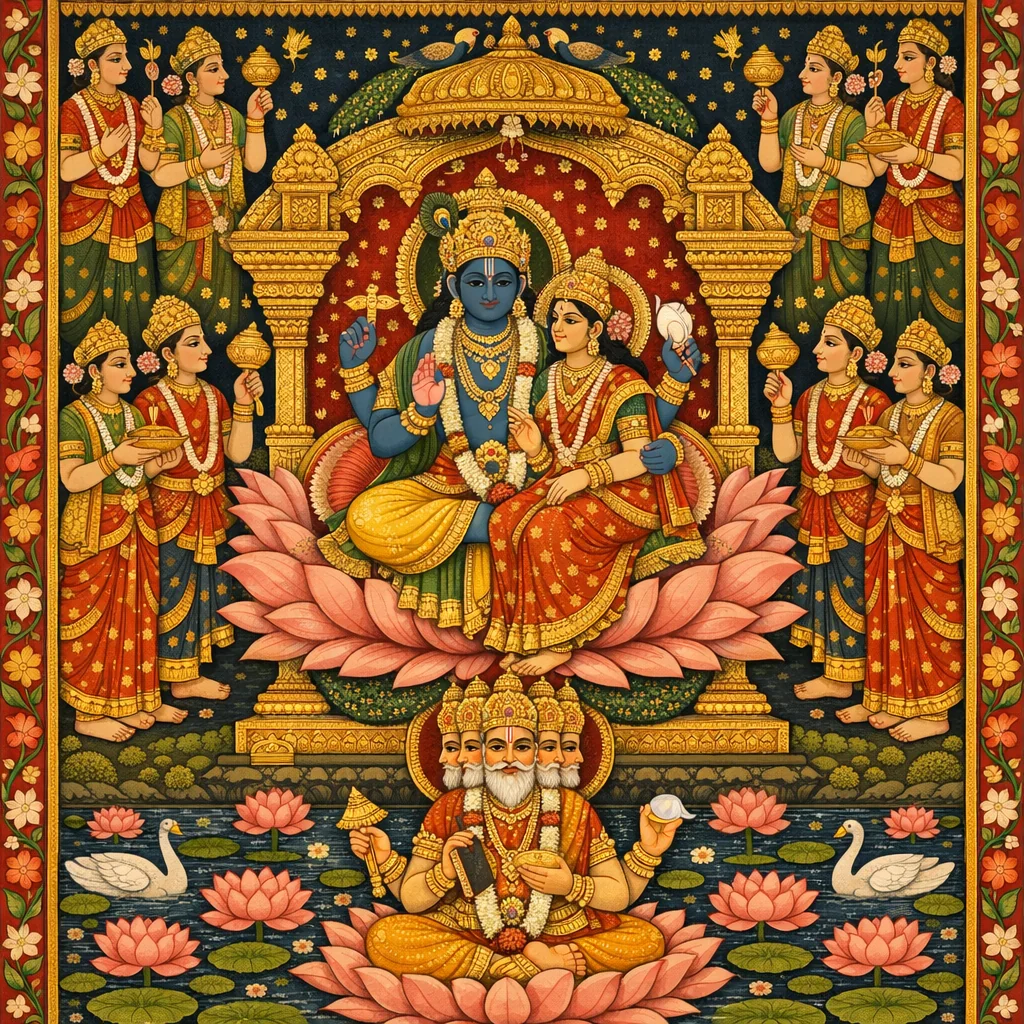
Continuing the Canto’s shift from inquiry to realized knowledge, Śukadeva explains that the soul’s identification with the body is māyā—like a dream—born of the twin delusions “I” and “mine.” The scene then turns to Brahmā at creation’s dawn: unable to find the source of his lotus seat or the means of creation, he hears the divine command “tapa” and performs long tapasya. Pleased, the Lord reveals Vaikuṇṭha—beyond time and the guṇas—describing its residents, splendor, and Lakṣmī’s service, drawing Brahmā into ecstatic surrender. The Lord empowers Brahmā for secondary creation (visarga) and imparts confidential truth to be realized through bhakti: Bhagavān alone exists before, during, and after creation; what is unrelated to Him is māyā; and He is both within all and beyond all. After the Lord disappears, Brahmā begins creation and transmits the Bhāgavatam through disciplic succession—Brahmā to Nārada to Vyāsa—setting the stage for Śukadeva to expand these foundational verses while answering Parīkṣit’s cosmological questions.
Shlokas
Verse 1
श्रीशुक उवाच आत्ममायामृते राजन् परस्यानुभवात्मन: । न घटेतार्थसम्बन्ध: स्वप्नद्रष्टुरिवाञ्जसा ॥ १ ॥
Śrī Śukadeva Gosvāmī said: O King, unless one is influenced by the Supreme Lord’s own energy (ātma-māyā), the relationship between the pure soul in pure consciousness and the material body has no real meaning; it is like a dreamer seeing his own body at work.
Verse 2
बहुरूप इवाभाति मायया बहुरूपया । रममाणो गुणेष्वस्या ममाहमिति मन्यते ॥ २ ॥
By the Lord’s external māyā the jīva seems to appear in many forms. Delighting in the guṇas of material nature, the bound soul mistakes life as “I” and “mine”.
Verse 3
यर्हि वाव महिम्नि स्वे परस्मिन् कालमाययो: । रमेत गतसम्मोहस्त्यक्त्वोदास्ते तदोभयम् ॥ ३ ॥
When the jīva becomes established in his own constitutional glory and delights in transcendence beyond time and māyā, his delusion is gone. He abandons the two misconceptions—“I” and “mine”—and fully shines as the pure self.
Verse 4
आत्मतत्त्वविशुद्ध्यर्थं यदाह भगवानृतम् । ब्रह्मणे दर्शयन् रूपमव्यलीकव्रतादृत: ॥ ४ ॥
O King, pleased with Brahmā’s undeceptive austerity in bhakti-yoga, the Bhagavān revealed to him His eternal, transcendental form. This is the supreme aim for purifying the conditioned soul’s realization of the Self.
Verse 5
स आदिदेवो जगतां परो गुरु: स्वधिष्ण्यमास्थाय सिसृक्षयैक्षत । तां नाध्यगच्छद् दृशमत्र सम्मतां प्रपञ्चनिर्माणविधिर्यया भवेत् ॥ ५ ॥
Brahmā, the first spiritual master and supreme within the universe, sat upon his lotus seat and looked on with the desire to create. Yet he could not trace the source of that seat, nor grasp the proper direction and method for fashioning the cosmos.
Verse 6
स चिन्तयन् द्वयक्षरमेकदाम्भ- स्युपाशृणोद् द्विर्गदितं वचो विभु: । स्पर्शेषु यत्षोडशमेकविंशं निष्किञ्चनानां नृप यद् धनं विदु: ॥ ६ ॥
O King, as Brahmā pondered, he heard nearby in the waters a two-syllabled utterance spoken twice. One syllable was taken from the sixteenth and the other from the twenty-first of the sparśa letters; joined, they became “tapa” (austerity), the wealth of the renounced.
Verse 7
निशम्य तद्वक्तृदिदृक्षया दिशो विलोक्य तत्रान्यदपश्यमान: । स्वधिष्ण्यमास्थाय विमृश्य तद्धितं तपस्युपादिष्ट इवादधे मन: ॥ ७ ॥
Hearing that sound, Brahmā searched for the speaker, looking in all directions. But finding no one besides himself, he sat firmly upon his lotus seat and, as instructed, fixed his mind upon the performance of sacred penance.
Verse 8
दिव्यं सहस्राब्दममोघदर्शनो जितानिलात्मा विजितोभयेन्द्रिय: । अतप्यत स्माखिललोकतापनं तपस्तपीयांस्तपतां समाहित: ॥ ८ ॥
Brahmā, whose vision is unfailing, performed divine austerity for one thousand years by the reckoning of the devas. Receiving the transcendental sound from the sky as sacred, he conquered mind and senses, and his tapas became a lesson for all beings; thus he is known as the greatest of ascetics.
Verse 9
तस्मै स्वलोकं भगवान् सभाजित: सन्दर्शयामास परं न यत्परम् । व्यपेतसंक्लेशविमोहसाध्वसं स्वदृष्टवद्भिर्पुरुषैरभिष्टुतम् ॥ ९ ॥
Greatly pleased with Brahmā’s penance, the Personality of Godhead revealed to him His own supreme abode, Vaikuṇṭha, beyond all other worlds. That transcendental dhāma is free from misery, delusion, and fear, and is worshiped and praised by self-realized souls.
Verse 10
प्रवर्तते यत्र रजस्तमस्तयो: सत्त्वं च मिश्रं न च कालविक्रम: । न यत्र माया किमुतापरे हरे- रनुव्रता यत्र सुरासुरार्चिता: ॥ १० ॥
In that abode, passion and ignorance do not prevail, and even goodness is unmixed and pure. Time holds no dominion there—what then to speak of māyā, the external illusory energy, which cannot enter. There, both devas and asuras, without discrimination, honor the devoted followers of Hari.
Verse 11
श्यामावदाता: शतपत्रलोचना: पिशङ्गवस्त्रा: सुरुच: सुपेशस: । सर्वे चतुर्बाहव उन्मिषन्मणि- प्रवेकनिष्काभरणा: सुवर्चस: ॥ ११ ॥
The residents of Vaikuṇṭha shine with a sky-blue radiance. Their eyes are like lotus petals, their garments are yellowish, and their forms are graceful and attractive. All have four arms, are adorned with pearl necklaces and gem-studded medallions, and appear effulgent.
Verse 12
प्रवालवैदूर्यमृणालवर्चस: । परिस्फुरत्कुण्डलमौलिमालिन: ॥ १२ ॥
Some shone in complexion like coral, vaidūrya gems, and lotus fiber; garlands adorned their heads, and sparkling earrings graced their ears.
Verse 13
भ्राजिष्णुभिर्य: परितो विराजते लसद्विमानावलिभिर्महात्मनाम् । विद्योतमान: प्रमदोत्तमाद्युभि: सविद्युदभ्रावलिभिर्यथा नभ: ॥ १३ ॥
The Vaikuṇṭha planets were encircled by rows of radiant vimānas, belonging to the great mahātmā devotees of the Lord. The celestial ladies, luminous like lightning, made the whole scene appear like the sky adorned with clouds and flashes of light.
Verse 14
श्रीर्यत्र रूपिण्युरुगायपादयो: करोति मानं बहुधा विभूतिभि: । प्रेङ्खं श्रिता या कुसुमाकरानुगै- र्विगीयमाना प्रियकर्म गायती ॥ १४ ॥
There, the goddess of fortune, Śrī Lakṣmī in her transcendental form, lovingly serves the lotus feet of the Lord, the widely glorified One, honoring them with many opulences. Stirred by the black bees that follow spring, she sits upon a swing and, with her constant companions, sings the glories of the Lord’s beloved deeds.
Verse 15
ददर्श तत्राखिलसात्वतां पतिं श्रिय: पतिं यज्ञपतिं जगत्पतिम् । सुनन्दनन्दप्रबलार्हणादिभि: स्वपार्षदाग्रै: परिसेवितं विभुम् ॥ १५ ॥
In the Vaikuṇṭha planets, Lord Brahmā beheld the Supreme Personality of Godhead—the Lord of the entire sātvata community of devotees, the Lord of Śrī (Lakṣmī), the Lord of all sacrifices, and the Lord of the universe—served by His foremost associates such as Nanda, Sunanda, Prabala, and Arhaṇa.
Verse 16
भृत्यप्रसादाभिमुखं दृगासवं प्रसन्नहासारुणलोचनाननम् । किरीटिनं कुण्डलिनं चतुर्भुजं पीतांशुकं वक्षसि लक्षितं श्रिया ॥ १६ ॥
The Supreme Personality of Godhead appeared favorably inclined toward His loving servants; His very glance was intoxicating and enchanting, and His smiling face and eyes shone with a captivating reddish hue. He wore a crown and earrings, had four arms, was clad in yellow garments, and His chest bore the marks of Śrī (Lakṣmī).
Verse 17
अध्यर्हणीयासनमास्थितं परं वृतं चतु:षोडशपञ्चशक्तिभि: । युक्तं भगै: स्वैरितरत्र चाध्रुवै: स्व एव धामन् रममाणमीश्वरम् ॥ १७ ॥
The Supreme Lord sat upon His most worshipful throne, surrounded by the energies of the four, the sixteen, the five, and the six, along with other lesser, temporary potencies; yet He alone was the true Paramēśvara, delighting in His own dhāma.
Verse 18
तद्दर्शनाह्लादपरिप्लुतान्तरो हृष्यत्तनु: प्रेमभराश्रुलोचन: । ननाम पादाम्बुजमस्य विश्वसृग् यत् पारमहंस्येन पथाधिगम्यते ॥ १८ ॥
Beholding the Personality of Godhead in His fullness, Brahmā’s heart was flooded with bliss; his body thrilled in devotional ecstasy and his eyes brimmed with tears of love. The creator of the universe bowed to the Lord’s lotus feet—this is the path of the paramahaṁsa to the highest perfection.
Verse 19
तं प्रीयमाणं समुपस्थितं कविं प्रजाविसर्गे निजशासनार्हणम् । बभाष ईषत्स्मितशोचिषा गिरा प्रिय: प्रियं प्रीतमना: करे स्पृशन् ॥ १९ ॥
Seeing Brahmā before Him—the sage-poet, fit to generate living beings and to be guided by His command—the Lord was greatly pleased. Touching Brahmā’s hand in affection, and smiling slightly, He addressed him in sweet, radiant words.
Verse 20
श्रीभगवानुवाच त्वयाहं तोषित: सम्यग् वेदगर्भ सिसृक्षया । चिरं भृतेन तपसा दुस्तोष: कूटयोगिनाम् ॥ २० ॥
The Blessed Lord said: O Brahmā, womb of the Vedas, you have truly pleased Me by your long, sustained penance undertaken with the desire to create; but I am not easily satisfied by pretended mystics.
Verse 21
वरं वरय भद्रं ते वरेशं माभिवाञ्छितम् । ब्रह्मञ्छ्रेय:परिश्राम: पुंसां मद्दर्शनावधि: ॥ २१ ॥
May auspiciousness be yours, O Brahmā. Ask of Me—the Lord of all benedictions—whatever gift you desire. Know that the supreme blessing, the final fruit of all austerity and endeavor, is to realize Me and behold Me.
Verse 22
मनीषितानुभावोऽयं मम लोकावलोकनम् । यदुपश्रुत्य रहसि चकर्थ परमं तप: ॥ २२ ॥
The highest perfection and finest spiritual ingenuity is to behold My abodes personally. This became possible because, with a submissive heart, you performed severe penance in secret according to My order.
Verse 23
प्रत्यादिष्टं मया तत्र त्वयि कर्मविमोहिते । तपो मे हृदयं साक्षादात्माहं तपसोऽनघ ॥ २३ ॥
O sinless Brahmā, when you were bewildered in your duty, it was I who first commanded you to perform penance. Penance is My very heart and soul; therefore penance and I are nondifferent.
Verse 24
सृजामि तपसैवेदं ग्रसामि तपसा पुन: । बिभर्मि तपसा विश्वं वीर्यं मे दुश्चरं तप: ॥ २४ ॥
By that very penance I create this cosmos, by the same power I sustain it, and by the same power I withdraw it again. Therefore My potency is penance alone.
Verse 25
ब्रह्मोवाच भगवन् सर्वभूतानामध्यक्षोऽवस्थितो गुहाम् । वेद ह्यप्रतिरुद्धेन प्रज्ञानेन चिकीर्षितम् ॥ २५ ॥
Lord Brahmā said: O Bhagavān, You dwell within the heart-cave of every living being as the supreme director. Thus, by Your superior and unobstructed intelligence, You know all endeavors without hindrance.
Verse 26
तथापि नाथमानस्य नाथ नाथय नाथितम् । परावरे यथा रूपे जानीयां ते त्वरूपिण: ॥ २६ ॥
Even so, O Lord, please fulfill the longing of my mind. Kindly explain: though You abide in Your transcendental form and are truly without any mundane form, how do You nevertheless assume a form within this world?
Verse 27
यथात्ममायायोगेन नानाशक्त्युपबृंहितम् । विलुम्पन् विसृजन् गृह्णन् बिभ्रदात्मानमात्मना ॥ २७ ॥
Please tell me how You, by the yoga of Your own internal māyā, expand manifold energies for annihilation, creation, acceptance, and maintenance—acting by Your own Self.
Verse 28
क्रीडस्यमोघसङ्कल्प ऊर्णनाभिर्यथोर्णुते । तथा तद्विषयां धेहि मनीषां मयि माधव ॥ २८ ॥
O Mādhava, Your resolve is never futile. You sport like a spider that spins its web by its own energy; therefore, place within me clear philosophical understanding of those energies.
Verse 29
भगवच्छिक्षितमहं करवाणि ह्यतन्द्रित: । नेहमान: प्रजासर्गं बध्येयं यदनुग्रहात् ॥ २९ ॥
Please instruct me so that, taught by the Bhagavān, I may act without negligence; and by Your grace, though generating living beings, I may not become bound by those activities.
Verse 30
यावत् सखा सख्युरिवेश ते कृत: प्रजाविसर्गे विभजामि भो जनम् । अविक्लवस्ते परिकर्मणि स्थितो मा मे समुन्नद्धमदोऽजमानिन: ॥ ३० ॥
O Lord, O Unborn One, You have clasped my hand like a friend to a friend, as though equal. I shall engage in creating the various kinds of living beings, remaining fixed in Your service; let me be unperturbed, and may this never give rise to pride as if I were the Supreme.
Verse 31
श्रीभगवानुवाच ज्ञानं परमगुह्यं मे यद् विज्ञानसमन्वितम् । सरहस्यं तदङ्गं च गृहाण गदितं मया ॥ ३१ ॥
The Supreme Personality of Godhead said: This most confidential knowledge of Me, joined with realized understanding (vijñāna), along with its sacred mystery and the necessary elements of the path, I now speak. Receive it with care.
Verse 32
यावानहं यथाभावो यद्रूपगुणकर्मक: । तथैव तत्त्वविज्ञानमस्तु ते मदनुग्रहात् ॥ ३२ ॥
As I truly am—My eternal form, My transcendental existence, My appearance, qualities, and lilas—may that factual realization awaken within you by My causeless mercy.
Verse 33
अहमेवासमेवाग्रे नान्यद् यत् सदसत् परम् । पश्चादहं यदेतच्च योऽवशिष्येत सोऽस्म्यहम् ॥ ३३ ॥
O Brahmā, before creation only I existed; nothing else—neither sat nor asat, nor even material nature as the cause. What you see now is also I, and after annihilation what remains will also be I alone.
Verse 34
ऋतेऽर्थं यत् प्रतीयेत न प्रतीयेत चात्मनि । तद्विद्यादात्मनो मायां यथाभासो यथा तम: ॥ ३४ ॥
O Brahmā, whatever seems valuable yet has no relation to Me has no reality. Know it as My māyā—like a reflection appearing in darkness.
Verse 35
यथा महान्ति भूतानि भूतेषूच्चावचेष्वनु । प्रविष्टान्यप्रविष्टानि तथा तेषु न तेष्वहम् ॥ ३५ ॥
O Brahmā, just as the great elements enter all beings, high and low, and yet do not enter, so I exist within everything created and at the same time remain outside of everything.
Verse 36
एतावदेव जिज्ञास्यं तत्त्वजिज्ञासुनात्मन: । अन्वयव्यतिरेकाभ्यां यत् स्यात् सर्वत्र सर्वदा ॥ ३६ ॥
One who seeks the Supreme Absolute Truth should inquire up to this: that which exists everywhere and always, understood by both direct presence and indirect exclusion (anvaya and vyatireka).
Verse 37
एतन्मतं समातिष्ठ परमेण समाधिना । भवान् कल्पविकल्पेषु न विमुह्यति कर्हिचित् ॥ ३७ ॥
O Brahmā, abide by this conclusion with the highest samādhi; in neither the partial nor the final devastation will pride ever bewilder you.
Verse 38
श्रीशुक उवाच सम्प्रदिश्यैवमजनो जनानां परमेष्ठिनम् । पश्यतस्तस्य तद् रूपमात्मनो न्यरुणद्धरि: ॥ ३८ ॥
Śukadeva said: Having thus instructed Brahmā, the leader of all beings, Hari revealed His transcendental form and then disappeared from his sight.
Verse 39
अन्तर्हितेन्द्रियार्थाय हरये विहिताञ्जलि: । सर्वभूतमयो विश्वं ससर्जेदं स पूर्ववत् ॥ ३९ ॥
When Hari—the transcendental delight of the devotees’ senses—disappeared, Brahmā, with folded hands, began to recreate the universe filled with living beings, just as before.
Verse 40
प्रजापतिर्धर्मपतिरेकदा नियमान् यमान् । भद्रं प्रजानामन्विच्छन्नातिष्ठत् स्वार्थकाम्यया ॥ ४० ॥
Thus, once, Brahmā—the progenitor of beings and father of dharma—seeking the welfare of all creatures, established himself in niyama and yama to fulfill his appointed purpose.
Verse 41
तं नारद: प्रियतमो रिक्थादानामनुव्रत: । शुश्रूषमाण: शीलेन प्रश्रयेण दमेन च ॥ ४१ ॥
Nārada, Brahmā’s dearest heir-son, ever eager to serve his father, strictly follows his father’s instructions through good conduct, humility, and control of the senses.
Verse 42
मायां विविदिषन् विष्णोर्मायेशस्य महामुनि: । महाभागवतो राजन् पितरं पर्यतोषयत् ॥ ४२ ॥
O King, the great sage Nārada, the foremost bhāgavata, desiring to know the māyā-energies of Viṣṇu, the Lord of all energies, greatly pleased his father, Brahmā.
Verse 43
तुष्टं निशाम्य पितरं लोकानां प्रपितामहम् । देवर्षि: परिपप्रच्छ भवान् यन्मानुपृच्छति ॥ ४३ ॥
Seeing his father Brahmā, the great-grandfather of all worlds, fully satisfied, the devarṣi Nārada inquired in detail into the very matters you ask, O King.
Verse 44
तस्मा इदं भागवतं पुराणं दशलक्षणम् । प्रोक्तं भगवता प्राह प्रीत: पुत्राय भूतकृत् ॥ ४४ ॥
Thereupon, this Bhāgavata Purāṇa, marked by ten characteristics and spoken by Bhagavān Himself, was joyfully related by Brahmā, the creator of beings, to his son Nārada.
Verse 45
नारद: प्राह मुनये सरस्वत्यास्तटे नृप । ध्यायते ब्रह्म परमं व्यासायामिततेजसे ॥ ४५ ॥
O King, in the line of succession Nārada taught Śrīmad-Bhāgavatam to the unlimitedly powerful Vyāsadeva, as he sat on the bank of the Sarasvatī, meditating in bhakti upon Bhagavān, the Supreme Person and Absolute Truth.
Verse 46
यदुताहं त्वया पृष्टो वैराजात् पुरुषादिदम् । यथासीत्तदुपाख्यास्ते प्रश्नानन्यांश्च कृत्स्नश: ॥ ४६ ॥
O King, your questions about how this universe became manifest from the Virāṭ-Puruṣa, and your other inquiries as well, I shall answer in full detail by explaining the four verses previously spoken.
Frequently Asked Questions
Brahmā’s perplexity shows that creative authority is not autonomous; it must be aligned with the Lord’s will. “Tapa” signifies disciplined absorption in devotional austerity that purifies intention, grants realization, and becomes the medium through which the Lord empowers visarga (secondary creation). The chapter explicitly equates this potency with the Lord’s own operative energy in creating, maintaining, and withdrawing the cosmos.
It establishes a categorical distinction between the spiritual realm and material cosmology. Vaikuṇṭha is not a refined material planet but a domain where kāla (time as decay/compulsion) and the guṇas cannot dominate; hence fear and misery rooted in temporality and ignorance do not arise. This supports the Bhāgavatam’s claim that liberation is positive engagement in the Lord’s service, not mere negation.
They are the foundational teachings summarized in SB 2.9.33–36: (1) Bhagavān alone exists before, during, and after creation; (2) anything appearing valuable without relation to Him is māyā; (3) the Lord is simultaneously within and outside all beings and elements; and (4) the seeker must search for the Absolute in all circumstances—directly and indirectly—up to this conclusion.
By teaching simultaneous immanence and transcendence: the universal elements ‘enter and do not enter’ the cosmos, and likewise the Lord pervades everything as inner controller while remaining beyond all. The world is real insofar as it is related to Him (sambandha); it becomes illusory when treated as independent of Him.
Brahmā taught Nārada, who taught Vyāsadeva, establishing guru-paramparā. This matters because the Bhāgavatam’s knowledge is presented as realized, devotional revelation (not speculation), safeguarded through disciplined succession and meditation in bhakti.