Adhyaya 8
Parīkṣit’s Comprehensive Inquiries and the Bhāgavata as Śabda-avatāra
Building on Skandha 2’s cosmological and devotional foundation, Mahārāja Parīkṣit presses Śukadeva Gosvāmī with sharper questions: how Nārada described the Lord’s transcendental qualities and to whom he spoke. He stresses the saving purpose of hearing—steady, serious śravaṇa of Śrīmad-Bhāgavatam makes Kṛṣṇa manifest in the heart and washes away lust, anger, and craving, like autumn rains clearing muddy pools. Parīkṣit then lays out a systematic set of inquiries that maps the Bhāgavata’s coming themes: the jīva’s embodiment and causality; the Lord’s divine body versus conditioned bodies; Brahmā’s lotus-birth and vision of the Lord; Paramātmā in the heart untouched by māyā; the true placement of planetary systems within the virāṭ-puruṣa; measures of time, lifespans, yugas, and manvantaras; transmigration driven by karma and guṇa; cosmic geography; varṇāśrama traits; tattvas, the bhakti process, and yogic perfections; Vedic literature and subsidiary rites; creation, maintenance, dissolution, and the Lord’s witnessing role through internal and external potencies. Sūta notes Śukadeva’s delight and readiness to answer, introducing that this science was first spoken by the Lord to Brahmā, bridging into the next exposition.
Shlokas
Verse 1
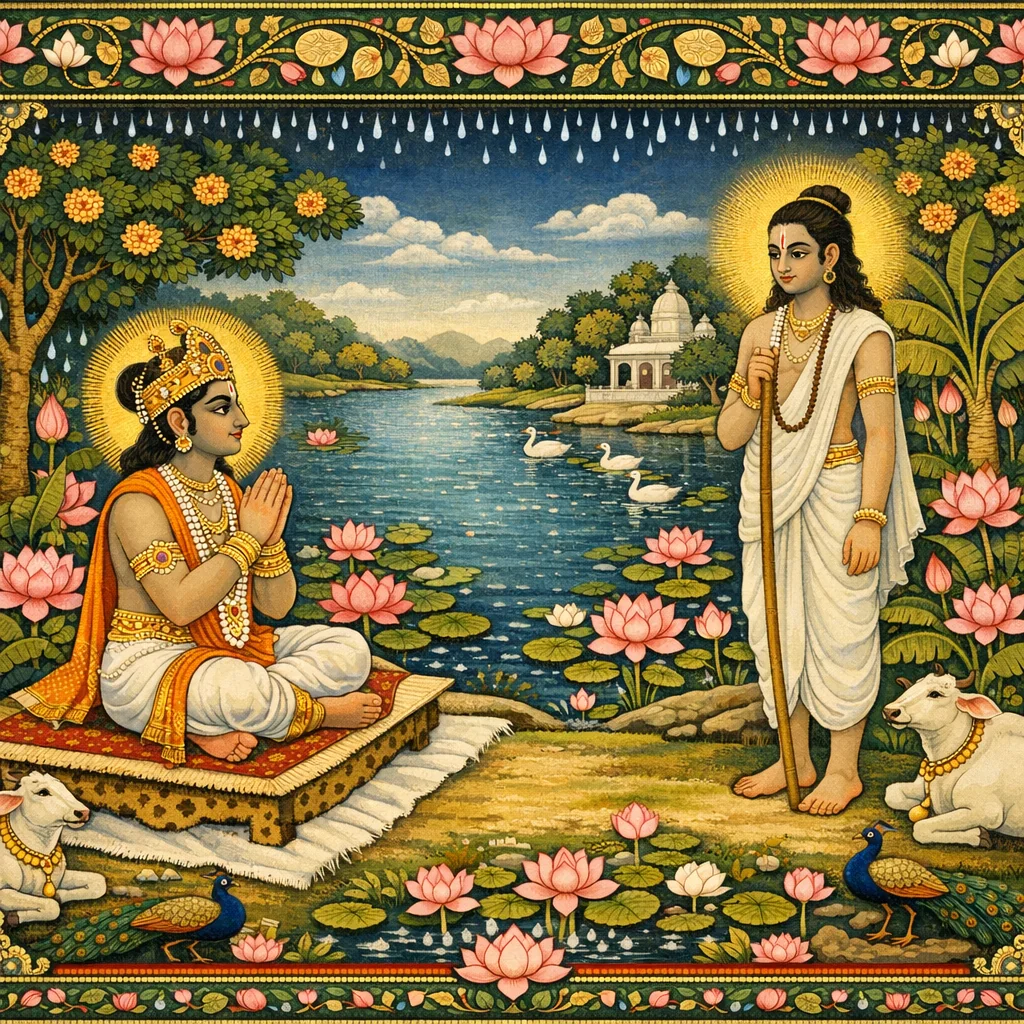
राजोवाच ब्रह्मणा चोदितो ब्रह्मन् गुणाख्यानेऽगुणस्य च । यस्मै यस्मै यथा प्राह नारदो देवदर्शन: ॥ १ ॥
King Parīkṣit said: O brāhmaṇa, urged by Lord Brahmā, to whom and in what manner did Nārada Muni, endowed with divine vision, describe the Lord’s transcendental qualities, though He is beyond material guṇas?
Verse 2
एतद् वेदितुमिच्छामि तत्त्वं तत्त्वविदां वर । हरेरद्भुतवीर्यस्य कथा लोकसुमङ्गला: ॥ २ ॥
The King said: O best of those who know the truth, I wish to understand this reality. Narrations of Hari, whose potencies are wondrous, are surely auspicious for all beings in every world.
Verse 3
कथयस्व महाभाग यथाहमखिलात्मनि । कृष्णे निवेश्य नि:सङ्गं मनस्त्यक्ष्ये कलेवरम् ॥ ३ ॥
O greatly fortunate one, please continue the narration, so that I may fix my mind upon Śrī Kṛṣṇa, the Supreme Soul of all, and, wholly free from attachment, relinquish this body.
Verse 4
शृण्वत: श्रद्धया नित्यं गृणतश्च स्वचेष्टितम् । कालेन नातिदीर्घेण भगवान् विशते हृदि ॥ ४ ॥
Those who regularly hear with faith and continually glorify His divine deeds will, in no great time, have Lord Śrī Kṛṣṇa enter and manifest within their hearts.
Verse 5
प्रविष्ट: कर्णरन्ध्रेण स्वानां भावसरोरुहम् । धुनोति शमलं कृष्ण: सलिलस्य यथा शरत् ॥ ५ ॥
Śrīmad-Bhāgavatam, the sound-incarnation of Kṛṣṇa, enters through the ear into the devotee’s heart, sits upon the lotus of loving bhāva, and shakes away the grime of lust, anger, and craving—just as autumn waters cleanse muddy pools.
Verse 6
धौतात्मा पुरुष: कृष्णपादमूलं न मुञ्चति । मुक्त सर्वपरिक्लेश: पान्थ: स्वशरणं यथा ॥ ६ ॥
A pure devotee, whose heart has been cleansed by devotional service, never abandons the lotus feet of Śrī Kṛṣṇa. Freed from all distress, he is fully satisfied there, as a traveler is content when, after a troubled journey, he reaches the shelter of home.
Verse 7
यदधातुमतो ब्रह्मन् देहारम्भोऽस्य धातुभि: । यदृच्छया हेतुना वा भवन्तो जानते यथा ॥ ७ ॥
O learned brāhmaṇa, the transcendental soul is distinct from this body, which is formed of material elements. Does the soul obtain a body by mere chance, or by some definite cause? Please explain, for you know this truth.
Verse 8
आसीद् यदुदरात् पद्मं लोकसंस्थानलक्षणम् । यावानयं वै पुरुष इयत्तावयवैः पृथक् ॥ तावानसाविति प्रोक्तः संस्थावयववानिव ॥ ८ ॥
If the Supreme Personality of Godhead—from whose abdomen the lotus stem, the sign of the universe’s arrangement, has sprung—possesses a vast body according to His own measure, then what specific difference is there between the Lord’s body and the bodies of ordinary living beings? Please clarify this.
Verse 9
अज: सृजति भूतानि भूतात्मा यदनुग्रहात् । ददृशे येन तद्रूपं नाभिपद्मसमुद्भव: ॥ ९ ॥
Brahmā, the ‘unborn’ who arose from the lotus emerging from the Lord’s navel, creates all beings who take material birth. And only by the Lord’s grace was Brahmā able to behold the Lord’s form—please explain this as well.
Verse 10
स चापि यत्र पुरुषो विश्वस्थित्युद्भवाप्यय: । मुक्त्वात्ममायां मायेश: शेते सर्वगुहाशय: ॥ १० ॥
Please also describe the Supreme Personality of Godhead, the cause of the universe’s maintenance, creation, and dissolution. Though He is the Lord of all energies, He is untouched by His external māyā, and He lies within the cave of every heart as Paramātmā, the Supersoul.
Verse 11
पुरुषावयवैर्लोका: सपाला: पूर्वकल्पिता: । लोकैरमुष्यावयवा: सपालैरिति शुश्रुम ॥ ११ ॥
O learned brāhmaṇa, it was said before that all the lokas, along with their presiding governors, are situated in the various limbs of the vast body of the Virāṭ-Puruṣa. I too have heard that the planetary systems are conceived within that body; yet what is their true placement? Kindly explain.
Verse 12
यावान् कल्पोविकल्पो वा यथा कालोऽनुमीयते । भूतभव्यभवच्छब्द आयुर्मानं च यत् सत: ॥ १२ ॥
Please explain the span between creation and annihilation—the kalpa—and the durations of subsidiary creations as well. Describe the nature of time as indicated by the terms past, present, and future. Also explain the measure and length of life for beings such as the devas, humans, and others in the various lokas.
Verse 13
कालस्यानुगतिर्या तु लक्ष्यतेऽण्वी बृहत्यपि । यावत्य: कर्मगतयो यादृशीर्द्विजसत्तम ॥ १३ ॥
O best of the brāhmaṇas, please explain the cause by which the course of time—moving along the path of karma—is perceived as sometimes minute and short, and sometimes vast and long; and also explain the beginning of time.
Verse 14
यस्मिन् कर्मसमावायो यथा येनोपगृह्यते । गुणानां गुणिनां चैव परिणाममभीप्सताम् ॥ १४ ॥
Then, kindly describe how the proportionate accumulation of karmic reactions arising from the guṇas of material nature acts upon the desiring living being, elevating or degrading him according to those guṇas among the various species—from the devas down to the most insignificant creatures.
Verse 15
भूपातालककुब्व्योमग्रहनक्षत्रभूभृताम् । सरित्समुद्रद्वीपानां सम्भवश्चैतदोकसाम् ॥ १५ ॥
O best of the brāhmaṇas, please also describe how creation takes place: the worlds from Bhū down to Pātāla, the four directions of heaven, the sky, the planets and stars, the mountains, rivers, seas, and islands, as well as the various kinds of beings who dwell within them.
Verse 16
प्रमाणमण्डकोशस्य बाह्याभ्यन्तरभेदत: । महतां चानुचरितं वर्णाश्रमविनिश्चय: ॥ १६ ॥
Please describe, by precise divisions and measures, the outer and inner expanse of the universal shell, the conduct and deeds of the great souls, and the determination of the dharma of varṇa and āśrama.
Verse 17
युगानि युगमानं च धर्मो यश्च युगे युगे । अवतारानुचरितं यदाश्चर्यतमं हरे: ॥ १७ ॥
Please explain the yugas within creation and their durations, the form of dharma in each yuga, and the most wondrous deeds and līlās of Hari’s incarnations in every age.
Verse 18
नृणां साधारणो धर्म: सविशेषश्च यादृश: । श्रेणीनां राजर्षीणां च धर्म: कृच्छ्रेषु जीवताम् ॥ १८ ॥
Please explain the common dharma of humanity and the specific dharmas of occupational duty; the dharma of the social orders and of the royal sages, and the religious principles for one who lives in distress.
Verse 19
तत्त्वानां परिसंख्यानं लक्षणं हेतुलक्षणम् । पुरुषाराधनविधिर्योगस्याध्यात्मिकस्य च ॥ १९ ॥
Kindly explain the elements of creation—their number, characteristics, causes and causal signs, and their unfolding—along with the process of worshiping the Supreme Puruṣa and the method of spiritual yoga.
Verse 20
योगेश्वरैश्वर्यगतिर्लिङ्गभङ्गस्तु योगिनाम् । वेदोपवेदधर्माणामितिहासपुराणयो: ॥ २० ॥
What are the opulences of the great yogic masters and their supreme destination? How does the perfected yogī break free from the liṅga, the subtle body? And what is the essential teaching of the Vedas, including the Upavedas, the Itihāsas, and the Purāṇas?
Verse 21
सम्प्लव: सर्वभूतानां विक्रम: प्रतिसंक्रम: । इष्टापूर्तस्य काम्यानां त्रिवर्गस्य च यो विधि: ॥ २१ ॥
O Bhagavān, please explain how all living beings are created, how they are maintained, and how they are annihilated. Tell me also the benefits and drawbacks of rendering bhakti-sevā to the Lord, the Vedic rites of iṣṭa-pūrta and kāmya-karmas, and the procedures for dharma, artha, and kāma.
Verse 22
यो वानुशायिनां सर्ग: पाषण्डस्य च सम्भव: । आत्मनो बन्धमोक्षौ च व्यवस्थानं स्वरूपत: ॥ २२ ॥
O Bhagavān, please explain also how living beings, merged within the Lord’s body, are created, and how pāṣaṇḍas—those who deny dharma—appear in this world. Kindly clarify the soul’s bondage and liberation, and the true standing of the unconditioned living beings.
Verse 23
यथात्मतन्त्रो भगवान् विक्रीडत्यात्ममायया । विसृज्य वा यथा मायामुदास्ते साक्षिवद् विभु: ॥ २३ ॥
The independent Supreme Personality of Godhead sports in His līlā by His internal potency (ātma-māyā); and at the time of dissolution He consigns them to the external māyā, while the all-powerful Lord remains as the witness of all.
Verse 24
सर्वमेतच्च भगवन् पृच्छतो मेऽनुपूर्वश: । तत्त्वतोऽर्हस्युदाहर्तुं प्रपन्नाय महामुने ॥ २४ ॥
O great sage, please satisfy my inquiry by speaking, in proper order and in truth, of everything I have asked—and even what I have not asked. Since I am surrendered to you, kindly impart complete knowledge on this matter.
Verse 25
अत्र प्रमाणं हि भवान् परमेष्ठी यथात्मभू: । अपरे चानुतिष्ठन्ति पूर्वेषां पूर्वजै: कृतम् ॥ २५ ॥
O great sage, in this matter you are the very authority, just as Svayambhū Brahmā (Parameṣṭhī) is. Others merely follow custom, imitating what the forefathers of earlier speculators once practiced.
Verse 26
न मेऽसव: परायन्ति ब्रह्मन्ननशनादमी । पिबतोऽच्युतपीयूषम् तद्वाक्याब्धिविनि:सृतम् ॥ २६ ॥
O learned brāhmaṇa, as I drink the nectar of the infallible Lord Acyuta’s message, flowing from the ocean of your words, I feel no exhaustion at all from fasting.
Verse 27
सूत उवाच स उपामन्त्रितो राज्ञा कथायामिति सत्पते: । ब्रह्मरातो भृशं प्रीतो विष्णुरातेन संसदि ॥ २७ ॥
Sūta Gosvāmī said: Invited by King Viṣṇurāta, Mahārāja Parīkṣit, to speak in the assembly of devotees on the Lord Śrī Kṛṣṇa, the master of the saintly, Brahmarāta (Śukadeva) became greatly pleased.
Verse 28
प्राह भागवतं नाम पुराणं ब्रह्मसम्मितम् । ब्रह्मणे भगवत्प्रोक्तं ब्रह्मकल्प उपागते ॥ २८ ॥
He said: This Purāṇa, called Bhāgavata, is equal in authority to Brahman; at the dawn of the Brahma-kalpa, the Lord Himself spoke it to Brahmā.
Verse 29
यद् यत् परीक्षिदृषभ: पाण्डूनामनुपृच्छति । आनुपूर्व्येण तत्सर्वमाख्यातुमुपचक्रमे ॥ २९ ॥
Whatever Parīkṣit, the best of the Pāṇḍus, inquired about, he began to narrate in full, step by step, in proper sequence.
Frequently Asked Questions
This chapter presents Bhāgavatam as śabda-avatāra: when heard regularly with seriousness (niṣṭhā) from realized devotees, its transcendental sound enters the heart, awakens sambandha (relationship) with the Lord, and cleanses anarthas like kāma, krodha, and lobha. The result is not merely conceptual belief but a lived inner revelation—Paramātmā/Bhagavān becoming experientially present through purified consciousness.
Parīkṣit seeks to prevent a materialistic misunderstanding of divine form. The Bhāgavata uses cosmic-form language (virāṭ) to explain the Lord’s energies and the universe’s arrangement, but the Lord’s body is not a product of karma, guṇas, or material elements. Ordinary bodies are acquired through causality (karma and guṇa); the Lord’s form is self-manifest, fully controlled, and never conditioned by māyā.