Adhyaya 7
Bhagavān’s Avatāras, Their Protections (Poṣaṇa), and the Limits of Knowing Him
Brahmā continues instructing Nārada that the Supreme Lord, Viṣṇu, is the root cause of creation and cosmic governance. This chapter gives a sweeping avatāra-saṅgraha (catalog of incarnations) to show poṣaṇa—divine protection of the universe and the Lord’s devotees—through the yugas and times of crisis. Brahmā recounts major descents: Varāha rescuing Earth; Kapila teaching sāṅkhya-bhakti to Devahūti; Dattātreya blessing dynasties; the Kumāras restoring spiritual truth; Nara-Nārāyaṇa’s invincible tapas; Dhruva and Pṛthu as models of devotion and righteous rule; Hayagrīva safeguarding the Veda; Matsya and Kūrma in cosmic transitions; Nṛsiṁha protecting the devas; Gajendra’s rescue; Vāmana humbling Bali; Haṁsa instructing Nārada; Dhanvantari bringing healing; Paraśurāma correcting fallen kṣatriyas; Rāma’s dharma-līlā; and Kṛṣṇa’s extraordinary childhood and royal pastimes. The chapter then reflects that Viṣṇu’s greatness is immeasurable—neither Brahmā nor Śeṣa can reach His limit—yet surrendered devotees can cross māyā and know Him by grace. Brahmā concludes by urging Nārada to spread this Bhāgavata science so humanity may develop firm devotional service, linking this avatāra overview to the next stage of systematic teaching and transmission.
Shlokas
Verse 1
ब्रह्मोवाच यत्रोद्यत: क्षितितलोद्धरणाय बिभ्रत् क्रौडीं तनुं सकलयज्ञमयीमनन्त: । अन्तर्महार्णव उपागतमादिदैत्यं तं दंष्ट्रयाद्रिमिव वज्रधरो ददार ॥ १ ॥
Brahmā said: When the unlimited Lord, as a divine pastime, assumed the boar form imbued with the essence of all yajñas to lift the earth submerged in the great Garbhodaka ocean, the first demon, Hiraṇyākṣa, appeared in those depths; and the Bhagavān pierced him with His tusk, as Indra with the vajra cleaves a mountain.
Verse 2
जातो रुचेरजनयत् सुयमान् सुयज्ञ आकूतिसूनुरमरानथ दक्षिणायाम् । लोकत्रयस्य महतीमहरद् यदार्तिं स्वायम्भुवेन मनुना हरिरित्यनूक्त: ॥ २ ॥
Prajāpati Ruci first begot Suyajña in the womb of his wife Ākūti, and Suyajña then begot the devas headed by Suyama in the womb of his wife Dakṣiṇā. As Indra, Suyajña removed the great distresses of the three worlds; therefore Svāyambhuva Manu called him “Hari”.
Verse 3
जज्ञे च कर्दमगृहे द्विज देवहूत्यां स्त्रीभि: समं नवभिरात्मगतिं स्वमात्रे । ऊचे ययात्मशमलं गुणसङ्गपङ्क- मस्मिन् विधूय कपिलस्य गतिं प्रपेदे ॥ ३ ॥
The Lord then appeared as the Kapila avatāra, the son of the brāhmaṇa prajāpati Kardama and his wife Devahūti, along with nine daughters. He taught His mother the path of self-realization; thus, in that very life, she washed away the mud of attachment to the guṇas and attained liberation—the way revealed by Kapila.
Verse 4
अत्रेरपत्यमभिकाङ्क्षत आह तुष्टो दत्तो मयाहमिति यद् भगवान् स दत्त: । यत्पादपङ्कजपरागपवित्रदेहा योगर्द्धिमापुरुभयीं यदुहैहयाद्या: ॥ ४ ॥
The great sage Atri longed for a son and prayed; pleased, the Lord said, “I am given to you as Datta,” and appeared as Atri’s son, Dattātreya. By the sanctifying dust of His lotus feet, the Yadus, Haihayas, and others were purified and attained both worldly prosperity and spiritual grace.
Verse 5
तप्तं तपो विविधलोकसिसृक्षया मे आदौ सनात् स्वतपस: स चतु:सनोऽभूत् । प्राक्कल्पसम्प्लवविनष्टमिहात्मतत्त्वं सम्यग् जगाद मुनयो यदचक्षतात्मन् ॥ ५ ॥
To create the many planetary systems, I performed intense austerities; pleased, the Lord first incarnated as the four Sanas—Sanaka, Sanatkumāra, Sanandana, and Sanātana. The spiritual truth, obscured by the devastation of the previous kalpa, they taught so perfectly that the sages at once perceived it clearly.
Verse 6
धर्मस्य दक्षदुहितर्यजनिष्ट मूर्त्यां नारायणो नर इति स्वतप:प्रभाव: । दृष्ट्वात्मनो भगवतो नियमावलोपं देव्यस्त्वनङ्गपृतना घटितुं न शेकु: ॥ ६ ॥
To reveal His own path of austerity and sacred discipline, the Lord appeared as the twin forms Nārāyaṇa and Nara in the womb of Mūrti, wife of Dharma and daughter of Dakṣa. The celestial beauties, companions of Cupid, came to break His vows, but failed—seeing that countless beauties like themselves were emanating from the Bhagavān Himself.
Verse 7
कामं दहन्ति कृतिनो ननु रोषदृष्टया रोषं दहन्तमुत ते न दहन्त्यसह्यम् । सोऽयं यदन्तरमलं प्रविशन् बिभेति काम: कथं नु पुनरस्य मन: श्रयेत ॥ ७ ॥
Great stalwarts can burn lust with a wrathful glance, yet they cannot burn away their own unbearable wrath—the very burner. But such wrath fears to enter the heart of the Lord, whose inner being is stainless. How, then, could lust ever take shelter in His mind?
Verse 8
विद्ध: सपत्न्युदितपत्रिभिरन्ति राज्ञो बालोऽपि सन्नुपगतस्तपसे वनानि । तस्मा अदाद् ध्रुवगतिं गृणते प्रसन्नो दिव्या: स्तुवन्ति मुनयो यदुपर्यधस्तात् ॥ ८ ॥
Stung by the sharp words of the king’s co-wife, even in the king’s presence, Prince Dhruva—though only a child—went to the forest for severe austerities. Pleased by his prayer, the Lord granted him the abode of Dhruva, Dhruvaloka, which great sages above and below revere and glorify.
Verse 9
यद्वेनमुत्पथगतं द्विजवाक्यवज्र- निष्प्लुष्टपौरुषभगं निरये पतन्तम् । त्रात्वार्थितो जगति पुत्रपदं च लेभे दुग्धा वसूनि वसुधा सकलानि येन ॥ ९ ॥
When Mahārāja Vena strayed from the path of dharma, the brāhmaṇas struck him with a thunderbolt-like curse; his merit and opulence were burnt away as he fell toward hell. Then the Lord, by causeless mercy, descended as his son named Pṛthu, delivered Vena from hell, and “milked” the earth to manifest every kind of crop and wealth.
Verse 10
नाभेरसावृषभ आस सुदेविसूनु- र्यो वै चचार समदृग् जडयोगचर्याम् । यत्पारमहंस्यमृषय: पदमामनन्ति स्वस्थ: प्रशान्तकरण: परिमुक्तसङ्ग: ॥ १० ॥
The Lord appeared as the son of Sudevī, wife of King Nābhi, and was known as Ṛṣabhadeva. With equal vision He practiced a yogic discipline that steadies the mind. The sages acclaim this as the parama-haṁsa state—situated in the Self, senses pacified, and freed from all attachment—the perfection of liberation.
Verse 11
सत्रे ममास भगवान् हयशीरषाथो साक्षात् स यज्ञपुरुषस्तपनीयवर्ण: । छन्दोमयो मखमयोऽखिलदेवतात्मा वाचो बभूवुरुशती: श्वसतोऽस्य नस्त: ॥ ११ ॥
In the sacrifice performed by me (Brahmā), the Lord appeared directly as Hayagrīva. Golden-hued, He is Yajña-Puruṣa Himself—the embodiment of Vedic meters and the Supersoul of all the devas. As He breathed, the sweet sounds of Vedic hymns streamed forth from His nostrils.
Verse 12
मत्स्यो युगान्तसमये मनुनोपलब्ध: क्षोणीमयो निखिलजीवनिकायकेत: । विस्रंसितानुरुभये सलिले मुखान्मे आदाय तत्र विजहार ह वेदमार्गान् ॥ १२ ॥
At the end of the age, the Lord would be perceived by Manu named Satyavrata (the future Vaivasvata) as the Fish incarnation, the shelter of all beings up to the earthly worlds. Fearing the vast waters of pralaya, the Vedas slipped from my (Brahmā’s) mouth; the Lord gathered them, sported in those immense waters, and protected the path of the Vedas.
Verse 13
क्षीरोदधावमरदानवयूथपाना- मुन्मथ्नताममृतलब्धय आदिदेव: । पृष्ठेन कच्छपवपुर्विदधार गोत्रं निद्राक्षणोऽद्रिपरिवर्तकषाणकण्डू: ॥ १३ ॥
In the Ocean of Milk, the devas and asuras churned with Mount Mandara to obtain amṛta. Then the primeval Lord assumed the Tortoise incarnation and bore the mountain upon His back as the pivot. As the mountain rocked back and forth, it scraped His back and stirred an itch; even in half-sleep, the Lord tasted the pleasure of that scratching.
Verse 14
त्रैपिष्टपोरुभयहा स नृसिंहरूपं कृत्वा भ्रमद्भ्रुकुटिदंष्ट्रकरालवक्त्रम् । दैत्येन्द्रमाशु गदयाभिपतन्तमारा- दूरौ निपात्य विददार नखै: स्फुरन्तम् ॥ १४ ॥
To dispel the great fear of the demigods, the Supreme Lord assumed the form of Nṛsiṁhadeva. With brows knit in wrath and a dreadful mouth of fangs, He cast the demon-king Hiraṇyakaśipu—who rushed at Him with a club—upon His thighs and tore him apart with His shining nails.
Verse 15
अन्त:सरस्युरुबलेन पदे गृहीतो ग्राहेण यूथपतिरम्बुजहस्त आर्त: । आहेदमादिपुरुषाखिललोकनाथ तीर्थश्रव: श्रवणमङ्गलनामधेय ॥ १५ ॥
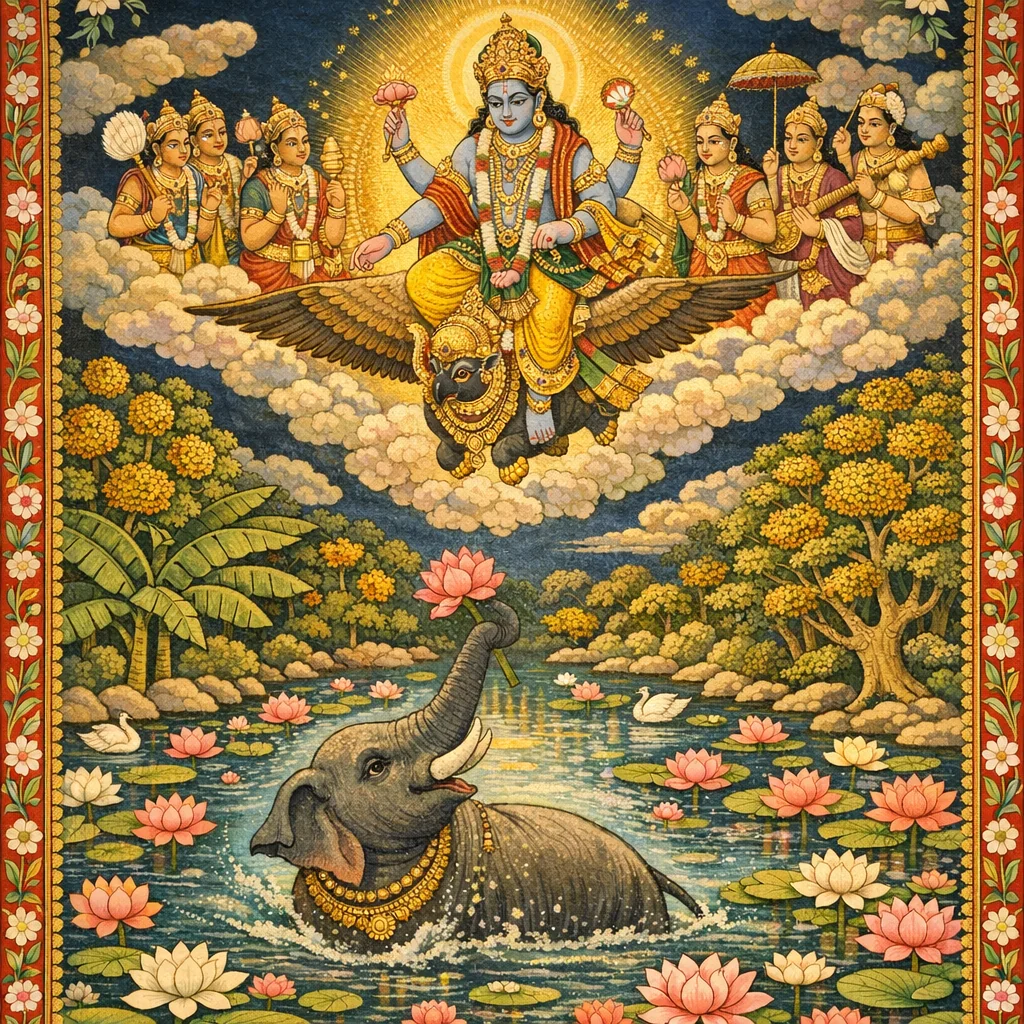
In the lake a crocodile of superior strength seized the leg of Gajendra, leader of the elephants, and he was sorely distressed. Holding a lotus in his trunk, he prayed: “O Ādipuruṣa, Lord of all worlds, famed like a holy tīrtha—merely hearing Your sacred Name is auspicious and purifying; that Name is worthy to be chanted.”
Verse 16
श्रुत्वा हरिस्तमरणार्थिनमप्रमेय- श्चक्रायुध: पतगराजभुजाधिरूढ: । चक्रेण नक्रवदनं विनिपाट्य तस्मा- द्धस्ते प्रगृह्य भगवान् कृपयोज्जहार ॥ १६ ॥
Hearing the elephant’s anguished plea, Hari—the immeasurable Lord, bearing the cakra—at once arrived, mounted upon Garuḍa, king of birds. With His discus He severed the crocodile’s mouth, and then, grasping the elephant by the trunk, the Lord compassionately delivered him.
Verse 17
ज्यायान् गुणैरवरजोऽप्यदिते: सुतानां लोकान् विचक्रम इमान् यदथाधियज्ञ: । क्ष्मां वामनेन जगृहे त्रिपदच्छलेन याच्ञामृते पथि चरन् प्रभुभिर्न चाल्य: ॥ १७ ॥
Though appearing as Aditi’s youngest son, the Lord surpassed all the Ādityas in excellence; as Adhiyajña He strode across and encompassed the worlds. In the form of Vāmana, on the pretext of begging for three steps of land, He took all of Bali Mahārāja’s dominion—because without a request, even authority cannot seize another’s rightful possession.
Verse 18
नार्थो बलेरयमुरुक्रमपादशौच- माप: शिखाधृतवतो विबुधाधिपत्यम् । यो वै प्रतिश्रुतमृते न चिकीर्षदन्य- दात्मानमङ्ग मनसा हरयेऽभिमेने ॥ १८ ॥
Bali Mahārāja placed upon his head the water that had washed the lotus feet of Urukrama. Though forbidden by his spiritual master, he thought of nothing but his vow. To fulfill the measure of the Lord’s third step, he offered even his own body to Hari; for him, the heavenly kingdom won by strength was of no worth.
Verse 19
तुभ्यं च नारद भृशं भगवान् विवृद्ध- भावेन साधुपरितुष्ट उवाच योगम् । ज्ञानं च भागवतमात्मसतत्त्वदीपं यद्वासुदेवशरणा विदुरञ्जसैव ॥ १९ ॥
O Nārada, the Bhagavān, as Haṁsāvatāra, being greatly pleased by your intense devotion, clearly taught you yoga, spiritual knowledge, and the Bhāgavata science—the lamp illuminating the truth of the self—readily understood by those surrendered to Lord Vāsudeva.
Verse 20
चक्रं च दिक्ष्वविहतं दशसु स्वतेजो मन्वन्तरेषु मनुवंशधरो बिभर्ति । दुष्टेषु राजसु दमं व्यदधात् स्वकीर्तिं सत्ये त्रिपृष्ठ उशतीं प्रथयंश्चरित्रै: ॥ २० ॥
As the Manu incarnation, the Lord became the heir of Manu’s dynasty. Bearing His wheel-weapon, unobstructed in all directions by His own splendor, He subdued the wicked kings through ten manvantaras, and by His deeds spread His glorious fame throughout the three worlds up to Satyaloka.
Verse 21
धन्वन्तरिश्च भगवान् स्वयमेव कीर्ति- र्नाम्ना नृणां पुरुरुजां रुज आशु हन्ति । यज्ञे च भागममृतायुरवावरुन्ध आयुष्यवेदमनुशास्त्यवतीर्य लोके ॥ २१ ॥
In His incarnation as Dhanvantari, the Lord swiftly destroys the diseases of ever-ailing beings simply by His fame embodied, and by Him alone the devas attain long life. He accepts His share in sacrifices and descends to teach Āyurveda, the sacred science of medicine.
Verse 22
क्षत्रं क्षयाय विधिनोपभृतं महात्मा ब्रह्मध्रुगुज्झितपथं नरकार्तिलिप्सु । उद्धन्त्यसाववनिकण्टकमुग्रवीर्य- स्त्रि:सप्तकृत्व उरुधारपरश्वधेन ॥ २२ ॥
When the kṣatriya rulers strayed from the path of Absolute Truth, scorning brahminical dharma and courting hell, the Mahātmā, as the sage Paraśurāma, with fierce prowess and a keen axe, uprooted those wicked kings—thorns upon the earth—twenty-one times, down to the root.
Verse 23
अस्मत्प्रसादसुमुख: कलया कलेश इक्ष्वाकुवंश अवतीर्य गुरोर्निदेशे । तिष्ठन् वनं सदयितानुज आविवेश यस्मिन् विरुध्य दशकन्धर आर्तिमार्च्छत् ॥ २३ ॥
By His causeless mercy to all beings, the Supreme Lord, with His plenary expansions, descended in the Ikṣvāku line as the Lord of His internal potency, Sītā. By the order of His father, King Daśaratha, He entered the forest and lived there for many years with His wife and younger brother; Rāvaṇa of ten heads opposed Him, committed a grave offense, and was ultimately vanquished.
Verse 24
यस्मा अदादुदधिरूढभयाङ्गवेपो मार्गं सपद्यरिपुरं हरवद् दिधक्षो: । दूरे सुहृन्मथितरोषसुशोणदृष्टया तातप्यमानमकरोरगनक्रचक्र: ॥ २४ ॥
The Supreme Lord Rāmacandra, anguished for His beloved Sītā far away, cast upon Rāvaṇa’s city a red, blazing glance like Hara’s when he would burn the heavens. The mighty ocean, trembling in fear, at once yielded a path, for its own creatures—sharks, serpents, and crocodiles—were scorched by the heat of the Lord’s wrathful eyes.
Verse 25
वक्ष:स्थलस्पर्शरुग्नमहेन्द्रवाह- दन्तैर्विडम्बितककुब्जुष ऊढहासम् । सद्योऽसुभि: सह विनेष्यति दारहर्तु- र्विस्फूर्जितैर्धनुष उच्चरतोऽधिसैन्ये ॥ २५ ॥
In battle, the tusks of Airāvata, Indra’s mount, shattered upon striking Rāvaṇa’s chest, their fragments seeming to light the quarters. Rāvaṇa swelled with pride and laughed as he roamed among the troops, imagining himself conqueror of all directions; but the moment the Lord Rāmacandra’s bow rang out with its quivering roar, his laughter—and his very breath of life—was cut off at once.
Verse 26
भूमे: सुरेतरवरूथविमर्दिताया: क्लेशव्ययाय कलया सितकृष्णकेश: । जात: करिष्यति जनानुपलक्ष्यमार्ग: कर्माणि चात्ममहिमोपनिबन्धनानि ॥ २६ ॥
When the earth is burdened by the warlike might of kings who lack faith in God, the Lord descends with His plenary portion to lessen the world’s distress. He comes in His original form, adorned with beautiful dark hair; His ways cannot be truly traced, and to unfold His own transcendental glory He performs extraordinary deeds.
Verse 27
तोकेन जीवहरणं यदुलूकिकाया- स्त्रैमासिकस्य च पदा शकटोऽपवृत्त: । यद् रिङ्गतान्तरगतेन दिविस्पृशोर्वा उन्मूलनं त्वितरथार्जुनयोर्न भाव्यम् ॥ २७ ॥
There is no doubt that Lord Kṛṣṇa is the Supreme Lord. Otherwise, how could He have slain the giant demoness Pūtanā while lying on His mother’s lap, overturned a cart with His foot at only three months of age, or uprooted the twin arjuna trees that reached the sky while He was still crawling? Such deeds are impossible for anyone but the Lord Himself.
Verse 28
यद् वै व्रजे व्रजपशून् विषतोयपीतान् पालांस्त्वजीवयदनुग्रहदृष्टिवृष्टया । तच्छुद्धयेऽतिविषवीर्यविलोलजिह्व- मुच्चाटयिष्यदुरगं विहरन् ह्रदिन्याम् ॥ २८ ॥
In Vraja, when the cowherd boys and their animals drank the poisoned waters of the Yamunā and fell lifeless, the Lord—even in childhood—revived them with a shower of merciful glances. Then, to purify the Yamunā, He leapt in as if at play and chastised the serpent Kāliya, whose wavering tongue poured forth waves of venom. Who but the Supreme Lord can perform such mighty deeds?
Verse 29
तत् कर्म दिव्यमिव यन्निशि नि:शयानं दावाग्निना शुचिवने परिदह्यमाने । उन्नेष्यति व्रजमतोऽवसितान्तकालं नेत्रे पिधाप्य सबलोऽनधिगम्यवीर्य: ॥ २९ ॥
That very night, while the people of Vraja slept without fear, a forest fire blazed up from dry leaves and it seemed death would surely take them all. Yet the Lord Śrī Kṛṣṇa, together with Balarāma, saved them simply by closing His eyes—such are His divine, superhuman deeds.
Verse 30
गृह्णीत यद् यदुपबन्धममुष्य माता शुल्बं सुतस्य न तु तत् तदमुष्य माति । यज्जृम्भतोऽस्य वदने भुवनानि गोपी संवीक्ष्य शङ्कितमना: प्रतिबोधितासीत् ॥ ३० ॥
When Mother Yaśodā tried to bind her son’s hands with ropes, however much rope she added it was always too short—He would not fit within it. Then the Lord gradually yawned and opened His mouth, and the gopī beheld all the universes within. She was struck with doubt, yet in the end she was convinced in another way of the mystic power (yoga-māyā) of her child.
Verse 31
नन्दं च मोक्ष्यति भयाद् वरुणस्य पाशाद् गोपान् बिलेषु पिहितान् मयसूनुना च । अह्न्यापृतं निशि शयानमतिश्रमेण लोकं विकुण्ठमुपनेष्यति गोकुलं स्म ॥ ३१ ॥
Lord Śrī Kṛṣṇa will free Nanda Mahārāja from the fear of Varuṇa’s bonds, and He will release the cowherd boys shut within mountain caves by the son of Māyā. And to the people of Vṛndāvana—who labored by day and slept soundly at night from their toil—He will grant elevation to Vaikuṇṭha. All these are His transcendental deeds.
Verse 32
गोपैर्मखे प्रतिहते व्रजविप्लवाय देवेऽभिवर्षति पशून् कृपया रिरक्षु: । धर्तोच्छिलीन्ध्रमिव सप्तदिनानि सप्त- वर्षो महीध्रमनघैककरे सलीलम् ॥ ३२ ॥
When the cowherd men, following Kṛṣṇa’s instruction, stopped Indra’s sacrifice, Indra poured down relentless rain for seven days, threatening to wash away Vraja. Out of causeless mercy to the people and the animals, the Lord Śrī Kṛṣṇa—only seven years old—held Govardhana Hill aloft with one hand like an umbrella for seven days.
Verse 33
क्रीडन् वने निशि निशाकररश्मिगौर्यां रासोन्मुख: कलपदायतमूर्च्छितेन । उद्दीपितस्मररुजां व्रजभृद्वधूनां हर्तुर्हरिष्यति शिरो धनदानुगस्य ॥ ३३ ॥
On a moonlit night in Vṛndāvana’s forest, the Lord, eager for the rāsa dance, sang sweet, melodious songs that stirred the love-longing of the Vraja maidens. Then the demon Śaṅkhacūḍa, a wealthy follower of Kuvera, abducted the girls, and the Lord severed his head from his body.
Verse 34
ये च प्रलम्बखरदर्दुरकेश्यरिष्ट- मल्लेभकंसयवना: कपिपौण्ड्रकाद्या: । अन्ये च शाल्वकुजबल्वलदन्तवक्र- सप्तोक्षशम्बरविदूरथरुक्मिमुख्या: ॥ ३४ ॥ ये वा मृधे समितिशालिन आत्तचापा: काम्बोजमत्स्यकुरुसृञ्जयकैकयाद्या: । यास्यन्त्यदर्शनमलं बलपार्थभीम- व्याजाह्वयेन हरिणा निलयं तदीयम् ॥ ३५ ॥
Pralamba, Dhenuka, Baka, Keśī, Ariṣṭa, Cāṇūra, Muṣṭika, the elephant Kuvalayāpīḍa, Kaṁsa, the Yavanas, Narakāsura, Pauṇḍraka and others—along with Śālva, Dvivida, Balvala, Dantavakra, the seven bulls, Śambara, Vidūratha and Rukmī—would all wage fierce battle with the Lord, Hari. Slain by Him, some attained the impersonal brahmajyoti, while others reached His own abode of Vaikuṇṭha.
Verse 35
ये च प्रलम्बखरदर्दुरकेश्यरिष्ट- मल्लेभकंसयवना: कपिपौण्ड्रकाद्या: । अन्ये च शाल्वकुजबल्वलदन्तवक्र- सप्तोक्षशम्बरविदूरथरुक्मिमुख्या: ॥ ३४ ॥ ये वा मृधे समितिशालिन आत्तचापा: काम्बोजमत्स्यकुरुसृञ्जयकैकयाद्या: । यास्यन्त्यदर्शनमलं बलपार्थभीम- व्याजाह्वयेन हरिणा निलयं तदीयम् ॥ ३५ ॥
And mighty bowmen, skilled in the clash of armies—Kāmboja, Matsya, Kuru, Sṛñjaya, Kekaya and others—also fought with Hari, who moved under the assumed names of Baladeva, Arjuna, Bhīma, and so on. When slain, they attained either the impersonal brahmajyoti or the Lord’s own abode in Vaikuṇṭha.
Verse 36
कालेन मीलितधियामवमृश्य नृणां स्तोकायुषां स्वनिगमो बत दूरपार: । आविर्हितस्त्वनुयुगं स हि सत्यवत्यां वेदद्रुमं विटपशो विभजिष्यति स्म ॥ ३६ ॥
Seeing that, in time, men’s minds grow dim and their lives are short, so that the Vedic path becomes too hard to traverse, the Lord will appear as the son of Satyavatī—Vyāsadeva—and, according to each age, divide the tree of Vedic knowledge into many branches.
Verse 37
देवद्विषां निगमवर्त्मनि निष्ठितानां पूर्भिर्मयेन विहिताभिरदृश्यतूर्भि: । लोकान् घ्नतां मतिविमोहमतिप्रलोभं वेषं विधाय बहु भाष्यत औपधर्म्यम् ॥ ३७ ॥
When the godless, though learned in Vedic science, begin to slaughter the beings of various worlds while moving unseen through the sky in well-made aerial cities and craft fashioned by Maya, the Lord Janārdana will bewilder their minds by assuming the alluring form of Buddha and will speak many teachings of upadharma—religion in a distorted guise.
Verse 38
यर्ह्यालयेष्वपि सतां न हरे: कथा: स्यु: पाषण्डिनो द्विजजना वृषला नृदेवा: । स्वाहा स्वधा वषडिति स्म गिरो न यत्र शास्ता भविष्यति कलेर्भगवान् युगान्ते ॥ ३८ ॥
When even in the homes of those deemed saintly there is no talk of Hari, when the twice-born become heretics and the rulers (nṛdevas) turn base in nature, and when even the sacrificial words “svāhā, svadhā, vaṣaṭ” are unknown—then, at the end of Kali-yuga, the Bhagavān will appear as the supreme chastiser.
Verse 39
सर्गे तपोऽहमृषयो नव ये प्रजेशा: स्थानेऽथ धर्ममखमन्वमरावनीशा: । अन्ते त्वधर्महरमन्युवशासुराद्या मायाविभूतय इमा: पुरुशक्तिभाज: ॥ ३९ ॥
At creation’s dawn there are austerity, I (Brahmā), the Prajāpatis and the nine great sages who beget the worlds; in the time of maintenance there are Lord Viṣṇu, the ruling devas and the kings of the various planets; but at the end arise irreligion, and then Rudra and the wrathful atheists and the like. All are representative manifestations of the Supreme Lord’s energy.
Verse 40
विष्णोर्नु वीर्यगणनां कतमोऽर्हतीह य: पार्थिवान्यपि कविर्विममे रजांसि । चस्कम्भ य: स्वरहसास्खलता त्रिपृष्ठं यस्मात् त्रिसाम्यसदनादुरुकम्पयानम् ॥ ४० ॥
Who can fully reckon the prowess of Viṣṇu? Even a sage who could measure the dust of the universe’s atoms cannot; for He alone, as Trivikrama, effortlessly raised His foot beyond the summit of Satyaloka to the neutral equilibrium of the three guṇas, and all creation trembled.
Verse 41
नान्तं विदाम्यहममी मुनयोऽग्रजास्ते मायाबलस्य पुरुषस्य कुतोऽवरा ये । गायन् गुणान् दशशतानन आदिदेव: शेषोऽधुनापि समवस्यति नास्य पारम् ॥ ४१ ॥
Neither I nor the sages born before you know the end of that omnipotent Supreme Person, whose power is māyā; how then could those born after us know Him? Even Śeṣa, the Lord’s first expansion, though singing His qualities with a thousand mouths, has not yet reached the far shore of that knowledge.
Verse 42
येषां स एष भगवान् दययेदनन्त: सर्वात्मनाश्रितपदो यदि निर्व्यलीकम् । ते दुस्तरामतितरन्ति च देवमायां नैषां ममाहमिति धी: श्वशृगालभक्ष्ये ॥ ४२ ॥
But one whom the infinite Lord mercifully favors, and who without duplicity takes full shelter of His feet in devotional service, crosses the insurmountable ocean of devī-māyā and comes to know the Lord. Those, however, who cling to this body—destined to be eaten by dogs and jackals—thinking “I” and “mine,” cannot.
Verse 43
वेदाहमङ्ग परमस्य हि योगमायां यूयं भवश्च भगवानथ दैत्यवर्य: । पत्नी मनो: स च मनुश्च तदात्मजाश्च प्राचीनबर्हिर्ऋभुरङ्ग उत ध्रुवश्च ॥ ४३ ॥ इक्ष्वाकुरैलमुचुकुन्दविदेहगाधि- रघ्वम्बरीषसगरा गयनाहुषाद्या: । मान्धात्रलर्कशतधन्वनुरन्तिदेवा देवव्रतो बलिरमूर्त्तरयो दिलीप: ॥ ४४ ॥ सौभर्युतङ्कशिबिदेवलपिप्पलाद- सारस्वतोद्धवपराशरभूरिषेणा: । येऽन्ये विभीषणहनूमदुपेन्द्रदत्त- पार्थार्ष्टिषेणविदुरश्रुतदेववर्या: ॥ ४५ ॥
O Nārada, although the Lord’s potencies are inconceivable and immeasurable, still, because we are surrendered souls, we know how He acts through His yoga-māyā. Likewise, the all-powerful Śiva; Prahlāda, foremost among the daityas; Svāyambhuva Manu, his wife Śatarūpā and their children (Priyavrata, Uttānapāda, Ākūti, Devahūti, Prasūti, and others); and also Prācīnabarhi, Ṛbhu, Aṅga, Dhruva, Ikṣvāku, Aila, Mucukunda, Videha (Janaka), Gādhi, Raghu, Ambarīṣa, Sagara, Gaya, Nāhuṣa, Māndhātā, Alarka, Śatadhanvā, Anu, Rantideva, Bhīṣma, Bali, Amūrttaraya, Dilīpa, Saubhari, Utaṅka, Śibi, Devala, Pippalāda, Sārasvata, Uddhava, Parāśara, Bhūriṣeṇa, Vibhīṣaṇa, Hanumān, Śukadeva, Arjuna, Ārṣṭiṣeṇa, Vidura, Śrutadeva, and others know His potencies as well.
Verse 44
वेदाहमङ्ग परमस्य हि योगमायां यूयं भवश्च भगवानथ दैत्यवर्य: । पत्नी मनो: स च मनुश्च तदात्मजाश्च प्राचीनबर्हिर्ऋभुरङ्ग उत ध्रुवश्च ॥ ४३ ॥ इक्ष्वाकुरैलमुचुकुन्दविदेहगाधि- रघ्वम्बरीषसगरा गयनाहुषाद्या: । मान्धात्रलर्कशतधन्वनुरन्तिदेवा देवव्रतो बलिरमूर्त्तरयो दिलीप: ॥ ४४ ॥ सौभर्युतङ्कशिबिदेवलपिप्पलाद- सारस्वतोद्धवपराशरभूरिषेणा: । येऽन्ये विभीषणहनूमदुपेन्द्रदत्त- पार्थार्ष्टिषेणविदुरश्रुतदेववर्या: ॥ ४५ ॥
O Nārada, though the Supreme Lord’s yoga-māyā potencies are unknowable and immeasurable, we surrendered souls still know how He acts through yoga-māyā. Likewise, this is known to all-powerful Śiva, to Prahlāda the foremost among the Daityas, to Svāyambhuva Manu and Śatarūpā with their progeny, and to Prācīnabarhi, Ṛbhu, Aṅga, Dhruva, and others.
Verse 45
वेदाहमङ्ग परमस्य हि योगमायां यूयं भवश्च भगवानथ दैत्यवर्य: । पत्नी मनो: स च मनुश्च तदात्मजाश्च प्राचीनबर्हिर्ऋभुरङ्ग उत ध्रुवश्च ॥ ४३ ॥ इक्ष्वाकुरैलमुचुकुन्दविदेहगाधि- रघ्वम्बरीषसगरा गयनाहुषाद्या: । मान्धात्रलर्कशतधन्वनुरन्तिदेवा देवव्रतो बलिरमूर्त्तरयो दिलीप: ॥ ४४ ॥ सौभर्युतङ्कशिबिदेवलपिप्पलाद- सारस्वतोद्धवपराशरभूरिषेणा: । येऽन्ये विभीषणहनूमदुपेन्द्रदत्त- पार्थार्ष्टिषेणविदुरश्रुतदेववर्या: ॥ ४५ ॥
Ikṣvāku, Aila, Mucukunda, Videha (Janaka), Gādhi, Raghu, Ambarīṣa, Sagara, Gaya, Nāhuṣa, Māndhātā, Alarka, Śatadhanvā, Anu, Rantideva, Devavrata (Bhīṣma), Bali, Amūrttaraya, and Dilīpa—all of them too know the Lord’s yoga-māyā potency.
Verse 46
ते वै विदन्त्यतितरन्ति च देवमायां स्त्रीशूद्रहूणशबरा अपि पापजीवा: । यद्यद्भुतक्रमपरायणशीलशिक्षा- स्तिर्यग्जना अपि किमु श्रुतधारणा ये ॥ ४६ ॥
Even surrendered souls from groups deemed sinful—women, śūdras, Hūṇas, Śabaras—can know the science of Godhead and cross beyond deva-māyā by taking shelter of the Lord’s pure devotees and following their footsteps in bhakti; what then of those who uphold the śruti?
Verse 47
शश्वत् प्रशान्तमभयं प्रतिबोधमात्रं शुद्धं समं सदसत: परमात्मतत्त्वम् । शब्दो न यत्र पुरुकारकवान् क्रियार्थो माया परैत्यभिमुखे च विलज्जमाना तद् वै पदं भगवत: परमस्य पुंसो ब्रह्मेति यद् विदुरजस्रसुखं विशोकम् ॥ ४७ ॥
That Reality is eternal, perfectly peaceful and fearless—pure consciousness alone—untainted and without distinction, beyond both being and nonbeing: the truth of the Paramātmā. There, no web of words serves fruit-seeking action, and māyā, facing Him, withdraws in shame. That is the supreme abode of the Supreme Person, known as Brahman—unceasing bliss, free from sorrow.
Verse 48
सध्रयङ् नियम्य यतयो यमकर्तहेतिं । जह्यु: स्वराडिव निपानखनित्रमिन्द्र: ॥ ४८ ॥
In that transcendental state there is no need for artificial mind-control, speculation, or meditation as pursued by jñānīs and yogīs; one relinquishes such methods, just as Indra, king of heaven, gives up the toil of digging a well.
Verse 49
स श्रेयसामपि विभुर्भगवान् यतोऽस्य भावस्वभावविहितस्य सत: प्रसिद्धि: । देहे स्वधातुविगमेऽनुविशीर्यमाणे व्योमेव तत्र पुरुषो न विशीर्यतेऽज: ॥ ४९ ॥
The all-powerful Bhagavān is the lord of all auspiciousness, for the fruits of the living being’s actions—whether in material or spiritual existence—are bestowed by Him; thus He is the ultimate benefactor. Though the bodily elements perish, the unborn soul does not perish, like air within the sky.
Verse 50
सोऽयं तेऽभिहितस्तात भगवान् विश्वभावन: । समासेन हरेर्नान्यदन्यस्मात् सदसच्च यत् ॥ ५० ॥
My dear son, I have briefly described Bhagavān, the nourisher of the universe. Apart from Hari, there is no other cause of either sat or asat—of being or nonbeing.
Verse 51
इदं भागवतं नाम यन्मे भगवतोदितम् । संग्रहोऽयं विभूतीनां त्वमेतद् विपुलीकुरु ॥ ५१ ॥
O Nārada, this divine science called Bhāgavata was spoken to me in summary by Bhagavān; it is a compendium of His diverse vibhūtis, His manifold potencies. Please expand this teaching yourself.
Verse 52
यथा हरौ भगवति नृणां भक्तिर्भविष्यति । सर्वात्मन्यखिलाधारे इति सङ्कल्प्य वर्णय ॥ ५२ ॥
Describe it with firm resolve, in such a way that human beings may awaken bhakti to Bhagavān Hari—the Supersoul of all, the support of everything, and the source of all energies.
Verse 53
मायां वर्णयतोऽमुष्य ईश्वरस्यानुमोदत: । शृण्वत: श्रद्धया नित्यं माययात्मा न मुह्यति ॥ ५३ ॥
The Lord’s pastimes in connection with His various energies should be described in harmony with His own teaching and approval. One who hears them regularly with śraddhā and devotion is not bewildered by the Lord’s māyā.
Frequently Asked Questions
The avatāra list functions as a theological map of poṣaṇa: the Lord repeatedly descends to protect dharma, rescue devotees, restore Vedic knowledge, and re-balance cosmic order. Rather than isolated legends, the incarnations collectively demonstrate that the Supreme Person remains transcendental yet personally intervenes through His energies. The chapter also uses the list to argue epistemically: the Lord’s acts are limitless, so He is known fully only by His grace received through bhakti.
The Nara-Nārāyaṇa episode shows the Lord as the standard of tapas and self-mastery: attempts to disrupt His vows fail because He is ātmārāma and self-sufficient. Verse 7 sharpens the point—great beings like Śiva can conquer lust but may still be affected by their own anger; the Lord, however, is beyond the guṇas, so neither lust nor wrath can take shelter in His heart. The teaching is that divine transcendence is not repression but ontological freedom from material modes.
Bali is praised because he exemplifies surrendered integrity (śaraṇāgati and satya): even when warned by his guru, he honors his promise to the Lord and offers his own body for the third step. The Bhāgavata presents this as the devotee’s victory—material loss becomes spiritual gain—showing that devotion values the Lord’s pleasure above worldly sovereignty, including heaven.
The chapter states that even Brahmā and ancient sages cannot fully measure the Lord, and Śeṣa with countless mouths cannot reach the end of His qualities. Yet one who is specifically favored due to unalloyed surrender can cross the ocean of illusion and understand Him. Attachment to the perishable body blocks this knowledge, while service to pure devotees opens it.
Brahmā indicates that the Lord spoke the Bhāgavata to him in summary (saṅkṣepa) as a concentrated presentation of divine potencies and līlā. Nārada is commissioned to elaborate it pedagogically for human society so that people can practically develop bhakti to Hari. This establishes a transmission chain: revelation received through surrender is responsibly expanded for the liberation (mukti) of others.