Adhyaya 5
Nārada’s Questions and Brahmā’s Reply: Vāsudeva as the Source; Sarga–Visarga; Virāṭ-rūpa Mapping
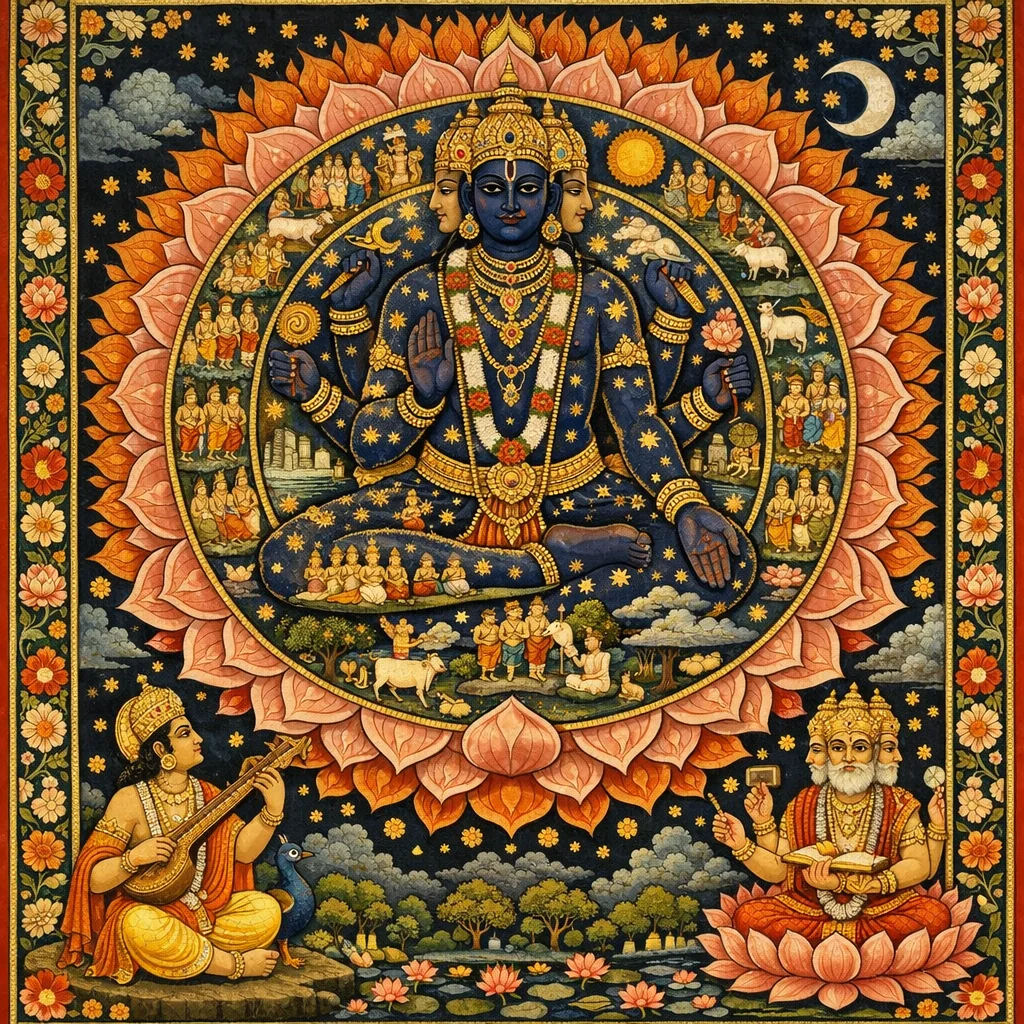
Continuing the teaching arc of Skandha 2, Nārada approaches Brahmā with reverence yet incisive theological questions. He seeks knowledge that distinguishes the individual soul (jīva) from the Supersoul (Paramātmā) and asks for a truthful account of the manifested world—its origin, creation, maintenance, and ruling authority. Testing Brahmā’s seeming independence through the spider analogy, Nārada asks whether Brahmā creates solely by his own śakti. Brahmā replies by attributing all greatness to Vāsudeva: his creative power is secondary, lit by the Lord’s effulgence, and māyā deludes those who mistake the secondary controller for the Supreme. He then outlines the process of creation (sarga–visarga): the puruṣa-avatāra, mahat-tattva, time, the guṇas, transformations of false ego, the rise of the five great elements and the senses, and the Lord’s necessary entry to enliven the universes. The chapter culminates in virāṭ-rūpa cosmography, mapping varṇas and planetary systems onto the Lord’s universal body, preparing for later, more detailed cosmological and theological exposition.
Shlokas
Verse 1
नारद उवाच देवदेव नमस्तेऽस्तु भूतभावन पूर्वज । तद् विजानीहि यज्ज्ञानमात्मतत्त्वनिदर्शनम् ॥ १ ॥
Nārada said: O god of the gods, O nourisher of all beings, O firstborn, I offer you my obeisances. Please impart that transcendental knowledge which clearly guides one to the truth of the individual ātman and the Supreme Soul, Paramātman.
Verse 2
यद्रूपं यदधिष्ठानं यत: सृष्टमिदं प्रभो । यत्संस्थं यत्परं यच्च तत् तत्त्वं वद तत्त्वत: ॥ २ ॥
My dear father, O Lord, please speak the truth of this manifest world—its form and foundation, from what it is created, how it is maintained, and under whose supreme control all this is carried out.
Verse 3
सर्वं ह्येतद् भवान् वेद भूतभव्यभवत्प्रभु: । करामलकवद् विश्वं विज्ञानावसितं तव ॥ ३ ॥
My dear father, O Lord, you know everything—past, future, and present; the entire universe is concluded within your realized knowledge, as plainly as a fruit resting in the palm of your hand.
Verse 4
यद्विज्ञानो यदाधारो यत्परस्त्वं यदात्मक: । एक: सृजसि भूतानि भूतैरेवात्ममायया ॥ ४ ॥
My dear father, what is the source of your knowledge? Under whose protection do you stand, and under whose authority do you act? What is your true position? Do you alone create all beings from the material elements by your own energy, ātma-māyā?
Verse 5
आत्मन् भावयसे तानी न पराभावयन् स्वयम् । आत्मशक्तिमवष्टभ्य ऊर्णनाभिरिवाक्लम: ॥ ५ ॥
O self-sufficient one, you yourself bring all this into manifestation and are not overcome by any other; as a spider effortlessly weaves its web by its own power, so you create by relying on your own ātma-śakti, without anyone’s help.
Verse 6
नाहं वेद परं ह्यस्मिन्नापरं न समं विभो । नामरूपगुणैर्भाव्यं सदसत् किञ्चिदन्यत: ॥ ६ ॥
O all-powerful Lord, I know neither the superior nor the inferior nor the equal; whatever is conceived through name, form, and qualities—whether eternal or temporary, real or unreal—arises from no source other than You alone.
Verse 7
स भवानचरद् घोरं यत् तप: सुसमाहित: । तेन खेदयसे नस्त्वं पराशङ्कां च यच्छसि ॥ ७ ॥
You performed terrible austerities in perfect concentration; therefore, though you are mighty in the work of creation, we are troubled by the doubt that there may be someone more powerful than you.
Verse 8
एतन्मे पृच्छत: सर्वं सर्वज्ञ सकलेश्वर । विजानीहि यथैवेदमहं बुध्येऽनुशासित: ॥ ८ ॥
O all-knowing one, Lord of all, please instruct me in everything I have asked, so that, as your student, I may understand it properly.
Verse 9
ब्रह्मोवाच सम्यक् कारुणिकस्येदं वत्स ते विचिकित्सितम् । यदहं चोदित: सौम्य भगवद्वीर्यदर्शने ॥ ९ ॥
Lord Brahmā said: My dear son Nārada, compassionate to all, your inquiry is proper, for, O gentle one, I too have been inspired to behold the prowess of Bhagavān, the Supreme Personality of Godhead.
Verse 10
नानृतं तव तच्चापि यथा मां प्रब्रवीषि भो: । अविज्ञाय परं मत्त एतावत्त्वं यतो हि मे ॥ १० ॥
O friend, what you have spoken about me is not untrue; for without knowing the Supreme Truth beyond me—Bhagavān—one is surely deluded upon beholding my mighty activities.
Verse 11
येन स्वरोचिषा विश्वं रोचितं रोचयाम्यहम् । यथार्कोऽग्निर्यथा सोमो यथर्क्षग्रहतारका: ॥ ११ ॥
By His own effulgence the universe is illumined, and by that very radiance I make the creation shine; just as when the sun appears, fire, the moon, the firmament, the planets, and the twinkling stars reveal their brightness.
Verse 12
तस्मै नमो भगवते वासुदेवाय धीमहि । यन्मायया दुर्जयया मां वदन्ति जगद्गुरुम् ॥ १२ ॥
I offer my obeisances and meditate upon Bhagavān Vāsudeva, Śrī Kṛṣṇa; by His invincible māyā, people come to call me the guru of the world.
Verse 13
विलज्जमानया यस्य स्थातुमीक्षापथेऽमुया । विमोहिता विकत्थन्ते ममाहमिति दुर्धिय: ॥ १३ ॥
The Lord’s māyā, ashamed, cannot stand before His gaze; yet those bewildered by her, of crooked intelligence, prattle on in “I” and “mine”.
Verse 14
द्रव्यं कर्म च कालश्च स्वभावो जीव एव च । वासुदेवात्परो ब्रह्मन्न च चान्योऽर्थोऽस्ति तत्त्वत: ॥ १४ ॥
Matter, action, time, nature, and the jīva are all differentiated portions of Vāsudeva; O brāhmaṇa, in truth there is no other independent value within them.
Verse 15
नारायणपरा वेदा देवा नारायणाङ्गजा: । नारायणपरा लोका नारायणपरा मखा: ॥ १५ ॥
The Vedas are centered on Nārāyaṇa; the devas are His servants, born as limbs of His body; the worlds exist for Nārāyaṇa, and sacrifices are performed only to please Him.
Verse 16
नारायणपरो योगो नारायणपरं तप: । नारायणपरं ज्ञानं नारायणपरा गति: ॥ १६ ॥
Yoga is meant for realizing Nārāyaṇa, and austerity is aimed at attaining Nārāyaṇa; transcendental knowledge is to behold Nārāyaṇa, and the supreme destination is entry into Nārāyaṇa’s kingdom.
Verse 17
तस्यापि द्रष्टुरीशस्य कूटस्थस्याखिलात्मन: । सृज्यं सृजामि सृष्टोऽहमीक्षयैवाभिचोदित: ॥ १७ ॥
Moved only by His glance—by that all-seeing Lord, the unchanging Soul of all—I unfold the creation already created by Him; and I too am created by Him alone.
Verse 18
सत्त्वं रजस्तम इति निर्गुणस्य गुणास्त्रय: । स्थितिसर्गनिरोधेषु गृहीता मायया विभो: ॥ १८ ॥
The Supreme Lord is beyond all material qualities, yet for the world’s creation, maintenance, and dissolution He, through His māyā, accepts the three modes—sattva, rajas, and tamas.
Verse 19
कार्यकारणकर्तृत्वे द्रव्यज्ञानक्रियाश्रया: । बध्नन्ति नित्यदा मुक्तं मायिनं पुरुषं गुणा: ॥ १९ ॥
These three modes, expanding as matter, knowledge, and activity, bind the jīva—eternally transcendental—within cause and effect and burden him with the sense of doership.
Verse 20
स एष भगवाल्लिंङ्गैस्त्रिभिरेतैरधोक्षज: । स्वलक्षितगतिर्ब्रह्मन् सर्वेषां मम चेश्वर: ॥ २० ॥
O brāhmaṇa Nārada, the Lord Adhokṣaja is beyond the senses of living beings because of these three modes; yet He is known by His own divine marks, and He is the controller of all—even of me.
Verse 21
कालं कर्म स्वभावं च मायेशो मायया स्वया । आत्मन् यदृच्छया प्राप्तं विबुभूषुरुपाददे ॥ २१ ॥
O Ātman, the Lord who rules over māyā, by His own potency brings forth eternal time, karma (the destiny of the jīvas), and their particular nature; and by His independent will He manifests them and again merges them back.
Verse 22
कालाद् गुणव्यतिकर: परिणाम: स्वभावत: । कर्मणो जन्म महत: पुरुषाधिष्ठितादभूत् ॥ २२ ॥
After the advent of the first Puruṣa (Kāraṇārṇavaśāyī Viṣṇu), the mahattattva manifests. Then time appears, and in time the three guṇas naturally intermingle and transform; under the presiding Purusha, karmic activity is born.
Verse 23
महतस्तु विकुर्वाणाद्रज:सत्त्वोपबृंहितात् । तम:प्रधानस्त्वभवद् द्रव्यज्ञानक्रियात्मक: ॥ २३ ॥
Material activity arises when the mahattattva is agitated. First, through the strengthening of sattva and rajas, transformation begins; later, as tamas predominates, matter, knowledge of matter, and the various activities rooted in material knowing come forth.
Verse 24
सोऽहङ्कार इति प्रोक्तो विकुर्वन् समभूत्त्रिधा । वैकारिकस्तैजसश्च तामसश्चेति यद्भिदा । द्रव्यशक्ति: क्रियाशक्तिर्ज्ञानशक्तिरिति प्रभो ॥ २४ ॥
That transforming principle is called ahaṅkāra, and it becomes threefold: vaikārika, taijasa, and tāmasa. O Lord, these divisions are known as the powers of matter, knowledge, and action. Nārada, you are fully able to grasp this.
Verse 25
तामसादपि भूतादेर्विकुर्वाणादभून्नभ: । तस्य मात्रा गुण: शब्दो लिङ्गं यद् द्रष्टृदृश्ययो: ॥ २५ ॥
From the tāmasa aspect of false ego (bhūtādi) in transformation, the first of the five elements—ākāśa, the ether—arises. Its subtle measure is the quality of sound (śabda), the sign of the relation between seer and seen.
Verse 26
नभसोऽथ विकुर्वाणादभूत् स्पर्शगुणोऽनिल: । परान्वयाच्छब्दवांश्च प्राण ओज: सहो बलम् ॥ २६ ॥ वायोरपि विकुर्वाणात् कालकर्मस्वभावत: । उदपद्यत तेजो वै रूपवत् स्पर्शशब्दवत् ॥ २७ ॥ तेजसस्तु विकुर्वाणादासीदम्भो रसात्मकम् । रूपवत् स्पर्शवच्चाम्भो घोषवच्च परान्वयात् ॥ २८ ॥ विशेषस्तु विकुर्वाणादम्भसो गन्धवानभूत् । परान्वयाद् रसस्पर्शशब्दरूपगुणान्वित: ॥ २९ ॥
As ākāśa transforms, vāyu arises with the quality of touch; and by prior succession it also bears sound, becoming the basis of prāṇa, ojas, endurance, and strength. When vāyu transforms according to time, karma, and nature, tejas (fire) is born, endowed with form and also with touch and sound. From the transformation of tejas, water manifests, of the essence of taste (rasa), and likewise possessing form, touch, and sound. And from the particular transformation of water, pṛthivī (earth) appears with fragrance; and, as before, it is endowed with taste, touch, sound, and form.
Verse 27
नभसोऽथ विकुर्वाणादभूत् स्पर्शगुणोऽनिल: । परान्वयाच्छब्दवांश्च प्राण ओज: सहो बलम् ॥ २६ ॥ वायोरपि विकुर्वाणात् कालकर्मस्वभावत: । उदपद्यत तेजो वै रूपवत् स्पर्शशब्दवत् ॥ २७ ॥ तेजसस्तु विकुर्वाणादासीदम्भो रसात्मकम् । रूपवत् स्पर्शवच्चाम्भो घोषवच्च परान्वयात् ॥ २८ ॥ विशेषस्तु विकुर्वाणादम्भसो गन्धवानभूत् । परान्वयाद् रसस्पर्शशब्दरूपगुणान्वित: ॥ २९ ॥
From the transformation of the sky (ether) arose air, endowed with the quality of touch; and by prior succession it also bears sound, and there appear prāṇa, ojas, saha, and bala. When air transforms according to time, karma, and nature, fire (tejas) is born, possessing form and also touch and sound. From the transformation of fire, water manifests, of the essence of taste, and it too possesses form, touch, and resonance. From the transformation of water, earth appears fragrant, and as before it becomes complete with the qualities of taste, touch, sound, and form.
Verse 28
नभसोऽथ विकुर्वाणादभूत् स्पर्शगुणोऽनिल: । परान्वयाच्छब्दवांश्च प्राण ओज: सहो बलम् ॥ २६ ॥ वायोरपि विकुर्वाणात् कालकर्मस्वभावत: । उदपद्यत तेजो वै रूपवत् स्पर्शशब्दवत् ॥ २७ ॥ तेजसस्तु विकुर्वाणादासीदम्भो रसात्मकम् । रूपवत् स्पर्शवच्चाम्भो घोषवच्च परान्वयात् ॥ २८ ॥ विशेषस्तु विकुर्वाणादम्भसो गन्धवानभूत् । परान्वयाद् रसस्पर्शशब्दरूपगुणान्वित: ॥ २९ ॥
From the transformation of fire (tejas), water manifests, whose very essence is taste; and by prior succession it is endowed with form, touch, and resonance (ghoṣa).
Verse 29
नभसोऽथ विकुर्वाणादभूत् स्पर्शगुणोऽनिल: । परान्वयाच्छब्दवांश्च प्राण ओज: सहो बलम् ॥ २६ ॥ वायोरपि विकुर्वाणात् कालकर्मस्वभावत: । उदपद्यत तेजो वै रूपवत् स्पर्शशब्दवत् ॥ २७ ॥ तेजसस्तु विकुर्वाणादासीदम्भो रसात्मकम् । रूपवत् स्पर्शवच्चाम्भो घोषवच्च परान्वयात् ॥ २८ ॥ विशेषस्तु विकुर्वाणादम्भसो गन्धवानभूत् । परान्वयाद् रसस्पर्शशब्दरूपगुणान्वित: ॥ २९ ॥
From the transformation of water arises the particular manifestation—earth, endowed with fragrance; and by prior succession it becomes invested with the qualities of taste, touch, sound, and form.
Verse 30
वैकारिकान्मनो जज्ञे देवा वैकारिका दश । दिग्वातार्कप्रचेतोऽश्विवह्नीन्द्रोपेन्द्रमित्रका: ॥ ३० ॥
From the mode of goodness (vaikārika) the mind (manas) was born, and along with it appeared ten vaikārika deities who preside over bodily movements: the guardians of the directions, Vāyu, Sūrya, Pracetas (Varuṇa), the Aśvinī-kumāras, Agni, Indra, Upendra (Vāmana/Viṣṇu), Mitra, and Prajāpati (Brahmā).
Verse 31
तैजसात् तु विकुर्वाणादिन्द्रियाणि दशाभवन् । ज्ञानशक्ति: क्रियाशक्तिर्बुद्धि: प्राणश्च तैजसौ । श्रोत्रं त्वग्घ्राणदृग्जिह्वा वागदोर्मेढ्राङ्घ्रिपायव: ॥ ३१ ॥
From the further transformation of rajas (taijasa) arose the ten sense organs; and from that same taijasa also manifested the power of knowledge, the power of action, intelligence (buddhi), and prāṇa. These organs are: ear, skin, nose, eyes, tongue, speech, hands, genitals, feet, and the outlet of evacuation.
Verse 32
यदैतेऽसङ्गता भावा भूतेन्द्रियमनोगुणा: । यदायतननिर्माणे न शेकुर्ब्रह्मवित्तम ॥ ३२ ॥
O Nārada, best among the knowers of Brahman: so long as the elements, the senses, the mind, and the guṇas of nature remain unjoined, the bodily form cannot be fashioned.
Verse 33
तदा संहृत्य चान्योन्यं भगवच्छक्तिचोदिता: । सदसत्त्वमुपादाय चोभयं ससृजुर्ह्यद: ॥ ३३ ॥
Thus, when all these were assembled under the urging of Bhagavān’s energy, this universe surely came forth, accepting both sat and asat—the primary and secondary causes of creation.
Verse 34
वर्षपूगसहस्रान्ते तदण्डमुदकेशयम् । कालकर्मस्वभावस्थो जीवोऽजीवमजीवयत् ॥ ३४ ॥
Thus, for thousands of yuga-cycles, all the universes lay within the waters (the Causal Ocean); then the Lord of living beings, abiding as time, karma, and nature, entered each one and fully enlivened it.
Verse 35
स एव पुरुषस्तस्मादण्डं निर्भिद्य निर्गत: । सहस्रोर्वङ्घ्रिबाह्वक्ष: सहस्राननशीर्षवान् ॥ ३५ ॥
That very Puruṣa (Mahā-Viṣṇu), though reclining in the Causal Ocean, manifested forth; breaking open the cosmic egg, He entered each universe as Hiraṇyagarbha and assumed the virāṭ-rūpa, with thousands of feet, arms, eyes, mouths, and heads.
Verse 36
यस्येहावयवैर्लोकान् कल्पयन्ति मनीषिण: । कट्यादिभिरध: सप्त सप्तोर्ध्वं जघनादिभि: ॥ ३६ ॥
Great sages conceive that all the planetary systems of this universe are displays of the Lord’s universal body (virāṭ): seven worlds below, from the waist downward, and seven worlds above, from the hips upward.
Verse 37
पुरुषस्य मुखं ब्रह्म क्षत्रमेतस्य बाहव: । ऊर्वोर्वैश्यो भगवत: पद्भ्यां शूद्रो व्यजायत ॥ ३७ ॥
From the Lord’s mouth come the brāhmaṇas; from His arms, the kṣatriyas; from His thighs, the vaiśyas; and from His feet, the śūdras are born.
Verse 38
भूर्लोक: कल्पित: पद्भ्यां भुवर्लोकोऽस्य नाभित: । हृदा स्वर्लोक उरसा महर्लोको महात्मन: ॥ ३८ ॥
Bhūrloka and the lower realms are situated in His feet; Bhuvarloka is in His navel; and the higher worlds such as Svargaloka and Maharloka rest in the heart and chest of the Supreme Lord.
Verse 39
ग्रीवायां जनलोकोऽस्य तपोलोक: स्तनद्वयात् । मूर्धभि: सत्यलोकस्तु ब्रह्मलोक: सनातन: ॥ ३९ ॥
In the Lord’s universal form, Janaloka and Tapoloka extend from the forepart of the chest up to the neck, while Satyaloka, the highest realm, rests upon His head; yet the spiritual worlds—Brahmaloka—are eternal.
Verse 40
तत्कट्यां चातलं क्लृप्तमूरुभ्यां वितलं विभो: । जानुभ्यां सुतलं शुद्धं जङ्घाभ्यां तु तलातलम् ॥ ४० ॥ महातलं तु गुल्फाभ्यां प्रपदाभ्यां रसातलम् । पातालं पादतलत इति लोकमय: पुमान् ॥ ४१ ॥
My dear Nārada, among the fourteen worlds there are seven lower realms: Atala at the waist, Vitala at the thighs, Sutala at the knees, Talātala at the shanks, Mahātala at the ankles, Rasātala upon the upper part of the feet, and Pātāla on the soles. Thus the Lord’s virāṭ form is filled with all planetary systems.
Verse 41
तत्कट्यां चातलं क्लृप्तमूरुभ्यां वितलं विभो: । जानुभ्यां सुतलं शुद्धं जङ्घाभ्यां तु तलातलम् ॥ ४० ॥ महातलं तु गुल्फाभ्यां प्रपदाभ्यां रसातलम् । पातालं पादतलत इति लोकमय: पुमान् ॥ ४१ ॥
My dear Nārada, among the fourteen worlds there are seven lower realms: Atala at the waist, Vitala at the thighs, Sutala at the knees, Talātala at the shanks, Mahātala at the ankles, Rasātala upon the upper part of the feet, and Pātāla on the soles. Thus the Lord’s virāṭ form is filled with all planetary systems.
Verse 42
भूर्लोक: कल्पित: पद्भ्यां भुवर्लोकोऽस्य नाभित: । स्वर्लोक: कल्पितो मूर्ध्ना इति वा लोककल्पना ॥ ४२ ॥
Others divide the entire planetary order into three: Bhūrloka upon His legs (up to the earth), Bhuvarloka at His navel, and Svarloka from His chest to His head—thus is the conception of the worlds.
Frequently Asked Questions
To establish proper hierarchy of causality: Brahmā is immensely powerful yet not ultimate. The challenge exposes a common theological error—confusing empowered administration (visarga) with the Supreme source (Vāsudeva). This protects the student from māyā’s distortion that equates cosmic power with Godhood.
Sarga refers to the Lord’s primary manifestation of the creation principles—mahat-tattva, time, and guṇas—through the puruṣa-avatāra. Visarga is Brahmā’s secondary work of assembling and differentiating beings and structures from those principles. The chapter stresses that Brahmā’s role is inspired and enabled by the Lord’s Supersoul presence.
Those “less intelligent” who, influenced by māyā, mistake Brahmā’s observable creative prowess for ultimate divinity. Brahmā corrects this by offering obeisances to Kṛṣṇa/Vāsudeva and explaining that his own brilliance is like reflected light—real but derivative.
It functions as contemplative cosmography: the universe is read as the Lord’s body, converting geography into theology. This supports meditation (dhyāna) and devotion by making the cosmos a reminder of the Supreme Person, while also situating social orders (varṇas) and lokas within a unified, God-centered ontology.