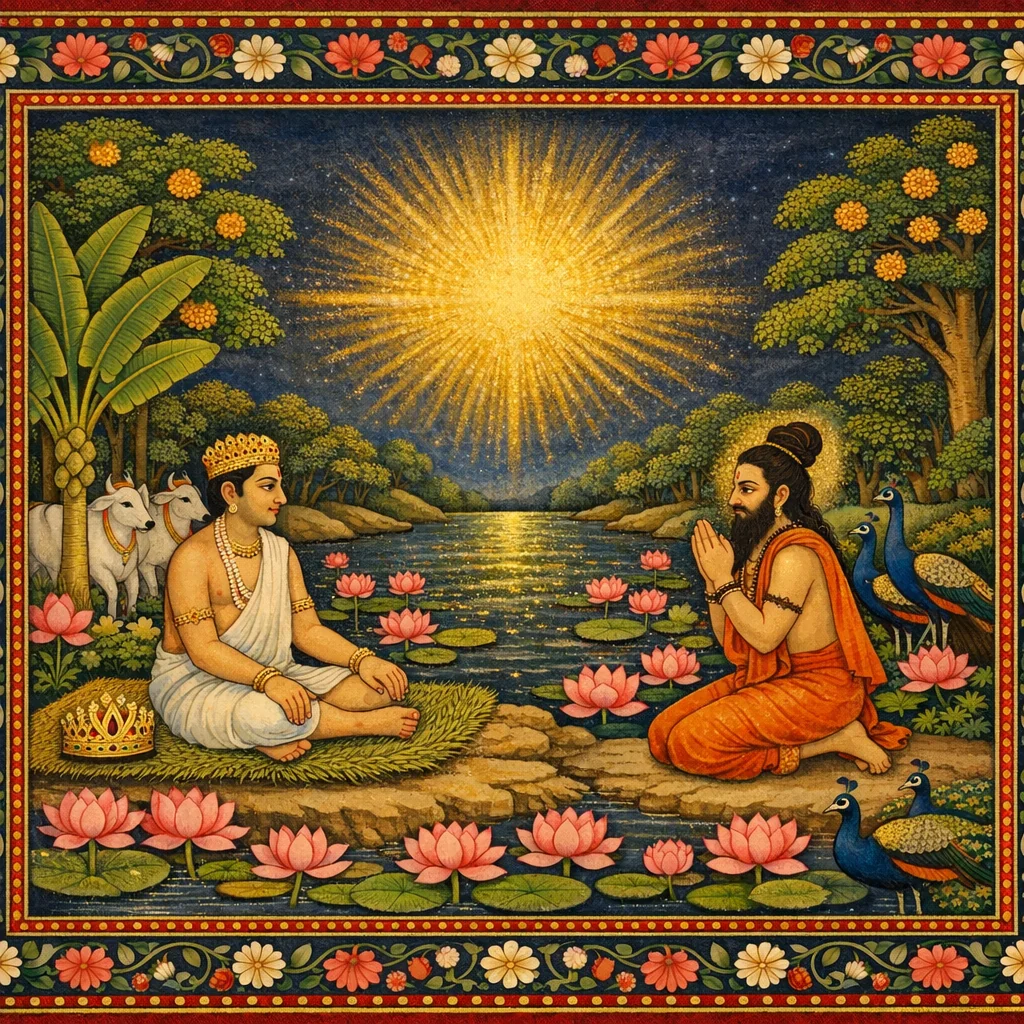
Adhyaya 4
Parīkṣit’s Full Surrender and Śukadeva’s Maṅgalācaraṇa to Kṛṣṇa (Inquiry into Creation, Maintenance, and Dissolution)
Continuing the deathbed dialogue, Sūta tells how Parīkṣit—after hearing Śukadeva on self-realization—becomes wholly absorbed in Kṛṣṇa and gives up attachment to body, family, royal splendor, and even the karma-driven triad of aims (dharma, artha, kāma). From this purified state he poses the “people’s questions” about Bhagavān’s acintya śaktis: how the Lord creates innumerable universes, how He uses the guṇas and His expansions (aṁśa/kalā) to maintain and dissolve the cosmos, and how the One appears to act singly, simultaneously, or in sequence. Asked to speak of the Lord’s creative energy, Śukadeva first remembers Hṛṣīkeśa (master of the senses) and offers a sustained maṅgalācaraṇa of obeisances: Kṛṣṇa purifies through bhakti, grants liberation, empowers Brahmā with Vedic knowledge, enters the universe as the puruṣa, and delivers even the most fallen through association with devotees. The chapter ends by pointing to the paramparā source—Brahmā answering Nārada from what he received directly from the Lord—setting up the next systematic cosmological exposition.
Shlokas
Verse 1
सूत उवाच वैयासकेरिति वचस्तत्त्वनिश्चयमात्मन: । उपधार्य मतिं कृष्णे औत्तरेय: सतीं व्यधात् ॥ १ ॥
Sūta Gosvāmī said: Mahārāja Parīkṣit, the son of Uttarā, having heard the words of Śukadeva—the son of Vyāsa—which ascertain the truth of the self, faithfully fixed his mind in concentration upon Lord Kṛṣṇa.
Verse 2
आत्मजायासुतागारपशुद्रविणबन्धुषु । राज्ये चाविकले नित्यं विरूढां ममतां जहौ ॥ २ ॥
By his wholehearted attraction to Lord Kṛṣṇa, Mahārāja Parīkṣit abandoned the deep-rooted possessiveness for his body, wife, children, palace, horses and elephants, treasury, friends and relatives, and his undisputed kingdom.
Verse 3
पप्रच्छ चेममेवार्थं यन्मां पृच्छथ सत्तमा: । कृष्णानुभावश्रवणे श्रद्दधानो महामना: ॥ ३ ॥ संस्थां विज्ञाय संन्यस्य कर्म त्रैवर्गिकं च यत् । वासुदेवे भगवति आत्मभावं दृढं गत: ॥ ४ ॥
O best of sages, the great-souled Mahārāja Parīkṣit, faithful in hearing Kṛṣṇa’s glories, knowing death was near, renounced all fruit-seeking acts—dharma, artha, and kāma—and, firmly fixed in his natural love for Bhagavān Vāsudeva, asked these very questions, just as you ask me.
Verse 4
पप्रच्छ चेममेवार्थं यन्मां पृच्छथ सत्तमा: । कृष्णानुभावश्रवणे श्रद्दधानो महामना: ॥ ३ ॥ संस्थां विज्ञाय संन्यस्य कर्म त्रैवर्गिकं च यत् । वासुदेवे भगवति आत्मभावं दृढं गत: ॥ ४ ॥
O best of sages, the great-souled Mahārāja Parīkṣit, faithful in hearing Kṛṣṇa’s glories, knowing death was near, renounced all fruit-seeking acts—dharma, artha, and kāma—and, firmly fixed in his natural love for Bhagavān Vāsudeva, asked these very questions, just as you ask me.
Verse 5
राजोवाच समीचीनं वचो ब्रह्मन् सर्वज्ञस्य तवानघ । तमो विशीर्यते मह्यं हरे: कथयत: कथाम् ॥ ५ ॥
The King said: O spotless brāhmaṇa, since you are all-knowing, whatever you have spoken seems perfectly proper to me. As you narrate Hari’s sacred topics, your words are steadily destroying the darkness of my ignorance.
Verse 6
भूय एव विवित्सामि भगवानात्ममायया । यथेदं सृजते विश्वं दुर्विभाव्यमधीश्वरै: ॥ ६ ॥
I beg to know further how Bhagavān, by His own ātma-māyā, creates these manifest universes as they are—something inconceivable even to the great devas.
Verse 7
यथा गोपायति विभुर्यथा संयच्छते पुन: । यां यां शक्तिमुपाश्रित्य पुरुशक्ति: पर: पुमान् । आत्मानं क्रीडयन् क्रीडन् करोति विकरोति च ॥ ७ ॥
As the all-powerful Supreme Lord, taking shelter of His various energies, maintains the universe and again withdraws it, so the Supreme Person, endowed with manifold potencies, creates and transforms in a spirit of divine play.
Verse 8
नूनं भगवतो ब्रह्मन् हरेरद्भुतकर्मण: । दुर्विभाव्यमिवाभाति कविभिश्चापि चेष्टितम् ॥ ८ ॥
O learned brāhmaṇa, the wondrous deeds of Bhagavān Hari are truly marvelous; even to great poets and scholars they appear inconceivable, for their finest efforts still fall short of comprehending them.
Verse 9
यथा गुणांस्तु प्रकृतेर्युगपत् क्रमशोऽपि वा । बिभर्ति भूरिशस्त्वेक: कुर्वन् कर्माणि जन्मभि: ॥ ९ ॥
Just as the modes of material nature may be borne by the One—either simultaneously or in succession, in many ways—so the one Bhagavān acts through many births and forms, directing those modes.
Verse 10
विचिकित्सितमेतन्मे ब्रवीतु भगवान् यथा । शाब्दे ब्रह्मणि निष्णात: परस्मिंश्च भवान्खलु ॥ १० ॥
Kindly resolve all these doubtful inquiries as they truly are, for you are deeply learned in the śabda-brahman of the Vedas and are also realized in the Supreme Truth.
Verse 11
सूत उवाच इत्युपामन्त्रितो राज्ञा गुणानुकथने हरे: । हृषीकेशमनुस्मृत्य प्रतिवक्तुं प्रचक्रमे ॥ ११ ॥
Sūta Gosvāmī said: Thus requested by the King to describe the creative potency of Bhagavān Hari, Śukadeva Gosvāmī remembered Hṛṣīkeśa, Śrī Kṛṣṇa, and then began to reply in a proper, systematic way.
Verse 12
श्री शुक उवाच नम: परस्मै पुरुषाय भूयसे सदुद्भवस्थाननिरोधलीलया । गृहीतशक्तित्रितयाय देहिना- मन्तर्भवायानुपलक्ष्यवर्त्मने ॥ १२ ॥
Śrī Śukadeva said: I offer repeated obeisances to the Supreme Purusha, who for His līlā of creation, maintenance, and dissolution accepts the power of nature’s three modes; He dwells as the complete whole within every embodied being, and His ways are inconceivable.
Verse 13
भूयो नम: सद्वृजिनच्छिदेऽसता- मसम्भवायाखिलसत्त्वमूर्तये । पुंसां पुन: पारमहंस्य आश्रमे व्यवस्थितानामनुमृग्यदाशुषे ॥ १३ ॥
Again I offer my obeisances to the Lord who is the very form of complete existence: He cuts away the distresses of saintly bhaktas and destroys the onward growth of atheistic temper in the asuric nondevotees; and to transcendentalists established in the paramahaṁsa stage, He swiftly grants their destined goal.
Verse 14
नमो नमस्तेऽस्त्वृषभाय सात्वतां विदूरकाष्ठाय मुहु: कुयोगिनाम् । निरस्तसाम्यातिशयेन राधसा स्वधामनि ब्रह्मणि रंस्यते नम: ॥ १४ ॥
Obeisances, obeisances to You, the foremost of the Sātvatas—ever unreachable to the misguided yogīs, like wood lying far away. By Your immeasurable, radiant opulence the very notion of an equal is cast aside; You delight in Your own sva-dhāma, the spiritual sky of Brahman.
Verse 15
यत्कीर्तनं यत्स्मरणं यदीक्षणं यद्वन्दनं यच्छ्रवणं यदर्हणम् । लोकस्य सद्यो विधुनोति कल्मषं तस्मै सुभद्रश्रवसे नमो नम: ॥ १५ ॥
Again and again I offer obeisances to the all-auspicious Lord Śrī Kṛṣṇa: glorifying Him, remembering Him, beholding Him, praying to Him, hearing about Him, and worshiping Him at once wash away the world’s sinful taint.
Verse 16
विचक्षणा यच्चरणोपसादनात् सङ्गं व्युदस्योभयतोऽन्तरात्मन: । विन्दन्ति हि ब्रह्मगतिं गतक्लमा- स्तस्मै सुभद्रश्रवसे नमो नम: ॥ १६ ॥
Again and again I offer obeisances to the all-auspicious Lord Śrī Kṛṣṇa. The discerning, simply by taking shelter of His lotus feet, cast off attachment to both present and future embodied life; freed from strain, they advance with ease toward brahma-gati, spiritual existence.
Verse 17
तपस्विनो दानपरा यशस्विनो मनस्विनो मन्त्रविद: सुमङ्गला: । क्षेमं न विन्दन्ति विना यदर्पणं तस्मै सुभद्रश्रवसे नमो नम: ॥ १७ ॥
Even ascetics, great donors, the renowned, the deep-minded, the knowers of mantras, and the auspicious cannot attain true welfare unless they offer those exalted qualities in the Lord’s service. Therefore I bow again and again to Śrī Kṛṣṇa, of blessed and auspicious fame.
Verse 18
किरातहूणान्ध्रपुलिन्दपुल्कशा आभीरशुम्भा यवना: खसादय: । येऽन्ये च पापा यदपाश्रयाश्रया: शुध्यन्ति तस्मै प्रभविष्णवे नम: ॥ १८ ॥
Kirāta, Hūṇa, Āndhra, Pulinda, Pulkaśa, Ābhīra, Śumbha, Yavana, the Khasa peoples, and even others steeped in sin are purified when they take shelter of the Lord’s devotees, by His supreme potency. To that Prabhaviṣṇu I offer my obeisances.
Verse 19
स एष आत्मात्मवतामधीश्वर- स्त्रयीमयो धर्ममयस्तपोमय: । गतव्यलीकैरजशङ्करादिभि- र्वितर्क्यलिङ्गो भगवान् प्रसीदताम् ॥ १९ ॥
He is the Paramātmā and the Supreme Lord of all self-realized souls—the very embodiment of the three Vedas, of dharma, and of austerity. Revered by Brahmā, Śaṅkara, and all saints free from pretense, may that Bhagavān be pleased with me.
Verse 20
श्रिय: पतिर्यज्ञपति: प्रजापति- र्धियां पतिर्लोकपतिर्धरापति: । पतिर्गतिश्चान्धकवृष्णिसात्वतां प्रसीदतां मे भगवान् सतां पति: ॥ २० ॥
May Bhagavān Śrī Kṛṣṇa—the Lord of the saintly—be merciful to me: the husband of all goddesses of fortune, the master of sacrifice, the ruler of all beings, the lord of intelligence, the lord of all worlds and of the earth, and the shelter and goal of the Andhaka, Vṛṣṇi, and Sātvata (Yadu) line.
Verse 21
यदङ्घ्र्यध्यानसमाधिधौतया धियानुपश्यन्ति हि तत्त्वमात्मन: । वदन्ति चैतत् कवयो यथारुचं स मे मुकुन्दो भगवान् प्रसीदताम् ॥ २१ ॥
By meditating on His lotus feet, the devotee—his intelligence cleansed in samādhi—beholds the truth of the Self; yet poets and speculators speak of Him according to their own fancy. May Mukunda, the giver of liberation, be pleased with me.
Verse 22
प्रचोदिता येन पुरा सरस्वती वितन्वताजस्य सतीं स्मृतिं हृदि । स्वलक्षणा प्रादुरभूत् किलास्यत: स मे ऋषीणामृषभ: प्रसीदताम् ॥ २२ ॥
May the Lord—who at creation’s dawn inspired Sarasvatī and expanded within Brahmā’s heart the pure remembrance and knowledge, and who seemed to manifest from Brahmā’s mouth—He, the foremost of sages, be pleased with me.
Verse 23
भूतैर्महद्भिर्य इमा: पुरो विभु- र्निर्माय शेते यदमूषु पूरुष: । भुङ्क्ते गुणान् षोडश षोडशात्मक: सोऽलङ्कृषीष्ट भगवान् वचांसि मे ॥ २३ ॥
May Bhagavān, the all-powerful Lord who fashions these bodies from the great elements and lies within the universe to enliven them, and who as the Puruṣa incarnation subjects the jīva to the sixteenfold divisions of the guṇas, graciously adorn my words.
Verse 24
नमस्तस्मै भगवते वासुदेवाय वेधसे । पपुर्ज्ञानमयं सौम्या यन्मुखाम्बुरुहासवम् ॥ २४ ॥
I offer my respectful obeisances to Śrī Vyāsadeva, the Vedhā, an incarnation of Vāsudeva who compiled the Vedic scriptures. O gentle one, pure devotees drink the nectar of divine knowledge that drips from the Lord’s lotuslike mouth.
Verse 25
एतदेवात्मभू राजन् नारदाय विपृच्छते । वेदगर्भोऽभ्यधात् साक्षाद् यदाह हरिरात्मन: ॥ २५ ॥
O King, when Nārada inquired, Brahmā, the self-born—filled with Vedic knowledge from birth—explained this very subject exactly as Hari had spoken it directly to his own son.
Frequently Asked Questions
Parīkṣit renounces fruitive motivation (karma-miśra aims) because death is imminent and because attraction to Kṛṣṇa has matured into niṣkāma-bhakti. His questions are not curiosity for control or prestige; they are bhakti-driven inquiry (paripraśna) meant to fix consciousness on Bhagavān. In the Bhāgavata, cosmology becomes a meditation-object: by hearing how everything depends on Kṛṣṇa’s śakti, the listener’s attachment to temporary designations dissolves.
Bhagavān is advaya (non-dual) in essence, yet manifests variegated expansions through His internal and external energies. The guṇas belong to prakṛti (material nature), while the Lord remains transcendental; He can preside over the guṇas via puruṣa expansions without becoming conditioned. Thus, the One may appear to act alone, simultaneously in multiple forms, or sequentially—without compromising unity—because all forms are expressions of the same supreme reality and will.
They denote groups traditionally viewed as mleccha or outside orthodox Vedic culture. The Bhāgavata’s theological point is universal eligibility: even those habituated to pāpa (sin) can be purified by taking shelter of the Lord’s devotees (bhakta-āśraya). Deliverance is attributed to the Lord’s supreme power operating through sādhus, emphasizing sadhu-saṅga as a decisive means of purification.
This functions as maṅgalācaraṇa (auspicious invocation) and a hermeneutic key: the subject of creation must be approached through devotion and humility, not mere speculation. The prayers also summarize core doctrines—Kṛṣṇa as liberator, indwelling Supersoul, source of Brahmā’s knowledge, and puruṣa entering the cosmos—thereby framing the forthcoming cosmology as bhakti-siddhānta rather than impersonal physics.