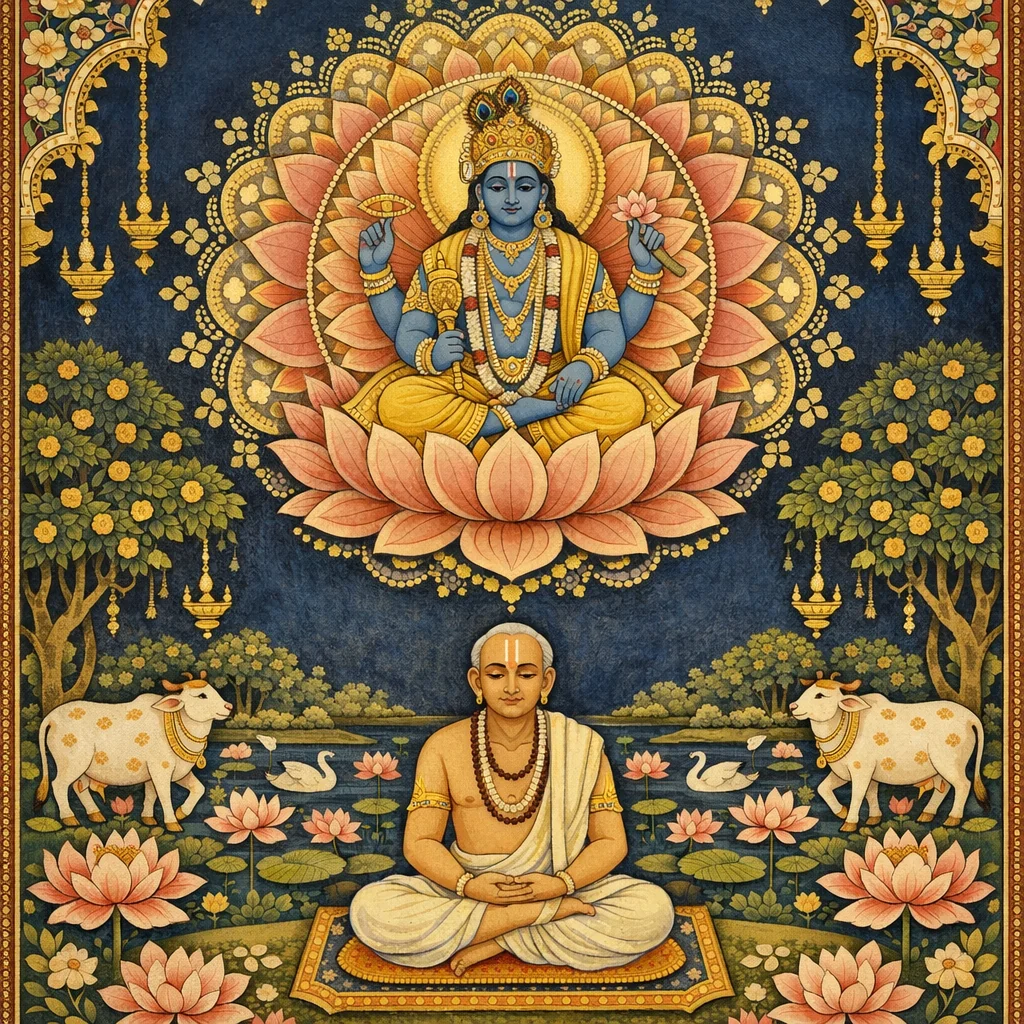
Adhyaya 2
The Lord in the Heart and the Discipline of Yoga-Bhakti
Continuing the canto’s stress on hearing and fixing the mind on the Supreme, Śukadeva tells Parīkṣit how Brahmā, before creation manifested, regained awareness by meditating on the virāṭ-rūpa and pleasing the Lord—showing that cosmogenesis is rooted in devotion, not independent material causation. He criticizes bewildering Vedic sound that diverts people toward heavenly ambitions, urging contentment with bare necessities, renunciation, and reliance on the Lord’s protection rather than flattering the wealthy. The chapter then presents a practical meditative theology: the Lord as Paramātmā in the heart, four-armed and adorned, and a stepwise meditation from the lotus feet up to the smiling face that progressively purifies intelligence. It next describes yogic departure at death—regulating prāṇa, merging mind and self toward the Superself—and contrasts desireless bhakti-yogīs with seekers of siddhis or higher planets. Expanding into cosmological routes (Suṣumṇā, Vaiśvānara, Śiśumāra, Maharloka, Satyaloka), it culminates in the doctrinal conclusion that Brahmā’s Vedic scrutiny establishes attraction to Śrī Kṛṣṇa as the highest dharma, and that constant hearing and remembrance lead back to Godhead, preparing for deeper creation accounts and the Bhāgavatam’s explicit Kṛṣṇa-centered theology ahead.
Shlokas
Verse 1
श्रीशुक उवाच एवं पुरा धारणयात्मयोनि- र्नष्टां स्मृतिं प्रत्यवरुध्य तुष्टात् । तथा ससर्जेदममोघदृष्टि- र्यथाप्ययात् प्राग् व्यवसायबुद्धि: ॥ १ ॥
Śrī Śukadeva Gosvāmī said: In former times, before the cosmos was manifest, self-born Lord Brahmā meditated upon the virāṭ-rūpa and, by pleasing the Lord, regained his lost remembrance. Then, with unfailing vision and firm resolve, he reconstructed creation as it had been before.
Verse 2
शाब्दस्य हि ब्रह्मण एष पन्था यन्नामभिर्ध्यायति धीरपार्थै: । परिभ्रमंस्तत्र न विन्दतेऽर्थान् मायामये वासनया शयान: ॥ २ ॥
The presentation of Vedic sound (śabda-brahman) can be so bewildering that it turns people’s intelligence toward empty aims such as heavenly realms. Conditioned souls drift like dreamers, lying in desires for illusory pleasures, yet in truth they find no tangible happiness there.
Verse 3
अत: कविर्नामसु यावदर्थ: स्यादप्रमत्तो व्यवसायबुद्धि: । सिद्धेऽन्यथार्थे न यतेत तत्र परिश्रमं तत्र समीक्षमाण: ॥ ३ ॥
Therefore the enlightened person should strive, within the world of names and forms, only for life’s bare necessities. Remaining vigilant and firm in resolve, he should not labor for what is unwanted, seeing clearly that such pursuits are nothing but fruitless toil.
Verse 4
सत्यां क्षितौ किं कशिपो: प्रयासै- र्बाहौ स्वसिद्धे ह्युपबर्हणै: किम् । सत्यञ्जलौ किं पुरुधान्नपात्र्या दिग्वल्कलादौ सति किं दुकूलै: ॥ ४ ॥
When the earth itself is ample as a bed, what need is there for cots and bedding? When one’s own arms can serve as a pillow, what need is there for a pillow? When the palms of the hands can be a vessel, what need is there for many utensils? When there is covering such as tree-bark and the cloak of the directions, what need is there for garments?
Verse 5
चीराणि किं पथि न सन्ति दिशन्ति भिक्षां नैवाङ्घ्रिपा: परभृत: सरितोऽप्यशुष्यन् । रुद्धा गुहा: किमजितोऽवति नोपसन्नान् कस्माद् भजन्ति कवयो धनदुर्मदान्धान् ॥ ५ ॥
Are there no torn garments on the roadside? Do the trees, meant to sustain others, no longer give charity? Have the rivers dried so they cannot quench the thirsty? Are the mountain caves now shut? And above all, does the invincible Lord Ajita not protect those who fully surrender? Why then should sages flatter those blinded by the pride of hard-earned wealth?
Verse 6
एवं स्वचित्ते स्वत एव सिद्ध आत्मा प्रियोऽर्थो भगवाननन्त: । तं निर्वृतो नियतार्थो भजेत संसारहेतूपरमश्च यत्र ॥ ६ ॥
Thus, with the mind made steady, one should serve and worship the Paramatma dwelling in one’s own heart. He is Bhagavan—almighty, eternal, and unlimited—the supreme goal of life; by His worship the very cause of bondage in samsara comes to an end.
Verse 7
कस्तां त्वनादृत्य परानुचिन्ता- मृते पशूनसतीं नाम कुर्यात् । पश्यञ्जनं पतितं वैतरण्यां स्वकर्मजान् परितापाञ्जुषाणम् ॥ ७ ॥
Who, other than gross materialists, would neglect such transcendental contemplation and cling only to fleeting names? They see the masses fallen into the river of suffering like the Vaitarani, enduring the burning pains born of their own karma.
Verse 8
केचित् स्वदेहान्तर्हृदयावकाशे प्रादेशमात्रं पुरुषं वसन्तम् । चतुर्भुजं कञ्जरथाङ्गशङ्ख- गदाधरं धारणया स्मरन्ति ॥ ८ ॥
Others, by steady concentration, remember the Supreme Person dwelling within the body in the region of the heart, of pradesha-matra measure, four-armed, bearing the lotus, the cakra, the conch (shankha), and the mace (gada).
Verse 9
प्रसन्नवक्त्रं नलिनायतेक्षणं कदम्बकिञ्जल्कपिशङ्गवाससम् । लसन्महारत्नहिरण्मयाङ्गदं स्फुरन्महारत्नकिरीटकुण्डलम् ॥ ९ ॥
His face shines with serene joy; His eyes are wide like lotus petals. He wears yellow garments like the pollen of the kadamba flower, adorned with jewel-studded golden ornaments; His radiant crown and earrings sparkle with great gems.
Verse 10
उन्निद्रहृत्पङ्कजकर्णिकालये योगेश्वरास्थापितपादपल्लवम् । श्रीलक्षणं कौस्तुभरत्नकन्धर- मम्लानलक्ष्म्या वनमालयाचितम् ॥ १० ॥
His lotus feet are set upon the lotus-hearts of the great yogīs, upon their innermost whorl. Upon His chest shine the Śrīvatsa mark and the Kaustubha jewel; gems gleam upon His shoulders, and His whole form is adorned with a fresh forest-garland (vanamālā).
Verse 11
विभूषितं मेखलयाङ्गुलीयकै- र्महाधनैर्नूपुरकङ्कणादिभि: । स्निग्धामलाकुञ्चितनीलकुन्तलै- र्विरोचमानाननहासपेशलम् ॥ ११ ॥
He is adorned with a jeweled girdle, precious rings upon His fingers, anklets, bangles, and other ornaments. His hair is pure and glossy with oil, curling with a bluish sheen, and His smiling face is exquisitely pleasing.
Verse 12
अदीनलीलाहसितेक्षणोल्लसद्- भ्रूभङ्गसंसूचितभूर्यनुग्रहम् । ईक्षेत चिन्तामयमेनमीश्वरं यावन्मनो धारणयावतिष्ठते ॥ १२ ॥
His magnanimous līlā, the radiance of His smiling glance, and the play of His brows all proclaim His abundant grace. Therefore, as long as the mind can remain steady in meditation, one should contemplate this transcendental form of the Lord.
Verse 13
एकैकशोऽङ्गानि धियानुभावयेत् पादादि यावद्धसितं गदाभृत: । जितं जितं स्थानमपोह्य धारयेत् परं परं शुद्ध्यति धीर्यथा यथा ॥ १३ ॥
In meditation one should contemplate the limbs of the Lord who bears the mace, one by one—beginning with His lotus feet and proceeding up to His smiling face. Having conquered and steadied the mind upon one part, let it move on and be held upon a higher part; thus, step by step, the intelligence becomes ever more purified.
Verse 14
यावन्न जायेत परावरेऽस्मिन् विश्वेश्वरे द्रष्टरि भक्तियोग: । तावत् स्थवीय: पुरुषस्य रूपं क्रियावसाने प्रयत: स्मरेत ॥ १४ ॥
Until bhakti-yoga—loving service to the Supreme Lord, the seer of both the transcendental and material worlds—arises, one should, at the close of prescribed duties, earnestly remember and meditate upon the Lord’s universal form.
Verse 15
स्थिरं सुखं चासनमास्थितो यति- र्यदा जिहासुरिममङ्ग लोकम् । काले च देशे च मनो न सज्जयेत् प्राणान् नियच्छेन्मनसा जितासु: ॥ १५ ॥
O King, when the yogī wishes to leave this human world, he should not entangle his mind in considerations of time or place; seated steadily and comfortably, he should regulate the prāṇa and, by the mind, bring the senses under control.
Verse 16
मन: स्वबुद्ध्यामलया नियम्य क्षेत्रज्ञ एतां निनयेत् तमात्मनि । आत्मानमात्मन्यवरुध्य धीरो लब्धोपशान्तिर्विरमेत कृत्यात् ॥ १६ ॥
Thereafter, the yogī should, by his unalloyed intelligence, merge the mind into the jīva (the knower of the field), and then merge the jīva into the Paramātmā. Thus attaining labdhopaśānti, he becomes fully pacified and ceases from all other activities.
Verse 17
न यत्र कालोऽनिमिषां पर: प्रभु: कुतो नु देवा जगतां य ईशिरे । न यत्र सत्त्वं न रजस्तमश्च न वै विकारो न महान् प्रधानम् ॥ १७ ॥
In that transcendental state of labdhopaśānti, there is no dominion of devastating Time, which subdues even the celestial devas. There are no material modes—neither goodness, passion, nor ignorance—nor false ego, nor mahat-tattva, nor pradhāna, material nature itself.
Verse 18
परं पदं वैष्णवमामनन्ति तद् यन्नेति नेतीत्यतदुत्सिसृक्षव: । विसृज्य दौरात्म्यमनन्यसौहृदा हृदोपगुह्यार्हपदं पदे पदे ॥ १८ ॥
The transcendentalists speak of the supreme Vaiṣṇava abode, where those who say “neti, neti” seek to cast off all that is godless. Therefore the pure devotee, abandoning crookedness of heart and living in exclusive harmony with the Lord, holds His lotus feet within the heart and worships them at every moment, step after step.
Verse 19
इत्थं मुनिस्तूपरमेद् व्यवस्थितो विज्ञानदृग्वीर्यसुरन्धिताशय: । स्वपार्ष्णिनापीड्य गुदं ततोऽनिलं स्थानेषु षट्सून्नमयेज्जितक्लम: ॥ १९ ॥
Thus the sage, empowered by spiritual knowledge, becomes firmly situated in absolute realization and extinguishes material desires. Then, pressing the outlet of evacuation with the heel, he raises the life air (prāṇa) step by step through the six primary stations, having conquered fatigue.
Verse 20
नाभ्यां स्थितं हृद्यधिरोप्य तस्मा- दुदानगत्योरसि तं नयेन्मुनि: । ततोऽनुसन्धाय धिया मनस्वी स्वतालुमूलं शनकैर्नयेत् ॥ २० ॥
The meditative devotee should slowly raise the prāṇa from the navel to the heart, from there by the course of udāna to the chest, and then—searching out the proper points with intelligence—gently bring it to the root of the palate.
Verse 21
तस्माद् भ्रुवोरन्तरमुन्नयेत निरुद्धसप्तायतनोऽनपेक्ष: । स्थित्वा मुहूर्तार्धमकुण्ठदृष्टि- र्निर्भिद्य मूर्धन् विसृजेत्परं गत: ॥ २१ ॥
Thereafter the bhakti-yogī should raise the prāṇa to the space between the eyebrows. Blocking the seven outlets of the life air and remaining free from attachment, he should hold an unwavering gaze for half a muhūrta; then, piercing the aperture at the crown, he gives up all material ties, having gone to the Supreme.
Verse 22
यदि प्रयास्यन् नृप पारमेष्ठ्यं वैहायसानामुत यद् विहारम् । अष्टाधिपत्यं गुणसन्निवाये सहैव गच्छेन्मनसेन्द्रियैश्च ॥ २२ ॥
Yet, O King, if a yogī still desires higher material enjoyment—such as reaching Brahmaloka, roaming outer space with the Vaihāyasas, attaining the eight mystic perfections, or gaining a post on one of the countless planets—then he must depart carrying with him the mind and senses shaped by the guṇas.
Verse 23
योगेश्वराणां गतिमाहुरन्त- र्बहिस्त्रिलोक्या: पवनान्तरात्मनाम् । न कर्मभिस्तां गतिमाप्नुवन्ति विद्यातपोयोगसमाधिभाजाम् ॥ २३ ॥
It is said that the course of the yogeśvaras—who take the prāṇa as the inner self—has no restriction, within and beyond the three worlds. By spiritual knowledge, austerity, yoga, and samādhi (strengthened by bhakti), they attain such freedom of movement; fruitive workers and gross materialists never can.
Verse 24
वैश्वानरं याति विहायसा गत: सुषुम्णया ब्रह्मपथेन शोचिषा । विधूतकल्कोऽथ हरेरुदस्तात् प्रयाति चक्रं नृप शैशुमारम् ॥ २४ ॥
O King, when the yogī travels by the radiant Suṣumṇā along the path of Brahman, crossing the Ocean of Milk toward Brahmaloka, he first reaches Vaiśvānara, the realm of the fire-deity, where all taint is burned away; then he ascends still higher to the circle of Śiśumāra, to draw near to Lord Hari, the Supreme Personality of Godhead.
Verse 25
तद् विश्वनाभिं त्वतिवर्त्य विष्णो- रणीयसा विरजेनात्मनैक: । नमस्कृतं ब्रह्मविदामुपैति कल्पायुषो यद् विबुधा रमन्ते ॥ २५ ॥
This Śiśumāra is the pivot of the turning of the entire universe, and it is known as the navel of Viṣṇu (Garbhodakaśāyī Viṣṇu). Only the yogī can pass beyond this circle and, with a purified self, attain Maharloka—revered by knowers of Brahman—where pure sages such as Bhṛgu delight in a lifespan as long as a kalpa.
Verse 26
अथो अनन्तस्य मुखानलेन दन्दह्यमानं स निरीक्ष्य विश्वम् । निर्याति सिद्धेश्वरयुष्टधिष्ण्यं यद् द्वैपरार्ध्यं तदु पारमेष्ठ्यम् ॥ २६ ॥
Then, when the fire blazing from the mouth of Ananta consumes the universe, the yogī beholds all worlds burning to ashes; and he departs for Satyaloka (Parameṣṭhya) in the celestial conveyances used by perfected souls. The lifespan in Satyaloka is reckoned as dvi-parārdha, equal to the lifetime of Brahmā.
Verse 27
न यत्र शोको न जरा न मृत्यु- र्नार्तिर्न चोद्वेग ऋते कुतश्चित् । यच्चित्ततोऽद: कृपयानिदंविदां दुरन्तदु:खप्रभवानुदर्शनात् ॥ २७ ॥
In Satyaloka there is neither grief, nor old age, nor death; no suffering of any kind exists there, and thus there is no anxiety. Only at times, by the stir of compassionate awareness, one feels mercy for those who do not know the path of bhakti-sevā and are therefore bound to unsurpassable miseries in the material world.
Verse 28
ततो विशेषं प्रतिपद्य निर्भय- स्तेनात्मनापोऽनलमूर्तिरत्वरन् । ज्योतिर्मयो वायुमुपेत्य काले वाय्वात्मना खं बृहदात्मलिङ्गम् ॥ २८ ॥
After reaching Satyaloka, the devotee, by the subtle body, fearlessly enters a distinct identity resembling the gross body. Then, in gradual succession, he attains the modes of existence from earth to water, from water to fire, from fire to radiant light, and from light to air, until at last he reaches the vast ethereal stage of ākāśa.
Verse 29
घ्राणेन गन्धं रसनेन वै रसं रूपं च दृष्टया श्वसनं त्वचैव । श्रोत्रेण चोपेत्य नभोगुणत्वं प्राणेन चाकूतिमुपैति योगी ॥ २९ ॥
Thus the yogi transcends the sense-objects—fragrance by smelling, taste by the tongue, form by sight, touch by the skin, and sound as the quality of ether by hearing—and by prāṇa attains the power of inner resolve, passing beyond the senses.
Verse 30
स भूतसूक्ष्मेन्द्रियसंनिकर्षं मनोमयं देवमयं विकार्यम् । संसाद्य गत्या सह तेन याति विज्ञानतत्त्वं गुणसंनिरोधम् ॥ ३० ॥
The sādhaka, having passed beyond the interaction of gross elements and subtle senses—an alteration of mind and of the presiding deities—moves onward with that course and reaches the vijñāna-tattva, where the guṇas are restrained and brought to neutralization.
Verse 31
तेनात्मनात्मानमुपैति शान्त- मानन्दमानन्दमयोऽवसाने । एतां गतिं भागवतीं गतो य: स वै पुनर्नेह विषज्जतेऽङ्ग ॥ ३१ ॥
By that, the soul attains its own peaceful nature and, in the end, abides in the supreme ānanda, fullness of bliss. Dear one, whoever reaches this bhāgavata destination is never again entangled in this material world.
Verse 32
एते सृती ते नृप वेदगीते त्वयाभिपृष्टे च सनातने च । ये वै पुरा ब्रह्मण आह तुष्ट आराधितो भगवान् वासुदेव: ॥ ३२ ॥
O King, these paths are sung in the Vedas, and what I have spoken in reply to your proper inquiry is eternal truth. Long ago, Bhagavān Vāsudeva, pleased by rightful worship, personally taught this to Brahmā.
Verse 33
न ह्यतोऽन्य: शिव: पन्था विशत: संसृताविह । वासुदेवे भगवति भक्तियोगो यतो भवेत् ॥ ३३ ॥
For those wandering in saṁsāra, there is no path more auspicious than this: that bhakti-yoga arise toward Bhagavān Vāsudeva, Śrī Kṛṣṇa.
Verse 34
भगवान् ब्रह्म कार्त्स्न्येन त्रिरन्वीक्ष्य मनीषया । तदध्यवस्यत् कूटस्थो रतिरात्मन् यतो भवेत् ॥ ३४ ॥
The blessed Brahmā, with unwavering attention and concentrated mind, examined the Vedas three times and, after careful scrutiny, concluded that loving attraction and bhakti to Śrī Kṛṣṇa, the Supreme Personality of Godhead, is the highest perfection of dharma.
Verse 35
भगवान् सर्वभूतेषु लक्षित: स्वात्मना हरि: । दृश्यैर्बुद्ध्यादिभिर्द्रष्टा लक्षणैरनुमापकै: ॥ ३५ ॥
Lord Hari, Śrī Kṛṣṇa, is present within all beings along with the individual soul. This truth is perceived and inferred through indicative signs such as perception, intelligence, and other faculties of knowing.
Verse 36
तस्मात् सर्वात्मना राजन् हरि: सर्वत्र सर्वदा । श्रोतव्य: कीर्तितव्यश्च स्मर्तव्यो भगवान्नृणाम् ॥ ३६ ॥
Therefore, O King, every human being should always and everywhere, with the whole heart, hear about Hari, glorify Him, and remember the Supreme Lord, Bhagavān.
Verse 37
पिबन्ति ये भगवत आत्मन: सतां कथामृतं श्रवणपुटेषु सम्भृतम् । पुनन्ति ते विषयविदूषिताशयं व्रजन्ति तच्चरणसरोरुहान्तिकम् ॥ ३७ ॥
Those who drink through the ears the nectar of Bhagavān’s narrations—of Lord Kṛṣṇa, beloved of the saints—purify the heart’s aim polluted by sense enjoyment, and thus attain the shelter of His lotus feet in the supreme abode.
Frequently Asked Questions
Because the chapter distinguishes śreyaḥ (ultimate good) from preyaḥ (temporary pleasure). Heaven-oriented aims keep the jīva within karma’s cycle, whereas the Bhāgavatam’s Vedic conclusion is devotion to Bhagavān; thus, misdirected Vedic engagement becomes “hard labor for nothing” when it does not awaken service to the Lord.
By aṅga-dhyāna: begin at the lotus feet and move upward—feet, calves, thighs, torso, ornaments, and finally the smiling face—fixing the mind sequentially. This graduated concentration purifies intelligence and stabilizes remembrance, making meditation devotional rather than merely technical.
This refers to Paramātmā, the localized expansion of the Supreme Lord situated in the heart, described with four hands and divine symbols. The chapter treats this as a valid object of meditation, yet it culminates in the higher conclusion that direct devotional service and attraction to Śrī Kṛṣṇa is the most auspicious and complete realization.
Śiśumāra is presented as the cosmic pivot (identified as the navel of Garbhodakaśāyī Viṣṇu) around which the universe turns. The yogī’s journey beyond it symbolizes transcending lower cosmic conditioning and aligning consciousness with Lord Hari, moving toward purified realms and ultimately toward spiritual perfection.
A bhakti-yogī aims for freedom from material desire and return to the Supreme, therefore transcending the need for planetary promotion or powers. A siddhi-seeking yogī retains subtle material desire, so he must carry a materially molded mind and senses, remaining within the graded cosmos rather than attaining final, desireless perfection.