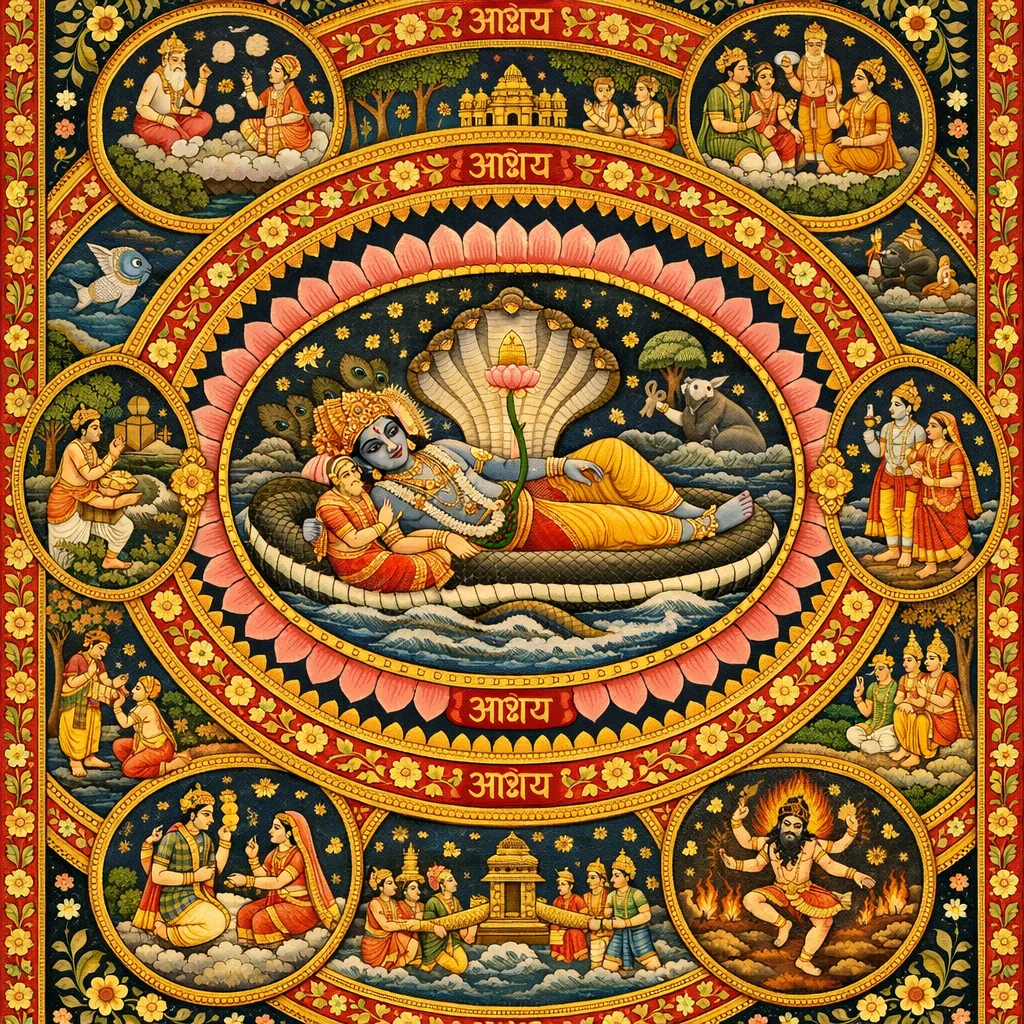
Adhyaya 10
Daśa-lakṣaṇam: The Ten Topics, Virāṭ-Puruṣa Sense-Manifestation, and the Supreme Shelter (Āśraya)
This chapter serves as an interpretive hinge in Skandha 2. Śukadeva Gosvāmī lists the Bhāgavatam’s ten defining topics (daśa-lakṣaṇam), explaining that the other nine are presented to illuminate the transcendence of the tenth—āśraya, the Supreme Lord as the ultimate shelter. He distinguishes sarga (primary creation of elemental categories and senses) from visarga (secondary creation through the interaction of the guṇas), and notes governance themes such as manvantara and poṣaṇa. The narration then turns to cosmological theology: Mahā-Viṣṇu enters each universe as Garbhodakaśāyī, the meaning of the name Nārāyaṇa is established, and it is affirmed that all ingredients, time, modes, and jīvas exist only by His mercy. A detailed “cosmic anatomy” follows, describing how the desires of the virāṭ-puruṣa manifest the senses, their objects, and their presiding deities. The chapter concludes by transcending the gross universal form, affirming that pure devotees accept the Lord’s personal transcendental form, and shifts the narrative frame toward Vidura–Maitreya discussions, preparing the inquiry-driven exposition to come.
Shlokas
Verse 1
श्रीशुक उवाच अत्र सर्गो विसर्गश्च स्थानं पोषणमूतय: । मन्वन्तरेशानुकथा निरोधो मुक्तिराश्रय: ॥ १ ॥
Śrī Śukadeva Gosvāmī said: In the Śrīmad-Bhāgavatam there are ten sacred themes—sarga and visarga, the ordering of the worlds, the Lord’s protection, the impulses of action (ūti), the manvantaras, narrations of the Supreme Lord, dissolution (nirodha), liberation (mukti), and āśraya, the Supreme Shelter.
Verse 2
दशमस्य विशुद्ध्यर्थं नवानामिह लक्षणम् । वर्णयन्ति महात्मान: श्रुतेनार्थेन चाञ्जसा ॥ २ ॥
To reveal the pure transcendence of the tenth theme—āśraya—the great sages describe the marks of the other nine, sometimes on the authority of śruti, sometimes by direct explanation of meaning, and sometimes in clear summary.
Verse 3
भूतमात्रेन्द्रियधियां जन्म सर्ग उदाहृत: । ब्रह्मणो गुणवैषम्याद्विसर्ग: पौरुष: स्मृत: ॥ ३ ॥
The primal creation of sixteen elements—five gross elements, five sense-objects, five knowledge-senses, and the mind—is called sarga; the subsequent creation carried out by Brahmā through the variegation of the guṇas is known as visarga, secondary creation.
Verse 4
स्थितिर्वैकुण्ठविजय: पोषणं तदनुग्रह: । मन्वन्तराणि सद्धर्म ऊतय: कर्मवासना: ॥ ४ ॥
The proper situation of the living beings is “victory in Vaikuṇṭha”—to abide by the Lord’s laws and thus dwell in peace; His protection is His mercy. The manvantaras establish righteous dharma, and ūti is the drive born of karma-vāsanā, the longing for fruitive results.
Verse 5
अवतारानुचरितं हरेश्चास्यानुवर्तिनाम् । पुंसामीशकथा: प्रोक्ता नानाख्यानोपबृंहिता: ॥ ५ ॥
Īśa-kathā, the science of God, proclaims the pastimes of Lord Hari’s avatāras and His deeds, along with the deeds of His great devotees who follow Him, expanded through many sacred narratives.
Verse 6
निरोधोऽस्यानुशयनमात्मन: सह शक्तिभि: । मुक्तिर्हित्वान्यथारूपं स्वरूपेण व्यवस्थिति: ॥ ६ ॥
Nirodha is the winding up of the cosmos, when the jīva, along with his conditioned tendencies and potencies, merges into the mystic yoga‑slumber of Mahā‑Viṣṇu. Mukti is the jīva’s eternal establishment in his own svarūpa after abandoning the changeable gross and subtle bodies.
Verse 7
आभासश्च निरोधश्च यतोऽस्त्यध्यवसीयते । स आश्रय: परं ब्रह्म परमात्मेति शब्द्यते ॥ ७ ॥
He from whom the universe’s manifestation, its resting place, and its nirodha (withdrawal) are ascertained is the Āśraya. He is praised as Parabrahman and Paramātmā—the Supreme Fountainhead, the Absolute Truth.
Verse 8
योऽध्यात्मिकोऽयं पुरुष: सोऽसावेवाधिदैविक: । यस्तत्रोभयविच्छेद: पुरुषो ह्याधिभौतिक: ॥ ८ ॥
The individual jīva endowed with the instruments of the senses is called the adhyātmika person. The presiding deity who governs the senses is called adhidaivika. The visible embodied form arising from the conjunction and separation of the two is called adhibhautika.
Verse 9
एकमेकतराभावे यदा नोपलभामहे । त्रितयं तत्र यो वेद स आत्मा स्वाश्रयाश्रय: ॥ ९ ॥
Without one of these three, the others cannot be understood; they are mutually dependent. Yet the Supreme Lord, who witnesses them all as the “shelter of all shelters,” is independent of everything—therefore He alone is the supreme shelter.
Verse 10
पुरुषोऽण्डं विनिर्भिद्य यदासौ स विनिर्गत: । आत्मनोऽयनमन्विच्छन्नपोऽस्राक्षीच्छुचि: शुची: ॥ १० ॥
Mahā‑Viṣṇu, the puruṣa, emerged from the Causal Ocean, split the universes apart, and—seeking a place to recline within each—created the pure Garbhodaka waters and entered every universe.
Verse 11
तास्ववात्सीत् स्वसृष्टासु सहस्रंपरिवत्सरान् । तेन नारायणो नाम यदाप: पुरुषोद्भवा: ॥ ११ ॥
The Lord remained for thousands of years within the waters He Himself had manifested. The waters born from the Supreme Person are called nāra, and because He reclines upon them, He is glorified as Nārāyaṇa.
Verse 12
द्रव्यं कर्म च कालश्च स्वभावो जीव एव च । यदनुग्रहत: सन्ति न सन्ति यदुपेक्षया ॥ १२ ॥
Matter, action, time, nature (the modes), and the living beings exist only by His mercy; the moment He withdraws His regard, everything becomes nonexistent.
Verse 13
एको नानात्वमन्विच्छन् योगतल्पात् समुत्थित: । वीर्यं हिरण्मयं देवो मायया व्यसृजत् त्रिधा ॥ १३ ॥
The one Lord, resting upon the bed of yoga-slumber, desired to manifest variety; through His external potency (māyā) He emitted the golden puruṣa-seed, unfolding it in three ways.
Verse 14
अधिदैवमथाध्यात्ममधिभूतमिति प्रभु: । अथैकं पौरुषं वीर्यं त्रिधाभिद्यत तच्छृणु ॥ १४ ॥
The Lord’s single puruṣa potency divides into three—adhidaiva, adhyātma, and adhibhūta. Hear from me how this threefold division takes place.
Verse 15
अन्त:शरीर आकाशात् पुरुषस्य विचेष्टत: । ओज: सहो बलं जज्ञे तत: प्राणो महानसु: ॥ १५ ॥
From the sky-like ether within the transcendental body of the manifest Mahā-Viṣṇu, by His stirring, arose sensory energy, mental prowess, and bodily strength; thereafter appeared Mahā-prāṇa, the fountainhead of the total life-force.
Verse 16
अनुप्राणन्ति यं प्राणा: प्राणन्तं सर्वजन्तुषु । अपानन्तमपानन्ति नरदेवमिवानुगा: ॥ १६ ॥
As the attendants of a king follow their lord, so when the total prāṇa-energy moves, all beings move; and when it ceases its striving, the activities of the senses in all also come to rest.
Verse 17
प्राणेनाक्षिपता क्षुत् तृडन्तरा जायते विभो: । पिपासतो जक्षतश्च प्राङ्मुखं निरभिद्यत ॥ १७ ॥
Agitated by the Virāṭ-Puruṣa, the living force produced hunger and thirst; and when He desired to drink and to eat, the mouth opened and became manifest.
Verse 18
मुखतस्तालु निर्भिन्नं जिह्वा तत्रोपजायते । ततो नानारसो जज्ञे जिह्वया योऽधिगम्यते ॥ १८ ॥
From the mouth the palate became manifest, and thereupon the tongue was generated; then the many varieties of taste came into being, so that the tongue might relish them.
Verse 19
विवक्षोर्मुखतो भूम्नो वह्निर्वाग् व्याहृतं तयो: । जले चैतस्य सुचिरं निरोध: समजायत ॥ १९ ॥
When the Supreme desired to speak, words vibrated from His mouth, and from that mouth arose the presiding deity, Agni, fire. Yet while He lay within the waters, all these functions remained suspended for a long time.
Verse 20
नासिके निरभिद्येतां दोधूयति नभस्वति । तत्र वायुर्गन्धवहो घ्राणो नसि जिघृक्षत: ॥ २० ॥
Thereafter, when the supreme Puruṣa desired to smell fragrances, the nostrils and the breath were generated; the organ of smell and the odors came into being, and the presiding deity of air, the carrier of scent, also became manifest.
Verse 21
यदात्मनि निरालोकमात्मानं च दिदृक्षत: । निर्भिन्ने ह्यक्षिणी तस्य ज्योतिश्चक्षुर्गुणग्रह: ॥ २१ ॥
When all was enveloped in darkness, the Bhagavān desired to behold Himself and the creation. Then the eyes manifested, along with Sūrya the deity of light, the power of vision, and the visible object.
Verse 22
बोध्यमानस्य ऋषिभिरात्मनस्तज्जिघृक्षत: । कर्णौ च निरभिद्येतां दिश: श्रोत्रं गुणग्रह: ॥ २२ ॥
As the great sages yearned to know the Ātman, the desire to hear arose. Then the ears manifested, along with the presiding deities of the directions, the power of hearing, and the objects of sound.
Verse 23
वस्तुनो मृदुकाठिन्यलघुगुर्वोष्णशीतताम् । जिघृक्षतस्त्वङ् निर्भिन्ना तस्यां रोममहीरुहा: । तत्र चान्तर्बहिर्वातस्त्वचा लब्धगुणो वृत: ॥ २३ ॥
When the desire arose to perceive material qualities—softness and hardness, lightness and heaviness, warmth and cold—the skin, the basis of touch, manifested, along with pores, bodily hairs, and their presiding deities (the tree-gods). Within and without the skin is a sheath of air by which the sense of touch becomes prominent.
Verse 24
हस्तौ रुरुहतुस्तस्य नानाकर्मचिकीर्षया । तयोस्तु बलवानिन्द्र आदानमुभयाश्रयम् ॥ २४ ॥
Thereafter, when the Supreme Person desired to perform many kinds of work, the two hands manifested. Along with them appeared their strength, Indra the lord of heaven, and the acts dependent on both—such as taking and giving.
Verse 25
गतिं जिगीषत: पादौ रुरुहातेऽभिकामिकाम् । पद्भ्यां यज्ञ: स्वयं हव्यं कर्मभि: क्रियते नृभि: ॥ २५ ॥
Then, desiring to master movement, His legs manifested, and from the legs arose the presiding deity named Viṣṇu. Under His own supervision, human beings busily perform their duties, offering oblations (havi) in sacrifice (yajña) through their works.
Verse 26
निरभिद्यत शिश्नो वै प्रजानन्दामृतार्थिन: । उपस्थ आसीत् कामानां प्रियं तदुभयाश्रयम् ॥ २६ ॥
Then, desiring sexual delight, the begetting of offspring, and the taste of heavenly nectar, the Lord manifested the genital organ (upastha); both the object of pleasure and its presiding deity, Prajāpati, rest under its shelter.
Verse 27
उत्सिसृक्षोर्धातुमलं निरभिद्यत वै गुदम् । तत: पायुस्ततो मित्र उत्सर्ग उभयाश्रय: ॥ २७ ॥
Thereafter, desiring to evacuate the refuse of food, He manifested the anus and the organ of excretion, along with its presiding deity, Mitra; both the organ and what is expelled abide under that shelter.
Verse 28
आसिसृप्सो: पुर: पुर्या नाभिद्वारमपानत: । तत्रापानस्ततो मृत्यु: पृथक्त्वमुभयाश्रयम् ॥ २८ ॥
Thereafter, desiring to pass from one body to another, He created together the navel-gate, the departing air (apāna), and death; the navel is the shelter of both death and the separating force.
Verse 29
आदित्सोरन्नपानानामासन् कुक्ष्यन्त्रनाडय: । नद्य: समुद्राश्च तयोस्तुष्टि: पुष्टिस्तदाश्रये ॥ २९ ॥
When the desire for food and drink arose, the abdomen, intestines, and channels (nāḍīs) became manifest; rivers and seas became the basis of their satisfaction and nourishment.
Verse 30
निदिध्यासोरात्ममायां हृदयं निरभिद्यत । ततो मनश्चन्द्र इति सङ्कल्प: काम एव च ॥ ३० ॥
When He desired to contemplate the workings of His own energy (ātma-māyā), the heart—the seat of mind—was manifested; then the mind, the moon as its presiding deity, resolve (saṅkalpa), and desire (kāma) also appeared.
Verse 31
त्वक्चर्ममांसरुधिरमेदोमज्जास्थिधातव: । भूम्यप्तेजोमया: सप्त प्राणो व्योमाम्बुवायुभि: ॥ ३१ ॥
The thin membrane of the skin, the skin, flesh, blood, fat, marrow, and bone—these seven bodily elements are formed of earth, water, and fire; whereas prāṇa, the life-breath, arises from ether, water, and air.
Verse 32
गुणात्मकानीन्द्रियाणि भूतादिप्रभवा गुणा: । मन: सर्वविकारात्मा बुद्धिर्विज्ञानरूपिणी ॥ ३२ ॥
The senses are constituted of the guṇas, and the guṇas arise from bhūtādi, the false ego. The mind (manas) is the seat of all transformations of experience, and intelligence (buddhi) is the form of deliberative discernment (vijñāna).
Verse 33
एतद्भगवतो रूपं स्थूलं ते व्याहृतं मया । मह्यादिभिश्चावरणैरष्टभिर्बहिरावृतम् ॥ ३३ ॥
Thus I have described to you the Lord’s gross manifestation, which is externally covered by eight layers of enclosure, beginning with mahī, the earth, and the rest.
Verse 34
अत: परं सूक्ष्मतममव्यक्तं निर्विशेषणम् । अनादिमध्यनिधनं नित्यं वाङ्मनस: परम् ॥ ३४ ॥
Therefore, beyond this gross manifestation is a transcendental revelation finer than the finest—avyakta and nirviśeṣa; without beginning, middle, or end; eternal, and beyond the reach of speech and mind.
Verse 35
अमुनी भगवद्रूपे मया ते ह्यनुवर्णिते । उभे अपि न गृह्णन्ति मायासृष्टे विपश्चित: ॥ ३५ ॥
Neither of these two forms of the Lord, as I have described them from a material point of view, is accepted by the pure devotees who truly know Him, for they recognize them as creations of māyā.
Verse 36
स वाच्यवाचकतया भगवान् ब्रह्मरूपधृक् । नामरूपक्रिया धत्ते सकर्माकर्मक: पर: ॥ ३६ ॥
The Bhagavān, assuming the form of Brahman, manifests His transcendental name, form, qualities, līlā, associates, and divine variety; though ever untouched by action, He appears as if engaged in it.
Verse 37
प्रजापतीन्मनून् देवानृषीन् पितृगणान् पृथक् । सिद्धचारणगन्धर्वान् विद्याध्रासुरगुह्यकान् ॥ ३७ ॥ किन्नराप्सरसो नागान् सर्पान् किम्पुरुषान्नरान् । मातृ रक्ष:पिशाचांश्च प्रेतभूतविनायकान् ॥ ३८ ॥ कूष्माण्डोन्मादवेतालान् यातुधानान् ग्रहानपि । खगान्मृगान् पशून् वृक्षान् गिरीन्नृप सरीसृपान् ॥ ३९ ॥ द्विविधाश्चतुर्विधा येऽन्ये जलस्थलनभौकस: । कुशलाकुशला मिश्रा: कर्मणां गतयस्त्विमा: ॥ ४० ॥
O King, Prajāpatis, Manus, devas, ṛṣis, the Pitṛs, Siddhas, Cāraṇas and Gandharvas, Vidyādharas, Asuras and Guhyakas, Kinnaras and Apsarās, Nāgas and serpents, Kimpuruṣas and humans, the dwellers of Mātṛloka, Rākṣasas, Piśācas, Preta-bhūta-vināyakas, Kūṣmāṇḍas, the deranged, Vetālas, Yātudhānas, and even the stars—are all brought forth by the Supreme Lord according to their former deeds.
Verse 38
प्रजापतीन्मनून् देवानृषीन् पितृगणान् पृथक् । सिद्धचारणगन्धर्वान् विद्याध्रासुरगुह्यकान् ॥ ३७ ॥ किन्नराप्सरसो नागान् सर्पान् किम्पुरुषान्नरान् । मातृ रक्ष:पिशाचांश्च प्रेतभूतविनायकान् ॥ ३८ ॥ कूष्माण्डोन्मादवेतालान् यातुधानान् ग्रहानपि । खगान्मृगान् पशून् वृक्षान् गिरीन्नृप सरीसृपान् ॥ ३९ ॥ द्विविधाश्चतुर्विधा येऽन्ये जलस्थलनभौकस: । कुशलाकुशला मिश्रा: कर्मणां गतयस्त्विमा: ॥ ४० ॥
O King, Kinnaras and Apsarās, Nāgas and serpents, Kimpuruṣas and humans, the dwellers of Mātṛloka, Rākṣasas and Piśācas, and the preta-bhūta-vināyakas—all are created by the Supreme Lord in accordance with their past karma.
Verse 39
प्रजापतीन्मनून् देवानृषीन् पितृगणान् पृथक् । सिद्धचारणगन्धर्वान् विद्याध्रासुरगुह्यकान् ॥ ३७ ॥ किन्नराप्सरसो नागान् सर्पान् किम्पुरुषान्नरान् । मातृ रक्ष:पिशाचांश्च प्रेतभूतविनायकान् ॥ ३८ ॥ कूष्माण्डोन्मादवेतालान् यातुधानान् ग्रहानपि । खगान्मृगान् पशून् वृक्षान् गिरीन्नृप सरीसृपान् ॥ ३९ ॥ द्विविधाश्चतुर्विधा येऽन्ये जलस्थलनभौकस: । कुशलाकुशला मिश्रा: कर्मणां गतयस्त्विमा: ॥ ४० ॥
O King, Kūṣmāṇḍas, the deranged, Vetālas, Yātudhānas, and the stars; as well as birds, beasts, cattle, trees, mountains, and reptiles—all are created by the Supreme Lord according to karma.
Verse 40
प्रजापतीन्मनून् देवानृषीन् पितृगणान् पृथक् । सिद्धचारणगन्धर्वान् विद्याध्रासुरगुह्यकान् ॥ ३७ ॥ किन्नराप्सरसो नागान् सर्पान् किम्पुरुषान्नरान् । मातृ रक्ष:पिशाचांश्च प्रेतभूतविनायकान् ॥ ३८ ॥ कूष्माण्डोन्मादवेतालान् यातुधानान् ग्रहानपि । खगान्मृगान् पशून् वृक्षान् गिरीन्नृप सरीसृपान् ॥ ३९ ॥ द्विविधाश्चतुर्विधा येऽन्ये जलस्थलनभौकस: । कुशलाकुशला मिश्रा: कर्मणां गतयस्त्विमा: ॥ ४० ॥
O King, all other beings dwelling in water, on land, and in the sky—of two kinds and of four kinds, in auspicious, inauspicious, or mixed conditions—are the courses of karma; all are created by the Supreme Lord according to their past deeds.
Verse 41
सत्त्वं रजस्तम इति तिस्र: सुरनृनारका: । तत्राप्येकैकशो राजन् भिद्यन्ते गतयस्त्रिधा । यदैकैकतरोऽन्याभ्यां स्वभाव उपहन्यते ॥ ४१ ॥
By the three guṇas—sattva, rajas, and tamas—living beings appear as demigods, humans, and hellish creatures. O King, even each single mode, mixed with the other two, divides into three; when one mode is overpowered by the others, the soul’s course and habits arise accordingly.
Verse 42
स एवेदं जगद्धाता भगवान् धर्मरूपधृक् । पुष्णाति स्थापयन् विश्वं तिर्यङ्नरसुरादिभि: ॥ ४२ ॥
He alone is Bhagavān, the bearer of the universe, assuming the form of Dharma. Having established creation, He nourishes and sustains the world through forms among animals, humans, and the devas, and He descends as avatāra to reclaim the bound souls.
Verse 43
तत: कालाग्निरुद्रात्मा यत्सृष्टमिदमात्मन: । संनियच्छति तत् काले घनानीकमिवानिल: ॥ ४३ ॥
Thereafter, at the end of the kalpa, the Lord Himself, as Kālāgni-Rudra, withdraws and destroys His entire creation, just as the wind drives away masses of clouds.
Verse 44
इत्थंभावेन कथितो भगवान् भगवत्तम: । नेत्थंभावेन हि परं द्रष्टुमर्हन्ति सूरय: ॥ ४४ ॥
Thus the great transcendentalists speak of Bhagavān, the most Supreme. Yet the pure devotees are fit to behold still greater spiritual glory, beyond these features.
Verse 45
नास्य कर्मणि जन्मादौ परस्यानुविधीयते । कर्तृत्वप्रतिषेधार्थं माययारोपितं हि तत् ॥ ४५ ॥
No direct doership is to be ascribed to the Supreme Lord in creation and dissolution. The Vedas speak of His direct intervention only to refute the notion that material nature (prakṛti) is the creator; such attribution is imposed by māyā for that purpose.
Verse 46
अयं तु ब्रह्मण: कल्प: सविकल्प उदाहृत: । विधि: साधारणो यत्र सर्गा: प्राकृतवैकृता: ॥ ४६ ॥
This is Brahmā’s kalpa, described in summary with its variations—the common regulative principle by which, throughout one day of Brahmā, the prākṛta and vaīkṛta creations proceed; and by that same rule, in the creation of the mahat-tattva, material nature expands and is dispersed.
Verse 47
परिमाणं च कालस्य कल्पलक्षणविग्रहम् । यथा पुरस्ताद्व्याख्यास्ये पाद्मं कल्पमथो शृणु ॥ ४७ ॥
O King, in due course I shall explain the measurement of time, with its gross and subtle features and their distinct symptoms; but for now, hear of the Pādma-kalpa.
Verse 48
शौनक उवाच यदाह नो भवान् सूत क्षत्ता भागवतोत्तम: । चचार तीर्थानि भुवस्त्यक्त्वा बन्धून् सुदुस्त्यजान् ॥ ४८ ॥
Śaunaka Ṛṣi said: O Sūta, you previously told us that Vidura, the foremost bhāgavata (kṣattā), left behind relatives who were most difficult to abandon and traveled to the holy places of the earth. Therefore I now inquire about Vidura.
Verse 49
क्षत्तु: कौशारवेस्तस्य संवादोऽध्यात्मसंश्रित: । यद्वा स भगवांस्तस्मै पृष्टस्तत्त्वमुवाच ह ॥ ४९ ॥ ब्रूहि नस्तदिदं सौम्य विदुरस्य विचेष्टितम् । बन्धुत्यागनिमित्तं च यथैवागतवान् पुन: ॥ ५० ॥
Śaunaka Ṛṣi said: O gentle one, tell us of the spiritually grounded dialogue between Vidura (kṣattā) and Maitreya Kaushāravi—what Vidura asked and what truth (tattva) Maitreya replied. Also explain why Vidura renounced family ties, why he later returned home, and what he did while visiting the sacred places of pilgrimage.
Verse 50
क्षत्तु: कौशारवेस्तस्य संवादोऽध्यात्मसंश्रित: । यद्वा स भगवांस्तस्मै पृष्टस्तत्त्वमुवाच ह ॥ ४९ ॥ ब्रूहि नस्तदिदं सौम्य विदुरस्य विचेष्टितम् । बन्धुत्यागनिमित्तं च यथैवागतवान् पुन: ॥ ५० ॥
O gentle one, tell us all of Vidura’s deeds—why he gave up family ties, how he came home again, and what he practiced at the holy places; and faithfully present the essence of Maitreya’s instruction.
Verse 51
सूत उवाच राज्ञा परीक्षिता पृष्टो यदवोचन्महामुनि: । तद्वोऽभिधास्ये शृणुत राज्ञ: प्रश्नानुसारत: ॥ ५१ ॥ यच्च व्रजन्त्यनिमिषामृषभानुवृत्त्या दूरेयमा ह्युपरि न: स्पृहणीयशीला: । भर्तुर्मिथ: सुयशस: कथनानुराग- वैक्लव्यबाष्पकलया पुलकीकृताङ्गा: ॥
Śrī Sūta Gosvāmī said: I shall now relate to you, in accordance with King Parīkṣit’s questions, the very topics spoken by the great sage in reply. Please listen with attentive devotion.
Frequently Asked Questions
Because āśraya (Bhagavān) is transcendental and independent, the Bhāgavatam uses the dependent categories—creation, time, guṇas, karmic governance, and dissolution—as inferential and direct teaching tools. By showing that sarga/visarga, the worlds (sthāna), and even liberation (mukti) rely on the Supreme, the text isolates the āśraya as the final explanatory ground: the shelter of all shelters.
Sarga is the elementary creation of foundational categories—elements, sense objects, and sense instruments (including mind). Visarga is the subsequent, resultant creation that unfolds through the interaction of the material modes (guṇas), leading to differentiated forms, functions, and living situations within the cosmos.
Nārāyaṇa is the Supreme Person who lies upon the transcendental waters within the universe. The waters are called nāra because they emanate from the Supreme Nara (the personal Absolute), and because He rests upon (ayana) those waters, He is known as Nārāyaṇa.
Adhyātmika refers to the individual embodied experiencer with sense instruments; adhidaivika refers to the presiding deities controlling those senses; adhibhautika refers to the perceivable embodied field/object level. The framework teaches interdependence within conditioned experience, while highlighting that the Supreme Being remains independent as the ultimate shelter beyond all three.
It denies materialistic misreadings that reduce the cosmos to autonomous nature while also clarifying the Lord’s transcendence: material nature operates as His energy under His sanction. Vedic statements of ‘direct’ divine action are presented to negate the misconception that prakṛti is the ultimate creator, not to imply the Lord is forced into mechanical labor like a finite agent.