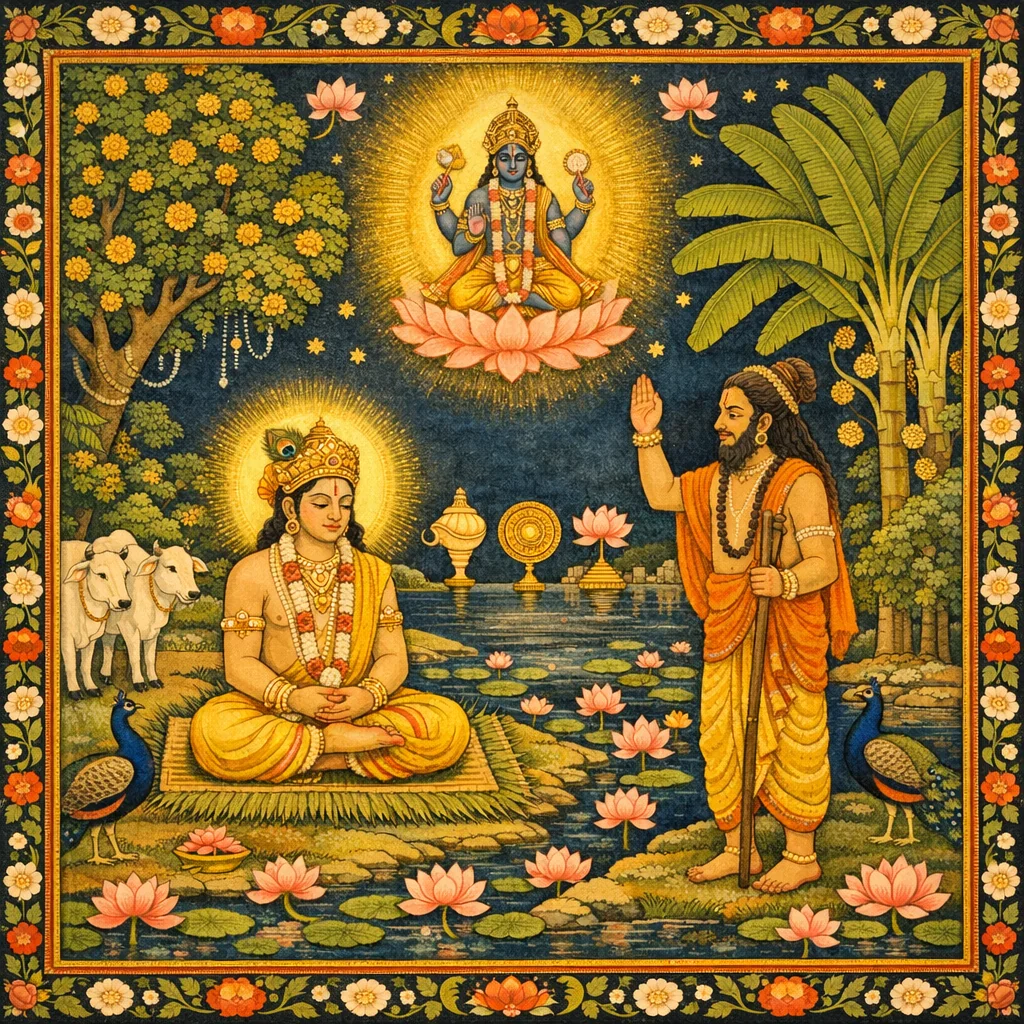
Adhyaya 5
Ātmā’s Unborn Nature and Fearlessness at Death (Parīkṣit’s Final Instruction)
In the closing movement of Skandha 12, Śukadeva Gosvāmī reaffirms the Bhāgavata’s purpose: it has revealed Hari, the Supreme Soul—from whom Brahmā arises and from whose anger Rudra manifests—thus placing all cosmic functions under Bhagavān’s supremacy. Turning to Parīkṣit Mahārāja’s imminent death, he urges him to abandon the animal-like certainty, “I will die.” Through layered analogies—witnessing a dream, fire distinct from fuel, the pot-sky remaining sky, and a lamp dependent on its parts—Śukadeva shows that birth and death belong to the māyā-shaped body-mind complex and the guṇas, while the ātmā is unborn, self-luminous, and the unchanging ground of change. He prescribes constant meditation on Vāsudeva with clear intelligence, assuring that Takṣaka’s bite cannot touch the realized self. The chapter culminates in nondual contemplation and surrender to the Supreme Soul, preparing the narrative to close Parīkṣit’s inquiry and move into the Bhāgavata’s final wrap-up.
Shlokas
Verse 1
श्रीशुक उवाच अत्रानुवर्ण्यतेऽभीक्ष्णं विश्वात्मा भगवान् हरि: । यस्य प्रसादजो ब्रह्मा रुद्र: क्रोधसमुद्भव: ॥ १ ॥
Śukadeva Gosvāmī said: In this Śrīmad-Bhāgavatam, through many narrations, Bhagavān Hari—the Supreme Soul of the universe—has been repeatedly described. From His satisfaction Brahmā is born, and from His anger Rudra arises.
Verse 2
त्वं तु राजन् मरिष्येति पशुबुद्धिमिमां जहि । न जात: प्रागभूतोऽद्य देहवत्त्वं न नङ्क्ष्यसि ॥ २ ॥
O King, abandon the animal-like notion, “I shall die.” Unlike the body, you were never born; there was never a time when you did not exist, nor will you be destroyed.
Verse 3
न भविष्यसि भूत्वा त्वं पुत्रपौत्रादिरूपवान् । बीजाङ्कुरवद् देहादेर्व्यतिरिक्तो यथानल: ॥ ३ ॥
You will not be born again as the form of sons and grandsons, like a sprout arising from a seed and producing another seed. Rather, you are wholly distinct from the body and its paraphernalia, as fire is distinct from its fuel.
Verse 4
स्वप्ने यथा शिरश्छेदं पञ्चत्वाद्यात्मन: स्वयम् । यस्मात् पश्यति देहस्य तत आत्मा ह्यजोऽमर: ॥ ४ ॥
Just as in a dream one may see his own head cut off and thus know that his true self stands apart from the dream, so in wakefulness one sees the body to be a product of the five elements. Therefore the soul is distinct from the body it observes—unborn and immortal.
Verse 5
घटे भिन्ने घटाकाश आकाश: स्याद् यथा पुरा । एवं देहे मृते जीवो ब्रह्म सम्पद्यते पुन: ॥ ५ ॥
When a pot is broken, the sky within it remains sky, just as before. In the same way, when the gross and subtle bodies perish, the jīva again resumes his spiritual identity—Brahman.
Verse 6
मन: सृजति वै देहान् गुणान् कर्माणि चात्मन: । तन्मन: सृजते माया ततो जीवस्य संसृति: ॥ ६ ॥
The material mind fashions for the spirit soul its bodies, qualities, and activities. That mind itself is produced by the Supreme Lord’s illusory potency, māyā; thus the jīva enters material existence and transmigration.
Verse 7
स्नेहाधिष्ठानवर्त्यग्निसंयोगो यावदीयते । तावद्दीपस्य दीपत्वमेवं देहकृतो भव: । रज:सत्त्वतमोवृत्त्या जायतेऽथ विनश्यति ॥ ७ ॥
As a lamp is a lamp only by the union of oil, vessel, wick, and fire, so material existence born of bodily identification arises and perishes by the workings of the three guṇas—goodness, passion, and ignorance.
Verse 8
न तत्रात्मा स्वयंज्योतिर्यो व्यक्ताव्यक्तयो: पर: । आकाश इव चाधारो ध्रुवोऽनन्तोपमस्तत: ॥ ८ ॥
The soul is self-luminous, beyond both the manifest gross body and the unmanifest subtle body. Like the sky, it stands as the steady support of changing bodily states; therefore the soul is endless and beyond material comparison.
Verse 9
एवमात्मानमात्मस्थमात्मनैवामृश प्रभो । बुद्ध्यानुमानगर्भिण्या वासुदेवानुचिन्तया ॥ ९ ॥
My dear King, constantly meditate on the Supreme Lord, Vāsudeva, and with clear, reasoned intelligence carefully discern your true self and how it abides within the material body.
Verse 10
चोदितो विप्रवाक्येन न त्वां धक्ष्यति तक्षक: । मृत्यवो नोपधक्ष्यन्ति मृत्यूनां मृत्युमीश्वरम् ॥ १० ॥
Takṣaka, though sent by the brāhmaṇa’s curse, will not burn your true self. Nor can death’s agents burn one who is master of himself, for you have taken shelter of the Lord who is the death of death.
Verse 11
अहं ब्रह्म परं धाम ब्रह्माहं परमं पदम् । एवं समीक्ष्य चात्मानमात्मन्याधाय निष्कले ॥ ११ ॥ दशन्तं तक्षकं पादे लेलिहानं विषाननै: । न द्रक्ष्यसि शरीरं च विश्वं च पृथगात्मन: ॥ १२ ॥
Consider: “I am Brahman, the supreme abode; and that Brahman, the supreme destination, is not different from me.” Thus placing yourself in the spotless Supreme Soul, free of all false identification, you will not even notice Takṣaka as he licks his poison fangs and bites your foot; nor will you see your dying body or this world, for you will have realized yourself to be separate from them.
Verse 12
अहं ब्रह्म परं धाम ब्रह्माहं परमं पदम् । एवं समीक्ष्य चात्मानमात्मन्याधाय निष्कले ॥ ११ ॥ दशन्तं तक्षकं पादे लेलिहानं विषाननै: । न द्रक्ष्यसि शरीरं च विश्वं च पृथगात्मन: ॥ १२ ॥
“I am Brahman, the supreme abode, and that Brahman, the supreme destination, is nondifferent from me.” Thus, having rightly examined the self and placing yourself within the spotless Supreme Soul, you will not even notice Takṣaka as he comes licking his poison fangs and bites your foot; nor will you see your dying body or the material world, for you will have realized yourself to be separate from them.
Verse 13
एतत्ते कथितं तात यदात्मा पृष्टवान् नृप । हरेर्विश्वात्मनश्चेष्टां किं भूय: श्रोतुमिच्छसि ॥ १३ ॥
Beloved King, I have told you what you asked from the depths of your soul—the pastimes of Lord Hari, the Supreme Soul of the universe. Now what more do you wish to hear?
Frequently Asked Questions
Because it arises from dehātma-buddhi—mistaking the perishable body for the self. Animals operate primarily from bodily survival instinct; similarly, a human who identifies as the body assumes death applies to the ātmā. Śukadeva corrects this by asserting the self is unborn, never absent in the past, and not subject to destruction.
The pot-sky analogy shows that when a container breaks, space is not harmed—only the limiting vessel is gone; similarly, death ends bodily coverings, not the ātmā’s existence. The dream analogy shows the observer remains distinct from changing experiences; even if one ‘sees’ beheading in a dream, the witnessing self stands apart—likewise, in waking life the soul observes a body made of five elements and is therefore distinct.
Takṣaka is the nāga (serpent) destined to deliver the brāhmaṇa’s curse that ends Parīkṣit’s embodied life. Śukadeva states the bite cannot ‘burn’ the true self because the ātmā is not a material object. For one fixed in self-realization and surrendered remembrance of Vāsudeva, death’s agents can only affect the body, not the realized identity.
In this instruction, Śukadeva employs contemplative language to dissolve material misidentification and fix Parīkṣit in the Absolute (brahma-bhāva) while simultaneously directing him to resign himself to the Supreme Soul. Within the Bhāgavata’s theology, such realization is meant to culminate in āśraya—taking shelter of Bhagavān, Hari—so the practical outcome is fearlessness, surrender, and uninterrupted God-remembrance rather than egoic self-deification.