Adhyaya 4
Brahmā’s Day, the Four Pralayas, and the Supreme Shelter Beyond Cause–Effect
Continuing the discussion of time’s measures and cosmic ages, Śukadeva widens Parīkṣit’s vision to Brahmā’s day (kalpa) and night, explaining naimittika pralaya, when the three worlds are withdrawn as Nārāyaṇa rests on Ananta and Brahmā sleeps. He then describes prākṛtika pralaya at the end of Brahmā’s full lifespan—drought and famine, the sun’s desiccation, Saṅkarṣaṇa’s fire, destructive winds, and finally total inundation. The dissolution is traced philosophically as the elements and their specific qualities are absorbed in order—earth’s fragrance, water’s taste, fire’s form, air’s touch, ether’s sound—culminating in ahaṅkāra, mahat, the guṇas, and pradhāna. Śuka argues that perceived cause–effect dualities are ultimately insubstantial without reference to the Supreme, using classic analogies (lamp-eye-form; sky-in-pot; sun-reflection; cloud and sun). He concludes with ātyantika pralaya—the final ending of bondage—when false ego is cut by discriminating knowledge and one realizes Acyuta. The chapter bridges into the closing emphasis on the Bhāgavatam’s unique saving power, its lineage, and the inevitability of time’s ceaseless creation and destruction for all beings.
Shlokas
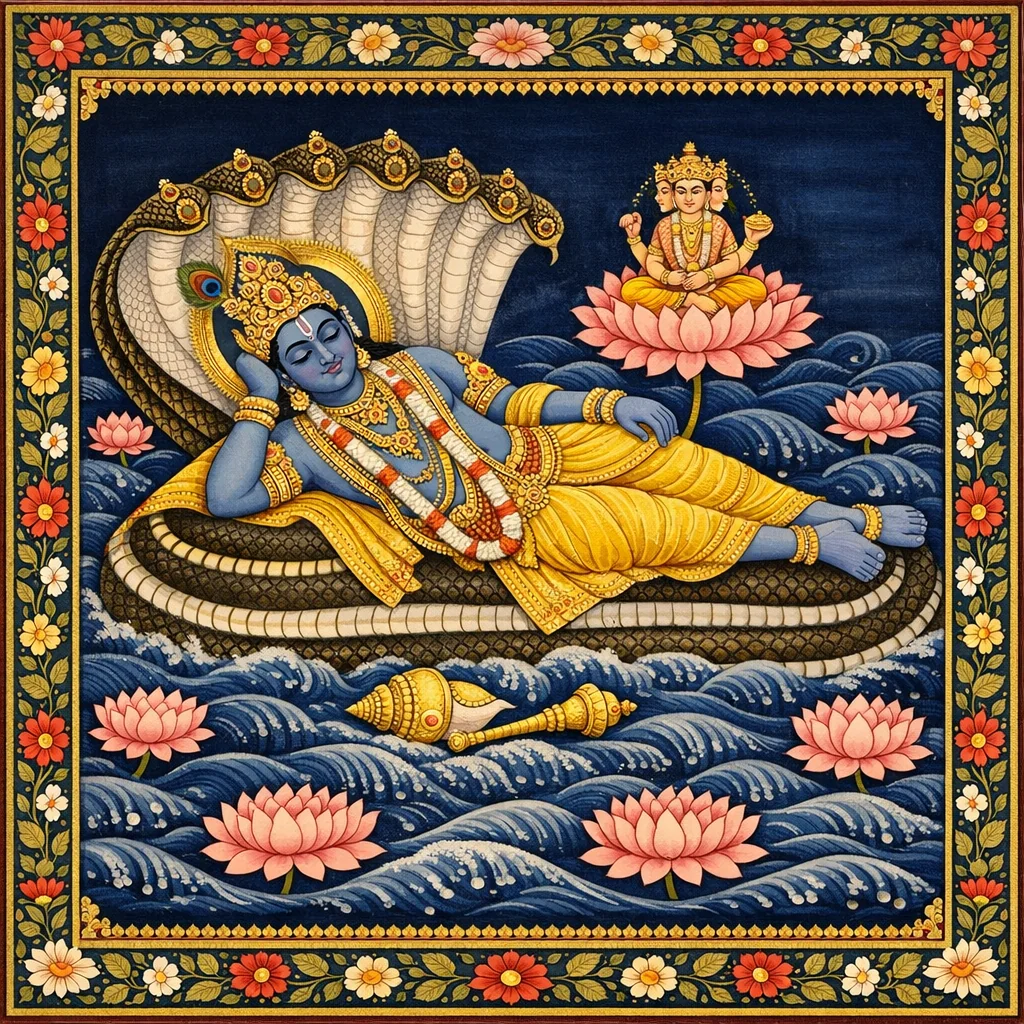
Verse 1
श्रीशुक उवाच कालस्ते परमाण्वादिर्द्विपरार्धावधिर्नृप । कथितो युगमानं च शृणु कल्पलयावपि ॥ १ ॥
Śukadeva Gosvāmī said: O King, I have already described to you the measures of time, from the tiniest fraction marked by the motion of a single atom up to Brahmā’s full lifespan, called a dviparārdha, and I have also explained the durations of the yugas. Now hear of the length of Brahmā’s day (a kalpa) and the process of pralaya, cosmic dissolution.
Verse 2
चतुर्युगसहस्रं तु ब्रह्मणो दिनमुच्यते । स कल्पो यत्र मनवश्चतुर्दश विशाम्पते ॥ २ ॥
One thousand cycles of the four yugas constitute a single day of Brahmā; this is called a kalpa. O King, within that span fourteen Manus appear and depart in succession.
Verse 3
तदन्ते प्रलयस्तावान् ब्राह्मी रात्रिरुदाहृता । त्रयो लोका इमे तत्र कल्पन्ते प्रलयाय हि ॥ ३ ॥
At the end of that day, an annihilation of equal duration takes place; this is called Brahmā’s night. Then all the three worlds are subject to destruction.
Verse 4
एष नैमित्तिक: प्रोक्त: प्रलयो यत्र विश्वसृक् । शेतेऽनन्तासनो विश्वमात्मसात्कृत्य चात्मभू: ॥ ४ ॥
This is called naimittika-pralaya, the occasional dissolution, when Brahmā, the universe’s creator, falls asleep. At that time Lord Nārāyaṇa, the original source of creation, lies upon the bed of Ananta Śeṣa and draws the entire universe into Himself.
Verse 5
द्विपरार्धे त्वतिक्रान्ते ब्रह्मण: परमेष्ठिन: । तदा प्रकृतय: सप्त कल्पन्ते प्रलयाय वै ॥ ५ ॥
When the two halves of the lifespan of Paramesthin Brahmā are completed, the seven fundamental elements of creation dissolve, entering pralaya.
Verse 6
एष प्राकृतिको राजन् प्रलयो यत्र लीयते । अण्डकोषस्तु सङ्घातो विघाट उपसादिते ॥ ६ ॥
O King, this is the material (prākṛtika) pralaya, wherein the elements merge and dissolve; then the universal egg, the aggregate of those elements, is shattered and destroyed.
Verse 7
पर्जन्य: शतवर्षाणि भूमौ राजन् न वर्षति । तदा निरन्ने ह्यन्योन्यं भक्ष्यमाणा: क्षुधार्दिता: । क्षयं यास्यन्ति शनकै: कालेनोपद्रुता: प्रजा: ॥ ७ ॥
O King, for one hundred years no rain will fall upon the earth. Then, without food and tormented by hunger, people will devour one another, and under the force of Time they will gradually perish.
Verse 8
सामुद्रं दैहिकं भौमं रसं सांवर्तको रवि: । रश्मिभि: पिबते घोरै: सर्वं नैव विमुञ्चति ॥ ८ ॥
The sun, in its annihilating form, will drink with dreadful rays all water—of the ocean, of living bodies, and of the earth itself—yet it will grant no rain in return.
Verse 9
तत: संवर्तको वह्नि: सङ्कर्षणमुखोत्थित: । दहत्यनिलवेगोत्थ: शून्यान् भूविवरानथ ॥ ९ ॥
Next, the annihilating fire (saṁvartaka) will blaze forth from the mouth of Lord Saṅkarṣaṇa. Driven by the fierce force of wind, it will burn everywhere, scorching even the empty fissures of the cosmic shell.
Verse 10
उपर्यध: समन्ताच्च शिखाभिर्वह्निसूर्ययो: । दह्यमानं विभात्यण्डं दग्धगोमयपिण्डवत् ॥ १० ॥
Burned on every side—above by the blazing sun and below by the fire of Lord Saṅkarṣaṇa—the universal sphere will shine like a burning ball of cow dung.
Verse 11
तत: प्रचण्डपवनो वर्षाणामधिकं शतम् । पर: सांवर्तको वाति धूम्रं खं रजसावृतम् ॥ ११ ॥
Then a fierce, dreadful wind of dissolution will blow for more than one hundred years, and the sky, veiled in dust, will turn smoky gray.
Verse 12
ततो मेघकुलान्यङ्ग चित्र वर्णान्यनेकश: । शतं वर्षाणि वर्षन्ति नदन्ति रभसस्वनै: ॥ १२ ॥
After that, O King, multicolored masses of clouds will gather; roaring with fierce thunder, they will pour down floodlike rains for one hundred years.
Verse 13
तत एकोदकं विश्वं ब्रह्माण्डविवरान्तरम् ॥ १३ ॥
At that time, the interior of the universe’s shell will fill with water, becoming a single cosmic ocean.
Verse 14
तदा भूमेर्गन्धगुणं ग्रसन्त्याप उदप्लवे । ग्रस्तगन्धा तु पृथिवी प्रलयत्वाय कल्पते ॥ १४ ॥
As the universe is flooded, the waters will swallow the earth’s distinctive quality—fragrance—and the element earth, bereft of its mark, will dissolve into pralaya.
Verse 15
अपां रसमथो तेजस्ता लीयन्तेऽथ नीरसा: । ग्रसते तेजसो रूपं वायुस्तद्रहितं तदा ॥ १५ ॥ लीयते चानिले तेजो वायो: खं ग्रसते गुणम् । स वै विशति खं राजंस्ततश्च नभसो गुणम् ॥ १६ ॥ शब्दं ग्रसति भूतादिर्नभस्तमनुलीयते । तैजसश्चेन्द्रियाण्यङ्ग देवान् वैकारिको गुणै: ॥ १७ ॥ महान् ग्रसत्यहङ्कारं गुणा: सत्त्वादयश्च तम् । ग्रसतेऽव्याकृतं राजन् गुणान् कालेन चोदितम् ॥ १८ ॥ न तस्य कालावयवै: परिणामादयो गुणा: । अनाद्यनन्तमव्यक्तं नित्यं कारणमव्ययम् ॥ १९ ॥
The element fire seizes taste from water, which merges into fire. Air seizes the form of fire, and fire, deprived of form, merges into air.
Verse 16
अपां रसमथो तेजस्ता लीयन्तेऽथ नीरसा: । ग्रसते तेजसो रूपं वायुस्तद्रहितं तदा ॥ १५ ॥ लीयते चानिले तेजो वायो: खं ग्रसते गुणम् । स वै विशति खं राजंस्ततश्च नभसो गुणम् ॥ १६ ॥ शब्दं ग्रसति भूतादिर्नभस्तमनुलीयते । तैजसश्चेन्द्रियाण्यङ्ग देवान् वैकारिको गुणै: ॥ १७ ॥ महान् ग्रसत्यहङ्कारं गुणा: सत्त्वादयश्च तम् । ग्रसतेऽव्याकृतं राजन् गुणान् कालेन चोदितम् ॥ १८ ॥ न तस्य कालावयवै: परिणामादयो गुणा: । अनाद्यनन्तमव्यक्तं नित्यं कारणमव्ययम् ॥ १९ ॥
Fire merges into air. The element ether seizes the quality of air, namely touch, and that air enters into ether. Then, O King, follows the quality of ether.
Verse 17
अपां रसमथो तेजस्ता लीयन्तेऽथ नीरसा: । ग्रसते तेजसो रूपं वायुस्तद्रहितं तदा ॥ १५ ॥ लीयते चानिले तेजो वायो: खं ग्रसते गुणम् । स वै विशति खं राजंस्ततश्च नभसो गुणम् ॥ १६ ॥ शब्दं ग्रसति भूतादिर्नभस्तमनुलीयते । तैजसश्चेन्द्रियाण्यङ्ग देवान् वैकारिको गुणै: ॥ १७ ॥ महान् ग्रसत्यहङ्कारं गुणा: सत्त्वादयश्च तम् । ग्रसतेऽव्याकृतं राजन् गुणान् कालेन चोदितम् ॥ १८ ॥ न तस्य कालावयवै: परिणामादयो गुणा: । अनाद्यनन्तमव्यक्तं नित्यं कारणमव्ययम् ॥ १९ ॥
False ego in ignorance seizes sound, and ether merges into it. False ego in passion takes the senses, and false ego in goodness absorbs the demigods.
Verse 18
अपां रसमथो तेजस्ता लीयन्तेऽथ नीरसा: । ग्रसते तेजसो रूपं वायुस्तद्रहितं तदा ॥ १५ ॥ लीयते चानिले तेजो वायो: खं ग्रसते गुणम् । स वै विशति खं राजंस्ततश्च नभसो गुणम् ॥ १६ ॥ शब्दं ग्रसति भूतादिर्नभस्तमनुलीयते । तैजसश्चेन्द्रियाण्यङ्ग देवान् वैकारिको गुणै: ॥ १७ ॥ महान् ग्रसत्यहङ्कारं गुणा: सत्त्वादयश्च तम् । ग्रसतेऽव्याकृतं राजन् गुणान् कालेन चोदितम् ॥ १८ ॥ न तस्य कालावयवै: परिणामादयो गुणा: । अनाद्यनन्तमव्यक्तं नित्यं कारणमव्ययम् ॥ १९ ॥
The total mahat-tattva seizes false ego. The modes of nature seize the mahat. O King, the unmanifest nature, impelled by time, seizes these modes.
Verse 19
अपां रसमथो तेजस्ता लीयन्तेऽथ नीरसा: । ग्रसते तेजसो रूपं वायुस्तद्रहितं तदा ॥ १५ ॥ लीयते चानिले तेजो वायो: खं ग्रसते गुणम् । स वै विशति खं राजंस्ततश्च नभसो गुणम् ॥ १६ ॥ शब्दं ग्रसति भूतादिर्नभस्तमनुलीयते । तैजसश्चेन्द्रियाण्यङ्ग देवान् वैकारिको गुणै: ॥ १७ ॥ महान् ग्रसत्यहङ्कारं गुणा: सत्त्वादयश्च तम् । ग्रसतेऽव्याकृतं राजन् गुणान् कालेन चोदितम् ॥ १८ ॥ न तस्य कालावयवै: परिणामादयो गुणा: । अनाद्यनन्तमव्यक्तं नित्यं कारणमव्ययम् ॥ १९ ॥
That unmanifest nature is not subject to the transformations of time. It has no beginning and no end. It is eternal and the infallible cause of creation.
Verse 20
न यत्र वाचो न मनो न सत्त्वं तमो रजो वा महदादयोऽमी । न प्राणबुद्धीन्द्रियदेवता वा न सन्निवेश: खलु लोककल्प: ॥ २० ॥ न स्वप्नजाग्रन्न च तत् सुषुप्तं न खं जलं भूरनिलोऽग्निरर्क: । संसुप्तवच्छून्यवदप्रतर्क्यं तन्मूलभूतं पदमामनन्ति ॥ २१ ॥
In the unmanifest state of material nature called pradhāna, there is no speech, no mind, and no manifestation of the subtle principles beginning with the mahat; nor do the guṇas—goodness, passion, and ignorance—exist there. There is no prāṇa or intelligence, no senses and no demigods, and no fixed arrangement of the worlds. The states of dreaming, waking, and deep sleep are absent; there is no ether, water, earth, air, fire, or sun. It is like complete sleep or like voidness, beyond description; yet the sages declare that, being the original substance, pradhāna is the very basis of material creation.
Verse 21
न यत्र वाचो न मनो न सत्त्वं तमो रजो वा महदादयोऽमी । न प्राणबुद्धीन्द्रियदेवता वा न सन्निवेश: खलु लोककल्प: ॥ २० ॥ न स्वप्नजाग्रन्न च तत् सुषुप्तं न खं जलं भूरनिलोऽग्निरर्क: । संसुप्तवच्छून्यवदप्रतर्क्यं तन्मूलभूतं पदमामनन्ति ॥ २१ ॥
In the avyakta of pradhāna there is neither dreaming, nor waking, nor deep sleep; there is no ether, water, earth, air, fire, or sun. It is like total sleep or like emptiness, beyond words and reasoning; yet those who know the truth declare pradhāna to be the root substance and the foundation of material creation.
Verse 22
लय: प्राकृतिको ह्येष पुरुषाव्यक्तयोर्यदा । शक्तय: सम्प्रलीयन्ते विवशा: कालविद्रुता: ॥ २२ ॥
This is the prākṛtika annihilation: by the force of time, the energies of the Supreme Person and of His unmanifest material nature are disassembled, rendered powerless, and wholly merge together.
Verse 23
बुद्धीन्द्रियार्थरूपेण ज्ञानं भाति तदाश्रयम् । दृश्यत्वाव्यतिरेकाभ्यामाद्यन्तवदवस्तु यत् ॥ २३ ॥
The one Absolute Truth alone shines forth as intelligence, the senses, and the objects of sense, and He is their ultimate foundation. Whatever has a beginning and an end is insubstantial, for it is an object perceived by limited senses and is nondifferent from its own cause.
Verse 24
दीपश्चक्षुश्च रूपं च ज्योतिषो न पृथग् भवेत् । एवं धी: खानि मात्राश्च न स्युरन्यतमादृतात् ॥ २४ ॥
A lamp, the eye that sees by that lamp’s light, and the visible form that is seen are, in essence, not different from the element fire. In the same way, intelligence, the senses, and sense perceptions have no existence separate from the supreme reality, although that Absolute Truth remains wholly transcendent and distinct from them.
Verse 25
बुद्धेर्जागरणं स्वप्न: सुषुप्तिरिति चोच्यते । मायामात्रमिदं राजन् नानात्वं प्रत्यगात्मनि ॥ २५ ॥
The three conditions of intelligence are called waking, dreaming, and deep sleep. O King, the variegated experiences that appear within the inner self are nothing but māyā, mere illusion.
Verse 26
यथा जलधरा व्योम्नि भवन्ति न भवन्ति च । ब्रह्मणीदं तथा विश्वमवयव्युदयाप्ययात् ॥ २६ ॥
Just as clouds in the sky appear and then disperse by the combining and dissolving of their elements, so this universe is created and destroyed within Brahman by the aggregation and disaggregation of its constituent parts.
Verse 27
सत्यं ह्यवयव: प्रोक्त: सर्वावयविनामिह । विनार्थेन प्रतीयेरन् पटस्येवाङ्ग तन्तव: ॥ २७ ॥
O King, it is taught that the ingredient cause—the parts constituting any composite—can be perceived as a separate reality, just as the threads of a cloth can be perceived apart from the cloth.
Verse 28
यत् सामान्यविशेषाभ्यामुपलभ्येत स भ्रम: । अन्योन्यापाश्रयात् सर्वमाद्यन्तवदवस्तु यत् ॥ २८ ॥
Anything experienced as a general cause and a specific effect is illusion, for cause and effect exist only in mutual dependence. Indeed, whatever has a beginning and an end is unreal.
Verse 29
विकार: ख्यायमानोऽपि प्रत्यगात्मानमन्तरा । न निरूप्योऽस्त्यणुरपि स्याच्चेच्चित्सम आत्मवत् ॥ २९ ॥
Although transformation is perceived, without reference to the Supreme Soul (Paramātmā) there is no ultimate definition even for the change of a single atom. To be accepted as truly existent, something must share the nature of pure spirit—eternal, unchanging being.
Verse 30
न हि सत्यस्य नानात्वमविद्वान् यदि मन्यते । नानात्वं छिद्रयोर्यद्वज्ज्योतिषोर्वातयोरिव ॥ ३० ॥
In the Absolute Truth there is no material duality. The duality imagined by the ignorant is like the difference between the sky within an empty pot and the sky outside it, like the difference between the sun reflected in water and the sun in the heavens, or like the difference between the prāṇa within one body and that within another.
Verse 31
यथा हिरण्यं बहुधा समीयते नृभि: क्रियाभिर्व्यवहारवर्त्मसु । एवं वचोभिर्भगवानधोक्षजो व्याख्यायते लौकिकवैदिकैर्जनै: ॥ ३१ ॥
Just as people, according to their purposes, employ gold in many ways along the paths of worldly dealings and thus perceive it in many forms, so the Supreme Lord, Bhagavān Adhokṣaja—beyond the reach of material senses—is described by different kinds of people in various terms, both ordinary and Vedic.
Verse 32
यथा घनोऽर्कप्रभवोऽर्कदर्शितो ह्यर्कांशभूतस्य च चक्षुषस्तम: । एवं त्वहं ब्रह्मगुणस्तदीक्षितो ब्रह्मांशकस्यात्मन आत्मबन्धन: ॥ ३२ ॥
Although a cloud is born from the sun and is made visible by the sun, it still casts darkness upon the seeing eye, which is itself a partial expansion of the sun. Similarly, material false ego—arising from Brahman and revealed by Brahman—obstructs the individual soul, a portion of Brahman, from realizing the Supreme Brahman.
Verse 33
घनो यदार्कप्रभवो विदीर्यते चक्षु: स्वरूपं रविमीक्षते तदा । यदा ह्यहङ्कार उपाधिरात्मनो जिज्ञासया नश्यति तर्ह्यनुस्मरेत् ॥ ३३ ॥
When the cloud, born of the sun, is torn apart, the eye beholds the sun’s true form. In the same way, when the soul destroys the covering of false ego by inquiring into transcendental knowledge, it regains its original spiritual awareness.
Verse 34
यदैवमेतेन विवेकहेतिना मायामयाहङ्करणात्मबन्धनम् । छित्त्वाच्युतात्मानुभवोऽवतिष्ठते तमाहुरात्यन्तिकमङ्ग सम्प्लवम् ॥ ३४ ॥
My dear Parīkṣit, when the māyā-made false ego that binds the soul is cut off by the sword of discriminating knowledge, and realization of Lord Acyuta, the Supreme Soul, becomes firmly established, this is called ātyantika—the ultimate annihilation of material existence.
Verse 35
नित्यदा सर्वभूतानां ब्रह्मादीनां परन्तप । उत्पत्तिप्रलयावेके सूक्ष्मज्ञा: सम्प्रचक्षते ॥ ३५ ॥
O subduer of the foe, those who know the subtle principles declare that all beings, beginning with Brahmā, perpetually undergo continuous processes of creation and annihilation.
Verse 36
कालस्रोतोजवेनाशु ह्रियमाणस्य नित्यदा । परिणामिनामवस्थास्ता जन्मप्रलयहेतव: ॥ ३६ ॥
Swept along by the swift, mighty current of time, all transforming material entities are constantly eroded; their various stages of existence are the perpetual causes of their birth and annihilation.
Verse 37
अनाद्यन्तवतानेन कालेनेश्वरमूर्तिना । अवस्था नैव दृश्यन्ते वियति ज्योतिषामिव ॥ ३७ ॥
These stages, produced by beginningless and endless time—the impersonal representative of the Supreme Lord—are not directly seen, just as the planets’ infinitesimal momentary shifts in the sky cannot be perceived.
Verse 38
नित्यो नैमित्तिकश्चैव तथा प्राकृतिको लय: । आत्यन्तिकश्च कथित: कालस्य गतिरीदृशी ॥ ३८ ॥
Thus the progress of time is described through four kinds of annihilation: continuous, occasional, elemental, and final.
Verse 39
एता: कुरुश्रेष्ठ जगद्विधातु- र्नारायणस्याखिलसत्त्वधाम्न: । लीलाकथास्ते कथिता: समासत: कार्त्स्न्येन नाजोऽप्यभिधातुमीश: ॥ ३९ ॥
O best of the Kurus, I have told you in brief these narrations of the līlās of Lord Nārāyaṇa, the creator and arranger of this world and the ultimate abode of all existence; even Brahmā himself cannot describe them in full.
Verse 40
संसारसिन्धुमतिदुस्तरमुत्तितीर्षो- र्नान्य: प्लवो भगवत: पुरुषोत्तमस्य । लीलाकथारसनिषेवणमन्तरेण पुंसो भवेद् विविधदु:खदवार्दितस्य ॥ ४० ॥
For one scorched by the fire of countless miseries and longing to cross the most difficult ocean of saṁsāra, there is no other boat than bhakti—devotional cultivation of the transcendental relish of narrations of the līlās of Bhagavān, the Supreme Person, Purusottama. Without this, a man is afflicted by many gates of sorrow.
Verse 41
पुराणसंहितामेतामृषिर्नारायणोऽव्यय: । नारदाय पुरा प्राह कृष्णद्वैपायनाय स: ॥ ४१ ॥
Long ago this essential compendium of all the Purāṇas was spoken by the infallible Ṛṣi Nara-Nārāyaṇa to Nārada, and Nārada then repeated it to Kṛṣṇa Dvaipāyana Vedavyāsa.
Verse 42
स वै मह्यं महाराज भगवान् बादरायण: । इमां भागवतीं प्रीत: संहितां वेदसम्मिताम् ॥ ४२ ॥
O Mahārāja Parīkṣit, that very Bhagavān Bādarāyaṇa (Śrīla Vyāsadeva), pleased at heart, taught me this Bhāgavatī saṁhitā—Śrīmad-Bhāgavatam—whose stature is equal to the four Vedas.
Verse 43
इमां वक्ष्यत्यसौ सूत ऋषिभ्यो नैमिषालये । दीर्घसत्रे कुरुश्रेष्ठ सम्पृष्ट: शौनकादिभि: ॥ ४३ ॥
O best of the Kurus, at Naimiṣāraṇya during the long sacrifice, when questioned by the sages headed by Śaunaka, that same Sūta Gosvāmī will recite this Bhāgavatam to the assembled ṛṣis.
Frequently Asked Questions
Naimittika (occasional) pralaya occurs at the end of Brahmā’s day, during his night of equal duration. The three planetary systems are devastated, and the universe is withdrawn while Brahmā sleeps. The chapter describes Nārāyaṇa reclining on Ananta Śeṣa and absorbing the cosmos within Himself—showing that dissolution is not chaos but a regulated withdrawal under the Supreme Lord’s control.
Prākṛtika pralaya occurs when Brahmā’s full lifespan ends. The narrative describes escalating cosmic events—drought, the sun’s desiccation, Saṅkarṣaṇa’s fire, destructive wind, then deluge—followed by metaphysical absorption: earth loses fragrance and dissolves; water loses taste into fire; fire loses form into air; air loses touch into ether; ether loses sound into ahaṅkāra; ahaṅkāra is absorbed into mahat; mahat into the guṇas; and the guṇas into pradhāna under the impulse of time.
The repetition functions as a didactic refrain: it fixes the sāṅkhya-style logic of dissolution in the listener’s mind and emphasizes inevitability—each element is defined by a distinguishing quality and is dissolved when that quality is seized by the subtler principle. It also reinforces the theological point that all manifest distinctions are temporary superimpositions upon the Supreme Reality (āśraya).
Ātyantika (ultimate) pralaya is the final destruction of material bondage for the individual jīva. Unlike naimittika or prākṛtika pralaya, which are cosmic cycles, ātyantika pralaya occurs when false ego is cut off by discriminating knowledge and one realizes Lord Acyuta as the Supreme Soul—ending the soul’s identification with the guṇas and the recurring experience of saṁsāra.
They illustrate nondual dependence: perceived differences arise from limiting conditions, not from an ultimate split in reality. The ‘sky in a pot’ shows apparent division without real separation; the ‘sun reflection’ shows a dependent image mistaken as separate; and ‘lamp-eye-form’ shows that knower, knowing, and known share a common basis. Likewise, intelligence, senses, and objects have no independent existence apart from the Absolute Truth, though the Absolute remains transcendent to them.