
Bhagavad Gita — Vishwarupa Darshana Yoga, Shloka 19
Vishwarupa Darshana Yoga
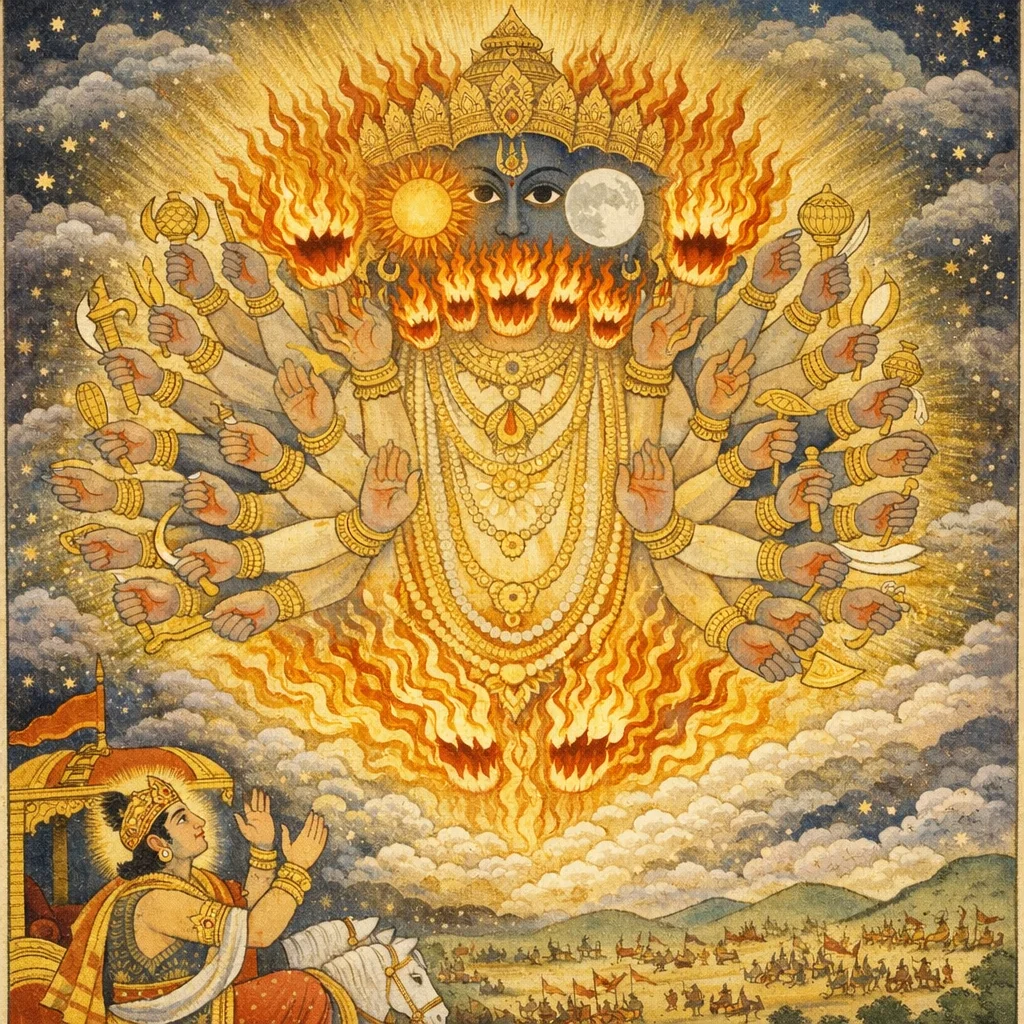
अनादिमध्यान्तमनन्तवीर्यं अनन्तबाहुं शशिसूर्यनेत्रम् । पश्यामि त्वां दीप्तहुताशवक्त्रं स्वतेजसा विश्वमिदं तपन्तम् ॥
anādi-madhyāntam ananta-vīryaṃ ananta-bāhuṃ śaśi-sūrya-netram | paśyāmi tvāṃ dīpta-hutāśa-vaktraṃ sva-tejasā viśvam idaṃ tapantam ||

I behold You without beginning, middle, or end; of infinite might; with innumerable arms; with the moon and the sun as Your eyes; with a mouth like blazing fire—by Your own radiance You illumine and heat this entire universe.
I see You without beginning, middle, or end; of infinite power; with countless arms; with moon and sun as eyes; with a face like blazing fire; warming/illuminating this whole universe with Your own radiance.
I behold you: without beginning, middle, or end; of limitless potency; with endless arms; with the moon and sun as eyes; with a mouth like blazing fire—by your own brilliance pervading and ‘heating’ this entire world.
tapantam can be read neutrally as ‘warming/irradiating’ rather than harshly ‘burning’; many translators choose a cosmological sense (solar heat/light as life-sustaining), consistent with the cosmic form imagery.
FAQs
The mind confronts the unbounded (no beginning/middle/end), a classic trigger for awe; the verse models how language stretches to represent what exceeds ordinary temporal thinking.
The divine is depicted as infinite potency and immanent cosmic intelligence, integrating natural phenomena (sun/moon) into a single metaphysical subject.
This continues Arjuna’s eyewitness account, intensifying the claim that the vision is not merely a deity’s body but the cosmos as a unified field of power.
As a contemplative reading, it encourages seeing interconnected systems—ecological, social, psychological—as parts of a larger whole rather than isolated fragments.