Adhyaya 254
Divya-pramāṇa-kathana (Explanation of Divine Proofs / Ordeals and Evidentiary Procedure)
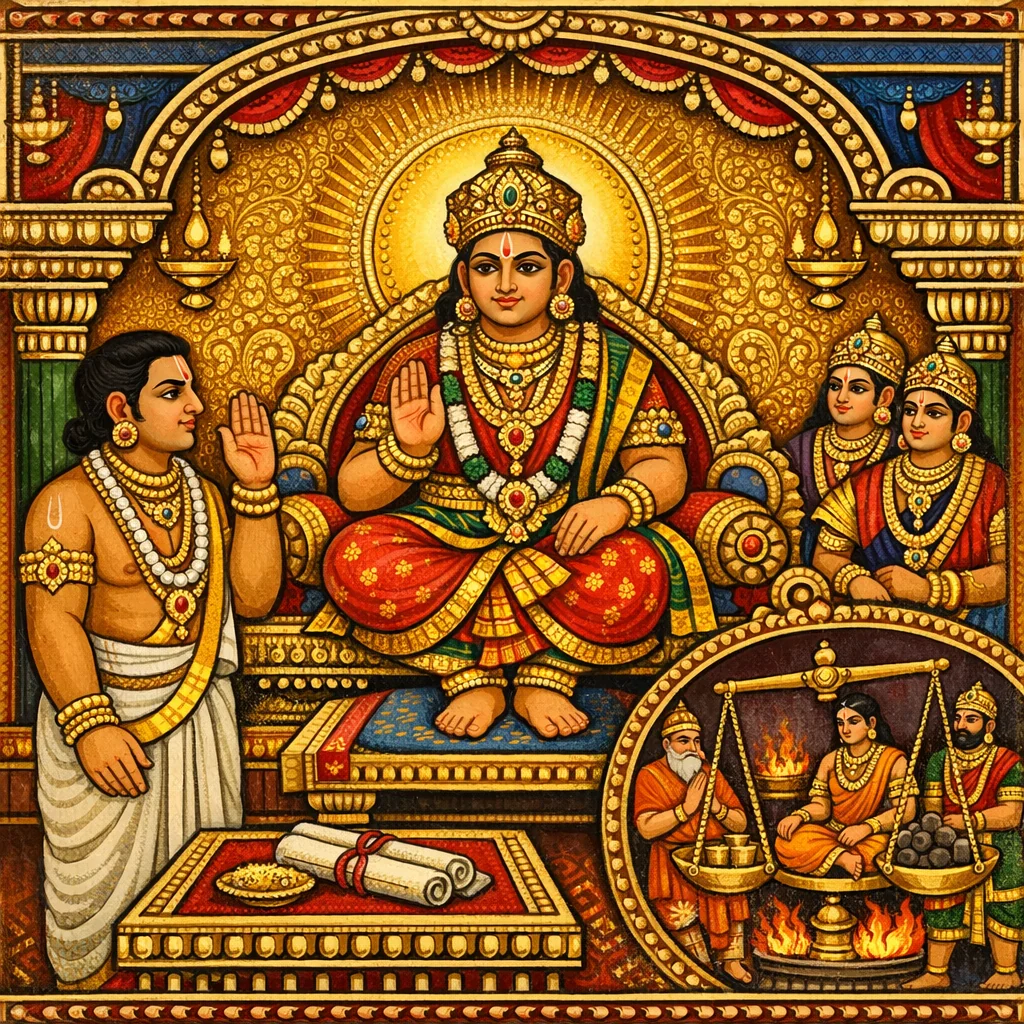
Agni continues the Vyavahāra (judicial law) teaching by defining trustworthy witnesses and disqualifying categories, yet permitting broader testimony in urgent crimes like theft and violence. He stresses the moral weight of evidence: concealing truth or speaking falsehood destroys merit and brings grave sin, and the king may compel compliance through escalating penalties. Principles for resolving doubt are given—prefer the many, the virtuous, and the more qualified—and contradictions and perjury are met with graded punishments (including banishment for some). The chapter then turns from oral testimony to documentary proof, explaining how debt and agreement instruments should be drafted, witnessed, corrected, replaced when damaged, and endorsed with receipts. Finally, Agni describes divya-pramāṇas (ordeals) for serious accusations—balance, fire, water, poison, and koṣa—stating procedural conditions, mantras, and suitability by social category and physical capacity, and concludes with “lighter” oaths for minor doubt (by deities, the guru’s feet, and iṣṭa–pūrta merit).
Shlokas
Verse 1
इत्य् आग्नेये महापुराणे व्यवहारो नाम त्रिपञ्चाशदधिकद्विशततमो ऽध्यायः अथ चतुःपञ्चाशदधिकद्विशततमो ऽध्यायः दिव्यप्रमाणकथनं अग्निर् उवाच तपस्विनो दानशीलाः कुलीनाः सत्यवादिनः धर्मप्रधाना ऋजवः पुत्रवन्तो धनान्विताः
Thus, in the Agni Mahāpurāṇa, the two-hundred-and-fifty-third chapter called “Vyavahāra” (Legal Procedure) concludes. Now begins the two-hundred-and-fifty-fourth chapter, “The Explanation of Divine Proofs (Divya-pramāṇa).” Agni said: “Those fit to be relied upon are ascetics, charitable in disposition, of good lineage, truthful in speech, foremost in Dharma, straightforward, possessing sons, and endowed with wealth.”
Verse 2
पञ्चयज्ञक्रियायुक्ताः साक्षिणः पञ्च वा त्रयः यथाजाति यथावर्ण सर्वे सर्वेषु वा स्मृताः
Witnesses should be persons engaged in the performance of the five sacrificial duties (pañca-yajña), and they should be either five in number or three. They are to be chosen according to one’s community (jāti) and social class (varṇa); or else, as taught, qualified persons from all groups may be accepted in all matters.
Verse 3
स्त्रीवृद्धबालकितवमत्तोन्मत्ताभिशस्तकाः रङ्गावतारिपाषण्डिकूटकृद्विकलेन्द्रियाः
Women, the very old, children, gamblers, the intoxicated, the deranged, those under accusation or censure, stage-performers, heretical sectarians, forgers, and those with impaired faculties are regarded as disqualified persons (in formal legal matters such as testimony).
Verse 4
पतिताप्तान्नसम्बन्धिसहायरिपुतस्कराः अमाक्षिणः सर्वसाक्षी चौर्यपारुष्यसाहसे
The fallen (patita), one’s intimates, those maintained by one’s food (dependents), relatives, allies, enemies, and thieves are not admissible as witnesses; however, in cases of theft, assault/violence, and forcible outrage, anyone may serve as a witness.
Verse 5
उभयानुमतः साक्षी भवत्येकोपि धर्मवित् अब्रुवन् हि नरः साक्ष्यमृणं सदशबन्धकम्
Even a single witness, if accepted by both parties and knowledgeable in dharma (law), becomes a valid witness. For a man who withholds testimony—though knowing the facts—the sin of that withheld testimony becomes a debt, ever binding him as if with ten fetters.
Verse 6
राज्ञा सर्वं प्रदाप्यः स्यात् षट्चत्वारिंशके ऽह्ननि न ददाति हि यः साक्ष्यं जानन्नपि नराधमः
On the forty-sixth day, the king should cause him to forfeit everything (by confiscation). For that lowest of men, though knowing the facts, does not give testimony.
Verse 7
स कूटसाक्षिणां पापैस्तुल्यो दण्डेन चैव हि साक्षिणः श्रावयेद्वादिप्रतिवादिसमीपगान्
He is indeed equal to false witnesses in sin and likewise in punishment; therefore, the witnesses should be examined (made to testify) in the presence of the plaintiff and the defendant who are nearby.
Verse 8
ये पातककृतां लोका महापातकिनां तथा अग्निदानाञ्च ये लोका ये च स्त्रीबालघातिनां
The worlds (realms) allotted to ordinary sinners, and likewise those of great sinners; the worlds of arsonists, and those of killers of women and children—all these are being set forth.
Verse 9
तान् सर्वान् समवाप्नोति यः साक्ष्यमनृतं वदेत् सुकृतं यत्त्वया किञ्चिज्जन्मान्तरशतैः कृतम्
Whoever speaks falsehood as testimony incurs all those (sins and consequences); and whatever merit you may have accumulated—even a little—over hundreds of births is thereby destroyed and forfeited.
Verse 10
तत्सर्वं तस्य जानीहि यं पराजयसे मृषा द्वैधे बहूनां वचनं समेषु गुणिनान्तथा
Know that all of it belongs to the person whom you defeat by falsehood. When there is doubt, accept the statement of the many; likewise, among equals, accept the statement of the virtuous.
Verse 11
गुणिद्वैधे तु वचनं ग्राह्यं ये गुणवत्तराः यस्योचुः साक्षिणः सत्यां प्रतिज्ञां स जयी भवेत्
When there is doubt regarding the respective credibility (qualities) of the parties, the statement of those with superior qualifications should be accepted. He for whom the witnesses declare a truthful assertion (or pledge) becomes victorious in the case.
Verse 12
अन्यथा वादिनो यस्य ध्रूवस्तस्य पराजयः उक्ते ऽपि साक्षिभिः साक्ष्ये यद्यन्ये गुणवत्तराः
If a litigant argues contrary to what has been established, his defeat is certain. Even when witnesses have already given testimony, if other witnesses are superior in reliability and merit, their testimony prevails.
Verse 13
द्विगुणा वान्यथा ब्रूयुः कूटाः स्युःपूर्वसाक्षिणः पृथक् पृथग्दण्डनीयाः कूटकृत्साक्षिणस् तथा
If the earlier witnesses speak otherwise (contradicting their former testimony), they are to be deemed false witnesses. Both the fabricators of falsehood and the witnesses who support such fabrication are to be punished separately, each according to his own act.
Verse 14
विवादाद्द्विगुणं दण्डं विवास्यो ब्राह्मणः स्मृतः यः साक्ष्यं श्रावितो ऽन्येभ्यो निह्नुते तत्तमोवृतः
For denial in a dispute, the penalty is declared to be double; and a brāhmaṇa who commits such an offence is to be banished. One who, after having his testimony heard by others, later denies it is said to be enveloped in darkness (tamas).
Verse 15
स दाप्यो ऽष्टगुणम् दण्डं ब्राह्मणन्तु विवासयेत् वर्णिनां हि बधो यत्र तत्र साक्ष्यअनृतं वदेत्
He should be made to pay a penalty eightfold; but a Brāhmaṇa should instead be banished. For where the execution of members of the (three) varṇas would occur as a consequence, there one should state untruth as testimony.
Verse 16
यः कश्चिदर्थो ऽभिमतः स्वरुच्या तु परस्परं लेख्यं तु साक्षिमत् कार्यं तस्मिन् धनिकपूर्वकम्
Whatever transaction is mutually agreed upon according to one’s own preference should be set down in a written document, supported by witnesses, and prepared in the presence of the creditor.
Verse 17
समामासतदर्हाहर् नामजातिस्वगोत्रजैः सब्रह्मचारिकात्मीयपितृनामादिचिह्नितम्
It should be marked with the year and month and the appropriate day, and identified by the person’s name, caste (jāti), and his own gotra, together with the names of fellow students (brahmacārins), as well as the names of his father and other identifying particulars.
Verse 18
समाप्ते ऽर्थे ऋणी नाम स्वहस्तेन निवेशयेत् मतं मे ऽमुकपुत्रस्य यदत्रोपरिलेखितं
When the transaction is concluded, the debtor should, with his own hand, enter his name (as an acknowledgment), stating: “This is my assent—of so-and-so, son of so-and-so—as written above in this document.”
Verse 19
साक्षिणश् च स्वहस्तेन पितृनामकपूर्वकम् अत्राहममुकः साक्षी लिखेयुरिति ते समाः
And the witnesses, in their own handwriting, preceded by their father’s name, should write in the document: “Here I, so-and-so, am the witness”—thus should those attestations be made.
Verse 20
अलिपिज्ञ ऋणी यः स्यालेकयेत् स्वमतन्तु सः साक्षी वा साक्षिणान्येन सर्वसाक्षिसमीपतः
If the debtor is illiterate, then his own statement shall be written down; and he (the debtor) should serve as a witness, or another competent person should do so, in the presence of all the witnesses.
Verse 21
उभयाभ्यर्थितेनैतन्मया ह्य् अमुकसूनुना लिखितं ह्य् अमुकेनेति लेखको ऽथान्ततो लिखेत्
Then, at the end, the scribe should write: “This has been written by me—so-and-so, the son of so-and-so—at the request of both parties, (and) for so-and-so.”
Verse 22
विनापि साक्षिभिर् लेख्यं स्वहस्तलिखितञ्च यत् तत् प्रमाणं स्मृतं सर्वं बलोपधिकृतादृते
A written document—even without witnesses—and whatever is written in one’s own hand are all regarded as valid proof, except when produced through force or fraud.
Verse 23
ऋणं लेख्यकृतं देयं पुरुषैस्त्रिभिरेव तु आधिस्तु भुज्यते तावद्यावत्तन्न प्रदीयते
A debt executed by a written instrument should be repaid as established, confirmed/enforced on the testimony of three persons. But pledged property (ādhi) may be enjoyed by the creditor only so long as that debt is not repaid.
Verse 24
देशान्तरस्थे दुर्लेख्ये नष्टोन्मृष्टे हृते तथा भिन्ने च्छिन्ने तथा दग्धे लेख्यमन्यत्तु कारयेत्
When a written deed is kept in another country, is difficult to read, has been lost, erased, stolen, torn, cut, or burned, one should have another document drawn up in its place.
Verse 25
सन्दिग्धार्थविशुद्ध्यर्थं स्वहस्तलिखितन्तु यत् युक्तिप्राप्तिक्रियाचिह्नसम्बन्धागमहेतुभिः
To clarify a doubtful meaning, one should rely on what is written in one’s own hand and determine it through the grounds of reasoning, established verification, practical procedure, identifying marks, contextual linkage, and authoritative tradition (āgama).
Verse 26
लेख्यस्य पृष्ठे ऽभिलिखेत् प्रविष्टमधमर्णिनः धनी चोपगतं दद्यात् स्वहस्तपरिचिह्नितम्
On the reverse of the written deed, one should record the entry made by the debtor (the fact of payment/settlement); and the creditor, upon receiving payment, should issue a receipt marked by his own hand (signature/hand-mark).
Verse 27
दत्वर्णं पाटयेल्लेख्यं शुद्ध्यै चान्यत्तु कारयेत् साक्षिमच्च भवेद्यत्तु तद्दातव्यं ससाक्षिकं
After supplying the missing or corrected letters, one should have the written document read aloud; and for the sake of rectification, one should have another fresh document prepared. Whatever must be supported by witnesses should be executed and delivered together with witnesses.
Verse 28
तुलाग्न्यापो विषं कोषो दिव्यानीह विशुद्धये महाभियोगेष्वेतानि शीर्षकस्थे ऽभियोक्तरि
Here, for establishing purity (innocence), the divine ordeals are: the balance (weighing), fire, water, poison, and the koṣa-ordeal; these are employed in cases of grave accusations, when the accuser is a person of high standing.
Verse 29
रुच्या वान्यतरः कुर्यादितरो वर्तयेच्छिरः विनापि शीर्षकात् कुर्यान्नृपद्रोहे ऽथ पातके
At his discretion, one (executioner) may carry out the act while the other turns his head away; or, even without a beheading-block, it should be carried out in cases of treason against the king and in other grave sins.
Verse 30
नासहस्राद्धरेत् फालं न तुलान्न विषन्तथा नृपार्थेष्वभियोगेषु वहेयुः शुचयः सदा
One should not accept a ploughshare even worth a thousand, nor a balance for weighing, nor likewise poison. In accusations and litigations concerning the king’s interests, the pure should always bear their duty with integrity.
Verse 31
सहस्रार्थे तुलादीनि कोषमल्पे ऽपि दापयेत् शतार्धं दापयेच्छुद्धमशुद्धो दण्डभाग् भवेत्
In a case involving a value of one thousand, one shall make the offender pay with reference to the balance, weights, and the like, and impose the koṣa-payment even if it is small. If the measurement or transaction is pure, one shall make him pay half of a hundred; but if it is impure (fraudulent or defective), he becomes liable to punishment and a penal fine.
Verse 32
सचेलस्नातमाहूय सूर्योदय उपोषितम् कारयेत्दर्वदिव्यानि नृपब्राह्मणसन्निधौ
Having summoned the person—bathed while still clothed and fasting at sunrise—one should have him undergo the darbha ordeals in the presence of the king and the Brahmins.
Verse 33
तुला स्त्रीबालवृद्धान्धपङ्गुब्राह्मणरोगिणां अग्निर्ज्वलं वा शूद्रस्य यवाः सप्त विषस्य वा
For women, children, the aged, the blind, the lame, Brahmins, and the sick, the ordeal is by the balance (weighing). For a Śūdra, it may be by blazing fire; or alternatively by poison, administered in the measure of seven barley-grains.
Verse 34
तुलाधारणविद्वद्भिरभियुक्तस्तुलाश्रितः प्रतिमानसमीभूतो रेखां कृत्वावतारितः
Then, instructed by experts skilled in the weighing rite, the person under examination mounts the balance; after being made equal to the standard weight, a mark (line) is drawn, and he is brought down.
Verse 35
आदित्यचन्द्रावनिलो ऽनलश् च द्यौर्भूमिरापोहृदयं यमश् च अहश् च रात्रिश् च उभे च सन्ध्ये धर्मश् च जानाति नरस्य वृत्तम्
The Sun and the Moon, the Wind and Fire, the Sky, the Earth, the Waters, one’s own Heart, and Yama; Day and Night, both twilights (dawn and dusk), and Dharma itself—all of these know a man’s conduct.
Verse 36
त्वं तुले सत्यधामासि पुरा देवैर् विनिर्मिता सत्यं वदस्व कल्याणि संशयान्मां विमोचय
O Balance (Scale), you are the abode of truth, fashioned long ago by the gods. O auspicious one, speak the truth and free me from all doubts.
Verse 37
यद्यस्मि पापकृन्मातस्ततो मां त्वमधो नय शुद्धश्चेद्गमयोर्ध्वम्मां तुलामित्यभिमन्त्रयेत्
“If I am a doer of sin, O Mother, then lead me downward; but if I am pure, then lead me upward”—thus one should recite this mantra while performing the weighing (tulā) rite.
Verse 38
करौ विमृदितव्रीहेर्लक्षयित्वा ततो न्यसेत् सप्ताश्वप्त्यस्य पत्राणि तावत् सूत्रेण वेष्टयेत्
Having marked the two hands with crushed rice-grains, one should then perform the placement (nyāsa). After that, one should wrap seven aśvaptī leaves with a thread.
Verse 39
त्वमेव सर्वभूतानामन्तश् चरसि पावक साक्षिवत् पुण्यपापेभ्यो ब्रूहि सत्यङ्गरे मम
You alone, O Pāvaka (Fire), move within the hearts of all beings as a witness. Concerning merit and sin, speak the truth to my very limbs, O Embers (Agni).
Verse 40
तस्येत्युक्तवतो लौहं पञ्चाशत्पलिकं समम् अग्निर्वर्णं न्यसेत् पिण्डं हस्तयोरुभयोरपि
For one who has been so instructed, an even mass of iron weighing fifty palas—having the color of fire—should be placed as a lump in both hands.
Verse 41
स तमादाय सप्तैव मण्डलानि शतैर् व्रजेत् षोडशाङ्गुलकं ज्ञेयं मण्डलं तावदन्तरम्
Taking that standard measure as the basis, one should proceed by hundreds up to seven maṇḍalas. A maṇḍala is to be understood as sixteen aṅgulas, and the interval between maṇḍalas is to be of that same extent.
Verse 42
मुक्त्वाग्निं मृदितव्रीहिरदग्धः शुद्धिमाप्नुयात् अन्तरा पतिते पिण्डे सन्देहे वा पुनर्हरेत्
If the fire has been set aside, the (rice-grain) offering—made from crushed rice and not scorched—brings about purification. But if the rice-ball (piṇḍa) falls in the middle (of the rite), or if there is any doubt (about its correctness), it should be taken/removed again and repeated.
Verse 43
पवित्राणां पवित्र त्वं शोध्यं शोधय पावन सत्येन माभिरक्षस्व वरुणेत्यभिशस्तकम्
O Varuṇa—purest among the pure—O purifier, purify what is to be purified. By truth, protect me; thus is the (mantra) called the Abhiśastaka.
Verse 44
नाभिदघ्नोदकस्थस्य गृहीत्वोरू जलं विशेत् समकालमिषुं मुक्तमानीयान्यो जवो नरः
Standing in water up to the navel, he should grasp his thighs and plunge into the water; another man—swift—should, in the same time, release an arrow and bring it back (retrieve it).
Verse 45
यदि तस्मिन्निमग्नाङ्गं पश्येच्च शुद्धिमाप्नुयात् त्वं विष ब्रह्मणः पुत्र सत्यधर्मे व्यवस्थित
If one sees a body (or limb) sunk in that (water), he would obtain purification. You, O Viṣa, son of Brahmā, are established in the dharma of truth.
Verse 46
त्रायस्वास्मादभीशापात् सत्येन भव मे ऽमृतम् एवमुक्त्वा विषं सार्ङ्गं भक्षयेद्धिमशैलजं
“Protect me from this dreadful curse; by the power of truth, become nectar (deathless) for me.” Having said thus, one should ingest the poison called Sārṅga, the kind that arises from the Himālaya.
Verse 47
यस्य वेगैर् विना जीर्णं शुद्धिं तस्य विनिर्दिशेत् देवानुग्रान् समभ्यर्च्य तत्स्नानोदकमाहरेत्
For one whose digestion has occurred without the natural bodily urges being properly discharged, the prescribed purification should be set forth. Having duly worshiped the deities who bestow favor, one should then bring the water used for that purificatory bath.
Verse 48
संश्राव्य पापयेत्तस्माज्जलात्तु प्रसृतित्रयम् आचतुर्दशमादह्नो यस्य नो राजदैविकम्
Having made it heard (i.e., publicly proclaimed or confessed), he should perform expiation; therefore he should drink three prasṛtis of water up to the fourteenth day, in a case where the fault is neither royal (against the king/state) nor “divine” (a sacrilege against the gods).
Verse 49
व्यसनं जायते घोरं स शुद्धः स्यादसंशयम् सत्यवाहनशस्त्राणि गोवीजकनकानि च
If a dreadful calamity befalls (the accused/participant), he should be regarded as purified—without doubt. (The ordeals/items employed include) the truth-bearing vehicle and weapons, as well as a cow, seeds, and gold.
Verse 50
देवतागुरुपादाश् च इष्टापूर्तकृतानि च इत्येते सुकराः प्रोक्ताः शपथाः स्वल्पसंशये
Swearing by the deities, by the feet of one’s guru, and by one’s acts of iṣṭa and pūrta—these are said to be the easier forms of oaths, to be used when the doubt is slight.
Frequently Asked Questions
Qualified witnesses are described as ascetic, charitable, well-born, truthful, dharma-oriented, straightforward, possessing sons, and financially established; additionally, they should be engaged in the pañca-yajña duties, typically in groups of three or five.
Women, the very old, children, gamblers, intoxicated or deranged persons, censured/accused persons, performers, sectarians, forgers, and impaired persons are listed as disqualified; however, in cases like theft, violence/assault, and forcible outrage, broader testimony is allowed.
Withholding known testimony is treated as a serious offense: the king may impose severe forfeiture, and the person is equated with false witnesses in sin and punishment.
In doubt, the statement of the many is preferred; among equals, the virtuous; and when credibility differs, the testimony of those with superior qualifications prevails—even over earlier testimony if later witnesses are more reliable.
The chapter prescribes written instruments marked with date and identity details (name, jāti/varṇa markers, gotra, father’s name), debtor acknowledgment in his own hand, witness attestations, scribe’s colophon, and validity of self-written documents—except those produced by force or fraud.
The ordeals are balance (tulā), fire (agni), water (āpaḥ), poison (viṣa), and koṣa; they are applied in grave accusations, particularly when the accuser is of high standing, with procedural constraints and suitability rules.