Adhyaya 357
Tिङ्विभक्तिसिद्धरूपम् (Established Forms of Tiṅ-Inflections)
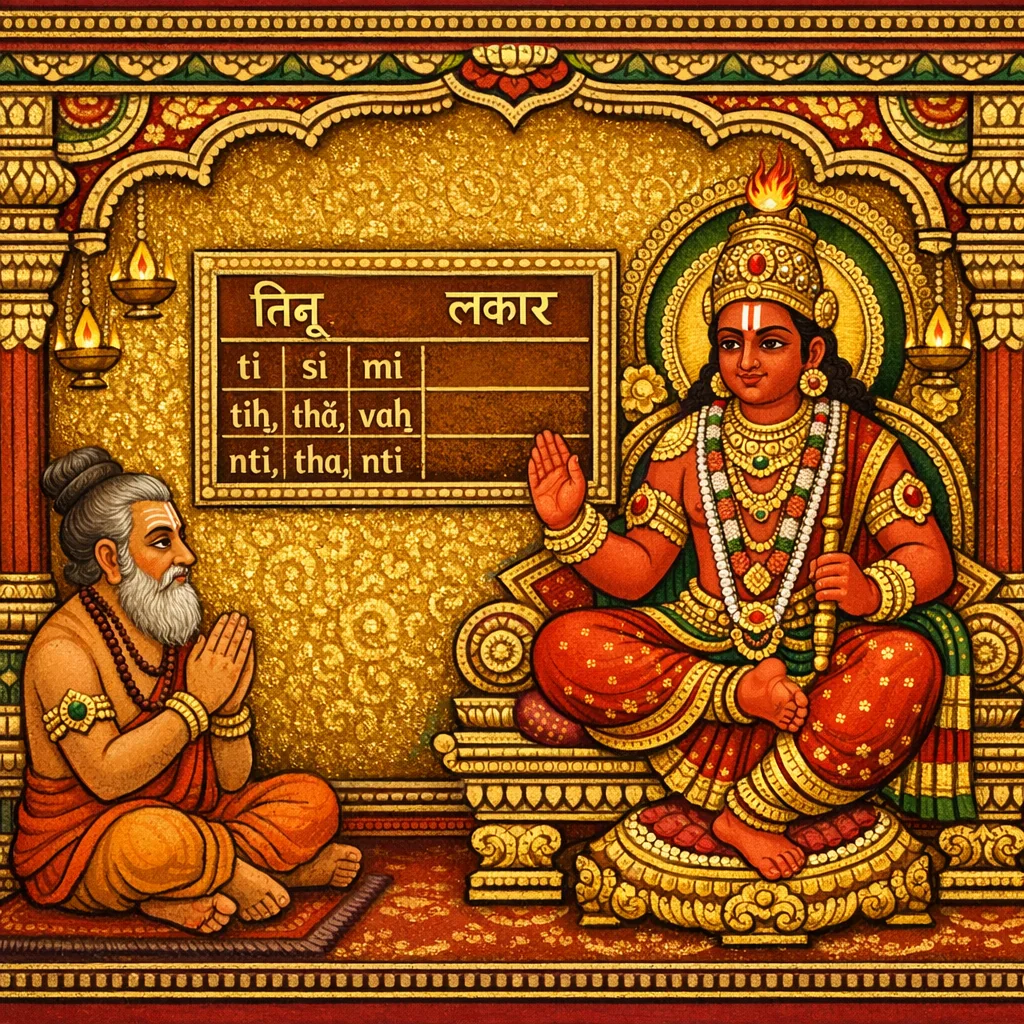
This chapter becomes a compact vyākaraṇa guide to tiṅ-endings (verbal personal terminations) and their proper use in bhāva (impersonal action/state), karma (object- or passive-oriented), and kartṛ (agent- or active-oriented) constructions. It first notes a textual break connected with the earlier uṇādi section, then systematically lists the lakāras and their meanings: laṭ (present), liṅ (injunction/optative and benedictive use), loṭ (imperative and blessings), laṅ (remote past), luṅ and liṭ (past, with liṭ stressing the unseen/indirect), and luṭ/ḷṅ (future senses). Next it sets out the person-endings and the voice distinction of parasmaipada and ātmanepada, illustrating paradigms with roots such as bhū (“to be/become”) and edh (“to prosper/kindle”), along with other dhātu sets and vikaraṇa notes. Finally it demonstrates derived formations—desiderative (san), causative (ṇic), frequentative (yaṅ), and yaṅ-luk—linking conjugational patterns to recognizable usage examples and model “rūpaka” illustrations.
Shlokas
No shlokas available for this adhyaya yet.
Frequently Asked Questions
The mapping of lakāras to time/meaning (present, past, future, injunction, benediction, conditional) along with tiṅ-ending paradigms across persons and voices, illustrated via bhū/edh and related dhātu examples plus san–ṇic–yaṅ derivations.
By safeguarding linguistic precision for mantra and śāstra, it supports correct ritual speech and disciplined study; this technical clarity is framed as Agneya Vidya—worldly mastery (bhukti) placed in service of dharma and inner purification toward mukti.