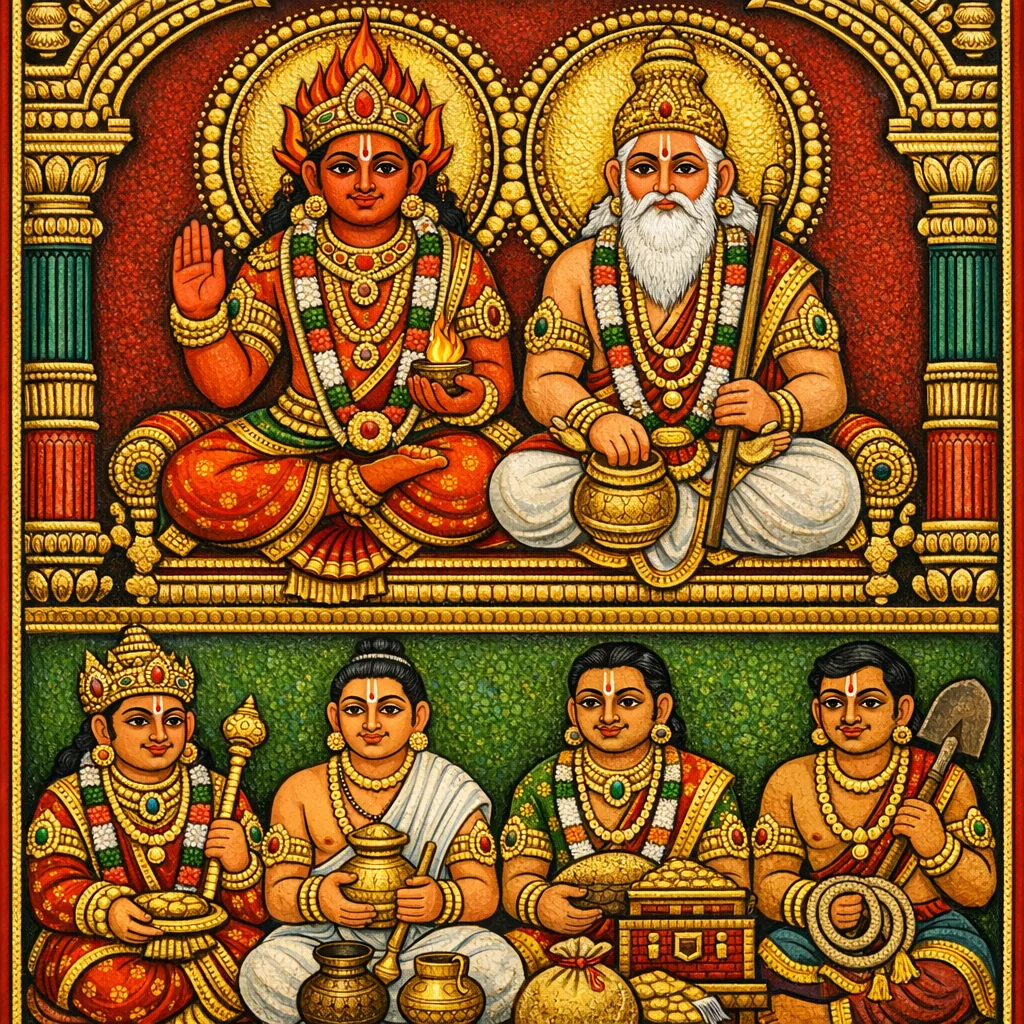
Adhyaya 363
Chapter 363: नृब्रह्मक्षत्रविट्शूद्रवर्गाः (Groups of terms for Men, Brahmins, Kṣatriyas, Vaiśyas, and Śūdras)
Lord Agni continues the Kosha (lexicon) sequence, turning from the prior adhyāya’s environmental categories to a human-centered classification. It begins with synonyms for “man,” “woman,” and “bride,” then expands to socially and ethically marked female types, kinship and lineage terms (sapinda/sanābha; gotra and relatives), and paired household identities (husband–wife terms). The chapter then shifts into a technical anatomical register: embryo and reproductive vocabulary, bodily conditions and disabilities, disease names (especially skin diseases and respiratory/consumptive ailments), and physiological substances (semen, flesh, fat, vessels). It proceeds through skeletal and organ terminology, notes on grammatical gender, and detailed body-part words from hips and genitals to shoulders, nails, neck regions, and hair. Finally, it codifies measures (aṅgula, vitasti, ratni/aratni), adornment and costume vocabulary, ornaments, textiles, dimensional descriptors, and compositional/structural forms—showing how the Agni Purāṇa renders worldly arts and sciences as dharmic knowledge through precise naming.
Shlokas
Verse 1
इत्य् आग्नेये महापुराणे भूमिवनौषध्यादिवर्गा नाम द्विषष्ट्यधिकत्रिशततमो ऽध्यायः अथ त्रिषष्ट्यधिकत्रिशततमो ऽध्यायः नृब्रह्मक्षत्रविट्शूद्रवर्गाः अग्निर् उवाच नृब्रह्मक्षत्रविट्शूद्रवर्गान्वक्ष्ये ऽथ नामतः नरः पञ्चजना मर्त्य यद्योषावंला वधूः
Thus, in the Agni Mahāpurāṇa, the chapter entitled “Groups of terms for earth, forests, medicinal plants, and the like” is the three-hundred-and-sixty-second. Now begins the three-hundred-and-sixty-third chapter, “Groups of terms for men, Brahmins, Kṣatriyas, Vaiśyas, and Śūdras.” Agni said: “I shall now set forth, by name, these groups of terms: for ‘man’—nara, pañcajana, martya; for ‘woman’—yadyoṣā, avaṃlā; for ‘bride/wife’—vadhū.”
Verse 2
कान्तार्थिनी तु या याति सङ्केतं साभिसारिका कुलटा पुंश् चल्यसती नग्निका स्त्री च कोटवी
A woman who, longing for her lover, goes to a prearranged trysting place is called an abhīsārikā. She is also termed kulaṭā, puṃścalī, asatī; and, in certain usages, nagnikā and koṭavī as well.
Verse 3
कात्यायन्यर्धवृद्धा या सैरिन्ध्री परवेश्मगा असिक्री स्यादवृद्धा या मलिनी तु रजस्वला
She who is “half-advanced in age” is termed Kātyāyanī; one who goes to another’s house (as a dependant/attendant) is called Sairindhrī. One who is not advanced in age is termed Asikrī; and a menstruating woman is called Malinī.
Verse 4
वारस्त्री गणिका वेश्या भ्रातृजायास्तु यातरः ननान्दा तु स्वसा पत्युः सपिण्डास्तु सनाभयः
A vārastrī is a courtesan; likewise a gaṇikā and a veśyā (a public woman/prostitute). The wife of one’s brother is called yātarā; the husband’s sister is called nanāndā. Those who share the same ancestral body-line are called sapiṇḍas, while those of the same womb-line are called sanābhas.
Verse 5
समानोदर्यसोदर्यसगर्भसहजास्समाः सगोत्रबान्धवज्ञातिबन्धुस्वस्वजनाः समाः
Those who share the same womb, those born of the same mother, those of the same uterine line, and those born together are regarded as equivalent; likewise, those of the same gotra, kinsmen, relatives (jñāti), bandhu (relations), and one’s own people (svajana) are regarded as equivalent.
Verse 6
दम्पती जम्पती भार्यापती जायापती च तौ गर्भाशयो जरायुः स्यादुल्वञ्च कललो ऽस्त्रियां
The two (husband and wife) are called dampatī, jampatī, bhāryāpatī, and jāyāpatī. The womb is termed garbhāśaya; the fetal membrane/afterbirth is called jarāyu; and ulva (the embryonic covering) and kalala (the early embryonic mass) are terms used in reference to a woman.
Verse 7
गर्भो भ्रुण इमौ तुल्यौ क्लीवं शण्डो नपुंसकम् स्यादुत्तानशया डिम्भा बालो माणवकः स्मृतः
‘Garbha’ and ‘bhruṇa’ are equivalent terms (for an embryo/fetus). ‘Klība’, ‘śaṇḍa’, and ‘napuṁsaka’ denote a eunuch/impotent, non-procreative male. A ‘ḍimbha’ is an infant lying on its back; and a ‘bāla’ is understood to be a ‘māṇavaka’ (a young boy/child).
Verse 8
पिचिण्डिलो वृहत्कुक्षिरवभ्रटो नतनासिके विकलाङ्गस्तु पोगण्ड आरोग्यं स्यादनामयम्
One who has a compressed or knotted bodily form, or a large belly; one who is bald (or whose hair is damaged), or has a drooping nose; even one with a defective limb, and one afflicted with goitre—for such persons there will be health; they become free from disease.
Verse 9
स्यादेडे वधिरः कुब्जे गडुलः कुकरे कुनिः क्षयः शोषश् च यक्ष्मा च प्रतिश्यायुस्तु पीनसः
In the condition called eḍa one becomes deaf; in kubja, one is hunchbacked; in gaḍula there is a stiff or crippled state; and in kukara there is contraction or lameness (kuni). Consumption (kṣaya), wasting (śoṣa), and phthisis (yakṣmā) are related terms; and for catarrh (pratiśyāya), the term is pīnasa (chronic rhinitis).
Verse 10
स्त्री क्षुत्क्षुतं क्षयं पुंसि कासस्तु क्षवथुः पुमान् शोथस्तु श्वयथुः शोफः पादस्फोटो विपादिका
The feminine form is kṣutkṣutam (sneezing), while in the masculine it is kṣayam. Kāsa (cough) is masculine; kṣavathu (sneeze) is also masculine. Śotha (swelling/edema) corresponds to śvayathu and śopha; and pāda-sphoṭa (cracking/blistering of the feet) is called vipādikā.
Verse 11
किलासं सिध्नकच्छान्तु पाम पामा विचर्चिका कोठो मण्डलकं कुष्ठं श्वित्रे द्रुर् नामकार्शसी
Kilāsa, sidhnaka, kaccha, pāma, pāmā, vicarcikā, koṭha, maṇḍalaka, kuṣṭha, śvitra, druḥ, and nāmakārśasī—these are the names of skin ailments.
Verse 12
अनाहस्तु विबन्धः स्याद्ग्रहणी रुक्प्रवाहिका वीजवीर्येन्द्रयं शुक्रं पललं क्रव्यमामिषं
‘Anāha’ is also called vibandha (obstruction/constipation). There are grahaṇī (a malabsorption disorder) and ruk-pravāhikā (painful diarrhoea/dysentery). Also: vīja (seed), vīrya (virility), indriya (sense-faculty), śukra (semen), palala (flesh), kravya (raw meat), and āmiṣa (meat).
Verse 13
वुक्काग्रमांसं हृदयं हन्मेदस्तु वपा वसा पश्चाद्ग्रीवा शिरा मन्या नाडी तु धमनिः शिरा
The flesh at the tip of the kidney is called vukkāgra-māṃsa; the heart is hṛdaya; the fat of the jaw region is han-medas; the omentum is vapā; fat is vasā; the back of the neck is paścād-grīvā; a vein is śirā; the nape/side of the neck is manyā; a tubular channel is nāḍī; and an artery is dhamanī (distinct from śirā).
Verse 14
तिलकं क्तोम मस्तिष्कं द्रूषिका नेत्रयोर्मलम् अन्त्रं पुरी तद्गुल्मस्तु प्लीहा पुंस्य् अथ वस्नसा
‘Tilaka’ denotes the forehead-mark; ‘ktoma’ here signifies the head; ‘mastiṣka’ means the brain. ‘Drūṣikā’ is the impurity (discharge) of the eyes. ‘Antra’ means the intestines; ‘purī’ means feces; ‘gulma’ denotes an abdominal lump (tumor-like mass); ‘plīhā’ is the spleen; and ‘vasnasā’ refers to the male organ/virility.
Verse 15
स्नायुः स्त्रियां कालखण्डयकृती तु समे इमे स्यात् कर्पूरः कपालो ऽस्त्री कीकसङ्कुल्यमस्थि च
The word snāyu (“sinew/ligament”) is feminine. The words kālakhaṇḍa and yakṛtī are of common gender. The words karpūra (“camphor”), kapāla (“skull/bowl”), kīkasaṅkulya, and asthi (“bone”) are non-feminine (i.e., masculine/neuter in usage).
Verse 16
स्याच्छरीरास्थ्नि कङ्कालः पृष्ठास्थ्नि तु कशेरुका शिरो ऽस्थनि करोटिः स्त्री पार्श्वास्थनि तु पर्शुका
The bones of the body are called «kaṅkāla», the skeleton. The bones of the back are termed «kaśerukā», the vertebral column. The skull-bone is designated by the feminine term «karoṭi». The bones of the sides are called «parśukā», the ribs.
Verse 17
अङ्गं प्रतीको ऽवयवः शरीरं वर्ष्म विग्रहः कटो ना श्रोणिफलकं कटिः श्रोणिः ककुद्मती
A limb is also called «aṅga». A bodily part is termed «pratīka» or «avayava». The body is called «śarīra», «varṣman», or «vigraha». The hip/waist is «kaṭa» or «nā»; the hip-bone is «śroṇi-phalaka»; the waist is «kaṭi»; and the pelvis/hips are «śroṇi», also termed «kakudmatī».
Verse 18
पश्चान्नितम्बः स्त्रीकट्याः क्लीवे तु जघनं पुरः कूपकौ तु नितम्बस्थौ द्वयहीने ककुन्दरे
The posterior region (buttocks), with reference to a woman’s waist/hips, is called «nitamba». In the case of a eunuch (klība), it is termed «jaghana». The two depressions situated on the buttocks are called «kūpaka»; and where that pair is absent, it is called «kakundara».
Verse 19
स्त्रियां स्फिचौ कटिप्रोथावुपस्थो वक्ष्यमाणयोः भगं योनिर्द्वयोः शिश्नो मेढ्रो मेहनशेफसी
In a woman, the buttocks are called «sphic»; the hips/waist are «kaṭi»; the pelvic prominence is «protha»; and the genital region is «upastha». For the two sexes, the female organ is termed «bhaga» and «yoni», while the male organ is called «śiśna», «meḍhra», «mehana», and «śephas».
Verse 20
पिचिण्डकुक्षी जठरोदरं तुन्दं कुचौ स्तनौ चूचुकन्तु कुचाग्रं स्यान्न ना क्रोडं भुजान्तरम्
«Kukṣi» (also called «piciṇḍa») denotes the belly. «Jaṭhara» and «udara» likewise mean the abdomen, while «tunda» signifies the paunch. «Kuca» and «stana» mean the breasts; «cūcuka» is the nipple, and «kucāgra» also denotes the breast-tip. «Kroḍa» denotes the armpit, the space between the arms.
Verse 21
स्कन्धो भुजशिरो ऽंशो ऽस्त्री सन्धी तस्यैव जत्रुणी पुनर्भवः कररुहो नखो ऽस्त्री नखरो ऽस्त्रियां
“Skandha” (shoulder), “bhujaśiras” (upper arm), and “aṃśa” (upper shoulder) are not feminine nouns. “Sandhi” (a joint) is of the same gender. “Jatruṇī” (clavicle) is feminine. “Punarbhava” (rebirth) is masculine. “Kararuha” (“hand-growth,” a nail) and “nakha” (nail) are not feminine; “nakhara” (claw/talon) is used in the neuter.
Verse 22
प्रदेशतालगोकर्णास्तर्जन्यादियुते तते अङ्गुष्ठे सकनिष्ठे स्याद्वितस्तिर्द्वादशाङ्गुलः
When the measures called “pradeśa,” “tāla,” and “gokarṇa” are taken together with the forefinger and the other fingers, then, with the thumb stretched apart from the little finger (kaniṣṭhā), the “vitasti” is obtained—equal to twelve “aṅgulas” (finger-breadths).
Verse 23
पाणौ च पेटप्रतलप्रहस्ता विस्तृताङ्गुलौ बद्धमुष्टिकरो रत्निररत्निः स कनिष्ठवान्
The “pāṇi” (open palm) is also called “peṭa,” “pratala,” and “prahasta.” With the fingers spread it is termed “vistṛtāṅgula”; with the fist closed, “baddhamuṣṭikara.” The measure “ratni” is also known as “aratni”; it is the one extending to the little finger (kaniṣṭhā).
Verse 24
कम्बुग्रीवा त्रिरेखा सावटुर्घाटा कृकाटिका अधः स्याच्चिवुकञ्चौष्ठादथ गण्डौ गलो हनुः
A conch-like neck is termed “kambugrīvā”; a neck or throat marked with three lines is “trirekhā.” The nape/occipital region is “sāvaṭurghāṭā,” and the cervical junction is called “kṛkāṭikā.” Below are: the chin (“civuka”), the region of the lips (“cauṣṭha”); then the cheeks (“gaṇḍa”), the throat/neck (“gala”), and the jaw (“hanu”).
Verse 25
अपाङ्गौ नेत्रयोरन्तौ कटाक्षो ऽपाङ्गदर्शने चिकुरः कुन्तलो बालः प्रतिकर्म प्रसाधनम्
The outer corners of the eyes are called “apāṅga”; a side-glance, looking from the corner of the eye, is “kaṭākṣa.” Hair is termed “cikura” or “kuntala”; “bāla” also means hair. Acts of grooming and beautifying are called “pratikarma,” and adornment is called “prasādhana.”
Verse 26
आकाल्पवेशौ नेपथ्यं प्रत्यक्षं खेलयोगजम् चूडामणिः शिरोरत्नं तरलो हारमध्यगः
Ākalpa and veśa are the stage-wardrobe (nepathya), and the manifest outer adornment arises from playful or performative application (khela-yoga). The cūḍāmaṇi is the crest-jewel, the gem upon the head; and the tarala is the pendant that rests in the middle of the necklace.
Verse 27
कर्णिका तालपत्रं स्याल्लम्बनं स्याल्ललन्तिका मञ्जीरो नूपुरं पादे किङ्किणी क्षुद्रघण्टिका
Karṇikā and tāla-patra are names for an ear-ornament; lambana and lalantikā are likewise terms for a hanging ornament. On the foot, mañjīra and nūpura denote an anklet, while kiṅkiṇī is a small bell used as an ornament.
Verse 28
दैर्घ्यमायाम आरोहः परिणाहो विशालता पटच्चरं जीर्णवस्त्रं संव्यानञ्चोत्तरीयकम्
“Length” is also called āyāma; “height” is āroha; “girth/circumference” is pariṇāha; and “breadth/expanse” is viśālatā. Paṭaccara is a ragged cloth, that is, a worn-out garment (jīrṇa-vastra); and saṃvyāna, clothing worn as a wrap, is also termed uttarīyaka, an upper cloth.
Verse 29
रचना स्यात् परिस्पन्द आभोगः परिपूर्णता समुद्गकः सम्पुटकः प्रतिग्राहः पतद्ग्रहः
Racanā (arrangement or composition) is of these kinds: parispanda (vibratory movement), ābhoga (full expansion), paripūrṇatā (complete fullness), samudgaka (a casket-like enclosure), sampuṭaka (a paired-casket or capsule-form enclosure), pratigrāha (a counter-receptacle), and patadgraha (a receptacle that catches what falls).
Frequently Asked Questions
Precision of nomenclature: the chapter standardizes synonym sets across social identity (kinship/gotra), medical description (skin diseases, wasting disorders, rhinitis), anatomy (vessels, organs, bones), and metrology (vitasti = 12 aṅgulas; ratni/aratni).
By treating correct naming and classification as dharmic discipline: accurate vocabulary supports right ritual usage, clear legal/kinship understanding, and reliable medical description—aligning worldly competence (Bhukti) with ordered dharma conducive to Mukti.
Human and female-type terms; kinship/lineage sets; conjugal and reproductive vocabulary; disability and disease lists (notably skin ailments); bodily substances and vessels; skeletal/body-part nomenclature; measures of length; and adornment/clothing/ornament terms.